
Key Takeaways
- Kenya's Companies Act 2015 eliminated mandatory local partnership requirements for most sectors, allowing foreign investors to hold 100% equity in a Kenyan-registered private limited company without structural compromise.
- The Kenya Revenue Authority applies a 30% corporate tax rate on locally sourced income equally to both resident and non-resident entities, removing the discriminatory tax treatment that burdens foreign investors in many competing jurisdictions.
- Bilateral tax treaties with key trading partners reduce withholding tax exposure on cross-border dividends and royalties, lowering the effective cost of repatriating earnings for foreign holding structures.
- Firms licensed through the Nairobi International Financial Centre gain access to a regulated, internationally recognised framework purpose-built for cross-border financial activity across the East African region.
Incorporating a business in Kenya has drawn growing interest from foreign investors seeking a regulated, well-connected entry point into sub-Saharan Africa. An independent republic in East Africa, the country falls under the oversight of the Registrar of Companies, operating within the framework of the Companies Act, 2015. Foreign businesses most commonly establish a private limited company to operate within the jurisdiction.
Kenya maintains a territorial tax posture, with the Kenya Revenue Authority administering domestic tax obligations on locally sourced income. The government has demonstrated a general openness to foreign direct investment, and most sectors permit full foreign ownership without mandatory local partnerships.
This article examines the key advantages your business stands to gain by registering a company here. Whether you're a regional operator or an overseas holding group, the regulatory and commercial factors at play are worth understanding before making a formation decision.
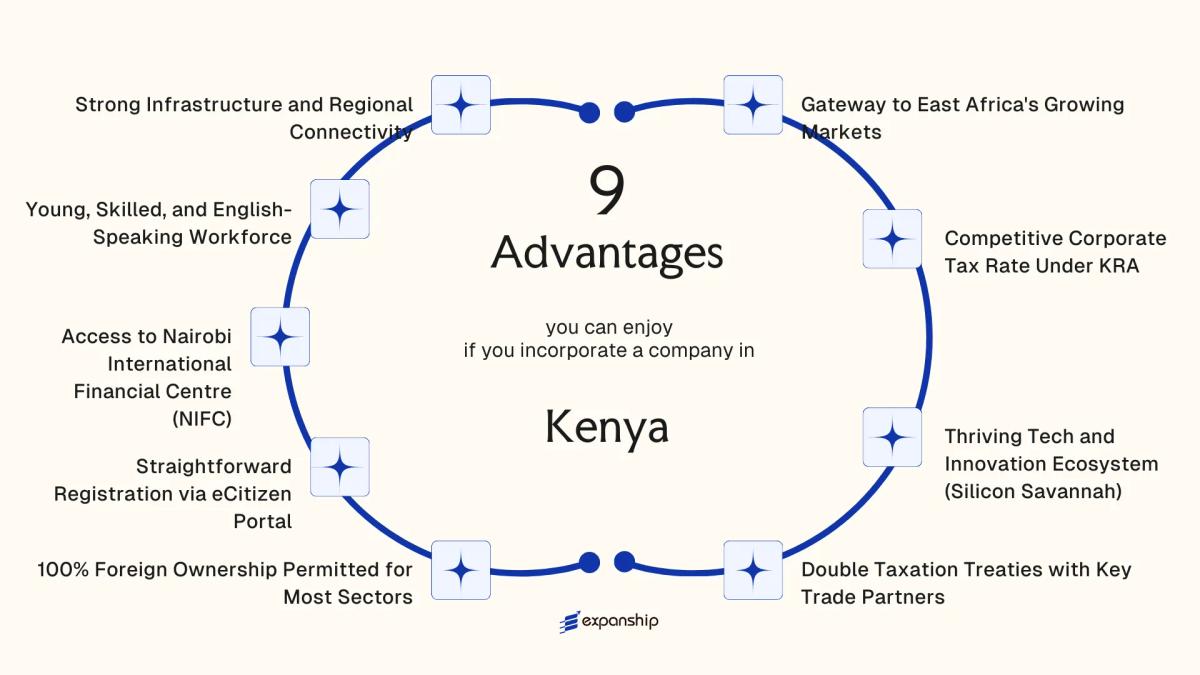
Gateway to East Africa's Growing Markets
Kenya's position as a gateway to East Africa markets gives incorporated entities direct commercial access to the East African Community (EAC), a bloc of eight member states with a combined population exceeding 300 million people.
Trading Under the EAC Customs Union
A company registered in Kenya can move goods across EAC member state borders under the EAC Customs Union Protocol, which eliminates internal tariffs on qualifying originating goods. This reduces the cost of cross-border trade significantly, because your firm avoids the duty layers that would otherwise apply if operating from outside the bloc.
The Common Market Protocol further extends this advantage by permitting the free movement of services, capital, and labour among member states. For a foreign-owned entity, this means a single Kenyan registration can support commercial operations across Uganda, Tanzania, Rwanda, and beyond without requiring separate establishment in each territory.
Access to COMESA's Extended Reach
Kenya also holds membership in COMESA, a regional trade bloc of 21 member states spanning eastern and southern Africa. Goods originating from your Kenyan entity may qualify for preferential tariff treatment across this wider network under COMESA's tariff reduction schedules.
One Kenyan registration can serve as your operational base for preferential trade access across two overlapping regional blocs simultaneously.
Competitive Corporate Tax Rate Under KRA
Kenya's standard corporate income tax rate sits at 30% for resident companies, administered by the Kenya Revenue Authority (KRA) under the Income Tax Act. For companies incorporated outside Kenya but earning income from domestic sources, the non-resident rate is 37.5%. The more significant advantage lies in the preferential rates available to specific business categories.
Companies that list at least 25% of their shares on the Nairobi Securities Exchange qualify for a reduced rate of 25% for a five-year period following listing. Export Processing Zone enterprises receive an even more favourable structure: a 0% rate during the first ten years of operation, followed by 25% thereafter. Special Economic Zone entities also benefit from a 10% corporate rate for the first ten years.
These incentives carry weight for foreign investors because they are statutory, not discretionary. Your tax position is governed by the Income Tax Act and its subsidiary legislation, not subject to negotiation.
Why this structure works in your favour as an incoming business:
- The 10% SEZ rate applies from the first year of operation, meaning early-stage ventures benefit before they reach full profitability
- Preferential rates are tied to specific, achievable criteria rather than opaque approval processes
- The KRA's iTax system links directly to your filing obligations, reducing administrative ambiguity on applicable rates

Incorporate Your Company in Kenya
Set up your Kenya entity with the correct structure to access applicable tax rates from day one.
Thriving Tech and Innovation Ecosystem (Silicon Savannah)
Nairobi's positioning as the Silicon Savannah reflects a concentration of tech infrastructure, policy support, and capital access that has tangible consequences for how foreign companies operate. The Silicon Savannah tech ecosystem benefits for investors are grounded in specific government programs and physical infrastructure rather than general pro-business sentiment.
The Konza Technopolis Development Authority (KoTDA) oversees the build-out of Konza City, a purpose-built technology hub south of Nairobi designed to house ICT firms, research institutions, and data centers. Companies establishing operations there gain access to dedicated fiber connectivity, planned smart infrastructure, and proximity to academic partners. iHub, one of Africa's earliest tech incubators, continues to anchor early-stage innovation in Nairobi's Westlands district, creating deal flow and partnership networks that are directly accessible to incoming firms.
| Entity | Function | Relevance to Foreign Firms |
|---|---|---|
| Konza Technopolis (KoTDA) | Smart city and ICT zone development | Infrastructure and co-location options |
| iHub | Tech incubator and innovation hub | Access to local talent and partnerships |
| Kenya ICT Authority | Sector regulator and digital policy | Compliance framework and incentive programs |
| Ajira Digital Program | Government-backed digital skills initiative | Trained remote-work workforce pipeline |
The Kenya ICT Authority administers sector-specific incentive programs and sets the regulatory framework governing digital services. For a foreign firm entering the market, this single-authority structure reduces the number of regulatory touchpoints during setup. The Ajira Digital Program, funded through the ICT Authority, has trained over one million Kenyans in digital freelancing and technical skills, which directly expands the hiring pool available to tech-oriented businesses.
Double Taxation Treaties with Key Trade Partners
Kenya double taxation treaties benefits are most visible when your business earns income across borders. Without treaty protection, the same profit can face tax in both the source country and your home jurisdiction. Kenya's network of Double Taxation Agreements (DTAs) eliminates or reduces this exposure by assigning taxing rights under bilateral rules.
Kenya has concluded DTAs with several major trade partners, including the United Kingdom, Germany, India, Canada, France, South Africa, the UAE, and the East African Community member states. These treaties typically reduce withholding tax rates on dividends, interest, and royalties below the standard domestic rates applied under the Income Tax Act (Cap. 470). For example, the DTA with India reduces withholding tax on royalties to 20% rather than the standard domestic rate, with specific rates varying by agreement.
For foreign investors, this means reduced friction when repatriating profits or paying technical service fees to parent entities abroad. Holding companies or regional headquarters established in Nairobi can structure cross-border payments with greater certainty over their final tax cost.
Keep these points in mind:
- Treaty benefits apply only to tax residents; your entity must be incorporated and resident in Kenya to qualify
- Each DTA has its own specific rate schedules; confirm the applicable rate for your specific payment type
- Anti-avoidance provisions under the Income Tax Act may affect treaty access for certain structures
- Treaty interpretation is subject to Kenya Revenue Authority guidance; confirm positions with qualified local tax counsel
Refer to the full list of Kenya's concluded treaties.
Kenya's DTA with the UAE, one of its newer agreements, specifically addresses income from air transport — a provision that reflects Nairobi's position as a regional aviation hub rather than a standard treaty boilerplate clause.
100% Foreign Ownership Permitted for Most Sectors
One of the primary Kenya 100% foreign ownership advantages is the absence of mandatory local partnership requirements across the majority of business sectors. Under the Companies Act, 2015 and the Investment Promotion Act, foreign nationals can hold the entirety of shares in a Kenyan-registered private limited company without needing a local co-owner. This removes a structural constraint that exists in many competing jurisdictions and gives you direct, undiluted control over your entity's decisions, profits, and exit strategy.
Statutory Basis and Sector Scope
Kenya Investment Authority foreign ownership policy permits full foreign ownership in most commercial sectors, including manufacturing, ICT, financial services, logistics, and professional services. The foreign investor ownership rights are grounded in statute rather than administrative discretion, which means your ownership structure is not subject to renegotiation based on policy shifts or bureaucratic interpretation. Certain sectors, including land ownership and specific regulated industries, carry restrictions, but these are defined and limited in scope.
What Full Ownership Means Operationally
Holding 100% of shares means your firm retains full authority over profit repatriation decisions without needing a local partner's consent. Full foreign ownership Kenya company benefits extend to dividend distribution, reinvestment choices, and the appointment of directors, all of which remain within your control under Kenyan company law. Foreign-owned entities are also eligible for the same investment protections available under the Investment Promotion Act, including guarantees against expropriation without fair compensation.
Maximize Your Ownership Rights in Kenya
Understand how full foreign ownership applies to your specific sector and structure your Kenya company with complete legal clarity from the start.
Straightforward Registration via eCitizen Portal
Registering a company through the Kenya eCitizen portal company registration benefits are immediately practical: the Business Registration Service (BRS), accessible via the eCitizen platform, allows foreign nationals to incorporate a private limited company online without requiring physical presence in the country.
- The eCitizen portal processes name searches, reservation, and incorporation through a single digital interface, reducing the time from application to certificate of incorporation to roughly one to three business days under standard conditions.
- Under the Companies Act, 2015, a private company requires only one director and one shareholder to incorporate, removing the structural burden that multi-member requirements impose in other jurisdictions.
- No minimum share capital is mandated for a standard private limited company, which means your firm can be capitalized at whatever level reflects actual operational needs rather than a regulatory floor.
- Foreign directors are not required to appoint a resident director, though a registered local address for service of documents is required under the Act.
- The entire fee structure for incorporation through BRS is published and fixed, making cost predictable before you begin the process.
The practical outcome is that your entity can be legally constituted and ready to open a bank account or sign contracts within days of submitting the online application, without engaging an agent for basic registration steps.
Access to Nairobi International Financial Centre (NIFC)
The Nairobi International Financial Centre benefits for businesses go beyond tax relief — the NIFC is a statutory framework established under the Nairobi International Financial Centre Act, 2017, designed specifically to attract financial services firms, fund managers, and fintech operators by offering a structured regulatory environment separate from the standard Companies Act regime.
Certified NIFC entities operate under a dedicated authority, the NIFC Authority, which coordinates licensing and compliance across relevant regulators including the Capital Markets Authority and the Insurance Regulatory Authority. This single-point coordination reduces the administrative fragmentation that firms typically encounter when seeking approvals from multiple bodies.
For foreign investors, NIFC certification unlocks access to a preferential corporate tax rate of 15% on income, compared to Kenya's standard rate of 30%. Fund vehicles and special purpose entities structured within the centre can also benefit from specific exemptions on certain capital gains and withholding tax obligations, subject to meeting NIFC certification criteria.
A fund management firm certified under the NIFC framework and earning KES 50 million in annual income would pay KES 7.5 million in corporate tax at the 15% rate, versus KES 15 million at the standard 30% rate — a direct annual saving of KES 7.5 million before any additional treaty-based reliefs.
Young, Skilled, and English-Speaking Workforce
Kenya's English-speaking skilled workforce advantages are directly tied to the country's constitutional and educational framework. English is an official language under the Constitution of Kenya 2010, and it serves as the primary medium of instruction from primary through university level. For a foreign business, this eliminates the translation overhead and miscommunication risks that commonly arise in non-English-speaking markets.
The demographic profile reinforces this. Roughly 75% of the population is under 35, producing a consistently large annual intake of graduates across engineering, finance, ICT, and business disciplines from institutions such as the University of Nairobi and Strathmore University.
Nairobi's skilled labor market also offers cost competitiveness relative to comparable talent pools in Western Europe or Southeast Asia, without the credential gaps that affect some lower-cost markets. Professionals entering sectors like fintech, logistics, and legal services arrive with internationally recognized qualifications.
- Graduate output spans technical, commercial, and professional fields
- English proficiency reduces onboarding friction for multinational teams
- Nairobi concentrations of talent reduce regional hiring lead times
Certain skilled roles in Kenya require work permits under the Kenya Citizenship and Immigration Act, and hiring foreign nationals over locally available talent may be subject to review by the relevant authorities.
Strong Infrastructure and Regional Connectivity
Kenya's infrastructure and regional connectivity advantages stem from geography as much as investment. Sitting at the intersection of East Africa's overland trade routes and the Indian Ocean coastline, the country functions as a natural distribution point for goods moving across the region.
Port of Mombasa and Northern Corridor
Mombasa is the largest port in East Africa and the primary maritime entry point for landlocked countries including Uganda, Rwanda, Burundi, South Sudan, and the Democratic Republic of Congo. For businesses importing or exporting physical goods, this gives your supply chain reach far beyond Kenya's own borders without requiring separate logistics infrastructure in each market.
Standard Gauge Railway
The Standard Gauge Railway (SGR), operated by Kenya Railways Corporation, connects Mombasa to Nairobi and extends toward the Kenyan-Ugandan border. Freight capacity on the SGR reduces transit times compared to road haulage, which directly affects inventory costs and delivery timelines for companies distributing goods inland.
Jomo Kenyatta International Airport
Nairobi's main international airport handles the highest cargo volumes in East Africa. This matters for firms in perishable exports, e-commerce fulfillment, or any business model dependent on air freight turnaround.
Road Connectivity Under KENHA
The Kenya National Highways Authority (KENHA) oversees the national road network linking Nairobi to major border crossings. Key corridors include:
- Nairobi to Namanga (Tanzania border)
- Nairobi to Busia (Uganda border)
- Nairobi to Malaba (Uganda border via western Kenya)
These routes allow your firm to serve multiple national markets from a single operational base in Nairobi.
Why Kenya Stands Out Against Regional Competitors
Evaluating Kenya vs East Africa competitors business advantages means looking at the jurisdictions a foreign investor would realistically weigh side by side: Tanzania, Uganda, and Rwanda. Each targets a similar pool of international businesses, operates within the East African Community (EAC) framework, and competes for the same regional mandates and holding structures. The comparison below is narrow by design, focused on parameters where Kenya holds a measurable or structural advantage rather than a complete scorecard.
What the comparison surfaces is less about any single metric and more about the combination of regulatory maturity, infrastructure, and institutional depth. The Companies Act, 2015 governs a company registry that has been digitised through the eCitizen portal, while the Capital Markets Authority and the Nairobi International Financial Centre (NIFC) provide institutional layers that newer financial hubs in the region are still building toward. For businesses that need a credible legal and financial address in East Africa, that depth of existing infrastructure carries practical weight.
| Parameter | Kenya | Tanzania | Uganda | Rwanda |
|---|---|---|---|---|
| Standard Corporate Tax Rate | 30% | 30% | 30% | 30% |
| 100% Foreign Ownership | Yes (most sectors) | Restricted in several sectors | Permitted with conditions | Yes (most sectors) |
| Online Company Registration | Yes (eCitizen) | Partial (BRELA portal) | Partial (URSB portal) | Yes (RDB portal) |
| Dedicated Financial Centre | Yes (NIFC) | No | No | Yes (Kigali IFC) |
| Double Tax Treaties (approx.) | 15+ | Limited | Limited | Growing network |
| Regional Stock Exchange | Nairobi Securities Exchange (NSE) | Dar es Salaam Stock Exchange | Uganda Securities Exchange | Rwanda Stock Exchange |
| Primary Business Language | English | Swahili / English | English | Kinyarwanda / English / French |
Compliance Services for Companies in Kenya
Stay compliant with KRA obligations, annual returns, and regulatory filings under the Companies Act, 2015.
Conclusion
Kenya's case as an incorporation destination rests on a combination of structural advantages that are difficult to replicate elsewhere in sub-Saharan Africa. The Companies Act 2015 removed the foreign ownership restrictions that once created friction for overseas investors, while the 30% corporate tax rate under the Kenya Revenue Authority applies on the same terms to resident and non-resident entities alike. These are not incidental features; they reflect a deliberate policy framework designed to attract and retain foreign capital.
Among the benefits of incorporating in Kenya, two carry particular weight for foreign companies: the bilateral tax treaty network, which reduces withholding tax exposure on dividends and royalties across key trading partners, and access to the Nairobi International Financial Centre, which provides licensed firms with a regulated, internationally recognised base for cross-border financial activity. Together, these features reduce the cost of doing business across the East African region in concrete, measurable ways.
That said, the right structure depends on your industry, shareholding arrangements, and the markets you intend to serve. A company targeting regional logistics will prioritise different factors than one operating in fintech or professional services. Understanding how Kenya's regulatory environment applies to your specific business model is a necessary step before formation. The Companies Registry, operating through the eCitizen portal, provides the administrative entry point, but the decisions that precede registration carry the greater strategic weight.
Start Your Kenya Company Formation with Expanship Today
Expanship's Kenya company formation services cover the full incorporation lifecycle, from selecting the appropriate entity type under the Companies Act 2015 to fulfilling post-registration obligations with the Registrar of Companies at the Business Registration Service (BRS). The entity types, tax considerations, treaty access, and eCitizen procedures examined throughout this blog each carry specific compliance requirements that vary depending on your ownership structure and intended activity. Expanship manages that process on your behalf, reducing the coordination burden of working across multiple agencies and timelines.
Specific services include:
- Preparation and legalization of incorporation documents, including the Memorandum and Articles of Association
- Registered office and resident agent provision in accordance with the Companies Act 2015
- Government filing and direct liaison with the BRS and relevant sector regulators
- Post-incorporation compliance management, including annual returns and statutory record maintenance
- Introductions to banking institutions operating in the Kenyan market
- KRA PIN registration and tax compliance support
Expanship Kenya is available to assist with your entity formation and ongoing statutory requirements.
Frequently Asked Questions (FAQ)
Registration through the eCitizen portal, managed by the Business Registration Service, typically takes between one and three business days once all required documents are submitted correctly. The process covers name reservation, incorporation, and issuance of a certificate of incorporation. Delays generally arise from incomplete documentation or name conflicts, not from the portal itself.
The Kenya Revenue Authority applies a corporate income tax rate of 30% to resident companies. Newly listed companies on the Nairobi Securities Exchange benefit from a reduced rate for a defined period, subject to conditions under the Income Tax Act. Non-resident companies operating through a permanent establishment are taxed at 37.5% on income attributable to that establishment.
Kenya has entered into double taxation agreements with several countries, including the United Kingdom, Germany, India, and members of the East African Community, among others. These treaties generally allocate taxing rights between Kenya and the treaty partner, reducing or eliminating withholding tax on dividends, interest, and royalties paid across borders. The specific relief available depends on the provisions of each individual treaty.
The Companies Act, 2015 does not require a private limited company to appoint a Kenya-resident director. At least one director must be appointed, but there is no statutory nationality or residency requirement for that position. Certain regulated entities, such as those licensed by the Central Bank of Kenya, may face additional governance requirements that effectively necessitate local representation.
The Nairobi International Financial Centre is a government-backed initiative established under the Nairobi International Financial Centre Act, 2017, designed to attract financial services businesses and international investment into Kenya. Firms that obtain NIFC certification may access a distinct regulatory and tax framework, including a reduced corporate tax rate, subject to meeting qualifying criteria set by the NIFC Authority. Eligibility is assessed based on the nature of the business, minimum capital thresholds, and operational requirements.
A company that fails to file annual returns with the Business Registration Service within the prescribed period under the Companies Act, 2015 is liable to financial penalties, and continued non-compliance can result in the company being struck off the register. Directors may also face personal liability for certain compliance failures depending on the nature of the breach. Reinstatement after being struck off is possible but requires a formal application and payment of outstanding fees and penalties.
Legal Disclaimer
The information provided in this article is for general informational purposes only and does not constitute legal, tax, or professional advice. While we strive to ensure the accuracy and timeliness of the content, laws and regulations are subject to change, and the application of laws can vary widely based on specific facts and circumstances.
Readers should not act upon this information without seeking professional counsel tailored to their individual situation. Expanship and its authors disclaim any liability for actions taken or not taken based on the content of this article.
For specific advice regarding your business setup, compliance requirements, or any legal matters, please consult with qualified legal and tax professionals in the relevant jurisdiction.