

Key Takeaways
- Foreign investors seeking full ownership face sector-specific restrictions that can legally cap their equity stake, with sensitive industries such as transport, media, and certain services subject to Jordanian partner requirements under the Foreign Investment Law.
- Under Companies Law No. 22 of 1997 and its amendments, the multi-step registration process involves coordination across several government bodies, adding procedural complexity that can extend the incorporation timeline beyond what comparable regional jurisdictions require.
- Certain entity types, including public shareholding companies, carry minimum capital thresholds that can represent a material upfront financial commitment before any commercial activity begins.
- Workforce localization obligations impose ongoing compliance costs, as businesses operating in Jordan must navigate Jordanian labor law quotas that restrict the proportion of foreign nationals that can be employed relative to the total workforce.
Jordan operates under a moderately regulated corporate framework, with company formation governed primarily by the Companies Law No. 22 of 1997 and its subsequent amendments. The disadvantages of incorporating in Jordan span ownership restrictions, capital obligations, procedural delays, and sector-specific regulatory barriers.
Not all of these disadvantages will apply equally to every business. The specific entity type you select, the industry you operate in, and your intended ownership structure each determine which constraints become relevant.
This article is most relevant to foreign investors and multinational firms seeking majority or full ownership of a locally registered entity.
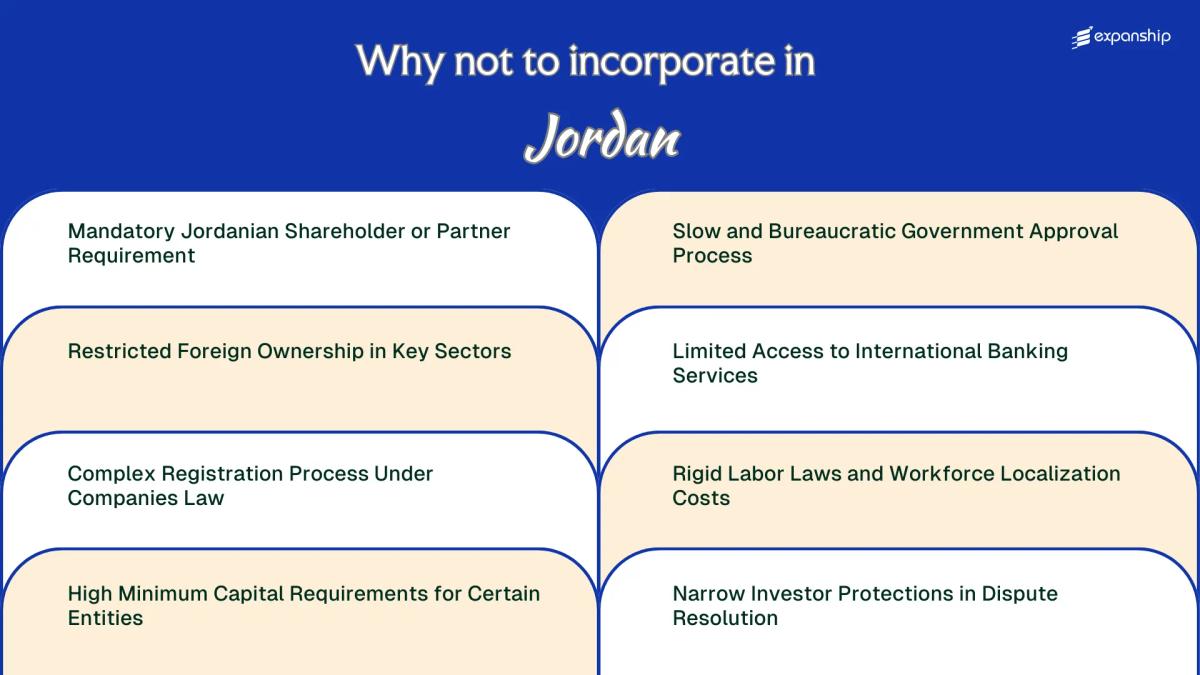
Mandatory Jordanian Shareholder or Partner Requirement
Under Jordan's Companies Law No. 22 of 1997 (as amended), certain business structures require a Jordanian national to hold a minimum ownership stake, making the Jordan mandatory local shareholder requirement a structural constraint for fully foreign-owned ventures.
Ownership Thresholds That Reduce Foreign Control
For entities operating in sectors not covered by the Investment Environment Law No. 30 of 2014, the default position under company regulations may limit foreign ownership below 100%, depending on the activity and entity type chosen. This directly affects your ability to retain full decision-making authority and repatriate profits without a local partner's consent.
A Jordanian partner holding a meaningful equity share is not a passive arrangement; that partner carries legal rights under the Companies Law, including voting entitlements that can influence operational and financial decisions.
The Cost of Mandatory Partnership Structures
Sourcing a trustworthy local partner adds both time and financial exposure, since profit-sharing obligations reduce the net return on your investment from the outset. The local ownership condition cannot always be substituted by a nominee arrangement without triggering additional regulatory scrutiny.
A mandatory Jordanian partner with statutory voting rights can materially constrain your control over business decisions, creating legal and financial exposure that persists for the entire life of the entity.
Restricted Foreign Ownership in Key Sectors
Restricted foreign ownership sectors in Jordan span several industries where non-Jordanian investors face hard legal ceilings on the equity they can hold. These limits are not informal policy preferences — they are codified under the Investment Environment Law No. 30 of 2014 and its associated regulations, enforced through the Jordan Investment Commission.
Certain activities are fully closed to foreign ownership. Others permit foreign participation only up to a defined percentage, which means your business may be structurally required to dilute control from day one.
The practical friction this creates includes:
- Minority equity positions force you to depend on a local partner for board-level decisions, even when your capital constitutes the dominant financial contribution
- Sector-specific caps can block a foreign firm from consolidating accounts with a parent company under majority ownership thresholds required by international accounting standards
- Restrictions on foreign ownership in retail, transport, and professional services limit the range of activities a single incorporated entity can legally conduct
- Acquiring additional shares over time to increase your stake requires regulatory approval, adding cost and delay to any future restructuring
Exemptions exist for certain free zone entities and projects designated as qualifying investments, but these carve-outs apply to a narrow category of businesses and do not eliminate the sector-level restrictions for standard onshore companies.

Company Incorporation in Jordan
Understand ownership structures and sector-specific requirements before incorporating your business in Jordan.
Complex Registration Process Under Companies Law
The complex company registration process in Jordan imposes a multi-stage burden that goes beyond simple paperwork. Under the Companies Law No. 22 of 1997 and its amendments, incorporating a private shareholding or limited liability company requires sequential approvals from the Companies Control Department (CCD), the Ministry of Industry and Trade, and in many cases additional line ministries depending on business activity.
| Company Type | Documents Required at CCD | Typical Approval Stages | Estimated Processing Time |
|---|---|---|---|
| Limited Liability Company (LLC) | MOA, AOA, shareholder IDs, registered address proof | CCD + MoIT + Tax Registration | 3 to 6 weeks |
| Private Shareholding Company | MOA, AOA, auditor appointment, board resolution | CCD + MoIT + sector ministry | 6 to 10 weeks |
| Foreign Branch | Parent company documents (notarized, apostilled), local agent agreement | CCD + Investment window + sector body | 8 to 14 weeks |
Each stage requires documents to be notarized, often apostilled, and translated into Arabic by a certified translator. For a foreign investor managing this remotely, the authentication chain alone adds weeks and measurable cost before the entity is even reviewed.
The CCD retains discretion to request supplementary documentation without a fixed deadline for doing so. This open-ended review power means your incorporation timeline cannot be reliably planned around.
Errors in any submitted document trigger a restart of that stage rather than a correction window, compounding delays. Firms operating under time-sensitive market entry schedules face direct financial exposure from a process that offers no guaranteed completion date.
High Minimum Capital Requirements for Certain Entities
Jordan's minimum capital requirements create a concrete financial barrier that most foreign investors underestimate before committing to entry. Under the Companies Law No. 22 of 1997 and its subsequent amendments, certain entity types carry prescribed minimum paid-up capital thresholds that must be deposited before registration proceeds.
Public shareholding companies face a minimum capital requirement of JOD 500,000. For a foreign business owner, that figure must be funded upfront, in local currency, before the firm is legally operational — capital that is locked in and unavailable for working operations during the setup phase.
Limited liability companies have a lower threshold, but sector-specific requirements can override the general floor. Firms operating in banking, insurance, or financial services face significantly higher capital mandates imposed by the Central Bank of Jordan or the Insurance Regulatory Commission, pushing required capital well beyond the standard LLC baseline.
- Minimum capital must be deposited in a Jordanian bank account prior to registration completion
- Public shareholding companies require a minimum of JOD 500,000 in paid-up capital
- Sectoral regulators may impose capital thresholds that override the Companies Law baseline
- Deposited capital cannot be freely repatriated or redirected until registration is formally concluded
- Foreign currency contributions must be converted to JOD, exposing your business to exchange rate risk at the point of deposit
Jordan requires capital to be physically deposited in a local bank before the registration certificate is issued, meaning your funds are frozen in an account you cannot yet legally control as an incorporated entity.
Slow and Bureaucratic Government Approval Process
The bureaucratic government approval process in Jordan adds measurable friction to business entry, particularly for foreign-owned entities that require clearance from multiple agencies before operations can begin.
Approval Chains Across Multiple Agencies
Registration through the Companies Control Directorate at the Ministry of Industry, Trade and Supply is only one part of the process. Depending on your sector, approvals from the Jordan Investment Commission, line ministries, or sector-specific regulators may be required in sequence, not in parallel, extending your pre-operational timeline considerably.
Foreign investors targeting regulated industries face the steepest delays. Each regulatory body operates on its own procedural timetable, and missing a single document or failing to meet a specific formatting requirement can restart portions of the review cycle.
Practical Cost of Regulatory Delays
Time lost in approval queues translates directly into carrying costs: office leases, retained staff, and professional fees that continue accruing without any revenue to offset them. Businesses in sectors requiring environmental, health, or municipal clearances face approval timelines that can stretch across several months.
Jordan's regulatory approval delays disproportionately affect foreign investors who lack established local relationships or familiarity with inter-agency procedures. Entities classified under the Investment Law No. 30 of 2014 may access facilitated services through the JIC's one-stop-shop, though this pathway does not eliminate all external agency requirements.
Navigating Government Approvals for Your Jordan Incorporation
Get structured guidance on managing multi-agency approval processes, regulatory timelines, and documentation requirements when setting up a business entity in Jordan.
Limited Access to International Banking Services
Limited international banking access Jordan is a consistent friction point for foreign-owned entities, with correspondent banking relationships and KYC requirements creating structural delays.
- The Central Bank of Jordan imposes strict anti-money laundering and customer due diligence requirements under the Anti-Money Laundering and Counter Terrorism Financing Law No. 46 of 2007, which licensed banks apply conservatively toward newly incorporated foreign-owned firms, often resulting in prolonged account-opening timelines.
- Foreign companies without a demonstrated local operating history or Jordanian resident signatories frequently face outright refusal from commercial banks, effectively blocking access to basic transactional infrastructure.
- Difficulties opening a business bank account in Jordan are compounded for holding companies or special-purpose vehicles that cannot produce local revenue documentation or physical office evidence.
- Jordan corporate banking restrictions on foreign companies extend to multi-currency accounts, with many local banks limiting access to USD or EUR-denominated facilities without a separate application process and additional compliance review.
- Non-resident directors listed in the company's articles face heightened scrutiny under bank internal policies, which is a separate burden from the formal legal requirements imposed by the Companies Control Department.
Rigid Labor Laws and Workforce Localization Costs
Jordan labor law restrictions on foreign businesses begin with the Jordanization quota system, enforced under the Labour Code and administered by the Ministry of Labour. Foreign-owned firms are required to meet minimum ratios of Jordanian nationals in their workforce, with the applicable percentage varying by sector and company size.
These quotas directly increase your payroll costs. Positions that cannot be filled locally may require Ministry of Labour approval for expatriate work permits, adding administrative overhead and processing delays.
Work permits for foreign employees must be renewed annually and are tied to specific employers, restricting your ability to redeploy staff across entities or projects. If your workforce needs shift mid-year, you cannot simply reassign a permit holder without reapplying.
Beyond quotas, foreign workers face a tiered fee structure for permit issuance that varies by nationality and sector, creating unequal cost burdens depending on where your employees originate.
A foreign-owned firm in Amman employing 20 staff would need to ensure the Jordanization ratio is met for its sector. If it cannot source qualified local hires, each foreign work permit renewal can cost several hundred dinars per employee annually, excluding legal and administrative processing fees.
Narrow Investor Protections in Dispute Resolution
Jordan investor dispute resolution limitations present a concrete operational risk that many foreign businesses underestimate until they are already in a dispute. While the kingdom is a signatory to the ICSID Convention and maintains bilateral investment treaties with numerous countries, access to those protections depends heavily on how your investment is structured and whether your home country has a qualifying treaty in force.
Domestic disputes are handled through the Jordanian court system or, where agreed, through arbitration under the Arbitration Law No. 31 of 2001. Enforcement of foreign arbitral awards is governed by the New York Convention, to which Jordan acceded, but local courts retain discretion to refuse enforcement on public policy grounds, creating unpredictability for your firm.
The Investment Law No. 30 of 2014, and its successor framework under the Investment Environment Law No. 21 of 2022, provides dispute resolution mechanisms through the Investment Window at the Jordan Investment Commission. However, the practical track record of these bodies in resolving disputes against local state-linked entities is inconsistent, and foreign companies have reported procedural delays that erode the utility of formal protections.
Your eligibility to invoke treaty-based arbitration or ICSID protections depends entirely on whether a qualifying bilateral investment treaty exists between Jordan and your home country, and whether your corporate structure satisfies the nationality requirements of that treaty.
Overcoming Incorporation Challenges in Jordan
Overcoming Jordan incorporation challenges requires structural preparation before you engage with any registration process. The regulatory constraints discussed in this blog are grounded in statute, which means procedural awareness is the starting point for any foreign investor.
- Identify your target sector against the Investment Law No. 30 of 2014 foreign ownership restrictions before selecting an entity type.
- Structure equity to meet the Jordanian national partner requirement where the Companies Law mandates local shareholding participation.
- Verify minimum paid-up capital thresholds with the Companies Control Department for your chosen entity type prior to capital transfer.
- Register under the correct entity classification with the Companies Control Department to avoid re-filing and procedural delays.
- Confirm Jordanian Social Security Corporation contribution obligations before finalising your workforce and payroll structure.
- Establish documentation for dispute resolution clauses that align with the Jordanian Arbitration Law No. 31 of 2001.
These steps address constraints embedded across multiple regulatory bodies. Compliance gaps at any stage can trigger delays that compound the approval timeline issues outlined earlier in this blog.
Jordan's Investment Potential Despite the Drawbacks
Weighing Jordan investment risks vs opportunities against each other produces a mixed but coherent picture. The barriers covered throughout this blog are real and structural, not minor procedural inconveniences. At the same time, the kingdom's geographic position, bilateral investment treaties, and the Investment Environment Law No. 30 of 2014 establish a legal framework that foreign businesses can work within.
| Pros | Cons |
|---|---|
| Bilateral investment treaties provide some protection against expropriation and unfair treatment | Dispute resolution through local courts can be slow, and enforcement of arbitral awards is not always straightforward |
| The Investment Environment Law permits full foreign ownership in most non-restricted sectors | Certain industries, including transport and media, impose hard foreign ownership ceilings |
| Jordan's free zones and development zones offer tax exemptions and reduced customs duties | Minimum capital thresholds for certain entity types create upfront financial exposure |
| The kingdom's location gives firms access to regional markets across the Levant and Gulf | Workforce localization requirements through the foreign labor quota system add recurring compliance costs |
| The Companies Control Directorate operates a defined registration framework | The process involves multiple government bodies, which extends timelines considerably |
For businesses that meet the ownership and capital requirements, the regulatory environment is workable, though not frictionless.
Corporate Compliance Services in Jordan
Stay current with Jordan's annual filing obligations, Companies Control Directorate requirements, and ongoing regulatory duties for foreign-owned entities.
Conclusion
The risks of starting a company in Jordan are real and consequential for foreign investors who have not thoroughly assessed the regulatory environment. Sector-specific foreign ownership restrictions under the Foreign Investment Law, mandatory local partnership requirements in certain business structures, and a registration process that spans multiple government bodies — including the Companies Control Directorate and the Ministry of Industry and Trade — create tangible friction. Capital requirements for public shareholding companies add a further financial threshold before operations can begin. Structural preparation and jurisdiction-specific legal counsel remain the most direct means of managing these constraints before filing.
Expanship's Services for Your Jordan Expansion
Incorporating in Jordan means engaging directly with the Companies Control Department under the Ministry of Industry and Trade, meeting sector-specific ownership caps, and satisfying capital thresholds that vary by entity type. Expanship's Jordan company formation services are built around these specific requirements, reducing the operational weight of document preparation, regulatory coordination, and post-incorporation obligations on your team.
Our support across the formation and compliance cycle covers the following:
- Your company registration and document preparation are handled end to end, aligned with Jordanian Companies Law requirements.
- A registered agent and local office address are provided to meet residency obligations.
- We liaise directly with the Companies Control Department and other relevant authorities on your behalf.
- Post-incorporation compliance management keeps your entity in good standing over time.
- Banking introduction assistance connects your business with suitable local financial institutions.
- Tax registration and coordination with the Income and Sales Tax Department are managed for you.
To discuss your incorporation requirements, contact Expanship Jordan.
Frequently Asked Questions (FAQ)
No, but the exemptions are narrow. Jordan's Investment Environment Law No. 30 of 2014 restricts full foreign ownership in sectors including retail trade, certain professional services, and parts of the transport industry. Outside designated free zones or projects approved by the Investment Commission, your firm will face ownership ceilings that vary by sector and are not always transparently published.
Your registration application will be rejected outright by the Companies Control Department. The required capital thresholds differ by entity type — public shareholding companies face significantly higher minimums than limited liability companies — and the capital must typically be verified before incorporation proceeds. Failure to deposit and document the required amount stalls the entire process.
Jordan's multi-agency approval process is slower than free zone incorporations in the UAE or Bahrain, where single-window systems compress timelines considerably. In Jordan, your application may pass through the Companies Control Department, relevant line ministries, and sector-specific regulators before a license is issued. Total timelines of several weeks to a few months are common for foreign-owned entities requiring special approvals.
Non-compliance with the Ministry of Labor's quotas for Jordanian employees exposes your business to fines and potential suspension of work permits for expatriate staff. The ratio requirements vary by sector and company size, but foreign firms in most industries must maintain a defined percentage of Jordanian nationals on payroll. Repeated violations can trigger a review of your operating license.
Jordan's domestic courts handle most commercial disputes under the Civil Code and Companies Law, and proceedings are conducted in Arabic, which adds translation costs and procedural complexity for foreign parties. While Jordan is a signatory to the ICSID Convention, investor-state protections only apply in specific treaty contexts. Enforcement of foreign arbitral awards through the courts can be slow and is not guaranteed without local legal representation.
Access is limited in practice. Jordanian banks apply stringent due diligence requirements to foreign-owned entities, particularly those with non-resident shareholders or cross-border transaction volumes. Opening a corporate account can take weeks, and some international correspondent banking relationships are restricted due to regional compliance concerns, which affects your ability to receive and transfer funds internationally without delays.
Legal Disclaimer
The information provided in this article is for general informational purposes only and does not constitute legal, tax, or professional advice. While we strive to ensure the accuracy and timeliness of the content, laws and regulations are subject to change, and the application of laws can vary widely based on specific facts and circumstances.
Readers should not act upon this information without seeking professional counsel tailored to their individual situation. Expanship and its authors disclaim any liability for actions taken or not taken based on the content of this article.
For specific advice regarding your business setup, compliance requirements, or any legal matters, please consult with qualified legal and tax professionals in the relevant jurisdiction.