

Key Takeaways
- Jordan's territorial-based corporate tax system, administered under a framework that taxes only locally sourced profits, means foreign-source income earned outside Jordan is structurally excluded from the domestic tax base.
- Under Investment Law No. 30 of 2014 and its successor frameworks, foreign investors can hold 100% equity in a broad range of sectors without any mandatory local partnership requirement, preserving full ownership control and profit repatriation rights.
- Access to over 30 bilateral and multilateral trade agreements provides companies incorporated in Jordan with tariff-reduced entry into multiple major markets, creating a compounding commercial advantage for export-oriented operations.
- Company registration through the Companies Control Department, operating under the Ministry of Industry, Trade and Supply, follows a codified statutory process rather than one subject to administrative discretion, giving foreign businesses a predictable legal path to entity formation.
Situated at the crossroads of the Middle East, Jordan is a sovereign constitutional monarchy that shares borders with Saudi Arabia, Iraq, Syria, Israel, and the Palestinian territories. This geographic position gives businesses registered there physical proximity to several of the region's largest economies. The benefits of incorporating in Jordan draw interest from companies across multiple sectors, and this article examines the specific structural, regulatory, and commercial factors that make entity formation here a substantive decision.
Company registration falls under the authority of the Companies Control Department, which operates under the Ministry of Industry, Trade and Supply. Foreign businesses most commonly establish a Limited Liability Company when entering the market. The country operates a territorial-based tax system with a standard corporate income tax applied to locally sourced profits, supplemented by a network of bilateral tax treaties.
Foreign direct investment is formally supported through the Investment Law No. 30 of 2014 and its successor frameworks, which set out defined channels for non-resident ownership. Openness to foreign capital is codified in statute rather than left to administrative discretion.
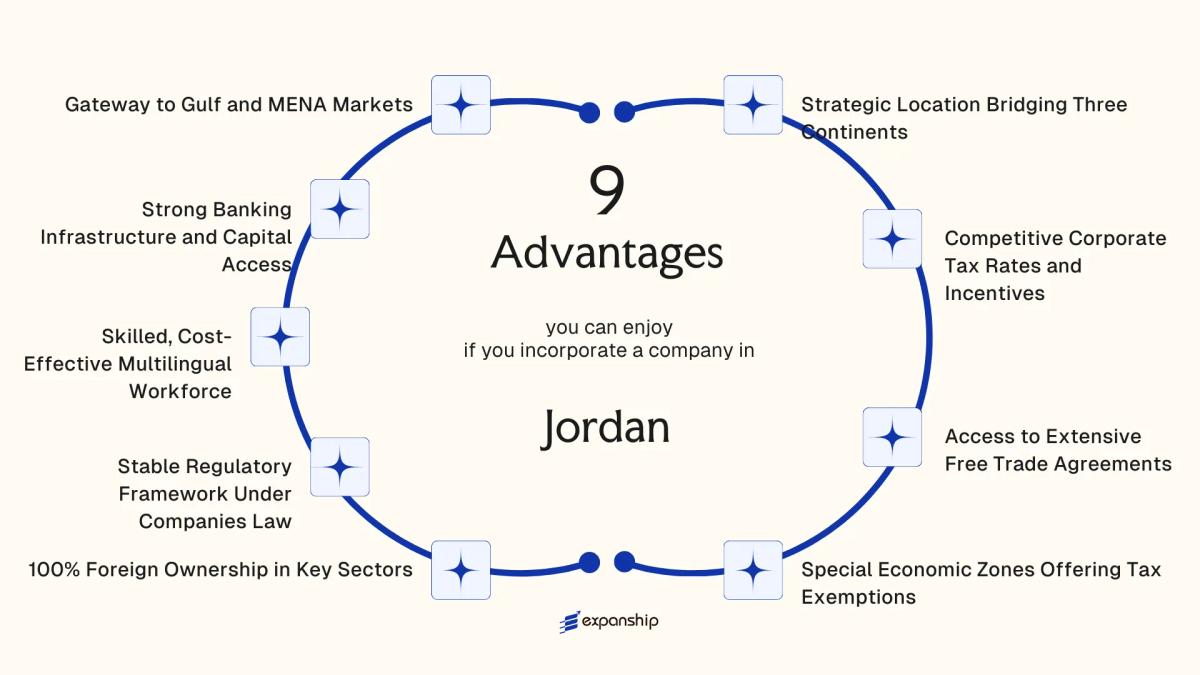
Strategic Location Bridging Three Continents
Jordan's geographic position gives it a functional role that few countries in the region can replicate. Sitting at the intersection of the Middle East, North Africa, and the broader Asian trade corridor, the country shares borders with Saudi Arabia, Iraq, Syria, Israel, and the Palestinian Territories.
A Physical Crossroads With Trade Consequences
This positioning translates directly into logistical advantage. The Port of Aqaba on the Red Sea provides your business with maritime access to East African and South Asian markets, while the country's road networks connect northward into the Levant and eastward toward the Gulf.
What Geography Means for Regional Market Access
Amman functions as a regional hub city, hosting the headquarters of numerous multinational firms that use it as a base for MENA operations. For a foreign business owner, this means local incorporation can support operations spanning multiple markets without requiring separate legal entities in each territory.
A company registered in Jordan can physically and commercially serve markets across three continents from a single operational base.
Competitive Corporate Tax Rates and Incentives
Jordan's standard corporate income tax rate sits at 20% for most sectors, governed by the Income Tax Law No. 34 of 2014 and its subsequent amendments. For foreign investors, this rate is materially lower than the OECD average of approximately 23.6%, which directly reduces the recurring tax burden on profits repatriated or reinvested through a Jordanian entity.
Certain sectors carry differentiated rates. Financial institutions, telecommunications companies, and mining firms are subject to higher rates, while qualifying industrial companies may benefit from reduced rates under specific investment promotion provisions. Knowing which rate tier applies to your business type before incorporation affects the entire financial structure of your operation.
Jordan corporate tax incentives for businesses extend beyond the headline rate. Under the Investment Environment Law No. 30 of 2014, companies registered in designated development zones can access income tax exemptions for defined periods, making the effective rate considerably lower than the statutory figure.
The practical advantages for a foreign-owned firm include:
- Tax exemptions tied to development zone registration are granted by law, not discretionary approval
- Sectoral incentives for industry and agriculture reduce taxable income rather than deferring liability
- No withholding tax applies to dividends distributed to foreign shareholders under general corporate rules
- Jordan income tax advantages for companies include the ability to carry forward losses for up to five years

Incorporate Your Company in Jordan
Set up a legally compliant business entity in Jordan with full support from registration through to post-incorporation compliance.
Access to Extensive Free Trade Agreements
Jordan free trade agreement benefits for companies are, in practical terms, unusually broad for a country of its size. The kingdom has signed preferential trade agreements with over 30 partners, including the United States, the European Union, Canada, Singapore, and the Arab League's 22 member states under the Greater Arab Free Trade Area (GAFTA). For a business incorporated here, this means manufactured or processed goods can reach major consumer markets at reduced or zero tariff rates, cutting distribution costs in ways that affect margin directly.
| Agreement | Partners Covered | Tariff Benefit |
|---|---|---|
| Jordan-US FTA (2001) | United States | Zero tariffs on qualifying goods |
| EU-Jordan Association Agreement | European Union (27 states) | Preferential or zero duties |
| GAFTA | 22 Arab League members | Full tariff elimination |
| EFTA-Jordan FTA | Switzerland, Norway, Iceland, Liechtenstein | Reduced industrial tariffs |
The Jordan-US free trade agreement business benefits extend beyond goods. The 2001 agreement, one of the first the US signed in the Middle East, also covers services and intellectual property, giving your firm a structural foothold for US market entry that requires no additional bilateral negotiation.
Under the EU-Jordan Association Agreement, goods meeting applicable rules-of-origin thresholds gain preferential access to the EU's single market. That origin requirement means production or sufficient processing must genuinely occur within the country, making incorporation here a functional prerequisite, not a formality.
Special Economic Zones Offering Tax Exemptions
Jordan special economic zones tax exemptions represent one of the more structurally significant incentives available to foreign businesses. Two primary frameworks govern these zones: the Aqaba Special Economic Zone (ASEZ), established under the Aqaba Special Economic Zone Authority (ASEZA), and the Development Zones program administered by the Jordan Development Zones Commission.
Within ASEZ, corporate income tax is set at a flat 5%, compared to the standard 20% rate applicable elsewhere. Goods imported into the zone are exempt from customs duties, and a reduced 0% VAT rate applies to most transactions within the zone's boundaries. For a foreign firm structuring regional distribution or manufacturing operations, this creates a measurable cost differential from day one.
Development Zones, governed under the Development Zones Law, offer income tax exemptions and customs duty relief calibrated to the zone's classification tier. Eligibility typically depends on the nature of the business activity and the specific zone where operations are registered.
Keep these points in mind:
- ASEZA and the Development Zones Commission are separate regulatory bodies with distinct application processes
- Tax rates and exemptions are tied to the registered activity, not just the zone location
- Profit repatriation conditions may differ between zone types
- Operating outside the approved activity scope can void zone-based tax treatment
The Aqaba Special Economic Zone operates under its own legal authority, meaning ASEZA functions as both regulator and municipal authority, giving it powers that extend well beyond standard free zone governance.
100% Foreign Ownership in Key Sectors
One of the more concrete Jordan 100 percent foreign ownership benefits is that foreign nationals can hold the entirety of a company without requiring a local partner in a broad range of sectors. This is governed primarily by the Investment Environment Law No. 30 of 2014 and its subsequent amendments, which shifted the default position toward open ownership rather than restricted entry.
Sectors Where Full Ownership Is Permitted
Under the Investment Law, most commercial and industrial activities outside a defined negative list are open to 100% foreign ownership. Manufacturing, information technology, tourism, logistics, and professional services generally fall within permitted categories, meaning your firm can operate without diluting equity through a mandatory local shareholding arrangement. Retaining full ownership means retained control over profit distribution, strategic decisions, and exit timing.
What This Means for Corporate Structure
Foreign investors can register a wholly owned Limited Liability Company or a branch of a foreign entity through the Companies Control Department under the Ministry of Industry, Trade and Supply. Because no local partner is structurally required in eligible sectors, there is no secondary approval layer tied to partner consent for routine business decisions. The Jordan Investment Commission administers sector-specific approvals and can confirm eligibility before registration, reducing structural uncertainty at the outset.
Confirm Your Ownership Rights Before You Incorporate in Jordan
Speak with an Expanship specialist to verify sector eligibility, ownership structure, and registration requirements under current Jordanian investment law.
Stable Regulatory Framework Under Companies Law
Jordan's Companies Law No. 22 of 1997, as amended, gives your business a predictable legal foundation that has remained structurally consistent for over two decades. The Jordan Companies Law regulatory framework benefits foreign investors precisely because the rules governing formation, governance, and dissolution are codified, publicly accessible, and administered by the Companies Control Department (CCD) under the Ministry of Industry and Trade.
- The CCD maintains a centralized commercial register, meaning ownership records, articles of association, and capital disclosures are verifiable through a single authority rather than fragmented across multiple bodies.
- Minimum capital requirements for a Limited Liability Company are defined by statute, giving you a fixed, knowable threshold before you commit capital.
- Dispute resolution for corporate matters falls under the jurisdiction of Jordanian civil courts, with commercial cases subject to procedural timelines set by the Code of Civil Procedure, reducing unpredictability in enforcement.
- Annual compliance obligations, including financial statement filing and auditor appointment requirements for qualifying entities, are standardized under the Companies Law, so your firm can budget for recurring compliance costs with accuracy.
- Amendments to the Companies Law require parliamentary approval, which means regulatory changes follow a formal legislative process rather than administrative discretion, reducing exposure to abrupt policy shifts.
Skilled, Cost-Effective Multilingual Workforce
Jordan's skilled multilingual workforce advantages are grounded in measurable education outputs. The country allocates a significant share of public spending to education, producing graduates across engineering, finance, IT, and legal fields each year from universities such as the University of Jordan and Jordan University of Science and Technology. For a foreign business, this means local hiring can cover technical and professional roles without relying on costly expatriate staffing.
Arabic is the primary business language, but English proficiency is widespread among university-educated professionals. Many workers also hold competency in French or German, which is relevant if your firm operates across European or North African client bases.
Labor costs remain meaningfully lower than in Gulf Cooperation Council (GCC) states. A mid-level professional in Amman typically commands a fraction of the equivalent salary in Dubai or Riyadh, without a corresponding reduction in qualification level.
A software developer with a four-year degree in Amman earns an average monthly salary of approximately USD 1,200 to USD 1,800, compared to USD 4,000 to USD 6,000 for an equivalent role in Dubai, based on regional compensation data from Mercer's 2023 Total Remuneration Survey.
The Employment Law No. 8 of 1996, along with subsequent amendments, governs employment contracts, working hours, and termination procedures, giving your firm a defined legal framework within which to structure local employment relationships.
Strong Banking Infrastructure and Capital Access
Jordan banking infrastructure advantages for businesses stem largely from the Central Bank of Jordan (CBJ), which governs monetary policy and bank licensing under the Banking Law No. 28 of 2000. The CBJ maintains capital adequacy requirements aligned with Basel III standards, which means your business operates within a banking environment that meets internationally recognized prudential norms.
Foreign-incorporated entities registered in Jordan can open multi-currency corporate accounts, facilitating cross-border transactions without mandatory conversion to Jordanian Dinar. This directly reduces foreign exchange friction for firms managing payables and receivables across multiple markets.
Several regional and international banks operate licensed branches in Amman, including Arab Bank, Housing Bank for Trade and Finance, and Citibank. This presence gives foreign companies practical access to trade finance instruments, letters of credit, and project financing from institutions familiar with cross-border deal structures.
- Corporate accounts are accessible to non-resident directors in most licensed banks, subject to KYC and AML documentation requirements under CBJ regulations.
- Trade finance facilities are available to eligible entities, supporting import and export operations without requiring a local guarantor in all cases.
Account opening timelines and documentation requirements vary by bank and are subject to CBJ anti-money laundering compliance procedures, which may require additional verification for foreign-owned entities.
Gateway to Gulf and MENA Markets
Jordan's position as a gateway to Gulf and MENA markets is less about geography alone and more about the legal and commercial architecture that makes regional expansion operationally practical. A company registered in Amman can sell into Gulf Cooperation Council markets, North Africa, and the Levant from a single base, without establishing separate entities in each territory.
Jordan maintains bilateral investment treaties and trade agreements with multiple GCC states, giving registered businesses preferential treatment that would otherwise require costly local incorporation in each Gulf country. For firms targeting Saudi Arabia, the UAE, or Iraq, operating through a Jordanian entity can reduce the structural overhead of maintaining parallel corporate registrations.
The Greater Arab Free Trade Area (GAFTA), to which Jordan is a signatory, eliminates or reduces tariffs on goods traded between member states. This directly affects cost calculations for businesses moving physical goods across the region, since duty savings compound at scale.
Proximity to Iraq also carries commercial weight. Iraq is one of Jordan's largest trading partners, and firms registered locally are positioned to supply reconstruction, infrastructure, and consumer goods markets across the border under existing trade arrangements.
Key structural advantages for regionally focused businesses include:
- Access to GAFTA's preferential tariff schedules across Arab League member states
- Bilateral agreements covering investment protection with GCC economies
- Established logistics corridors connecting Aqaba port to Gulf and Iraqi markets
- Amman's function as a regional headquarters location for multinationals already operating across MENA
Why Jordan Stands Out Against Regional Competitors
Compared to other business destinations in the MENA region, the Jordan business advantages over regional competitors become clearest when you look at the structural features that affect day-to-day operations: ownership rights, tax exposure, workforce cost, and treaty access. The competitors most relevant to this comparison are the UAE, Egypt, and Lebanon — each targets a similar profile of foreign investor and sits within the same geographic corridor that businesses entering the Arab world typically evaluate together.
What the comparison reveals is less about headline incentives and more about consistency. The UAE offers zero corporate tax in free zones but imposes a 9% federal rate on mainland profits above AED 375,000 since 2023. Egypt has wider market access by population but carries a standard corporate tax rate of 22.5% for most sectors. Lebanon's banking and regulatory instability since 2019 has materially reduced its viability for new entity formation. Against that backdrop, Jordan's flat corporate rate structure, treaty network covering over 30 countries, and full foreign ownership in designated sectors under the Investment Environment Law No. 30 of 2014 present a measurable contrast.
| Parameter | Jordan | UAE (Mainland) | Egypt | Lebanon |
|---|---|---|---|---|
| Standard Corporate Tax Rate | 20% (general) | 9% (above AED 375K) | 22.5% | 17% (nominal) |
| 100% Foreign Ownership | Yes, in key sectors | Yes, since 2021 reforms | Restricted in many sectors | Yes, but regulatory risk high |
| Free Trade Agreements | 30+ bilateral/regional | Limited FTA coverage | AfCFTA + bilateral | Minimal active FTAs |
| Regulatory Stability | Stable, Companies Law 2022 | Stable | Moderate | Significantly disrupted |
| Special Economic Zones | Yes, with tax exemptions | Yes (free zones) | Yes (SEZs) | Minimal operational zones |
| Workforce Cost | Low-to-moderate | High | Low | Volatile |
Compliance Services for Companies in Jordan
Stay aligned with Jordan's regulatory requirements under the Companies Law and Investment Environment Law, from annual filings to ongoing statutory obligations.
Conclusion
Jordan's position as a structured, treaty-connected jurisdiction makes it a credible base for businesses targeting the MENA region and beyond. The combination of access to over 30 bilateral and multilateral trade agreements with tariff-reduced entry into major markets, alongside the exemptions available within designated Special Economic Zones under the Investment Environment Law No. 30 of 2014, creates a measurable cost and market access advantage that compounds over time.
Foreign ownership rights, which extend to 100% equity in a broad range of sectors without mandatory local partnership, remove a structural barrier that many comparable jurisdictions still impose. For businesses where ownership control and profit repatriation are primary concerns, this feature alone changes the calculus of where to establish a regional entity.
The right fit depends on your business model, the sectors you operate in, and the markets you intend to serve. A firm focused on Gulf distribution faces a different decision than one building a regional technology operation, and Jordan's regulatory framework under the Companies Law accommodates both, but not identically. Understanding which provisions apply to your structure is the necessary starting point for any formation decision.
Start Your Jordan Company Formation With Expanship
Expanship handles Jordan company formation end-to-end, covering everything from selecting the right entity type under the Companies Law No. 22 of 1997 to managing ongoing compliance obligations with the Companies Control Department at the Ministry of Industry, Trade and Supply. The firm works directly within the regulatory framework that governs Limited Liability Companies, public and private shareholding structures, and branch registrations, so your incorporation follows the correct procedural path from the outset.
Expanship Jordan incorporation services cover each stage of the corporate setup process:
- Document preparation, notarization, and legalization for submission to the Companies Control Department
- Registered agent and registered office provision to satisfy local presence requirements
- Government filing and direct liaison with the relevant registrar and licensing bodies
- Post-incorporation compliance management, including annual filings and statutory record maintenance
- Banking introduction assistance to support account opening with locally licensed financial institutions
- Coordination with the Jordan Investment Commission where sector-specific approvals or incentive applications are required
To discuss your corporate setup requirements, contact Expanship Jordan.
Frequently Asked Questions (FAQ)
Registration through the Companies Control Directorate, which operates under the Ministry of Industry, Trade and Supply, generally takes between one and two weeks for a standard limited liability company once all documents are in order. The timeline can extend if notarization, translation, or capital deposit requirements require additional steps. Delays are most common when foreign documents require authentication under the Apostille Convention or via Jordanian consular channels.
The standard corporate income tax rate is 20% for most industries, though this varies by sector under the Income Tax Law No. 34 of 2014. Financial institutions, telecommunications companies, and mining firms face higher rates, while companies operating in designated development zones or special economic zones may qualify for reduced rates or full exemptions for defined periods. Your effective rate depends on the sector classification assigned at registration.
No, businesses established within the Aqaba Special Economic Zone (ASEZA) benefit from a preferential income tax rate of 5%, which is substantially below the standard national rate. ASEZA operates under its own regulatory framework and offers additional exemptions on customs duties and sales tax for qualifying activities conducted within the zone. The zone covers Aqaba Governorate and is administered by the Aqaba Special Economic Zone Authority.
Yes, Jordan has concluded free trade agreements with the United States, the European Union, Canada, Singapore, and several Arab League member states under the Greater Arab Free Trade Area (GAFTA) framework. These agreements allow goods produced or substantially transformed in Jordan to enter partner markets at reduced or zero tariff rates, which can be commercially significant for manufacturing and export-oriented businesses. Qualifying for preferential treatment typically requires meeting defined rules of origin criteria specified in each agreement.
Under the Companies Law No. 22 of 1997 and its amendments, a Limited Liability Company (LLC) in Jordan does not carry a statutory minimum share capital requirement at the national level, though certain licensed activities, such as financial services or insurance, impose their own capital thresholds through sectoral regulators. In practice, the Companies Control Directorate may assess whether declared capital is sufficient for the stated business purpose. For investment-related entities, the Investment Commission may set minimum thresholds depending on the activity category.
Failure to file annual returns or comply with ongoing obligations under the Companies Law No. 22 of 1997 can result in administrative penalties and, in persistent cases, the company being struck off the commercial register by the Companies Control Directorate. A deregistered entity loses its legal standing, which affects its ability to operate bank accounts, enter contracts, or repatriate funds. Reinstatement is possible in some circumstances but requires settling outstanding fees and submitting overdue filings, subject to the Directorate's discretion.
Legal Disclaimer
The information provided in this article is for general informational purposes only and does not constitute legal, tax, or professional advice. While we strive to ensure the accuracy and timeliness of the content, laws and regulations are subject to change, and the application of laws can vary widely based on specific facts and circumstances.
Readers should not act upon this information without seeking professional counsel tailored to their individual situation. Expanship and its authors disclaim any liability for actions taken or not taken based on the content of this article.
For specific advice regarding your business setup, compliance requirements, or any legal matters, please consult with qualified legal and tax professionals in the relevant jurisdiction.