

Key Takeaways
- Jamaica's 33⅓% corporate income tax rate for unregulated companies places a heavier tax burden on incorporated entities than many competing Caribbean jurisdictions that offer lower or zero corporate tax regimes.
- Under the Companies Act administered by the Companies Office of Jamaica, foreign-owned entities must navigate a multi-step registration process and maintain a mandatory local registered office, adding recurring operational costs for non-resident investors.
- Gaps in Jamaica's intellectual property enforcement framework expose businesses that rely on proprietary assets to meaningful protection risks that are not adequately offset by the country's treaty commitments.
- Restrictions on foreign exchange repatriation and cross-border capital movement create material friction for internationally oriented businesses that require efficient movement of funds between Jamaica and overseas parent or affiliate structures.
Jamaica operates under a structured statutory framework for corporate registration, governed primarily by the Companies Act administered through the Companies Office of Jamaica. The regulatory environment is moderately developed, with established compliance obligations that create meaningful administrative burdens for incorporated entities.
The disadvantages of incorporating in Jamaica span taxation, operational requirements, capital access, and enforcement gaps — each examined separately in this article.
Not every drawback applies equally across all business types. A small domestic trading company faces a different compliance profile than a foreign-owned holding structure or a firm operating in a regulated sector such as financial services.
This article is most relevant to foreign investors, non-resident shareholders, and internationally oriented businesses that encounter friction where local statutory requirements intersect with cross-border operational needs. The cons of registering a company in Jamaica are most acute for entities that depend on efficient capital movement, strong intellectual property protections, or integration with international financial systems.
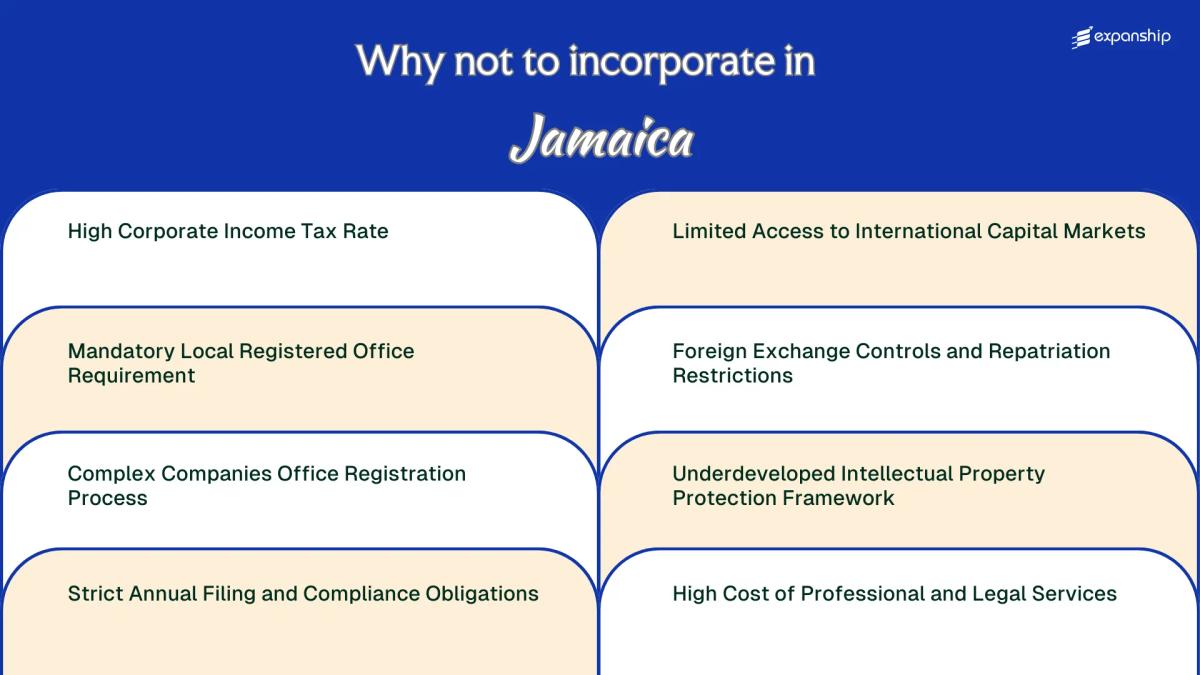
High Corporate Income Tax Rate
Jamaica's standard corporate income tax rate sits at 25% for most companies, and this flat rate applies regardless of profit size. For foreign businesses accustomed to tiered or lower-rate regimes elsewhere, the Jamaica corporate income tax drawbacks become apparent quickly when modeling post-tax returns.
A Rate That Compresses Profit Margins
Regulated companies in sectors such as banking and insurance face a higher rate of 33.33% under the Income Tax Act. For a foreign-owned entity operating in those sectors, that differential can significantly reduce the competitiveness of the Jamaican operation compared to regional peers in jurisdictions like Barbados, where the general rate scales down to as low as 1% for higher-earning companies.
The high corporate tax rate Jamaica business operators face is not offset by a wide network of double taxation treaties. Jamaica's treaty coverage remains limited, meaning withholding taxes on dividends, royalties, and interest paid to foreign shareholders often compound the overall tax burden.
Impact on Foreign Investor Returns
Profit extraction is where the Jamaica company tax burden problems become most tangible for foreign principals. A 25% corporate tax applied before any distribution, combined with withholding tax on dividends, erodes the effective return to non-resident shareholders.
Foreign business owners should calculate the combined effective tax rate, including corporate tax, dividend withholding, and any home-country obligations, before committing to a Jamaican structure, as the layered burden can substantially exceed the headline 25% rate.
Mandatory Local Registered Office Requirement
Every company registered under the Companies Act of Jamaica must maintain a registered office address within the island. This address must be operational and capable of receiving official correspondence from the Companies Office of Jamaica (COJ), which means a virtual mailbox or overseas address does not satisfy the requirement.
For a foreign business owner, this creates an unavoidable dependency on a local service provider even before operations begin. The registered office cannot be a post office box, and the physical address must be disclosed in public filings.
In practice, this obligation generates several recurring burdens:
- Retaining a local registered agent adds an annual service cost that persists regardless of whether your company generates revenue in Jamaica
- Any change of registered office address requires formal notification to the COJ, triggering administrative fees and processing delays
- If your appointed local agent ceases operations or withdraws services, your company risks falling out of good standing while you arrange a replacement
Sole reliance on a third-party agent for a mandatory compliance function also introduces a layer of operational risk that you cannot fully control from abroad.

Company Incorporation in Jamaica
Set up your Jamaica company with a compliant registered office and qualified local agent, handled through a single structured process.
Complex Companies Office Registration Process
Jamaica Companies Office registration problems are a frequent friction point for foreign incorporators, and the source of much of that friction is structural. The Companies Office of Jamaica (COJ) operates as the primary registry under the Companies Act 2004, and its processes carry procedural demands that create real delays for businesses with no prior presence in the country.
Incorporation requires submission of prescribed forms, including the Articles of Incorporation, and all documents must meet specific formatting and content standards set by the COJ. Errors or omissions trigger requisitions, which are formal rejection notices that send your filing back for correction, restarting the review cycle.
| Requirement | Detail | Implication for Foreign Applicants |
|---|---|---|
| Processing time (standard) | Several weeks, subject to requisitions | Delays market entry without guaranteed timeline |
| Requisition process | Mandatory correction and resubmission cycle | Each rejection restarts the review clock |
| Name reservation | Must be filed and approved separately | Adds a procedural stage before incorporation begins |
| Document authentication | Foreign documents may require notarization | Increases cost and turnaround time from abroad |
The name reservation process operates as a distinct pre-incorporation step, meaning your timeline extends before a single incorporation form is submitted. Foreign applicants managing this remotely face compounding delays since any correspondence with the COJ typically occurs through postal or in-person channels rather than fully digital workflows.
Online filing functionality through the COJ portal exists but remains inconsistent in practice. For a foreign business owner without local legal representation, the combination of formal filing standards and limited remote accessibility makes the complex company registration process in Jamaica disproportionately burdensome compared to jurisdictions with fully digitized, self-service registry systems.
Strict Annual Filing and Compliance Obligations
Jamaica annual filing compliance risks are an ongoing operational cost, not a one-time setup issue. Under the Companies Act 2004, every registered company must file an annual return with the Companies Office of Jamaica (COJ), accompanied by updated particulars of directors, shareholders, and registered office details.
Missing the filing deadline triggers late fees, and persistent non-compliance can result in the COJ striking the company from the register. For a foreign-owned entity, restoring a struck-off company requires a formal reinstatement application, adding legal costs and operational disruption.
The COJ also requires that financial statements be filed for certain company types, meaning your accounts must meet local format standards. This creates an additional layer of obligation beyond what many offshore structures require.
- Annual return must be filed with the COJ within the prescribed period after the company's anniversary date
- Filing must include current director, shareholder, and registered office information
- Late filings attract statutory penalty fees under the Companies Act 2004
- Certain company types must attach financial statements prepared to local standards
- Strike-off for non-compliance requires a formal reinstatement process to reverse
The Companies Office of Jamaica operates an online e-services portal, yet paper-based verification requirements for certain filings still apply, meaning fully remote compliance management is not always possible.
Limited Access to International Capital Markets
Jamaica's limited access to international capital markets is a structural constraint that affects how foreign-incorporated entities can scale and attract investment.
Structural Limitations of the Jamaica Stock Exchange
The Jamaica Stock Exchange (JSE) operates a Junior Market and a Main Market, but neither offers the depth or liquidity found in major exchanges such as the NYSE or London Stock Exchange. Foreign companies seeking to list face regulatory requirements under the Securities Act of Jamaica, and the relatively small investor base limits the volume of capital your firm can realistically raise through public equity.
Practical Consequences for Foreign Investors
Debt financing options are similarly constrained. Access to international bond markets or cross-border institutional lending is not facilitated through any dedicated framework under Jamaican corporate law, meaning businesses often depend on domestic commercial banks, which carry higher lending rates than offshore alternatives.
This limitation applies regardless of company size, though smaller entities with no pre-existing banking relationships in the jurisdiction face the most significant financing gaps.
Addressing Capital Market Constraints for Your Jamaica Entity
Our team can help you assess financing structures and registration pathways that account for the limitations of Jamaica's capital markets framework.
Foreign Exchange Controls and Repatriation Restrictions
Jamaica foreign exchange controls restrictions affect how and when your business can move money across borders, creating friction that purely domestic firms never encounter.
- The Bank of Jamaica, under the Bank of Jamaica Act, oversees foreign currency transactions, meaning your firm must work through authorized dealers for most cross-border transfers, adding procedural layers to routine financial operations.
- Profit repatriation restrictions in Jamaica require documentary evidence of the underlying commercial transaction before funds can be transferred abroad, delaying distributions to foreign shareholders.
- Authorized dealer banks may impose their own compliance reviews on top of regulatory requirements, extending transfer timelines unpredictably.
- Foreign currency accounts are permitted but subject to conditions set by the Bank of Jamaica, which limits your flexibility in holding and deploying USD or EUR reserves locally.
- Non-resident investors repatriating capital gains face currency conversion requirements that expose them to exchange rate risk during the processing period.
Underdeveloped Intellectual Property Protection Framework
Jamaica intellectual property protection limitations present a meaningful structural risk for any foreign business that holds patents, trademarks, or proprietary technology. The Jamaica Intellectual Property Office (JIPO) administers registrations under the Trade Marks Act and the Patents and Designs Act, but enforcement mechanisms remain underdeveloped relative to the economic exposure businesses face.
Patent protection, once granted, still depends heavily on civil litigation through the Jamaican court system. Proceedings are slow and costly, meaning infringement can persist for years before a rights holder obtains relief.
- Trademark opposition and cancellation proceedings lack the procedural speed found in more developed IP jurisdictions.
- There is no dedicated IP court; disputes are handled by the Supreme Court of Jamaica under general civil procedure.
- JIPO's examination capacity can delay grant timelines, leaving applications in a vulnerable unregistered state.
For technology firms, pharmaceutical companies, or brands entering the Caribbean market, this gap between formal registration and practical enforcement is a direct operational risk.
A software firm that registers a trademark with JIPO but faces an infringer may spend upward of two to three years in civil proceedings before obtaining an injunction, incurring legal costs that can exceed the commercial value of the Jamaican market itself.
High Cost of Professional and Legal Services
High professional services costs in Jamaica represent a structural friction point that disproportionately affects foreign-owned entities with no existing local relationships or market knowledge. Attorney fees for company formation, shareholder agreements, and ongoing compliance work are billed at rates that reflect a concentrated professional market, with limited price competition among qualified corporate law firms in Kingston.
The Companies Office of Jamaica requires documentation prepared or authenticated by licensed local attorneys or notaries, meaning you cannot substitute overseas counsel for filings that demand local sign-off. This creates a mandatory dependency on Jamaican professionals regardless of your firm's existing legal infrastructure.
Registered agent services, statutory secretarial work, and annual compliance filings each carry separate fee structures. Because these services are often unbundled, the cumulative annual cost of maintaining a compliant entity can significantly exceed initial estimates made before incorporation.
Firms operating in specialized sectors such as financial services or telecommunications face additional licensing requirements under bodies like the Financial Services Commission, which typically demand dedicated legal support throughout the application process.
Foreign-owned companies that assume they can manage Jamaican statutory filings using overseas legal counsel will face rejection at the Companies Office, as certain submissions legally require locally licensed professionals, making remote-only legal arrangements non-compliant by default.
Strategies to Overcome These Disadvantages
Overcoming Jamaica incorporation disadvantages requires a structural approach rather than reactive fixes. The regulatory challenges covered in this blog, from the 33.33% corporate tax rate to foreign exchange restrictions under the Bank of Jamaica Act, call for deliberate pre-incorporation planning.
- Register your entity under an applicable sector with the Jamaica Special Economic Zone Authority (JSEZA) to access tax incentives that offset the standard corporate income tax rate.
- Appoint a locally resident registered agent at the point of incorporation to satisfy the Companies Office of Jamaica's mandatory local office requirement.
- Submit your Annual Return within the statutory deadline to the Companies Office to avoid late filing penalties and maintain good standing.
- Structure dividend repatriation through formal bank channels in compliance with the Foreign Exchange Act to reduce delays in cross-border transfers.
- File trademark and patent applications with the Jamaica Intellectual Property Office (JIPO) before commencing commercial operations to establish documented IP ownership.
These steps operate within a framework governed by the Companies Act 2004 and sector-specific legislation. Full compliance depends on how your business activity intersects with Jamaica's regulatory bodies, each of which maintains its own filing and approval processes.
Jamaica's Overall Investment Viability
Jamaica's overall investment viability assessment reflects a jurisdiction with genuine structural drawbacks that you should weigh against a stable legal system rooted in English common law and a government that has maintained consistent foreign investment policies through the Jamaica Promotions Corporation (JAMPRO). The disadvantages covered in this blog are real and measurable. For certain business profiles, they are manageable within a deliberate compliance and cost strategy.
| Pros | Cons |
|---|---|
| Legal system based on English common law provides predictability for foreign firms | Corporate income tax rate of 25% is high relative to many competing Caribbean jurisdictions |
| JAMPRO actively facilitates foreign direct investment through structured support programs | The Companies Office of Jamaica registration process involves multiple sequential steps and processing delays |
| Geographic position supports trade access to North American and Caribbean markets | Foreign exchange controls and repatriation restrictions can complicate profit distribution |
| Double taxation treaties with select jurisdictions reduce cross-border tax exposure | Annual filing obligations under the Companies Act are strictly enforced with financial penalties for non-compliance |
| English-language legal environment reduces translation and interpretation costs | Intellectual property protection framework lacks the depth of more developed registry systems |
Corporate Compliance Services in Jamaica
Meet your annual filing obligations and maintain good standing with the Companies Office of Jamaica.
Conclusion
The Jamaica company formation drawbacks summary reflects a jurisdiction with genuine structural friction for foreign investors. Across the areas covered, the 33⅓% corporate income tax rate and foreign exchange controls administered under the Bank of Jamaica's oversight stand out as the most operationally consequential constraints. The complexity of the Companies Office of Jamaica's registration process adds further friction at the entry stage. For any firm weighing incorporation here, professional guidance specific to local regulatory requirements will materially affect both setup timelines and ongoing compliance outcomes.
Expanship's Jamaica Incorporation Support
Incorporating in Jamaica involves specific obligations under the Companies Act and registration requirements with the Companies Office of Jamaica, along with ongoing compliance duties that can absorb significant management time and cost. Expanship's Jamaica incorporation support services are structured to reduce that operational burden, handling the procedural and regulatory work so your team can focus elsewhere.
From initial setup to post-incorporation maintenance, Expanship assists with the following:
- Preparing and submitting all company registration documents required by the Companies Office of Jamaica.
- Providing a local registered agent and office address to satisfy Jamaica's statutory presence requirements.
- Liaising directly with government agencies and regulatory bodies on your entity's behalf.
- Managing ongoing annual filing obligations and compliance deadlines after your business is established.
- Facilitating introductions to local banking institutions suited to your corporate structure.
- Handling tax registration and coordination with the Tax Administration Jamaica on your behalf.
To discuss your incorporation requirements, contact Expanship Jamaica.
Frequently Asked Questions (FAQ)
The Bank of Jamaica administers foreign exchange controls under the Bank of Jamaica Act, and restrictions on repatriation apply broadly across corporate structures rather than being limited to specific entity types. Dividend payments and capital transfers abroad require approved dealer transactions and supporting documentation, which adds processing time and administrative cost. Companies with high-frequency cross-border cash flows will feel this friction most acutely.
Failure to file annual returns with the Companies Office of Jamaica results in the company being struck off the register if non-compliance persists. Reinstatement requires an application, payment of outstanding fees, and submission of overdue filings, which can delay business operations significantly. Directors can also face personal liability in some circumstances depending on the nature of the default.
Professional fees in Jamaica are high relative to comparable offshore jurisdictions, with legal and accounting services for incorporation and ongoing compliance often running into several thousand US dollars annually. Attorneys in Jamaica are regulated by the General Legal Council, and their fee structures reflect a relatively small, specialized market. Budget expectations should account for both setup costs and recurring compliance expenditure.
Jamaica's IP framework is underdeveloped compared to jurisdictions like Barbados or Trinidad and Tobago, which have more recently updated their legislative infrastructure. The Intellectual Property Office of Jamaica administers trademark and patent registration, but enforcement mechanisms are inconsistent and litigation can be slow. Businesses relying on IP-intensive assets should treat this as a genuine operational risk rather than a minor procedural inconvenience.
Jamaica's Companies Act requires a physical local registered office address where official correspondence and statutory notices can be served, and a virtual office may not satisfy this requirement depending on how it is structured. The address must be a genuine, accessible location within Jamaica. Using a non-compliant address can expose the company to regulatory notices going unserved, which creates downstream compliance failures.
The Companies Act of Jamaica imposes financial penalties for late annual returns, and the Companies Office has the authority to strike off entities that remain non-compliant over an extended period. Penalty amounts accrue over time, meaning prolonged delays compound the financial exposure. Restoring a struck-off company involves a court application in some cases, adding legal cost on top of the administrative arrears.
Legal Disclaimer
The information provided in this article is for general informational purposes only and does not constitute legal, tax, or professional advice. While we strive to ensure the accuracy and timeliness of the content, laws and regulations are subject to change, and the application of laws can vary widely based on specific facts and circumstances.
Readers should not act upon this information without seeking professional counsel tailored to their individual situation. Expanship and its authors disclaim any liability for actions taken or not taken based on the content of this article.
For specific advice regarding your business setup, compliance requirements, or any legal matters, please consult with qualified legal and tax professionals in the relevant jurisdiction.