

Key Takeaways
- Jamaica's 25% corporate tax rate under the Income Tax Act applies to locally sourced income, giving foreign investors a defined and predictable liability on profits generated within the jurisdiction.
- Administered under the Companies Act 2004, the Companies Office of Jamaica provides a statutory registration process rooted in English common law principles that Commonwealth-based directors and legal advisors can apply familiar frameworks to.
- The absence of foreign exchange controls on capital repatriation means businesses can move profits out of Jamaica without the conversion restrictions or approval mechanisms that add friction in comparable regional markets.
- Export-oriented businesses benefit from an additional layer of fiscal incentives through the Special Economic Zones regime, administered by the Jamaica Special Economic Zones Authority, which operates separately from the standard corporate tax framework.
Incorporating a business in Jamaica offers access to a mid-sized, independent Caribbean economy governed by a stable parliamentary system under the Westminster model. Company registration is administered by the Companies Office of Jamaica, the statutory body responsible for incorporating and maintaining records for all registered entities. Foreign investors most commonly establish a private limited company when entering the market.
The country operates a territorial-leaning tax system with standard corporate rates applied to locally sourced income, alongside a growing network of treaty arrangements. Ownership restrictions for foreign nationals are generally limited, and the government has positioned the economy to attract foreign direct investment across multiple sectors.
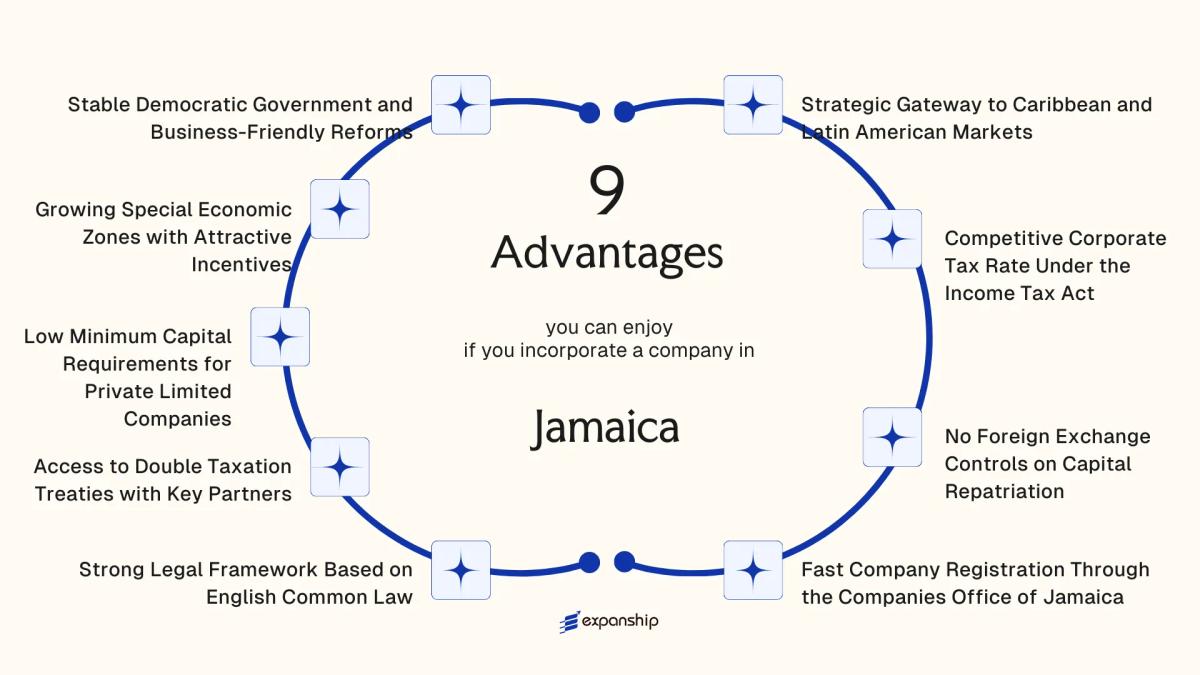
This article outlines the key advantages that Jamaica's regulatory and commercial environment presents to businesses considering incorporation there.
Strategic Gateway to Caribbean and Latin American Markets
Positioned at the crossroads of the Caribbean Sea and the western Atlantic, Jamaica functions as a practical Jamaica gateway to Caribbean Latin American markets for businesses targeting regional expansion. Its proximity to Central American trade corridors and major Caribbean economies gives incorporated entities here a geographic foundation that few island jurisdictions can match.
Regional Connectivity That Affects Trade Costs
Kingston's Norman Manley International Airport and the Port of Kingston — one of the largest natural harbours in the Western Hemisphere — connect your business to over 30 regional ports and freight hubs. Reduced transit times to markets in Colombia, Mexico, and the wider Caribbean Archipelago translate directly into lower logistics costs and faster distribution cycles.
A Recognized Base for Regional Headquarters
CARICOM membership grants companies incorporated in Jamaica preferential trade access across 15 member states under the Revised Treaty of Chaguaramas. Your firm can operate regionally without facing standard third-country tariff treatment, which matters when pricing goods and services across multiple Caribbean markets from a single registered entity.
A Jamaica-incorporated company can serve as your regional operating base, accessing CARICOM preferential trade terms while maintaining logistical proximity to both Latin American and North American markets.
Competitive Corporate Tax Rate Under the Income Tax Act
Under the Income Tax Act, the standard corporate tax rate applied to companies in Jamaica is 25%. For publicly traded companies listed on the Jamaica Stock Exchange, a reduced rate of 33.33% applies in some contexts, but private limited companies, the most common vehicle for foreign incorporation, are assessed at the flat 25% rate. That rate applies to net chargeable income, meaning your firm is taxed on profit after allowable deductions rather than on gross revenue.
Compared to jurisdictions such as the United States, where the federal corporate rate sits at 21% before state-level taxes are added, 25% is not a nominal rate. The practical advantage lies in what accompanies it: a transparent statutory framework under the Income Tax Act, predictable assessment procedures administered by Tax Administration Jamaica, and no additional profit-based levies that inflate the effective rate beyond the headline figure.
For foreign investors structuring a private limited company, this consistency matters. Rate predictability allows for reliable financial modelling across multi-year investment horizons. Several factors contribute to why this rate structure is commercially workable:
- Allowable business deductions reduce the taxable base before the 25% rate is applied
- Tax Administration Jamaica publishes clear guidance on chargeable income calculations
- The flat rate removes tiered complexity that can distort growth decisions for scaling businesses
- Private limited companies face no additional municipal or parish-level corporate income tax

Incorporate a Company in Jamaica
Set up a private limited company in Jamaica with full compliance support from Expanship, covering registration, documentation, and post-incorporation requirements.
No Foreign Exchange Controls on Capital Repatriation
Jamaica no foreign exchange controls on capital repatriation is among the most commercially significant features of the jurisdiction's investment environment. Under the Bank of Jamaica Act and the Bank of Jamaica (Validation) Order, Jamaica does not impose restrictions on the movement of foreign currency in or out of the country. Profits, dividends, loan repayments, and sale proceeds can be transferred abroad without prior regulatory approval.
For a foreign business owner, this means your returns are not locked into the local economy pending government clearance. Many jurisdictions require licensed dealers, mandatory holding periods, or central bank approval before capital can exit. None of those conditions apply here, which reduces both administrative burden and conversion risk for cross-border operations.
| Transaction Type | Restriction | Governing Authority |
|---|---|---|
| Dividend repatriation | None | Bank of Jamaica |
| Loan principal repayment | None | Bank of Jamaica |
| Proceeds from asset sale | None | Bank of Jamaica |
| Foreign currency accounts | Permitted | Financial Services Commission |
Authorized dealer banks facilitate foreign exchange transactions, and businesses can hold accounts denominated in foreign currencies. This means your firm does not bear compulsory conversion losses when moving funds across borders. The practical benefit is direct: your treasury operations remain under your control, and the timing of capital repatriation can align with your financial planning rather than regulatory schedules.
Fast Company Registration Through the Companies Office of Jamaica
The Companies Office of Jamaica administers company registration under the Companies Act 2004, and the process for incorporating a private limited company is notably direct. A new entity can typically be registered within a few business days once the required documents are submitted, provided the proposed name has been reserved and the incorporation forms are completed accurately.
For a foreign business owner, this speed has a concrete operational value. Faster registration means your company can open a bank account, execute contracts, and begin generating local revenue sooner. Delays at the incorporation stage often create downstream problems, including deferred tax registration, delayed payroll setup, and gaps in regulatory standing.
Jamaica company registration advantages here stem from a digitised submission process, which reduces the back-and-forth that characterises many Commonwealth jurisdictions with paper-heavy procedures.
Keep these points in mind to avoid delays:
- Name reservation must be completed before submitting incorporation documents
- At least one director is required; there is no residency requirement for directors of private companies
- The Memorandum and Articles of Association must align with the Companies Act 2004
- Registration fees are payable to the Companies Office of Jamaica at the time of filing
- Incomplete or inconsistent documentation is the most common cause of processing delays
A private limited company in Jamaica can be incorporated with a single shareholder and a single director, with no minimum paid-up capital required at the point of registration.
Strong Legal Framework Based on English Common Law
Jamaica's legal system traces directly to English common law, a foundation that foreign businesses can rely on for contract enforcement, dispute resolution, and property rights. The Jamaica English common law legal framework advantages are most visible in how the courts treat commercial agreements — using precedent-based reasoning that mirrors principles familiar to businesses from the UK, Canada, Australia, and other common law jurisdictions.
Predictable Contract Enforcement
Commercial contracts in Jamaica are governed by established common law principles, with courts applying precedent to interpret obligations, damages, and breach. For a foreign investor, this predictability reduces legal exposure — you can structure agreements with reasonable confidence about how disputes will be resolved, without needing to adapt to a civil law system or codified commercial statutes that differ significantly from what your legal counsel already understands.
Judicial Independence and Property Rights
The court system operates with constitutional protections for judicial independence, and property rights are enforced through a framework that foreign firms from common law backgrounds will recognize structurally. Final appeals in certain matters can be heard by the Caribbean Court of Justice or the Judicial Committee of the Privy Council in London, depending on the case type — this external appellate layer provides an additional tier of oversight that carries weight for foreign investors assessing legal risk. Your business benefits from a dispute resolution environment that has not been subject to arbitrary structural changes, which matters when evaluating long-term investment security.
Structure Your Jamaica Incorporation With Legal Clarity
Speak with an Expanship specialist about how Jamaica's common law framework applies to your specific business structure and investment goals.
Access to Double Taxation Treaties with Key Partners
Jamaica's double taxation treaty network offers measurable advantages for foreign investors structuring cross-border operations. The country has concluded tax treaties with several major economies, including the United States, the United Kingdom, Canada, China, Denmark, Norway, Sweden, and CARICOM member states. These agreements reduce or eliminate withholding taxes on dividends, interest, and royalties paid between treaty partners, which directly reduces the tax cost of moving profits across borders.
- Withholding tax rates on dividends and interest payments to non-residents can be reduced under applicable treaty provisions, lowering the effective tax burden on repatriated income compared to standard domestic rates.
- Treaty provisions typically include tie-breaker rules for tax residency and mechanisms to resolve disputes between tax authorities, giving your business greater certainty over its tax position in multiple jurisdictions.
- Under the Income Tax Act, treaty benefits are applied through domestic law implementation, meaning treaty-resident entities can rely on these reduced rates without separate advance rulings in routine cases.
- CARICOM member states benefit from the Agreement for the Avoidance of Double Taxation within the Caribbean Community, broadening the firm's regional tax planning options across multiple Caribbean markets.
Eligibility for treaty benefits depends on meeting the residency and substance requirements defined in each specific agreement, so the applicable treaty text governs entitlement rather than general domestic rules.
Low Minimum Capital Requirements for Private Limited Companies
Jamaica's low minimum capital requirements for private companies mean you can incorporate without tying up significant capital before your business generates revenue. Under the Companies Act 2004, there is no statutory minimum paid-up share capital required to form a private limited company. A single share at nominal value is sufficient to satisfy the registration requirement with the Companies Office of Jamaica.
This structural flexibility has a direct financial implication: your entity can be capitalized at a level that reflects actual operational needs rather than an arbitrary regulatory threshold. For early-stage businesses or holding structures, this reduces the upfront financial commitment considerably.
- Share capital can be denominated in Jamaican dollars or a foreign currency, depending on how the articles of incorporation are drafted.
- Authorized share capital determines the registration fee payable to the Companies Office of Jamaica, so keeping initial authorized capital modest also reduces formation costs.
A private limited company incorporated with an authorized share capital of JMD 1,000 (roughly USD 6–7 at current exchange rates) would incur the base-tier registration fee, compared to a company authorized at JMD 5,000,000, which would attract a significantly higher fee. Calibrating authorized capital to actual needs at the point of formation produces a measurable cost saving from day one.
Growing Special Economic Zones with Attractive Incentives
Jamaica Special Economic Zones incentives for businesses are governed by the Special Economic Zones Act (2016) and administered by the Special Economic Zones Authority (SEZA). Entities operating within a designated SEZ are subject to a concessionary corporate income tax rate of 12.5%, compared to the standard 25% rate that applies outside the zone.
Beyond the reduced tax rate, SEZ-registered companies benefit from:
- Exemption from import duties on raw materials, equipment, and machinery used within the zone
- Relief from the General Consumption Tax (GCT) on qualifying goods and services
- Access to streamlined customs procedures through SEZA-coordinated oversight
For foreign investors, the practical consequence is a materially lower operating cost structure, particularly for manufacturing, logistics, and export-oriented service businesses where input costs and tax exposure are significant variables.
Approved enterprises also benefit from greater certainty through SEZA's regulatory framework, which sets defined obligations and entitlements in writing. This reduces interpretive ambiguity that can otherwise affect cost projections.
SEZ incentives apply only to entities formally registered and operating within a SEZA-designated zone; companies incorporated in Jamaica but operating outside these zones do not qualify for the concessionary 12.5% rate.
Stable Democratic Government and Business-Friendly Reforms
Jamaica operates as a constitutional parliamentary democracy, maintaining uninterrupted democratic governance since independence in 1962. For foreign investors, this continuity translates into a predictable legal and regulatory environment where property rights, contract enforcement, and judicial processes are not subject to abrupt political reversal.
The country's adherence to Westminster-style governance means that legislative changes follow structured parliamentary procedures, giving businesses advance notice of regulatory shifts. This is a material advantage when structuring long-term investment arrangements or multi-year contractual commitments.
On the reform side, the government has actively worked to reduce bureaucratic friction for business entry and operations. The Companies Office of Jamaica and the Online Registry have been central to digitising commercial registration processes, cutting the time and administrative overhead required to establish a formal presence.
Jamaica's participation in international frameworks also reflects institutional stability:
- Membership in CARICOM and the CARIFORUM-EU Economic Partnership Agreement
- Signatory to the ICSID Convention, providing foreign investors access to international arbitration under established treaty rules
- Ongoing engagement with the World Bank's Doing Business reform agenda, which shaped targeted improvements in contract enforcement and business licensing
Under the Jamaica Business Facilitation Act, regulatory agencies are required to meet published service standards. That statutory obligation creates an accountability mechanism that protects your business from indefinite administrative delays.
Political risk is a genuine cost in many emerging markets. The institutional consistency present here, underpinned by independent courts and a free press, reduces that exposure for your entity without requiring additional structuring to manage governance uncertainty.
Why Jamaica Stands Out Against Competing Caribbean Jurisdictions
Comparing Jamaica vs other Caribbean jurisdictions for incorporation requires looking at the specific structural features each territory offers rather than general regional reputation. The competitors most relevant to this comparison are the Cayman Islands, Barbados, and Trinidad and Tobago — each targeting a similar profile of foreign investor through tax efficiency, legal familiarity, or regional market access.
What the table below reflects is not simply a list of rates, but a pattern in trade-offs. Offshore-focused territories like Cayman offer tax neutrality but limited treaty access and no domestic market substance. Barbados presents a treaty network of comparable depth, yet its corporate tax structure has undergone significant reform pressure. Trinidad's economy is larger but carries more regulatory complexity for new entrants. Against this backdrop, the combination of statutory company registration through the Companies Office of Jamaica, an active treaty network, and a common law court system with Privy Council access represents a set of features that few Caribbean rivals replicate together.
| Parameter | Jamaica | Cayman Islands | Barbados | Trinidad & Tobago |
|---|---|---|---|---|
| Corporate Tax Rate | 25% (standard rate) | 0% (no corporate tax) | 5.5%–9% (tiered) | 30% (standard rate) |
| Double Taxation Treaties | Yes (active network) | Very limited | Yes (broad network) | Yes (moderate network) |
| Legal System | English common law, Privy Council | English common law | English common law | English common law |
| Company Registration Body | Companies Office of Jamaica | Cayman Islands Registrar | CAIPO | Companies Registry (T&T) |
| Foreign Exchange Controls | None on repatriation | None | None | Partial restrictions apply |
| Special Economic Zones | Yes (JSEZA-administered) | Limited | Limited | Yes (limited scope) |
Compliance Services for Companies in Jamaica
Stay on top of annual filing obligations, registered office requirements, and statutory deadlines under the Companies Act 2004.
Conclusion
Jamaica's position as an incorporation destination rests on a combination of structural features that are difficult to replicate elsewhere in the region. The benefits of incorporating in Jamaica, from its 25% corporate tax rate under the Income Tax Act to its absence of foreign exchange controls on capital repatriation, reflect a framework that treats foreign capital without the friction common in less open economies. For businesses that require reliable access to profits earned abroad, that combination carries real operational weight.
Two factors stand out when assessing Jamaica company formation advantages for foreign investors. Registration through the Companies Office of Jamaica is governed by the Companies Act 2004, providing a statutory process grounded in English common law principles that are familiar to advisors and directors from Commonwealth jurisdictions. Access to double taxation treaties with trading partners reduces withholding tax exposure at the point of income distribution, which directly affects the after-tax return on investment.
Fit, however, depends on your specific circumstances. A firm operating primarily in CARICOM markets will draw different value from this jurisdiction than one using it as a holding structure for Latin American assets. The Special Economic Zones regime, administered under the Jamaica Special Economic Zones Authority, adds another layer of relevance for export-oriented businesses specifically. Determining which structural and tax benefits apply to your entity requires mapping the available frameworks against your actual business model, ownership structure, and intended markets. That mapping is where the real planning work begins.
Start Your Jamaica Company Formation With Expanship Today
Expanship assists foreign entrepreneurs with Jamaica company formation, handling the full registration process under the Companies Act 2004 with the Companies Office of Jamaica. From structuring your private limited company to meeting annual filing obligations, the firm works within the same legal and regulatory framework this blog has examined throughout.
Services available through Expanship Jamaica include:
- Preparation and legalization of incorporation documents required by the Companies Office of Jamaica
- Registered agent and registered office provision to satisfy statutory address requirements
- Government filing and direct liaison with the Companies Office of Jamaica on your behalf
- Post-incorporation compliance management, including annual returns and director obligations
- Banking introduction assistance to support your firm's operational setup in the jurisdiction
Reach out to Expanship Jamaica to discuss your incorporation requirements.
Frequently Asked Questions (FAQ)
Registration through the Companies Office of Jamaica can be completed in as little as one to two business days when documents are submitted correctly. The office operates an online portal that accepts applications for private limited companies, reducing the need for in-person attendance. Delays typically arise from incomplete submissions or name reservation issues, not from the process itself.
The standard corporate income tax rate under the Income Tax Act is 25% for most companies, with a reduced rate of 33.33% applicable to unregulated financial institutions. Businesses operating within a Special Economic Zone may qualify for a preferential rate of 12.5% on qualifying income. The applicable rate depends on the nature of the business and whether it holds SEZ operator or occupant status.
The Companies Act 2004 does not require directors to be resident or domiciled in Jamaica. A private limited company can be incorporated with foreign directors, provided the statutory filing requirements are met, including the submission of consent forms and identification documents. There is no minimum number of directors specified beyond the general requirement for at least one.
Jamaica has concluded double taxation agreements with several key trading partners, including the United Kingdom, the United States, Canada, and CARICOM member states. These treaties generally allocate taxing rights between jurisdictions and reduce withholding tax rates on dividends, interest, and royalties. The specific relief available depends on the treaty provisions applicable to the investor's country of residence.
A company that fails to comply with the requirements set by the Jamaica Special Economic Zones Authority risks losing its SEZ designation and the associated tax incentives. The Authority has the power to suspend or revoke occupant or operator status following an investigation. Loss of SEZ status would subject the entity to the standard corporate tax regime under the Income Tax Act from the date of revocation.
Jamaica's legal system is grounded in English common law, and commercial contracts are enforceable through the Supreme Court of Jamaica. The country is also a signatory to the New York Convention on the Recognition and Enforcement of Foreign Arbitral Awards, which supports the enforceability of international arbitration clauses. This provides foreign businesses with a predictable and recognized mechanism for resolving disputes outside the local court system.
Legal Disclaimer
The information provided in this article is for general informational purposes only and does not constitute legal, tax, or professional advice. While we strive to ensure the accuracy and timeliness of the content, laws and regulations are subject to change, and the application of laws can vary widely based on specific facts and circumstances.
Readers should not act upon this information without seeking professional counsel tailored to their individual situation. Expanship and its authors disclaim any liability for actions taken or not taken based on the content of this article.
For specific advice regarding your business setup, compliance requirements, or any legal matters, please consult with qualified legal and tax professionals in the relevant jurisdiction.