

Key Takeaways
- All Jersey companies must be incorporated under the Companies (Jersey) Law 1991, with the Jersey Financial Services Commission (JFSC) serving as the statutory authority responsible for overseeing registration and ongoing compliance.
- Foreign investors structuring a Jersey entity are required to account for director residency considerations, which carry particular regulatory weight under the jurisdiction's corporate governance framework.
- Beneficial ownership information must be registered with the JFSC, making it a mandatory ongoing obligation rather than a one-time formation step.
- Appointing a qualified company secretary is a corporate governance requirement under Jersey law, and failure to maintain this appointment post-incorporation can expose the entity to sanctions.
Company formation in Jersey is governed by the Companies (Jersey) Law 1991, with the Jersey Financial Services Commission (JFSC) serving as the primary regulatory authority overseeing incorporation and ongoing compliance. This article addresses the structural, documentary, and regulatory requirements that apply across the formation process.
Failure to satisfy these requirements results in rejection of the registration application or, where deficiencies arise post-incorporation, potential sanctions under Jersey law.
Requirements can differ based on the type of entity being formed, the industry sector in which it will operate, and the structure of its ownership. A private company limited by shares, for instance, faces different obligations than a limited liability company or a cell company.
This article is most relevant to foreign investors, holding company structures, and fund managers seeking to establish or maintain a regulated or unregulated entity under Jersey's corporate framework.
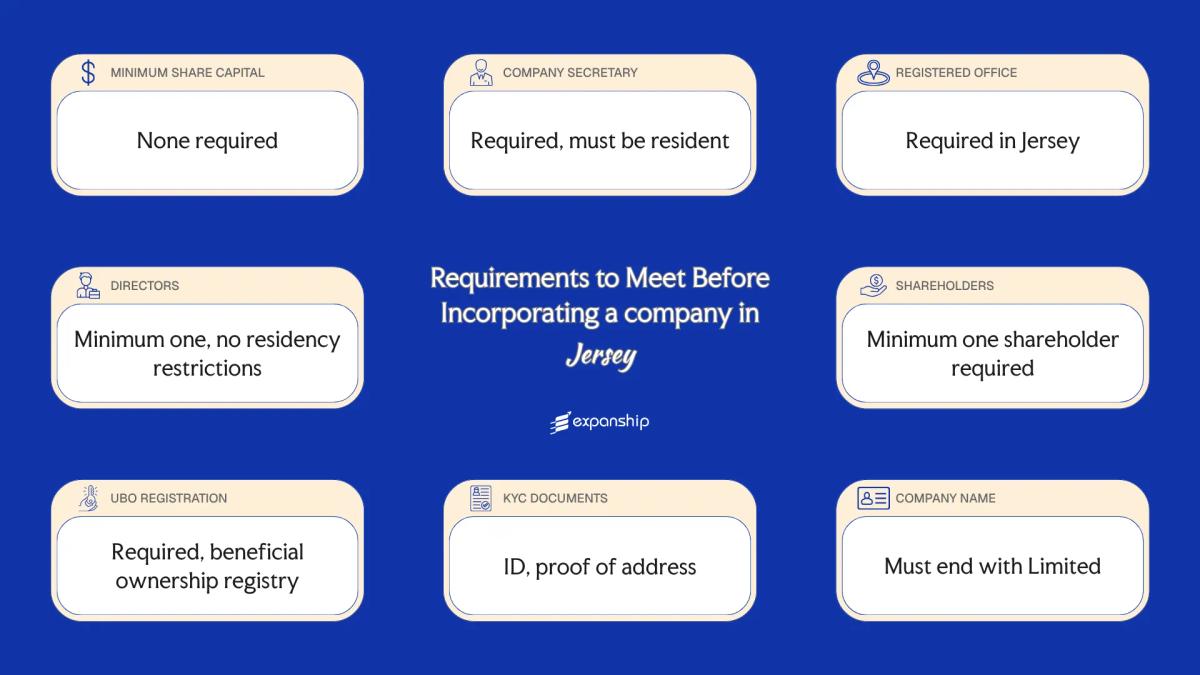
Minimum Share Capital Requirements in Jersey

Under the Companies (Jersey) Law 1991, there is no statutory minimum share capital requirement for private or public companies. Jersey share capital requirements are structured around flexibility, with the registry — the Jersey Financial Services Commission (JFSC) — not mandating a minimum authorized or paid-up amount at the point of incorporation.
Jersey operates on a no-par value share system, meaning shares are issued without a nominal or face value assigned to them. Capital obligations are therefore defined by the company's own articles of association rather than imposed by statute.
| Parameter | Detail |
|---|---|
| Minimum Authorized Share Capital | No statutory requirement |
| Maximum Authorized Share Capital | No statutory requirement |
| Minimum Paid-Up Capital | No statutory requirement |
| Paid-Up Requirement at Incorporation | No statutory requirement |
| Accepted Currency | Any currency |
| Accepted Forms of Contribution | Cash and non-cash contributions permissible |
| Timeframe to Deposit Capital | No statutory timeframe prescribed |
Even without a statutory minimum, your company must still establish an authorized share structure within its memorandum of association filed with the JFSC. Omitting a defined capital structure entirely can create complications when issuing shares post-incorporation.
Company Secretary Requirements in Jersey
Under the Companies (Jersey) Law 2008, appointing a company secretary is not a statutory requirement for private companies. Public companies, however, must appoint one. Where a secretary is appointed voluntarily or by requirement, the role carries defined corporate secretary rules Jersey-governed entities are expected to observe.
The secretary's duties typically include maintaining statutory registers, ensuring filings with the Jersey Financial Services Commission are submitted on time, and acting as the formal point of contact for regulatory correspondence. Meeting company secretary requirements Jersey sets out for public companies means the appointee must meet specific eligibility conditions.
Qualification criteria for who may serve as company secretary:
- Individuals must have the requisite knowledge and experience to discharge the functions of the role.
- Corporate entities may be appointed as secretary, provided they are properly constituted legal persons.
- No mandatory residency requirement applies to the secretary position under current Jersey company law.
- Regulated trust and corporate service providers licensed by the Jersey Financial Services Commission may fulfil the role professionally.
- There is no prescribed professional qualification required by statute, though competency standards are implied.

Incorporate a Company in Jersey
Set up your Jersey company with full compliance support, from initial filing through to ongoing corporate maintenance.
Registered Office Requirements in Jersey
Registered office requirements in Jersey are governed under the Companies (Jersey) Law 1991, which mandates that every company incorporated on the island maintains a registered office address at all times within the jurisdiction. Failure to comply can result in regulatory action by the Jersey Financial Services Commission, including the company being struck off the register.
- A physical address within Jersey is required; a P.O. box alone does not satisfy the obligation.
- Virtual office addresses are permissible provided they represent a genuine, staffable location in Jersey.
- The address must be locally based; an overseas address does not meet the statutory requirement.
- No ownership of the premises is required, but a lease or formal arrangement with the address provider must be in place.
- The registered address is publicly listed on the Jersey Companies Registry and is accessible to third parties.
- Any change to the registered office address must be formally notified to the Jersey Financial Services Commission by filing the prescribed notice.
Director Requirements in Jersey

Under the Companies (Jersey) Law 1991, directors assume full fiduciary duties upon appointment, including acting in the best interests of the company and exercising reasonable care and diligence. Statutory liability extends to wrongful trading, fraudulent conduct, and breaches of duties owed to the company and its members.
| Parameter | Detail |
|---|---|
| Minimum Number of Directors | One director is required. |
| Maximum Number of Directors | No statutory maximum is prescribed. |
| Local/Resident Director Required | No statutory requirement for a locally resident director exists. |
| Nationality Restrictions | No nationality restrictions are imposed under the Companies (Jersey) Law 1991. |
| Minimum Age Requirement | Directors must be at least 18 years of age. |
| Corporate Directors Permitted | Corporate directors are permitted, subject to the corporate director itself being duly incorporated. |
| Director Must Be a Shareholder | No requirement for a director to hold shares in the company. |
| Publicly Listed on Registry | Director details are filed with the Jersey Financial Services Commission and are accessible on the public register. |
| Disqualification Conditions | Disqualification may result from insolvency-related misconduct, fraudulent activity, or a court order under Jersey law. |
Despite Jersey's reputation as a finance-focused jurisdiction, there is no statutory requirement for any director to be a local resident or Jersey-qualified professional, even for regulated entities that require a licensed registered agent.
Shareholder Requirements in Jersey

Jersey companies incorporated under the Companies (Jersey) Law 1991 require a minimum of one shareholder. No statutory maximum applies, making sole shareholder structures fully permissible.
Nationality and Residency Restrictions
Shareholder requirements in Jersey impose no nationality or residency conditions on individuals holding shares. Foreign ownership is unrestricted, meaning non-resident individuals and overseas entities may hold 100% of the share capital.
Corporate Shareholders
Corporate entities are permitted to act as shareholders in a Jersey company. No additional conditions are attached solely by reason of the shareholder being a body corporate, though Jersey's AML framework may require enhanced due diligence on corporate shareholders.
Shareholder Liability
Liability is limited to the amount unpaid on a shareholder's shares. Piercing the corporate veil remains an exceptional remedy under Jersey law and does not arise from ordinary shareholder status.
Register of Shareholders
Under the Companies (Jersey) Law 1991, your company must maintain a register of members at its registered office. This register is not publicly accessible through the Jersey Financial Services Commission, though it must be kept accurate and available for inspection by members.
Setting Up Your Shareholding Structure in Jersey
Get guidance on structuring your shareholding arrangements to meet Jersey's legal requirements from the outset of incorporation.
UBO / Beneficial Ownership Registration Requirements in Jersey
Beneficial ownership registration in Jersey is governed by the Beneficial Ownership (Jersey) Law 2017, which defines a beneficial owner as any individual holding, directly or indirectly, more than 25% of the shares or voting rights, or who otherwise exercises control over the entity.
- Identify all individuals who meet the 25% ownership or control threshold prior to incorporation.
- Submit beneficial ownership information to the Jersey Financial Services Commission (JFSC) through the designated registry system.
- Ensure the filing is completed at the point of incorporation or when the entity first becomes subject to the law.
- Notify the JFSC of any changes to beneficial ownership within 21 days of the change occurring.
| Parameter | Detail |
|---|---|
| Ownership Threshold for UBO Status | More than 25% of shares, voting rights, or control |
| Filing Authority | Jersey Financial Services Commission (JFSC) |
| Disclosure Deadline at Incorporation | At point of incorporation |
| Publicly Accessible Register | No — the register is not publicly accessible |
| Penalties for Non-Disclosure | Criminal penalties under the Beneficial Ownership (Jersey) Law 2017 |
| Ongoing Update Obligation | Changes must be reported within 21 days |
KYC / Document Requirements in Jersey

KYC requirements for a Jersey company are governed by the Money Laundering (Jersey) Order 2008, administered by the Jersey Financial Services Commission, which sets the due diligence standards that all regulated introducers and service providers must apply at the point of incorporation.
Individual / Personal Documents
- Certified copy of a valid passport or government-issued photo ID for each director, shareholder, and beneficial owner
- Proof of residential address dated within three months, such as a utility bill or bank statement
- Completed personal questionnaire or declaration of source of wealth, as required by the service provider
- Details of any politically exposed person (PEP) status or sanctions exposure
Corporate Documents
- Certificate of incorporation for any corporate shareholder or director
- Constitutional documents, including articles of association or equivalent
- Register of current directors and shareholders of the corporate entity
- Proof of registered office address for the corporate entity
Source of Funds Documentation
- Bank statements covering a minimum recent period to evidence the origin of capital
- Audited accounts or management accounts where the source is business income
- Sale agreements, inheritance documentation, or equivalent where funds derive from a specific event
Notarisation and Apostille Requirements
- Documents issued outside Jersey generally require notarisation by a qualified notary
- Countries party to the Hague Convention must apostille notarised documents before submission
- Certified translations into English are required for any document not originally in English
The most common cause of incorporation delay is submission of address verification documents that exceed the accepted three-month recency threshold.
Company Name Requirements in Jersey
Company name requirements in Jersey are assessed by the Jersey Financial Services Commission (JFSC) at the point of incorporation. Proposed names must not be identical or too similar to an existing registered entity, and the JFSC retains discretion to reject any name deemed undesirable or misleading.
Names must end with a legal suffix such as "Limited" or "Ltd" to denote limited liability. No statutory minimum or maximum character count is formally prescribed, but the name must be in Roman script.
Certain words require prior consent from relevant authorities before use — terms suggesting a connection to government, banking, insurance, or royalty fall into this category. Words implying regulated activities without the appropriate authorisation are prohibited outright.
Name reservation is available in Jersey prior to formal incorporation. Reservations are generally granted for a limited period, and your application is submitted directly through the JFSC's online portal.
Compliance Services for Companies in Jersey
Stay up to date with Jersey's regulatory obligations, from annual filings to ongoing statutory requirements for registered entities.
Conclusion
Meeting the incorporation requirements in Jersey involves engaging with a defined regulatory structure administered by the Jersey Financial Services Commission under the Companies (Jersey) Law 1991. Among the requirements covered, the JFSC's ongoing involvement in beneficial ownership registration and the residency considerations for directors carry particular weight for foreign investors. Corporate governance obligations, including the appointment of a qualified company secretary, also warrant careful attention. Once these requirements are understood, the practical work of structuring your entity and coordinating with licensed service providers in the jurisdiction begins.
Expanship's Corporate Services for Jersey Expansion
Jersey's incorporation framework, from JFSC-supervised due diligence to the requirement for locally resident directors and a registered office, places real administrative weight on incoming businesses. Expanship's Jersey corporate services expansion support is structured around these specific requirements, reducing the coordination burden that comes with managing regulated formation processes from outside the island.
Our service scope covers the full lifecycle of your entity's establishment and ongoing presence in Jersey:
- We prepare and submit all company registration documents in line with Jersey Companies Law requirements.
- A registered agent and compliant registered office address are provided on your behalf.
- We handle filings with the JFSC and Jersey Financial Services Commission registry on your behalf.
- Post-incorporation obligations, including annual returns and statutory maintenance, are managed for your business.
- Banking introductions are facilitated to support your firm's operational setup in Jersey.
- Tax registration and liaison with the Jersey Taxes Office are included where applicable.
To discuss your requirements, contact Expanship Jersey.
Frequently Asked Questions (FAQ)
A non-resident can serve as a director, but Jersey's regulatory environment adds a practical constraint. Jersey Finance and the Jersey Financial Services Commission expect that locally licensed corporate service providers are involved in the administration of the company, which means a non-resident sole director arrangement will often require a licensed co-director or administrator to satisfy the substance considerations that apply to certain entity types.
Failure to comply with beneficial ownership obligations under the Beneficial Ownership (Jersey) Law 2017 constitutes a criminal offence, and companies can face significant financial penalties. The obligation applies to all Jersey companies, so there is no exemption based on company size or the residency of shareholders.
The registered office must be a physical address in Jersey, but it does not have to be your company's principal place of business. Most foreign-owned companies fulfil this requirement through a licensed corporate service provider operating in Jersey, which is also consistent with the JFSC's expectation that a local administration point exists for the entity.
Jersey law does not impose a universal statutory obligation on private companies to appoint a company secretary, unlike some other common law jurisdictions. However, where a company secretary is appointed, there is no residency requirement, though in practice the role is commonly handled by the same licensed provider supplying the registered office.
The JFSC must grant consent under the Control of Borrowing (Jersey) Order 1958 before a company can be incorporated, which means incorporation is not instantaneous. Processing timelines vary depending on the complexity of the structure and the completeness of the KYC documentation submitted, so delays in providing certified identification or source-of-funds evidence will directly extend the time before your entity is registered.
Legal Disclaimer
The information provided in this article is for general informational purposes only and does not constitute legal, tax, or professional advice. While we strive to ensure the accuracy and timeliness of the content, laws and regulations are subject to change, and the application of laws can vary widely based on specific facts and circumstances.
Readers should not act upon this information without seeking professional counsel tailored to their individual situation. Expanship and its authors disclaim any liability for actions taken or not taken based on the content of this article.
For specific advice regarding your business setup, compliance requirements, or any legal matters, please consult with qualified legal and tax professionals in the relevant jurisdiction.


