

Key Takeaways
- Under the Taxation (Companies — Economic Substance) Law, Jersey-incorporated entities in relevant sectors must demonstrate genuine local economic activity, creating ongoing staffing, expenditure, and reporting obligations that can significantly raise the true cost of maintaining the structure.
- Jersey's position outside the EU Single Market means that businesses incorporated there cannot passport financial services or other regulated activities into EU member states, limiting its utility for companies that require direct market access across Europe.
- Oversight by the Jersey Financial Services Commission imposes a layer of regulatory scrutiny and licensing requirements that goes beyond what many comparable offshore jurisdictions demand, particularly for fund, finance, and holding structures.
- Foreign investors who did not anticipate the depth of Jersey's compliance framework — including mandatory resident company secretary requirements and beneficial ownership disclosure obligations — often find that annual maintenance costs and administrative burdens substantially exceed initial projections.
Jersey operates under a heavily regulated corporate framework, administered primarily by the Jersey Financial Services Commission and underpinned by legislation including the Companies (Jersey) Law 1991. The disadvantages of incorporating in Jersey span across cost, compliance, structural limitations, and international market access. How significantly these affect your business depends on the nature of the entity, the industry it operates in, and whether it has genuine economic activity on the island.
This article is most relevant to foreign investors and offshore holding company structures that may not have anticipated the depth of ongoing regulatory obligation that Jersey incorporation carries.
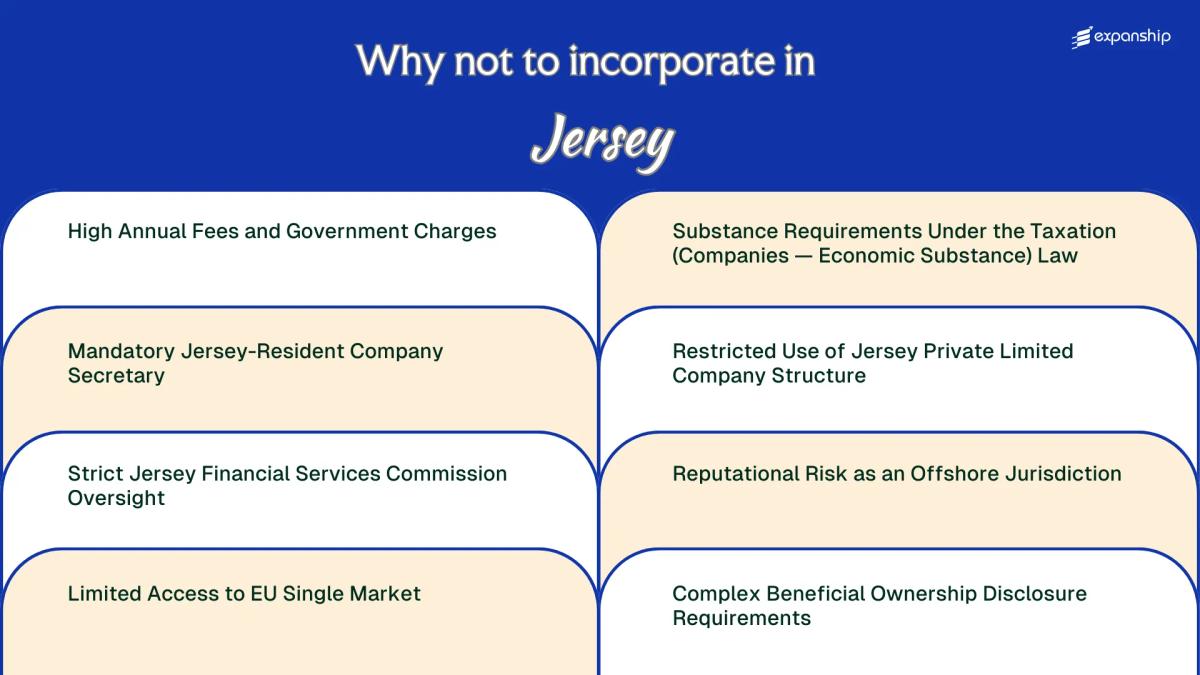
High Annual Fees and Government Charges
Jersey company annual fees drawbacks are a recurring concern for foreign owners, particularly those accustomed to the lower registry costs typical of onshore EU jurisdictions. The charges extend beyond a one-time incorporation fee and accumulate predictably each year.
Annual Registry Fees Administered by the Jersey Financial Services Commission
The Jersey Financial Services Commission (JFSC) administers the annual return and associated filing fees for all locally incorporated entities. A standard Jersey private company currently pays an annual return fee in the range of £300 to £500 depending on its share capital structure, a figure that sits above comparable costs in many onshore European registries.
For a lean foreign-owned holding entity generating no local revenue, this recurring charge represents a fixed operational cost that cannot be offset against any economic activity in the island.
The Cumulative Cost Burden on Passive Holding Structures
Registered office fees, nominee charges, and mandatory accounting obligations compound the base government charge. Your total annual compliance spend can reach several thousand pounds once professional service providers are engaged to satisfy JFSC requirements, even before substantive business activity begins.
Small or dormant entities bear these costs disproportionately, as the fees are not scaled against turnover.
A foreign owner maintaining a passive holding company in Jersey faces fixed annual government and professional fees that may exceed the operational value the structure provides in early or low-revenue years.
Mandatory Jersey-Resident Company Secretary
Jersey's company law requires that every company incorporated under the Companies (Jersey) Law 1991 appoints a secretary, and that role must be held by a person or entity with a physical presence in the jurisdiction. For a foreign business owner, this creates an immediate structural dependency on a local service provider before the company can operate.
This is not a formality you can fulfil remotely. The secretary must be resident or licensed in Jersey, which means you are required to engage a regulated corporate services provider, typically a firm licensed by the Jersey Financial Services Commission under the Financial Services (Jersey) Law 1998.
That ongoing engagement carries a recurring cost. The practical friction this creates includes:
- Annual retainer fees to a licensed provider that persist regardless of whether the company is actively trading
- Limited ability to switch providers without triggering administrative procedures and notifying the JFSC
- Contractual dependence on a third party for statutory filings, registered office maintenance, and record-keeping
- Reduced operational autonomy, as key compliance functions sit outside your direct control
Smaller entities with low turnover bear the same mandatory secretary costs as large structures, making the requirement disproportionately burdensome at early stages.

Company Incorporation in Jersey
Understand the full compliance requirements before incorporating in Jersey, including mandatory resident secretary obligations.
Strict Jersey Financial Services Commission Oversight
Jersey Financial Services Commission restrictions affect a wide range of business activities, not just those in banking or fund management. The JFSC operates under the Financial Services (Jersey) Law 1998, and its licensing requirements extend to trust company business, investment business, money service business, and more. If your company's activities fall within any regulated category, you must obtain a licence before operating, and that process involves detailed scrutiny of directors, shareholders, business plans, and financial projections.
| Requirement | Detail | Impact on Foreign Owner |
|---|---|---|
| Fit and Proper Assessment | All directors and controllers assessed individually | Delays incorporation timeline; rejects nominees |
| Minimum Capital Requirements | Varies by licence class; can reach £500,000+ | Ties up working capital before trading begins |
| Annual Compliance Return | Mandatory submission to JFSC each year | Requires local compliance expertise to complete accurately |
| Ongoing Regulatory Reporting | Ad hoc and periodic reporting obligations | Increases administrative cost and professional fees |
Even firms that do not require a licence face indirect JFSC oversight through regulated service providers, since your registered agent or trust company must itself hold a JFSC licence. That dependency means your service provider's own compliance obligations filter down to your entity, adding cost and procedural friction you have limited control over.
JFSC regulatory challenges become acute when your business model evolves. Expanding into a new regulated activity requires a licence variation, which restarts a formal review process. Jersey FSC regulatory challenges of this kind disproportionately affect foreign-owned businesses that lack embedded local compliance infrastructure.
Limited Access to EU Single Market
Jersey limited EU market access is a structural constraint, not a temporary regulatory gap. The island is a British Crown Dependency, not a member of the European Union, and it did not participate in the EU's internal market frameworks even before Brexit. Post-2020, the relationship between the UK and the EU has no direct bearing on Jersey's access either, meaning your entity cannot rely on any passporting rights or mutual recognition arrangements that EU-incorporated firms take for granted.
A company registered in Jersey cannot passport financial services into EU member states under MiFID II or equivalent directives. Each jurisdiction where you want to operate requires separate authorisation, which adds cost, legal complexity, and lead time that an EU-domiciled firm simply does not face.
For businesses targeting European customers at scale, this is a material limitation. Exporting goods or services from Jersey into the EU may trigger customs procedures, VAT registration obligations in EU member states, and compliance with local regulatory regimes on a country-by-country basis.
- No EU passporting rights apply to Jersey-registered financial services firms.
- Goods exported to EU member states are subject to EU customs and import VAT rules.
- Services provided into the EU may require country-specific licences or local entity registration.
- Jersey has no bilateral market access agreement with the EU covering financial services.
- VAT registration may be required separately in each EU country where you make taxable supplies.
Jersey adopted EU VAT rules for goods traded with the EU not as a member, but under its own customs arrangements, meaning a Jersey business can face EU import VAT obligations without having any EU membership protections in return.
Substance Requirements Under the Taxation (Companies — Economic Substance) Law
Jersey economic substance requirements challenges are among the more operationally demanding compliance obligations facing foreign-owned resident companies. Under the Taxation (Companies — Economic Substance) Law 2019, entities deriving income from certain "relevant activities" must demonstrate genuine substance on the island.
What the Law Requires of Your Business
Companies conducting relevant activities, which include holding company, finance and leasing, and intellectual property business, must satisfy a three-part substance test: adequate physical presence, locally qualified employees, and core income-generating activities conducted within the jurisdiction. This means your entity cannot be a letter-box structure administered from abroad, a common arrangement that foreign owners frequently rely on to reduce operational costs.
Why Meeting This Standard Creates a Real Burden
Hiring locally qualified staff and maintaining genuine office premises in Jersey generates recurring expenditure that would not arise in many comparable low-tax jurisdictions. The Jersey tax authority, the Taxes Office, enforces annual substance declarations, and a failure to satisfy the test can result in financial penalties, automatic information exchange with your home country's tax authority under OECD frameworks, and ultimately strike-off. IP-holding structures face the most stringent sub-test, as demonstrating local strategic decision-making over intangible assets is particularly difficult for foreign principals who retain effective control from overseas.
Substance Compliance Support for Jersey Companies
If your business conducts relevant activities under the Taxation (Companies — Economic Substance) Law 2019, understanding your obligations before incorporation can prevent costly penalties and regulatory exposure later.
Restricted Use of Jersey Private Limited Company Structure
Jersey private limited company restrictions apply to the types of activities and ownership arrangements the structure can support, and these constraints are frequently misaligned with the operational needs of internationally active businesses.
- A private limited company in Jersey cannot offer shares to the public, which prevents founders from using the structure to raise capital through public markets without a full restructuring into a different entity class.
- Bearer shares are prohibited under the Companies (Jersey) Law 1991 as amended, eliminating an ownership mechanism that some international investors specifically require for confidentiality or estate planning arrangements.
- Jersey LTD structure limitations mean the vehicle cannot carry on certain regulated activities, such as fund management or deposit-taking, without separate licensing from the Jersey Financial Services Commission, adding cost and time that some foreign operators do not anticipate at the formation stage.
- A private company is restricted to no more than 30 shareholders in certain contexts, which constrains equity distribution for firms planning multi-party joint ventures or employee share schemes.
Reputational Risk as an Offshore Jurisdiction
Jersey offshore jurisdiction reputational risk is a practical concern that affects how banks, counterparties, and institutional investors respond to your entity. Despite holding a strong AA- sovereign credit rating and operating under a well-regulated financial framework, the island is still categorised by many external bodies alongside traditional tax havens.
The OECD and EU institutions have historically scrutinised low-tax Crown Dependencies. Your firm may face enhanced due diligence requirements from correspondent banks or partner institutions simply because of where it is registered, regardless of its actual activities.
This offshore Jersey company stigma can translate into delayed account openings, additional compliance documentation, and reduced appetite from EU-based lenders or institutional partners. Some counterparties apply blanket restrictions on entities incorporated in Crown Dependencies.
- Certain EU payment processors decline firms registered in offshore jurisdictions by policy
- US-based institutional investors may apply additional FATF-related screening to Jersey-registered entities
- Partner businesses in regulated industries sometimes require jurisdiction disclosure upfront
A foreign-owned trading company incorporated in Jersey seeking a euro-denominated bank account through a German correspondent bank could face three to six months of additional due diligence, requiring legal opinions and substance evidence, before the account is opened, adding an estimated €4,000 to €8,000 in professional fees alone.
Complex Beneficial Ownership Disclosure Requirements
Jersey beneficial ownership disclosure requirements extend beyond simple registration. Under the Beneficial Ownership (Companies) (Jersey) Law 2023, all companies must maintain accurate, up-to-date beneficial owner information with the Jersey Financial Services Commission, and this data is shared with law enforcement and certain competent authorities.
For foreign business owners, the exposure is not merely administrative. Structures involving layered ownership, nominee arrangements, or foreign holding companies trigger detailed disclosure obligations that require tracing ultimate beneficial owners to a natural person level, often demanding documentation your home jurisdiction may not ordinarily require.
Non-compliance carries serious consequences, including civil penalties and potential criminal liability. The burden of ongoing maintenance means any change in ownership structure, even a minor equity transfer, must be promptly reflected in the register.
Delays or inaccuracies in beneficial ownership transparency Jersey records are treated as regulatory failures, not clerical oversights. This creates a compliance discipline that many foreign owners underestimate until enforcement begins.
- Disclosure applies regardless of company activity level
- Foreign nominee or trust arrangements require full UBO tracing
- JFSC retains authority to investigate and sanction non-compliant entities
If your ownership structure involves trusts, nominees, or foreign holding vehicles, Jersey UBO register compliance requires tracing through every layer to identify the ultimate natural person, and failure to do so accurately exposes your entity to criminal sanction under Jersey law.
Navigating These Incorporation Challenges
Navigating Jersey incorporation challenges begins with understanding which structural and compliance obligations are fixed requirements under Jersey law, not discretionary choices.
- Appoint a qualified, Jersey-resident company secretary to satisfy the residency requirement under the Companies (Jersey) Law 1991.
- Conduct a substance assessment before incorporation to determine whether your business activity triggers obligations under the Taxation (Companies — Economic Substance) (Jersey) Law 2019.
- Register beneficial ownership information accurately with the Jersey Financial Services Commission central register at the point of formation.
- Review whether your intended trading activities require a licence from the JFSC before submitting an incorporation application.
- Budget for annual government fees and ongoing JFSC charges at the outset, accounting for the full cost of maintaining a compliant Jersey entity.
- Assess your EU market access requirements separately, given that Jersey sits outside the EU Single Market and no passporting rights apply.
Each of these steps corresponds to a statutory obligation or structural constraint embedded in Jersey's regulatory framework. Treating them as fixed parameters rather than variables will produce a more accurate picture of the true cost and complexity of maintaining this type of entity.
Jersey's Overall Appeal for Business
Jersey's position as an international finance centre is well-established, underpinned by political stability, a mature legal system, and a zero percent corporate tax rate for most businesses. That said, the disadvantages covered in this blog are structural, not incidental, and they carry real cost and compliance implications for foreign-owned entities.
| Pros | Cons |
|---|---|
| Zero percent corporate tax rate applies to most Jersey-incorporated companies | Annual government fees and filing charges add meaningful ongoing cost |
| The Jersey Financial Services Commission enforces a well-regarded regulatory regime | JFSC oversight imposes licensing, filing, and conduct obligations that require active management |
| Jersey's legal framework is stable, with company law rooted in well-developed statute | A resident company secretary must be appointed, adding local operational dependency |
| No capital gains tax or withholding tax on dividends in most cases | Economic substance requirements demand genuine local activity for relevant sector businesses |
| Jersey operates outside the UK but maintains strong ties to English common law | Access to the EU single market is not available, limiting certain trade and service structures |
| Beneficial ownership registers are maintained by the Jersey Financial Services Commission | The jurisdiction's offshore profile generates reputational scrutiny in some banking and counterparty relationships |
For businesses in regulated sectors or those requiring EU market access, the compliance burden and structural limitations warrant careful assessment before committing to a Jersey structure.
Compliance Services for Companies in Jersey
Maintain good standing with the Jersey Financial Services Commission, meet economic substance obligations, and manage your annual statutory requirements.
Conclusion
The cons of Jersey company registration are real and structural, not incidental. Substance requirements under the Taxation (Companies — Economic Substance) Law demand genuine local activity, while JFSC oversight adds a layer of regulatory compliance that many firms underestimate at formation stage. Beneficial ownership disclosure obligations have also tightened considerably. For businesses without the operational footprint or budget to meet these demands, the jurisdiction presents material friction. Professional guidance specific to Jersey's regulatory framework remains a practical necessity before committing to incorporation.
Expanship's Jersey Incorporation Support
Expanship's Jersey incorporation support services are built around the specific compliance demands that make Jersey a complex jurisdiction to enter, from Jersey Financial Services Commission authorisation requirements to economic substance obligations under the Taxation (Companies — Economic Substance) Law. Our role is to reduce the administrative and regulatory burden your business carries at each stage, not to sidestep the rules that apply.
Expanship's service scope covers the full incorporation cycle and the ongoing obligations that follow.
- We prepare and submit company registration documents in accordance with Jersey's Companies Registry requirements.
- Our team provides a registered agent and registered office address to satisfy local presence obligations.
- We handle government filings and liaise directly with the JFSC and other relevant authorities on your behalf.
- Post-incorporation compliance management keeps your entity in good standing with annual obligations.
- We facilitate introductions to banking partners familiar with Jersey-incorporated structures.
- Tax registration and liaison with Jersey's Revenue Department are handled as part of your setup.
Reach out to Expanship Jersey to discuss your incorporation requirements.
Frequently Asked Questions (FAQ)
The Taxation (Companies — Economic Substance) (Jersey) Law 2019 applies to Jersey tax-resident companies carrying out specific "relevant activities," which include holding company business, finance and leasing, headquarters operations, and several others. Companies that do not conduct any of those defined activities are not subject to the full substance test, though they still fall under general Jersey tax and compliance obligations. If your business falls within a relevant activity category, you must demonstrate genuine local presence, including qualified staff and adequate expenditure in Jersey.
Failure to satisfy the substance requirements can result in financial penalties, with initial fines rising significantly for continued non-compliance, and the Comptroller of Revenue is empowered to exchange information with foreign tax authorities in the jurisdictions where beneficial owners are resident. Persistent non-compliance can ultimately lead to the company being struck off the register. The reputational damage from a substance failure disclosed to a foreign tax authority compounds the financial penalty substantially.
Annual government fees, registered agent costs, and the mandatory Jersey-resident company secretary together create a recurring cost base that is notably higher than many competing offshore jurisdictions. The Jersey Financial Services Commission charges annual confirmation statement fees that vary by company type, and regulated entities face additional supervisory levies. When professional service fees for substance compliance and local directorship arrangements are included, annual maintenance costs for a straightforward holding company can run into several thousands of pounds.
The JFSC is generally regarded as a more interventionist regulator than the registries of the British Virgin Islands or Cayman Islands, particularly for entities carrying out financial services activities. Jersey's regulatory framework aligns closely with IOSCO and FATF standards, which means ongoing compliance obligations are closer in intensity to an onshore financial centre than to a light-touch offshore registry. For purely passive holding structures, the difference is less pronounced, but any entity conducting fund administration, lending, or management activity will face a materially heavier compliance burden in Jersey.
Nominee arrangements do not exempt a company from Jersey's beneficial ownership regime. Under the Beneficial Ownership (Jersey) Law 2017, the ultimate beneficial owner must be identified and recorded in the central register maintained by the JFSC, regardless of whether legal title to shares is held by a nominee. The register is not fully public, but it is accessible to law enforcement and competent authorities, and the trend under international pressure is toward broader access over time.
Operating without a locally licensed company secretary in breach of Jersey's Companies (Jersey) Law 1991 and associated administrative requirements exposes the company and its officers to regulatory sanction by the JFSC, including financial penalties and potential licence revocation for any regulated activities the entity conducts. The JFSC has the authority to investigate and publicly censure non-compliant firms, which creates a disclosure risk beyond the financial penalty itself. Rectifying the breach retroactively does not automatically eliminate liability for the period of non-compliance.
The impact falls most heavily on businesses that relied on passporting rights or required EU regulatory authorisation to serve clients across member states. A Jersey holding company with no EU client-facing operations is largely unaffected in practical terms, whereas a Jersey-based fund or financial services firm that previously accessed EU markets through UK passporting arrangements now requires a separate EU-authorised entity to do so. Jersey has negotiated certain bilateral arrangements, but these do not replicate the breadth of access that EU membership or an EU-equivalent designation would provide.
Legal Disclaimer
The information provided in this article is for general informational purposes only and does not constitute legal, tax, or professional advice. While we strive to ensure the accuracy and timeliness of the content, laws and regulations are subject to change, and the application of laws can vary widely based on specific facts and circumstances.
Readers should not act upon this information without seeking professional counsel tailored to their individual situation. Expanship and its authors disclaim any liability for actions taken or not taken based on the content of this article.
For specific advice regarding your business setup, compliance requirements, or any legal matters, please consult with qualified legal and tax professionals in the relevant jurisdiction.