
Key Takeaways
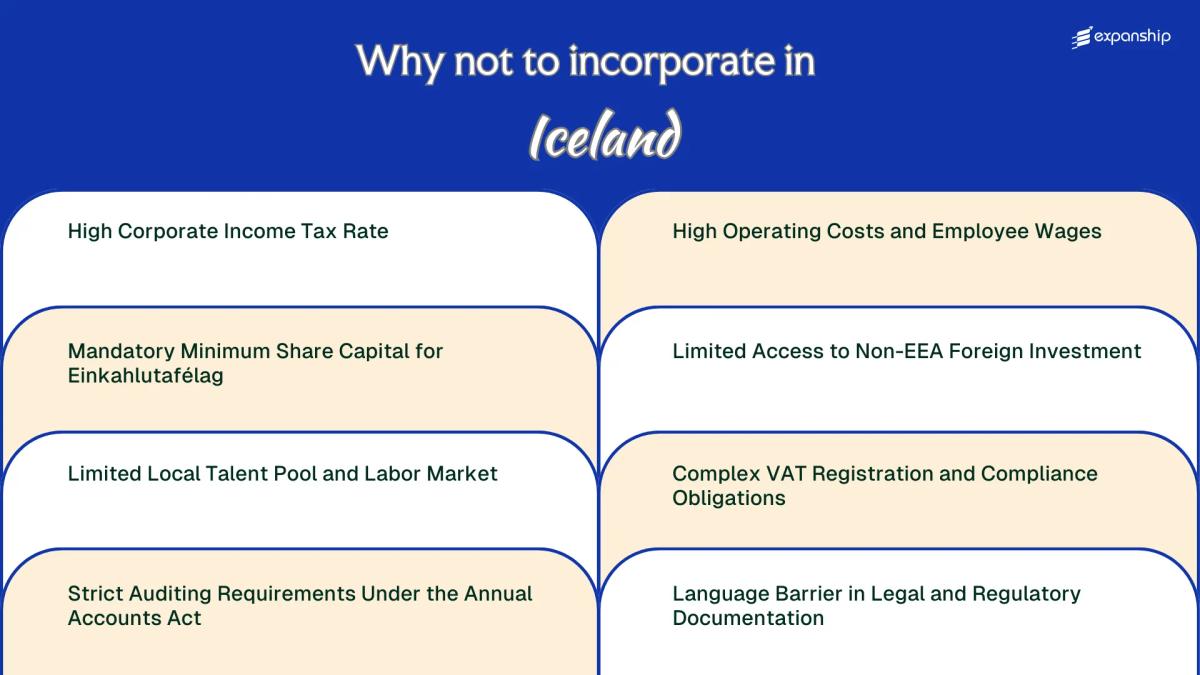
- Iceland's corporate income tax rate creates a meaningful cost burden for profitable entities, particularly when compared to lower-rate EEA jurisdictions competing for the same foreign investment.
- Under the Private Limited Companies Act (lög um einkahlutafélög), founders of an Einkahlutafélag must commit mandatory minimum share capital upfront, increasing the financial barrier to incorporation relative to jurisdictions with no such requirement.
- Compliance with Iceland's Annual Accounts Act imposes structured auditing obligations that add recurring administrative and professional costs, especially for smaller foreign-owned entities with limited local infrastructure.
- Operating costs in Iceland, including statutory employee wages and associated payroll obligations, are among the higher in the EEA, which compresses margins for businesses relying on local labor.
Iceland operates under a heavily regulated corporate framework, governed primarily by the Private Limited Companies Act (lög um einkahlutafélög) and administered through bodies such as the Directorate of Internal Revenue and the Companies Registry (Fyrirtækjaskrá). The Companies Act sets the foundational legal obligations for registered entities.
The disadvantages of incorporating in Iceland span several distinct categories, from tax exposure to compliance burdens and structural constraints. How significantly these affect your business depends on its size, industry, and the extent of its cross-border activity.
Foreign investors considering Iceland incorporation drawbacks should understand that a sole trader entering a low-margin service industry faces a materially different risk profile than a capital-intensive firm seeking EEA market access. This article is most relevant to non-Icelandic founders and foreign-owned entities planning to establish or relocate a business operation within the jurisdiction.
High Corporate Income Tax Rate
One of the more concrete Iceland corporate income tax drawbacks is the standard corporate rate of 20%, applied to the net profits of limited liability companies under the Income Tax Act (lög um tekjuskatt). While 20% sits below several Western European rates, it exceeds the EU average of around 21.3% only marginally — yet the absence of a territorial exemption system means foreign-sourced income can face taxation without the offsets available in more favorable regimes.
No Participation Exemption for Most Foreign Structures
Iceland does not operate a full participation exemption regime comparable to those in the Netherlands or Luxembourg, which routinely exempt dividend income and capital gains derived from qualifying foreign subsidiaries. For a holding company structure routing international profits through an Icelandic entity, this gap translates directly into a higher effective tax burden than the headline rate suggests.
Withholding Tax on Distributed Profits
Dividends paid to non-resident shareholders are subject to a 20% withholding tax under domestic rules, unless reduced by a bilateral tax treaty. Not all jurisdictions hold a treaty with Iceland, leaving non-treaty investors exposed to the full rate on profit repatriation.
Foreign shareholders in non-treaty jurisdictions face a combined corporate and withholding tax burden that materially erodes after-tax returns compared to treaty-protected structures.
Mandatory Minimum Share Capital for Einkahlutafélag
Einkahlutafélag minimum share capital requirements set the baseline cost of entry before your business earns a single krona. Under Icelandic company law, an ehf must be registered with a minimum share capital of ISK 500,000, which must be fully paid up at the time of incorporation.
That figure translates to roughly EUR 3,300 to EUR 3,500 depending on exchange rates, which is not trivial for early-stage ventures or founders testing a new market.
Unlike some EU member states that have moved toward symbolic minimum capital or eliminated the requirement entirely, Iceland maintains a hard statutory floor with no tiered or deferred payment option for private limited companies.
For a foreign business owner, this creates several layers of friction:
- Capital tied up at registration cannot be deployed for initial operating expenses, effectively splitting your setup budget before the entity is even active.
- Exchange rate exposure means the ISK-denominated requirement may cost more in your home currency than anticipated at the time of planning.
- If the entity is wound down early, recovering that capital through formal liquidation proceedings takes time and involves regulatory steps under Icelandic law.
- Non-resident founders must transfer funds internationally to meet the requirement, adding banking fees and potential compliance documentation from both ends.
The requirement applies uniformly regardless of business size or sector, with no reduced threshold for micro-enterprises or startups.

Einkahlutafélag Incorporation in Iceland
Set up your Icelandic private limited company with full support on share capital requirements, registration filings, and ongoing compliance.
Limited Local Talent Pool and Labor Market
Iceland's limited labor market challenges are immediate for any foreign business planning to hire locally. The country's total population sits at approximately 370,000, which places a hard ceiling on the available pool of qualified professionals across most specialised fields.
Sectors such as software engineering, financial services, and advanced manufacturing face acute shortages. Recruiting for mid-to-senior roles often means competing directly with established domestic employers, public institutions, and the growing tourism sector for the same narrow group of candidates.
| Constraint | Specific Burden |
|---|---|
| Total labor force size | Approximately 220,000 workers across all sectors |
| Non-EEA worker permit requirement | Work permits required via the Directorate of Immigration (Útlendingastofnun) |
| Processing time for non-EEA work permits | Typically 1 to 3 months, delaying operational timelines |
| Icelandic language requirements | Many administrative and regulated roles expect Icelandic proficiency |
When your business requires non-EEA talent to fill gaps, the permit process through Útlendingastofnun adds time and administrative overhead before a hire becomes operational. EEA nationals have easier access under freedom of movement, but the wider international talent pool remains restricted.
Collective wage agreements negotiated by trade unions, particularly under the ASÍ (Alþýðusamband Íslands) framework, further reduce flexibility in employment terms. Your firm has limited room to negotiate individual contracts outside agreed structures, which compounds the difficulty of attracting scarce specialists.
Strict Auditing Requirements Under the Annual Accounts Act
Iceland's Annual Accounts Act audit restrictions impose a statutory audit obligation on companies that exceed specific financial thresholds, and the cost and procedural burden this creates is a tangible drawback for foreign-owned entities.
Under the Annual Accounts Act, companies meeting two of three criteria — revenue above ISK 300 million, total assets above ISK 150 million, or more than 50 employees — are required to appoint a registered state-authorized auditor. Even smaller private limited companies (einkahlutafélög) may face mandatory audit requirements depending on their structure and investor composition.
Auditors in Iceland must be certified by the Auditing Board (Endurskoðandaráð), a regulatory body that governs professional standards. Foreign firms cannot simply appoint a preferred auditor from their home jurisdiction, which limits flexibility and adds local procurement costs.
Compliance with mandatory audit cycles also means your financial statements must be prepared to a prescribed standard before submission, extending reporting timelines considerably.
- Audits must be conducted by an Endurskoðandaráð-certified auditor; foreign-appointed auditors are not accepted
- Financial statements must be filed annually with Ríkisskattstjóri (the Directorate of Internal Revenue)
- Audit thresholds are assessed against three criteria; breaching two of the three triggers the obligation
- Audit fees in Iceland reflect a high-wage professional services market, increasing compliance overhead
Even a small einkahlutafélag with a single foreign shareholder may still be subject to audit obligations if its ownership structure connects it to a larger group that collectively meets the thresholds.
High Operating Costs and Employee Wages
Iceland high operating costs for businesses are among the most immediate financial pressures a foreign-incorporated entity will encounter, driven by some of the highest wage floors in Europe.
Wage Structures and Collective Agreements
Minimum wage levels in Iceland are not set by statute but are determined through collective agreements negotiated between trade unions and employer federations, with the Confederation of Icelandic Enterprise (SA) and the Icelandic Federation of Labour (ASÍ) setting the prevailing standards. These agreements are regularly renegotiated and carry broad legal force, meaning your business must comply regardless of sector or company size.
Overhead Beyond Payroll
Mandatory employer contributions to the national pension system under the Mandatory Pension Insurance Act add a further 11.5% of gross wages to your payroll costs. For a foreign firm staffing even a modest operation, this creates a structurally higher cost base than most comparable European jurisdictions, with limited room to offset expenses through lower base salaries.
Managing Business Cost Pressures When Incorporating in Iceland
Speak with our team about the financial obligations and overhead structures you should account for before establishing a company in Iceland.
Limited Access to Non-EEA Foreign Investment
Iceland non-EEA foreign investment restrictions create structural barriers that go beyond standard licensing requirements. Under the Act on Investment by Non-Residents in Business Enterprises (No. 34/1991), non-EEA nationals face ownership ceilings in specific sectors that EEA-based investors do not encounter.
- Non-EEA investors are prohibited from holding more than 25% ownership in Icelandic fishing companies, directly blocking access to one of the country's most economically significant industries.
- Ownership restrictions in geothermal energy and certain natural resource sectors limit the commercial viability of establishing a controlling stake as a non-EEA entity.
- Approval requirements from the Ministry of Industries and Innovation add an administrative layer that increases the time and cost of structuring your investment.
- The asymmetry between EEA and non-EEA investor treatment means your firm faces Iceland FDI restrictions that domestic or EU-based competitors are not subject to.
- These foreign ownership limitations apply regardless of the size or strategic intent of the investment, offering no threshold-based exemption for smaller transactions.
Complex VAT Registration and Compliance Obligations
Iceland VAT registration compliance challenges begin before your business generates its first króna of revenue. Any entity that supplies taxable goods or services domestically must register for virðisaukaskattur (VAT) with the Directorate of Internal Revenue (Ríkisskattstjóri) once projected or actual turnover exceeds ISK 1,000,000 in any twelve-month period.
The standard VAT rate is 24%, with a reduced rate of 11% applying to specific categories such as food and accommodation. Filing obligations are tied to a bimonthly reporting cycle, meaning your firm submits six returns per year, each requiring accurate input and output tax reconciliation.
For foreign businesses without resident accounting staff, maintaining this cycle adds recurring compliance costs. Errors in return submissions can trigger audits by Ríkisskattstjóri, which carries financial penalty exposure.
Non-resident entities supplying digital or electronic services to Icelandic consumers face additional registration obligations under the simplified registration scheme, separate from the standard domestic process.
A foreign-owned service firm billing ISK 4,000,000 annually across six bimonthly periods would owe approximately ISK 960,000 in output VAT at the 24% rate, while needing to track deductible input tax separately for each period — requiring either dedicated bookkeeping staff or paid local accounting support for every filing cycle.
Language Barrier in Legal and Regulatory Documentation
Íslenska is the official language of public administration, and the Iceland language barrier in regulatory documentation creates a concrete operational burden for foreign-owned entities. Filings submitted to Fyrirtækjaskrá (the Companies Registry) and the Ríkisskattstjóri (Directorate of Internal Revenue) are processed in Icelandic, meaning your legal documents, articles of association, and statutory submissions must conform to Icelandic-language requirements.
Certified translation is not simply an administrative formality. Any foreign-language document that forms part of a statutory submission typically requires professional legal translation, generating recurring costs that compound across annual filings, audits, and regulatory correspondence.
Contractual documents, employment agreements, and shareholder resolutions drafted in English carry legal ambiguity until rendered into Icelandic for domestic enforcement purposes. For a foreign director managing the firm remotely, this creates a structural dependency on local legal counsel for routine compliance tasks.
- Statutory filings with Fyrirtækjaskrá require Icelandic-language documentation
- Tax correspondence with Ríkisskattstjóri is conducted in Icelandic
- Employment contracts and board resolutions face enforceability risks if not properly translated
Even if your business operates entirely in English internally, all formal submissions to Icelandic public authorities must comply with Icelandic-language requirements, meaning no regulatory filing is exempt from this obligation regardless of the company's foreign ownership structure.
Overcoming Incorporation Challenges in Iceland
Overcoming Iceland incorporation challenges requires structural preparation before the company formation process begins, not adjustments made after problems emerge. The disadvantages covered in this blog are addressable, but each requires deliberate engagement with specific regulatory requirements.
- Register for VAT through Skatturinn (the Icelandic Tax Authority) before commencing taxable operations to avoid non-compliance penalties.
- Meet the ISK 500,000 minimum share capital requirement for an Einkahlutafélag at the time of incorporation, as late correction is not permitted under the Private Limited Companies Act.
- Engage a certified auditor approved under the Annual Accounts Act if your firm meets the statutory thresholds triggering mandatory audit obligations.
- Structure foreign ownership through an EEA-based holding entity to reduce exposure to restrictions on non-EEA investment in certain regulated sectors.
- Retain a certified Icelandic translator for all legal filings submitted to Fyrirtækjaskrá, the Companies Registry.
These steps operate within a unified regulatory framework administered across Skatturinn, Fyrirtækjaskrá, and sector-specific authorities. Managing Iceland business registration drawbacks depends on understanding how these bodies interact before, not after, the entity is established.
Iceland's Overall Business Appeal
Iceland presents a credible incorporation destination for foreign businesses, but the Iceland business environment limitations documented in this blog are structural rather than incidental. High operating costs, a constrained labor market, and layered compliance obligations under Icelandic law are material factors that shape the realistic cost of doing business here.
| Pros | Cons |
|---|---|
| EU/EEA market access through the European Economic Area agreement | Corporate income tax rate of 20% applies to resident companies |
| Stable regulatory environment with transparent legal institutions | Einkahlutafélag requires a minimum share capital of ISK 500,000 |
| Strong digital infrastructure supporting remote business operations | Annual Accounts Act imposes mandatory audit requirements on qualifying entities |
| Strategic geographic position between North America and Europe | High wage levels and a small domestic labor pool limit local hiring options |
| Recognized as a low-corruption, rule-of-law jurisdiction | VAT registration and filing obligations carry strict deadlines under the Revenue and Customs directorate |
Regulatory documentation, including filings with Fyrirtækjaskrá, is conducted in Icelandic, which creates a practical barrier for foreign directors and shareholders. Your firm will need qualified local support to remain compliant with statutory obligations.
Company Compliance Services in Iceland
Meet your ongoing statutory obligations in Iceland, from annual accounts and audit requirements to VAT filings and regulatory reporting with Icelandic authorities.
Conclusion
An Iceland company incorporation summary must account for a regulatory environment that imposes real structural costs on foreign and domestic founders alike. The mandatory minimum share capital for an Einkahlutafélag, the 20% corporate income tax rate, and the compliance obligations under the Annual Accounts Act each represent concrete operational commitments rather than abstract risks. Tight labor market conditions compound these pressures for firms dependent on specialist hiring. Understanding the full scope of these factors before committing to a structure is where precise, jurisdiction-specific guidance becomes material.
Expanship's Iceland Incorporation Support
Incorporating in Iceland brings genuine administrative weight. From the share capital requirements under the Companies Act for an Einkahlutafélag to VAT registration obligations managed through the Directorate of Internal Revenue, the compliance demands are specific and ongoing. Expanship's Iceland incorporation support helps your business manage these regulatory obligations without absorbing them entirely into your internal operations.
Expanship works with businesses at every stage of the incorporation process and beyond.
- Your company registration and document preparation are handled with accuracy and in line with Icelandic requirements.
- A registered agent and local office address are provided to satisfy legal presence obligations.
- Government filings and liaison with Icelandic regulatory bodies are managed on your behalf.
- Post-incorporation compliance management keeps your entity in good standing over time.
- Banking introductions connect your business with suitable financial institutions in Iceland.
- Tax registration and coordination with local authorities are facilitated from the outset.
Reach out to Expanship Iceland to discuss your incorporation requirements.
Frequently Asked Questions (FAQ)
The ISK 500,000 minimum share capital requirement applies specifically to the Einkahlutafélag (Ehf), Iceland's private limited liability company. Public limited companies, known as Hlutafélag (Hf), carry a significantly higher threshold. If your intended structure does not require limited liability, other forms exist, but the Ehf is the standard vehicle for foreign investors, making this requirement practically unavoidable for most incorporation scenarios.
Failure to meet auditing and filing obligations under the Annual Accounts Act can result in administrative sanctions issued through the Directorate of Internal Revenue and, in serious cases, referral to the Register of Enterprises for enforcement action. Companies that repeatedly miss statutory deadlines risk deregistration. The severity scales with the duration of non-compliance, not just the single instance of failure.
Iceland's total population sits below 380,000, which creates a structurally constrained labor market regardless of economic conditions. Specialized roles in finance, technology, and engineering are particularly difficult to fill locally, and competition from established domestic firms intensifies that pressure. Relying on foreign recruitment adds immigration processing timelines and relocation costs that smaller entities may not budget for at the outset.
Businesses with annual taxable turnover exceeding ISK 2,000,000 are required to register for VAT with the Directorate of Internal Revenue in Iceland. The standard VAT rate is 24%, with a reduced rate of 11% applying to specific categories such as accommodation and food. Once registered, you face recurring filing obligations that require either in-house accounting capability or an external compliance provider, both of which carry cost implications in a high-wage market.
You cannot fully avoid it. Official filings with Fyrirtækjaskrá, Iceland's company registry, and regulatory submissions to bodies such as the Financial Supervisory Authority (FME) are conducted in Icelandic. While some government agencies provide English-language guidance, the binding legal documents, articles of association, and statutory forms must conform to Icelandic requirements. This means ongoing reliance on qualified local legal counsel or a licensed agent, which adds to your operational overhead.
Iceland is a member of the European Economic Area (EEA), which grants access to the EU single market for goods, services, capital, and persons under the EEA Agreement. However, Iceland falls outside the EU Customs Union, which means goods crossing between Iceland and EU member states are subject to customs formalities. For service-based businesses, the EEA membership largely neutralizes this gap, but for product-oriented firms, the customs layer adds friction that a Dublin or Amsterdam-incorporated entity would not face.
Iceland consistently ranks among the highest-cost labor markets in Europe, with average gross wages substantially above the EU average and no statutory national minimum wage set by legislation, as pay floors are instead determined through collective bargaining agreements. These collectively agreed minimums are legally binding and regularly revised upward through negotiations between trade unions and employer federations. For a foreign business accustomed to lower-cost markets, the wage structure alone can make Iceland operationally expensive before factoring in social security contributions and mandatory pension fund payments.
Legal Disclaimer
The information provided in this article is for general informational purposes only and does not constitute legal, tax, or professional advice. While we strive to ensure the accuracy and timeliness of the content, laws and regulations are subject to change, and the application of laws can vary widely based on specific facts and circumstances.
Readers should not act upon this information without seeking professional counsel tailored to their individual situation. Expanship and its authors disclaim any liability for actions taken or not taken based on the content of this article.
For specific advice regarding your business setup, compliance requirements, or any legal matters, please consult with qualified legal and tax professionals in the relevant jurisdiction.