
Key Takeaways
- Iceland's 20% corporate tax rate, administered through the unified registry at Skatturinn, sits below the rates of several comparable Northern European EEA members, reducing the baseline tax burden for foreign-owned entities from the point of incorporation.
- The Einkahlutafélag structure established under the Companies Act no. 138/1994 gives foreign investors a limited liability vehicle with a legally familiar design that does not require adapting to an unfamiliar or jurisdiction-specific corporate form.
- Access to Iceland's network of double taxation treaties means cross-border income flows between Iceland and treaty partner countries are subject to reduced withholding obligations, a material advantage for businesses operating across multiple jurisdictions.
- Because Skatturinn consolidates both company registration and tax enrollment into a single administrative process, businesses avoid the fragmented multi-agency filing sequences common in other EEA jurisdictions.
Iceland is an independent sovereign nation situated in the North Atlantic, positioned between continental Europe and North America. Company registration is administered by Fyrirtækjaskrá, the Companies Registry operated under the Icelandic Revenue and Customs (Skatturinn). Foreign businesses establishing a presence here most commonly do so through an Einkahlutafélag.
The country operates a low-tax regime with a corporate tax rate that remains competitive relative to neighboring European economies. Foreign ownership of Icelandic companies is generally permitted, and the regulatory environment does not impose blanket restrictions on foreign direct investment across most sectors, making the benefits of incorporating in Iceland accessible to international founders and institutional investors alike.
Skatturinn maintains a unified registry that handles both tax enrollment and company registration, reducing administrative fragmentation from the outset. Your business is treated, in principle, on terms comparable to domestically owned entities. This article examines the concrete advantages that Iceland company formation offers across legal, financial, geographic, and operational dimensions.
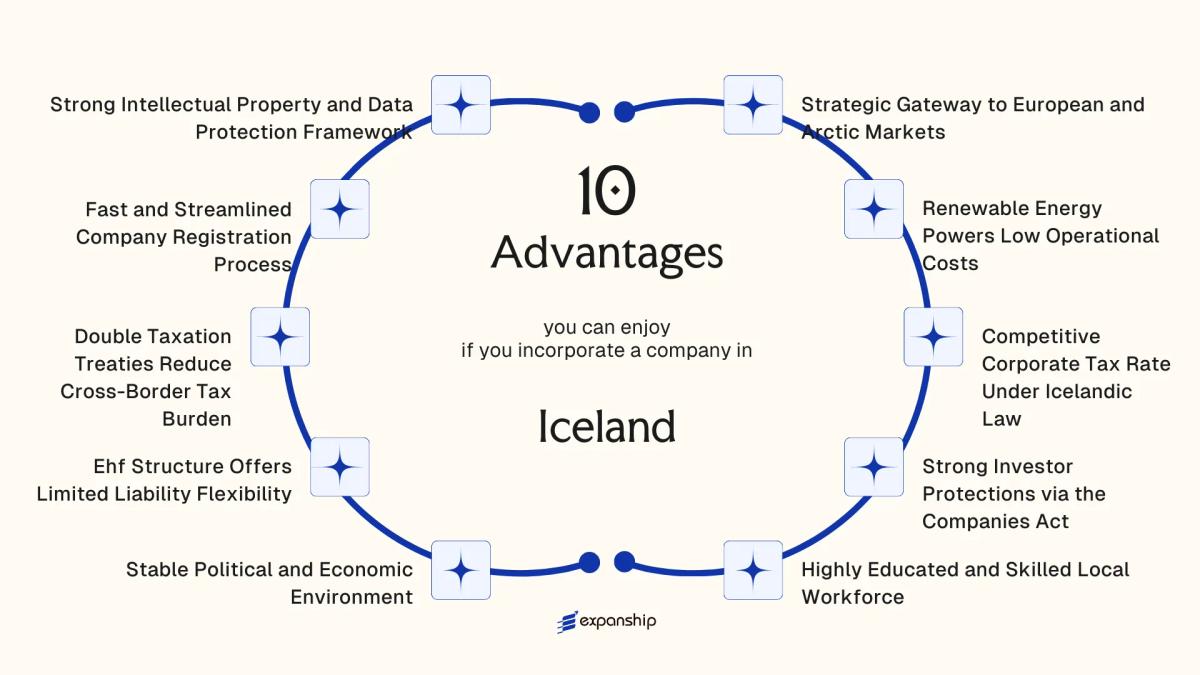
Strategic Gateway to European and Arctic Markets
Iceland's position as an Iceland gateway to European Arctic markets is built on geography and treaty architecture, not just proximity. Membership in the European Economic Area under the EEA Agreement grants Icelandic-registered entities access to the EU single market without EU membership obligations.
EEA Membership Without EU Constraints
Your business can sell goods and services across 30 EEA countries under single market rules, without needing a separate EU entity. This access operates through the EEA Agreement, which Iceland signed in 1994, covering free movement of goods, services, capital, and persons.
Regulatory compliance with EEA standards is generally sufficient for market entry across member states, removing the cost and administrative burden of duplicating registrations in multiple jurisdictions.
Arctic Positioning as a Commercial Corridor
Reykjavik sits within a five-hour flight radius of both North American and Northern European commercial centers. For firms operating in Arctic resource sectors, subsea infrastructure, or transatlantic logistics, this geographic position reduces transit times and operational coordination costs in ways that Central European bases cannot replicate.
An Icelandic entity gives you single-market access across 30 EEA countries while positioning your operations at the intersection of European and North American commercial routes.
Renewable Energy Powers Low Operational Costs
Approximately 97% of Iceland's electricity comes from renewable sources, primarily geothermal and hydropower. For energy-intensive businesses, this translates directly into some of the lowest industrial electricity prices among OECD nations. That cost differential is not incidental — it is structural, and it persists regardless of global fossil fuel price fluctuations.
Geothermal energy, drawn from the country's volcanic geology, supplies the majority of space heating nationally. Businesses operating physical facilities benefit from heating costs that are a fraction of what comparable firms pay in continental Europe. Combined with low electricity rates, total energy expenditure for manufacturing, data processing, or industrial operations is materially lower than in most Western European markets.
This cost profile is particularly relevant for sectors where energy is a primary operating expense:
- Data centre operators benefit from cool ambient temperatures that reduce cooling energy demands year-round
- Aluminium smelting and energy-intensive manufacturing face a structurally lower cost base than in fossil-fuel-dependent markets
- Server farms and AI compute businesses gain from pricing stability tied to renewable output rather than commodity markets
- Green-certified operations may qualify for preferential industrial tariffs under agreements with energy utility Landsvirkjun, Iceland's dominant power producer
Your company's energy contracts are typically negotiated directly with suppliers, and long-term fixed-rate arrangements are available for large consumers, providing operational cost predictability that variable energy markets cannot offer.

Company Incorporation in Iceland
Set up your Icelandic company with full compliance support across registration, documentation, and ongoing obligations.
Competitive Corporate Tax Rate Under Icelandic Law
Iceland's corporate income tax rate sits at 20%, applied to the worldwide income of resident companies. That figure is below the OECD average of approximately 23%, and meaningfully lower than the EU average, which has consistently hovered above 21%. For a foreign investor establishing a resident entity here, that gap translates directly into retained earnings that can be reinvested or repatriated.
| Tax Type | Rate | Applicable Base |
|---|---|---|
| Corporate Income Tax | 20% | Worldwide income (resident companies) |
| Withholding Tax on Dividends | 20% | Distributions to shareholders |
| Capital Gains Tax (companies) | 20% | Taxable gains on asset disposals |
| Branch Profit Tax | 20% | Net profits of registered branches |
Under the Income Tax Act (lög um tekjuskatt), resident companies are taxed on their global income, while non-resident entities are subject to tax only on Icelandic-source income. This distinction matters for structuring decisions: a branch of a foreign firm pays tax only on profits generated locally, whereas a fully incorporated subsidiary brings its worldwide income into scope.
The 20% rate applies uniformly across sectors, without a reduced rate for small businesses or an elevated rate for large ones. That flat structure gives your business predictable tax liability from the outset. Dividend distributions to shareholders are also subject to a 20% withholding tax, though treaty provisions can reduce that rate depending on the shareholder's country of residence.
Strong Investor Protections via the Companies Act
Iceland Companies Act investor protections are grounded in the Act on Public Limited Companies (No. 2/1995) and the Act on Private Limited Companies (No. 138/1994). These statutes codify specific rights for shareholders that cannot be waived by company articles, giving foreign investors a legally enforceable floor of protection from day one.
Minority shareholders are entitled by statute to request an extraordinary general meeting if they hold at least 10% of share capital. That threshold creates a direct mechanism to escalate governance concerns without relying on majority shareholder cooperation. Pre-emption rights on new share issuances are also codified, protecting your equity stake from dilution without your consent.
The Companies Registry operates under the supervision of the Ministry of Justice, and all registered filings are publicly accessible. Transparency at the registry level means you can audit ownership structures, directorship changes, and capital movements before entering any transaction.
Keep these points in mind:
- Minority shareholder meeting rights activate at 10% share capital ownership
- Pre-emption rights on new issuances are statutory, not optional
- Annual accounts must be filed with the Companies Registry within eight months of the financial year-end
- Directors owe fiduciary duties to the company under the same legislative framework
- Shareholder agreements must not conflict with mandatory statutory provisions to remain enforceable
Iceland's company legislation grants shareholders the right to appoint an independent auditor to review specific transactions, even when the board objects.
Highly Educated and Skilled Local Workforce
Iceland skilled workforce advantages for businesses extend well beyond raw literacy figures. The country consistently ranks among OECD nations with the highest tertiary education attainment rates, and its labor market is structured around a small but technically capable population of roughly 200,000 working-age individuals.
Education Attainment and Sectoral Depth
The University of Iceland and Reykjavik University produce graduates concentrated in engineering, computer science, marine sciences, and renewable energy. For a foreign firm establishing operations, this translates directly into a talent pipeline already oriented toward sectors where Iceland holds structural advantages. Hiring locally means fewer dependency on expatriate recruitment, which reduces both cost and administrative burden under the Foreigners Act No. 80/2016 governing work permit conditions for non-EEA nationals.
Icelandic workers also operate within a well-documented tripartite labor framework, where wage agreements are negotiated between the Confederation of Icelandic Employers (SA) and major trade union federations. This brings predictability to employment costs, which your business can plan around without exposure to unpredictable labor disputes.
Bilingual Competence and Digital Readiness
English proficiency across the working population is high, with the language used routinely in professional and technical environments. This reduces onboarding friction for foreign management teams. A significant portion of the tech sector workforce has direct exposure to international project environments, partly due to Iceland's participation in the European Economic Area and cross-border collaboration under EU research frameworks such as Horizon Europe.
Plan Your Market Entry Around Iceland's Human Capital
Speak with Expanship to understand how Iceland's workforce structure and employment framework align with your business model and hiring plans.
Stable Political and Economic Environment
Iceland's stable political environment for business is grounded in structural consistency rather than circumstance. The country has maintained an uninterrupted parliamentary democracy since 1944 under the framework of the Constitutional Act, with governance carried out through the Althingi, one of the oldest functioning parliaments in the world. For foreign investors, this continuity translates directly into policy predictability — a factor that affects everything from tax planning to long-term capital commitments.
- Transparency International consistently ranks Iceland among the lowest-corruption countries globally, which means regulatory decisions affecting your business are less likely to be subject to discretionary interference or informal pressure.
- The Icelandic Financial Supervisory Authority (Fjármálaeftirlitið) operates under a defined statutory mandate, giving regulated entities a clear and consistent oversight framework rather than an unpredictable enforcement environment.
- Iceland's membership in the European Economic Area through the EEA Agreement brings it within the scope of EU single market rules on trade and services, providing legal stability that mirrors EU member state conditions without full EU membership obligations.
- The króna's managed exchange rate regime and the Central Bank of Iceland's inflation-targeting policy provide a degree of macroeconomic predictability that supports multi-year financial planning for foreign-owned entities.
Ehf Structure Offers Limited Liability Flexibility
The Iceland Ehf limited liability company benefits foreign investors primarily through personal asset protection. Under the Companies Act No. 138/1994 (Einkahlutafélagalög), shareholders are not personally liable for the debts or obligations of the Einkahlutafélag. Your exposure is capped at the amount invested in the entity.
Minimum share capital for an Ehf is ISK 500,000. This fixed threshold means you can define your financial commitment upfront, with no obligation to inject additional capital beyond the registered amount if the business underperforms.
Ownership in an Ehf is represented by shares, which can be transferred or assigned subject to the rules set out in the company's articles of association. This gives investors control over exit conditions from the outset, rather than leaving succession or buyout terms to default statutory rules.
Single-person Ehf formation is permitted. One individual can act as both sole shareholder and director, making the structure practical for sole operators or holding entities without requiring multiple principals.
A sole foreign shareholder establishing an Ehf with ISK 500,000 (approximately EUR 3,400) holds 100% equity in a legally distinct entity. If the company incurs ISK 10,000,000 in liabilities, the shareholder's personal assets remain entirely outside the creditor's reach under the Einkahlutafélagalög.
Double Taxation Treaties Reduce Cross-Border Tax Burden
Iceland double taxation treaties benefits extend to a broad network of agreements that directly reduce withholding tax obligations on dividends, royalties, and interest paid across borders. These treaties follow OECD Model Convention principles, which means reduced source-country tax rates apply in predictable, standardized ways.
Your business benefits most visibly when repatriating profits or paying fees to parent entities abroad. Without treaty protection, source-country withholding rates can reach 20–25% in many jurisdictions. Treaty provisions typically reduce these rates to 0–15%, depending on the specific agreement and the nature of the payment.
Treaty coverage includes agreements with major trading partners across Europe and North America, giving foreign-owned Icelandic entities a structured framework for cross-border transactions. The treaties also govern permanent establishment definitions, which affects how your overseas activities are taxed at source.
Residency-based tax eligibility under Icelandic law follows the Act on Income Tax (Lög um tekjuskatt), and a company must qualify as tax-resident in Iceland to access treaty benefits. Shell or non-resident structures generally do not qualify.
Treaty benefits apply only to entities that are tax-resident in Iceland under domestic law; your company must have genuine economic substance to qualify under most agreements.
Fast and Streamlined Company Registration Process
Iceland's company registration advantages begin at the administrative level. The Companies Registry (Fyrirtækjaskrá), operated under the authority of the Directorate of Internal Revenue, processes private limited company (ehf) registrations electronically through a centralized online portal. This digital-first infrastructure means your entity can be legally constituted without requiring physical presence in the country.
Registration typically completes within a few business days once all documentation is submitted correctly. For a foreign investor, this speed has a direct operational consequence: your firm can begin contracting, opening bank accounts, and trading without the weeks-long administrative delays common in many EU member states.
The minimum share capital requirement for an ehf is ISK 500,000, which must be paid up at incorporation. That threshold is fixed by the Companies Act (lög um einkahlutafélög nr. 138/1994), giving you a predictable financial baseline rather than an open-ended capital commitment.
Key procedural features that reduce incorporation friction include:
- Electronic submission of the memorandum and articles of association through Fyrirtækjaskrá
- Company name reservation available prior to formal filing
- A single shareholder is sufficient to form an ehf, removing the need to source co-founders
- Directors and shareholders are not required to be Icelandic residents
Because the process is governed by a defined statutory framework rather than discretionary administrative review, approval timelines are consistent. A foreign business owner receives legal certainty on formation without depending on variable bureaucratic judgment, which directly reduces the cost and risk of market entry.
Strong Intellectual Property and Data Protection Framework
Iceland intellectual property protection benefits stem from the country's participation in major international IP conventions, including the Patent Cooperation Treaty (PCT) and the European Patent Convention (EPC). Through the EPC, patents validated in Iceland carry the same legal weight as those registered across participating European states, giving foreign firms a single-point entry into broad territorial coverage.
Copyright, trademark, and design rights are governed by domestic statutes that align with EU directives, even though Iceland is not an EU member state. This alignment occurs through the European Economic Area (EEA) Agreement, which incorporates the bulk of the EU's intellectual property acquis into Icelandic law. For a foreign business, this means IP protections are structurally comparable to what you would hold inside the EU, without requiring EU membership for your entity.
On data protection, the General Data Protection Regulation applies in Iceland via EEA incorporation, enforced by the Icelandic Data Protection Authority (Persónuvernd). Hosting or processing data through an Icelandic entity therefore satisfies GDPR compliance obligations for European operations. This matters particularly to firms handling customer data from EU member states, where non-compliance carries penalties of up to 4% of global annual turnover.
Key IP and data protection advantages for foreign entities include:
- PCT and EPC access without requiring EU incorporation
- GDPR applicability enforced through Persónuvernd, providing legal certainty for data-driven businesses
- Domestic trademark registration available through the Icelandic Intellectual Property Office (Hugverkastofan)
- EEA membership ensures ongoing harmonisation with EU IP directive updates
Why Iceland Stands Out Against Competing Jurisdictions
Compared against its Nordic neighbours, Iceland presents a distinct incorporation profile. Denmark, Norway, and Sweden are frequently evaluated by foreign investors alongside Iceland, given their shared regulatory traditions and EEA membership. The comparison is instructive: where those jurisdictions impose higher corporate tax rates and steeper administrative costs, Iceland's 20% corporate tax rate and geothermal-subsidised energy costs create a materially different cost structure for energy-intensive or IP-holding businesses. Iceland's EEA membership also replicates much of the EU single market access that competitors offer, without full EU membership obligations.
What the table below does not capture is the structural context: Iceland's privately held limited company, the Einkahlutafélag (Ehf), operates under the Companies Act No. 138/1994, and its registration process through Skatturinn (the Icelandic Revenue and Customs) carries no residency requirement for directors. That combination, accessible legal structure plus single-market access plus competitive operating costs, defines where Iceland sits relative to the comparison jurisdictions.
| Parameter | Iceland | Denmark | Norway | Sweden |
|---|---|---|---|---|
| Corporate Tax Rate | 20% | 22% | 22% | 20.6% |
| EEA Single Market Access | Yes | Yes (EU) | Yes | Yes (EU) |
| Director Residency Requirement | None | None | At least half must be EEA residents | At least one must be EEA resident |
| Primary Private Company Structure | Ehf | ApS | AS | AB |
| Geothermal/Renewable Energy Subsidy | Significant | Minimal | Moderate (hydro) | Moderate |
| Minimum Share Capital (Private Co.) | ISK 500,000 | DKK 40,000 | NOK 30,000 | SEK 25,000 |
Compliance Services for Companies in Iceland
Maintain good standing with Icelandic regulatory requirements, including annual filings with Skatturinn and the Companies Registry.
Conclusion
Iceland's combination of a 20% corporate tax rate, renewable-energy-driven operational cost advantages, and treaty-backed cross-border tax relief forms a coherent case for business registration that few Northern European jurisdictions can match on the same terms. The private limited liability company, established under the Companies Act no. 138/1994, gives foreign owners a structurally sound and legally familiar vehicle without requiring them to navigate unfamiliar corporate forms.
That said, the advantages of Iceland company formation are not uniformly applicable. Businesses with significant physical infrastructure needs, large local payroll requirements, or operations outside sectors where the ehf structure offers efficiency gains should assess fit carefully before committing.
For those whose business model aligns with what the jurisdiction offers, particularly in energy-intensive sectors, digital services, or transatlantic trade, the foundations are well-established. The legal framework is stable, the regulatory bodies are consistent in their application of the rules, and the company registration process is among the more administratively straightforward in the EEA. The next practical step is understanding how those structures apply to your specific entity type and operational model.
Start Your Icelandic Company Formation With Expanship
Expanship assists foreign founders and investors through Iceland company formation with Expanship handling the procedural requirements that sit between intent and a registered entity. The blog has outlined the advantages specific to the Einkahlutafélag structure, the tax treaty network, the Companies Act protections, and the filing processes managed through Fyrirtækjaskrá, the Companies Registry. Expanship's role is to translate those structural advantages into a functioning, compliant company without requiring you to interpret Icelandic administrative requirements independently.
From document preparation to post-registration obligations, the firm covers the full scope of what a foreign business owner needs to establish and maintain a legal presence:
- Document preparation, notarization, and legalization for Fyrirtækjaskrá submission
- Registered agent and local office address provision
- Government filing and direct liaison with the Companies Registry
- Post-incorporation compliance management, including annual reporting obligations
- Director and shareholder registry maintenance under the Companies Act
- Banking introduction assistance to support account establishment
Expanship Iceland services also extend to advising on the ongoing compliance calendar that Icelandic law imposes on private limited companies, including obligations to the Ríkisskattstjóri, the Directorate of Internal Revenue, relevant to corporate tax filings.
Reach out through Expanship Iceland to discuss your registration requirements.
Frequently Asked Questions (FAQ)
The standard corporate income tax rate in Iceland is 20%, which applies to resident companies including the Ehf structure. This rate is assessed on worldwide income for tax-resident entities and is administered by the Icelandic Tax Authority (Skatturinn). Certain deductions and treaty reliefs may reduce the effective rate depending on the nature of income and applicable double taxation agreements.
Registration through Fyrirtækjaskrá, the Icelandic Companies Registry operated under the auspices of the District Commissioner, can be completed within a few business days once all documentation is submitted in proper order. The process is conducted electronically, and the timeline is largely contingent on the accuracy and completeness of the founding documents. Delays generally arise from incomplete articles of association or missing identification documentation for directors.
Act No. 138/1994 includes provisions that protect minority shareholders from decisions that disproportionately disadvantage them relative to other shareholders. Minority shareholders retain rights to challenge resolutions that violate the Act or the company's articles of association through Icelandic courts. These protections are relevant for foreign co-investors structuring joint ventures with local partners through an Ehf.
Iceland has concluded double taxation treaties with a significant number of countries, reducing or eliminating withholding taxes on dividends, interest, and royalties paid to foreign residents. The applicable rate depends on the specific treaty in force between Iceland and the recipient's country of tax residence, and treaty benefits must generally be claimed through Skatturinn. Where no treaty exists, domestic withholding tax rates under Icelandic tax law apply by default.
Iceland is a member of the European Economic Area (EEA) through the EEA Agreement, which grants Icelandic-registered companies access to the EU single market for goods, services, capital, and persons without requiring EU membership. This means an Ehf incorporated in Iceland can, in principle, provide services and establish commercial relationships across EEA member states under the same regulatory framework as EU-based entities. The EEA Agreement does not, however, extend to EU customs union membership or all areas of EU trade policy.
Iceland generates the majority of its electricity from geothermal and hydroelectric sources, which results in comparatively low and stable industrial electricity prices relative to most European jurisdictions. For data centres and energy-intensive operations, this translates into meaningfully lower operational costs alongside alignment with sustainability reporting requirements increasingly mandated under EU and EEA frameworks. The cold climate also reduces cooling costs for server infrastructure, a practical consideration for businesses in that sector.
Legal Disclaimer
The information provided in this article is for general informational purposes only and does not constitute legal, tax, or professional advice. While we strive to ensure the accuracy and timeliness of the content, laws and regulations are subject to change, and the application of laws can vary widely based on specific facts and circumstances.
Readers should not act upon this information without seeking professional counsel tailored to their individual situation. Expanship and its authors disclaim any liability for actions taken or not taken based on the content of this article.
For specific advice regarding your business setup, compliance requirements, or any legal matters, please consult with qualified legal and tax professionals in the relevant jurisdiction.