

Key Takeaways
- Under Croatia's Zakon o trgovačkim društvima (Companies Act), a d.o.o. must meet the mandatory minimum share capital threshold before the Commercial Court Registry (Trgovački sud) will accept a registration application.
- Foreign investors are required to register beneficial ownership information in Croatia's BO registry as a condition of maintaining legal standing, not merely as a post-incorporation formality.
- Director residency rules established under Croatian law directly constrain how a foreign investor may structure the management of a Croatian subsidiary or branch.
- Incorporation applications submitted through HITRO.hr must satisfy documentary, structural, and capital requirements simultaneously, as incomplete compliance results in outright rejection of the filing.
Entity formation in Croatia is governed by the Companies Act, known locally as the Zakon o trgovačkim društvima, with the Commercial Court Registry (Trgovački sud) serving as the principal body responsible for company registration. Meeting the incorporation requirements in Croatia is a prerequisite for obtaining legal standing and conducting business within the country.
This article covers the structural, documentary, and compliance requirements that apply to entity formation, from capital thresholds to registered office obligations. Failure to satisfy these requirements results in rejection of the registration application or, in cases of post-incorporation non-compliance, potential legal liability and loss of operating authorisation.
Specific requirements vary depending on the entity type selected, the industry in which the business will operate, and whether the investor is a domestic or foreign national. Foreign investors, particularly those establishing a Croatian subsidiary or branch for the first time, are the primary audience for the requirements outlined here.
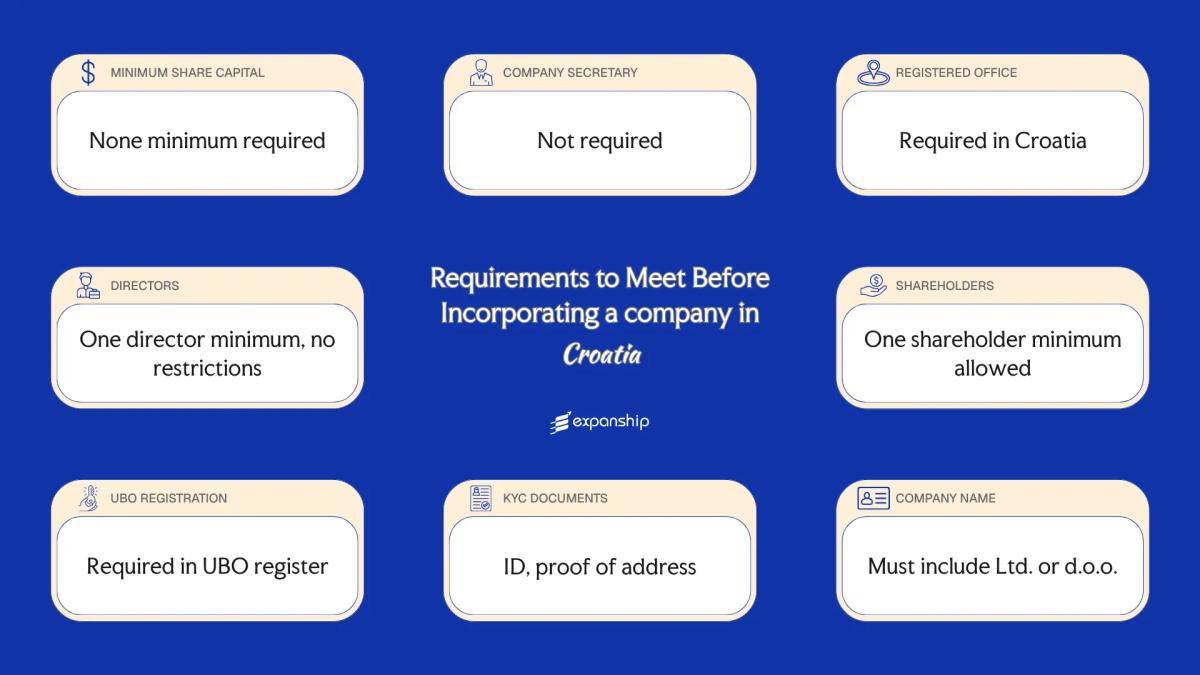
Minimum Share Capital Requirements in Croatia
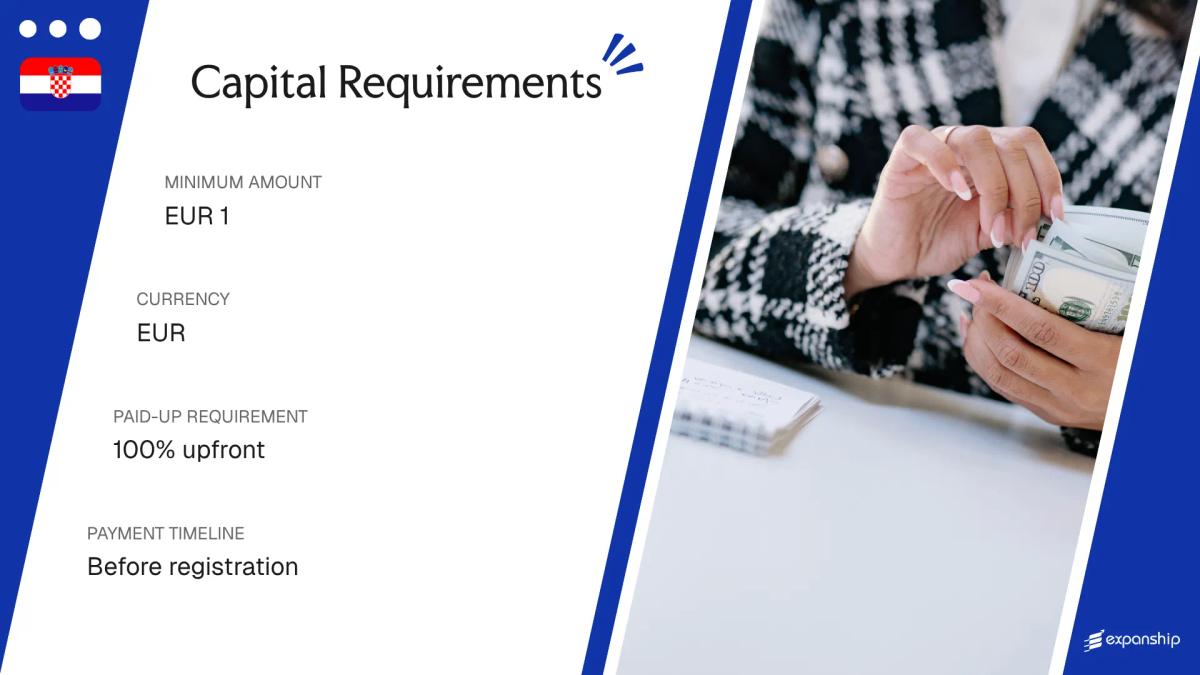
Croatia minimum share capital requirements apply specifically to the type of legal entity you form. For a društvo s ograničenom odgovornošću (d.o.o.), the Croatian Companies Act (Zakon o trgovačkim društvima) sets a statutory minimum that must be satisfied before registration is completed.
Capital is deposited into a temporary bank account prior to submission to the court registry. The Commercial Court (Trgovački sud) verifies that the capital requirement has been met as part of the incorporation process.
| Parameter | Detail |
|---|---|
| Minimum Authorized Share Capital | HRK 20,000 (approximately EUR 2,654 under the fixed conversion rate following euro adoption proceedings) |
| Maximum Authorized Share Capital | No statutory requirement |
| Minimum Paid-Up Capital | HRK 20,000 |
| Paid-Up Requirement at Incorporation | At least HRK 10,000 must be paid up prior to registration |
| Accepted Currency | Croatian Kuna (HRK); EUR accepted under transitional provisions |
| Accepted Forms of Contribution | Cash contributions; non-cash contributions subject to valuation |
| Timeframe to Deposit Capital | Prior to filing with the Commercial Court |
The minimum paid-up amount must be deposited into a temporary bank account before the incorporation application is submitted. Registration will not proceed without confirmation of this deposit.
Company Secretary Requirements in Croatia
Croatian law does not impose a company secretary requirement as a distinct mandatory corporate office for a d.o.o. (društvo s ograničenom odgovornošću). The company secretary requirements Croatia firms encounter are instead absorbed into the responsibilities of the management board (uprava) and any appointed prokura holders, who carry out administrative and compliance functions under the Companies Act (Zakon o trgovačkim društvima).
Certain administrative duties — including maintaining statutory records, filing changes with the court register (sudski registar), and ensuring regulatory correspondence is handled — fall to the appointed management rather than a separate secretarial officer.
Qualification criteria for those performing company secretarial functions in Croatia:
- No statutory minimum age is prescribed beyond general legal capacity under Croatian civil law.
- Both natural persons and legal entities may be appointed to hold prokura and carry out administrative duties.
- Non-residents may serve in administrative capacities; no local residency requirement applies to these roles.
- No professional licensing or mandatory certification is required to perform company secretarial functions.
- Directors themselves frequently absorb secretarial responsibilities without a separate appointment being necessary.

Incorporate a Company in Croatia
Set up your Croatian d.o.o. with full compliance support, from court register filing to post-incorporation administration.
Registered Office Requirements in Croatia
Registered office requirements in Croatia are governed by the Companies Act (Zakon o trgovačkim društvima), which obliges every limited liability company (d.o.o.) and joint-stock company (d.d.) to designate a registered seat (sjedište) at the time of incorporation. The address recorded with the court registry must correspond to an actual, identifiable location within the country.
- A physical address is required; a PO box alone does not satisfy the registered seat obligation.
- The address must be located within Croatia; a foreign address cannot serve as the registered seat.
- Virtual office addresses are generally accepted provided they correspond to a real, verifiable physical location accessible to official correspondence.
- Documentary evidence of the right to use the address, such as a lease agreement or proof of ownership, is typically required when registering or updating the seat.
- The registered seat is publicly listed in the court register (sudski registar) maintained by the Commercial Court, making it visible to third parties.
- Any change to the registered seat must be formally reported to the relevant Commercial Court through a registration amendment procedure; the change takes effect upon entry in the court register.
- Failure to maintain a valid, reachable registered seat can result in regulatory scrutiny and may expose the entity to enforcement action by the court registry authorities.
Director Requirements in Croatia
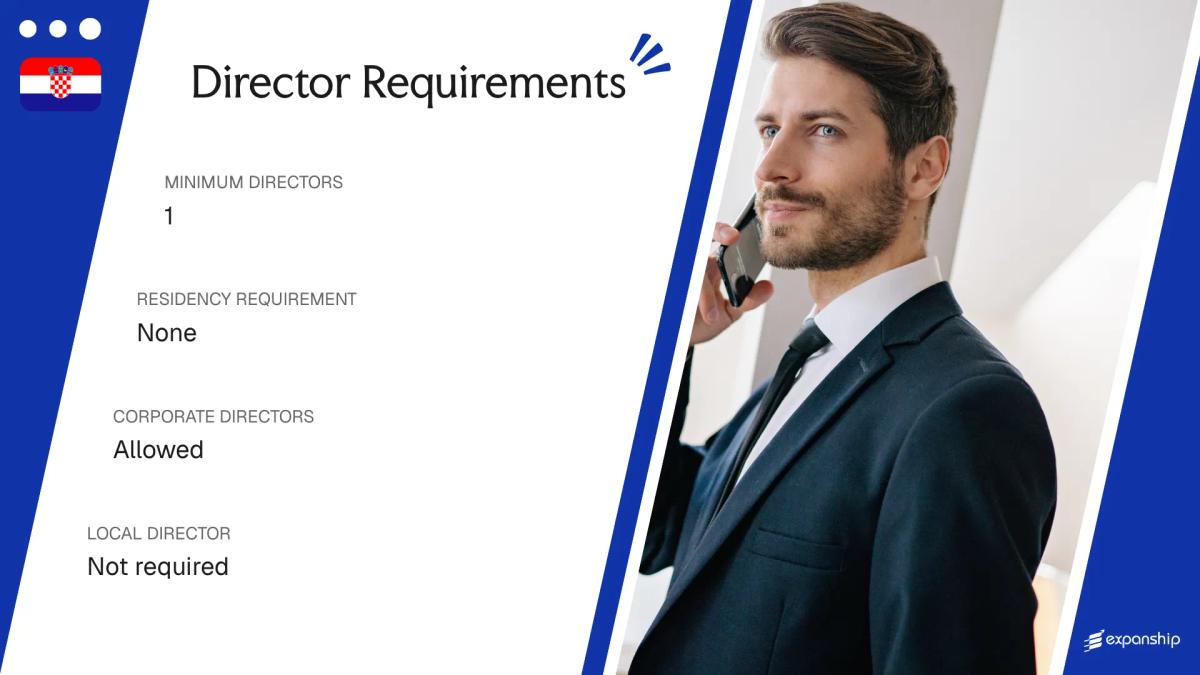
Under Croatian law, director requirements in Croatia are governed primarily by the Companies Act (Zakon o trgovačkim društvima), which imposes statutory duties of care, fiduciary responsibility, and liability for the lawful conduct of the company's affairs. Upon appointment, a director (uprava) of a d.o.o. assumes personal liability for damages arising from breach of those duties.
| Parameter | Detail |
|---|---|
| Minimum Number of Directors | One director is required for a d.o.o. |
| Maximum Number of Directors | No statutory maximum is prescribed for a d.o.o. |
| Local/Resident Director Required | No residency requirement exists under the Companies Act. |
| Nationality Restrictions | No nationality restrictions apply; foreign nationals may serve. |
| Minimum Age Requirement | Directors must be at least 18 years of age. |
| Corporate Directors Permitted | Corporate directors are not permitted; only natural persons may serve. |
| Director Must Be a Shareholder | No requirement for a director to hold shares in the entity. |
| Publicly Listed on Registry | Directors are publicly listed in the court register (sudski registar). |
| Disqualification Conditions | A person is disqualified if subject to a court-imposed prohibition on performing business activities under the Companies Act. |
Despite having no residency requirement, a director's name and personal details are fully visible on Croatia's publicly searchable court register, making director information more transparent than in many comparable EU jurisdictions.
Shareholder Requirements in Croatia
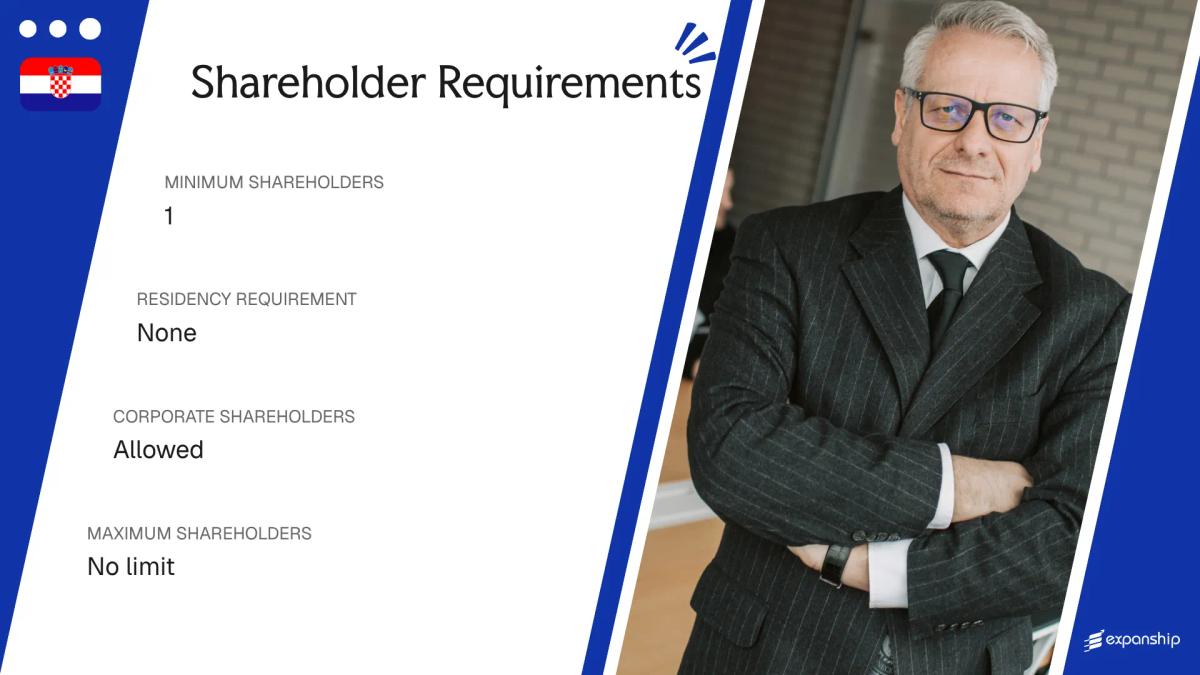
A Croatian limited liability company (d.o.o.) requires at least one shareholder, meaning a sole shareholder structure is fully permitted under the Companies Act (Zakon o trgovačkim društvima). There is no statutory maximum on the number of shareholders.
Nationality and Residency Restrictions
Shareholder requirements in Croatia impose no nationality or residency conditions on individual shareholders. Foreign nationals and non-residents may hold shares without restriction, and there is no cap on foreign ownership percentage in a d.o.o.
Corporate Shareholders
Legal entities, including foreign corporations, may act as shareholders in a Croatian d.o.o. No special conditions are attached solely by virtue of the shareholder being a corporate body rather than a natural person.
Shareholder Liability
Liability is limited to each shareholder's capital contribution. Under the Companies Act, personal assets are generally not exposed to company obligations, though courts may pierce the corporate veil in cases of abuse of the legal form.
Register of Shareholders
Each d.o.o. must maintain an internal register of shareholders. This record is not publicly accessible through the court register, though ownership data disclosed to the Financial Agency (FINA) may reflect shareholding changes following structural amendments.
Structuring Your Shareholder Setup for Croatian Incorporation
Get guidance on meeting shareholder obligations when forming a company in Croatia, from ownership structure to compliance with local corporate law.
UBO / Beneficial Ownership Registration Requirements in Croatia
UBO registration requirements Croatia are governed by the Act on Prevention of Money Laundering and Terrorist Financing (ZPNFT), which defines a beneficial owner as any natural person holding more than 25% of shares or voting rights, or otherwise exercising ultimate control over a legal entity.
- Identify all natural persons meeting the 25% ownership or control threshold prior to registration.
- Submit beneficial ownership data to the Court Register (Sudski registar) as part of the company formation filing.
- Provide full name, date of birth, nationality, and country of residence for each UBO.
- Report any changes in beneficial ownership to the Court Register within eight days of the change occurring.
- Retain supporting documentation internally to substantiate the disclosed information.
| Parameter | Detail |
|---|---|
| Ownership Threshold for UBO Status | Above 25% of shares, voting rights, or equivalent control |
| Filing Authority | Court Register (Sudski registar) |
| Disclosure Deadline at Incorporation | At the time of company registration |
| Publicly Accessible Register | Yes, the Court Register is publicly accessible |
| Penalties for Non-Disclosure | Administrative fines applicable under the ZPNFT |
| Ongoing Update Obligation | Changes must be reported within eight days |
KYC / Document Requirements in Croatia
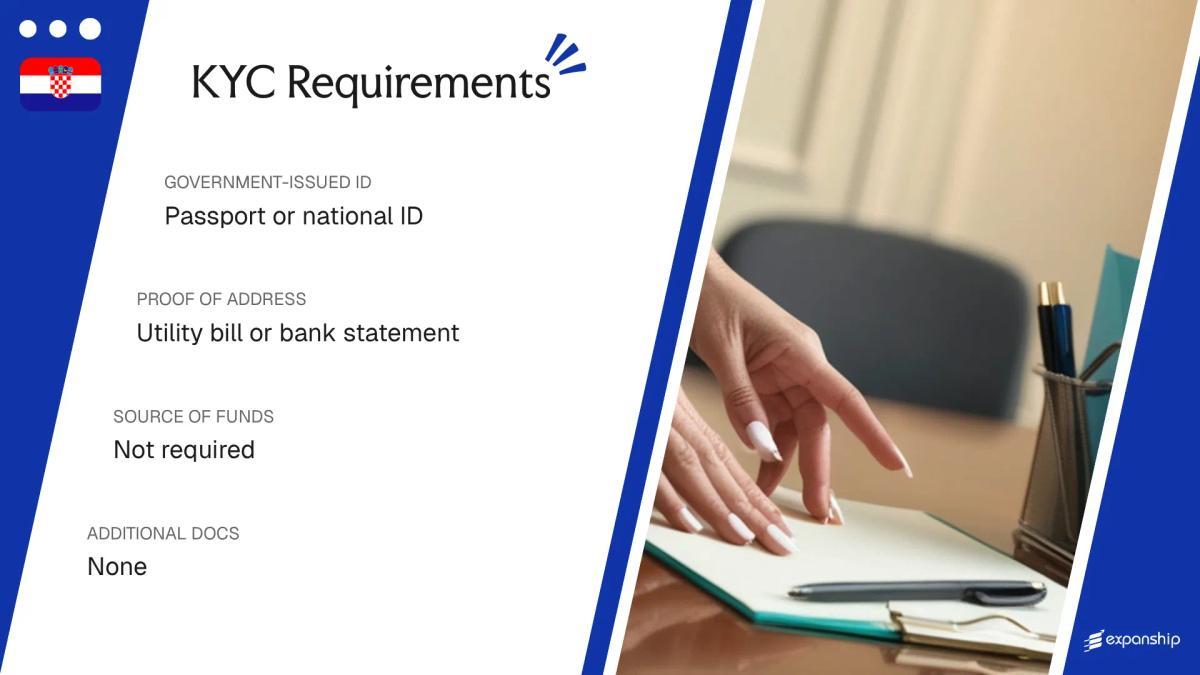
KYC document requirements Croatia are governed primarily by the Anti-Money Laundering and Counter-Terrorist Financing Act (Zakon o sprječavanju pranja novca i financiranja terorizma), administered by the Anti-Money Laundering Office (Ured za sprječavanje pranja novca). All parties with a qualifying interest in the entity must be verified before registration is completed.
Individual / Personal Documents
- Valid government-issued photo ID (passport or national identity card) for each director, shareholder, and beneficial owner
- Proof of residential address dated within the last three months, such as a utility bill or bank statement
- Completed and signed personal data form, as required by the notary handling the incorporation
- Tax identification number, where already issued by the relevant home jurisdiction
Corporate Documents
- Certificate of incorporation or equivalent constitutional document from the shareholder entity's home jurisdiction
- Articles of association or statutes of the corporate shareholder
- Current register of directors and shareholders of the corporate entity
- Proof of the corporate entity's registered address
Source of Funds Documentation
- Bank statements covering a minimum of three months prior to incorporation
- Audited financial statements, where the subscribing entity or individual is subject to audit requirements
- A signed declaration of the origin of capital, if bank statements are insufficient to evidence the source
Notarisation and Apostille Requirements
- Foreign public documents must carry an Apostille under the 1961 Hague Convention, unless a bilateral treaty exempts the issuing country
- All documents not in Croatian must be accompanied by a certified translation prepared by a court-sworn translator (sudski tumač)
- Notarisation of the founding act (osnivački akt) before a Croatian civil-law notary (javni bilježnik) is mandatory for d.o.o. formation
The most common cause of registration delay is submitting foreign corporate documents without a valid Apostille or a certified Croatian translation.
Company Name Requirements in Croatia
Company name requirements in Croatia are assessed by the court registry at the point of incorporation. The proposed name must be distinguishable from existing registered entities and must not mislead the public about the nature or scope of the business.
Names must be written in the Croatian language using the Latin script. A mandatory legal suffix indicating the entity type, such as d.o.o. for a private limited liability company, must appear in the name.
Certain words are restricted from use without prior approval from the relevant authority. Terms referencing state institutions, financial regulators, or international organisations generally fall into this category.
Name reservation is available prior to incorporation. Once reserved, the name is held for a defined period, after which it lapses if the registration process is not completed.
Compliance Services for Companies in Croatia
Maintain your Croatian entity's standing with ongoing compliance support, from annual filings to statutory obligations.
Conclusion
Croatia company incorporation requirements span multiple regulatory areas, each governed by the Companies Act and administered through HITRO.hr and the court registry system. Among the requirements covered, the mandatory HRK-equivalent minimum share capital for a d.o.o. and the obligation to register beneficial owners in the BO registry carry particular weight for foreign investors. Director residency rules also affect how your firm structures its management. Once these obligations are understood, the practical next step is engaging a local service provider familiar with Croatian registry procedures to move from compliance planning to formal registration.
Expanship's Corporate Services for Croatia Expansion
Incorporating in Croatia involves specific obligations under the Companies Act (Zakon o trgovačkim društvima), from maintaining a registered seat to meeting UBO registration requirements with FINA. Expanship supports your Croatia corporate services expansion by handling the procedural groundwork these obligations generate, so your team can focus on the business itself rather than the administration surrounding it.
Expanship's service scope covers the full formation and maintenance cycle for entities in Croatia:
- Your company is registered with supporting documents prepared to meet Croatian notarial and court registry standards.
- A registered agent and compliant office address are provided to satisfy the registered seat requirement.
- Filings with the Commercial Court Registry and relevant regulatory bodies are handled on your behalf.
- Ongoing compliance obligations are managed after incorporation to keep your entity in good standing.
- Introductions to local banking relationships are facilitated to support your operational setup.
- Tax registration and coordination with the Tax Administration (Porezna uprava) are arranged for your business.
Reach out to Expanship Croatia to discuss your incorporation requirements.
Frequently Asked Questions (FAQ)
Failure to register beneficial ownership information with the Register of Beneficial Owners, maintained by the Financial Agency (FINA), constitutes a regulatory violation under Croatia's anti-money laundering framework and can result in financial penalties. The obligation applies to all legal entities incorporated in Croatia, including d.o.o. structures, and there is no grace period that exempts foreign-owned companies from this requirement.
The minimum share capital of €2,650 (following Croatia's adoption of the euro in January 2023) must be paid in before the company can be registered with the commercial court. At least the full amount of cash contributions must be deposited into a temporary bank account prior to filing, and proof of that deposit forms part of the registration documentation submitted to the court.
Croatian company law does not impose a mandatory company secretary requirement for a d.o.o. There is no equivalent office under the Companies Act, and administrative compliance functions are typically handled by the management board or an external service provider. This distinguishes the Croatian structure from common law jurisdictions where a company secretary is a statutory appointment.
The registered office address submitted to the commercial court must be a valid, functioning address in Croatia where official correspondence can be received and served. While the law does not require the business to operate from that address, a purely virtual address that cannot receive legal documents or court notices would not satisfy the registration requirement under the Companies Act.
Submitting false or incomplete documentation to the commercial court during incorporation can result in the rejection of the registration application and, in more serious cases, criminal liability under Croatian law. FINA and the commercial courts cross-reference submitted documents, and discrepancies in identity or ownership information can trigger additional scrutiny from the Anti-Money Laundering Office (Ured za sprječavanje pranja novca).
A Croatian d.o.o. can have up to 50 shareholders; there is no two-shareholder cap. The minimum is one shareholder, making a single-member d.o.o. (jednostavno društvo s ograničenom odgovornošću) a valid structure, though the simplified variant carries specific restrictions on share capital and profit distribution that the standard d.o.o. does not.
Legal Disclaimer
The information provided in this article is for general informational purposes only and does not constitute legal, tax, or professional advice. While we strive to ensure the accuracy and timeliness of the content, laws and regulations are subject to change, and the application of laws can vary widely based on specific facts and circumstances.
Readers should not act upon this information without seeking professional counsel tailored to their individual situation. Expanship and its authors disclaim any liability for actions taken or not taken based on the content of this article.
For specific advice regarding your business setup, compliance requirements, or any legal matters, please consult with qualified legal and tax professionals in the relevant jurisdiction.