
Key Takeaways
- Honduras's Código de Comercio requires Sociedad Anónima formation to be executed through a notarized public deed, adding procedural complexity and notarial costs that are absent in jurisdictions permitting digital or self-filed incorporation.
- Foreign investors entering regulated sectors such as media, fishing, or certain land-use activities face ownership restrictions that limit structural flexibility and may require local partner arrangements to achieve legal compliance.
- The Servicio de Administración de Rentas (SAR) administers a layered tax compliance regime that imposes ongoing filing obligations — including income tax, sales tax, and municipal levies — creating a cumulative administrative burden that disproportionately affects smaller foreign operations.
- Political and legal instability in Honduras increases the risk of abrupt regulatory change, which undermines long-term planning certainty for incorporated entities operating under the current commercial framework.
Honduras operates under an evolving regulatory framework, where the primary legislation governing commercial entities — the Código de Comercio — establishes the foundational rules for company formation and ongoing compliance obligations.
The disadvantages of incorporating in Honduras span procedural, financial, legal, and operational dimensions, each presenting distinct friction points for foreign investors.
How significantly these drawbacks affect your business depends on the entity type chosen, the industry you operate in, and the scale of intended activity. A sole-branch operation faces different compliance exposure than a fully incorporated Sociedad Anónima.
This article is most relevant to foreign investors, multinational firms, and entrepreneurs from common law or highly digitized regulatory environments who are evaluating the practical realities of Honduras company formation for the first time.
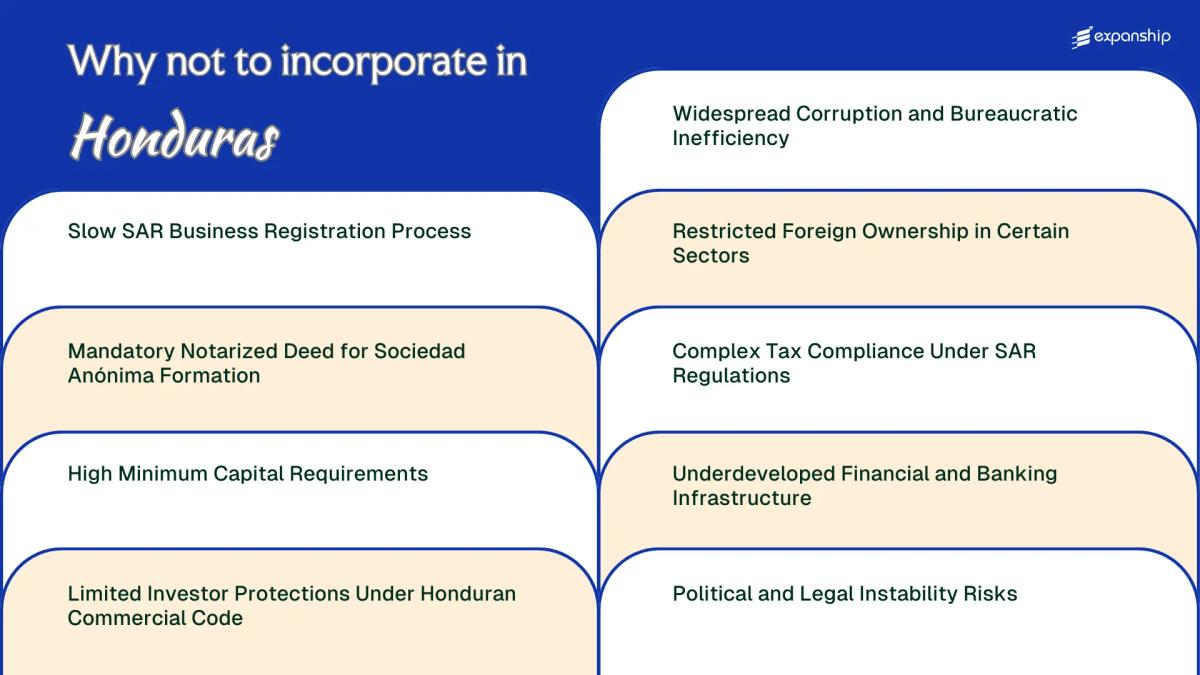
Slow SAR Business Registration Process
The slow SAR business registration Honduras presents is not merely an inconvenience. Processing timelines at the Servicio de Administración de Rentas extend registration well beyond what most foreign investors anticipate.
Bureaucratic Delays Within the SAR Registration Pipeline
Honduras company registration delays stem from sequential approval requirements across multiple government bodies, including the Registro Mercantil and SAR itself. Your business cannot operate legally until each agency completes its review, and these offices do not coordinate on a fixed schedule.
Obtaining a Registro Tributario Nacional (RTN) tax identification number alone can take weeks when documentation is queried or returned for correction. Each delay resets your operational timeline, meaning capital is committed but the entity cannot generate revenue or enter contracts.
What Delayed Registration Costs a Foreign Business Owner
SAR registration process challenges compound when foreign principals are not physically present in Honduras, requiring notarized powers of attorney that add further processing time.
A firm that expected to begin trading within 30 days may find itself waiting three months or longer, absorbing legal fees, local representative costs, and opportunity costs simultaneously.
If your market entry depends on a fixed launch window or a time-sensitive commercial contract, Honduras registration delays can directly invalidate your business case before the entity is even operational.
Mandatory Notarized Deed for Sociedad Anónima Formation
Forming a Sociedad Anónima in Honduras requires a notarized deed of incorporation executed before a licensed Honduran notary. This notarized deed requirement Honduras incorporation rules impose is not a formality — it is a gatekeeping mechanism that adds time, cost, and logistical dependency before your company legally exists.
The deed must contain specific information prescribed by the Honduran Commercial Code (Código de Comercio), including the corporate purpose, capital structure, shareholder identities, and governance rules. Any omission or error requires a corrective deed, which means another notary fee and another round of public registry processing.
For a foreign business owner, the practical friction compounds quickly:
- Engaging a Honduran notary remotely is not straightforward, often requiring apostilled powers of attorney to authorize local representatives to sign on your behalf
- Errors in the original deed cannot be corrected administratively; each amendment requires a new notarized instrument, generating additional legal fees
- The notary's own schedule and availability can delay formation independently of any government processing timeline
- If shareholders are foreign nationals, identity documentation must meet local authentication standards, adding document preparation time before the notary will proceed
The deed then must be registered with the Registro Mercantil, meaning any defect identified post-notarization restarts a portion of that chain.

Sociedad Anónima Incorporation in Honduras
Expanship manages the notarized deed process, Registro Mercantil filing, and compliance requirements for forming a Sociedad Anónima in Honduras.
High Minimum Capital Requirements
One of the Honduras minimum capital requirements drawbacks that directly affects foreign investors is the statutory minimum paid-in capital for a Sociedad Anónima. Under the Honduran Commercial Code (Decreto No. 73-1950), forming an SA requires a minimum authorized capital of 25,000 Honduran lempiras, with at least 10% paid in at incorporation.
| Requirement | Threshold | Practical Burden |
|---|---|---|
| Minimum authorized capital | L. 25,000 | Must be established in public deed before registration |
| Minimum paid-in capital at formation | 10% of authorized capital | Capital must be deposited and certified prior to notarization |
| Remaining capital payment deadline | Within 1 year of incorporation | Extends financial exposure before the business generates revenue |
While the lempira figure appears modest in absolute terms, the requirement that capital be certified and recorded within a notarized public deed before the entity is registered creates an upfront financial and procedural commitment. For a foreign investor still assessing market viability, locking capital before the company is operational adds real financial risk.
The one-year window to pay the remaining subscribed capital does not reduce the initial burden, since the notarization and registration process itself cannot proceed without the paid-in portion being confirmed. Any shortfall in the declared capital structure can invalidate the deed, forcing a restart of the formation process at additional cost.
Limited Investor Protections Under Honduran Commercial Code
Limited investor protections Honduras stem largely from gaps within the Código de Comercio (Commercial Code), which governs shareholder rights, dispute resolution, and corporate liability. Unlike jurisdictions with modern corporate statutes, Honduras has not substantially updated core investor protection provisions to reflect international standards.
Minority shareholders hold a structurally weak position. The Commercial Code imposes no mandatory buyout rights, no statutory appraisal remedies, and limited mechanisms to challenge decisions made by controlling shareholders in a Sociedad Anónima.
Derivative actions, where shareholders sue on behalf of a company against directors for breach of fiduciary duty, are technically permissible but practically rare. Enforcement requires engaging Honduran courts, which carry significant backlogs and inconsistent application of commercial law.
There is no independent securities regulator comparable to the SEC or ESMA overseeing listed or privately held companies. This absence means disclosure obligations and governance standards vary by entity, leaving foreign investors with limited recourse against mismanagement.
- Minority shareholders have no statutory right to force a buyout of their stake
- No equivalent of a securities regulator mandates disclosure or governance standards for private firms
- Fiduciary duty enforcement against directors depends on civil court proceedings, not a dedicated commercial tribunal
- The Commercial Code does not provide statutory pre-emptive rights in all share issuance scenarios
Honduras has no dedicated commercial court system, meaning complex shareholder disputes are processed through the same general civil judiciary that handles unrelated civil matters.
Widespread Corruption and Bureaucratic Inefficiency
Corruption risks doing business in Honduras are well-documented. Transparency International's Corruption Perceptions Index consistently ranks Honduras among the lower-performing countries in Latin America, reflecting systemic issues that directly affect how foreign businesses operate on the ground.
Institutional Corruption Across Regulatory Bodies
Bribery and informal payments have been reported across multiple regulatory channels, including interactions with the Registro Mercantil, municipal licensing offices, and customs administration. For a foreign firm without local connections, this environment means that even technically compliant processes can stall indefinitely or require unofficial facilitation to advance.
The Honduran judiciary has also faced documented integrity concerns, with commercial dispute resolution subject to delays that are not always procedural in origin. Your business cannot rely on a predictable enforcement timeline when contractual rights need defending.
Bureaucratic Friction and Its Cost to Foreign Entities
Honduras bureaucratic inefficiency problems compound the corruption issue by creating redundant requirements across overlapping government agencies. A simple municipal operating permit can involve multiple offices with inconsistent documentation standards, translating directly into extended setup timelines and higher legal costs.
Time lost to administrative friction is a real financial cost. Foreign entities without established local representation are disproportionately affected, as the informal knowledge needed to move processes forward is not codified anywhere.
Managing Regulatory and Compliance Challenges in Honduras
Understand the practical risks of operating within Honduras's regulatory environment and get guidance specific to your business structure.
Restricted Foreign Ownership in Certain Sectors
Foreign ownership restrictions in Honduras are sector-specific and codified in law, meaning certain industries are either fully closed to foreign capital or subject to conditions that create structural disadvantages for non-national investors.
- Under the Honduran Constitution and sectoral legislation, activities related to small retail trade (comercio minorista) are reserved exclusively for Honduran nationals, barring foreign firms from entering one of the most accessible market entry points.
- Agricultural land ownership by foreign individuals and entities is restricted under constitutional provisions, limiting your ability to secure land-based assets as collateral or for operational use.
- Media and broadcasting concessions are subject to nationality requirements, preventing foreign-owned entities from holding licenses directly.
- Even in nominally open sectors, the Foreign Investment Law (Decreto 80-92) requires registration with PROINVERSION, adding a regulatory layer that domestic firms do not face.
- These restrictions apply regardless of the corporate structure you use, so forming a Sociedad Anónima does not circumvent sector-level nationality rules.
Complex Tax Compliance Under SAR Regulations
Honduras SAR tax compliance challenges stem from a system that places a disproportionate administrative burden on foreign-owned entities. The Servicio de Administración de Rentas (SAR) oversees tax collection and enforcement, and its filing requirements involve multiple declarations, strict deadlines, and reconciliation obligations that are difficult to manage without a locally licensed contador público.
Corporate income tax is levied at a flat rate of 25%, but that figure alone understates the total compliance load. Your firm may also face the Aportación Solidaria Temporal, an additional surtax applied to higher-earning entities, and monthly VAT (Impuesto Sobre Ventas) filings at 15%.
SAR audits can be triggered without advance notice, and the agency has broad authority to reassess prior-year returns.
- Annual income tax return (Declaración Jurada)
- Monthly ISV (sales tax) declarations
- Withholding tax filings on payments to non-residents
- Municipal industry and commerce tax, filed separately from SAR
Each obligation runs on its own calendar, so a missed municipal deadline does not excuse a SAR penalty.
A foreign-owned Sociedad Anónima generating approximately USD 500,000 in annual revenue could face combined compliance costs, including local accountant fees, legal review of SAR filings, and municipal tax submissions, exceeding USD 8,000 to USD 12,000 per year, before any tax liability is calculated.
Underdeveloped Financial and Banking Infrastructure
Honduras banking infrastructure limitations create friction at every stage of corporate operations, from opening an account to executing international transfers. The domestic banking sector is concentrated among a small number of institutions, primarily regulated by the Comisión Nacional de Bancos y Seguros (CNBS), which means foreign-owned entities often face restricted access and limited service options.
Corporate account opening for foreign-controlled firms typically involves extensive documentation requirements and prolonged review periods. This delays the operational launch of your business, effectively tying up capital in a jurisdiction where banking alternatives are few.
Correspondent banking relationships between Honduran institutions and international banks remain limited. For a firm that depends on cross-border payments or foreign currency transactions, this creates real bottlenecks in day-to-day financial management.
Access to trade finance and credit facilities is also constrained for foreign entities without an established local credit history. Without these instruments, scaling operations or managing working capital becomes structurally harder than in more developed financial centers.
- Sparse ATM and branch networks outside Tegucigalpa and San Pedro Sula
- Limited multi-currency account options for foreign entities
- Slow domestic interbank transfer processing
Foreign-controlled companies are subject to enhanced due diligence under CNBS anti-money laundering regulations, which can significantly extend corporate account approval timelines or result in outright rejection without a locally established banking relationship.
Political and Legal Instability Risks
Political instability risks in Honduras business operations stem from a governance environment that has shifted considerably since the 2009 coup and the contested 2017 presidential election, both of which triggered regulatory freezes and abrupt policy reversals. For a foreign investor, this history signals that statutory frameworks can be disrupted by political transitions without structured legal recourse.
The Zelaya-era creation of special economic zones, later challenged through constitutional disputes, illustrates how investment-linked legal arrangements can be unwound through political conflict rather than standard legislative process. Your corporate structure can lose its regulatory basis without warning.
Judicial independence remains a documented concern. The Supreme Court of Justice (Corte Suprema de Justicia) operates within a system where external political pressure on rulings has been widely reported by bodies including the Inter-American Commission on Human Rights. Contract enforcement and dispute resolution consequently carry elevated uncertainty for foreign-owned entities.
Strategies to Overcome These Obstacles
Overcoming Honduras incorporation obstacles requires structural preparation rather than reactive problem-solving once registration has already begun.
- Draft the Sociedad Anónima's escritura de constitución before engaging with SAR to reduce notarization delays caused by incomplete documentation.
- Verify your sector's foreign ownership restrictions under the Honduran Investment Law (Decreto 51-2011) before committing to a legal structure.
- Register with the SAR portal early to initiate the RTN tax identification process, which runs parallel to commercial registration.
- Confirm minimum capital thresholds with the Registro Mercantil at the time of filing, as requirements may vary by entity class.
- Establish a local bank account only after obtaining your RTN and commercial registration certificate, since most Honduran banks require both documents before account opening.
Mitigating Honduras business registration challenges does not eliminate the underlying structural conditions that produce them. The Código de Comercio and SAR regulations remain the binding framework within which all mitigation operates.
Honduras Still Has Business Potential
Honduras business potential despite drawbacks is a fair characterization of what the country represents for foreign investors today. The structural and regulatory challenges covered in this blog are real and measurable. Yet for businesses that can operate within those constraints, the market retains genuine commercial and strategic value.
| Pros | Cons |
|---|---|
| Geographic position supports Central American and Caribbean trade routes | SAR's business registration process is slow and procedurally burdensome |
| Membership in CAFTA-DR provides preferential access to the U.S. market | Formation of a Sociedad Anónima requires a notarized public deed, adding cost and delay |
| A relatively young and growing labor force supports operational scaling | Minimum capital thresholds create financial barriers before a business begins trading |
| The Honduran Commercial Code provides a recognized legal framework for corporate structures | Foreign ownership is restricted in sectors including media, retail trade, and certain professional services |
| Export-oriented zones such as ZIPs and RITs offer tax incentive regimes | Corruption indices and bureaucratic inefficiencies raise compliance and operational risk |
Tax obligations under SAR regulations require consistent attention, and political instability has historically disrupted business planning cycles. Your firm's risk tolerance and sector of operation will determine whether the country's trade advantages outweigh those exposures.
Corporate Compliance Services in Honduras
Manage your ongoing SAR obligations, annual reporting requirements, and regulatory filings for your Honduran entity.
Conclusion
The Honduras incorporation drawbacks summary is straightforward: the country presents real structural friction for foreign investors. SAR's slow registration procedures, the mandatory notarized deed requirement for a Sociedad Anónima, and persistent corruption across public institutions create tangible delays and cost overruns that affect your timeline and budget. These are not incidental risks. Working with advisors who have direct experience operating within Honduran regulatory and legal frameworks remains the practical path for any firm that intends to incorporate and maintain compliance there.
Expanship's Honduras Expansion Services
From managing the notarized deed requirements for a Sociedad Anónima to staying compliant with SAR's tax registration obligations, incorporating in Honduras generates a significant administrative load. Honduras company formation services from Expanship are structured around reducing that burden at each stage, from the initial SAR filing through ongoing regulatory reporting.
Beyond formation, Expanship supports your business across the full compliance lifecycle in Honduras.
- Your company's registration documents are prepared and submitted accurately to the relevant Honduran authorities.
- A registered agent and local office address are provided to satisfy legal presence requirements.
- All government filings and liaison with bodies such as SAR are handled on your behalf.
- Post-incorporation compliance obligations, including annual renewals and reporting, are tracked and managed.
- Banking introductions are facilitated to help your entity establish a local account.
- Tax registration is completed and local authority coordination is managed throughout the process.
To discuss your Honduras setup, contact Expanship Honduras.
Frequently Asked Questions (FAQ)
The SAR registration requirement applies broadly to entities operating in Honduras, but the Sociedad Anónima formation process carries additional layers of delay due to its mandatory notarized deed requirement and subsequent registration with the Honduran Mercantile Registry. Simpler structures may move faster in theory, but bureaucratic backlogs at the Mercantile Registry affect most commercial entities. The SA remains the most commonly used vehicle for foreign investors, so these delays are disproportionately relevant to international entrants.
Legal instability in Honduras means that regulatory frameworks can shift with limited notice, and contract enforcement through the courts is unreliable by international standards. The World Bank's Doing Business indicators have historically ranked Honduras poorly on enforcing contracts, reflecting a judiciary that is under-resourced and susceptible to political influence. For foreign businesses, this makes dispute resolution unpredictable and increases the risk of being unable to recover losses through formal legal channels.
Under the Honduran Commercial Code, a Sociedad Anónima requires a minimum authorized capital of 25,000 Honduran lempiras, which at current exchange rates is a modest figure in absolute terms. However, sectoral regulators frequently impose higher capital thresholds for licensed activities such as financial services or telecommunications, and in practice, banking institutions may require substantially higher capitalization before opening a corporate account. The statutory minimum alone does not reflect the true capital exposure required to operate effectively.
Yes, the Honduran Constitution and sector-specific legislation restrict or prohibit full foreign ownership in certain industries. Areas including retail commerce below defined revenue thresholds, specific agricultural activities, and some media operations carry ownership limitations that require local participation. Foreign investors who overlook these restrictions during the SA formation stage can face regulatory rejection or forced restructuring after incorporation, which is both costly and time-consuming.
SAR has authority to impose fines, suspend tax identification numbers, and initiate administrative proceedings against non-compliant entities. Honduras operates a self-assessment tax system, and failures in monthly VAT filings, income tax declarations, or payroll obligations can trigger penalties that accumulate quickly. Beyond financial penalties, non-compliance can result in the suspension of the company's ability to issue valid invoices, which effectively halts commercial operations.
Honduras does not have a uniquely complex tax code by regional standards, but the combination of fragmented filing obligations, limited digital infrastructure at SAR, and inconsistent enforcement creates practical compliance difficulties that exceed what the written law suggests. Guatemala and Costa Rica both offer more developed e-filing systems and clearer guidance for foreign entities, making day-to-day compliance management comparatively more straightforward in those jurisdictions. For a foreign firm without local accounting support, Honduras presents a higher administrative burden in practice than its statutory framework implies.
Relying solely on Honduran domestic courts for contract enforcement carries material risk. The country's judicial system faces documented issues with delays, inconsistent rulings, and susceptibility to external influence, which reduces predictability in commercial disputes. Foreign investors with significant capital exposure typically supplement domestic legal arrangements with international arbitration clauses under frameworks such as ICSID, to which Honduras is a signatory, rather than depending on local court proceedings as a primary recourse.
Legal Disclaimer
The information provided in this article is for general informational purposes only and does not constitute legal, tax, or professional advice. While we strive to ensure the accuracy and timeliness of the content, laws and regulations are subject to change, and the application of laws can vary widely based on specific facts and circumstances.
Readers should not act upon this information without seeking professional counsel tailored to their individual situation. Expanship and its authors disclaim any liability for actions taken or not taken based on the content of this article.
For specific advice regarding your business setup, compliance requirements, or any legal matters, please consult with qualified legal and tax professionals in the relevant jurisdiction.