
Key Takeaways
- Honduras's territorial tax system means foreign-sourced income falls outside the scope of local taxation entirely, a structural advantage for businesses with cross-border revenue streams.
- Companies incorporated within ZEDE territories under Decree 120-2013 can access a zero-tax environment on income, import duties, and other fiscal obligations that would otherwise apply under the standard Honduran tax code.
- The Sociedad Anónima framework under the Código de Comercio imposes no minimum capital requirement, reducing the financial barrier to formal incorporation for early-stage ventures and lean operational models.
- Membership in CAFTA-DR provides Honduras-incorporated exporters with preferential tariff access to the U.S. market, a treaty-based advantage that carries more certainty than discretionary investment incentives.
Honduras is an independent republic in Central America, bordered by Guatemala, El Salvador, and Nicaragua, with coastlines on both the Caribbean Sea and the Pacific Ocean. For businesses evaluating the benefits of incorporating in Honduras, the starting point is the Mercantile Registry (Registro Mercantil), which sits under the Secretaría de Estado en los Despachos de Industria y Comercio and serves as the primary authority for company formation. The Sociedad Anónima remains the most common vehicle through which foreign businesses establish a formal presence.
On tax posture, the country operates a territorial-based system, meaning income generated outside its borders is generally not subject to local taxation. Foreign ownership faces few statutory restrictions across most sectors, and the government has maintained a generally open stance toward foreign direct investment in recent decades.
This article covers the key advantages the jurisdiction offers to foreign businesses and investors considering formal incorporation.
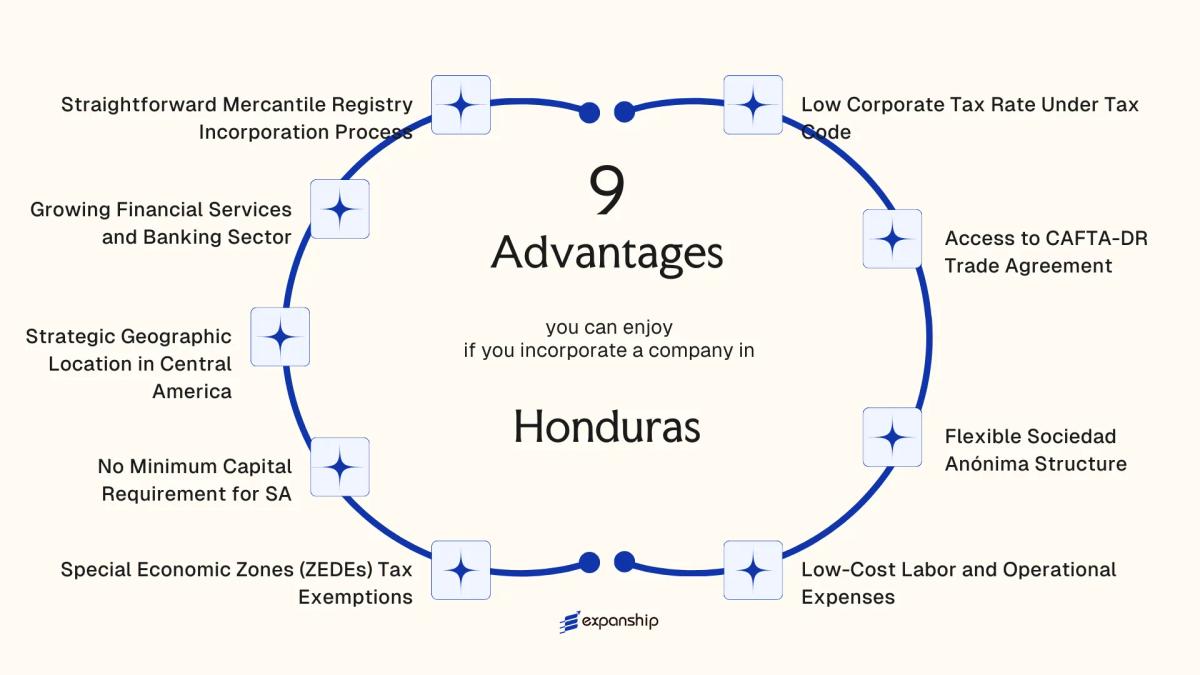
Low Corporate Tax Rate Under Tax Code
Honduras applies a corporate income tax rate of 25% under the Impuesto Sobre la Renta (ISR) framework, which positions it competitively within the Central American region for foreign-owned entities.
ISR Rate and What It Means in Practice
The 25% ISR rate applies to net taxable income generated by Sociedades Anónimas and other registered business structures. For a foreign investor operating through a locally incorporated firm, this rate reduces the overall tax burden compared to jurisdictions in South America or Western Europe, where corporate rates frequently exceed 30%.
An additional 5% solidarity contribution applies to companies with net taxable income above a defined threshold, so your effective rate may be slightly higher depending on profitability levels.
Territorial Considerations Under the Tax Code
Honduras operates on a territorial tax principle, meaning income sourced outside the country is generally not subject to ISR. A business that generates foreign-sourced revenue through a Honduran entity can, in principle, exclude that income from its local taxable base, reducing the overall ISR liability.
Foreign-sourced income may fall outside the ISR base, allowing your entity to retain more of its international earnings under current territorial tax rules.
Access to CAFTA-DR Trade Agreement
Honduras ratified the Dominican Republic-Central America Free Trade Agreement (CAFTA-DR) in 2006, creating binding, rules-based preferential access between Honduran companies and the United States, the world's largest consumer market. For a business incorporated here, this translates directly into lower landed costs on exports to US buyers and a more predictable trading relationship than companies in non-signatory jurisdictions can offer.
Under CAFTA-DR, the vast majority of Honduran-origin industrial and consumer goods enter the US either duty-free or at reduced tariff rates. The agreement also disciplines non-tariff barriers, establishes investor-state dispute resolution mechanisms, and includes enforceable intellectual property protections. These provisions matter because they reduce legal uncertainty for cross-border commercial arrangements between your entity and US counterparties.
Rules-of-origin requirements under CAFTA-DR determine whether your products qualify for preferential treatment, so understanding those thresholds at the product level is necessary before structuring supply chains around the agreement.
Why this benefits your business structurally:
- Tariff elimination applies across most manufactured goods categories, directly reducing the cost of competing against non-CAFTA suppliers in US markets
- Investor protections within the treaty sit above domestic law, offering a layer of security that bilateral investment treaties alone rarely provide
- Access to US government procurement under CAFTA-DR gives qualifying firms standing that companies in non-signatory jurisdictions cannot claim

Incorporate a Company in Honduras
Establish a legally recognized Honduran entity and position your business to access CAFTA-DR trade benefits and the broader Central American market.
Flexible Sociedad Anónima Structure
The Sociedad Anónima (SA) is the principal corporate vehicle used by foreign investors operating in Honduras, and its structural flexibility is one of its most practical attributes under the Honduran Commercial Code (Código de Comercio).
Ownership can be distributed across an unlimited number of shareholders, with shares freely transferable unless the articles of incorporation impose specific restrictions. No residency requirement applies to shareholders or directors, which means your entire ownership and management structure can be based outside the country. This matters because it removes a common operational constraint that would otherwise require you to appoint local nominees in a fiduciary capacity.
| Feature | Detail |
|---|---|
| Minimum shareholders | 2 |
| Director residency requirement | None |
| Share types permitted | Ordinary and preferred |
| Shareholder liability | Limited to capital contribution |
| Foreign ownership allowed | 100% |
Liability protection is another concrete advantage. Each shareholder's exposure is capped at their contributed capital, shielding personal and foreign assets from the entity's obligations. The SA structure also permits the issuance of both ordinary and preferred shares under the Commercial Code, giving your firm the ability to differentiate investor rights, control voting arrangements, and accommodate varied capital structures without forming a separate entity class.
For foreign-owned businesses, this combination of unrestricted ownership, liability separation, and share class flexibility creates a corporate structure that can adapt to diverse investment arrangements without requiring statutory amendments each time your ownership or financing terms change.
Low-Cost Labor and Operational Expenses
Honduras low-cost labor advantages for businesses are grounded in concrete wage structures. The national minimum wage is set by sector and firm size under the Código del Trabajo and reviewed periodically by the Consejo Económico y Social. For many manufacturing and service categories, monthly minimums remain substantially below those in Mexico or Costa Rica, meaning your fixed payroll costs start from a lower baseline before any negotiation.
Beyond wages, office and industrial lease rates in secondary cities like San Pedro Sula are considerably lower than in regional hubs such as Panama City or San José. This matters because operational overhead directly affects your break-even timeline, particularly in labor-intensive industries.
Honduras workforce cost advantages extend to social security contributions. Employers contribute to the Instituto Hondureño de Seguridad Social (IHSS), with contribution rates governed by current IHSS regulations. These rates are defined by statute and apply uniformly, so your total employment cost per worker remains predictable.
Keep these points in mind:
- Minimum wages vary by economic sector and company size under the Código del Trabajo
- IHSS employer contribution rates are statutory and published officially
- Lease costs differ significantly between Tegucigalpa and San Pedro Sula
- Wage floors are reviewed periodically; budget for potential adjustments annually
Honduras has one of the youngest median populations in Central America, meaning the available labor pool is disproportionately large relative to the country's total geographic size.
Special Economic Zones (ZEDEs) Tax Exemptions
Honduras ZEDE tax exemption benefits represent one of the more structurally distinct incentive regimes in the region. Established under the Ley Orgánica de las Zonas de Empleo y Desarrollo Económico (ZEDE Law), these zones operate as semi-autonomous jurisdictions with their own regulatory and fiscal frameworks, separate from the general tax code that governs entities incorporated outside the zones.
Fiscal Exemptions Within ZEDE Boundaries
Businesses operating inside a ZEDE can qualify for exemptions from import and export duties, income tax, and certain municipal charges, depending on the sector and the specific ZEDE's internal regulations. For a foreign company establishing manufacturing, logistics, or service operations, this can substantially reduce the recurring tax burden that would otherwise apply under the standard Honduran regime. Eligibility typically requires formal registration within the zone and compliance with the ZEDE's own administrative authority.
What This Means for Foreign Investors
Honduras special economic zone advantages extend beyond tax rates alone. Because each ZEDE can set its own commercial and labor regulations within the boundaries permitted by the Ley ZEDE, your business may also benefit from expedited administrative procedures and a distinct legal environment. Foreign firms drawn to ZEDE Honduras incentives often cite the combination of sector-specific exemptions and reduced bureaucratic friction as the primary operational advantage over incorporating in a standard Honduran jurisdiction.
Plan Your ZEDE Entry Strategy in Honduras
Speak with our corporate services team to determine ZEDE eligibility, applicable tax exemptions, and the registration process for your business structure.
No Minimum Capital Requirement for SA
Honduras imposes no minimum capital requirement for a Sociedad Anónima, which means you can legally incorporate and register a company without committing a fixed sum of capital at the outset. This rule is grounded in the Código de Comercio de Honduras, which governs SA formation and leaves share capital to the discretion of the founders.
- Your initial capital exposure is self-determined. You decide what the company needs operationally, rather than meeting an arbitrary statutory threshold before the entity can function.
- Capital can be structured across share classes without a floor amount, giving founders room to align equity distribution with their actual business model from day one.
- For foreign investors testing a new market, the absence of a minimum deposit obligation reduces the administrative and financial friction of establishing a legal presence.
- Authorized capital and paid-in capital are treated as separate figures under Honduran commercial law, so your entity can be incorporated with a modest paid-in amount while maintaining a larger authorized structure for future investment rounds.
- The Mercantile Registry does not require proof of capital deposit as a condition for completing registration, which shortens the pre-incorporation checklist compared to jurisdictions that mandate notarized bank confirmations.
Strategic Geographic Location in Central America
Honduras sits at the center of the Central American isthmus, sharing borders with Guatemala, El Salvador, and Nicaragua, while its Caribbean coastline opens directly onto Atlantic shipping corridors. For a business that needs physical access to both North American and South American markets, this positioning reduces overland transit distances considerably compared to operating from a country at either extreme of the region.
The country's two primary ports, Puerto Cortés on the Caribbean and Puerto de Henán Cortés, are among the most active cargo entry points in Central America. Puerto Cortés connects directly to major ports in the United States, Europe, and Asia through established shipping lines, meaning your goods can reach Houston or Miami without complex transshipment routing.
Honduras strategic location Central America benefits extend beyond sea freight. The road network connects to the Pan-American Highway system, giving logistics operators ground-level access to the full Central American corridor from a single operational base.
A business distributing manufactured goods from a facility near San Pedro Sula can reach Guatemala City by road in approximately 5 hours and the El Salvador border in under 3 hours, covering three national markets within a single business day's transit window.
Growing Financial Services and Banking Sector
Honduras financial services sector advantages extend beyond basic account access. The Comisión Nacional de Bancos y Seguros (CNBS) regulates banking, insurance, and securities activities, providing a defined supervisory framework that foreign firms can reference when assessing counterparty and compliance risk.
The domestic banking system includes several major commercial institutions such as Banco Atlántida, Ficohsa, and Banco de Occidente, which offer multi-currency accounts and trade finance facilities. For businesses operating across Central America, this means your entity can access credit lines, letters of credit, and foreign exchange services from day one of operations.
Regulated under the Ley del Sistema Financiero, banks in Honduras are required to maintain capital adequacy standards aligned with international norms, which reduces systemic risk for business depositors. Corporate account opening for a formally incorporated Sociedad Anónima is a documented process with the CNBS-regulated institution, rather than an opaque or discretionary procedure.
- Correspondent banking relationships with U.S. and regional institutions support cross-border transactions.
- Trade finance products are available through commercial banks for import/export-oriented businesses.
- Insurance and securities services fall under the same CNBS supervisory umbrella, simplifying regulatory engagement.
Corporate banking access depends on satisfying your chosen bank's KYC and anti-money laundering requirements under Honduran law, which vary by institution and business activity.
Straightforward Mercantile Registry Incorporation Process
One of the Honduras Mercantile Registry incorporation advantages is the relatively contained administrative burden placed on foreign founders. Registration is handled through the Registro Mercantil, which operates under the framework of the Código de Comercio de Honduras. The process does not require a foreign applicant to be physically present, provided a local representative or notary is appointed.
A Honduran notary public prepares and certifies the incorporation deed, which is then submitted to the Registro Mercantil for entry into the public record. Once registered, the entity receives a legal existence under Honduran commercial law. This means the company can open bank accounts, execute contracts, and begin operations without extended post-incorporation waiting periods.
The documents typically required include:
- Notarized articles of incorporation (escritura de constitución)
- Identification of shareholders and directors
- Appointment of a legal representative domiciled in Honduras
- Payment of applicable registration fees
For foreign investors managing multiple entities across jurisdictions, this structure reduces the coordination complexity that longer, multi-agency processes impose. The company registration efficiency advantages here stem partly from the fact that share issuance, director appointments, and corporate purpose declarations are all consolidated within a single notarial act.
Honduras company registration does not require prior government approval from a foreign investment authority before incorporating a standard Sociedad Anónima. That absence of a pre-clearance requirement shortens the timeline between entity formation and operational readiness, which has direct implications for business planning and capital deployment schedules.
Why Honduras Stands Out Among Central American Jurisdictions
Among the factors that make Honduras advantages over Central American jurisdictions relevant to this analysis, the most useful comparison involves Guatemala, Costa Rica, and Panama. These three countries target a similar profile of foreign investor, offer comparable incorporation structures, and are geographically proximate. The comparison reveals that Honduras holds a measurably favourable position on tax exposure and zone-based incentives, without the higher administrative costs associated with some of its neighbours.
Costa Rica carries a corporate tax rate that scales up to 30% for larger firms, and Panama, while competitive on offshore structures, imposes more demanding registered agent and compliance requirements for locally active companies. Guatemala's incorporation process through the Registro Mercantil involves notarial requirements that add time and cost. Across these parameters, Honduras presents a structurally lighter entry point for foreign-owned entities, particularly those operating within a Zona Económica de Desarrollo y Empleo (ZEDE) or under the Ley de Zonas Libres framework.
| Parameter | Honduras | Guatemala | Costa Rica | Panama |
|---|---|---|---|---|
| Standard Corporate Tax Rate | 25% | 25% | Up to 30% (tiered) | 25% |
| Special Economic Zone Regime | Yes (ZEDE, ZIP, ZOLI) | Limited | Yes (Free Zones) | Yes (Panama Pacifico, ZLC) |
| Minimum Share Capital (SA/Equivalent) | None | None | None | None |
| CAFTA-DR Membership | Yes | Yes | Yes | No |
| Mercantile Registry Incorporation | Yes | Yes | Yes | Yes |
Compliance Services for Companies in Honduras
Maintain good standing with Honduran regulatory requirements, including annual filings, tax obligations, and corporate record-keeping under the Código de Comercio.
Conclusion
The benefits of incorporating in Honduras rest on a combination of structural, fiscal, and geographic factors that are difficult to replicate at comparable cost elsewhere in the region. Access to CAFTA-DR preferential tariffs, the zero-tax environment available within ZEDE territories, and the absence of a minimum capital requirement for a Sociedad Anónima each address different priorities — whether your business is export-oriented, operationally lean, or in an early capital-formation stage.
That said, the weight of these advantages varies by business model. A manufacturing firm focused on U.S. market access will find the trade agreement provisions more material than a service-based entity that benefits more from the flexible SA structure and low incorporation costs.
For the right type of business, the case is grounded in codified law and treaty obligations rather than discretionary policy. The framework under the Código de Comercio, the incentives embedded within Decree 120-2013, and Honduras's commitments under CAFTA-DR all provide a defined legal basis. Understanding how these provisions apply to your specific corporate structure and activity type is where the practical work begins.
Start Your Honduras Company With Expanship Today
To incorporate a Honduras company with Expanship, you work with a team that understands the full regulatory path through the Registro Mercantil, the tax obligations under the Código Tributario, and the structural requirements specific to the Sociedad Anónima. Every stage of formation and post-incorporation compliance is handled with reference to the actual legal framework, not generic procedures.
Expanship's services for Honduras entity formation cover:
- Preparation and legalization of incorporation documents, including the escritura pública and company bylaws
- Registered agent and registered office provision within Honduras, as required for ongoing legal standing
- Government filing and liaison with the Registro Mercantil de Comercio
- Post-incorporation compliance management, including annual reporting and tax registration with the Servicio de Administración de Rentas (SAR)
- Banking introduction assistance to support your firm's operational setup
Reach out to Expanship Honduras to discuss your incorporation requirements.
Frequently Asked Questions (FAQ)
The standard corporate income tax rate under the Honduran Tax Code (Código Tributario) is 25% on net taxable income. Businesses operating within a ZEDE or under a qualifying maquiladora or free trade zone regime may access significantly reduced rates or full exemptions, depending on the specific zone's enabling legislation. The applicable rate should be confirmed against the entity's actual operational structure and registration status.
A company incorporated in Honduras qualifies as a regional originating entity under CAFTA-DR, which can entitle its exports to preferential or zero-rate tariff treatment when entering the United States and other signatory markets. This benefit is not automatic; goods must meet the agreement's rules of origin requirements to qualify. Manufacturing and agricultural exporters tend to derive the most direct advantage from this treaty access.
Honduran law requires that an SA appoint a legal representative, who does not need to be a Honduran citizen, but must be legally authorized to act within the country. A registered agent with a local address is required for service of process purposes during Mercantile Registry registration. The company's board members and shareholders themselves may be entirely foreign nationals.
Failure to meet annual filing obligations with the Registro Mercantil can result in administrative penalties and, in prolonged cases, the entity being declared inactive or struck from the register. Tax non-compliance with the Servicio de Administración de Rentas (SAR) carries separate financial penalties and may trigger audits. Reinstatement is generally possible but requires settling outstanding fees and submitting overdue filings.
Honduras is the only Central American country to have enacted the ZEDE framework under the Ley Orgánica de las ZEDE, which creates privately governed special economic zones with distinct legal, tax, and regulatory environments. No equivalent mechanism exists in Costa Rica, Guatemala, or Panama in the same structural form. Whether this model suits a specific business depends on the operational requirements, risk tolerance regarding the political stability of the ZEDE framework, and the nature of the activity.
The Mercantile Registry (Registro Mercantil) process for incorporating an SA typically takes between two and four weeks under standard conditions, though timing can vary depending on notarial preparation, document completeness, and registry workload at the relevant regional office. Expedited processing is not formally codified as a standard national procedure. Engaging a local notary (Notario Público) with prior registry experience generally reduces processing delays.
No statutory minimum paid-up capital requirement applies to a standard SA at the time of incorporation. While the deed of incorporation (escritura de constitución) must specify the authorized capital and share structure, Honduran corporate law does not mandate that a defined minimum amount be deposited or verified before registration is completed. The authorized capital figure is declared in the articles, but the actual paid-in amount is a matter for the shareholders to determine internally.
Legal Disclaimer
The information provided in this article is for general informational purposes only and does not constitute legal, tax, or professional advice. While we strive to ensure the accuracy and timeliness of the content, laws and regulations are subject to change, and the application of laws can vary widely based on specific facts and circumstances.
Readers should not act upon this information without seeking professional counsel tailored to their individual situation. Expanship and its authors disclaim any liability for actions taken or not taken based on the content of this article.
For specific advice regarding your business setup, compliance requirements, or any legal matters, please consult with qualified legal and tax professionals in the relevant jurisdiction.