
Key Takeaways
- All commercial entities in Guatemala must be registered with the Registro Mercantil under the framework established by the Código de Comercio (Decreto 2-70), and failure to complete this process prevents the entity from obtaining legal standing or operating as a recognised business.
- Beneficial ownership information must be disclosed in accordance with the Ley para el Fortalecimiento de la Transparencia Fiscal, making UBO compliance a formal legal obligation rather than a voluntary reporting measure.
- Foreign investors forming a Sociedad Anónima in Guatemala are subject to minimum share capital requirements that must be satisfied prior to registration, along with notarial deed execution as a prerequisite for filing.
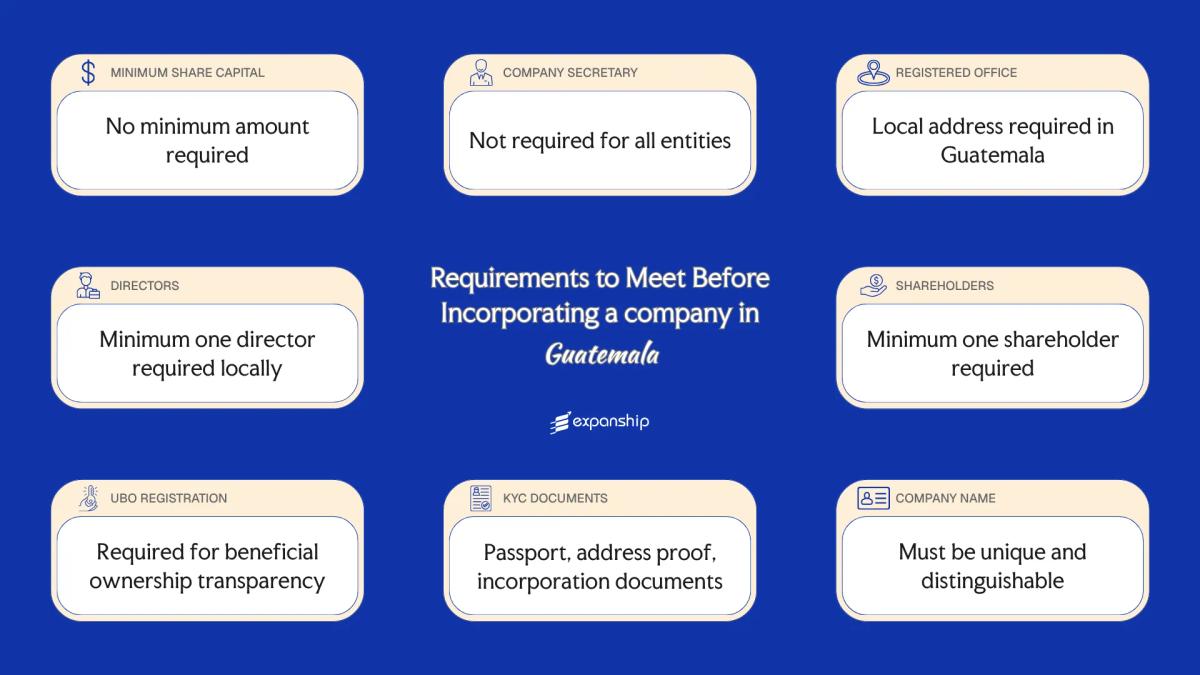
- The structural requirements for incorporation in Guatemala — including director appointments, shareholder composition, and registered office designation — vary depending on the chosen entity type and the sector in which the business intends to operate.
Entity formation in Guatemala is governed by the Código de Comercio (Decree 2-70), with the Registro Mercantil serving as the authority responsible for registering commercial entities. Meeting the incorporation requirements in Guatemala is a prerequisite for obtaining legal standing; failure to satisfy them results in outright rejection of the registration application or an inability to operate as a recognised legal entity.
This article addresses the structural, documentary, and compliance requirements that apply across the formation process. Requirements can differ based on the chosen entity type, the sector in which the business will operate, and the ownership structure involved.
Foreign investors establishing a commercial presence, particularly those forming a Sociedad Anónima or a branch of a foreign corporation, will find this article most directly applicable to their situation.
Minimum Share Capital Requirements in Guatemala
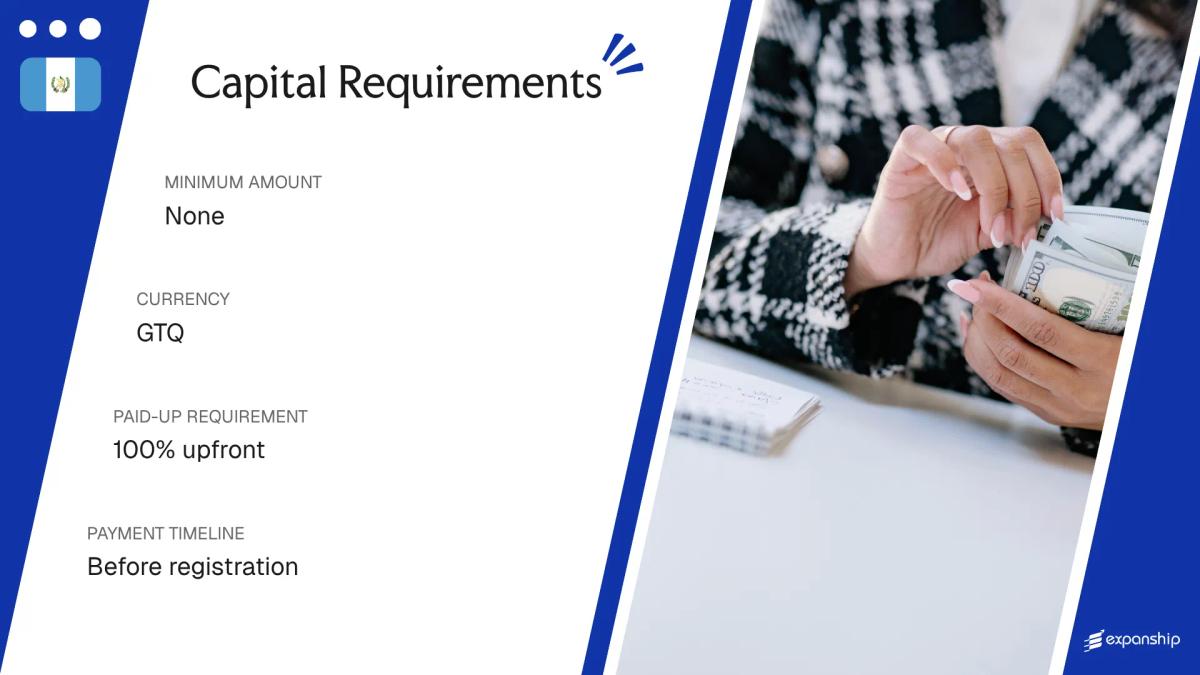
Under the Código de Comercio de Guatemala (Decree 2-70), the minimum share capital requirements in Guatemala apply specifically to the Sociedad Anónima, the predominant corporate vehicle for foreign and domestic investors. Guatemalan law operates on a par value share system, meaning each share must carry a nominal value stated in the company's articles of incorporation.
Capital contributions are declared before a Guatemalan notary at the time of incorporation and registered with the Registro Mercantil, the authority responsible for verifying the entity's corporate documentation. There is no separate bank deposit certificate required to evidence paid-up capital prior to registration.
| Parameter | Detail |
|---|---|
| Minimum Authorized Share Capital | No statutory minimum |
| Maximum Authorized Share Capital | No statutory maximum |
| Minimum Paid-Up Capital | At least 25% of subscribed capital must be paid up at incorporation |
| Paid-Up Requirement at Incorporation | Yes, partial payment required at time of deed execution |
| Accepted Currency | Guatemalan Quetzal (GTQ) |
| Accepted Forms of Contribution | Cash or non-cash assets (valued and declared in the notarial deed) |
| Timeframe to Deposit Capital | Remaining subscribed capital must be paid within one year of incorporation |
The absence of a statutory minimum does not exempt shareholders from structuring an authorized capital in the articles. The Registro Mercantil requires a defined capital figure in the notarial deed before it will process the registration.
Company Secretary Requirements in Guatemala
Under Guatemala's Código de Comercio, there is no statutory requirement for a company secretary as a distinct corporate officer. Instead, Guatemalan sociedades anónimas operate under a governance structure centered on the board of directors and a fiscal auditor known as the Contador Fiscal or Auditor, who carries certain oversight functions.
Certain administrative duties that a company secretary would handle elsewhere fall to the board or its designated representative. These include maintaining the corporate books, recording shareholder resolutions, and ensuring the entity meets its filing obligations with the Registro Mercantil de Guatemala.
Qualification criteria for those serving in equivalent administrative or representative roles:
- Individuals must have full legal capacity under Guatemalan civil law to act on behalf of the entity.
- Corporate representatives are generally required to be formally appointed through a public deed authenticated by a Guatemalan notary.
- No statutory professional licensing is required for a general corporate administrator, though the fiscal auditor role requires accounting credentials.
- Foreign nationals may serve in administrative roles, subject to their immigration status permitting commercial activity.

Incorporate a Company in Guatemala
Set up your business entity in Guatemala through a structured process handled in accordance with local commercial law and Registro Mercantil requirements.
Registered Office Requirements in Guatemala
Registered office requirements in Guatemala are governed under the Guatemalan Commercial Code (Decreto 2-70), which mandates that every company maintain a designated legal address within the country from the time of incorporation. Failure to maintain a compliant domicilio fiscal can result in administrative sanctions by the Superintendencia de Administración Tributaria (SAT) and may affect the entity's legal standing before the Registro Mercantil.
- A physical address located within Guatemala is required; correspondence-only addresses do not satisfy this requirement.
- Virtual offices are generally not accepted as a qualifying registered address under Guatemalan commercial law.
- The address must be based in Guatemala; foreign addresses cannot serve as a company's legal domicile.
- Supporting documentation, such as a lease agreement or proof of property ownership, is typically required to validate the address.
- The registered address is recorded in the Registro Mercantil and forms part of the publicly accessible company file.
- Any change to the registered address must be formally notified to the Registro Mercantil through an amendment filing; unregistered changes are not legally recognized.
Director Requirements in Guatemala
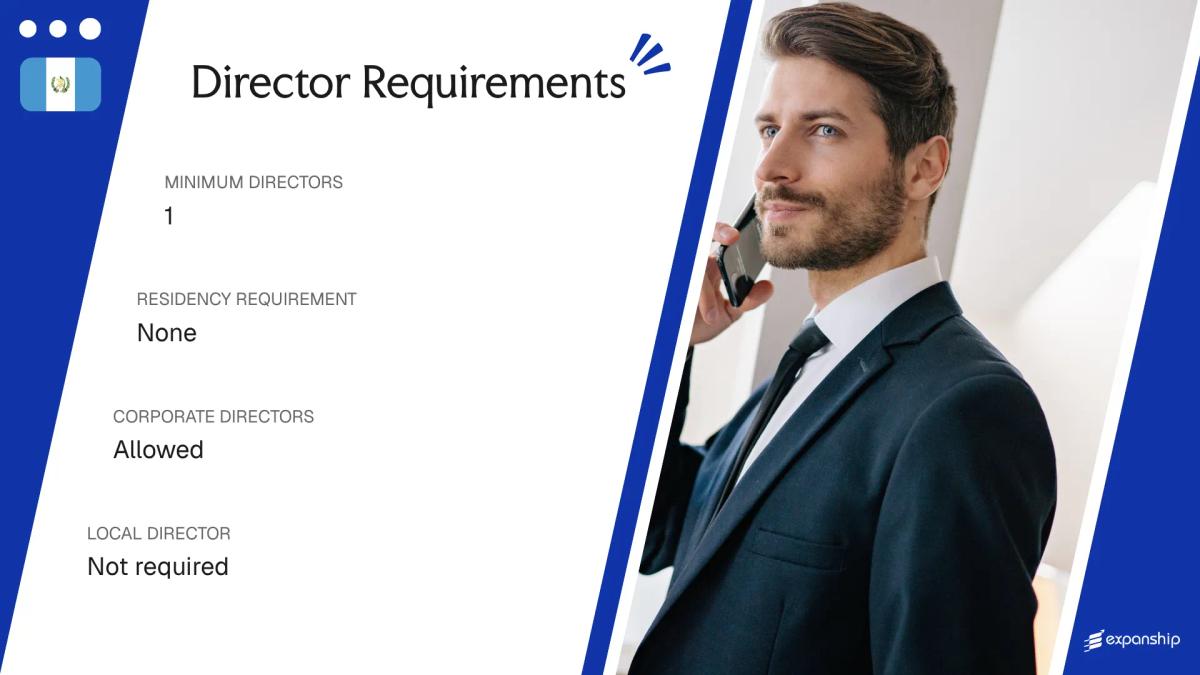
Under Guatemala's Código de Comercio (Decree 2-70), director requirements in Guatemala assign personal liability to appointed directors for acts carried out outside their authorized scope or in breach of fiduciary duties owed to the entity.
| Parameter | Detail |
|---|---|
| Minimum Number of Directors | One director is sufficient; a sole administrator (Administrador Único) structure is permitted under the Código de Comercio. |
| Maximum Number of Directors | No statutory maximum; the company's escritura social (articles of incorporation) governs the board's size. |
| Local/Resident Director Required | No statutory requirement for a locally resident director. |
| Nationality Restrictions | No nationality restrictions are imposed on directors under Guatemalan commercial law. |
| Minimum Age Requirement | Directors must have reached the age of majority, which is 18 years under Guatemalan law. |
| Corporate Directors Permitted | No statutory provision expressly permits corporate directors; natural persons are the standard requirement. |
| Director Must Be a Shareholder | No statutory requirement for a director to hold shares in the company. |
| Publicly Listed on Registry | Director details are recorded in the Registro Mercantil upon incorporation and must reflect any subsequent changes. |
| Disqualification Conditions | Individuals declared bankrupt or convicted of fraud-related offenses may be disqualified from serving as directors. |
A single individual can simultaneously act as the sole director, sole shareholder, and legal representative of a Guatemalan Sociedad Anónima, with no requirement for any additional officers or board members.
Shareholder Requirements in Guatemala
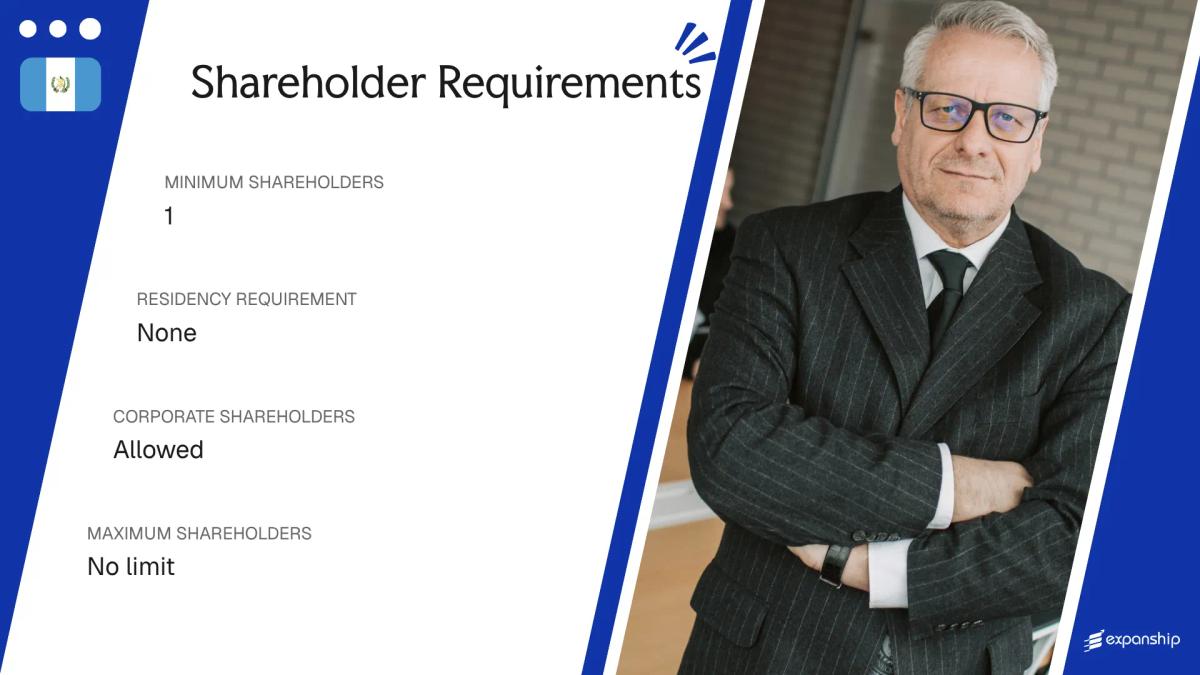
A Guatemala Sociedad Anónima requires a minimum of two shareholders at formation. No statutory maximum applies, giving the structure flexibility for both closely held firms and larger enterprises.
Nationality and Residency Restrictions
Shareholder requirements in Guatemala impose no nationality or residency conditions on individuals holding shares. Foreign nationals and non-residents may own 100% of a Guatemalan entity without restriction.
Corporate Shareholders
Legal entities, including foreign corporations, may act as shareholders in a Sociedad Anónima. No special authorization or local presence is required for a corporate body to hold shares.
Shareholder Liability
Liability is limited to each accionista's capital contribution. Guatemalan corporate law does not generally extend liability beyond the subscribed share value, though courts may pierce the corporate veil in cases of fraud or abuse of the legal structure.
Register of Shareholders
A private share registry must be maintained at the company's registered office. This register is not publicly accessible, though the entity is obligated to keep it current and produce it upon request by authorized authorities.
Guidance on Shareholder Structuring for Your Guatemala Entity
Get practical guidance on structuring your shareholding in accordance with Guatemalan corporate law requirements.
UBO / Beneficial Ownership Disclosure Requirements in Guatemala
Under Guatemala's anti-money laundering framework, beneficial ownership disclosure Guatemala requirements are governed by the Ley para Prevenir y Reprimir el Financiamiento del Terrorismo and supervised by the Intendencia de Verificación Especial (IVE), the country's financial intelligence unit. A beneficial owner is generally defined as any natural person who ultimately owns or controls 25% or more of an entity.
- Identify all natural persons holding 25% or more of the entity's capital or voting rights.
- Submit beneficial ownership information to the IVE as part of the entity's registration with an obligated subject or regulated institution.
- Maintain internal records that identify the UBO chain, including indirect ownership structures.
- Update the IVE and relevant records when ownership changes occur.
| Parameter | Detail |
|---|---|
| Ownership Threshold for UBO Status | 25% ownership or control |
| Filing Authority | Intendencia de Verificación Especial (IVE) |
| Disclosure Deadline at Incorporation | No specific statutory deadline established |
| Publicly Accessible Register | No |
| Penalties for Non-Disclosure | Administrative sanctions under AML legislation |
| Ongoing Update Obligation | Yes, upon material ownership changes |
KYC / Document Requirements in Guatemala
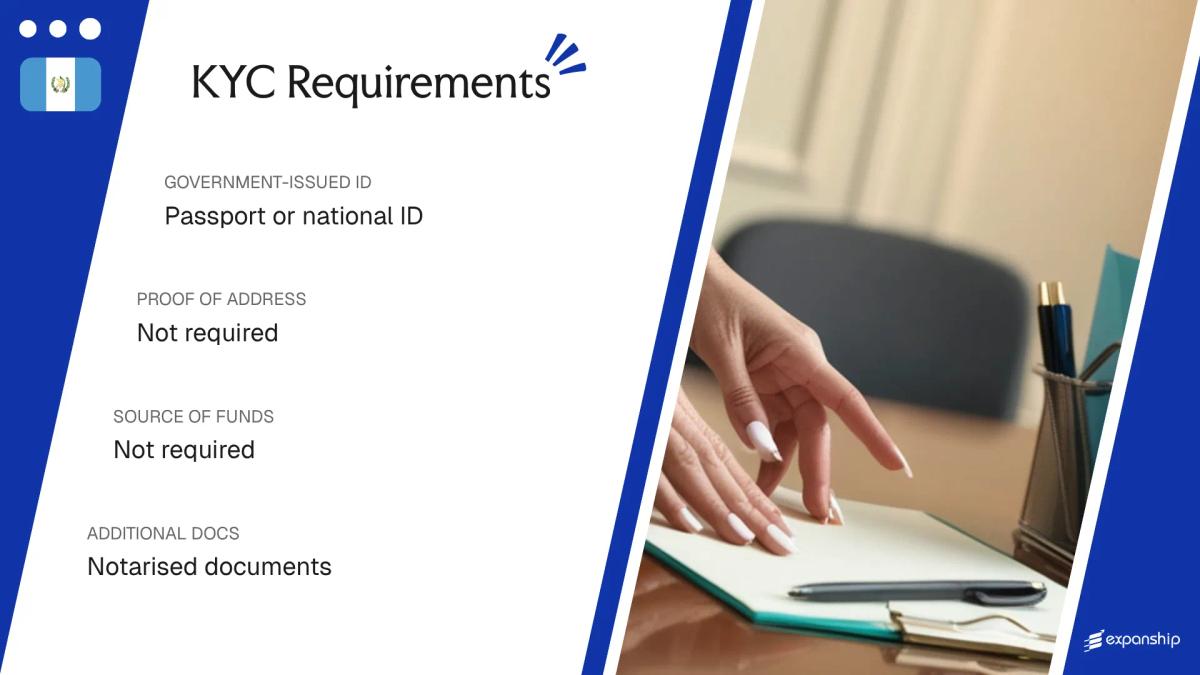
KYC document requirements Guatemala fall under the framework established by the Ley para Prevenir y Reprimir el Financiamiento del Terrorismo and the broader anti-money laundering provisions enforced by the Intendencia de Verificación Especial (IVE), which is the Financial Intelligence Unit operating under the Superintendencia de Bancos.
Individual / Personal Documents
- Valid government-issued photo identification (passport or national ID)
- Proof of residential address dated within three months (utility bill or bank statement)
- Completed KYC/due diligence form disclosing the individual's role in the entity
- Tax identification number (NIT) where the individual is a Guatemalan resident
Corporate Documents
- Certificate of incorporation or equivalent constitutional document from the home jurisdiction
- Articles of association or bylaws, confirming the entity's legal structure
- Register of current directors and shareholders of the corporate entity
- Proof of the corporate entity's registered address
Source of Funds Documentation
- Recent bank statements covering a minimum of three months
- Audited financial statements or accountant-certified accounts where available
- Written declaration of the origin of capital being contributed
Notarisation and Apostille Requirements
- Foreign documents generally require apostille under the Hague Convention
- Documents not in Spanish must be translated by a certified translator recognised in Guatemala
- Notarisation by a Guatemalan notary (Notario) may be required for certain constitutional documents
Incomplete or untranslated foreign corporate documents are the most frequent cause of incorporation delays before the Registro Mercantil.
Company Name Requirements in Guatemala
Proposed company name requirements Guatemala are assessed during incorporation registration, with names evaluated for uniqueness, legality, and distinctness from existing registered entities.
All business names must be in Spanish and include a legal suffix corresponding to the chosen entity type, such as "Sociedad Anónima" or its abbreviation "S.A." for public limited companies.
Certain words implying government affiliation, banking activity, or regulated financial services require prior authorization from the relevant supervisory authority before the name can be registered.
Name reservation is available through the Registro Mercantil, providing temporary protection while incorporation documents are prepared, though the reservation period is limited.
Compliance Services for Companies in Guatemala
Maintain your Guatemalan entity in good standing with ongoing compliance support, from annual filings to regulatory reporting obligations.
Conclusion
Incorporation requirements in Guatemala are defined primarily through the Guatemalan Commercial Code (Decreto 2-70), with oversight from the Registro Mercantil governing entity registration. Minimum share capital thresholds, notarial deed requirements, and beneficial ownership disclosure obligations under the Ley para el Fortalecimiento de la Transparencia Fiscal each carry practical weight for foreign investors. Once these structural and compliance requirements are understood, the next step is executing the formation process correctly through qualified local counsel and registered agents authorised to operate within the Guatemalan system.
Expanship's Corporate Formation Services in Guatemala
Expanship's Guatemala corporate formation services are structured around the specific requirements that govern sociedad anónima registration under Guatemalan law, including notarial deed preparation, SAT tax registration, and compliance with the Registro Mercantil. Your operational burden lies in coordinating these interdependent steps correctly and in sequence, and Expanship's role is to manage that coordination on your behalf.
Our Guatemala business registration assistance covers the full formation cycle and extends well into post-incorporation obligations.
- Preparing and filing all corporate documents, including the public deed and Registro Mercantil submissions
- Providing a registered agent and compliant local office address throughout your entity's operational life
- Liaising directly with the Registro Mercantil, SAT, and other relevant authorities on your behalf
- Managing ongoing compliance obligations after your company is formally registered
- Facilitating introductions to banking institutions familiar with foreign-owned entities in Guatemala
- Handling tax registration with SAT and coordinating with local authorities as required
To discuss your requirements, contact Expanship Guatemala.
Frequently Asked Questions (FAQ)
Guatemala's Mercantile Code (Decree 2-70) does not impose a statutory minimum share capital for a Sociedad Anónima, giving founders flexibility in setting the capital amount. However, at least 25% of each subscribed share must be paid in at the time of incorporation, with the remainder payable within the period established in the company's articles. The Registro Mercantil will not complete registration unless this partial payment requirement is documented in the public deed.
Approval by the Registro Mercantil confirms the name is not already registered as a commercial name in its own records, but it does not constitute clearance against trademarks held at the Registro de la Propiedad Intelectual. If a conflict surfaces after registration, the trademark holder can pursue legal action that may compel a name change and expose your company to liability. Conducting a trademark search before submitting the company name is the only way to confirm there is no prior conflicting right.
Foreign nationals can serve as directors of a Guatemalan Sociedad Anónima without a residency requirement. The Mercantile Code does not impose a nationality or domicile condition on directors, though the appointed administrator or legal representative who acts on behalf of the entity within Guatemala must have a valid address for legal notifications in the country. In practice, many foreign-owned firms appoint a local manager or registered agent to handle in-country legal correspondence.
Beneficial ownership disclosure in Guatemala is an ongoing obligation, not a one-time filing. Both the Superintendencia de Bancos, through its anti-money laundering framework, and the Superintendencia de Administración Tributaria require that ownership information remain current, with updates filed when changes in control or ownership occur. Failure to maintain accurate records can result in administrative sanctions and may trigger enhanced scrutiny from financial institutions operating under Guatemala's AML regime.
Operating without a valid registered office recorded at the Registro Mercantil can result in the company being unable to receive lawful service of process, which creates immediate procedural vulnerabilities in any legal or regulatory action brought against it. Beyond procedural consequences, the Registro Mercantil can flag the entity as non-compliant, which may affect its ability to obtain certificates of good standing required for banking relationships or contract execution. Sanctions vary but can include fines and suspension of the entity's registration status.
Guatemala's Mercantile Code does not require a company secretary as a distinct statutory officer in the same way some common-law jurisdictions do. The administrative function is instead handled by the administrator or board of directors, who are responsible for governance, record-keeping, and regulatory filings. This is a meaningful structural difference from jurisdictions like the United Kingdom or Singapore, where a company secretary carries defined legal duties separate from the directors.
Foreign shareholders are generally required to provide a certified copy of their passport, proof of residential address, and, for corporate shareholders, authenticated corporate documentation confirming the entity's legal existence and the authority of its signatories. Because the public deed of incorporation must be executed before a Guatemalan notary, all foreign-sourced documents typically require apostille certification under the Hague Convention or consular legalization if the issuing country is not a signatory. The notary bears professional responsibility for verifying the identity and capacity of all parties to the deed.
Legal Disclaimer
The information provided in this article is for general informational purposes only and does not constitute legal, tax, or professional advice. While we strive to ensure the accuracy and timeliness of the content, laws and regulations are subject to change, and the application of laws can vary widely based on specific facts and circumstances.
Readers should not act upon this information without seeking professional counsel tailored to their individual situation. Expanship and its authors disclaim any liability for actions taken or not taken based on the content of this article.
For specific advice regarding your business setup, compliance requirements, or any legal matters, please consult with qualified legal and tax professionals in the relevant jurisdiction.