
Key Takeaways
- Guatemala's territorial tax system means foreign-sourced income falls outside the scope of local taxation, giving internationally active businesses a structural advantage when managing cross-border earnings.
- Under Decree 9-98, the Foreign Investment Law, full foreign ownership of a Guatemalan Sociedad Anónima is legally protected without requiring a local partner, reducing both structural complexity and operational dependency on third parties.
- Free trade zone regimes in Guatemala offer meaningful exemptions from corporate income tax and related obligations, creating a materially lower cost base for qualifying businesses compared to standard onshore operations.
- With a flat 25% corporate income tax rate and no capital gains tax applied to most asset disposals, Guatemala's fiscal framework provides a degree of cost predictability that supports longer-term financial planning for foreign-owned entities.
Guatemala is an independent republic in Central America, sharing borders with Mexico, Belize, Honduras, and El Salvador — a position that defines much of its commercial relevance. The benefits of incorporating in Guatemala draw interest from foreign investors across multiple industries, and understanding the regulatory framework is the starting point for any formation decision.
Company registration falls under the authority of the Registro Mercantil, the official body responsible for commercial registrations at the national level. Foreign businesses most commonly establish a Sociedad Anónima when entering the market. Guatemala operates a territorial tax system, meaning income earned outside the country's borders is generally not subject to local taxation.
The legal framework does not impose blanket restrictions on foreign ownership, and foreign direct investment is permitted across most sectors without requiring a local partner. Certain regulated industries carry their own licensing requirements, but the general posture toward foreign capital is permissive.
This article examines the key advantages that company formation here presents for international businesses.
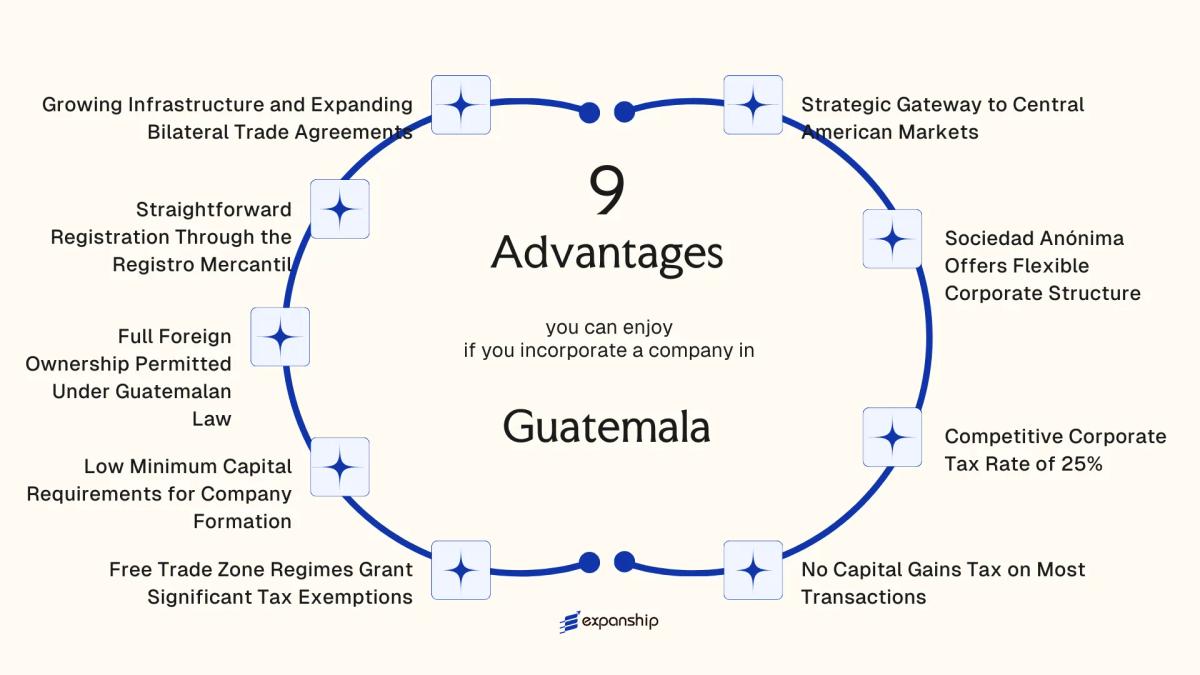
Strategic Gateway to Central American Markets
Positioned at the northern edge of Central America, Guatemala shares borders with Mexico, Belize, Honduras, and El Salvador, placing your business within a day's drive of five national markets. That geographic configuration translates directly into distribution range and regional supply chain reach.
Regional Trade Access Through Established Agreements
Guatemala is a signatory to the Dominican Republic-Central America Free Trade Agreement (CAFTA-DR), which governs trade relations with the United States and five other regional partners. A company registered here can ship goods under preferential tariff conditions across borders that together represent a consumer base exceeding 50 million people.
Proximity to the Pacific and Atlantic Corridors
The country maintains active commercial port infrastructure on both coastlines, with Puerto Quetzal on the Pacific and Puerto Barrios on the Caribbean side. For businesses moving physical goods, dual-coast access reduces transit dependency on any single shipping lane, which matters when managing freight costs across regional distribution networks.
A Guatemalan entity gives you tariff-preferential access to CAFTA-DR markets while operating from a dual-coast logistics base at the center of the Central American land corridor.
Sociedad Anónima Offers Flexible Corporate Structure
The Sociedad Anónima (SA) is the predominant corporate vehicle for foreign investment in Guatemala, and its internal governance structure reflects that purpose. Governed by the Código de Comercio (Decree 2-70), the SA separates ownership from management, allowing shareholders to hold equity without taking on direct operational liability. Your personal assets remain distinct from the company's obligations, which is a foundational protection for any foreign investor operating across borders.
Shares in an SA can be structured in different classes, giving you the ability to allocate voting rights, profit distributions, and transfer restrictions according to your specific needs. This flexibility is not incidental — it means founding shareholders can retain control while bringing in additional capital from outside parties without diluting decision-making authority.
The Guatemala SA flexible business structure also imposes no requirement for shareholders to be resident in the country. Directors and officers can similarly be foreign nationals, removing a common barrier that limits investor participation in other Central American jurisdictions.
Why this matters structurally for your business:
- Shareholder identity does not need to be disclosed publicly in the same manner as in civil partnerships, offering a degree of privacy within legal parameters
- The minimum shareholder requirement is low, making single-owner or small-group structures entirely viable
- Corporate shareholders are permitted, allowing holding company arrangements to function without restriction

Incorporate a Sociedad Anónima in Guatemala
Establish your Guatemala SA with full compliance support, from Registro Mercantil registration to ongoing corporate maintenance.
Competitive Corporate Tax Rate of 25%
Guatemala's standard corporate income tax rate sits at 25%, applied under the Impuesto Sobre la Renta (ISR) regime. For a foreign-owned entity operating through a Sociedad Anónima, this rate applies to net taxable income after allowable deductions, meaning your actual effective rate depends on how efficiently business expenses are documented and claimed. That predictability matters when projecting post-tax returns across multi-year operations.
| Regime | Tax Base | Rate |
|---|---|---|
| Régimen Sobre las Utilidades | Net profit (after deductions) | 25% |
| Régimen Opcional Simplificado | Gross income | 7% (up to GTQ 30,000/month) / 5% below threshold |
The Guatemala 25% corporate tax rate advantage becomes clearer when measured against peers in the broader Latin American region, where rates commonly reach 30% or above. Mexico applies 30%, Colombia 35%, and Brazil's combined rate can exceed 34%. A firm incorporated in Guatemala and operating under the standard ISR regime starts at a structurally lower baseline than most comparable economies in the hemisphere.
Under the Régimen Opcional Simplificado, businesses with lower gross revenues may opt for a flat withholding-based rate instead, offering a simpler calculation method for early-stage or smaller operations. Eligibility depends on income thresholds set by the Superintendencia de Administración Tributaria (SAT), Guatemala's tax authority, which administers both regimes and issues compliance guidance.
No Capital Gains Tax on Most Transactions
Guatemala's treatment of capital gains sets it apart from many tax regimes in the region. Under the Guatemalan tax code, administered by the Superintendencia de Administración Tributaria (SAT), most gains derived from the sale of assets are not subject to a separate capital gains tax. For foreign business owners, this means proceeds from asset disposals can be reinvested without the additional tax drag that would apply in many other jurisdictions.
This exemption applies broadly to transactions involving movable property and certain business asset transfers. When your firm disposes of shares in a Guatemalan Sociedad Anónima or sells equipment, the absence of a dedicated capital gains levy reduces the effective tax cost of restructuring or exiting a position. That directly affects how you structure acquisitions and plan eventual asset monetization.
Real property transactions do carry a transfer tax, so the exemption is not universal. Understanding which asset classes fall outside capital gains treatment is necessary before structuring a deal.
Keep the following in mind:
- Gains on share disposals in a Sociedad Anónima are generally not taxed as capital gains under current SAT rules
- Movable asset sales typically fall outside the capital gains regime
- Real estate transfers are subject to a separate stamp duty and transfer tax
- Tax treatment can depend on whether the transaction is classified as ordinary business income versus a capital event
Guatemala does not impose a capital gains tax on the sale of shares in most private companies, a treatment that many jurisdictions in Latin America explicitly tax at rates between 10% and 15%.
Free Trade Zone Regimes Grant Significant Tax Exemptions
Guatemala free trade zone tax exemptions represent one of the more substantial fiscal advantages available to businesses operating in export-oriented or manufacturing activities. Two primary regimes govern this space: the Free Trade Zone Law (Decreto 65-89) and the ZOLIC framework, which administers the Santo Tomás de Castilla Special Public Economic Zone on the Caribbean coast. Together, these regimes create defined legal spaces where qualifying entities operate under a separate tax structure from the general corporate regime.
What the Exemptions Actually Cover
Under Decreto 65-89, authorized free zone operators can access full exemption from income tax for a defined period, along with exemptions from import duties on raw materials, machinery, and equipment used in production. For a foreign-owned manufacturing or logistics firm, this means the cost base for capital expenditure and inputs can differ materially from what a domestically-registered company outside the zone would face. ZOLIC zone benefits extend similar protections, with the added advantage of direct port access at Puerto Barrios, which reduces inland freight costs for import-export operations.
Eligibility and Operational Conditions
Access to these regimes is not automatic. Your business must obtain authorization from the relevant administering body, operate within a designated physical zone, and conduct activities that qualify under the approved categories, which typically center on manufacturing, assembly, or international services. Compliance with these conditions determines whether the tax exemptions remain in force. A firm that shifts activities outside the authorized scope risks losing the preferential treatment entirely.
Structure Your Guatemala Entity to Access Free Zone Benefits
Expanship advises on free zone eligibility, regime selection, and the authorization process under Guatemalan law to ensure your entity qualifies from the outset.
Low Minimum Capital Requirements for Company Formation
Under the Guatemalan Commercial Code (Decree 2-70), a Sociedad Anónima can be incorporated with a minimum authorized capital of Q5,000 (approximately USD 650), of which only 25% must be paid in at the time of registration. Low minimum capital requirements for Guatemala company formation mean your initial cash commitment to establish a legal presence is modest, leaving working capital available for operational priorities rather than locked in a statutory deposit.
- The Q5,000 threshold is defined in the Commercial Code, not set by administrative policy, so it is fixed by statute rather than subject to frequent regulatory adjustment.
- Only Q1,250 needs to be paid in at incorporation. The remainder can be subscribed and contributed later, giving your business flexibility in how it stages its capital deployment.
- Capital is denominated and held in Guatemalan quetzales, which means formation costs are not exposed to foreign currency conversion requirements at the point of registration.
- There is no minimum paid-in capital requirement tied to the nationality of shareholders, so foreign-owned entities are subject to the same threshold as domestically owned firms.
- Because the statutory minimum is low, the capital structure of your entity can be designed around actual business needs rather than around satisfying a regulatory floor.
Full Foreign Ownership Permitted Under Guatemalan Law
Full foreign ownership allowed in Guatemala means a non-resident investor can hold 100% of the shares in a Guatemalan Sociedad Anónima without any local partner requirement. This removes a structural constraint that exists in several other jurisdictions, where minority local ownership is mandatory by law.
Under the Código de Comercio de Guatemala (Decree 2-70), foreign nationals hold the same ownership rights as Guatemalan citizens with respect to share capital in a corporation. Your business is not subject to sector-specific equity caps in most industries, which means you retain full decision-making authority and profit entitlement from the outset.
This matters most when you consider capital repatriation. Retaining 100% ownership means there is no profit-sharing obligation to a local partner, and any dividends declared flow entirely to foreign shareholders.
A foreign investor holding 100% of shares in a Guatemalan S.A. and declaring Q500,000 in annual dividends retains the full distribution, subject only to the applicable withholding tax rate, with no statutory obligation to distribute any portion to a mandatory local shareholder.
Straightforward Registration Through the Registro Mercantil
The Guatemala Registro Mercantil company registration benefits are largely procedural. Company registration is handled by the Registro Mercantil de la República de Guatemala, the official commercial registry operating under the Ministry of Economy. Filing takes place at the registry's offices or through its electronic platform, and a Sociedad Anónima can typically be constituted and registered within a few weeks once documentation is in order.
Registration requires a public deed executed before a Guatemalan notary, which is then submitted to the registry for inscription. Because the legal structure and required documentation are defined by the Código de Comercio (Decree 2-70), there is no ambiguity about what must be filed. This clarity reduces back-and-forth with authorities, which directly shortens the time between incorporation and operational readiness.
For foreign founders, the registry's defined process means your legal team can prepare documentation to a known standard without extended consultations about variable requirements. The predictability of the process translates to cost control on professional fees and faster access to a registered business entity.
Registration must be completed through a locally licensed Guatemalan notary, meaning foreign-based legal counsel cannot execute the constitutive deed without local representation.
Growing Infrastructure and Expanding Bilateral Trade Agreements
Guatemala bilateral trade agreements business benefits extend well beyond regional commerce. The country participates in CAFTA-DR, the Dominican Republic-Central America-United States Free Trade Agreement, which grants your business preferential tariff access to the U.S. market. For a company exporting manufactured goods or agricultural products, this translates directly into reduced duty costs against one of the world's largest import markets.
Access Through CAFTA-DR
Under CAFTA-DR, the majority of qualifying goods originating in Guatemala enter the United States either duty-free or at reduced tariff rates. The rules-of-origin requirements under the agreement mean that structuring your supply chain through a Guatemalan entity can qualify your products for these preferences, which is a concrete cost advantage over sourcing from non-signatory countries.
Broader Trade Network
Beyond CAFTA-DR, Guatemala maintains free trade agreements with the European Union under the EU-Central America Association Agreement, as well as bilateral arrangements with Mexico, Colombia, and several other partners. Each agreement carries its own product-specific provisions, but the cumulative effect is that a business incorporated here can access preferential terms across multiple major trading blocs from a single legal entity.
Infrastructure Connectivity
Puerto Quetzal on the Pacific coast and Puerto Barrios on the Atlantic coast are the primary commercial ports serving export-oriented businesses. The country's road network connects these ports to the capital and to the borders of Mexico and El Salvador, supporting cross-border supply chains without requiring intermediate re-routing through third countries.
- CAFTA-DR membership with the United States
- EU-Central America Association Agreement access
- Trade agreements with Mexico and Colombia
- Dual-coast port access via Puerto Quetzal and Puerto Barrios
Why Guatemala Stands Out Against Regional Competitors
Assessed against its most direct regional competitors, Guatemala's advantages over Central American competitors become measurable rather than theoretical. The jurisdictions in this comparison, El Salvador, Honduras, and Costa Rica, target broadly similar foreign investors and offer comparable incorporation structures, making them realistic alternatives a prospective registrant would evaluate. What the comparison surfaces is that Guatemala holds a consistent position on ownership rights, capital requirements, and territorial tax treatment across several parameters simultaneously, rather than excelling in one area while conceding ground in others.
For a foreign-owned firm operating regionally, the practical implication is reduced structural complexity. Where some neighbouring jurisdictions impose residency requirements on directors or apply capital gains tax more broadly, Guatemalan law under the Código de Comercio and the Ley de Actualización Tributaria permits full foreign ownership and exempts most capital gains, without requiring the business to restructure its shareholder arrangement or hold assets through an intermediary. That combination of rules, applied together, affects how your entity is set up from day one.
| Parameter | Guatemala | El Salvador | Honduras | Costa Rica |
|---|---|---|---|---|
| Standard Corporate Tax Rate | 25% | 30% | 25% | 30% |
| Capital Gains Tax (general) | Exempt on most transactions | Applicable | Applicable | Applicable |
| Full Foreign Ownership | Yes | Yes | Yes | Yes |
| Minimum Share Capital | None prescribed | None prescribed | None prescribed | None prescribed |
| Free Trade Zone Regime | Yes (ZOLIC and others) | Yes | Yes | Yes |
| Director Residency Requirement | Not required | Not required | Not required | Not required |
Compliance Services for Companies in Guatemala
Stay current with Guatemala's ongoing corporate obligations, including annual tax filings, Registro Mercantil renewals, and SAT reporting requirements.
Conclusion
Guatemala's combination of a 25% flat corporate income tax rate, the absence of capital gains tax on most asset disposals, and the tax exemption frameworks available under free trade zone regimes creates a measurable cost advantage for foreign-owned businesses. These structural features are grounded in the country's tax code and reinforced by the legal protections afforded to foreign investors under the Foreign Investment Law, Decree 9-98. That foundation gives your business a degree of fiscal predictability that matters when planning cross-border operations.
The benefits of incorporating in Guatemala are most tangible for businesses that can align their structure with the available regimes. A Sociedad Anónima, registered through the Registro Mercantil, allows full foreign ownership with no local partner requirement, and the minimum capital thresholds remain accessible for entities of varying size. For businesses targeting Central American markets, Guatemala's geographic position and expanding bilateral trade agreements extend the commercial reach of a locally registered entity well beyond its borders.
The right fit depends on your industry, corporate structure, and how your entity is intended to interact with international tax obligations. Not every business will qualify for free trade zone benefits, and sector-specific regulations may apply. For those where the conditions align, the framework is substantive. Determining exactly how these advantages apply to your specific circumstances is the practical next step.
Start Your Guatemala Company Formation With Expanship Today
Initiating Guatemala company formation with Expanship begins with understanding which structure fits your operational goals. The blog has covered the Sociedad Anónima, the Registro Mercantil filing process, free trade zone regimes, and the 25% corporate tax rate under the Ley de Actualización Tributaria. Expanship's work connects directly to those specifics, handling the documents, filings, and ongoing obligations that keep your entity in good standing.
Expanship's services for Guatemala cover the full scope of what incorporation and maintenance require:
- Preparation and legalization of incorporation documents, including the escritura social and estatutos
- Registered agent and registered office provision, satisfying the local presence requirement
- Liaison with the Registro Mercantil for entity registration and patente de comercio issuance
- Post-incorporation compliance management, including SAT registration and annual reporting obligations
- Banking introduction assistance to support your company's operational setup in Guatemala
Expanship Guatemala is available to discuss your incorporation requirements directly.
Frequently Asked Questions (FAQ)
The standard corporate income tax rate is 25%, applied under the Optional Simplified Regime on profits. Alternatively, businesses may opt for a 5% rate on gross income under the Simplified Regime, which suits firms with lower margins or limited deductible expenses. The choice between regimes is made at registration and can affect overall tax liability significantly depending on your cost structure.
Companies established within a free trade zone under Decree 65-89 (Ley de Zonas Francas) can qualify for exemptions from income tax, import duties, and value-added tax on goods and services used within the zone. The scope and duration of exemptions depend on the specific zone and the nature of operations conducted. Manufacturing and export-oriented businesses typically benefit most from this regime.
Registration through the Registro Mercantil generally takes between one and four weeks, depending on document completeness and notarial processing. The process requires a Guatemalan notary to draft the public deed of incorporation before submission. Delays typically arise from incomplete documentation or apostille requirements for foreign shareholders.
Capital gains on the sale of shares and certain other assets are generally exempt from tax under Guatemala's standard income tax framework, though specific transaction types may be treated differently depending on how income is classified. The applicable rules are governed by the Ley de Actualización Tributaria (Decree 10-2012). Professional tax advice is recommended for transactions involving real property or significant asset transfers, as those may be treated as ordinary income in some circumstances.
Guatemala's membership in the Central American Common Market (CACM) and its network of free trade agreements give businesses registered there preferential access to regional and international markets. The country shares land borders with Mexico, Belize, Honduras, and El Salvador, which supports distribution and logistics operations across the isthmus. These structural factors make it a functional base for firms with multi-country Central American operations.
The Código de Comercio does not impose a high paid-up capital threshold for forming a Sociedad Anónima; the statutory minimum is relatively low compared to many other jurisdictions. Capital can be denominated in Guatemalan quetzales, and only a portion needs to be paid in at the time of incorporation. The remainder may be contributed over time according to the company's articles of incorporation.
Legal Disclaimer
The information provided in this article is for general informational purposes only and does not constitute legal, tax, or professional advice. While we strive to ensure the accuracy and timeliness of the content, laws and regulations are subject to change, and the application of laws can vary widely based on specific facts and circumstances.
Readers should not act upon this information without seeking professional counsel tailored to their individual situation. Expanship and its authors disclaim any liability for actions taken or not taken based on the content of this article.
For specific advice regarding your business setup, compliance requirements, or any legal matters, please consult with qualified legal and tax professionals in the relevant jurisdiction.