
Key Takeaways
- Under Guatemala's Código de Comercio (Decree 2-70), company formation requires mandatory involvement of a public notary, adding procedural cost and time delays that are not present in jurisdictions with online self-filing systems.
- Foreign investors face compliance obligations across two distinct tax regimes administered by the Superintendencia de Administración Tributaria (SAT), creating a reporting burden that increases the risk of inadvertent non-compliance.
- Intellectual property protections in Guatemala are formally established but weakly enforced in practice, exposing rights-holders to infringement risks that litigation through local courts may not adequately resolve.
- Capital markets in Guatemala remain underdeveloped relative to other Latin American economies, limiting the financing options available to incorporated entities that require equity investment or structured debt beyond traditional bank lending.
Guatemala operates under an evolving regulatory framework, where company formation and ongoing compliance obligations are governed primarily by the Código de Comercio (Commercial Code, Decree 2-70). The disadvantages of incorporating in Guatemala span several distinct categories — procedural, legal, institutional, and financial — each relevant at different stages of a business lifecycle.
The extent to which these challenges affect your business depends on the entity type, the industry sector, and the degree of foreign ownership involved. A fully foreign-owned subsidiary faces a different set of friction points than a locally managed joint venture.
This article is most relevant to foreign investors and internationally incorporated firms considering Guatemala as a market-entry point or operational base in Central America.
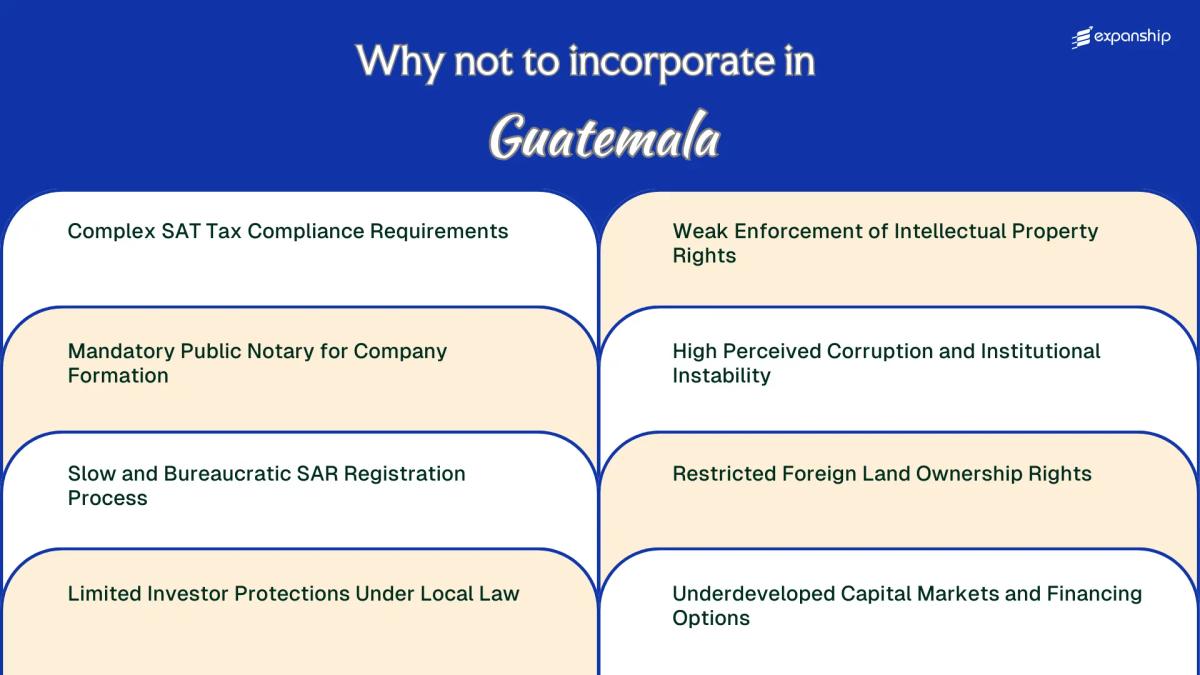
Complex SAT Tax Compliance Requirements
Guatemala SAT tax compliance problems represent one of the more operationally demanding aspects of running a registered entity in the country, particularly for foreign business owners unfamiliar with the local regulatory structure.
Filing Obligations Under the Superintendencia de Administración Tributaria
All companies registered in Guatemala must fulfill their tax obligations through the Superintendencia de Administración Tributaria (SAT), which administers corporate income tax, VAT, and withholding requirements. Corporate income tax is levied at a flat rate of 25% under the Impuesto Sobre la Renta regime, and VAT is set at 12%, with monthly declaration cycles that require consistent local bookkeeping capacity. Foreign-owned firms without a permanent local accounting team frequently fall out of compliance simply due to the volume and frequency of SAT Guatemala filing requirements.
Penalties and Audit Exposure for Foreign Entities
SAT holds authority to conduct audits and impose financial penalties for late or incorrect filings, and foreign directors who lack familiarity with Guatemala's tax code face disproportionate exposure to these risks. Errors in transfer pricing documentation or misclassification of income categories are common triggers for audit proceedings.
Foreign business owners without a locally licensed contador should expect material compliance gaps that SAT can penalize retroactively, including across prior fiscal years.
Mandatory Public Notary for Company Formation
Guatemala notary requirements for company formation add a layer of procedural cost that does not exist in many comparable jurisdictions. Under the Guatemalan Commercial Code (Decreto 2-70), all sociedades anónimas and other commercial entities must be constituted through a public deed drafted and authenticated by a licensed Notario Público. This is not an optional formality — without notarization, the company has no legal existence.
Notary fees are not standardized by a fixed public rate, which means costs vary and are often negotiable, creating unpredictability for foreign incorporators unfamiliar with local market norms.
For a foreign business owner, this mandatory notary requirement creates several concrete friction points:
- Every amendment to the company's deed, including changes to directors or capital structure, requires a return to a Guatemalan notary, generating recurring legal fees throughout the entity's lifespan.
- You cannot execute formation documents remotely or through a foreign notary, forcing either physical presence in-country or reliance on a local legal representative.
- Drafting errors or notarial deficiencies can delay registration with the Registro Mercantil, extending your incorporation timeline by weeks.
- Translation and apostille requirements for foreign-language supporting documents add cost before the notary can proceed.
Digital or remote incorporation, which is standard across much of the EU and increasingly common in Latin America, remains unavailable here.

Company Incorporation in Guatemala
Understand what it takes to incorporate a legal entity in Guatemala, including notary coordination and Registro Mercantil filing.
Slow and Bureaucratic SAR Registration Process
The SAR Guatemala registration process delays begin well before your company can legally operate. New entities must register with the Registro Mercantil, the official commercial registry, before conducting any business activity. Processing times at this institution frequently extend beyond the timelines published officially, with practical delays often stretching several weeks due to document queues, manual review procedures, and inter-agency coordination requirements.
Each submission is subject to review for formal compliance with the Código de Comercio, and any deficiency in documentation triggers a formal objection requiring resubmission. A single corrective cycle can add two to four weeks to your timeline, a meaningful operational cost when market entry timing matters.
| Registration Stage | Typical Delay | Business Impact |
|---|---|---|
| Initial document review | 2–4 weeks | Delayed legal existence |
| Deficiency correction cycle | 2–4 weeks per round | Compounding timeline risk |
| Publication in Diario de Centro América | Variable scheduling | Cannot finalize registration until published |
| Full registration completion | 6–10+ weeks total | Operational paralysis during this period |
Publication in the Diario de Centro América, the official state gazette, is a mandatory step before registration is considered complete. Your firm cannot open a corporate bank account or register with SAT until this step is finalized, creating a bottleneck with no practical workaround. The dependency on a government publication schedule sits entirely outside your control.
Limited Investor Protections Under Local Law
Guatemala's Commercial Code (Decreto 2-70) provides the foundational legal framework for company formation, but it offers foreign investors limited recourse in shareholder disputes. Minority shareholders in a Sociedad Anónima have few statutory mechanisms to challenge board decisions or demand information disclosure, placing significant control in the hands of majority stakeholders.
Limited investor protections in Guatemala mean that contractual agreements often bear more weight than statutory defaults. If your shareholders' agreement is poorly drafted or unenforceable under local law, you have minimal fallback protection. Judicial enforcement of investor rights through Guatemalan civil courts is slow and inconsistent.
There is no independent securities regulator comparable to the U.S. SEC or the UK's FCA. That absence leaves foreign minority investors with little institutional support when disputes arise over equity ownership or profit distributions.
- Minority shareholder protections under Decreto 2-70 are limited by default; bespoke contractual protections must be explicitly negotiated.
- No dedicated securities regulator exists to oversee or arbitrate shareholder disputes.
- Civil court proceedings for commercial disputes are subject to prolonged timelines.
- Foreign investors cannot assume international investor protection standards apply domestically.
Guatemala has bilateral investment treaties with several countries, yet domestic investor protections within company law remain largely unchanged since the Commercial Code was enacted in 1970.
Weak Enforcement of Intellectual Property Rights
Intellectual property rights risks Guatemala presents to foreign businesses stem from a legal framework that, while formally established, suffers from limited practical enforcement capacity at the institutional level.
Structural Gaps in IP Protection
Guatemala is a signatory to the Agreement on Trade-Related Aspects of Intellectual Property Rights (TRIPS) and has domestic IP legislation under Decree 57-2000 (the Industrial Property Law). However, the Registro de la Propiedad Intelectual, the body responsible for trademark and patent registration, operates with procedural delays that can extend registration timelines significantly, leaving your mark unprotected in the interim.
Counterfeiting and trademark infringement are documented problems, particularly in consumer goods sectors. Weak IP enforcement Guatemala businesses face is compounded by an understaffed judiciary with limited specialization in IP matters, meaning civil and criminal cases rarely reach timely resolution.
Consequences for Foreign Trademark Holders
Guatemala trademark protection challenges are most acute for foreign firms that register IP in their home jurisdiction but fail to file locally, as Guatemala follows a first-to-file system. A third party can register your brand name domestically before you do, creating costly disputes.
Even with valid local registration, enforcement through the courts is slow and resource-intensive, and border enforcement against counterfeit imports remains inconsistent.
Protecting Your Business Interests in Guatemala
Expanship can connect you with local legal counsel and guide you through IP registration and compliance requirements to reduce your exposure in the Guatemalan market.
High Perceived Corruption and Institutional Instability
Guatemala corruption risks for businesses are documented extensively by international indices, with Transparency International's Corruption Perceptions Index consistently ranking the country in the lower tier globally, reflecting systemic concerns that extend into commercial and judicial operations.
- Judicial rulings in commercial disputes can be influenced by factors outside the merits of the case, which undermines your ability to rely on courts as a neutral enforcement mechanism.
- The Ministerio Público and CICIG (now dissolved) historically exposed deep institutional interference in public procurement, meaning government contracts carry elevated due diligence burdens for foreign firms.
- Institutional instability Guatemala incorporation drawbacks include frequent turnover in regulatory leadership at bodies such as SAT and SAR, which disrupts procedural consistency your business depends on for compliance planning.
- Informal payments to expedite administrative processes, while illegal under Guatemala's Ley Contra la Corrupción, remain a reported operational reality that creates legal exposure for foreign-owned entities subject to extraterritorial anti-bribery laws such as the U.S. FCPA.
- Guatemala governance risks for foreign companies are compounded by limited whistleblower protections, reducing the internal reporting options available to multinational firms operating local subsidiaries.
Restricted Foreign Land Ownership Rights
Foreign land ownership restrictions in Guatemala create a structural constraint that can directly affect how your business acquires and uses real property. Under the Guatemalan Constitution, certain categories of land — including areas within 15 kilometers of international borders and islands — are reserved exclusively for Guatemalan nationals and cannot be acquired by foreign individuals or foreign-registered entities.
For a foreign company incorporated locally as a Sociedad Anónima, the restriction still applies if the firm is majority foreign-owned and the target property falls within a restricted zone. This limits site selection for logistics operations, agricultural ventures, and manufacturing facilities that depend on border-adjacent land.
Qualifying for ownership through a locally incorporated entity does not eliminate the risk entirely. Regulatory interpretation of what constitutes foreign control can vary, and title security in rural areas remains inconsistent due to gaps in the national land registry.
A foreign logistics firm seeking to establish a distribution hub near the border with Mexico would be constitutionally barred from acquiring land within the 15-kilometer restricted zone, regardless of its local incorporation status — forcing the business to pursue long-term lease arrangements that carry no ownership equity and greater tenure uncertainty.
Underdeveloped Capital Markets and Financing Options
Guatemala's underdeveloped capital markets severely limit how a foreign-incorporated entity can raise growth capital outside of traditional bank lending. The Bolsa de Valores Nacional (BVN), the country's primary stock exchange, remains thinly traded and largely inaccessible to small or mid-sized foreign companies seeking equity financing.
Debt financing through local banks typically requires substantial collateral, often in the form of local real estate, which compounds the restrictions foreign firms already face on land ownership. Credit access for businesses without an established local banking history is further constrained by conservative lending criteria from institutions supervised by the Superintendencia de Bancos (SIB).
Venture capital and private equity ecosystems are nascent compared to regional peers like Mexico or Colombia, where dedicated funds and formal deal infrastructure exist at scale. For a foreign business that depends on staged equity rounds or institutional funding to operate, this gap translates directly into a reliance on offshore financing structures, which add legal complexity and cost.
- Angel investment networks are informal and lack standardized term frameworks.
- Corporate bond issuance through the BVN is technically available but rarely used by foreign-owned entities due to listing requirements and low secondary market liquidity.
Foreign companies without an established local credit history or Guatemalan-held collateral will find access to SIB-regulated institutional lending effectively closed, regardless of the company's financial standing in its home jurisdiction.
Mitigating the Challenges of Incorporating in Guatemala
Mitigating the challenges of incorporating in Guatemala requires structural decisions made before the entity is registered, not after problems surface. The jurisdiction's regulatory conditions reward advance preparation over reactive compliance.
- Engage a licensed Guatemalan notary (notario) at the outset, as company formation under the Código de Comercio cannot proceed without notarised public deed documentation.
- Register your entity with the SAT under the correct tax regime from the start, since reclassification after registration creates retroactive compliance exposure.
- Structure intellectual property rights through international treaties such as the TRIPS Agreement and deposit filings with the Registro de la Propiedad Intelectual before commercial operations begin.
- Where land acquisition is a business objective, engage a local legal representative to assess constitutional ownership restrictions before entering any purchase agreement.
- Establish financing arrangements through foreign parent entities or international credit facilities prior to incorporation, given the limited depth of domestic capital markets.
Guatemala's regulatory bodies, including the SAR and SAT, operate within a framework shaped by domestic legislation that changes independently of international norms. Understanding that these institutions set the binding compliance baseline is a necessary starting point for any foreign operator.
Guatemala's Overall Appeal for Foreign Investors
Guatemala presents a mixed picture for foreign investors. The Guatemala foreign investment drawbacks vs appeal calculation ultimately depends on how well a specific business model can absorb the compliance burden, institutional friction, and enforcement gaps documented across this article. For certain profiles, the country's strategic position, young workforce, and dollarized-adjacent trade environment still make it a credible destination.
| Pros | Cons |
|---|---|
| No restrictions on foreign ownership of shares in most entity types | SAT imposes dual tax regimes requiring an active filing decision that carries ongoing compliance risk |
| Guatemala borders both the Pacific and Atlantic coasts, supporting trade and logistics operations | A mandatory public notary must authenticate all formation documents, adding cost and procedural dependency |
| The Sociedad Anónima structure is a recognized corporate form familiar to international counterparts | SAR registration timelines are subject to bureaucratic delays outside the applicant's control |
| Foreign investors may repatriate profits without capital controls under current general law | IP rights enforcement through MARN and the courts remains unreliable in practice |
| Free trade zone regimes offer tax incentives for qualifying export-oriented activities | Land ownership for foreign nationals is subject to specific constitutional restrictions |
Institutional instability and perceived corruption, as measured by indices such as Transparency International's CPI, remain structural concerns rather than isolated incidents.
Compliance Services for Companies in Guatemala
Ongoing compliance obligations in Guatemala include SAT tax filings, annual SAR reporting, and corporate recordkeeping under the Código de Comercio. This service covers the recurring requirements your entity must meet to remain in good standing.
Conclusion
Guatemala presents a documented set of structural barriers for foreign investors, and the cons of incorporating in Guatemala are not minor procedural inconveniences. SAT's layered tax compliance obligations, the slow SAR registration process, and pervasive concerns about institutional integrity each carry practical consequences for your business. Structural gaps in intellectual property enforcement add further exposure for firms holding intangible assets. How your entity manages these conditions from the outset will determine much of its operational stability. Professional guidance specific to Guatemalan corporate and tax law remains a material factor in whether a registered entity functions as intended.
Expanship's Guatemala Incorporation Support Services
Incorporating in Guatemala involves a chain of regulatory touchpoints that can slow your timeline and increase administrative exposure. From coordinating with a public notary to registering with the Registro Mercantil and fulfilling SAT tax obligations, each step carries its own procedural requirements. Expanship's Guatemala incorporation support services are structured around these specific compliance burdens, helping your business move through each stage without accumulating preventable delays.
Beyond the formation process itself, our team supports the ongoing obligations that follow registration.
- Preparing and filing all company registration documents with the relevant authorities
- Providing a registered agent and local office address for your entity in Guatemala
- Handling government filings and liaising directly with bodies such as the SAT and Registro Mercantil
- Managing post-incorporation compliance obligations on a continuing basis
- Facilitating introductions to local banking institutions suited to your business structure
- Registering your firm with tax authorities and coordinating with local regulatory bodies
To discuss how we can support your Guatemala entry, contact Expanship Guatemala.
Frequently Asked Questions (FAQ)
SAT's compliance requirements apply to all registered entities regardless of size, which means a small foreign-owned Sociedad Anónima faces the same filing obligations as a large corporation. Guatemala operates both a net income tax regime and an optional simplified gross income regime under the Income Tax Law (Decreto 10-2012), and misclassifying your filing basis can trigger audits or penalties. Smaller firms without dedicated local accounting support are disproportionately exposed to compliance errors.
Late or missing filings with SAT can result in monetary fines, interest charges on unpaid tax, and in more serious cases, criminal liability under Guatemala's tax code. Fines are calculated as a percentage of the outstanding tax liability, and repeated non-compliance can lead to the suspension of your firm's tax registration. Operating without an active tax registration makes it legally impossible to issue invoices or enter formal commercial contracts.
Guatemala's requirement that a licensed Guatemalan notary draft and authenticate the deed of incorporation is stricter than in some neighboring countries where online or self-filing procedures have been introduced. The notary does not simply witness signatures; under Guatemalan law, the public notary (Notario) is legally responsible for the constitutional documents and their conformity with the Código de Comercio. This creates a hard dependency on a qualified local professional that cannot be substituted by a foreign lawyer or a digital process.
Foreign individuals face restrictions on owning land within 15 kilometers of Guatemala's borders or coastlines under the Political Constitution of Guatemala. For business operations in unrestricted zones, a foreign-owned Sociedad Anónima can hold property, but the constitutional limitations mean that certain industrial or agricultural sites near frontier areas are effectively off-limits without a Guatemalan partner. This is a structural constraint, not an administrative one, and it cannot be resolved through corporate structuring alone.
Enforcement is the core problem, not registration. Guatemala is party to international IP treaties and has a domestic registration framework, but the practical capacity to pursue infringers through the courts is limited by slow judicial processes and inconsistent application of IP statutes. A registered trademark or patent provides legal standing but does not guarantee timely or effective relief, making Guatemala a jurisdiction where deterrence through registration is weaker than in more developed IP enforcement environments.
Guatemala's Bolsa de Valores Nacional is small relative to regional peers, and bank lending to foreign-owned entities often requires substantial collateral and local credit history. If your business plan depends on equity financing or credit facilities beyond what retained earnings or parent-company loans can cover, you will likely need to arrange financing outside Guatemala entirely. This limits the firm's ability to scale using local capital and adds currency and jurisdictional complexity to your funding structure.
Legal Disclaimer
The information provided in this article is for general informational purposes only and does not constitute legal, tax, or professional advice. While we strive to ensure the accuracy and timeliness of the content, laws and regulations are subject to change, and the application of laws can vary widely based on specific facts and circumstances.
Readers should not act upon this information without seeking professional counsel tailored to their individual situation. Expanship and its authors disclaim any liability for actions taken or not taken based on the content of this article.
For specific advice regarding your business setup, compliance requirements, or any legal matters, please consult with qualified legal and tax professionals in the relevant jurisdiction.