

Key Takeaways
- All Greek companies must register with the General Commercial Registry (GEMI) under the framework established by Law 4548/2018 for Sociétés Anonymes or Law 4072/2012 for Private Capital Companies (I.K.E.), and failure to satisfy filing requirements results in rejection of the registration application.
- Minimum share capital thresholds vary by entity type, meaning founders must confirm the applicable requirement for their chosen structure before initiating the incorporation process with GEMI.
- Beneficial ownership information must be submitted to the Financial Intelligence Unit in accordance with Greek UBO registration obligations, forming a mandatory post-incorporation compliance step for all qualifying entities.
- The registered office declared at the point of formation must correspond to an actual operational address within Greek territory, not a nominal or virtual location that cannot satisfy GEMI's verification requirements.
Company incorporation requirements in Greece are governed primarily by Law 4548/2018, which regulates Sociétés Anonymes (S.A.), and Law 4072/2012, which covers Private Capital Companies (I.K.E.) and other entity forms. The General Commercial Registry, known as GEMI (Γ.Ε.ΜΗ.), serves as the central body responsible for registering and maintaining commercial entities.
This article covers the structural, documentary, and statutory requirements that apply at the point of formation and ongoing compliance under Greek company law.
Failure to meet these requirements results in rejection of the registration application by GEMI or, in the case of post-incorporation non-compliance, exposure to administrative penalties and potential loss of legal standing.
Requirements differ depending on whether you are forming an I.K.E., an S.A., a General Partnership (O.E.), or a Limited Partnership (E.E.), and may be further shaped by the sector in which your business operates.
Foreign investors, non-resident entrepreneurs, and multinational entities establishing a subsidiary or branch in Greece will find this article directly applicable to their formation process.
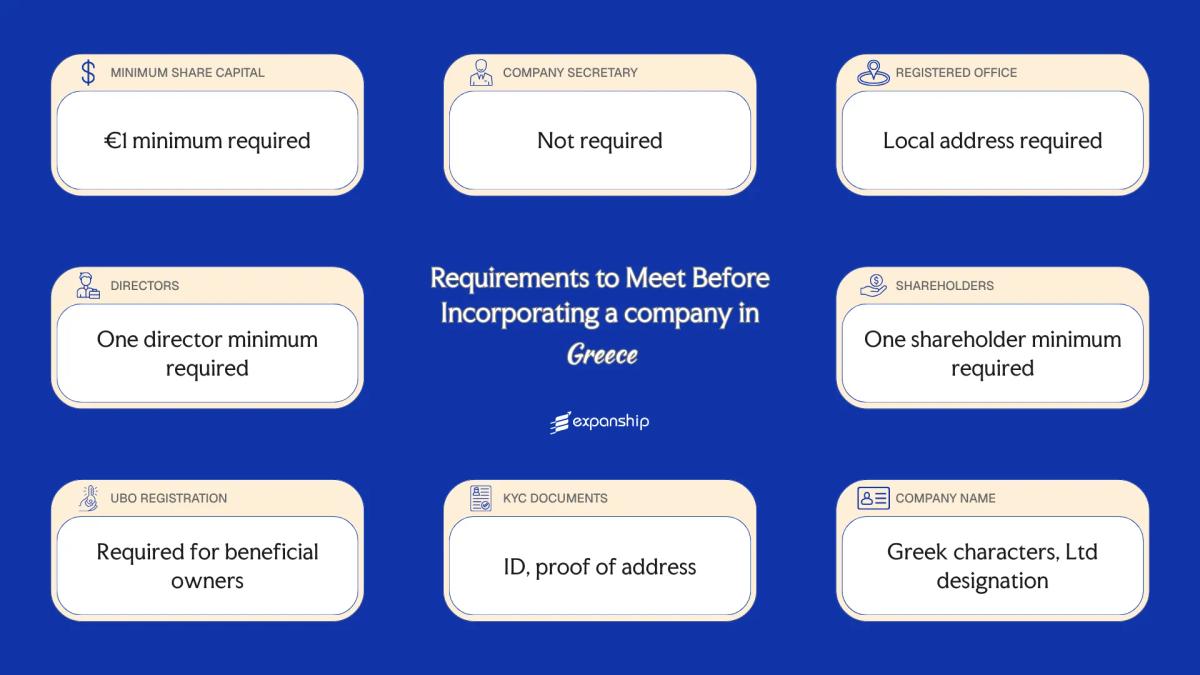
Minimum Share Capital Requirements in Greece
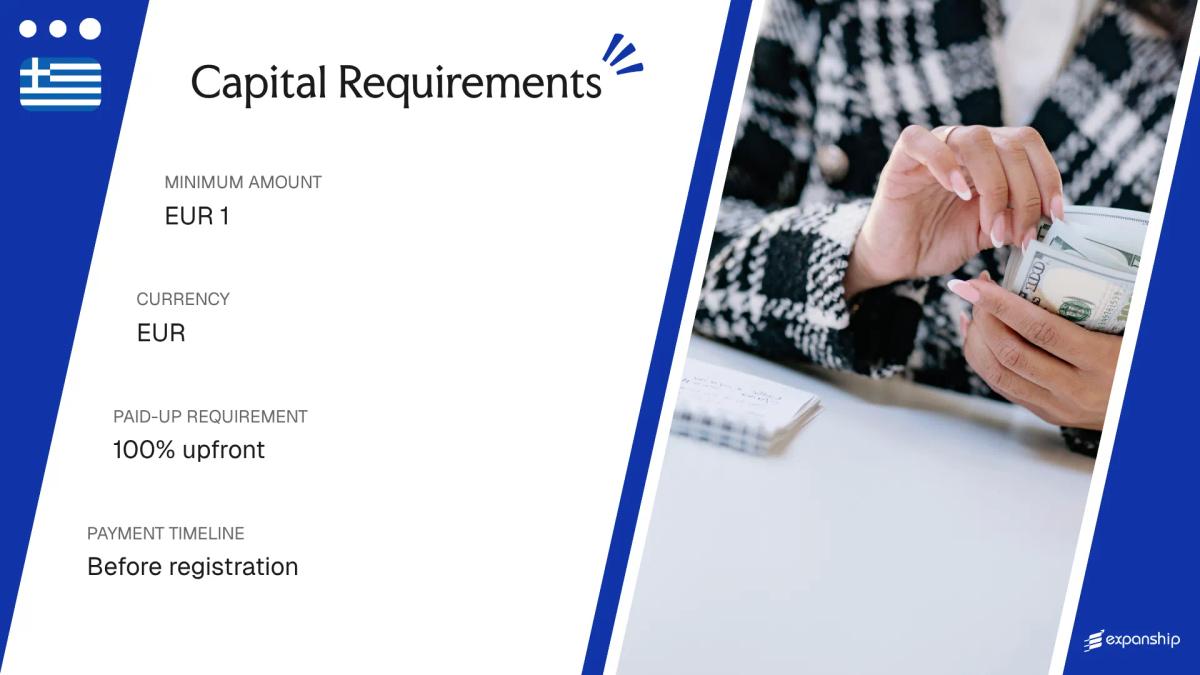
Greece operates on a par value share system, meaning each share must carry a fixed nominal value. The minimum share capital requirements in Greece differ by entity type, with the Societe Anonyme (AE) and the Limited Liability Company (EPE) each subject to distinct statutory thresholds under Greek corporate law.
Capital verification at incorporation falls under the remit of the General Commercial Registry (GEMI), which reviews documentation confirming that the required capital has been deposited or contributed before the entity is registered.
| Parameter | Detail |
|---|---|
| Minimum Authorized Share Capital | EUR 25,000 for AE; EUR 1 for EPE (no statutory minimum beyond EUR 1 per share) |
| Maximum Authorized Share Capital | No statutory requirement |
| Minimum Paid-Up Capital | EUR 25,000 for AE at incorporation; no prescribed minimum for EPE |
| Paid-Up Requirement at Incorporation | 25% of subscribed capital for AE must be paid up at registration |
| Accepted Currency | Euro (EUR) |
| Accepted Forms of Contribution | Cash contributions; non-cash contributions subject to independent valuation |
| Timeframe to Deposit Capital | Prior to or at the point of registration with GEMI |
For an AE, the minimum paid-up portion must be deposited into a dedicated bank account before GEMI processes the registration. Proof of deposit is a required submission document, not a post-incorporation obligation.
Company Secretary Requirements in Greece
Greek law does not impose a mandatory company secretary requirement for the most common corporate forms, including the private capital company (IKE) and the société anonyme (AE). Under the Greek Companies Act (Law 4548/2018 for AEs and Law 4072/2012 for IKEs), neither entity type is legally required to appoint a dedicated corporate secretary as a distinct officer role.
That said, AEs with more complex governance structures may designate a secretary to the board of directors to support administrative functions. This individual typically handles record-keeping, maintains the minute book, and ensures that board resolutions are properly documented and filed with the General Commercial Registry (GEMI).
Qualification criteria for those serving in a secretary or equivalent administrative capacity:
- No statutory licensing requirement applies; the role is governed by internal company rules or articles of association.
- Both natural persons and legal entities may serve, subject to the company's constitutional documents.
- Greek residency is not a prescribed condition for this role under current legislation.
- The individual or entity must have legal capacity under Greek civil law.

Incorporate a Company in Greece
Set up your legal entity in Greece with full support on structure selection, GEMI registration, and statutory documentation.
Registered Office Requirements in Greece
Registered office requirements in Greece mandate that every company maintain a physical address within the country, serving as the official seat (έδρα) recorded in the General Commercial Registry (GEMI). Failure to maintain a compliant registered address can result in administrative penalties and may affect the firm's good standing under Greek company law (Law 4548/2018 for Sociétés Anonymes and Law 4072/2012 for private companies).
- A physical address is required; P.O. boxes do not satisfy the registered seat obligation under Greek law.
- Virtual office addresses are generally accepted provided they correspond to a verifiable physical location in Greece.
- The registered address must be located within Greece; a foreign address does not satisfy the statutory seat requirement.
- Supporting documentation, such as a lease agreement or proof of property ownership, is typically required to substantiate the address during registration.
- The registered seat is publicly listed in GEMI and accessible through the official online registry portal.
- Any change to the registered address must be formally notified to GEMI, requiring a shareholder or board resolution and submission of the relevant amendment filing.
Director Requirements in Greece
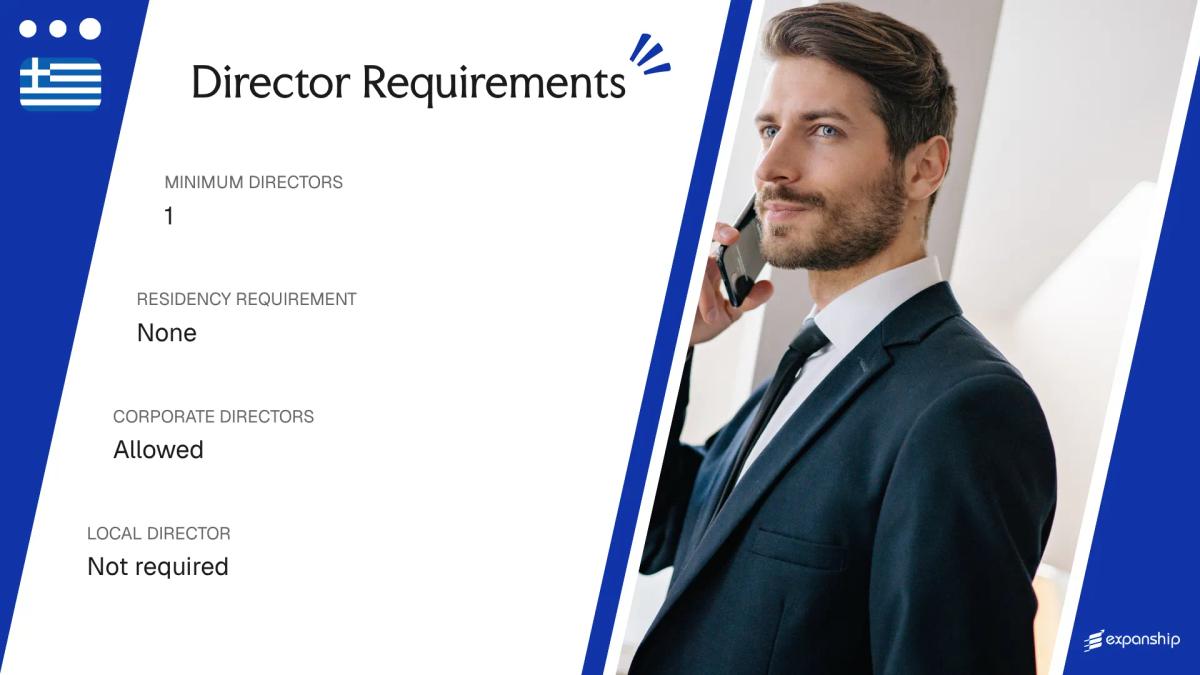
Under Greek law, directors of an Anonymi Etaireia (AE) assume statutory duties upon appointment that include acting in the company's best interest, maintaining accurate financial records, and filing required disclosures with the General Commercial Registry (GEMI). Personal liability can arise under Law 4548/2018 where a director's actions cause loss to the entity or third parties.
| Parameter | Detail |
|---|---|
| Minimum Number of Directors | A minimum of one director is required for an AE. |
| Maximum Number of Directors | No statutory maximum is prescribed under Law 4548/2018. |
| Local/Resident Director Required | No residency requirement exists under Greek law. |
| Nationality Restrictions | No nationality restrictions apply to directors of a Greek AE. |
| Minimum Age Requirement | Directors must be at least 18 years of age. |
| Corporate Directors Permitted | Corporate directors are not permitted; only natural persons may serve. |
| Director Must Be a Shareholder | No statutory requirement for a director to hold shares in the company. |
| Publicly Listed on Registry | Directors are recorded in GEMI and the information is publicly accessible. |
| Disqualification Conditions | Persons convicted of financial crimes or subject to bankruptcy restrictions may be disqualified under Greek law. |
Greece permits a single individual to serve simultaneously as the sole director, sole shareholder, and legal representative of an AE, concentrating full corporate authority in one person without any statutory obligation to appoint additional oversight.
Shareholder Requirements in Greece
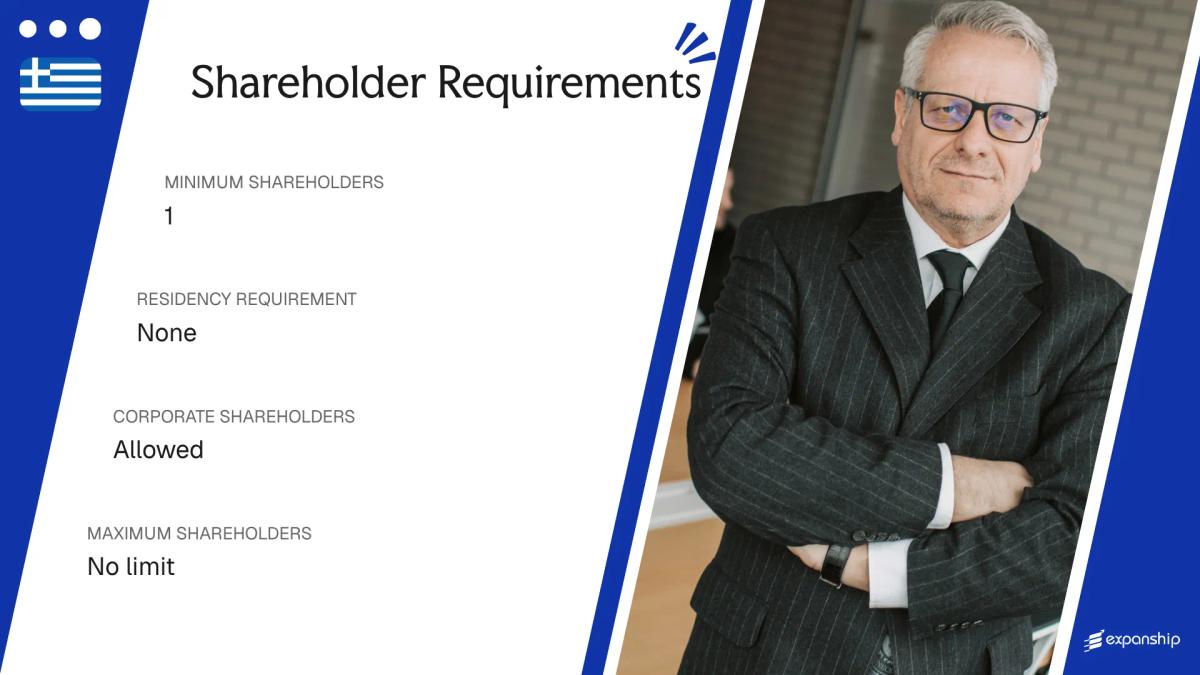
Greek law permits the formation of a Private Company (IKE) with a single shareholder, making a sole-shareholder structure fully valid. For a Société Anonyme (AE), at least one shareholder is also sufficient under current Greek corporate legislation.
Nationality and Residency Restrictions
Shareholder requirements in Greece impose no nationality or residency conditions on individual shareholders. Foreign nationals and non-residents may hold shares in both IKE and AE entities without ownership percentage restrictions.
Corporate Shareholders
Corporate entities are permitted to act as shareholders in Greek companies. No specific conditions unique to corporate shareholders are imposed beyond the standard documentation requirements applicable during incorporation.
Shareholder Liability
In an IKE, shareholder liability is limited to each member's capital contribution. An AE follows the same principle, with shareholders liable only to the extent of their subscribed share capital.
Register of Shareholders
An IKE must maintain a register of shareholders, which records ownership interests and any transfers. The General Commercial Registry (GEMI) holds filing obligations for certain ownership changes, though full shareholder registers are not publicly accessible in their entirety.
Shareholder Structuring Support for Your Greek Entity
Get guidance on structuring your ownership framework in compliance with Greek corporate law before and during the incorporation process.
UBO / Beneficial Ownership Registration Requirements in Greece
Beneficial ownership registration requirements Greece are governed by Law 4557/2018, which transposed the EU's Fourth Anti-Money Laundering Directive into national law and was subsequently updated to reflect the Fifth AMLD. A beneficial owner is defined as any natural person holding, directly or indirectly, more than 25% of the shares or voting rights in a legal entity.
- Identify all natural persons who meet or exceed the 25% ownership or control threshold.
- Submit UBO data to the General Commercial Registry (GEMI) at the time of incorporation or within 60 days of any subsequent change.
- Confirm the accuracy of UBO records on an annual basis, even where no changes have occurred.
- Retain supporting documentation that substantiates the declared ownership structure.
| Parameter | Detail |
|---|---|
| Ownership Threshold for UBO Status | Above 25% of shares or voting rights |
| Filing Authority | General Commercial Registry (GEMI) |
| Disclosure Deadline at Incorporation | At the time of incorporation |
| Publicly Accessible Register | Partially; competent authorities and obliged entities have full access |
| Penalties for Non-Disclosure | Administrative fines under Law 4557/2018; amounts determined by the supervising authority |
| Ongoing Update Obligation | Annual confirmation required; updates due within 60 days of any change |
KYC / Document Requirements in Greece
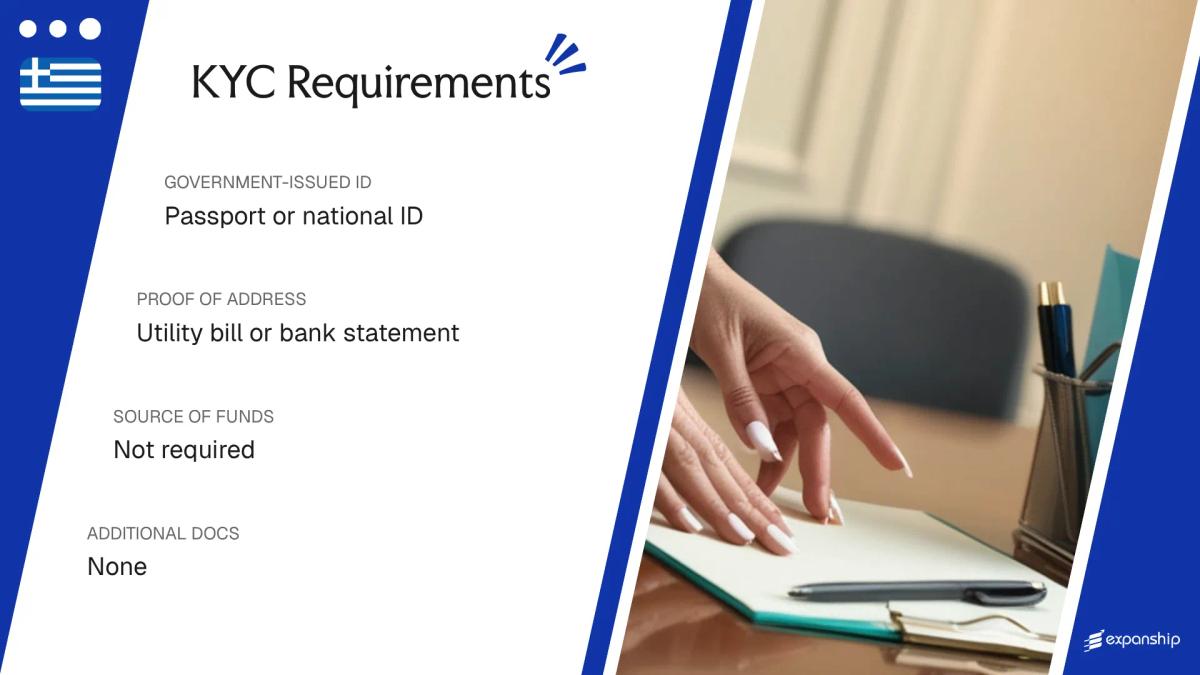
KYC document requirements Greece incorporation are governed by Law 4557/2018, which transposed the EU's Fourth Anti-Money Laundering Directive into national law and was subsequently amended to align with the Fifth AMLD. The HELLENIC FIU oversees compliance obligations applicable to obliged entities, including lawyers and notaries involved in company formation.
Individual / Personal Documents
- Valid government-issued photo ID (passport or national identity card) for each director, shareholder, and beneficial owner
- Proof of residential address dated within three months, such as a utility bill or bank statement
- Tax identification number (AFM) where the individual is a Greek tax resident
- Completed and signed KYC declaration form as required by the notary or formation agent
Corporate Documents
- Certificate of incorporation or equivalent constitutional document from the entity's home jurisdiction
- Articles of association or memorandum confirming the corporate structure
- Current register of directors and shareholders of the corporate entity
- Proof of registered address of the corporate shareholder or director
Source of Funds Documentation
- Recent bank statements covering at least three months prior to incorporation
- Audited financial statements where the entity has been trading for more than one financial year
- Written declaration of the origin of capital if the source cannot be evidenced through financial records
Notarisation and Apostille Requirements
- Foreign-issued identity documents must generally be accompanied by an official translation into Greek
- Corporate documents originating outside Greece require an Apostille under the 1961 Hague Convention
- Notarisation must be performed by a qualified notary in the issuing country before the Apostille is affixed
The most common cause of incorporation delay is the submission of address verification documents older than three months at the time of filing.
Company Name Requirements in Greece
Company name requirements in Greece are assessed at the point of registration through the General Commercial Registry (GEMI), which cross-checks proposed names against its existing database before approval is granted.
Greek law requires that the company name be written in Greek characters. A legal suffix denoting the entity type is mandatory; for example, an Anonymi Etaireia must include "A.E." and a Private Capital Company must include "I.K.E."
Certain words are restricted and require prior approval from relevant authorities before GEMI will accept them. Terms implying state affiliation, regulated professional activities, or financial institutions fall into this category.
Name reservation is available through GEMI prior to formal incorporation. Reserved names are held for a defined period, during which no other entity may register an identical or confusingly similar name.
Compliance Services for Companies in Greece
Maintain your Greek entity's good standing with ongoing compliance support, from annual filings to GEMI obligations.
Conclusion
Greece company incorporation requirements span several distinct legal obligations, from the structural rules under Law 4601/2019 governing Societas Europaea and private companies, to UBO registration with the Financial Intelligence Unit. Minimum share capital thresholds differ by entity type, and the registered office must correspond to an actual operational address within Greek territory. Director residency carries no statutory restriction, but appointment formalities must be completed before the General Commercial Registry (GEMI) finalises registration. Once these requirements are understood, the practical next step is coordinating document preparation, notarisation, and filings across the relevant Greek authorities.
Expanship's Corporate Services for Greece Expansion
Expanship's corporate services for Greece expansion cover the specific procedural and compliance requirements that come with setting up a business under Greek law — from preparing notarially certified documents to registering with the General Commercial Registry (GEMI) and meeting the share capital thresholds applicable to your chosen entity type. The goal is to reduce the administrative coordination involved, not to sidestep the requirements themselves.
Beyond initial registration, Expanship supports your business across the full setup process:
- Preparing and filing company registration documents with GEMI and coordinating notarial deed execution
- Providing a registered agent and a compliant local office address in Greece
- Handling government filings and liaising directly with Greek regulatory bodies on your behalf
- Managing post-incorporation obligations to keep your entity in good standing
- Facilitating introductions to banking institutions familiar with foreign-owned Greek entities
- Registering your business for tax purposes with the Greek Tax Authority (AADE) and handling local authority filings
To discuss your incorporation requirements, contact Expanship Greece.
Frequently Asked Questions (FAQ)
A non-resident director must obtain a Greek Tax Registration Number (AFM) from the Greek Tax Authority (AADE) before or during the incorporation process. This applies regardless of nationality or residency status. Without an AFM, the director cannot be formally registered with the General Commercial Registry (GEMI) or execute notarial documents required for incorporation.
Failure to register or update beneficial ownership information in the Greek UBO Registry, held under the Ministry of Finance, can result in administrative fines. The obligation applies to all Greek legal entities, and non-compliance can also restrict the company's ability to open bank accounts or access certain public contracts. Repeated or deliberate non-disclosure carries escalating penalties under the national AML framework implementing the EU's Fourth and Fifth Anti-Money Laundering Directives.
A virtual or serviced office address is generally acceptable as the registered office for a Greek company, provided it can receive official correspondence and is registered with GEMI. The address must be a physical location within Greece; a P.O. box does not satisfy the requirement. Some banks may scrutinise virtual office arrangements during account opening, so the nature of the address can have practical downstream consequences.
Greek law requires that the company name be expressed in Greek characters, though a transliteration or translation of a foreign-language name is permitted. The name must be distinct from existing registered entities and cannot mislead the public about the nature of the business. GEMI conducts a name availability check as part of the registration process, and approval is not guaranteed for names that closely resemble existing registrations.
A single-member IKE retains the same limited liability protection as a multi-member IKE; the sole shareholder's personal assets remain separate from the company's obligations. The tax treatment is also consistent, with corporate income taxed at the applicable rate under Greek income tax law rather than passed through to the individual. The single-member structure does, however, require that certain decisions normally made by a general meeting be documented in writing by the sole shareholder.
A foreign national shareholder must provide a certified copy of a valid passport, proof of residential address, and an AFM obtained from AADE. Where the shareholder is a corporate entity rather than an individual, certified constitutional documents, a certificate of good standing, and UBO documentation for the parent company are also required. Notarised and apostilled versions of foreign documents are standard requirements under Greek notarial and GEMI practice.
Legal Disclaimer
The information provided in this article is for general informational purposes only and does not constitute legal, tax, or professional advice. While we strive to ensure the accuracy and timeliness of the content, laws and regulations are subject to change, and the application of laws can vary widely based on specific facts and circumstances.
Readers should not act upon this information without seeking professional counsel tailored to their individual situation. Expanship and its authors disclaim any liability for actions taken or not taken based on the content of this article.
For specific advice regarding your business setup, compliance requirements, or any legal matters, please consult with qualified legal and tax professionals in the relevant jurisdiction.