
Key Takeaways
- Under Law 4548/2018, forming a société anonyme (SA) in Greece requires meeting a mandatory minimum share capital threshold, creating an upfront financial barrier that does not apply to private company (IKE) structures under Law 4072/2012.
- Employer social security contributions in Greece rank among the higher burdens in the EU, directly increasing the cost of hiring local staff and reducing the competitiveness of labor-intensive business models.
- Frequent amendments to Greek tax legislation administered by AADE make long-term financial planning materially more difficult, as corporate tax rules, rates, and reporting obligations have shifted repeatedly over recent years.
- Greece's administrative registration process through GEMI, combined with layered bureaucratic requirements across multiple authorities, extends the timeline and compliance cost of establishing an active commercial presence compared to more streamlined EU jurisdictions.
Greece operates under a heavily regulated corporate framework, shaped by European Union directives and domestic legislation including the Greek Company Law — formally Law 4548/2018 for sociétés anonymes and Law 4072/2012 for private companies (IKE). Understanding the disadvantages of incorporating in Greece requires examining several distinct categories, spanning registration procedures, taxation, labor obligations, and financing conditions.
The specific challenges covered in this article range across operational, legal, and financial dimensions of running a business entity here. Not all of these disadvantages apply equally — their impact depends substantially on the legal form you choose, the industry your firm operates in, and whether your structure involves cross-border transactions or local Greek employees.
This article is most relevant to foreign investors and non-resident business owners considering an active commercial presence, particularly those unfamiliar with Greek administrative processes or the requirements imposed by AADE, the Independent Authority for Public Revenue.
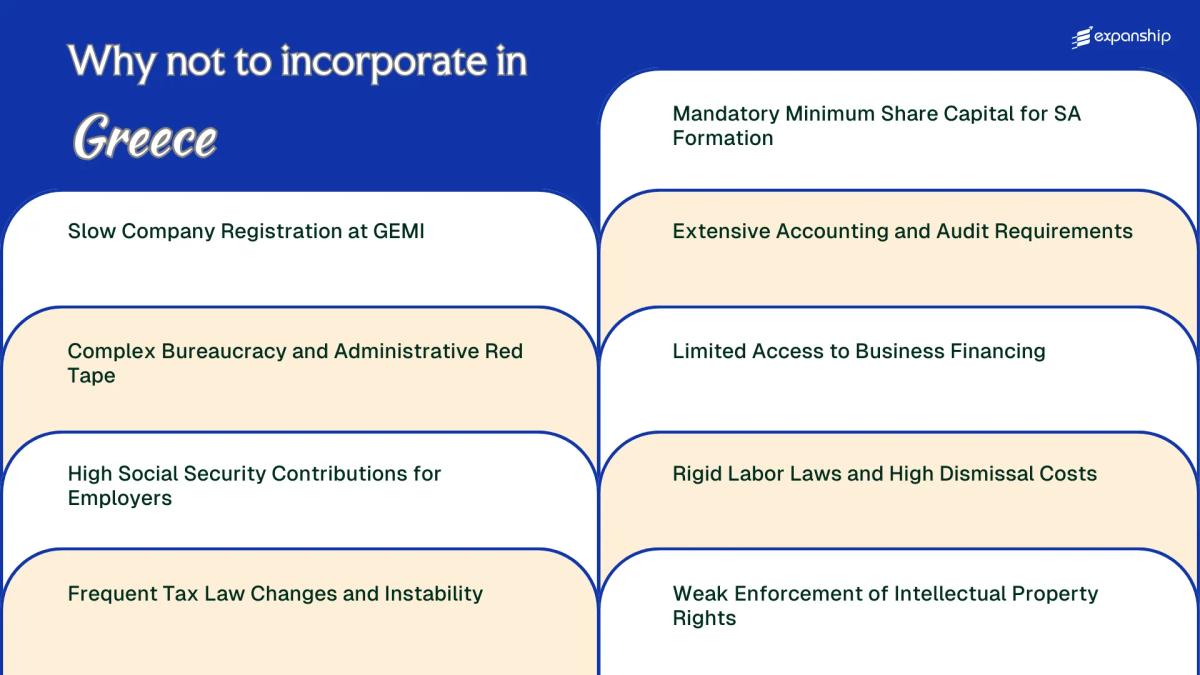
Slow Company Registration at GEMI
Slow company registration at GEMI (General Electronic Commercial Registry) is a documented friction point for foreign investors entering the Greek market. Even with digital reforms, the process carries structural delays that affect your ability to start operations on schedule.
Registration Timelines and Why They Slip
Registering a Private Company (IKE) or Limited Liability Company (EPE) through GEMI can take anywhere from several days to several weeks, depending on the regional chamber handling the filing and whether notarial documentation is required. Any discrepancy in submitted documents triggers a formal rejection cycle, restarting portions of the review.
The Cost of Delayed Legal Existence
Until GEMI issues a registration number and publishes the company in the Government Gazette, your entity has no legal standing. This means you cannot open a corporate bank account, execute contracts, or register with the Tax Authority (AADE), compressing your entire setup timeline.
If your business requires a physical operating license tied to legal entity status, GEMI registration delays directly postpone your ability to generate revenue in Greece.
Complex Bureaucracy and Administrative Red Tape
The bureaucracy challenges doing business in Greece extend well beyond company registration. Multiple overlapping authorities — including the Independent Authority for Public Revenue (AADE), regional labor inspectorates, municipal offices, and sector-specific licensing bodies — each operate under separate procedural requirements, and failure to satisfy any one of them can stall your operations entirely.
Obtaining a business activity license (άδεια λειτουργίας) can require documentation from several unconnected agencies, with no centralized coordination between them. For foreign owners unfamiliar with Greek administrative processes, this fragmentation translates directly into higher legal fees and longer timelines.
The Greek regulatory burden for foreign businesses becomes particularly acute in regulated sectors such as food services, healthcare, or construction, where additional permits from technical chambers or health authorities layer further complexity onto the baseline requirements.
Practically, this creates friction at multiple points:
- Delays at one agency reset timelines across other pending approvals, compounding the total wait period before you can trade.
- Greek-language documentation requirements force reliance on certified translators, adding recurring costs to routine filings.
- Inconsistent interpretation of administrative rules between regional offices means identical applications can produce different outcomes depending on location.
- Public sector response windows under Law 4727/2020 on digital governance still face uneven implementation across departments.

Company Incorporation in Greece
Set up your Greek entity with guidance through every administrative requirement and regulatory checkpoint.
High Social Security Contributions for Employers
High employer social security contributions in Greece represent one of the more tangible cost pressures for any foreign business planning to hire locally. Employer contributions to EFKA (Unified Social Security Entity) currently stand at approximately 22.29% of gross salary, applied on top of wages before any income tax calculation. For a firm accustomed to lower-contribution environments elsewhere in the EU, this rate materially inflates the total cost of each hire beyond what the headline salary figure suggests.
| Insurance Branch | Employer Rate (approx.) |
|---|---|
| Main Pension (IKA-ETAM) | 13.33% |
| Healthcare (EOPYY) | 4.55% |
| Auxiliary Pension (ETEAEP) | 3.25% |
| Other Funds (lump sum branches) | ~1.16% |
| Total Employer Contribution | ~22.29% |
When combined with employee-side deductions of roughly 15.75%, the total social insurance burden on gross payroll exceeds 38%. This means your stated salary budget does not reflect your actual staffing cost, and the gap widens with each additional employee you onboard.
Contribution obligations apply from the first day of employment under Law 4387/2016, the primary legislative framework governing social insurance. There is no minimum employment threshold that defers or reduces this liability for small firms or newly incorporated entities.
For a foreign business owner projecting headcount costs at the feasibility stage, the EFKA employer cost often comes as a material underestimate if benchmarked against Western European averages, let alone lower-rate jurisdictions.
Frequent Tax Law Changes and Instability
Tax law instability risks Greece presents to foreign investors are not theoretical. Since the 2010 sovereign debt crisis, the Greek tax code has undergone repeated, often structural, amendments, making long-term financial planning genuinely difficult for foreign-owned entities.
The Income Tax Code (Law 4172/2013) has been revised numerous times since its enactment. Each amendment cycle forces businesses to reassess deductibility rules, withholding obligations, and corporate rate calculations, generating recurring compliance costs that are disproportionately burdensome for smaller foreign firms without dedicated Greek tax counsel.
The Independent Authority for Public Revenue (AADE) administers tax enforcement, and its interpretive circulars do not always align consistently with legislative text. Retroactive application of tax positions has occurred in prior fiscal years, meaning your entity may face reassessment for periods already closed under prior rules.
- Corporate income tax rate changes must be monitored annually, as the rate has shifted multiple times since 2013
- Dividend withholding tax rates and exemptions are subject to legislative revision without extended transition periods
- AADE circulars can alter the practical interpretation of existing law independent of formal legislative change
- Tax audits can reach back up to five years under standard conditions, extending to twenty years in cases of concealment
Greece has amended its primary Income Tax Code more than fifteen times since 2013, averaging more than one substantive legislative change per year.
Mandatory Minimum Share Capital for SA Formation
Forming an Anonymi Etairia (SA) in Greece carries a statutory minimum share capital requirement of €25,000, a threshold that has no equivalent for private limited companies (IKE) and sets a direct financial barrier for foreign entrepreneurs choosing this corporate structure.
The Statutory Threshold and What It Demands
Greek law, specifically Law 4548/2018 governing sociétés anonymes, requires this capital to be fully subscribed at incorporation and at least 25% paid up immediately. That means a minimum of €6,250 must be deposited before the entity is legally formed, tying up funds before a single transaction occurs.
Practical Consequences for Foreign Incorporators
The minimum share capital requirements in Greece SA formations create a structural cost that is absent in more flexible EU jurisdictions, where private company forms often require as little as €1. For foreign investors who intended to use the SA form specifically to access capital markets or issue shares to multiple classes of shareholders, this upfront capital lock-in reduces financial agility during the critical early operating phase.
The requirement applies regardless of company size or sector, with no industry-based exemptions reducing the burden for asset-light businesses or early-stage foreign entrants.
Guidance on Incorporating and Structuring Your Business in Greece
Get clarity on Greece's corporate capital requirements, entity selection, and incorporation process from specialists with direct jurisdiction experience.
Extensive Accounting and Audit Requirements
Accounting and audit requirements in Greece impose a layered compliance structure that creates ongoing operational costs few foreign founders anticipate before incorporating. The obligations vary by entity type and size, but even smaller firms face mandatory bookkeeping standards under Greek GAAP as codified in Law 4308/2014.
- All Société Anonyme (SA) entities are subject to statutory audit by certified auditors registered with the Institute of Certified Public Accountants of Greece (SOEL), adding a recurring professional fee that cannot be waived.
- Greek GAAP under Law 4308/2014 requires double-entry bookkeeping for most business classifications, meaning a sole-director foreign-owned IKE still carries formal accounting obligations from day one.
- Annual financial statements must be filed with the General Commercial Registry (GEMI) and published, exposing your company's financial position publicly regardless of whether you operate in a competitive market.
- Exceeding two of three size thresholds — balance sheet over €4 million, turnover over €8 million, or more than 50 employees — triggers mandatory audit under Greek mandatory audit obligations, escalating compliance costs significantly.
Limited Access to Business Financing
Limited business financing access in Greece remains a structural obstacle, not a temporary condition. Greek banks, still recovering from the sovereign debt crisis and the subsequent recapitalization cycles, apply conservative lending criteria that disadvantage newly incorporated foreign entities with no local credit history.
The Bank of Greece has reported persistently elevated non-performing loan ratios within the domestic banking sector, which has led commercial banks to tighten collateral requirements and reduce exposure to SME lending. For a foreign-owned company without Greek assets to pledge, securing a term loan or credit facility is considerably harder than in comparable eurozone markets.
Greece's underdeveloped capital market deepens the problem. Alternative financing instruments — venture debt, listed SME bonds, or public equity for smaller firms — are far less accessible than in markets like the Netherlands or Germany, leaving bank credit as the near-exclusive option.
EU-backed instruments through programs such as COSME and the InvestEU fund exist but involve intermediary Greek banks that still apply domestic credit-scoring models.
A foreign-owned EPE incorporated in Athens in its first operating year, with no Greek immovable property as collateral, would typically be assessed under standard bank criteria requiring 2-3 years of local audited financials before a credit line is extended — effectively locking out new entrants from bank financing during the period when capital need is highest.
Rigid Labor Laws and High Dismissal Costs
The rigid labor laws drawbacks in Greece are among the most operationally consequential for foreign employers. Greek employment relationships are governed primarily by Law 4808/2021 and the Labor Code (Presidential Decree 80/2022), both of which impose strict conditions on hiring, working hours, and termination procedures.
Dismissing an employee carries statutory severance obligations that scale with tenure. For white-collar workers, severance can reach up to 12 monthly salaries depending on years of service, creating a significant exit cost that foreign firms rarely anticipate at the point of hiring.
Collective redundancies trigger additional procedural requirements under Law 1387/1983, including mandatory consultation with employee representatives and notification to the Supreme Labor Council (OMED). This process introduces delays of weeks or months before any workforce reduction can be legally executed.
Fixed-term contracts are subject to restrictions that limit consecutive renewals. Repeated renewals can convert a fixed-term position into an indefinite contract by operation of law, removing the flexibility that short-term arrangements are intended to provide.
Greek courts have historically interpreted employment protections in favor of employees, which increases the litigation risk for foreign businesses unfamiliar with local precedent.
If your entity employs even a single worker on Greek soil, the full dismissal cost and procedural framework under Greek labor law applies regardless of where your parent company is incorporated or where your employment contracts are governed.
Weak Enforcement of Intellectual Property Rights
Intellectual property enforcement problems in Greece stem from a combination of slow judicial proceedings and under-resourced administrative oversight. Civil IP cases can take several years to reach a final judgment through the Greek courts, meaning injunctive relief rarely arrives in time to prevent market damage.
The Hellenic Industrial Property Organisation (OBI) handles patents and certain IP registrations, but enforcement authority ultimately rests with the courts and, for criminal matters, the Greek police and public prosecutors. This fragmented structure creates delays that leave your firm exposed while proceedings unfold.
Trademark infringement in physical markets and online channels remains a documented concern, particularly for foreign firms without established local legal representation. Greece has faced European Commission scrutiny over IP enforcement gaps, reflecting a structural weakness that goes beyond isolated incidents.
Counterfeiting cases involving imported goods add further risk, as customs enforcement capacity does not consistently match the volume of infringing products entering through Greek ports.
Strategies to Overcome These Challenges
Overcoming business challenges in Greece requires structural decisions made before incorporation, not adjustments after problems arise.
- Register your entity through the GEMI portal to access the official One-Stop Shop and reduce manual filing delays.
- Elect the IKE (Private Company) structure over the SA to avoid the EUR 25,000 minimum share capital requirement.
- Engage a certified Greek accountant (logistis) from day one to meet mandatory bookkeeping obligations under Greek tax law.
- Budget for employer social security contributions to EFKA, which can exceed 24% of gross payroll, before finalising your staffing model.
- Register IP assets with the OBI (Industrial Property Organisation) promptly to establish enforceable rights under Greek and EU frameworks.
- Monitor AADE (Independent Authority for Public Revenue) announcements to track tax code amendments that affect your filing obligations.
Greek corporate compliance sits within both domestic legislation and EU regulatory obligations, which adds layers that cannot be addressed through structural choices alone. Mitigating these risks requires ongoing attention to local regulatory changes, not a one-time setup decision.
Greece's Overall Appeal for Foreign Investors
Greece's foreign investment appeal despite risks is real, but conditional. The country offers EU membership, a strategic Mediterranean location, and access to established double tax treaty networks — advantages that hold genuine weight for certain business profiles. The disadvantages covered in this blog are structural, not incidental, and they bear directly on the cost and complexity of operating a Greek entity over time.
| Pros | Cons |
|---|---|
| EU member state with access to the single market and ESPA funding programmes | GEMI registration delays extend company formation timelines beyond comparable EU jurisdictions |
| Double tax treaty network reduces withholding tax exposure for cross-border structures | Employer social security contributions add significant cost to every hire |
| Strategic geographic position connecting Europe, the Middle East, and North Africa | Frequent amendments to the Income Tax Code create tax planning uncertainty |
| Corporate tax rate of 22% is broadly in line with the EU average | IKE and SA formation require meeting specific capital and compliance thresholds |
| Relatively low real estate and operational costs compared to Western European markets | Weak IP enforcement raises exposure for rights-dependent business models |
Weighing the drawbacks of Greek market entry against the country's structural advantages ultimately depends on how your business generates and protects its value. A firm with no local workforce, minimal IP exposure, and a primary interest in EU market access faces a different risk profile than one requiring a large payroll or active litigation support.
Compliance Services for Companies in Greece
Maintain good standing with Greek regulatory requirements, including GEMI filings, tax obligations, and annual reporting under Greek corporate law.
Conclusion
The cons of company formation in Greece are real and documented. Slow registration timelines at GEMI, employer-side social security burdens among the highest in the EU, and persistent instability in the tax framework represent the most operationally significant friction points for foreign businesses. These are structural conditions, not temporary disruptions. For any firm weighing Greece business incorporation drawbacks, the decision ultimately depends on whether the market opportunity justifies those costs. Structural reform is ongoing, and evolving regulatory conditions mean the calculus for your business may shift over time.
Expanship's Services for Your Greece Expansion
Incorporating in Greece means engaging directly with GEMI, meeting IKA-EFKA employer contribution obligations, and staying current with a tax framework that has shifted repeatedly over the past decade. Expanship's Greece company formation services are structured around reducing the administrative weight these specific requirements place on foreign businesses, from initial registration through ongoing compliance.
Beyond formation, Expanship supports your entity across its full operational lifecycle in Greece.
- Expanship prepares and submits all registration documentation required by GEMI on your behalf.
- A registered agent and local office address are provided to satisfy Greek legal presence requirements.
- Expanship liaises directly with GEMI, AADE, and other relevant authorities for government filings.
- Post-incorporation compliance, including statutory reporting and annual obligations, is managed on a continuing basis.
- Banking introduction assistance is available to help your business establish a local account.
- Tax registration with AADE and coordination with local authorities is handled as part of the onboarding process.
Reach out through Expanship Greece to discuss your incorporation requirements.
Frequently Asked Questions (FAQ)
The €25,000 minimum share capital requirement applies specifically to the Société Anonyme (Anonymi Etairia or SA), not to all Greek entity types. A Private Capital Company (IKE), introduced under Law 4072/2012, can be formed with as little as €1 in share capital, which makes the SA requirement a meaningful financial threshold only for businesses choosing that structure. If your business model requires the credibility or structural features of an SA, the capital must be deposited and verified before registration proceeds.
Failure to comply with statutory audit obligations under Greek Law 4308/2014 (Greek Accounting Standards) and the requirements set by the Institute of Certified Public Accountants of Greece (SOEL) can result in fines issued by the Independent Authority for Public Revenue (AADE). Penalties scale with the size and nature of the violation, and repeated non-compliance can trigger broader tax investigations. The financial exposure goes beyond the fine itself, as an audit trigger often draws scrutiny across multiple tax years.
Greece's total employer social security contribution rate sits at approximately 22-24% of gross salary, which is above the EU average and notably higher than flat-rate regimes in Eastern European member states such as Bulgaria or Romania. This cost is fixed and applies from the first employee, regardless of company size or profitability. For early-stage businesses or those hiring multiple staff, the cumulative payroll burden can meaningfully compress margins.
Greek labor law imposes mandatory notice periods and statutory severance pay under Law 3863/2010, and non-compliance exposes the employer to civil claims before Greek labor courts. The severance amount is calculated based on the employee's years of service and salary level, and dismissal without following the correct procedural steps can render the termination legally void. Greek courts have historically ruled in favor of employees in wrongful dismissal cases, which increases the financial risk for foreign employers unfamiliar with local employment law.
Enforcement of intellectual property rights in Greece is materially weaker in practice than in countries such as Germany or the Netherlands, despite Greece being a signatory to international IP conventions and subject to EU IP directives. The gap lies in enforcement speed and consistency: IP infringement cases can take years to resolve through the Greek court system, and interim injunctions, while available, are not always granted swiftly. For businesses whose value is concentrated in trademarks, patents, or proprietary content, this creates a period of exposure that is difficult to mitigate through legal registration alone.
Yes, and this is one of the more underappreciated risks for foreign-owned entities in Greece. Tax legislation has been amended repeatedly since the financial crisis period, and changes introduced mid-year by AADE or through emergency legislative decrees can alter obligations that your accountant correctly handled in the prior period. A business that was fully compliant under rules in force at the start of a fiscal year may find that amended provisions apply retroactively or require amended filings, creating administrative costs and potential penalties that were not budgeted for.
Foreign-owned companies often face additional friction because Greek banks require extensive local credit history and collateral documentation that newly incorporated foreign entities cannot provide. Domestic firms with established banking relationships and Greek-registered assets are generally better positioned to access credit facilities. For a foreign business setting up a subsidiary or branch in Greece, this means working capital requirements should be funded from the parent entity initially, as local financing is unlikely to be available in the early operational phase.
Legal Disclaimer
The information provided in this article is for general informational purposes only and does not constitute legal, tax, or professional advice. While we strive to ensure the accuracy and timeliness of the content, laws and regulations are subject to change, and the application of laws can vary widely based on specific facts and circumstances.
Readers should not act upon this information without seeking professional counsel tailored to their individual situation. Expanship and its authors disclaim any liability for actions taken or not taken based on the content of this article.
For specific advice regarding your business setup, compliance requirements, or any legal matters, please consult with qualified legal and tax professionals in the relevant jurisdiction.