
Key Takeaways
- Greece's 22% corporate tax rate, applied uniformly to all resident entities including foreign-owned IKEs, positions it among the more competitive fiscal environments within the EU single market.
- Holding structures registered in Greece can access participation exemptions on qualifying dividends and capital gains, making the jurisdiction particularly efficient for companies managing cross-border equity stakes.
- The Development Law framework provides tiered investment incentives that operational entities can apply against qualifying expenditures, offering a codified mechanism to reduce effective tax burden beyond the standard rate.
- Foreign investors benefit from Greece's network of 57+ bilateral double tax treaties, which covers most major trade corridors and reduces withholding tax exposure on income flows between a Greek entity and counterparts abroad.
Greece is a sovereign EU member state positioned at the crossroads of southeastern Europe, with a company registration framework overseen by the General Commercial Registry (GEMI). Foreign investors most commonly establish an Idiotiki Kefalaiouchiki Etaireia (IKE) when setting up operations in the country. The tax framework is treaty-based, with corporate income subject to a standard rate and participation in an extensive network of bilateral agreements.
Greek law places no general restrictions on foreign ownership of private companies, and the government has actively pursued foreign direct investment through legislative reform in recent years. This openness extends to non-EU nationals, who may hold 100% equity in a locally registered entity without requiring a domestic partner. The regulatory environment has undergone significant modernization, particularly through the digitization of the GEMI registration process.
The benefits of incorporating in Greece span tax efficiency, market access, structural flexibility, and strategic geography. This article examines the key advantages your business can expect when establishing a legal presence here.
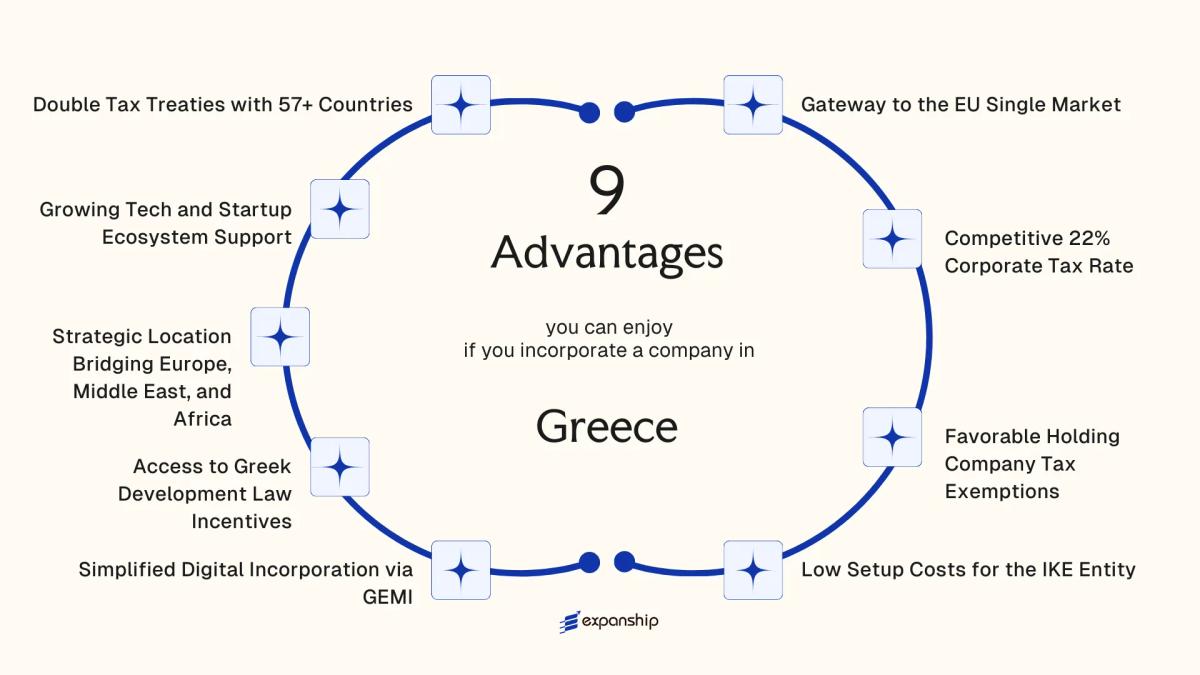
Gateway to the EU Single Market
Incorporating in Greece grants your business full membership in the EU single market — a trading bloc covering over 440 million consumers with no internal tariffs, no customs declarations between member states, and standardized regulatory requirements across borders. Greece EU single market access for businesses is governed by the same EU treaty framework that applies to any member state, but the country's position adds a distinct operational dimension.
What EU Membership Actually Confers
A company registered in Greece holds an EU legal domicile, which entitles it to the free movement of goods, services, capital, and workers across all 27 member states. This eliminates the need for separate market entry structures in each country you intend to operate in.
The Eurozone Factor
Greece operates within the eurozone, meaning your entity invoices, holds capital, and repatriates profits in euros without currency conversion costs or exchange rate exposure across the bloc. For businesses sourcing from Asia or the Middle East and selling into EU markets, euro-denominated operations reduce transactional friction at scale.
A single Greek entity can contract, invoice, and employ across all EU member states without establishing separate legal presence in each jurisdiction.
Competitive 22% Corporate Tax Rate
Greece applies a standard corporate income tax rate of 22% to resident companies, including the Idiotiki Kefalaiouchiki Etaireia (IKE) and the Anonimi Etaireia (AE). For foreign investors comparing jurisdictions across the EU, this rate sits below the bloc's average of approximately 21.3% as calculated on statutory rates, though more notably it undercuts several Western European peers — France at 25%, Germany's combined federal and trade tax burden exceeding 30%, and Italy at 24%.
The practical consequence is direct: a larger share of taxable profit remains within the business after each fiscal year. For an international holding or operating entity booking income through a Greek subsidiary, that differential compounds across multiple tax periods.
Greek corporate tax is governed by Law 4172/2013, the Income Tax Code (ITC), which consolidates the rules on taxable income, deductions, and rates into a single codified framework. Foreign investors benefit from this codification because the rules governing their liability are centrally documented and consistently applied by the Independent Authority for Public Revenue (AADE).
Several structural features reinforce the rate advantage:
- Taxable income is calculated after deducting business expenses, meaning your effective rate is applied to net, not gross, profit
- The 22% rate applies uniformly regardless of profit tier, removing the complexity of graduated band calculations
- Advance tax payments are credited against the final annual liability, reducing cash-flow disruption during the fiscal year
- The ITC provides defined rules for carry-forward of losses, giving your firm a mechanism to offset future taxable income
All Greek resident companies, including foreign-owned subsidiaries, are subject to this rate on worldwide income, while non-resident entities are taxed only on Greek-source income.

Company Incorporation in Greece
Set up a Greek IKE or AE with full regulatory compliance through Expanship's incorporation service.
Favorable Holding Company Tax Exemptions
Greece holding company tax exemptions make the country a structurally sound base for businesses managing subsidiaries or investment income across multiple jurisdictions.
Under Greek tax law, dividends received by a Greek resident company from qualifying subsidiaries are exempt from corporate income tax, provided the receiving entity holds at least 10% of the subsidiary's share capital for a minimum of 24 months. This participation exemption aligns with the EU Parent-Subsidiary Directive, meaning your holding structure benefits from a well-established legal framework rather than a discretionary concession.
| Condition | Requirement |
|---|---|
| Minimum shareholding | 10% of subsidiary's share capital |
| Minimum holding period | 24 months |
| Subsidiary location | EU or treaty-partner jurisdiction |
| Tax framework | EU Parent-Subsidiary Directive (2011/96/EU) |
Capital gains derived from the sale of subsidiary shares can also qualify for exemption under the same participation threshold and holding period conditions. For a foreign investor consolidating equity stakes across European or regional markets, this eliminates a layer of taxation that would otherwise erode returns at the holding level.
The Greek participation exemption benefits extend to dividends received from subsidiaries established in other EU member states without withholding tax obligations at the source, reducing friction in profit repatriation. Qualifying structures must ensure the subsidiary is subject to corporate tax in its home jurisdiction, as purely artificial arrangements do not satisfy the anti-abuse provisions embedded in Greek domestic tax legislation.
Low Setup Costs for the IKE Entity
One of the Greece IKE entity low setup benefits is the absence of a minimum share capital requirement. Unlike the SA (Anonymi Etaireia), which requires at least €25,000 in share capital, the Idiotiki Kefalaiouchiki Etaireia can be formed with as little as €1 in capital. For a foreign entrepreneur testing a new market, this removes a significant upfront financial commitment.
Incorporation fees are equally contained. State registration fees under GEMI (General Commercial Registry) are calculated as a small percentage of stated capital, meaning a low-capital IKE incurs minimal notarial and registration costs. This structure makes the IKE company advantages in Greece particularly relevant for holding companies, service businesses, and early-stage ventures that do not require substantial physical assets at formation.
Greek IKE affordable incorporation benefits also extend to the entity's governance simplicity. No mandatory board structure is required for single-member formations, reducing the legal drafting costs typically associated with multi-tier corporate arrangements.
Keep these points in mind:
- Capital contributions can be in cash, kind, or services under Law 4072/2012
- GEMI registration is the sole mandatory registration body for formation
- Notarial involvement is not required for standard IKE formations
- Guarantee contributions (non-capital contributions) have specific valuation rules
An IKE shareholder can contribute personal services as their capital input, a formation mechanism with no direct equivalent in most other EU private company forms.
Simplified Digital Incorporation via GEMI
Greece's GEMI digital incorporation advantages begin before your company even exists. The General Commercial Registry (GEMI) platform allows foreign founders to register a private capital company (IKE) or other eligible entity types entirely online, without requiring physical presence in the country during the registration process. This removes a logistical barrier that persists in many EU member states where notarial presence or in-person filings remain mandatory.
Remote Registration Without a Physical Footprint
For a foreign business owner, the ability to complete Greece online company registration through GEMI without traveling to Athens or engaging a local representative for in-person procedures translates directly into lower setup costs and faster operational timelines. The Ministry of Development oversees GEMI, and the digital registry interface supports document submission, fee payment, and certificate issuance through a single government portal. Standard incorporation for an IKE can be completed within one to five business days under normal processing conditions.
Reduced Friction in Regulatory Processing
GEMI also integrates with the Tax Authority (AADE) and the relevant social security bodies, meaning that tax registration and employer enrollment can be initiated through connected workflows rather than separate agency visits. This interconnected structure reduces the administrative lag that typically follows company formation in jurisdictions where agencies operate in isolation. For a foreign investor establishing a holding structure or a trading entity, earlier registration completion means an earlier start date for tax residency and banking eligibility.
Set Up Your Greek Company the Right Way
Get expert guidance on incorporating through GEMI and meeting all Greek regulatory requirements from day one.
Access to Greek Development Law Incentives
Greece's Development Law framework gives incorporated businesses access to a structured incentive system backed by national legislation. Under Law 4887/2022 (the current Development Law), qualifying investments can receive combinations of tax exemptions, cash grants, leasing subsidies, and wage cost subsidies — the specific mix depends on the investment category, size of the firm, and geographic location within the country.
- Cash grants can cover a defined percentage of eligible investment costs, reducing the capital you deploy from day one without requiring repayment, unlike debt financing.
- Tax exemption incentives allow qualifying businesses to offset a portion of taxable income over multiple years, which directly reduces the effective tax burden during the growth phase of operations.
- Wage subsidies for new employment created through a qualifying investment lower the per-hire cost for foreign firms scaling a local workforce.
- Leasing subsidies reduce the cost of financing fixed assets, which is particularly relevant for manufacturing, logistics, or technology infrastructure investments.
- Businesses operating in designated regional zones may qualify for higher incentive rates, as the law applies a tiered geographic weighting to direct more support toward underdeveloped areas.
Applications are submitted to the Ministry of Development, which administers the program and sets eligibility thresholds by investment size and sector.
Strategic Location Bridging Europe, Middle East, and Africa
Greece's position at the southeastern edge of the EU places it within a four-hour flight of over 60 countries across three continents. For a business targeting the Greece strategic location EMEA business hub opportunity, this geography translates into a single registered entity that can operationally serve markets from Frankfurt to Dubai to Cairo without requiring separate regional offices.
The country's port infrastructure reinforces this. Piraeus, operated under a majority stake by COSCO Shipping since 2016, is one of the highest-throughput container ports in the Mediterranean. Physical supply chain access to North Africa and the Levant is a direct consequence of that positioning.
Athens International Airport connects to over 140 direct international destinations. For service-sector firms whose executives move frequently across the EMEA corridor, this reduces operational friction without requiring a secondary hub.
A company incorporated in Athens operates within EU regulatory jurisdiction while sitting geographically closer to Beirut, Cairo, and Riyadh than to Paris or Berlin. That proximity cuts average flight time to Gulf Cooperation Council capitals to under four hours, a structural cost reduction for businesses running regional operations across the Greece gateway Europe Middle East Africa corridor.
Growing Tech and Startup Ecosystem Support
Greece startup ecosystem benefits for investors have become more concrete since the passage of Law 4712/2020, which introduced a formal legal definition for startups and established a national registry for qualifying firms. Registration in this registry can unlock access to fast-track licensing, state-backed funding programs, and participation in public procurement set-asides reserved for innovative companies.
Elevate Greece is the official national platform administered by the Secretariat General for Research and Innovation. It functions as the primary gateway through which startups gain visibility with institutional investors and qualify for state support programs, including those co-funded under EU structural funds.
- Foreign-founded entities incorporated as an IKE or AE can qualify for Elevate Greece registration, provided they maintain a registered office and genuine operational presence in the country.
- The Hellenic Foundation for Research and Innovation (HFRI) funds applied research projects, offering a direct financing channel for tech-oriented businesses that operate alongside or within a Greek corporate structure.
- Athens and Thessaloniki host accredited incubators and accelerators, some operating under university auspices, which provide workspace, mentorship, and introductions to regional venture capital networks.
Elevate Greece registration and associated benefits require your company to meet specific innovation and operational criteria defined under Law 4712/2020; incorporation alone does not automatically confer eligibility.
Double Tax Treaties with 57+ Countries
Greece's double tax treaty network benefits foreign-owned businesses by reducing or eliminating withholding taxes on dividends, interest, and royalties paid across borders. With treaties in force covering more than 57 countries, the network spans major trading partners including the United States, Germany, the United Kingdom, China, India, and the United Arab Emirates.
Reduced Withholding Tax on Cross-Border Payments
Under domestic Greek tax law, withholding taxes apply to outbound dividends, interest, and royalty payments. The applicable rate under a given treaty often falls below the standard domestic rate, which directly reduces the tax cost of repatriating profits or paying for intellectual property licenses. For businesses structuring regional operations through a Greek entity, this reduction can materially affect after-tax returns on intra-group transactions.
Treaty Access for Holding and IP Structures
Greek double taxation agreement benefits extend to holding structures, where a parent company in a treaty country receives dividends from a Greek subsidiary at a reduced rate. This is distinct from the EU Parent-Subsidiary Directive exemption, which applies only within the EU, and expands the benefit to non-EU treaty partners. A Greek entity serving as a regional hub for the Middle East or North Africa can use applicable treaty provisions to manage withholding exposure on payments flowing in either direction.
Conditions for Treaty Eligibility
Treaty benefits are generally available to tax residents of the relevant treaty country. Eligibility typically requires that the recipient entity has genuine substance and is the beneficial owner of the income received, not merely a conduit arrangement.
Why Greece Stands Out Among Mediterranean Business Hubs
Positioned against Cyprus and Malta, the two Mediterranean jurisdictions most commonly evaluated alongside Greece for incorporation purposes, Greece presents a distinct profile. Cyprus attracts holding structures through its 12.5% corporate tax rate, while Malta operates a refund mechanism that can reduce effective tax to around 5%. Greece does not compete on headline rate alone. Instead, the comparison shifts to market substance, treaty depth, and EU regulatory standing, areas where the structural differences become material for your business.
For companies requiring genuine operational presence, access to a large domestic consumer market, or direct integration with Balkan and Eastern Mediterranean trade corridors, the Greek framework offers attributes that low-tax micro-jurisdictions cannot replicate. The development law incentives under Law 4887/2022 have no parallel in Cyprus or Malta's regimes. For businesses that must demonstrate economic substance, the combination of GEMI-registered entities, a physical talent base, and an expanding startup infrastructure provides a credible operational foundation.
| Parameter | Greece | Cyprus | Malta |
|---|---|---|---|
| EU Member State | Yes | Yes | Yes |
| Corporate Tax Rate | 22% | 12.5% | 35% (refund system ~5% effective) |
| Dividend Participation Exemption | Yes (conditions apply) | Yes | Yes (via refund) |
| Double Tax Treaties | 57+ | 65+ | 70+ |
| Digital Incorporation Available | Yes (GEMI) | Partial | Partial |
| Development/Investment Incentives Law | Yes (Law 4887/2022) | Limited | Limited |
| Domestic Market Size (population) | ~10.4 million | ~1.3 million | ~530,000 |
Compliance Services for Companies in Greece
Meet your ongoing statutory obligations in Greece, from annual filings and GEMI updates to corporate secretarial support.
Conclusion
Greece offers a structurally sound case for foreign incorporation: EU membership that opens a single market of over 440 million consumers, a 22% corporate tax rate applied uniformly to resident entities, and a digital registration process through GEMI that removes the geographic barrier of in-person setup. These are not incidental features but embedded structural conditions that remain consistent for foreign-owned businesses.
The benefits of incorporating in Greece apply differently depending on your business model. A holding structure benefits most from the participation exemption on qualifying dividends and capital gains. An operational entity gains more from the Development Law incentive tiers and the network of 57+ double tax treaties. Understanding which structural features align with your specific activity determines how much of the available framework you can actually use.
Greece company formation advantages are grounded in codified law, EU regulatory alignment, and a tax treaty network broad enough to cover most major trade corridors. For a foreign business owner evaluating Mediterranean options, that combination of formal legal infrastructure and geographic positioning creates conditions that are measurable, not speculative. The next step is assessing how those conditions map to your entity type, ownership structure, and intended operations.
Start Your Greek Company Formation with Expanship Today
Expanship assists foreign founders and investors with structuring a Greek presence, from selecting between an IKE and an AE to meeting the ongoing compliance obligations enforced by the General Commercial Registry (GEMI) and the Independent Authority for Public Revenue (AADE). The firm handles each stage of the incorporation process and the post-registration requirements that keep a Greek entity in good standing.
Services available through Expanship for your Greek company formation include:
- Document preparation, notarization, and apostille legalization for submission to GEMI
- Registered agent and registered office address provision within Greece
- Government filing and direct liaison with GEMI and relevant tax authorities
- Post-incorporation compliance management, covering annual financial statements and tax filings
- Corporate secretarial support for shareholder and directorship changes
- Banking introduction assistance with Greek and international financial institutions
Expanship Greece is available to advise on the structure and registration process that fits your business objectives.
Frequently Asked Questions (FAQ)
The Idiotiki Kefalaiouchiki Etaireia (IKE) can be formed with a minimum share capital of just one euro, making it one of the most cost-accessible corporate structures available through GEMI. Capital contributions can be monetary, in-kind, or in the form of a guarantee contribution, giving founders flexibility in how they structure initial funding. This structure was introduced under Law 4072/2012 specifically to reduce barriers for small and medium-sized businesses.
Greek resident companies are subject to a flat corporate income tax rate of 22%, which applies to net taxable profits. This rate applies uniformly to both domestic and foreign-sourced income of a Greek-registered entity. Certain qualifying activities under the Greek Development Law (Law 4887/2022) may be eligible for tax rate reductions or other fiscal incentives, depending on the approved investment category.
Greece's participation exemption on dividends generally requires that the receiving company holds at least 10% of the distributing entity's share capital. The exemption does not automatically apply if the subsidiary is resident in a jurisdiction listed on the EU's non-cooperative territories list or if the arrangement constitutes an artificial structure. These conditions align with the EU Parent-Subsidiary Directive, which Greece has transposed into domestic law.
Incorporation through the GEMI one-stop-shop system is typically completed within one to five business days for standard cases where all documents are submitted correctly. Delays can occur if the notarized power of attorney or identity documents require additional verification, or if the chosen company name conflicts with an existing registration. Once registered, the entity receives its tax identification number (AFM) and is enrolled in the social security system simultaneously.
Greece has signed double tax treaties with over 57 countries, including major economies such as Germany, the United States, the United Kingdom, and China. Under most of these treaties, withholding tax on dividends paid to foreign parent companies is reduced below the standard domestic rate, though the exact rate varies by treaty. You should verify the specific bilateral agreement applicable to your jurisdiction of residence, as rates and conditions differ across treaties.
Law 4887/2022, which governs the current Greek Development Law framework, provides a range of incentives including tax exemptions on profits, cash grants, leasing subsidies, and wage cost subsidies for qualifying investment projects. The available incentive type depends on the region where the investment is made, the size of the investing company, and the sector of activity. Applications are submitted to the relevant ministry, and approved projects must meet specific employment and capital expenditure thresholds to maintain eligibility.
Greece and Cyprus offer different advantages depending on the structure's purpose. Cyprus applies a 12.5% corporate tax rate, which is lower than Greece's 22%, but Greece's participation exemption on dividends and capital gains from qualifying shareholdings, combined with its broader treaty network of 57+ agreements, can make it more suitable for certain holding arrangements that require treaty access rather than rate optimization alone. The appropriate choice depends on the specific flow of income, the jurisdictions involved, and the substance requirements under applicable anti-avoidance rules.
Legal Disclaimer
The information provided in this article is for general informational purposes only and does not constitute legal, tax, or professional advice. While we strive to ensure the accuracy and timeliness of the content, laws and regulations are subject to change, and the application of laws can vary widely based on specific facts and circumstances.
Readers should not act upon this information without seeking professional counsel tailored to their individual situation. Expanship and its authors disclaim any liability for actions taken or not taken based on the content of this article.
For specific advice regarding your business setup, compliance requirements, or any legal matters, please consult with qualified legal and tax professionals in the relevant jurisdiction.