

Key Takeaways
- Foreign investors operating in Gambia face a restricted double tax treaty network, limiting the ability to structure cross-border arrangements that reduce withholding tax exposure across multiple jurisdictions.
- Under the Companies Act administered by the Registrar General's Department, entities must maintain a mandatory local registered office, creating an ongoing compliance obligation that adds operational cost for foreign-based owners.
- Procedural inconsistency at the Gambia Revenue Authority introduces unpredictable administrative delays that can extend the timeline between incorporation and the ability to conduct regulated business activities.
- The combination of underdeveloped banking infrastructure and limited foreign exchange access constrains the practical movement of capital in and out of the jurisdiction, a material burden for internationally oriented businesses that require routine cross-border transactions.
Incorporating in Gambia operates under an evolving regulatory framework, governed primarily by the Companies Act alongside oversight from bodies such as the Registrar General's Department and the Gambia Revenue Authority. The framework is neither heavily codified nor minimally regulated — it sits in a transitional state, where formal requirements exist but enforcement and administrative consistency remain uneven.
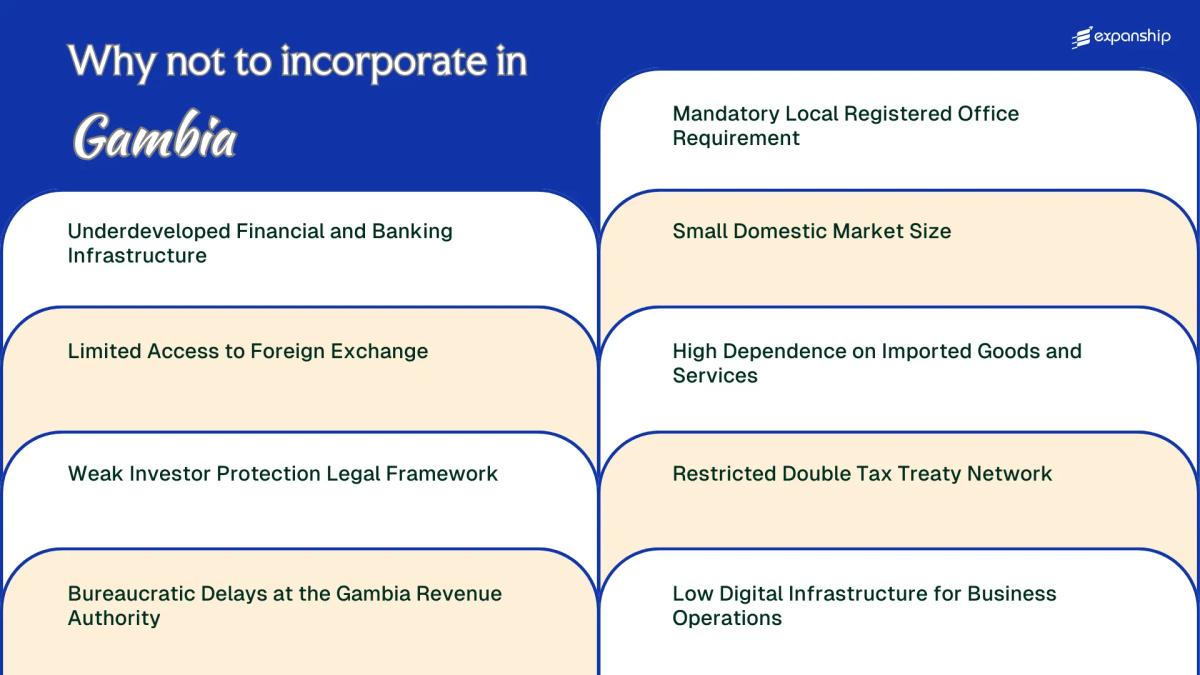
The disadvantages of incorporating in Gambia span several distinct categories, from financial infrastructure constraints to treaty limitations and procedural friction at the registration level.
Not every drawback will affect every business equally. The specific structure of your entity, the industry you operate in, and whether you require cross-border financing all influence which challenges carry the most practical weight for your situation.
This article is most directly relevant to foreign investors and internationally oriented business owners who are evaluating Gambia as a base for trade, services, or regional operations on the African continent.
Underdeveloped Financial and Banking Infrastructure
Gambia banking infrastructure limitations affect foreign-owned companies from the first day of operations. The country's financial sector remains shallow relative to regional peers, with a narrow range of institutional banking services available to incorporated entities.
Constrained Commercial Banking Capacity
Only a small number of licensed commercial banks operate under the supervision of the Central Bank of The Gambia, and most concentrate their services on trade finance and personal accounts rather than structured corporate banking products. Your business is unlikely to access credit facilities, multi-currency accounts, or sophisticated treasury services without significant collateral requirements or pre-existing banking relationships.
Correspondent banking relationships between local institutions and major international banks are limited, which slows cross-border transactions and raises intermediary costs for foreign firms remitting funds or receiving international payments.
Restricted Access to Formal Financial Products
Trade finance instruments such as letters of credit and standby guarantees are available only through select institutions, and processing timelines are inconsistent. For a foreign business dependent on reliable international settlement, this operational unpredictability creates direct costs and counterparty risk.
Underdeveloped financial sector conditions also mean that foreign currency accounts and hedging instruments are largely unavailable to most incorporated businesses outside of specific banking arrangements.
Foreign companies incorporated here should expect that routine cross-border banking transactions may face delays of several business days due to limited correspondent banking infrastructure, directly affecting working capital cycles.
Limited Access to Foreign Exchange
Foreign exchange restrictions in Gambia business operations present a direct obstacle for any company that needs to move capital across borders. The Gambian dalasi is not freely convertible on international markets, which means your ability to repatriate profits or pay foreign suppliers depends on the availability of foreign currency through the domestic banking system.
The Central Bank of The Gambia oversees foreign exchange transactions and sets the regulatory conditions under which businesses can access hard currency. When dollar or euro liquidity is tight within the system, companies face queuing delays or shortfalls that disrupt payment obligations abroad.
For foreign-owned entities, this creates specific operational friction:
- Paying overseas contractors in hard currency can be delayed by days or weeks when bank reserves are low
- Import-dependent businesses face unpredictable cost increases when dalasi convertibility problems force reliance on parallel rates
- Dividend repatriation to foreign parent companies requires central bank compliance steps that add processing time and uncertainty
- Foreign currency accounts, where permitted, are subject to conditions that restrict how freely funds can be deployed
Exporters generating foreign currency revenue are partially shielded, but most incorporated entities operating in the local market have limited natural hedging against these constraints.

Company Incorporation in Gambia
Understand the full regulatory and financial requirements before incorporating a company in Gambia.
Weak Investor Protection Legal Framework
The weak investor protection Gambia offers under its current legal structure is a concrete liability for foreign business owners. The Companies Act of 1955, which remains the foundational statute governing corporate entities, was not designed with modern international investment structures in mind, leaving significant gaps in shareholder rights enforcement.
Minority shareholders hold a structurally weak position. There are no codified rights to mandatory buyout mechanisms or statutory appraisal rights, meaning that if a controlling shareholder acts against your interests, your practical remedies are limited to general common law actions through courts that are under-resourced and slow.
| Protection Mechanism | Status Under Current Framework |
|---|---|
| Statutory minority buyout rights | Not codified |
| Derivative action thresholds | Undefined in statute |
| Mandatory disclosure to minority shareholders | No specific requirement |
| Shareholder agreement enforceability | Inconsistent judicial interpretation |
| Director liability for breach of fiduciary duty | Rarely enforced in practice |
Judicial enforcement compounds the problem. Even where rights exist in theory, the absence of a dedicated commercial court means investor disputes pass through a general civil judiciary with limited exposure to complex corporate or securities matters.
Your firm has no securities regulator with active investor protection powers. The Securities Act exists, but its enforcement capacity remains limited, reducing deterrence against misconduct by majority shareholders or directors.
Bureaucratic Delays at the Gambia Revenue Authority
Gambia Revenue Authority bureaucratic delays are a documented friction point for foreign businesses attempting to establish tax compliance after incorporation. The GRA administers business registration, tax identification, VAT registration, and related filings, and processing times across these functions can extend well beyond initial estimates, creating gaps in operational readiness.
Tax identification numbers and VAT registration certificates are prerequisites for opening corporate bank accounts and executing formal contracts. Delays in obtaining these documents directly stall business activation, not just administrative setup.
GRA registration challenges for businesses are compounded by limited digital processing capacity. Most submissions still require physical presence or paper-based documentation, which creates additional lag for foreign principals who are not locally based.
- TIN issuance and VAT registration are separate processes, each with independent queues and timelines at the GRA
- Physical documentation submission is generally required; remote processing options are limited
- Delays at the GRA can affect downstream processes, including bank account activation and contract execution
- No statutory maximum processing period is publicly defined for most GRA registration procedures
The absence of a published service-level commitment means your business has no formal recourse if processing stalls. You can review the GRA's official guidance for current filing requirements, but timelines remain discretionary in practice.
The GRA administers both domestic tax collection and customs duties under a single unified authority, a structural consolidation that concentrates significant regulatory burden in one agency with limited published processing benchmarks.
Mandatory Local Registered Office Requirement
Under the Companies Act of Gambia, every registered company must maintain a physical registered office address within the country. This address must be a genuine, operational location — not a postal box — and serves as the official point of contact for regulatory correspondence from the Registrar General's Department.
The Structural Requirement and Its Cost Implications
Foreign-owned firms without a pre-existing local presence must contract a registered agent or service provider to fulfil this obligation, generating an ongoing operational cost that exists regardless of actual business activity in the country. This recurring expense is not a one-time incorporation fee; it persists for the life of the entity.
Compliance Exposure and Oversight Limitations
Because all formal notices, legal documents, and regulatory filings are directed to this address, any failure in address maintenance or agent responsiveness can result in missed deadlines and compliance breaches. Your business may have no practical visibility into correspondence received on its behalf, creating a layer of administrative dependency that is difficult to manage remotely.
The requirement applies uniformly to all company types registered under the Act, with no exemptions for dormant entities or holding structures.
Addressing Registered Office and Compliance Obligations in Gambia
If your business needs a compliant registered office address or local agent support in Gambia, speak with our incorporation specialists about the obligations involved.
Small Domestic Market Size
Gambia small domestic market limitations represent a structural ceiling on revenue potential that few foreign investors account for before incorporating. With a population of approximately 2.7 million and GDP per capita below $800, the addressable consumer base is among the smallest on the African continent.
- Domestic demand is too thin to sustain a viable business at scale, meaning your entity will depend almost entirely on export revenue or regional trade to remain commercially viable.
- The limited consumer base concentrates purchasing power within a narrow income bracket, compressing margins across most retail and service categories.
- Sectors requiring volume-driven returns, such as manufacturing or fast-moving consumer goods, face a market size that cannot support minimum efficient scale without access to ECOWAS regional markets.
- Foreign firms registered under the Companies Act 2013 cannot rely on domestic sales alone to recover incorporation and ongoing compliance costs within a reasonable timeframe.
High Dependence on Imported Goods and Services
Gambia import dependence business risks are structural, not incidental. The country produces limited manufactured goods domestically, which means most operational inputs — equipment, raw materials, finished products, and specialist services — must be sourced from abroad.
Import duties under the Customs and Excise Act are applied on top of freight and insurance costs, directly increasing the landed price of goods your business relies on. For any entity that imports regularly, this creates a sustained cost disadvantage that compounds over time.
Supply chain timelines are unreliable. The Port of Banjul has capacity constraints, and clearance delays at the Gambia Revenue Authority's customs division are common, meaning inventory planning becomes difficult and operationally expensive.
Businesses in sectors like manufacturing, retail, or construction face particular exposure. Local substitution is limited, so when import costs rise due to currency depreciation or freight disruptions, there is little domestic alternative to absorb the pressure.
A business importing USD 200,000 worth of equipment annually could face combined import duties, port charges, and clearance fees that add 25–35% to the base cost, before the goods ever reach the warehouse.
Restricted Double Tax Treaty Network
Gambia's double tax treaty limitations are a concrete structural problem for any foreign-owned entity conducting cross-border business. The country has signed very few bilateral tax treaties, leaving most international transactions without the reduced withholding tax rates that treaty networks in jurisdictions like Mauritius or Singapore routinely provide.
Without treaty protection, dividends, interest, and royalties paid from a Gambian entity to a foreign parent or investor are subject to withholding tax under domestic rates. This directly increases the cost of repatriating profits, since no treaty framework exists to reduce or eliminate the applicable rate.
For holding structures or regional operating companies, this gap is particularly damaging. Investors who chose Gambia as a base for West African operations may find that every profit distribution triggers a withholding charge with no treaty override available.
- Payments to EU-based parent companies carry full domestic withholding exposure
- Royalty flows to foreign IP-holding entities receive no treaty relief
- Loan interest paid to foreign lenders is similarly unprotected
The Income Tax Act governs withholding obligations, and the Gambia Revenue Authority enforces collection. Neither body has the authority to waive statutory rates absent a ratified treaty.
If your business structure relies on cross-border profit flows, interest payments, or royalty transfers to a foreign parent or investor, withholding tax risks from Gambia incorporation apply at full domestic statutory rates with no treaty reduction available on most corridors.
Low Digital Infrastructure for Business Operations
Low digital infrastructure Gambia business owners encounter goes beyond slow internet speeds — it affects how your company can realistically function day-to-day. Fixed broadband penetration remains among the lowest in West Africa, and mobile data remains the primary connectivity channel for most businesses.
Unreliable connectivity creates direct operational costs. Cloud-based accounting, remote team coordination, and client communication all become friction-heavy, forcing firms to maintain redundant systems or on-site infrastructure that adds expense.
E-commerce presents a separate constraint. Payment gateway options are limited, and the absence of a mature digital payments ecosystem means online transactions with international counterparties often require workarounds rather than standard integrations.
- Filing obligations with the Gambia Revenue Authority increasingly rely on digital portals, which become harder to meet during outages.
- Document-heavy processes, such as company registration through the Registrar General's Department, are not fully digitised, adding processing time.
Overcoming the Key Incorporation Challenges
Overcoming Gambia incorporation challenges requires structural preparation before the company registration process begins, not improvised responses after problems arise. The barriers covered in this blog — from foreign exchange restrictions to treaty gaps — are systemic, and addressing them demands deliberate formation decisions.
- Appoint a locally resident registered agent to satisfy the physical office requirement under the Companies Act 2013 before submitting incorporation documents to the Registrar General.
- Open a multi-currency account outside Gambia to reduce exposure to dalasi liquidity constraints and Central Bank of The Gambia transfer approval delays.
- Structure the entity under a jurisdiction with an active double tax treaty where Gambia has no bilateral agreement with your home country.
- File all tax registrations directly with the Gambia Revenue Authority at the point of incorporation to avoid compounding bureaucratic delays post-registration.
- Establish supplier contracts with international vendors prior to launch to account for the country's dependence on imported goods and services.
These steps operate within a regulatory environment where the Companies Act 2013 and GRA oversight remain the primary compliance anchors. Mitigating risks of incorporating in Gambia is achievable, but it does not eliminate the structural constraints that define the jurisdiction's current business environment.
Gambia's Overall Business Potential
Gambia's business potential despite limitations is real, but confined to a specific set of use cases. The disadvantages covered in this blog, ranging from foreign exchange restrictions to a thin double tax treaty network, are structural rather than incidental, meaning they won't resolve quickly.
| Pro | Con |
|---|---|
| Low incorporation costs relative to comparable West African jurisdictions | The Gambia Revenue Authority is subject to significant bureaucratic delays in processing registrations and tax matters |
| Tourism and re-export trade create niche commercial opportunities | Foreign exchange access is restricted, complicating profit repatriation for international firms |
| English is the official language, reducing legal and administrative translation burdens | The domestic market is among the smallest in West Africa, limiting local revenue potential |
| The legal system draws from English common law, providing a recognizable framework | Investor protection legislation lacks the depth found in more developed jurisdictions |
| Physical presence in the ECOWAS bloc supports regional trade access | A narrow double tax treaty network increases cross-border tax exposure for foreign-owned entities |
The common law foundation and ECOWAS membership offer a workable base for certain cross-border structures. At the same time, the infrastructure deficits, both digital and financial, place a ceiling on what most foreign-owned entities can operationally achieve from within the jurisdiction.
Compliance Services for Companies in Gambia
Maintaining good standing for a Gambian entity requires ongoing engagement with the Companies Act, the Gambia Revenue Authority, and annual filing obligations. This service covers the statutory requirements your company must meet post-incorporation.
Conclusion
The cons of Gambia company registration are real and measurable. Structurally, the jurisdiction presents a distinct set of friction points for foreign investors, shaped by limited institutional capacity rather than regulatory hostility. Foreign exchange restrictions and the narrow double tax treaty network stand out as the most commercially consequential barriers, directly affecting how your business moves capital and manages cross-border tax exposure. Bureaucratic processing timelines at the Gambia Revenue Authority add further unpredictability. Working with professionals who understand these specific conditions reduces the risk of delays and structural missteps from the outset.
Expanship's Gambia Incorporation Services
From coordinating with the Registrar of Companies under the Companies Act 2013 to managing tax registration with the Gambia Revenue Authority, the compliance requirements covered throughout this blog represent genuine operational weight. Expanship's Gambia incorporation services are designed to reduce the time and coordination burden these obligations place on foreign founders, particularly during the setup phase when regulatory missteps carry the most cost.
Beyond registration, Expanship offers practical support across the full formation process.
- Your company registration and documentation are prepared to meet local filing standards.
- A registered agent and office address in Gambia are provided to satisfy statutory requirements.
- All government filings and liaison with relevant regulatory bodies are handled on your behalf.
- Post-incorporation compliance obligations are tracked and managed on an ongoing basis.
- Banking introduction assistance is available to help your business establish a local account.
- Tax registration and liaison with the Gambia Revenue Authority are coordinated as part of the process.
To discuss your requirements, contact Expanship Gambia.
Frequently Asked Questions (FAQ)
It primarily affects businesses with cross-border income flows, but the impact extends to any foreign-owned entity receiving dividends, royalties, or service fees from abroad. Gambia has a narrow treaty network, meaning withholding taxes on cross-border payments may not be reduced through bilateral relief, leaving your firm exposed to higher effective tax rates than you would face in jurisdictions with broader treaty coverage.
The Companies Act requires every registered company in Gambia to maintain a physical registered office address within the country, and this cannot be a P.O. box. The annual cost varies depending on the service provider, but it represents an ongoing fixed overhead that foreign-owned entities cannot eliminate, even if the business operates entirely from outside Gambia.
Processing times at the Gambia Revenue Authority are generally slower than in more developed regional peers such as Ghana or Senegal. Tax registration, compliance filings, and correspondence with the Authority often involve manual processes and in-person attendance, which adds time and administrative cost for businesses that do not have local staff managing these interactions.
Your business remains legally liable for those obligations regardless of Central Bank restrictions. Currency access issues do not constitute a legal excuse for non-payment under most commercial contracts, which means your entity could face breach of contract claims even when the underlying problem is a regulatory constraint rather than insolvency.
The legal framework governing shareholder protections in Gambia is less developed than in common law jurisdictions such as the UK or Singapore, and enforcement through the courts can be slow. If a dispute arises between shareholders or between an investor and a local partner, the absence of strong statutory protections and efficient judicial processes means resolving the matter may require significant time and legal expense with uncertain outcomes.
Partial workarounds exist, but they do not eliminate the underlying constraint. Unreliable internet connectivity and limited e-government services mean that many regulatory submissions and filings still require physical presence or paper-based processes, and no third-party provider can substitute for a government portal that simply does not exist or functions inconsistently.
Legal Disclaimer
The information provided in this article is for general informational purposes only and does not constitute legal, tax, or professional advice. While we strive to ensure the accuracy and timeliness of the content, laws and regulations are subject to change, and the application of laws can vary widely based on specific facts and circumstances.
Readers should not act upon this information without seeking professional counsel tailored to their individual situation. Expanship and its authors disclaim any liability for actions taken or not taken based on the content of this article.
For specific advice regarding your business setup, compliance requirements, or any legal matters, please consult with qualified legal and tax professionals in the relevant jurisdiction.