

Key Takeaways
- Gambia's Companies Act eliminates the minimum paid-up capital requirement for private limited companies, removing a financial barrier that commonly delays incorporation in comparable West African jurisdictions.
- Registration through the Registrar General's Department under a single regulatory framework reduces administrative complexity for foreign-owned entities establishing a local presence.
- Membership in ECOWAS grants Gambia-incorporated businesses preferential access to a regional market spanning multiple West African states, making the jurisdiction strategically useful for trade-oriented structures.
- Gambia's bilateral investment treaty framework provides foreign investors with enforceable protections against expropriation and discriminatory treatment, reducing legal risk exposure from the point of incorporation.
Situated on the west coast of Africa and fully surrounded by Senegal except for its Atlantic coastline, Gambia is an independent republic and one of the continent's smallest sovereign nations by land area. For foreign entrepreneurs exploring the benefits of incorporating in Gambia, the starting point is the Registrar General's Department, which sits under the Ministry of Justice and administers business registration in accordance with the Companies Act. The most common vehicle through which foreign businesses establish a local presence is the private limited liability company.
From a tax standpoint, the jurisdiction operates a standard corporate tax regime rather than a zero-tax or purely territorial model, though rates remain comparatively moderate within the West African region. Foreign ownership is generally permitted across most sectors, and the government has maintained a formal policy orientation toward attracting foreign direct investment through its investment promotion framework.
This article examines the specific structural, regulatory, and commercial advantages that company registration here offers to international business owners.
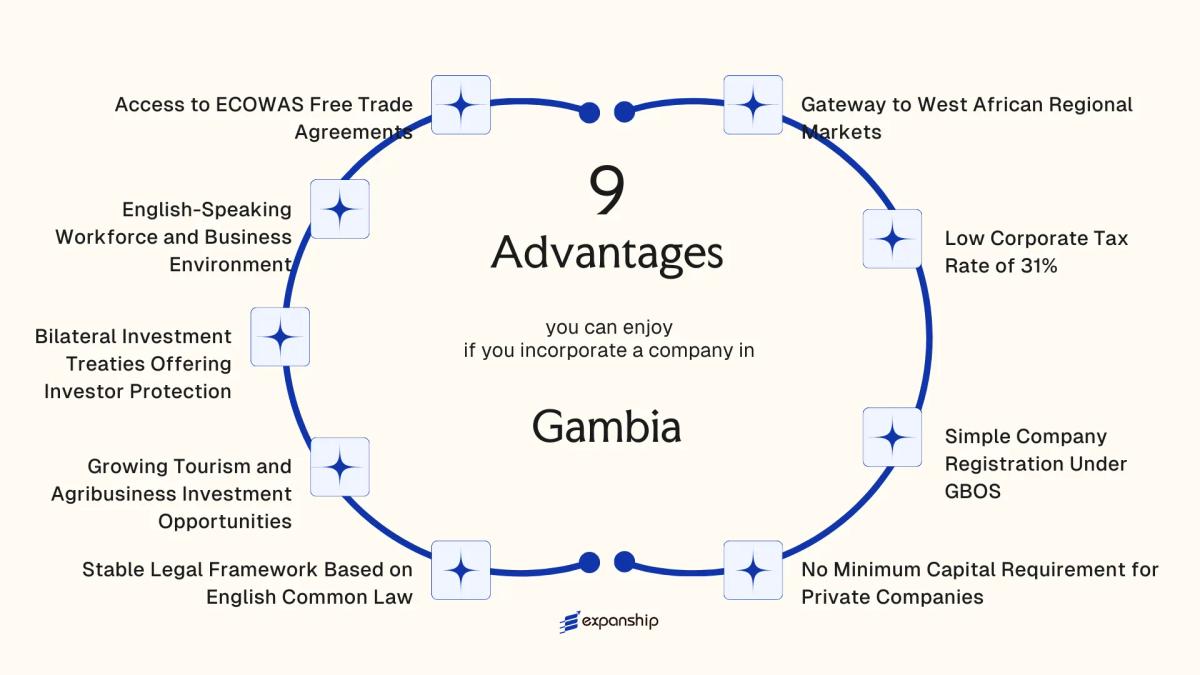
Gateway to West African Regional Markets
Positioned along the Atlantic coast with land borders connecting to Senegal, The Gambia sits within immediate reach of a consumer base that spans the entire ECOWAS region. For foreign investors, this geography is not incidental — it directly shapes how goods, services, and capital can move once a business entity is established there.
Proximity to Regional Trade Corridors
Senegal surrounds The Gambia on three sides, making it a natural entry point into Francophone West Africa without requiring a separate incorporation in a French-law jurisdiction. A company registered in Banjul can conduct trade with ECOWAS member states under the bloc's protocols on the free movement of goods and persons, reducing the operational cost of reaching markets in Senegal, Guinea-Bissau, and beyond.
Port and Transport Infrastructure as a Commercial Asset
The Port of Banjul handles both import and re-export activity, functioning as a logistics channel for goods moving into the sub-region. Because The Gambia operates as a Gambia gateway to West African markets through this port corridor, your firm can structure a regional distribution presence without the overhead of establishing multiple entities across different national jurisdictions.
A single Gambia-registered entity can serve as your operational base for West Africa regional market access across ECOWAS member states.
Low Corporate Tax Rate of 31%
Gambia's corporate income tax rate sits at 31% for most companies, which positions it below several comparable West African economies where headline rates reach 30% to 35% or higher once additional levies are applied. Under the Income and Value Added Tax Act, corporate income tax is assessed on the chargeable profits of a resident entity, giving your business a defined and predictable tax base to work from.
For a foreign investor, predictability carries real value. Knowing the applicable rate at the point of incorporation allows for accurate financial modelling without uncertainty about base erosion through supplementary corporate charges.
The Gambia Revenue Authority administers corporate tax compliance, and the statutory framework applies uniformly across most sectors, which limits exposure to discretionary treatment.
Several features of this tax position make it accessible for newly registered foreign entities:
- The rate applies to net profits rather than gross revenue, so early-stage businesses with modest margins are not disproportionately taxed during the growth phase
- No local branch profits surcharge exists that would otherwise inflate the effective rate beyond the headline figure
- The defined residency rules under the Income and Value Added Tax Act give foreign-owned companies clarity on when and how local tax obligations apply

Incorporate a Company in Gambia
Set up your Gambia-registered company with full compliance support from Expanship.
Simple Company Registration Under GBOS
Registering a business through the Gambia Bureau of Statistics carries a structural advantage that many foreign investors underestimate. The Gambia GBOS company registration benefits begin with the administrative design itself: the process is consolidated under a single registry, which means your business avoids the fragmented multi-agency filing requirements found in many comparable African jurisdictions.
Under the Companies Act, private limited companies can be incorporated without a local resident director requirement, which removes a common logistical barrier for foreign founders. The entity can be registered, in principle, without the owner being physically present throughout the process, reducing the time and cost involved in establishing an operational legal presence.
| Parameter | Detail |
|---|---|
| Registry Authority | Gambia Bureau of Statistics (GBOS) |
| Governing Legislation | Companies Act (Chapter 89:01) |
| Company Type | Private Limited Company (Ltd) |
| Residency Requirement for Directors | Not mandatory for foreign shareholders |
| Physical Presence for Registration | Not required throughout the process |
Speed has a direct commercial implication. A faster registry process means your firm can open corporate bank accounts, sign contracts, and begin trading operations sooner. For foreign entrepreneurs timing a market entry or responding to a regional tender window, weeks saved at the incorporation stage translate into concrete operational advantages. The GBOS business registration structure is designed to support this kind of entry timeline without requiring extensive local intermediaries as a precondition.
No Minimum Capital Requirement for Private Companies
One of the most direct expressions of the Gambia no minimum capital requirement benefit is found in the Companies Act 2013, which governs private limited companies registered under the Gambia Bureau of Statistics (GBOS) and the broader regulatory framework. Private companies face no statutory floor on paid-up or authorized share capital at the point of incorporation.
This matters in a concrete way: your initial capital outlay is determined by your actual operational needs, not an arbitrary legislative threshold. A single founder can capitalize a private limited company at a nominal value and deploy financial resources toward business activity rather than tying them up to meet a regulatory condition.
Under the Companies Act 2013, share capital structure can be set at the incorporators' discretion, which gives early-stage firms and lean foreign holding structures genuine flexibility in how they organize equity from day one.
Keep the following in mind:
- A private company must still issue at least one share upon formation
- Minimum capital rules may apply separately under sector-specific licensing (for example, banking or insurance)
- Authorized capital figures must appear in the memorandum of association regardless of the nominal amount
- Foreign-owned entities should confirm capital requirements with the Gambia Investment and Export Promotion Agency (GIEPA) for their specific sector
A private limited company in Gambia can be incorporated with a share capital as low as one dalasi, making it one of the most capital-accessible incorporation environments on the African continent.
Stable Legal Framework Based on English Common Law
Gambia's legal system descends directly from English common law, a foundation that carries practical weight for foreign business owners. Contracts, corporate governance, and dispute resolution all operate within a framework that international investors, particularly those from Commonwealth countries or jurisdictions with similar legal traditions, will find familiar and predictable.
Judicial Precedent and Contractual Certainty
Decisions made by Gambian courts draw on a body of case law that parallels established common law principles, meaning your contracts and shareholder agreements are interpreted through a doctrine of precedent rather than discretionary civil code interpretation. This consistency reduces legal uncertainty when drafting enforceable agreements with local partners or employees. The Companies Act of 2013 governs corporate structures and provides clear statutory rules on directorship, shareholder rights, and fiduciary duties, all rooted in common law principles that most international counsel can work with efficiently.
Regulatory Predictability for Incorporated Entities
The Gambia Revenue Authority administers tax obligations under a codified system, and corporate disputes can be escalated through a court hierarchy that mirrors the English model, including a right of appeal structure that gives investors a defined path for redress. For a foreign-owned private limited company, this means your entity operates within a legal environment where the rules of evidence, contract enforcement, and company law are documented, accessible, and consistent over time. Predictability in the legal framework reduces the cost of due diligence and ongoing compliance management.
Get Clarity on Incorporating in Gambia
Speak with our team about how Gambia's common law framework applies to your business structure and compliance obligations.
Growing Tourism and Agribusiness Investment Opportunities
Two sectors have drawn sustained foreign investment interest in Gambia: tourism and agribusiness. Together, they represent structured entry points for foreign businesses looking to establish operations with defined regulatory support and existing market demand.
- Tourism accounts for a significant share of GDP and is administered under the Gambia Tourism Authority (GTA), which licenses and regulates tourism enterprises. Foreign-owned entities can obtain operating licenses through the GTA, giving your business a clear regulatory pathway rather than an ambiguous approval process.
- Agribusiness investment opportunities are supported through the Gambia Investment and Export Promotion Agency (GIEPA), which facilitates entry for firms in horticulture, groundnut processing, and aquaculture. GIEPA-registered businesses may access designated investment incentives under the Investment Act, including potential tax concessions tied to sector classification.
- Groundnut products and fresh horticultural produce are among the country's primary export commodities, meaning agribusiness firms enter a sector with established supply chains and existing export infrastructure rather than building from a blank slate.
- The Atlantic coastline supports year-round fishing and aquaculture activity, and foreign firms operating in this space can structure entities under the Companies Act to hold licenses, employ local staff, and repatriate profits within the legal framework governing foreign ownership.
Bilateral Investment Treaties Offering Investor Protection
Gambia bilateral investment treaties investor protection gives foreign investors a formal legal recourse that operates above the domestic court system. The country has signed BITs with several nations, including members of the European Union, which establish binding obligations on both contracting states to protect covered investments.
Under these treaties, your business typically gains access to the following protections:
- Fair and equitable treatment, preventing arbitrary or discriminatory measures by the host state
- Protection against expropriation without prompt and adequate compensation
- Free transfer of capital, profits, and returns in convertible currency
- Access to international arbitration, most commonly under ICSID rules, if disputes arise
That last point carries significant practical weight. Rather than relying solely on domestic proceedings, treaty-eligible investors can bring claims before an independent international tribunal, which reduces exposure to unpredictable local adjudication.
Eligibility for these protections generally depends on structuring your investment through a qualifying entity from a treaty-partner jurisdiction. The specific scope of protection, including which assets are covered, varies by treaty text.
A hypothetical scenario: A European investor holding a 60% stake in a registered Gambian agribusiness entity, incorporated from a BIT-partner EU member state, would be entitled to initiate ICSID arbitration in the event of unlawful expropriation, bypassing domestic court proceedings entirely.
English-Speaking Workforce and Business Environment
English is the official language of Gambia, a direct result of its history as a British protectorate. For foreign companies, this eliminates the translation overhead and miscommunication risk that often accompanies entry into francophone West African markets.
The Gambia English-speaking business environment advantages extend into the operational layer. Contracts, regulatory filings with the Gambia Revenue Authority, and correspondence with the Registrar General's Department are all conducted in English. Your legal documents require no certified translation, which reduces both cost and turnaround time.
The anglophone business advantages for foreign companies operating here go beyond paperwork:
- University graduates from the University of the Gambia enter the workforce trained in English-medium instruction
- The judicial system operates in English, which directly supports contract enforcement and dispute resolution
- Government ministries publish regulatory guidance in English, reducing interpretive ambiguity for foreign directors
Professionals with English-language proficiency are available across accounting, law, and administration. This matters for firms that need locally compliant staff without extensive language training costs.
Foreign firms hiring local staff must comply with employment terms governed by the Labour Act 2007, which sets mandatory conditions around contracts, termination, and leave entitlements.
Access to ECOWAS Free Trade Agreements
Gambia ECOWAS free trade agreement benefits apply directly to any company incorporated in the country. As a member state of the Economic Community of West African States, the jurisdiction sits within a trading bloc of 15 nations covering a combined population exceeding 400 million people. Goods produced or traded through a registered Gambian entity can move across member state borders under the ECOWAS Trade Liberalisation Scheme (ETLS), which reduces or eliminates tariffs on approved goods originating within the bloc.
What the ETLS Means for Your Business
To access ETLS benefits, products must meet the rules-of-origin criteria set by ECOWAS and receive approval from the national authority. Once certified, your goods qualify for preferential tariff treatment across all member states. This removes a significant cost barrier that non-ECOWAS entities face when entering West African markets.
ECOWAS trade advantages for Gambia companies extend beyond tariff reduction. The bloc's protocols also cover the free movement of persons, right of residence, and right of establishment, which can reduce operational friction when expanding into neighboring markets such as Senegal, Ghana, or Nigeria.
Eligibility and Practical Scope
- Products must meet ECOWAS rules-of-origin requirements to qualify under ETLS
- Certification is processed through the national competent authority before cross-border benefits apply
- Services trade remains less liberalized than goods trade under current ECOWAS frameworks
- Industrial goods, agricultural products, and handicrafts each fall under distinct approval categories within the scheme
Why Gambia Stands Out Against Competing African Jurisdictions
Comparing Gambia's incorporation profile against regional alternatives helps clarify where it holds a structural position worth considering. The three jurisdictions selected for comparison, Senegal, Ghana, and Nigeria, are geographically proximate, target similar categories of foreign investors, and are frequently evaluated alongside each other by businesses entering West Africa. The comparison focuses on parameters where the regulatory and fiscal structure here is neutral or favourable, drawing on the facts already covered in this blog without repeating their full detail.
What the table below reveals is not simply a cost comparison, but a picture of administrative friction. Senegal operates under a civil law framework derived from French commercial law, which creates a different compliance environment for common law-trained legal counsel. Nigeria's corporate income tax rate sits at 30% for large companies, though its regulatory environment through the Corporate Affairs Commission involves more procedural layers. Ghana, also an English common law jurisdiction, has a corporate tax rate of 25%, though its minimum capital requirements for foreign-owned entities are significantly higher. Gambia advantages over competing African jurisdictions become clearer when viewed through the lens of entry costs, legal familiarity, and the absence of minimum capital thresholds for private companies under the Companies Act 2013.
| Parameter | Gambia | Senegal | Ghana | Nigeria |
|---|---|---|---|---|
| Legal System | English Common Law | French Civil Law | English Common Law | English Common Law |
| Corporate Tax Rate | 31% | 30% | 25% | 30% (large companies) |
| Minimum Share Capital (Foreign Private Co.) | None (private companies) | Required | Required for foreign entities | Required for foreign entities |
| Official Business Language | English | French | English | English |
| ECOWAS Membership | Yes | Yes | Yes | Yes |
| Company Registration Body | GBOS | APIX / RCCM | Registrar-General's Dept | Corporate Affairs Commission |
| Bilateral Investment Treaties | Yes | Yes | Yes | Yes |
Compliance Services for Companies in Gambia
Stay current with statutory filing deadlines, annual returns, and regulatory obligations under Gambian corporate law.
Conclusion
Incorporating in Gambia positions a foreign-owned business at the intersection of English common law governance, ECOWAS market access, and a registration process administered by a single regulatory body, the Gambia Bureau of Statistics. These structural features reduce both entry friction and ongoing operational complexity in ways that matter from day one.
Among the benefits of incorporating in Gambia, two stand out for international investors: the absence of a minimum paid-up capital requirement for private limited companies, which removes a common capital-lock barrier, and the country's bilateral investment treaty framework, which provides enforceable protections against expropriation and discriminatory treatment. Together, these reduce the financial exposure and legal risk that typically weigh on early-stage cross-border incorporation decisions.
Whether this jurisdiction suits your business depends on factors specific to your structure, industry, and target markets. A firm focused on ECOWAS trade flows will find different utility here than one oriented toward tourism or agribusiness. The advantages of registering a company in Gambia are most pronounced when the business model aligns with the country's regional trade position and legal environment. Confirming that alignment, and executing the registration correctly under the Companies Act, is where the process requires careful attention.
Let Expanship Handle Your Gambia Company Formation
Expanship's Gambia company formation services cover the full incorporation process under the Companies Act 2013, from initial name reservation with the Gambia Bureau of Statistics to the issuance of a certificate of incorporation. Foreign investors who have reviewed the structural advantages outlined in this blog, including the absence of minimum capital requirements for private limited companies and the protections embedded in English common law, can engage Expanship to translate those advantages into a registered, compliant entity.
Our Gambia business incorporation services for foreign investors address every procedural stage of setting up a company, including post-registration obligations with the Gambia Revenue Authority:
- Company name search and reservation with GBOS
- Preparation and notarization of incorporation documents
- Registered agent and registered office provision
- Government filing and statutory registrar liaison
- Post-incorporation compliance management, including annual returns
- Banking introduction assistance for corporate account opening
Professional Gambia company registration assistance through Expanship removes the need to manage unfamiliar administrative processes from abroad, particularly for investors without a local presence during the initial setup phase.
Reach out to Expanship Gambia to discuss your corporate setup requirements.
Frequently Asked Questions (FAQ)
The standard corporate income tax rate in Gambia is 31% for most companies. GIEPA-registered investors may qualify for incentives such as tax holidays and import duty exemptions under the Investment Act, depending on the sector and scale of investment. The applicable benefits are tied to the investment certificate issued by GIEPA rather than being automatic.
The Gambia Bureau of Statistics (GBOS) handles business registration, and processing times vary depending on document completeness and the type of entity being registered. In practice, registration of a private limited company can take anywhere from a few days to several weeks. Delays most commonly occur when submitted documentation requires clarification or correction.
Under the Companies Act 2013, a private limited company in Gambia is generally required to have at least one director, though the law does not strictly mandate that this director be a Gambian resident. However, having a local contact or registered office address is a practical requirement for receiving official correspondence and maintaining good standing with regulators.
ECOWAS membership allows goods originating from Gambia to move across member states under the ECOWAS Trade Liberalisation Scheme (ETLS), which reduces or eliminates tariffs on qualifying products. To benefit, your business must register its products under the ETLS and obtain the relevant certificate of origin. This is particularly relevant for manufacturing or agribusiness operations looking to distribute across the West African region.
Gambia has signed bilateral investment treaties (BITs) with several countries, which typically provide protections against expropriation without compensation and grant access to international arbitration mechanisms. The specific protections available to your business depend on whether a BIT exists between Gambia and your home country. Where no BIT applies, the Investment Act and domestic legal framework under English common law principles govern dispute resolution.
No minimum share capital is required for private limited companies incorporated in Gambia under the Companies Act 2013. You may set the share capital at whatever amount reflects your operational requirements, though issued capital must be declared at the time of registration. This differs from some other West African jurisdictions that impose statutory minimum capital thresholds as a condition of incorporation.
Legal Disclaimer
The information provided in this article is for general informational purposes only and does not constitute legal, tax, or professional advice. While we strive to ensure the accuracy and timeliness of the content, laws and regulations are subject to change, and the application of laws can vary widely based on specific facts and circumstances.
Readers should not act upon this information without seeking professional counsel tailored to their individual situation. Expanship and its authors disclaim any liability for actions taken or not taken based on the content of this article.
For specific advice regarding your business setup, compliance requirements, or any legal matters, please consult with qualified legal and tax professionals in the relevant jurisdiction.