

Key Takeaways
- Foreign investors incorporating in Ghana must contend with a 25% corporate income tax rate, which sits above the threshold that many comparable emerging market jurisdictions impose on business profits.
- Under the Ghana Investment Promotion Centre Act, strict foreign ownership restrictions and sector-specific minimum paid-up capital requirements create a layered entry barrier that varies significantly depending on the industry a foreign entity intends to operate in.
- The Registrar-General's Department registration process involves multiple procedural stages that extend incorporation timelines beyond what investors accustomed to streamlined single-window systems typically encounter.
- Persistent depreciation of the Ghanaian cedi compounds the financial exposure of foreign-owned entities, particularly those with cross-border payment obligations or capital structures denominated in harder currencies.
Ghana operates under an evolving but layered regulatory framework, where corporate compliance obligations are distributed across multiple statutory bodies and sector-specific authorities. The disadvantages of incorporating in Ghana span procedural, financial, and structural categories, each of which this article addresses in turn.
Not every drawback applies equally to all business types. A foreign investor entering the mining sector faces a different compliance profile than one establishing a technology firm or a trading company under the Companies Act 2019 (Act 992).
This article is most relevant to foreign nationals and internationally-owned entities seeking to establish or acquire a business presence, particularly those unfamiliar with the requirements imposed by the Ghana Investment Promotion Centre and the Registrar-General's Department. The cons of doing business in Ghana tend to be most acute at the intersection of foreign ownership rules and sector-specific capital thresholds.
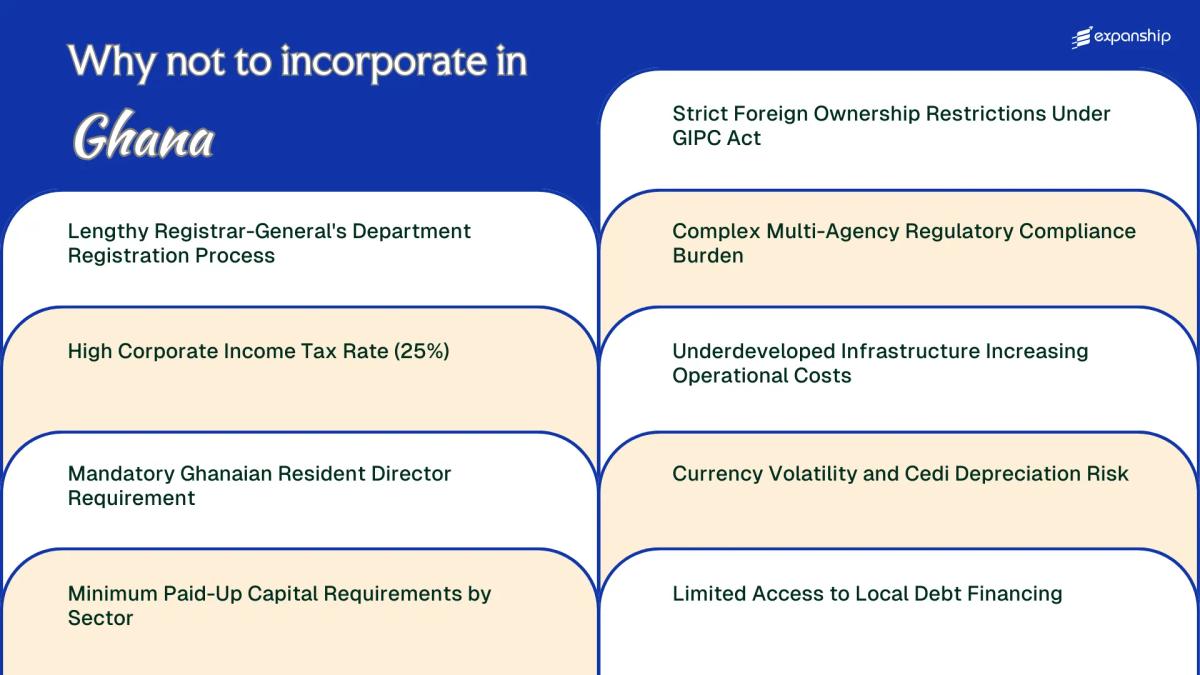
Lengthy Registrar-General's Department Registration Process
Ghana Registrar-General registration delays affect foreign businesses before operations even begin. The Registrar-General's Department (RGD), operating under the Companies Act, 2019 (Act 992), processes all business incorporation filings, and the timeline rarely matches official estimates.
Processing Backlogs at the RGD
The RGD's online portal, ORC (Office of the Registrar of Companies), was introduced to reduce manual bottlenecks, but system outages and document verification queues still extend registration timelines beyond the projected five to seven working days. For a foreign investor with a time-sensitive market entry, each additional week represents deferred revenue and accumulated legal fees.
Courier delays in obtaining certified documents from overseas jurisdictions compound the problem, since the RGD requires notarized and apostilled foreign director identification before processing can advance.
Why Delays Cost More Than Time
Slow company registration process in Ghana creates a secondary financial burden: pre-incorporation expenses such as office lease commitments, staff salaries, and import permits cannot be legally activated until the entity holds a valid certificate of incorporation.
Foreign firms operating under regional deadlines or investor reporting cycles face reputational exposure when incorporation timelines slip without a clear resolution mechanism at the RGD.
Until the RGD issues a certificate of incorporation, your business has no legal standing to sign contracts, open a corporate bank account, or employ staff in Ghana.
High Corporate Income Tax Rate (25%)
Ghana's corporate income tax rate of 25% sits notably above what many competing jurisdictions charge, and that gap translates directly into reduced post-tax returns for foreign investors. For context, regional peers such as Mauritius apply a headline rate of 15%, making the Ghana corporate income tax rate drawbacks particularly visible when comparing net profitability across African markets.
Under the Income Tax Act, 2015 (Act 896), this 25% rate applies to the chargeable income of resident and non-resident companies alike. Your foreign-owned entity does not benefit from a lower entry-rate during initial years of operation, which compresses margins at exactly the stage when capital recovery matters most.
The 25% corporate tax burden in Ghana becomes more significant when layered with other statutory levies:
- Dividend withholding tax of 8% reduces the effective return when repatriating profits to a foreign parent company.
- The National Fiscal Stabilisation Levy applies an additional 5% on profit before tax for certain sectors, increasing the effective rate well beyond 25%.
- Value Added Tax at 15%, combined with the Ghana Education Trust Fund levy and National Health Insurance Levy, inflates the total tax cost on business transactions.
- Thin capitalisation rules under Act 896 limit interest deductibility, reducing a common tax-planning tool available in other jurisdictions.
Certain extractive industries and free zone entities operate under different rate structures, but the standard 25% rate governs most foreign-owned commercial enterprises outside those narrow categories.

Company Incorporation in Ghana
Understand the full tax and compliance obligations before registering your business in Ghana.
Mandatory Ghanaian Resident Director Requirement
The Ghana resident director requirement under the Companies Act, 2019 (Act 992) mandates that every company incorporated in the country must have at least one director who is ordinarily resident in Ghana. For foreign founders managing their business remotely or from another country, this creates an immediate structural problem before operations even begin.
You cannot simply appoint a co-founder or overseas executive to satisfy this requirement. The director must be physically resident in Ghana, which means foreign-owned entities typically must either relocate a senior employee or engage a nominee director service, both of which carry ongoing costs and governance risks.
| Requirement | Restriction / Cost Imposed |
|---|---|
| Residency standard | Director must be ordinarily resident in Ghana, not merely a citizen or registered agent |
| Minimum number of resident directors | At least one out of the required minimum two directors |
| Nominee director annual cost (market estimate) | USD 500–1,500+ per year depending on provider and scope |
| Legal authority risk | Nominee directors hold legal signing authority, creating fiduciary exposure |
Engaging a nominee director does not transfer governance risk away from your business. That individual holds legal directorial authority under Act 992, meaning disputes over decision-making or liability can arise if the arrangement is not tightly structured through a separate deed of indemnity.
The requirement applies to all private limited companies and is not waived for wholly foreign-owned entities registered under the Ghana Investment Promotion Centre Act, 2013 (Act 865).
Minimum Paid-Up Capital Requirements by Sector
Ghana minimum paid-up capital requirements vary significantly by sector and business type, and for foreign investors, the thresholds are considerably higher than those applied to locally owned entities. Under the Ghana Investment Promotion Centre Act, 2013 (Act 865), a foreign-owned enterprise operating in a joint venture with a Ghanaian partner must have a minimum paid-up capital of USD 200,000. Wholly foreign-owned businesses face a higher threshold of USD 500,000.
These figures represent capital that must be demonstrably transferred into the country, meaning your firm cannot simply declare an amount on paper.
Sectors such as banking, insurance, and mining carry their own separate capital requirements imposed by their respective regulators, the Bank of Ghana, the National Insurance Commission, and the Minerals Commission. This creates a layered obligation where general GIPC thresholds and sector-specific minimums both apply simultaneously.
For smaller foreign enterprises, the USD 500,000 requirement alone can disqualify entry entirely or force a structuring decision driven by capital constraints rather than operational logic.
- Foreign wholly-owned enterprises must deposit USD 500,000 in paid-up capital under Act 865
- Joint ventures with Ghanaian partners require a minimum of USD 200,000
- Sector regulators impose additional capital thresholds independent of GIPC requirements
- Capital must be verifiably transferred into the country, not merely declared
- Trading companies face a separate minimum of USD 1,000,000 in paid-up capital
Foreign investors in Ghana's trading sector face a USD 1,000,000 minimum capital requirement, five times higher than the standard foreign enterprise threshold, making it one of the most restrictive entry points for foreign-owned commercial trading businesses in West Africa.
Strict Foreign Ownership Restrictions Under GIPC Act
Ghana GIPC Act foreign ownership restrictions represent one of the more structurally limiting features of the country's investment framework for foreign-owned entities.
Sector-Specific Equity Ceilings Under the GIPC Act
The Ghana Investment Promotion Centre Act, 2013 (Act 865) reserves certain business activities exclusively for Ghanaian citizens, including retail trading with a floor space under 1,000 square metres, beauty salons, and hire-purchase trading. Beyond these reserved sectors, the law imposes GIPC foreign equity limitations in several industries, effectively capping your ownership stake regardless of how much capital you intend to commit.
In joint ventures, the minimum Ghanaian equity participation requirements can structurally reduce your control over dividend policy, governance decisions, and exit options.
Practical Consequences for Foreign Investors
Where full foreign ownership is permitted, the Ghana Investment Promotion Centre ownership rules still require minimum capital thresholds — $500,000 for a wholly foreign-owned enterprise — which function as an indirect barrier to market entry. This financial floor has no equivalent in many competing West African jurisdictions, placing smaller foreign firms at an immediate structural disadvantage.
Enterprises in mining, petroleum, and fishing face additional sector-specific equity conditions under separate legislation, compounding the restrictions under Act 865.
Guidance on Foreign Ownership Challenges in Ghana
Understand how the GIPC Act's equity restrictions may affect your intended business structure before you commit to incorporation in Ghana.
Complex Multi-Agency Regulatory Compliance Burden
The Ghana multi-agency compliance burden means your business must satisfy multiple independent regulatory bodies simultaneously, each with its own fees, timelines, and renewal cycles.
- The Ghana Revenue Authority (GRA) requires separate registration for corporate income tax, VAT, and PAYE, each treated as a distinct compliance obligation rather than a unified process.
- Businesses operating in regulated sectors must obtain approvals from sector-specific agencies such as the Food and Drugs Authority (FDA), the National Communications Authority (NCA), or the Bank of Ghana, in addition to standard incorporation filings.
- The Ghana Investment Promotion Centre (GIPC) mandates annual reporting and capital verification, creating a recurring administrative obligation beyond the initial registration.
- Environmental permits issued by the Environmental Protection Agency (EPA) add a separate approval track for firms in manufacturing, extractives, or construction.
- Each agency operates on its own schedule, meaning approval delays at one body can stall the entire operational timeline for a foreign-owned entity.
Underdeveloped Infrastructure Increasing Operational Costs
Ghana infrastructure problems business costs compound quickly for foreign firms operating outside Accra. Unreliable electricity supply forces most businesses to procure backup generation, either diesel generators or inverter systems, which adds recurring fuel and maintenance expenditure that does not exist in more developed markets.
The Electricity Company of Ghana (ECG) distributes power across the southern grid, but outages remain frequent and unpredictable. Your operations absorb these disruptions directly through lost productivity, equipment damage, and the capital cost of redundant power systems.
Road freight conditions across secondary corridors increase logistics costs and extend delivery timelines. Perishable goods, time-sensitive manufacturing inputs, and imported equipment all face elevated spoilage and delay risks that your pricing and supply chain models must absorb.
Water supply inconsistencies in several industrial zones also force firms to fund independent storage and treatment infrastructure. These are not discretionary investments; they are operational prerequisites in many locations.
A manufacturing firm in Tema that runs a 100 kVA diesel generator for 10 hours daily at current pump prices could spend upward of GHS 250,000 annually on fuel alone, before factoring in generator servicing, depreciation, and operator costs. This expenditure has no equivalent in markets with stable grid supply.
Currency Volatility and Cedi Depreciation Risk
Ghana cedi depreciation risks are among the most financially damaging exposures a foreign-incorporated entity can face in this market. The cedi has lost significant value against major currencies over successive years, driven by high inflation, large fiscal deficits, and external debt pressures that culminated in Ghana's 2022 IMF bailout program.
For a foreign business billing clients in cedis but carrying costs in dollars or euros, the currency mismatch directly erodes profit margins. Repatriating earnings through the Bank of Ghana's foreign exchange framework adds another layer of friction, as forex availability tightens during periods of external pressure.
Sectors with long project cycles face compounding exposure. A contract priced in cedis at the start of a 12-month engagement may settle at a materially lower dollar equivalent by completion.
- Revenue denominated in cedis loses real value faster during inflationary cycles
- Import-dependent operations absorb higher local-currency costs when the cedi weakens
- Multi-year investment returns become difficult to model under unpredictable exchange rate conditions
Foreign businesses that price contracts, set budgets, or project returns in cedis without accounting for sustained depreciation trends risk material financial losses that no corporate structure change can offset.
Limited Access to Local Debt Financing
Limited debt financing Ghana businesses can access through domestic channels is structurally constrained. Commercial banks in Ghana typically apply high lending rates, which the Bank of Ghana's monetary policy rate directly influences, keeping borrowing costs elevated for corporate borrowers.
Ghana's capital market remains shallow relative to peer economies in the region. The Ghana Stock Exchange lists a limited number of companies, and the corporate bond market is underdeveloped, leaving businesses with few viable instruments to raise debt capital locally.
For foreign-owned entities, restricted bank lending in Ghana compounds this problem. Banks often require substantial collateral, and foreign firms without an established local credit history face steeper scrutiny during credit assessments.
- Access to concessional credit through the Ghana Exim Bank is largely reserved for qualifying sectors such as export-oriented businesses.
- Non-bank financial institutions operate under the Non-Bank Financial Institutions Act, 2008 (Act 774), but their lending capacity is limited compared to commercial banks.
Strategies to Overcome These Disadvantages
Overcoming Ghana incorporation disadvantages requires structural decisions made before registration, not after. The GIPC Act, sector-specific capital thresholds, and multi-agency compliance obligations each demand deliberate pre-entry planning.
- Structure your entity under a sector that qualifies for GIPC incentives, such as export-oriented manufacturing, to access reduced tax exposure under the Ghana Revenue Authority's incentive framework.
- Appoint a qualified Ghanaian resident director prior to submitting your incorporation application to the Registrar-General's Department.
- Verify your sector's minimum paid-up capital requirement under the GIPC Act before remitting capital, as thresholds differ materially across industries.
- Open a foreign-currency-denominated account with a Bank of Ghana-licensed institution to manage Cedi depreciation exposure at the treasury level.
- Confirm all required permits from sector-specific regulators before commencing operations, as post-incorporation licensing sits outside the Registrar-General's remit.
Ghana's regulatory framework distributes compliance authority across multiple statutory bodies, and no single registration event satisfies all obligations. Addressing each layer systematically reduces the risk of operational delays tied to licensing gaps or capital shortfalls.
Ghana's Overall Investment Potential
Ghana presents a credible case for foreign incorporation despite the friction points documented throughout this blog. The regulatory burdens, capital requirements, and macroeconomic risks are real, but the country's position as West Africa's second-largest economy, its democratic governance record, and its English-language legal system grounded in common law tradition give it a foundation that many regional peers lack.
| Pros | Cons |
|---|---|
| Common law legal system provides a familiar contractual framework for foreign investors | The Registrar-General's Department registration process involves multiple sequential steps that extend timelines |
| English is the official business language, reducing translation and communication costs | The 25% corporate income tax rate sits above the rates of several competing African jurisdictions |
| The GIPC Act provides a formal investment registration pathway with defined protections | Foreign ownership is prohibited or capped in specific sectors under the same GIPC Act |
| Ghana Stock Exchange and regional banking presence support some capital activity | Local debt financing options are limited and lending rates remain high relative to developed markets |
| Relatively stable democratic institutions reduce political volatility for long-term planning | Persistent cedi depreciation creates currency risk that compounds over multi-year investment horizons |
Compliance obligations in Ghana span multiple agencies, each with independent filing cycles.
Compliance Services for Companies in Ghana
Meet your annual filing, tax registration, and multi-agency reporting obligations under Ghanaian law.
Conclusion
The cons of company formation in Ghana are material enough to require deliberate planning before commitment. Foreign ownership caps under the Ghana Investment Promotion Centre Act, a 25% corporate income tax rate, and persistent cedi depreciation collectively create a cost and compliance profile that demands careful financial modelling. Structural constraints at the Registrar-General's Department add time pressure that affects your market-entry timeline. Working with advisors who hold direct experience with Ghana's regulatory agencies reduces exposure to procedural delays and avoidable penalties.
Expanship's Ghana Incorporation Services
Incorporating in Ghana means contending with a specific set of regulatory requirements -- the Registrar-General's Department filing process, GIPC equity thresholds, sector-specific capital minimums, and multi-agency compliance obligations across the Ghana Revenue Authority, sector regulators, and local authorities. Expanship's Ghana company incorporation services are structured around these particular demands, reducing the administrative load your business carries when entering this market.
From initial registration through to ongoing compliance, our team manages the operational detail so your attention stays on the business itself. Services include:
- Preparing and filing all incorporation documents with the Registrar-General's Department
- Providing a registered agent and local office address in Ghana
- Liaising directly with government agencies and sector regulatory bodies on your behalf
- Managing post-incorporation compliance requirements as they fall due
- Facilitating introductions to local banking institutions
- Handling tax registration and coordination with the Ghana Revenue Authority
Reach out to Expanship Ghana to discuss your incorporation requirements.
Frequently Asked Questions (FAQ)
The standard corporate income tax rate under Ghana's Income Tax Act, 2015 (Act 896) is 25%, but sector-specific rates do exist. Free zone enterprises operating under the Ghana Free Zones Authority pay a different rate, and certain agribusiness activities attract reduced rates for a limited period. However, most standard commercial and services companies incorporated outside free zone designations face the full 25% rate.
Failure to meet the minimum paid-up capital thresholds prescribed under the Ghana Investment Promotion Centre Act, 2013 (Act 865) can result in the GIPC refusing or revoking a business's registration certificate. Without a valid GIPC certificate, the company cannot legally operate as a foreign-owned entity in Ghana. The GIPC has authority to investigate and refer non-compliant businesses to other regulatory bodies for further action.
It can be, particularly for investors without existing local networks or business relationships in Ghana. The requirement is not merely administrative — the individual must be a genuine resident, and nominee arrangements that exist only on paper carry legal and reputational risk. If the Registrar-General's Department or the GIPC determines that a directorship appointment is not substantive, it can complicate the company's standing.
Ghana's 25% rate is broadly in line with Nigeria's 30% standard rate for larger companies, but higher than Senegal's reduced rates available to certain qualifying businesses. The comparison is not straightforwardly favourable to Ghana, especially when combined with additional levies such as the National Fiscal Stabilisation Levy applicable to certain sectors. An investor choosing between West African hubs should factor in the full effective tax burden, not the headline rate alone.
Operating under the Ghana Free Zones Authority does simplify some interactions by channelling oversight through a single authority, but it does not eliminate all multi-agency requirements. Sector-specific regulators, the Ghana Revenue Authority, and environmental bodies may still have jurisdiction depending on what the business does. Free zone status is also subject to its own conditions, including export revenue thresholds, which may not suit businesses primarily serving the domestic market.
Delays at the Registrar-General's Department push back every subsequent step — GIPC registration, tax identification number issuance through the Ghana Revenue Authority, and sector-specific licences all depend on receiving the Certificate of Incorporation first. A delay of several weeks is common, and during that period your business cannot legally operate, open a corporate bank account, or sign enforceable contracts in the company's name. The cascading effect on your launch timeline and associated holding costs is a genuine operational risk.
Access is materially restricted. Ghanaian commercial banks typically require collateral in the form of local fixed assets, and foreign-owned entities that have not yet built a local credit history face higher lending rates and stricter conditions. The Bank of Ghana's regulatory framework places capital adequacy requirements on banks that incentivise lending to established local borrowers over newer foreign-owned firms. In practice, many foreign businesses in Ghana rely on offshore financing or shareholder loans rather than local debt facilities.
Legal Disclaimer
The information provided in this article is for general informational purposes only and does not constitute legal, tax, or professional advice. While we strive to ensure the accuracy and timeliness of the content, laws and regulations are subject to change, and the application of laws can vary widely based on specific facts and circumstances.
Readers should not act upon this information without seeking professional counsel tailored to their individual situation. Expanship and its authors disclaim any liability for actions taken or not taken based on the content of this article.
For specific advice regarding your business setup, compliance requirements, or any legal matters, please consult with qualified legal and tax professionals in the relevant jurisdiction.