
Key Takeaways
- Ghana's corporate tax rate of 25%, administered by the Ghana Revenue Authority, is complemented by sector-specific reductions and a Free Zone structure that offers a 10-year tax holiday followed by a capped 8% rate for qualifying export-oriented enterprises.
- Enacted in 2019, the Companies Act modernised the governance framework that applies to registered entities, giving foreign investors a clearly defined legal environment for structuring and operating a business in Ghana.
- Membership in ECOWAS extends preferential market access across fifteen West African nations, making Ghana a structurally useful base for businesses with regional expansion objectives beyond a single-jurisdiction operation.
- Profit repatriation rights secured under the Foreign Exchange Act, reinforced by a network of bilateral investment treaties, provide foreign shareholders with a defined legal basis for moving capital out of the country rather than relying on administrative discretion.
Incorporated as an independent republic in 1957, Ghana sits along the Gulf of Guinea in West Africa, sharing borders with Côte d'Ivoire, Burkina Faso, and Togo. The country operates under a stable constitutional democracy, which provides a defined legal environment for business registration and operation. Foreign entities looking to establish a presence here most commonly do so through a Private Limited Liability Company.
Company registration falls under the jurisdiction of the ORC, the Office of the Registrar of Companies, which serves as the primary regulatory authority for incorporating and maintaining businesses in the country. Ghana operates a territorial-leaning tax system with standard corporate rates applied to locally sourced income, and the government has maintained a generally open posture toward foreign direct investment across most sectors. Certain industries carry minimum capital requirements for foreign participation, but the broader regulatory framework does not impose blanket restrictions on overseas ownership.
The benefits of incorporating in Ghana span tax policy, regional trade access, legal protections, and workforce considerations. This article examines the key advantages relevant to your business formation decision.
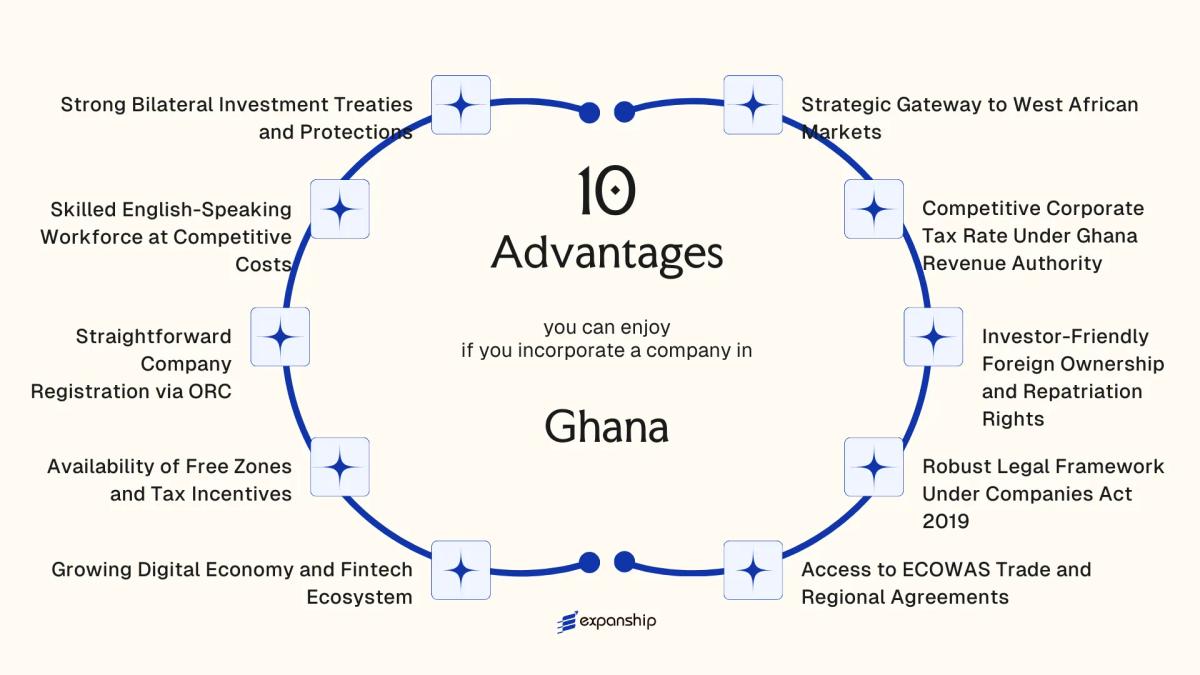
Strategic Gateway to West African Markets
Ghana's position as a Ghana strategic gateway to West Africa is geographic and institutional. Accra sits at the midpoint of the West African coastline, and the country's stable governance structure gives your firm a credible operational base from which to reach over 400 million consumers across the region.
Regional Access Through ECOWAS Membership
Membership in the Economic Community of West African States means goods produced or substantially transformed within Ghana can move across member borders under defined preferential trade terms. That tariff access reduces the cost of serving markets like Nigeria, Côte d'Ivoire, and Senegal from a single incorporated entity rather than registering separately in each jurisdiction.
Infrastructure and Connectivity Advantages
Tema Port, one of West Africa's busiest container terminals, handles a significant share of landlocked neighbouring countries' import and export cargo, including Burkina Faso and Mali. Establishing your business in Ghana therefore positions it within an existing logistics corridor that already serves cross-border trade flows, without requiring you to build distribution infrastructure from scratch.
A Ghana-registered company can serve multiple ECOWAS markets commercially while maintaining a single compliance and governance structure under the Companies Act 2019.
Competitive Corporate Tax Rate Under Ghana Revenue Authority
Ghana's standard corporate income tax rate sits at 25%, which positions the country competitively within sub-Saharan Africa, where rates frequently exceed 30%. For foreign businesses, this baseline rate already represents a meaningful reduction in annual tax liability compared to many home jurisdictions, without requiring special registration or preferential treatment to access it.
The Ghana Revenue Authority administers the corporate tax regime under the Income Tax Act, 2015 (Act 896). That legislation also establishes reduced rates for qualifying sectors. Agribusinesses, for instance, benefit from lower rates, and certain manufacturing firms operating outside the two major cities can access further reductions. These graduated rates mean your effective tax burden is directly shaped by where and how the business operates, giving you a degree of planning flexibility from the outset.
Sector-specific incentives under Act 896 offer concrete advantages:
- Income from farming activities is taxed at a reduced rate, lowering entry costs for agri-focused investors
- Companies in priority manufacturing zones outside Accra and Kumasi qualify for reduced rates tied to location
- Free zone entities, subject to separate qualification rules, access a 0% rate for the first ten years of operation
- Upstream petroleum and mining firms are subject to ring-fenced rules that prevent losses from unrelated operations inflating tax positions
The ten-year exemption available to free zone enterprises is contingent on meeting the Ghana Free Zones Authority's minimum investment and export thresholds.

Company Incorporation in Ghana
Register your company in Ghana with support from Expanship, covering entity structuring, GRA registration, and compliance setup.
Investor-Friendly Foreign Ownership and Repatriation Rights
Ghana foreign ownership rights for investors are defined primarily by the Ghana Investment Promotion Centre Act, 2013 (Act 865), which governs how foreign capital enters, operates, and exits the country. Under this framework, foreign nationals can hold up to 100% equity in most sectors, removing the need for a local partner in the majority of business activities. This degree of ownership control is material for investors who require full decision-making authority over their operations.
| Feature | Rule / Threshold |
|---|---|
| Maximum foreign equity (most sectors) | 100% |
| Minimum foreign capital (wholly foreign-owned enterprise) | USD 500,000 |
| Minimum foreign capital (joint venture with Ghanaian partner) | USD 200,000 |
| Governing legislation | GIPC Act, 2013 (Act 865) |
| Repatriation right | Guaranteed under Act 865 |
Profit repatriation rights are codified in Act 865, which explicitly guarantees foreign investors the right to transfer dividends, loan repayments, and proceeds from the sale of an enterprise through a designated bank. Because this right is statutory rather than discretionary, your ability to move capital is not subject to administrative approval on a case-by-case basis. Capital repatriation advantages of this kind reduce the financial exposure that comes with long-term market entry. The minimum capital thresholds apply at the point of registration and vary depending on whether a Ghanaian partner holds equity in the firm.
Robust Legal Framework Under Companies Act 2019
The Companies Act 2019 replaced the Companies Code 1963 (Act 179) and introduced a modernised corporate governance structure that aligns with international standards. For foreign investors, this matters because the statutory framework governing your entity is not a patchwork of colonial-era rules but a purpose-built legislative instrument designed for contemporary commercial activity.
Under the Act, private limited companies benefit from clearly defined rules on director duties, shareholder rights, and minority protections. These provisions give foreign shareholders predictable recourse in the event of a governance dispute, which reduces legal uncertainty when structuring multi-party ownership arrangements from abroad.
The Registrar-General's Department, operating as the Office of the Registrar of Companies (ORC), administers company incorporation and statutory filings under this legislation. Having a single designated statutory authority means your compliance obligations are channelled through one accountable body rather than fragmented across multiple agencies.
Keep these points in mind while relying on this legal framework:
- Private companies must maintain a registered office in Ghana at all times
- The Act requires at least one director to be ordinarily resident in the country
- Annual returns must be filed with the ORC within the prescribed period
- Non-compliance with filing obligations can result in administrative penalties or striking off
The Companies Act 2019 introduced a single-member private company structure, meaning you can incorporate a fully owned entity without a second shareholder, which was not permitted under the 1963 Code.
Access to ECOWAS Trade and Regional Agreements
Ghana ECOWAS trade agreement benefits extend directly to any company incorporated within the country. As a founding member of the Economic Community of West African States, Ghana gives registered businesses preferential access to a regional market of roughly 400 million people across 15 member states, without the tariff burdens that apply to firms operating outside the bloc.
Tariff-Free Movement Under the ECOWAS Trade Liberalisation Scheme
The ECOWAS Trade Liberalisation Scheme (ETLS) allows qualifying goods manufactured in member states to move across borders free of import duties. For your business, this means goods produced in Ghana can enter Senegal, Nigeria, Côte d'Ivoire, and other member economies without standard customs charges, provided the product meets ETLS origin criteria and the firm holds valid ECOWAS approval documentation.
ETLS certification is administered through the Ghana National ETLS Secretariat. Eligibility depends on local value-added content thresholds and product classification under the ECOWAS harmonized tariff schedule, so the benefit applies most directly to manufacturers and processors with genuine production activity in-country.
Regional Protocols That Strengthen Market Position
Beyond tariffs, ECOWAS protocols on free movement of persons and the right of establishment allow businesses to deploy staff across member states with fewer visa and residency constraints. This reduces operational friction for firms managing multi-country West African operations from a single incorporated entity.
Ghana also participates in the African Continental Free Trade Area (AfCFTA), which is headquartered in Accra. That physical presence signals active governmental engagement and gives locally incorporated firms proximity to AfCFTA institutional processes as the agreement's tariff schedules continue to be implemented.
Maximize Your ECOWAS and AfCFTA Trade Advantages in Ghana
Speak with our corporate specialists about structuring your Ghana entity to qualify for ETLS certification and regional trade benefits.
Growing Digital Economy and Fintech Ecosystem
Ghana's fintech sector has expanded considerably over the past decade, supported by a regulatory architecture that gives foreign investors a defined, enforceable operating environment. For businesses assessing Ghana fintech ecosystem benefits for investors, the Bank of Ghana's regulatory sandbox — introduced under the Payment Systems and Services Act, 2019 (Act 987) — is a concrete structural advantage. It allows fintech firms to test products under a supervised framework before full licensing, reducing capital exposure during early-stage deployment.
- Act 987 governs payment service providers, e-money issuers, and switching companies, giving your business a clear licensing pathway rather than navigating sector-specific ambiguity common in less codified markets.
- The Ghana Interbank Payment and Settlement Systems (GhIPSS) infrastructure supports mobile money interoperability, meaning a fintech entity incorporated locally can connect to an existing national payments network rather than building settlement rails independently.
- Mobile money penetration in Ghana exceeds 60% of the adult population, creating an addressable user base that operates through formal digital channels your business can reach from day one.
- The National Communications Authority and Bank of Ghana maintain concurrent oversight roles, which produces clearer compliance boundaries than single-regulator markets where fintech and telecoms responsibilities overlap without formal delineation.
Availability of Free Zones and Tax Incentives
Ghana free zone tax incentives for businesses are administered under the Free Zones Act, 1995 (Act 504), which established the Ghana Free Zones Authority (GFZA) as the designated regulatory body. Companies operating under this regime are exempt from corporate income tax for the first ten years of operation, after which a maximum rate of 8% applies. For export-oriented businesses, this represents a significant structural cost advantage over standard corporate rates.
Entities registered under the free zone scheme are also exempt from import duties on raw materials, capital goods, and production equipment. Since manufacturing and re-export businesses typically carry high import input costs, this exemption directly reduces operating expenditure from the outset.
To qualify, a free zone enterprise must export at least 70% of its output. Domestic sales are permitted up to 30%, but those transactions are subject to standard import duty treatment.
The Ghana Investment Promotion Centre (GIPC) also administers sector-specific incentives outside the free zone framework, including reduced rates for agribusiness and manufacturing under the Ghana Revenue Authority's applicable schedules.
A manufacturing firm exporting $2 million in goods annually and importing $800,000 in production equipment could avoid approximately $80,000-$120,000 in import duties per year, depending on applicable tariff classifications, solely by operating under the free zone regime.
Straightforward Company Registration via ORC
Ghana ORC company registration benefits begin at the point of entry: the Office of the Registrar of Companies operates an online portal that allows foreign investors to register a business without requiring physical presence in the country. This removes a logistical barrier that remains common across much of Sub-Saharan Africa.
Under the Companies Act, 2019 (Act 992), the standard registration process involves reserving a company name, filing the constitution, and submitting particulars of directors and shareholders. Most straightforward incorporations are completed within five to seven working days through the ORC's electronic platform.
A private limited company requires a minimum of one shareholder and one director, with no minimum share capital prescribed for most business categories. This low structural threshold means a foreign investor can establish a legal presence without committing significant capital upfront purely for compliance purposes.
- Name reservation and entity registration are handled through a single integrated ORC online platform
- The constitution filing replaces the older dual-document model under the repealed Companies Act, 1963 (Act 179), reducing documentation volume
- Certified copies of incorporation documents are issued digitally upon completion
Businesses in regulated sectors such as banking, insurance, or mining must obtain additional licences from the relevant sector authority before commencing operations, regardless of ORC registration status.
Skilled English-Speaking Workforce at Competitive Costs
Ghana's Ghana English-speaking workforce advantages are grounded in a structural reality: English is the official language of government, commerce, and education. Business correspondence, contracts, and regulatory filings all operate in English, which removes the translation overhead that foreign firms routinely absorb in francophone or lusophone African markets.
Education Pipeline and Skill Levels
Tertiary institutions such as the University of Ghana, Kwame Nkrumah University of Science and Technology (KNUST), and the University of Cape Coast produce tens of thousands of graduates annually across engineering, finance, law, and technology disciplines. For your business, this means a locally available talent pool that can fill professional and technical roles without requiring expatriate hires at significantly higher cost.
Wage Competitiveness
Salary benchmarks in Accra, while rising, remain materially lower than those in Western Europe or North America for equivalent roles. The national minimum wage is set annually by the National Tripartite Committee, providing a transparent floor from which employment agreements are structured. Mid-level professionals in accounting, software development, and logistics can typically be hired at a fraction of comparable Western market rates.
Labour Regulatory Framework
Employment relationships are governed by the Labour Act, 2003 (Act 651), which defines rights and obligations for both employers and employees. The act covers matters including working hours, termination procedures, and leave entitlements. Knowing the legal parameters in advance allows your firm to budget employment costs with a reasonable degree of certainty.
- Official language: English across all government and commercial functions
- Annual minimum wage set by the National Tripartite Committee
- Labour Act, 2003 (Act 651) governs employment contracts and disputes
- Graduate output from multiple nationally accredited universities
- Competitive mid-level professional salaries relative to Western markets
Strong Bilateral Investment Treaties and Protections
Ghana bilateral investment treaty protections form a meaningful layer of legal security for foreign capital, sitting outside the domestic legal system and enforceable through international arbitration mechanisms.
Ghana is a signatory to a number of Bilateral Investment Treaties, including agreements with the United States, the United Kingdom, the Netherlands, Germany, and China, among others. Each treaty typically guarantees fair and equitable treatment, protection against expropriation without compensation, and free transfer of funds related to an investment. For your business, this means that disputes with the state are not confined to local courts — most treaties provide access to international arbitration under ICSID (International Centre for Settlement of Investment Disputes) or UNCITRAL rules.
Protection against expropriation is a particularly relevant guarantee. Under applicable BITs, any government measure that effectively deprives an investor of their investment triggers an obligation to pay prompt, adequate, and effective compensation. This standard is defined at the treaty level, not by domestic statute, so it cannot be altered by a change in local legislation.
Key protections commonly available under Ghana's BITs include:
- National treatment or most-favoured-nation (MFN) status, preventing discriminatory treatment relative to domestic investors or investors from third countries
- Free repatriation of profits, dividends, and proceeds from asset sales
- Access to binding international arbitration without requiring exhaustion of local remedies in many agreements
- Guarantees against performance requirements that restrict management or operational control
Eligibility for these protections depends on the investor's nationality and the structure of the investment, as each treaty defines "investor" and "investment" differently.
How Ghana Stacks Up Against Other African Business Hubs
Comparing Ghana against other African incorporation destinations reveals practical differences that matter to foreign investors. The three jurisdictions most commonly evaluated alongside it are Nigeria, Kenya, and Rwanda. Nigeria draws attention for its market size; Kenya for its East African positioning and fintech maturity; Rwanda for its ease-of-doing-business reforms. Each targets a similar profile of foreign-owned entities, making the comparison instructive rather than arbitrary.
What the comparison surfaces is less about cost and more about structural predictability. Ghana's Companies Act 2019 removed the requirement for local equity participation across most sectors, a threshold that still constrains ownership structures in Nigeria under certain sectoral rules. Rwanda scores highly on registration speed, but its domestic market remains significantly smaller, which affects revenue potential for firms targeting West African consumers directly.
| Parameter | Ghana | Nigeria | Kenya | Rwanda |
|---|---|---|---|---|
| Foreign Ownership (General) | Up to 100% permitted | Sector-restricted in some industries | Up to 100% permitted | Up to 100% permitted |
| Corporate Income Tax Rate | 25% | 30% | 30% | 28% |
| Official Business Language | English | English | English / Swahili | English / French / Kinyarwanda |
| Regional Trade Bloc | ECOWAS | ECOWAS | EAC | EAC / COMESA |
| Free Zone Regime | Yes (GFZA-administered) | Yes (NEPZA-administered) | Yes (EPZ Authority) | Yes (Kigali SEZ) |
| Bilateral Investment Treaties | 30+ | 30+ | 40+ | 20+ |
| Company Registry | Office of the Registrar of Companies (ORC) | CAC | Business Registration Service | RDB |
Compliance Services for Companies in Ghana
Stay current with Ghana Revenue Authority filings, ORC annual returns, and ongoing statutory obligations for your Ghana-registered entity.
Conclusion
Ghana's position as a structured, treaty-backed incorporation destination is grounded in concrete legal and regulatory architecture. The Companies Act 2019 modernised the governance framework for registered entities, while the Ghana Revenue Authority administers a corporate tax rate of 25% alongside sector-specific reductions that can materially affect after-tax returns. For businesses oriented toward regional expansion, the country's ECOWAS membership provides preferential market access across fifteen West African nations.
The benefits of incorporating in Ghana extend beyond single-jurisdiction operations. Free Zone enterprises, regulated under the Ghana Free Zones Authority, can access a 10-year corporate tax holiday with a capped rate of 8% thereafter, a structural advantage for export-driven businesses. Profit repatriation rights, protected under the Foreign Exchange Act and reinforced through bilateral investment treaties, give foreign investors a defined legal basis for moving capital across borders.
Whether the corporate tax treatment, the free zone framework, or the regional trade access carries the most weight depends on your business model, the sector you operate in, and the markets you intend to serve. Not every structure fits every objective, and the advantages of setting up a company in Ghana are most fully realised when the chosen entity type and registration approach align with your operational requirements. The next step is matching those requirements to the correct incorporation structure and ensuring ongoing compliance under the Office of the Registrar of Companies.
Start Your Ghana Company Formation with Expanship Today
Expanship assists foreign businesses through each stage of company formation in Ghana, from selecting the appropriate entity type under the Companies Act 2019 to fulfilling post-incorporation obligations monitored by the Registrar-General's Department and the Ghana Revenue Authority. The services described throughout this blog, covering Free Zone registration, ORC filings, sector-specific licensing, and compliance with GIPC minimum capital thresholds, reflect the actual regulatory steps your business will encounter.
Expanship's service scope for Ghana company formation with Expanship covers the following:
- Preparation and legalization of incorporation documents in accordance with ORC requirements
- Registered agent and local office provision to satisfy the Companies Act 2019 residency conditions
- Government filing and liaison with the Registrar-General's Department
- Post-incorporation compliance management, including annual returns and statutory filings
- Coordination with sector regulators such as the Ghana Investment Promotion Centre where applicable
- Banking introduction assistance to support your firm's operational setup in-country
To discuss your specific requirements, contact Expanship Ghana.
Frequently Asked Questions (FAQ)
The standard corporate income tax rate administered by the Ghana Revenue Authority is 25%. Companies operating within a Free Zone enclave under the Ghana Free Zones Authority are taxed at a reduced rate of 15% after an initial tax holiday period. The applicable rate can vary further depending on the sector, with different rates applying to extractive industries and financial institutions.
Standard registration through the Office of the Registrar of Companies generally takes between one and five business days for straightforward applications submitted via the ORC's online portal. Processing times can extend if documentation is incomplete or if the business activity requires additional sectoral approvals from bodies such as the Bank of Ghana or the Securities and Exchange Commission. Free Zone enterprises require a separate licence from the Ghana Free Zones Authority, which adds to the overall timeline.
Under the Companies Act, 2019 (Act 992), a private company incorporated in Ghana must have a minimum of one director, and at least one director must be ordinarily resident in the country. This residency requirement applies regardless of the nationality of the shareholders. Failure to maintain a resident director puts the company in breach of its statutory obligations under Act 992.
Bilateral investment treaties to which Ghana is a signatory typically provide foreign investors with access to international arbitration, protection against expropriation without compensation, and guarantees of fair and equitable treatment. The specific mechanisms available depend on the treaty signed between Ghana and the investor's home country, as treaty terms are not uniform. Where a treaty provides for ICSID arbitration, investors can bypass domestic courts entirely for qualifying disputes.
ECOWAS trade provisions, including those under the ECOWAS Trade Liberalisation Scheme, can reduce or eliminate tariffs on goods originating from member states, but eligibility is not automatic upon incorporation. A company must obtain a Certificate of Origin and demonstrate that its goods meet the applicable rules of origin criteria under ECOWAS protocols. Compliance with these origin rules is verified at the point of export and can require documentation from relevant Ghanaian trade authorities.
Companies licensed under the Ghana Free Zones Authority are primarily intended to produce goods or services for export, and sales into the domestic market are restricted. A Free Zone enterprise may sell up to 30% of its output into the local market, subject to payment of applicable import duties on that portion. Exceeding this threshold without authorisation constitutes a breach of Free Zone licence conditions.
Legal Disclaimer
The information provided in this article is for general informational purposes only and does not constitute legal, tax, or professional advice. While we strive to ensure the accuracy and timeliness of the content, laws and regulations are subject to change, and the application of laws can vary widely based on specific facts and circumstances.
Readers should not act upon this information without seeking professional counsel tailored to their individual situation. Expanship and its authors disclaim any liability for actions taken or not taken based on the content of this article.
For specific advice regarding your business setup, compliance requirements, or any legal matters, please consult with qualified legal and tax professionals in the relevant jurisdiction.