
Key Takeaways
- Guernsey's corporate framework, governed by the Companies (Guernsey) Law, 2008 and administered by the Guernsey Registry, offers at least ten distinct entity types spanning companies, partnerships, foreign registrations, and sole trader status.
- The private company limited by shares is the most commonly registered entity in Guernsey and suits the widest range of closely held trading and holding arrangements.
- Most commercial activities in Guernsey are subject to a 0% corporate tax rate, with exceptions applying only to certain regulated sectors.
- Structures such as the General Partnership, Limited Partnership, and Limited Liability Limited Partnership serve distinct investor and operational configurations, while foreign company registration allows overseas entities to establish a local presence without incorporating a separate legal person.
Introduction to Entity Types in Guernsey
Guernsey is a Crown Dependency situated in the English Channel, closer to the French coast of Normandy than to mainland Britain. It operates as a self-governing jurisdiction with its own legislature, legal system, and tax regime — distinct from the United Kingdom, though the British Crown retains responsibility for its defence and international representation. Corporate registration and oversight fall under the Guernsey Registry, which operates within the framework established by the Companies (Guernsey) Law, 2008.
The island applies a standard corporate tax rate of 0% for most businesses, making it a zero-tax jurisdiction for the majority of commercial activities, with specific exceptions for certain regulated sectors.
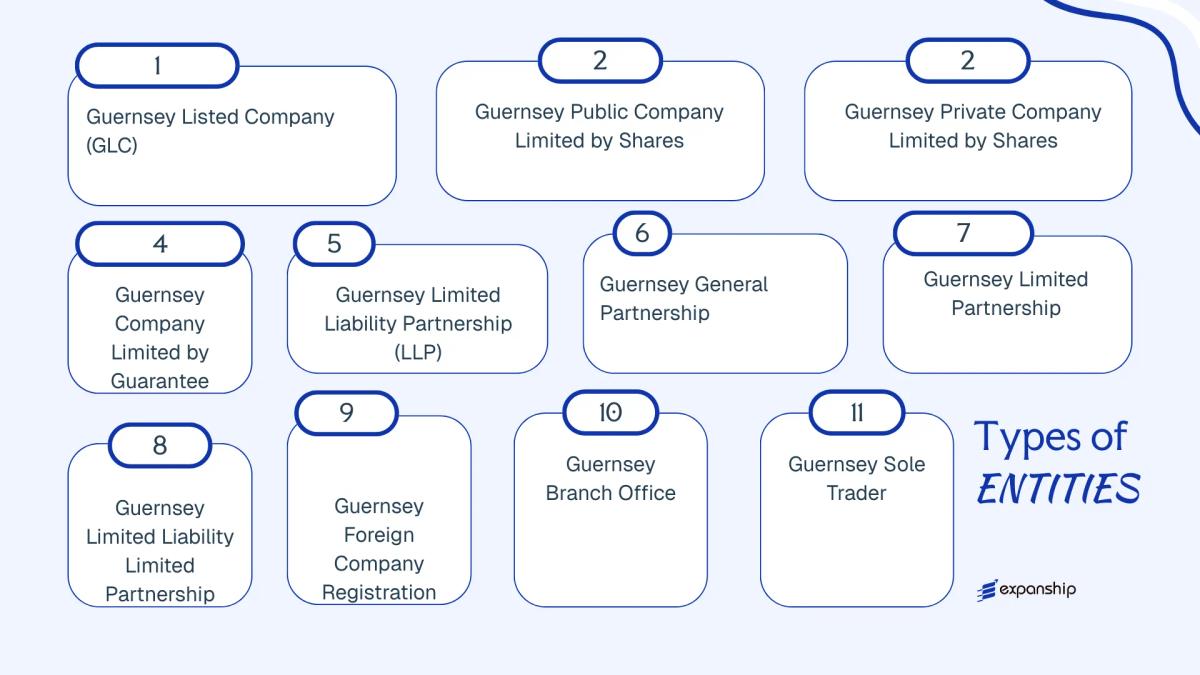
Understanding the types of business entities in Guernsey requires familiarity with the full range of structures available under local law. These include the Private Company Limited by Shares, Public Company Limited by Shares, Listed Company, Company Limited by Guarantee, Limited Liability Partnership, General Partnership, Limited Partnership, Limited Liability Limited Partnership, registered foreign entities, and the Sole Trader.
Each structure carries distinct formation requirements, governance obligations, and liability implications. This article examines each one in detail.
An Overview of Business Structures in Guernsey
Guernsey's company law framework provides several distinct legal structures, each governed primarily by the Companies (Guernsey) Law, 2008. Additional structures, including partnerships and foreign entity registrations, fall under separate legislation such as the Limited Liability Partnerships (Guernsey) Law, 2013 and the Partnerships (Guernsey) Law, 1995. Each structure carries different implications for liability, taxation, governance, and permitted activity.
Business Structures at a Glance
| Entity Type | Legal Form | Liability | Taxed / Exempt | Local Trading | Minimum Members | Regulatory Authority | Governing Act |
|---|---|---|---|---|---|---|---|
| Listed Company (GLC) | Corporate | Limited | 0% standard rate | Permitted | 2 shareholders | Guernsey Financial Services Commission | Companies (Guernsey) Law, 2008 |
| Public Company Limited by Shares | Corporate | Limited | 0% standard rate | Permitted | 2 shareholders | Guernsey Registry | Companies (Guernsey) Law, 2008 |
| Private Company Limited by Shares | Corporate | Limited | 0% standard rate | Permitted | 1 shareholder | Guernsey Registry | Companies (Guernsey) Law, 2008 |
| Company Limited by Guarantee | Corporate | Limited to guarantee | 0% standard rate | Permitted | 1 member | Guernsey Registry | Companies (Guernsey) Law, 2008 |
| Limited Liability Partnership | Hybrid | Limited | Partner-level | Permitted | 2 partners | Guernsey Registry | LLP (Guernsey) Law, 2013 |
| General Partnership | Unincorporated | Unlimited | Partner-level | Permitted | 2 partners | Guernsey Registry | Partnerships (Guernsey) Law, 1995 |
| Limited Partnership | Unincorporated | Mixed | Partner-level | Permitted | 2 partners | Guernsey Registry | Partnerships (Guernsey) Law, 1995 |
| Limited Liability Limited Partnership | Hybrid | Limited | Partner-level | Permitted | 2 partners | Guernsey Registry | Partnerships (Guernsey) Law, 1995 |
| Foreign Company Registration | Corporate (foreign) | Per home jurisdiction | Per home jurisdiction | Permitted | N/A | Guernsey Registry | Companies (Guernsey) Law, 2008 |
| Branch Office | Non-incorporated | Per parent entity | Per parent entity | Permitted | N/A | Guernsey Registry | Companies (Guernsey) Law, 2008 |
| Sole Trader | Unincorporated | Unlimited | Personal income tax | Permitted | 1 individual | Revenue Service (Guernsey) | General law |
Each of these structures is examined in full in the sections below.
Guernsey Listed Company (GLC)
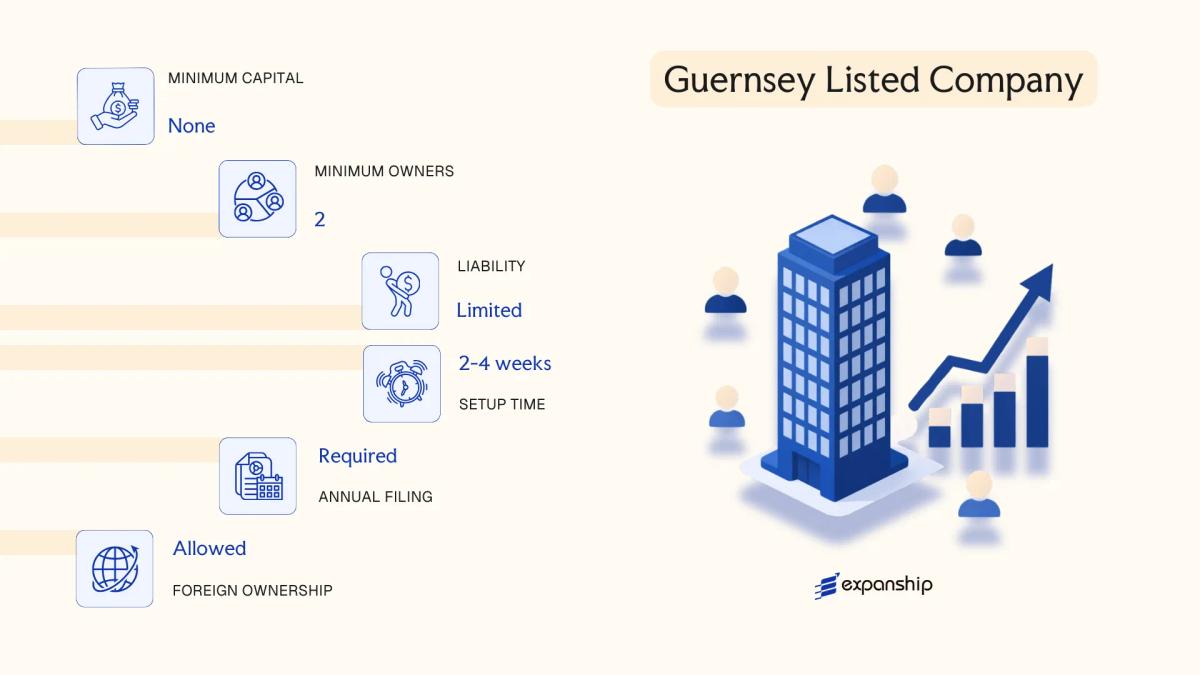
Guernsey Listed Company formation is governed by the Companies (Guernsey) Law 2008, which provides the statutory framework for incorporation, share issuance, and ongoing governance. A GLC carries separate legal personality, meaning the entity itself holds rights and obligations distinct from its shareholders, and liability is limited to the amount unpaid on shares.
Listing on the [[The International Stock Exchange (TISE)|https://www.tisegroup.com]], formerly the Channel Islands Securities Exchange, is the most common route for a GLC seeking public capital markets access. TISE admission requires compliance with its listing rules alongside the Companies Law, creating a dual regulatory layer that distinguishes this structure from a standard public company.
Key Characteristics
| Requirement | Detail | Notes |
|---|---|---|
| Legal Form | Public company limited by shares, listed on a recognised exchange | Separate legal personality; shareholder liability limited to unpaid share capital |
| Governing Roles | Directors (min. 2), Company Secretary, Shareholders | Directors hold fiduciary duties under the Companies (Guernsey) Law 2008 |
| Membership | Minimum 1 shareholder; no maximum | Shares freely transferable on the exchange |
| Local Presence | Registered office in Guernsey required | A licensed registered agent is typically engaged for compliance purposes |
| Share Capital | No statutory minimum; GBP, USD, EUR commonly used | Shares must be admitted to a recognised investment exchange for GLC status |
| Privacy | Directors and shareholders on public record | Beneficial ownership held in a central register accessible to authorities |
Focus Points
- Taxation: Subject to Guernsey's standard 0% corporate income tax for most income; exceptions apply for Guernsey-source income from certain regulated activities taxed at 10% or 20%; no VAT, no capital gains tax, and no withholding tax on dividends.
- Economic Substance: Listed entities are exempt from the economic substance requirements that apply to certain other company classifications under the Substance (Companies and Partnerships) (Guernsey) Law 2021.
- Annual Compliance: Mandatory annual validation with the Guernsey Registry, audited financial statements, and ongoing TISE listing obligations including disclosure of material events.
- Treaty Access: Guernsey has limited double tax agreements; however, a number of tax information exchange agreements (TIEAs) are in force, which affects withholding tax planning for cross-border structures.
- Conversion: A GLC may be delisted and re-registered as a private company under the Companies (Guernsey) Law 2008 without requiring reincorporation.
Closing
A GLC suits cross-border investment vehicles, debt issuance programmes, and structures requiring capital markets credibility. The exchange listing adds regulatory transparency but also imposes continuous disclosure obligations that increase administrative costs relative to private structures.
Established investment funds, holding vehicles, and issuers of listed securities seeking access to institutional capital through a recognised exchange.

Company Incorporation in Guernsey
Incorporate a Guernsey company with full registry compliance and ongoing support.
Guernsey Public Company Limited by Shares
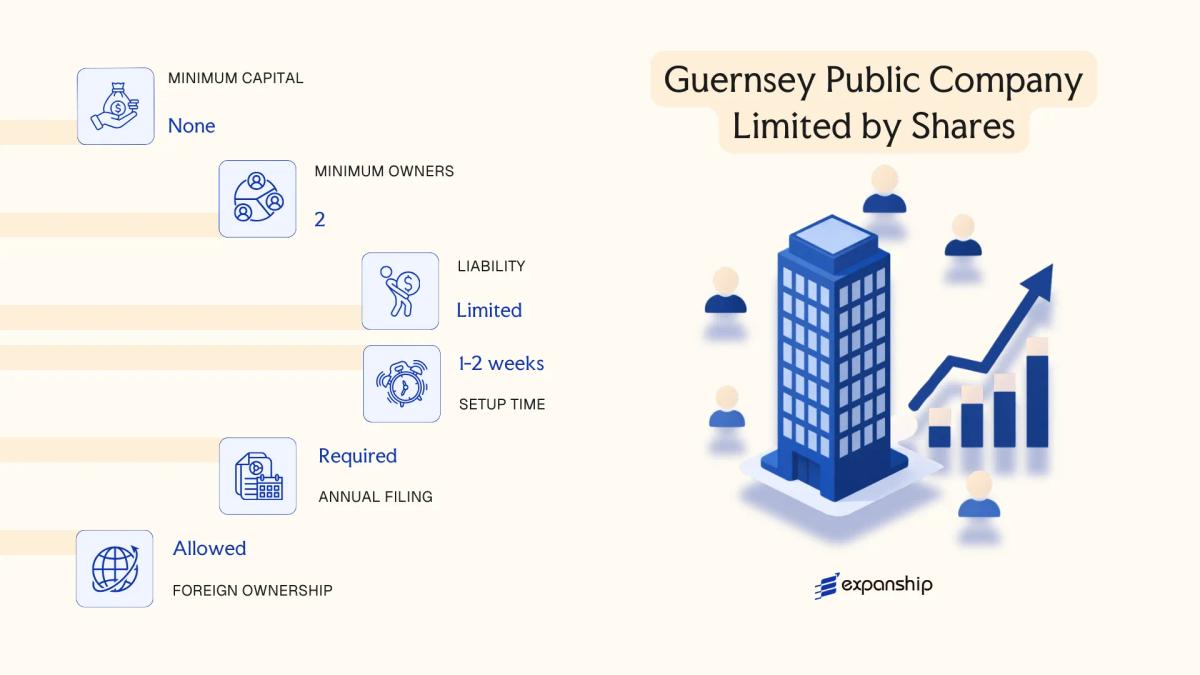
A Guernsey public company limited by shares is incorporated under the Companies (Guernsey) Law, 2008. It carries separate legal personality, meaning the company itself holds rights and obligations distinct from its shareholders.
Shares in a public company can be offered to the general public, distinguishing it structurally from its private counterpart. If your business intends to list on an exchange or raise capital from retail investors, this structure provides the legal framework to do so.
Key Characteristics
| Requirement | Detail | Notes |
|---|---|---|
| Legal Form | Public Company Limited by Shares | Separate legal personality; shareholder liability capped at unpaid share value |
| Governance Roles | Directors and Shareholders | Minimum 2 directors; no maximum on shareholders |
| Local Presence | Registered Office in Guernsey | Must maintain a registered office address; a licensed administrator typically provides this |
| Share Capital | No statutory minimum capital; shares can be denominated in any currency | Par value or no-par-value shares permitted |
| Privacy | Director and shareholder details filed with the Guernsey Registry | Beneficial ownership held on a non-public register accessible to authorities |
| Auditor Requirement | Appointment of a qualified auditor is required | Financial statements must be audited annually |
Focus Points
- Taxation: Guernsey applies a standard 0% corporate income tax rate for most companies; no VAT, no capital gains tax, and no inheritance tax, though certain regulated or financial service businesses may be subject to a 10% or 20% rate.
- Economic Substance: Public companies carrying on relevant activities must satisfy the economic substance requirements under the Income Tax (Substance Requirements) (Implementation) Regulations, 2018.
- Annual Compliance: Annual validation filing is required with the Guernsey Registry, along with audited financial statements submitted to shareholders.
- Listing: Admission to trading on the Channel Islands Securities Exchange (CISE) or other exchanges requires separate regulatory approval beyond basic incorporation.
- Conversion: A public company may be re-registered as a private company under the 2008 Law, subject to shareholder approval and filing requirements.
Closing
This structure suits businesses seeking public capital markets access, large-scale investment vehicles, or regulated financial products where public accountability is a legal or commercial requirement. The ability to offer shares to the public is its primary advantage; the corresponding disclosure obligations and audit requirements add meaningful administrative overhead.
Best suited for businesses planning a public listing, broad investor participation, or regulated fund structures that require the credibility and transparency of a publicly accountable corporate form.
Guernsey Private Company Limited by Shares
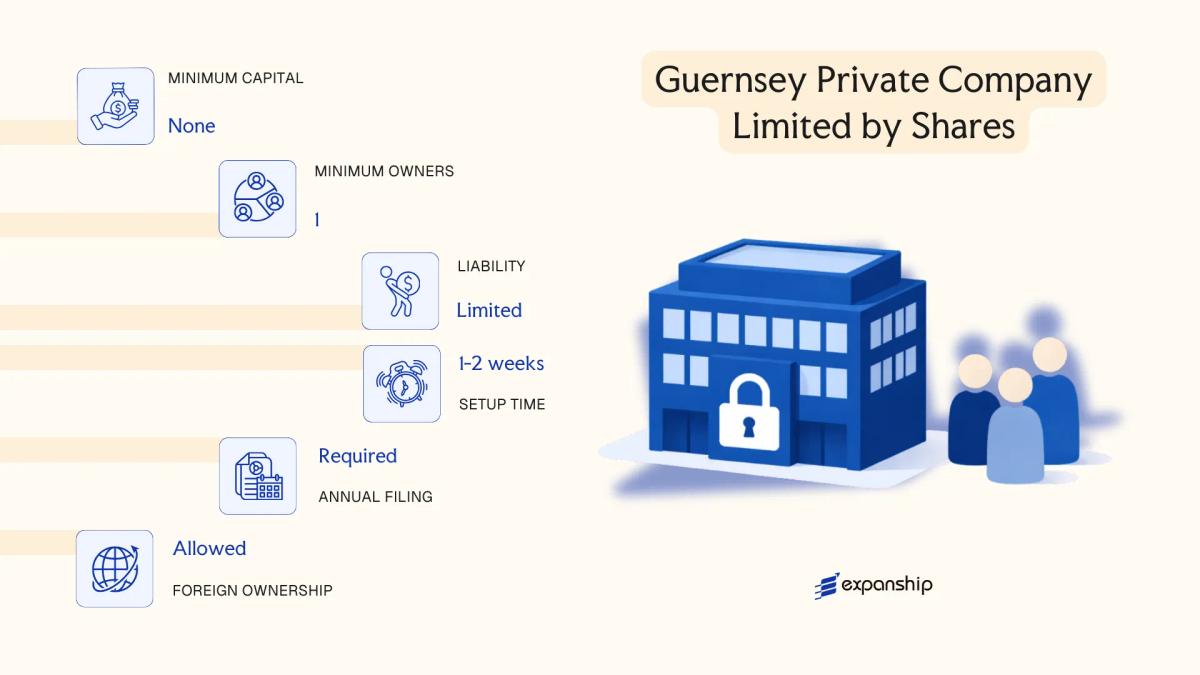
A Guernsey private company limited by shares is governed by the Companies (Guernsey) Law, 2008, as amended. The entity possesses separate legal personality, meaning it can own assets, enter contracts, and incur liabilities in its own name.
Shareholder liability is capped at the amount unpaid on their shares. This structure suits both operational trading businesses and holding arrangements, making it the most widely used corporate form on the island.
Key Characteristics
| Requirement | Detail | Notes |
|---|---|---|
| Legal Form | Private Company Limited by Shares | Incorporated under Companies (Guernsey) Law, 2008 |
| Governed By | Guernsey Registry (via the Registrar of Companies) | Filing and incorporation handled through the Guernsey Registry |
| Members | Shareholders: minimum 1, maximum 50 | Restrictions on public share transfer apply |
| Management | Minimum 1 director; no residency requirement | Corporate directors are permitted |
| Local Presence | Registered office in Guernsey required | Must be a physical address; PO Box alone is insufficient |
| Capital | No minimum share capital; shares can be denominated in any currency | Par value and no-par-value shares both permitted |
| Privacy | Shareholder details are not on the public register | Director names are publicly filed; beneficial ownership held on a non-public register |
Focus Points
- Taxation: Subject to Guernsey's standard zero percent corporate income tax rate, unless qualifying as a financial services business (10%) or utility company (20%); no VAT, no capital gains tax, and no withholding tax on dividends.
- Economic Substance: If the company is tax resident in Guernsey and conducts a relevant activity (as defined under the Revenue Service's substance legislation), it must meet the economic substance test.
- Annual Compliance: Annual validation filing required with the Guernsey Registry, along with applicable fees; financial statements are not publicly filed but must be maintained.
- Conversion: A private company can be re-registered as a public company under the 2008 Law, subject to meeting the relevant conditions.
- Restrictions: Shares may not be offered to the public; transfer of shares is typically restricted by the articles of incorporation.
Closing
This entity is used for trading operations, intra-group holding, IP ownership, and family wealth structuring. The absence of a minimum capital requirement and publicly accessible shareholder information offers operational and privacy flexibility, though the 50-shareholder cap limits its suitability for businesses seeking broad equity participation.
Founders and international groups seeking a straightforward, privately held corporate vehicle with liability protection and minimal public disclosure obligations.
Guernsey Company Limited by Guarantee
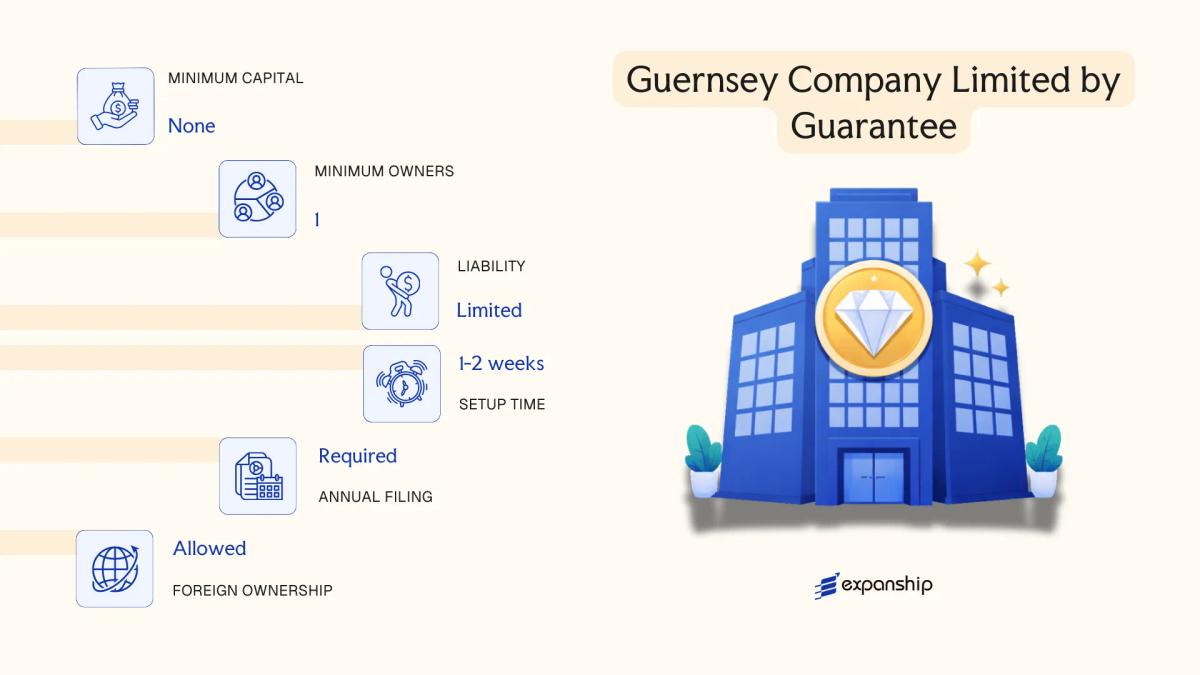
A Guernsey company limited by guarantee (CLG) is governed by the Companies (Guernsey) Law, 2008. Rather than issuing shares, the entity is underpinned by members' guarantees — each member commits to contributing a fixed sum to cover liabilities if the company is wound up. The entity holds separate legal personality and confers limited liability on its members.
Guarantee company registration in Guernsey is most common among non-profit organisations, charities, professional associations, and membership bodies. Because no share capital exists, profits cannot be distributed to members in the conventional sense, which aligns the structure with organisations that reinvest surpluses into their stated objectives.
Key Characteristics
| Requirement | Detail | Notes |
|---|---|---|
| Legal Form | Company Limited by Guarantee (CLG) | Incorporated under the Companies (Guernsey) Law, 2008 |
| Governed By | Guernsey Registry (administered by the Guernsey Financial Services Commission) | Annual validation filings submitted to the Registry |
| Members | Minimum 1; no statutory maximum | Members provide a guarantee amount, typically £1 |
| Directors | Minimum 1; no residency requirement under statute | Corporate directors are permitted |
| Local Presence | Registered office in Guernsey required | No mandatory resident director, but a registered agent is required |
| Capital | No share capital; guarantee amount per member applies | No minimum paid-up capital requirement |
| Privacy | Director and member details filed at the Registry; beneficial ownership held on the Central Register | Central Register is not publicly accessible |
Focus Points
- Taxation: Subject to Guernsey's standard 0% corporate income tax rate for most non-financial entities; no VAT regime, no withholding tax on distributions, and no capital gains tax.
- Economic Substance: CLGs engaged in relevant activities under the Economic Substance (Companies and Partnerships) (Guernsey) Law, 2021 must satisfy substance requirements.
- Annual Compliance: Annual validation filing and fee payable to the Guernsey Registry; accounts preparation obligations apply under the 2008 Law.
- Conversion: A CLG may apply to convert to another company form under the 2008 Law, subject to Guernsey Registry approval and member consent.
- Restrictions: Profit distribution to members is not permitted; the structure is unsuitable for commercial ventures seeking investor returns.
Closing
A Guernsey CLG suits non-profit and membership-based organisations that require a formal legal structure with limited liability but have no need for share capital or profit distribution. The primary limitation is precisely that restriction on distributable returns, which limits its use to mission-driven entities.
This structure is best suited for charities, trade associations, regulatory bodies, and professional membership organisations operating in or through Guernsey.
Guernsey Limited Liability Partnership (LLP)
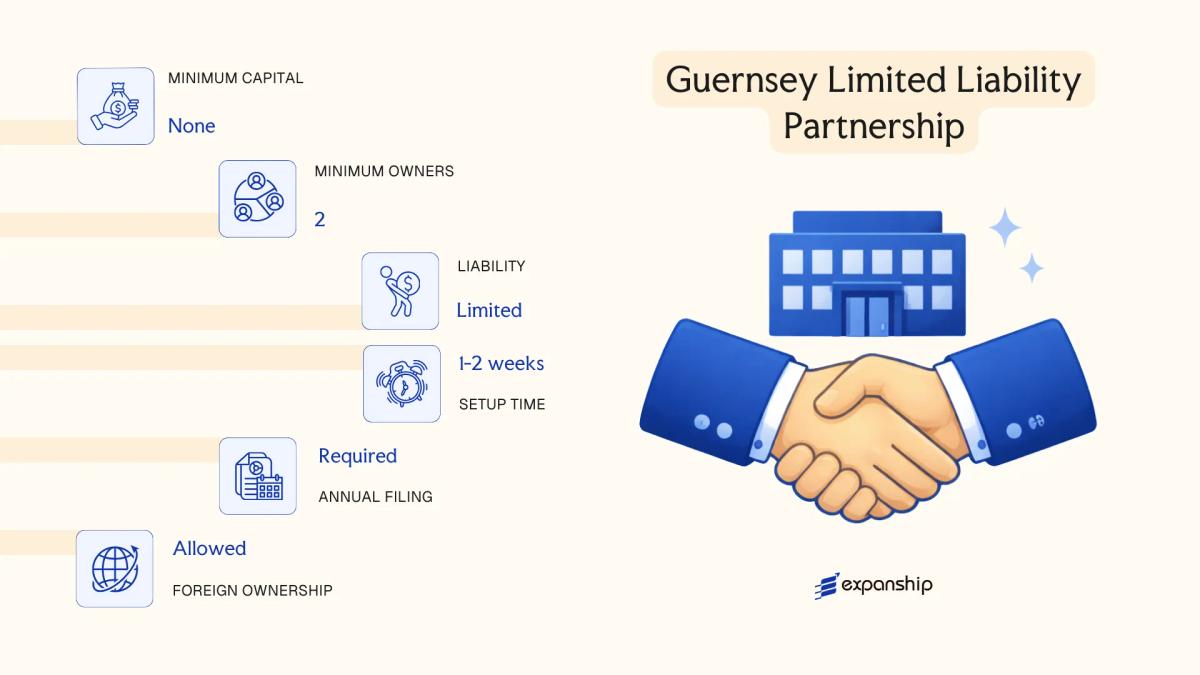
Guernsey Limited Liability Partnership registration is governed by the Limited Liability Partnerships (Guernsey) Law, 2013. An LLP constitutes a body corporate with separate legal personality, meaning the entity itself owns assets, enters contracts, and bears liabilities distinct from its members. This hybrid structure combines the contractual flexibility of a partnership with the liability protection typically associated with incorporated companies.
Each member's exposure is limited to their agreed contribution, unless personal guarantees or wrongful conduct alter that position.
Key Characteristics
| Requirement | Detail | Notes |
|---|---|---|
| Legal Form | Body corporate with separate legal personality | Distinct from both traditional partnerships and companies |
| Members | Referred to as Members; minimum 2, no statutory maximum | At least 2 members must execute the incorporation document |
| Designated Members | Minimum 1 Designated Member required | Responsible for filing and compliance obligations |
| Local Presence | Registered office in Guernsey; registered agent not mandatorily prescribed by the 2013 Law, though a local address is required | Filing address must be maintained in the island |
| Capital | No minimum capital requirement; contributions defined in the LLP agreement | Contributions may be cash, property, or services |
| Privacy | Member details filed with the Guernsey Registry; beneficial ownership held on the central register under FSTF regulations | Not fully private |
Focus Points
- Taxation: LLPs are generally treated as tax-transparent; profits are allocated to members and taxed at member level, meaning the entity itself typically does not pay Guernsey income tax; no VAT, no withholding tax on distributions, and no stamp duty on capital contributions as a general principle.
- Economic Substance: LLPs conducting relevant activities under the Income Tax (Substance Requirements) (Implementation) Regulations, 2018 must satisfy substance obligations in Guernsey.
- Annual Compliance: Annual validation filing required with the Guernsey Registry; an LLP agreement governs internal arrangements and must be maintained, though it need not be filed publicly.
- Treaty Access: Guernsey is not an EU member and has limited double tax treaty coverage; LLP members should assess treaty access at their own residence jurisdiction level given the transparent treatment.
- Conversion: The 2013 Law does not provide a direct statutory conversion mechanism from an LLP to a company; restructuring requires separate legal steps.
Closing
The LLP suits professional services firms, joint ventures, and fund management structures where members require liability protection without the governance formalities of a company. The tax-transparent treatment is a clear structural advantage, though the absence of a streamlined statutory conversion path can complicate future restructuring.
Best suited for professional practices and joint venture vehicles where two or more parties require liability protection while maintaining pass-through tax treatment at member level.
Guernsey Partnerships [General Partnership, Limited Partnership, Limited Liability Limited Partnership]
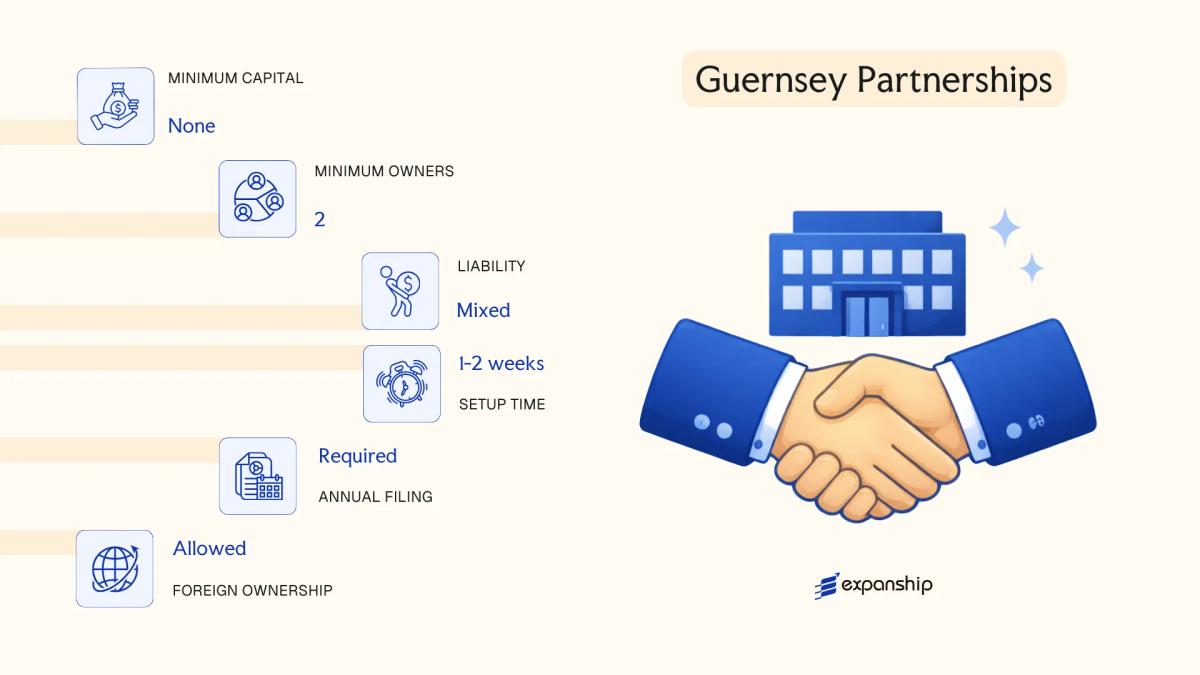
Guernsey partnership types — general, limited, and limited liability limited — are governed primarily by the Partnerships (Guernsey) Law, 1995, as amended. Unlike companies, general partnerships do not carry separate legal personality under Guernsey law, though limited partnerships and LLLPs can be structured to achieve greater liability separation.
Registration is handled through the Guernsey Registry. A Guernsey limited partnership registration requires filing with the Registry and appointing at least one general partner who bears unlimited liability for the firm's obligations.
Key Characteristics
| Requirement | Detail | Notes |
|---|---|---|
| Legal Form | Partnership (contractual or registered) | General partnerships lack separate legal personality; LPs and LLLPs are registered entities |
| Members | Partners (general and/or limited) | GP: minimum 2 partners, no upper limit; LP: at least 1 GP + 1 LP; LLLP: same structure with extended liability shield |
| Local Presence | Registered office in Guernsey | A principal place of business or registered address is required |
| Capital | No minimum capital requirement; no prescribed currency | Contributions defined by partnership agreement |
| Privacy | Partnership agreement is private | Registered particulars (partner names for GPs) are on public record |
Focus Points
- Taxation: Partnerships are generally treated as tax-transparent; partners are taxed individually on their share of profits, with Guernsey's standard 0% corporate rate applying to non-resident partners on non-Guernsey-sourced income.
- Economic Substance: Trading partnerships with Guernsey-resident partners may be subject to substance requirements depending on the nature of the business activity.
- Annual Compliance: Annual validation filings are required for registered limited partnerships; general partnerships have lighter ongoing filing obligations.
- Treaty Access: Partnerships generally do not benefit directly from tax treaties; access depends on the tax residency status of individual partners.
- Conversion: A limited partnership may apply to convert to an LLLP under the applicable provisions of the 1995 Law, subject to Registry approval.
Sub-Types
General Partnership
All partners carry unlimited joint and several liability. No registration is required to form a general partnership, though the arrangement should be documented by a partnership agreement. This structure suits smaller professional collaborations where partners are known to one another.
Limited Partnership
At least one general partner retains unlimited liability, while limited partners are liable only to the extent of their agreed capital contribution, provided they do not participate in management. This structure is widely used for private equity and fund vehicles.
Limited Liability Limited Partnership (LLLP)
A Guernsey LLLP formation extends liability protection to general partners as well, distinguishing it from a standard LP. This structure is less common but suits arrangements where GP-level liability exposure is a specific commercial concern.
Closing
Partnerships are commonly used for fund structuring, joint ventures, and professional service arrangements where pass-through taxation is a priority. The flexibility of the partnership agreement is a notable advantage, though the unlimited liability exposure of general partners in non-LLLP structures remains a significant constraint.
Guernsey partnerships are best suited for fund managers, private equity vehicles, and professional firms that require tax transparency and contractual flexibility over corporate formality.
Guernsey Foreign Entities [Foreign Company Registration, Branch Office]
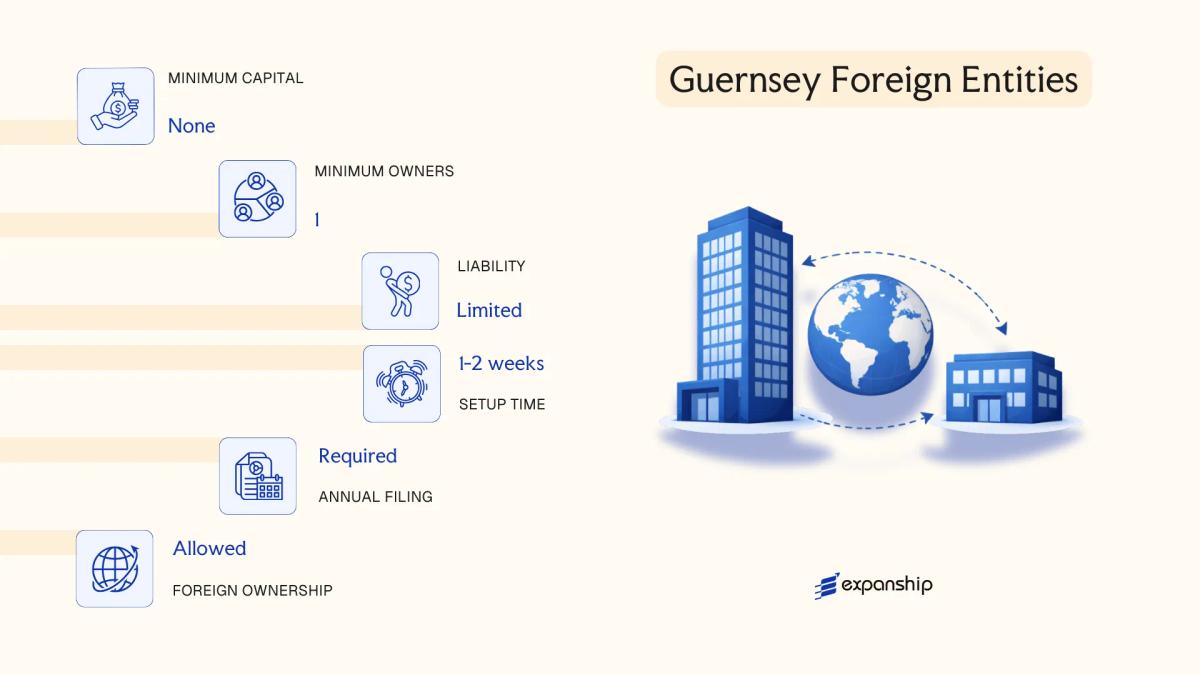
Overseas businesses seeking to operate in Guernsey without forming a new local entity can register under the Companies (Guernsey) Law, 2008. Guernsey foreign company registration allows an existing overseas entity to establish a formal presence on the island while retaining its original legal identity and liability structure from its home jurisdiction.
A registered foreign company or branch office does not constitute a separate legal person in Guernsey. The parent entity remains fully liable for all obligations incurred through the local presence, which is a significant structural distinction from locally incorporated firms.
Key Characteristics
| Requirement | Detail | Notes |
|---|---|---|
| Legal Form | Branch of a foreign company | No separate legal personality; parent bears full liability |
| Local Representatives | Authorised representative (resident) required | Must be an individual or entity resident in Guernsey |
| Local Presence | Registered address in Guernsey required | Physical address; PO Box not sufficient |
| Registration Body | Guernsey Registry | Filing required under the Companies (Guernsey) Law, 2008 |
| Capital | No separate capital requirement | Parent company's capital structure applies |
| Privacy | Parent company documents filed publicly | Memorandum, Articles, and director details disclosed |
Focus Points
- Taxation: Subject to Guernsey's standard 0% corporate income tax rate on most income; exceptions apply for banking, compliance-regulated activities, and property income taxed at 20%. No VAT, no withholding tax on dividends, and no capital gains tax.
- Economic Substance: If the branch conducts relevant activities as defined under the Income Tax (Substance Requirements) (Implementation) Regulations, 2018, substance obligations apply to the Guernsey presence.
- Annual Compliance: Annual confirmation statement and updated particulars must be filed with the Guernsey Registry; failure to maintain filings can result in deregistration.
- Treaty Access: Guernsey is not an EU member and has a limited tax treaty network; branch structures do not automatically inherit treaty benefits applicable to the parent's home jurisdiction.
- Restrictions: Certain regulated activities, including financial services, require additional licensing from the Guernsey Financial Services Commission regardless of the parent's authorisation elsewhere.
Sub-Types
Foreign Company Registration
A foreign company formally registered with the Guernsey Registry under Part XXIII or equivalent provisions of the Companies (Guernsey) Law, 2008. This route is used by overseas businesses that need a recognised legal presence for contracting, employment, or regulatory purposes without forming a new Guernsey entity.
Branch Office
Functionally comparable to a foreign company registration but typically used to describe an operational presence conducting day-to-day trading or service activities. The branch is treated as an extension of the parent for liability and tax purposes, with no ring-fencing of assets or obligations.
Closing
A branch or registered foreign entity suits overseas firms testing the Guernsey market, fulfilling a regulatory requirement, or providing services directly to local clients. The primary advantage is structural simplicity, as no new entity needs to be formed. The key drawback is unlimited parental liability, since the parent organisation remains exposed to all branch-level obligations.
Established overseas companies that require a formal Guernsey presence for operational, contractual, or regulatory purposes without committing to a separately incorporated local entity.
Guernsey Sole Trader
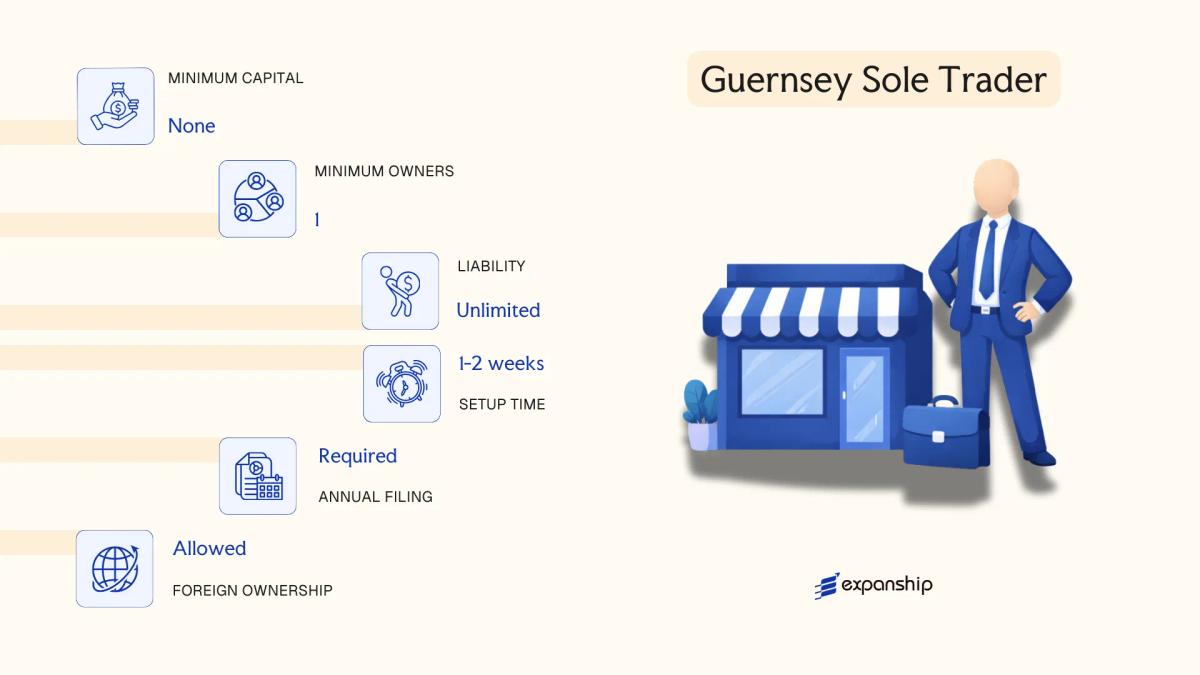
A sole trader is the simplest form of self-employed Guernsey business setup, operating without separate legal personality. The proprietor and the business are legally the same person, meaning personal assets are exposed to any business liabilities. There is no dedicated sole trader legislation equivalent to the Companies (Guernsey) Law, 2008; instead, registration and tax obligations are governed through the Income Tax (Guernsey) Law, 1975 and administered by the Revenue Service (Guernsey).
Before trading, you must register with the Revenue Service as self-employed. If your taxable income exceeds the relevant threshold, registration for Guernsey's Goods and Services Tax (GST) may also be required.
Key Characteristics
| Requirement | Detail | Notes |
|---|---|---|
| Legal Form | Unincorporated sole proprietorship | No separate legal identity from the proprietor |
| Referred To As | Sole trader / proprietor | No directors, shareholders, or members |
| Ownership | Single individual only | Cannot have co-owners; partnerships require a separate structure |
| Local Presence | No registered agent required | A local business address may be needed for correspondence |
| Capital | No minimum requirement; no share capital | Personal funds used directly |
| Privacy | Name and tax details held by Revenue Service | No public register equivalent to company filings |
Focus Points
- Taxation: Income taxed at the standard Guernsey personal income tax rate of 20%; no corporate tax applies, no withholding tax on drawings, and GST registration is required once the applicable turnover threshold is met.
- Economic Substance: No economic substance obligations apply; substance rules under the Economic Substance (Companies and Partnerships) (Guernsey) Law, 2021 do not extend to sole traders.
- Annual Compliance: Annual personal tax return required; no separate company accounts or audit obligations.
- Treaty Access: Guernsey's tax information exchange agreements and limited double taxation arrangements are generally not accessible through this structure.
- Conversion: You can convert to a limited company at a later stage, though assets and contracts must be formally transferred as there is no statutory merger mechanism for sole traders.
Closing
Starting as a sole trader in Guernsey suits service-based or early-stage self-employment where administrative simplicity outweighs the need for liability protection; the principal drawback is unlimited personal liability for all business debts.
Freelancers, consultants, and sole proprietors operating low-risk, owner-managed activities who do not require a corporate structure.
How to Choose the Right Entity Type in Guernsey
Selecting the wrong structure from the outset creates legal, financial, and operational consequences that are difficult to unwind after incorporation.
Why Your Entity Choice Matters
The Companies (Guernsey) Law, 2008 governs most corporate entities registered on the island, and operating outside its provisions carries real consequences:
- Registering an offshore entity while intending to trade locally may constitute a breach of the Law, exposing the business to striking off by the Guernsey Registry or financial penalties.
- Choosing a tax-exempt entity forfeits access to double taxation agreements, meaning withholding tax reductions available under treaty arrangements cannot be claimed by the entity.
- Selecting a structure without adequate substance capacity, when Economic Substance rules apply to your activity, triggers mandatory reporting failures and potential fines under the Income Tax (Substance Requirements) (Implementation) Regulations, 2018.
- Forming a company when a foundation would better serve asset protection needs locks your structure into annual shareholder obligations that foundations are not subject to.
Key Factors to Consider
- Business Activity: Active trading, passive asset-holding, and regulated activities such as fund management each point toward distinct entity types under Guernsey law.
- Local vs. Offshore Operations: Firms transacting with Guernsey residents face different registration and licensing requirements than those operating entirely outside the island.
- Ownership and Management: Multi-party ventures requiring defined governance benefit from a company structure, while partnerships offer contractual flexibility without mandatory board obligations.
- Tax Objectives: Your eligibility for the standard zero percent corporate rate, exempt status, or a specific regulated-sector regime determines which structures are viable.
- Substance Capacity: If your business cannot maintain genuine employees, office space, or board meetings locally, the entity type must be one to which substance requirements do not apply.
- Exit Strategy: Not all Guernsey structures permit redomiciliation or conversion; confirm the available exit mechanisms before committing to a form.
Compliance Services for Companies in Guernsey
Ongoing compliance support for Guernsey-registered entities, covering annual filings, economic substance obligations, and regulatory reporting.
Conclusion
Reaching a Guernsey company incorporation decision requires matching each structure to a defined commercial purpose. The private company limited by shares suits most closely held trading and holding arrangements, and it remains the most commonly registered entity on the island. Public companies limited by shares serve businesses seeking broader capital access, while the listed company structure applies specifically to those pursuing a regulated market quotation. Companies limited by guarantee fit membership organisations without a profit-distribution mandate. The LLP suits professional firms requiring partnership flexibility alongside liability separation. General, limited, and limited liability limited partnerships each address distinct investor and operational configurations. Foreign companies and branch registrations allow overseas entities to establish a presence without forming a separate legal person. Sole trader status carries no liability shield and suits individuals operating at minimal scale.
Regulated by the Guernsey Registry under the Companies (Guernsey) Law, 2008, the jurisdiction continues to refine its framework in line with FATF standards and OECD transparency expectations. Expanship's team works directly within this framework to support your selection and registration process.
How Expanship Can Assist You
Expanship's Guernsey company formation services cover the full range of structures registered under the Companies (Guernsey) Law, 2008 — from private companies limited by shares to protected cell companies and limited liability partnerships. Our team works directly with the Guernsey Registry to ensure your incorporation filings meet current requirements, whether you're establishing a standard trading entity or a specialist fund structure.
From first filing to ongoing obligations, here is what we handle on your behalf:
- Document preparation and notarisation or apostille where required
- Registered agent and registered office provision in Guernsey
- Filing and liaison with the Guernsey Registry
- Post-incorporation compliance management, including annual confirmations
- Director, secretary, and nominee arrangements where applicable
- Banking introduction assistance with Guernsey-based and international institutions
Get in touch with Expanship Guernsey to discuss how we can support your business formation.
Frequently Asked Questions (FAQ)
The Private Company Limited by Shares is the most frequently registered structure. Its combination of limited liability, single-shareholder eligibility, and minimal public disclosure requirements makes it the default choice for both resident entrepreneurs and international holding arrangements.
A Private Company Limited by Shares cannot offer its securities to the public, whereas a Guernsey Listed Company trades on an approved exchange and faces continuous disclosure obligations under the relevant listing rules. Both structures are subject to standard corporate income tax treatment, but the compliance burden for a listed entity is substantially higher.
The Private Company Limited by Shares discloses limited information publicly; beneficial ownership details are held by the Guernsey Registry but are not available on open public search. Nominee director and shareholder services are permitted under applicable regulations.
A sole individual can incorporate a Private Company Limited by Shares or a Public Company Limited by Shares. General Partnerships and Limited Partnerships each require a minimum of two partners, so single-person formation is not available for those structures.
Foreign nationals face no statutory prohibition on incorporating or owning a company registered under the Companies (Guernsey) Law, 2008. Non-residents can act as directors or shareholders without requiring local residency, though certain regulated activities require prior licensing from the Guernsey Financial Services Commission.
The Companies (Guernsey) Law, 2008 permits re-registration between certain company types, including conversion from a private to a public company. Conversion from a company structure to a partnership form generally requires dissolution and fresh incorporation rather than a direct re-registration.
Companies incorporated under the 2008 Law, along with Limited Liability Partnerships and Limited Partnerships registered under their respective Guernsey statutes, carry separate legal personality. General Partnerships do not; partners in that structure bear unlimited joint liability for firm obligations.
Protected Cell Companies and Incorporated Cell Companies, both available under Guernsey law, are specifically structured for investment fund use. Each cell maintains statutory segregation of assets and liabilities, which is the primary reason fund promoters favour these vehicles over standard corporate forms.
Legal Disclaimer
The information provided in this article is for general informational purposes only and does not constitute legal, tax, or professional advice. While we strive to ensure the accuracy and timeliness of the content, laws and regulations are subject to change, and the application of laws can vary widely based on specific facts and circumstances.
Readers should not act upon this information without seeking professional counsel tailored to their individual situation. Expanship and its authors disclaim any liability for actions taken or not taken based on the content of this article.
For specific advice regarding your business setup, compliance requirements, or any legal matters, please consult with qualified legal and tax professionals in the relevant jurisdiction.