

Key Takeaways
- Guernsey's economic substance legislation imposes active operational requirements on resident companies, meaning foreign investors cannot use a Guernsey entity as a passive shell without risking non-compliance penalties.
- Under the Companies (Guernsey) Law, 2008, companies are subject to public disclosure obligations that reduce the confidentiality typically sought by international investors structuring cross-border assets.
- Guernsey's limited double taxation treaty network creates measurable withholding tax exposure for businesses repatriating income across multiple jurisdictions, compared to holding company locations with broader treaty coverage.
- The mandatory resident director requirement and Guernsey Financial Services Commission oversight add recurring compliance costs and operational constraints that are particularly burdensome for lean foreign-owned entities with no existing local infrastructure.
Guernsey operates under a well-established, heavily regulated corporate framework, and that regulatory density has direct implications for foreign businesses considering formation there. The disadvantages of incorporating in Guernsey span compliance obligations, cost structures, market access limitations, and disclosure requirements — each examined in the sections that follow.
Not every drawback applies equally to all entities. A holding company, a fund vehicle, and an active trading business will encounter different friction points under the same legal system.
This article is most relevant to foreign investors and business owners — particularly those based outside the British Isles — who are evaluating Guernsey as a base for international operations or asset structuring. The governing legislation for private and public companies is the Companies (Guernsey) Law, 2008, which sets the foundational rules your entity will operate under from the point of incorporation.
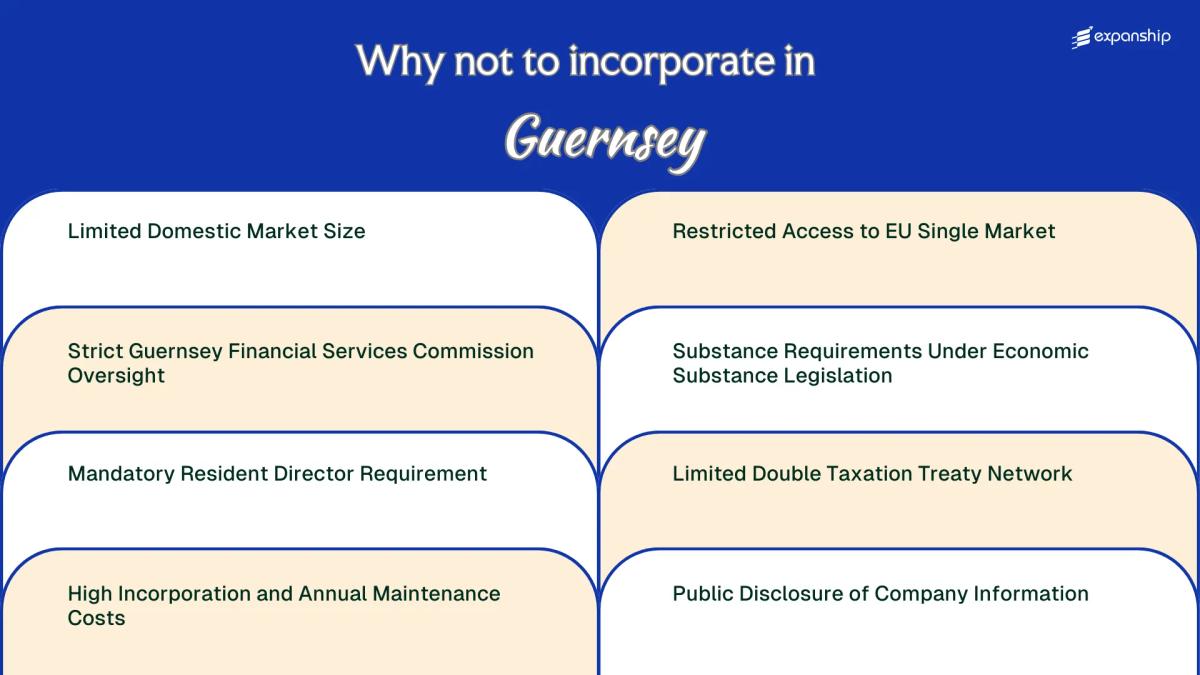
Limited Domestic Market Size
Guernsey small domestic market limitations represent one of the most immediate structural barriers for any foreign business planning to generate revenue locally. With a resident population of approximately 63,000 people, the addressable consumer base is among the smallest of any incorporation destination.
A Consumer Base Too Small to Sustain Most Business Models
Local demand cannot realistically support volume-dependent industries such as retail, consumer goods, or mass-market services. Any entity incorporated here that relies on domestic sales will find that revenue ceilings are reached quickly, often before the firm recovers its setup and compliance costs.
Most businesses registered in Guernsey are structured to serve international clients rather than local ones, which means your operational model must be export-oriented from the outset. If your business requires a home market to test products or build initial revenue, this jurisdiction offers almost none of that capacity.
Geographic Isolation Compounds the Scale Problem
The island's physical separation from the UK and continental Europe adds logistical costs to an already limited consumer base. Importing goods, maintaining supply chains, or delivering services to local customers carries overhead that larger jurisdictions absorb through economies of scale.
If your business model depends on domestic market revenue at any stage, the limited consumer base in Guernsey makes local viability structurally unachievable for most foreign-owned companies.
Strict Guernsey Financial Services Commission Oversight
The Guernsey Financial Services Commission restrictions affect a wide range of business activities, not just those in traditional financial services. Under the Financial Services Commission (Bailiwick of Guernsey) Law 1987 and subsequent regulatory instruments, the GFSC holds licensing authority over fund administration, insurance, banking, investment management, and fiduciary services. If your business touches any of these sectors, you will require a GFSC licence before operating.
Obtaining that licence is not a formality. The application process involves detailed business plans, financial projections, fit-and-proper assessments of principals, and ongoing capital adequacy requirements. This adds months to your operational timeline before any revenue is generated.
GFSC regulatory compliance burdens extend well beyond initial licensing. Once authorised, your firm faces:
- Annual fees and periodic returns that require dedicated compliance resources, increasing operating costs for a lean foreign-owned structure
- Ongoing obligation to notify the GFSC of material changes to ownership, directors, or business scope, making routine corporate restructuring administratively intensive
- Required appointment of a locally approved compliance officer, which typically means retaining a specialist at market rates
Guernsey financial regulation drawbacks are especially pronounced for smaller entities. The cost-to-revenue ratio of maintaining GFSC compliance can undermine the viability of structures that would face lighter-touch regulation in other offshore centres.

Company Incorporation in Guernsey
Understand the full regulatory and licensing requirements before establishing your entity in Guernsey.
Mandatory Resident Director Requirement
Guernsey resident director requirement problems begin before your company earns its first dollar. Under the Companies (Guernsey) Law, 2008, there is no statutory requirement mandating a locally resident director by default, but in practice the Guernsey Financial Services Commission expects companies holding regulated licences to have at least one director with sufficient local knowledge and physical presence. For unregulated entities, substance expectations under the Income Tax (Substance Requirements) (Implementation) Regulations, 2018 create an equivalent de facto pressure.
Sourcing a qualified resident director is not straightforward. The pool of eligible professionals on the island is limited, and service providers who offer nominee director arrangements typically charge annual fees that add a recurring fixed cost to your operating budget.
| Requirement Type | Typical Annual Cost Range | Key Constraint |
|---|---|---|
| Nominee resident director fee | £3,000 – £8,000+ | Recurring; non-negotiable for regulated entities |
| Director liability insurance | £1,000 – £3,000+ | Required by most professional directors |
| Minimum director meeting attendance | Varies by licence condition | Must occur physically in Guernsey for substance compliance |
A professional nominee director does not simply lend their name. They must exercise genuine oversight, meaning they can and do decline appointments where the business model raises compliance concerns. This vetting process can delay incorporation timelines for foreign founders unfamiliar with local governance expectations.
The financial cost compounds the loss of control. Your firm's decision-making formally involves an individual you did not recruit through your own network, whose primary obligation runs partly to their own regulatory standing rather than exclusively to your business objectives.
High Incorporation and Annual Maintenance Costs
Guernsey company maintenance costs represent a recurring financial burden that often surprises foreign business owners unfamiliar with the island's fee structure. The Guernsey Registry publishes its schedule of incorporation and annual return fees, and while the initial registration cost is modest, the combined weight of ongoing professional service fees quickly accumulates.
Annual compliance for a standard company requires a licensed registered agent, which only firms authorised by the Guernsey Financial Services Commission may provide. That licensing requirement creates a limited pool of service providers, reducing competitive pricing pressure and keeping professional fees elevated relative to lower-cost offshore alternatives.
Maintaining a local registered office, filing annual returns, and engaging qualified local professionals for even routine corporate secretarial work all carry separate charges. For a dormant or holding entity generating no active income, these costs deliver no commercial return.
- Annual return fees are payable to the Guernsey Registry on a fixed schedule regardless of company activity
- A licensed registered agent must be retained at all times; this cannot be self-managed by a foreign owner
- Corporate secretarial and compliance services are typically billed separately from registered agent fees
- Late filing penalties under the Companies (Guernsey) Law, 2008 add further financial exposure for non-resident directors unfamiliar with local deadlines
Did You Know? A Guernsey company can be struck off the register for unpaid annual fees even if it has no outstanding legal disputes or regulatory violations.
Restricted Access to EU Single Market
Guernsey EU single market access restrictions affect any business that uses the island as its primary base for selling into Europe. As a Crown Dependency, Guernsey sits outside both the UK and the EU, meaning it holds no automatic right of entry into the single market.
Structural Exclusion from EU Frameworks
No EU passporting rights apply to Guernsey-incorporated entities, which means financial services firms cannot use their local authorisation to operate freely across EU member states. Each target country requires a separate regulatory approval process, which multiplies compliance costs and delays market entry considerably.
Post-Brexit market limitations have further tightened this position, since UK equivalence arrangements no longer extend to Crown Dependencies by default. A firm that might have used a UK-authorised subsidiary as a market entry bridge must now establish a presence directly within an EU jurisdiction to access those clients.
Operational Consequences for Foreign-Owned Businesses
For non-financial businesses, the absence of a trade agreement between the Bailiwick and the EU creates friction around goods, services, and professional recognition. Your business cannot assume that qualifications, certifications, or contractual arrangements accepted locally will carry weight across the Channel.
This restriction primarily affects businesses whose revenue depends on EU client acquisition rather than those serving global or non-EU markets exclusively.
Guidance on Structuring Around Guernsey's Market Access Limitations
Understand how Guernsey's exclusion from EU frameworks affects your specific business model and what structural options exist for your situation.
Substance Requirements Under Economic Substance Legislation
Guernsey economic substance requirements risks are real and recurring for foreign-owned entities that hold intellectual property, conduct financing activities, or operate within any of the defined "relevant sectors" under the Income Tax (Substance Requirements) (Implementation) Regulations, 2018.
- Your entity must demonstrate that its core income-generating activities are physically directed and managed on the island, which is difficult to satisfy without resident personnel, office space, and operational infrastructure.
- The substance test applies to holding companies, finance and leasing businesses, IP-holding entities, and several other categories, meaning the compliance burden extends well beyond trading firms.
- Failing the substance test exposes your company to escalating financial penalties and potential disclosure to foreign tax authorities in the jurisdiction where your beneficial owners are resident.
- Regulated by the Director of Revenue Service, the assessment is annual, so the economic substance rules create a recurring compliance obligation rather than a one-time registration cost.
- Pure equity holding companies face a reduced substance test, but this exception does not apply once the entity conducts any active income-generating function.
Limited Double Taxation Treaty Network
Guernsey's limited tax treaty network is a structural constraint that directly affects how foreign businesses manage cross-border income. The island has concluded a relatively small number of full double taxation agreements (DTAs), with the most significant being treaties with Jersey, the Isle of Man, Malta, Singapore, Qatar, Hong Kong, and the United Kingdom.
For businesses receiving dividends, royalties, or interest from jurisdictions outside this narrow treaty network, withholding taxes imposed by the source country apply in full. There is no bilateral relief mechanism to fall back on, which increases the effective tax burden on cross-border income flows.
Firms structured around supply chains or holding arrangements involving EU member states, the United States, or major Asian markets outside the treaty list face this limitation directly. The absence of a DTA does not just create a tax cost — it complicates intercompany pricing, profit repatriation planning, and investor reporting.
Partial relief may be available through unilateral tax credit provisions within Guernsey's domestic law, but these do not replicate the certainty or full mitigation that a bilateral treaty provides.
A holding company incorporated in Guernsey receiving royalty income from a French subsidiary could face a 30% withholding tax at source under French domestic rules, with no DTA in place to reduce or eliminate that charge. Over a year with €500,000 in royalty payments, that represents €150,000 in unrecoverable withholding tax that a Luxembourg-based holding company under the EU Parent-Subsidiary Directive might have avoided entirely.
Public Disclosure of Company Information
Guernsey company public disclosure risks are often underestimated by foreign founders who assume the island's offshore reputation equates to full privacy. Under the Companies (Guernsey) Law, 2008, the Guernsey Registry maintains a public register containing director details, registered office addresses, and company filings.
Beneficial ownership information is held by the Registry and accessible to law enforcement and tax authorities, but it is not currently open to the general public. That distinction matters less than it appears: director names and service addresses are publicly searchable, exposing individuals who hold directorships across multiple entities to reputational and competitive scrutiny.
For businesses in sensitive industries or those with confidentiality-dependent structures, this partial transparency creates real exposure. A competitor, litigant, or counterparty can identify the principals behind a firm through a basic registry search, without any formal legal process.
- Annual validation filings must be submitted to the Guernsey Registry, keeping company records current and continuously accessible.
- Any change in directors triggers an update obligation, expanding the publicly visible record over the company's lifetime.
While beneficial ownership data is not publicly accessible today, the scope of disclosure obligations can change under future legislative reform or international pressure, and your current privacy assumptions may not hold across the company's operational lifetime.
Strategies to Overcome These Challenges
Overcoming Guernsey incorporation challenges requires structural decisions made before and during the formation process, not adjustments applied after problems arise. Each disadvantage covered in this blog has a corresponding structural response that reduces exposure without eliminating the jurisdiction's core character.
- Appoint a qualifying resident director with demonstrable sector experience to satisfy the GFSC fit-and-proper requirements from day one.
- Establish genuine economic substance by ensuring core income-generating activities, employees, and decision-making occur locally, in compliance with the Income Tax (Substance Requirements) (Implementation) Regulations, 2018.
- Structure international agreements through contract rather than relying on Guernsey's limited double taxation treaty network, using tax opinions where treaty access is unavailable.
- Conduct a cost-benefit analysis of annual registry fees, audit requirements, and director costs before committing to the jurisdiction.
- Review the public register obligations under the Companies (Guernsey) Law, 2008 and determine what filings become accessible to third parties.
These steps sit within a regulatory framework administered by the GFSC. Compliance is ongoing, and the obligations attached to each structural choice persist for the life of the entity.
Guernsey's Overall Value as a Jurisdiction
Guernsey's jurisdiction value despite drawbacks is best understood by separating structural limitations from actual operational impact. The disadvantages covered in this blog are real and measurable, yet they exist within a jurisdiction that maintains a stable legal framework under the Companies (Guernsey) Law, 2008 and a regulator, the Guernsey Financial Services Commission, with a consistent track record.
| Pro | Con |
|---|---|
| Zero corporate tax rate for most non-resident businesses | No access to the EU Single Market following Brexit |
| The Companies (Guernsey) Law, 2008 provides a well-established legal foundation | Economic substance requirements demand genuine local activity for certain entity types |
| English-language legal system reduces documentation friction | Mandatory resident director adds recurring overhead costs |
| Recognised in major financial centres as a reputable offshore jurisdiction | Limited double taxation treaty network compared to larger jurisdictions |
| Political stability as a Crown Dependency | Certain company information is publicly accessible on the Registry |
The overall calculus depends on your business structure and operational footprint.
Compliance Services for Companies in Guernsey
Maintain good standing with the Guernsey Financial Services Commission and meet your ongoing statutory obligations under local law.
Conclusion
Guernsey presents a defined set of structural constraints that any prospective registrant should weigh carefully. The Guernsey company formation cons summary is clear: economic substance obligations under the Income Tax (Substance Requirements) (Implementation) (Guernsey) Regulations 2018, the absence of EU market access following Brexit, and a limited double taxation treaty network each carry real operational weight. These are not incidental concerns. Professional guidance specific to Guernsey's regulatory environment, including GFSC requirements and local compliance obligations, remains relevant from the point of incorporation onward.
Expanship's Guernsey Company Formation Support
Expanship's Guernsey company formation support services are designed to reduce the operational burden that comes with the jurisdiction's specific compliance framework, from satisfying the Guernsey Financial Services Commission's licensing requirements to meeting the economic substance obligations under the Income Tax (Substance Requirements) (Implementation) Regulations, 2018. Managing resident director arrangements, annual filings, and Registrar of Companies submissions takes considerable administrative effort, and Expanship helps coordinate those obligations so your business stays on track.
Our service scope covers the full incorporation and post-registration cycle across these requirements:
- Preparing and filing all company registration documentation with the Registrar of Companies
- Providing a registered agent and local registered office address in Guernsey
- Handling government filings and liaising with the relevant regulatory bodies on your behalf
- Managing ongoing compliance obligations after your entity is incorporated
- Facilitating introductions to banking institutions appropriate to your business structure
- Registering your firm for tax purposes and coordinating with local authorities as required
Reach out to Expanship Guernsey to discuss your incorporation requirements.
Frequently Asked Questions (FAQ)
The Guernsey Financial Services Commission applies heightened scrutiny to regulated entities, particularly those conducting financial services, investment business, or insurance activity under the Financial Services Business (Enforcement Powers) (Bailiwick of Guernsey) Law, 2020. Unregulated trading companies face lighter direct supervision, but all businesses remain subject to AML/CFT obligations under the Criminal Justice (Proceeds of Crime) (Bailiwick of Guernsey) Law, 1999. The practical burden varies significantly depending on your business activity, not just your company type.
The Guernsey Revenue Service can impose tiered financial penalties, beginning at £10,000 for a first-year failure and rising to £100,000 for continued non-compliance. Beyond fines, the authority can share company information with relevant foreign tax jurisdictions automatically, which creates secondary tax exposure in your home country. Persistent failure can result in the entity being referred for striking off.
Guernsey's position is broadly comparable to Jersey and the Isle of Man — none are EU members, and none benefit from passporting rights for financial services into the EU since the UK's departure from the bloc. However, Guernsey's third-country status under AIFMD means alternative fund managers must rely on national private placement regimes in each EU member state rather than a single passport, which increases distribution costs. For non-financial businesses, the absence of a customs union arrangement means goods face standard third-country procedures at EU borders.
Guernsey has signed full double taxation agreements with a small number of jurisdictions, including the UK, Malta, Isle of Man, Jersey, Cyprus, Liechtenstein, Luxembourg, Qatar, Singapore, and the UAE. This is substantially narrower than onshore EU or OECD member states, which may have treaty networks spanning 70 to 100+ countries. If your business generates income from countries outside this list, withholding taxes on dividends, royalties, or interest may apply without treaty relief, directly affecting your effective tax rate.
Registered office fees, local director costs, and annual return filing fees collectively make Guernsey more expensive to maintain than many mid-tier offshore jurisdictions. A resident director from a professional services firm typically costs between £5,000 and £15,000 per year depending on scope of involvement, and that is before accounting for accounting, audit, and GFSC licence fees where applicable. For smaller businesses, these fixed costs can erode the tax efficiency that made Guernsey attractive in the first place.
There is no statutory law that expressly prohibits a fully foreign-directed board, but in practice the GFSC expects regulated entities to demonstrate genuine local management and control, and corporate governance standards under the Companies (Guernsey) Law, 2008 reinforce this expectation. For entities with substance obligations, a board composed entirely of non-resident directors will almost certainly fail the directed and managed test. Even for unregulated companies, nominee arrangements involving no local participation may raise red flags during AML due diligence by Guernsey-licensed service providers.
Guernsey's Registry requires disclosure of director names and registered office addresses, which are accessible publicly through the Guernsey Registry search portal. Beneficial ownership information is held in a central register but is not currently public-facing, though it is accessible to law enforcement and tax authorities. Compared to jurisdictions like the BVI or Cayman Islands, Guernsey's disclosure obligations are more extensive, and ongoing international transparency initiatives are likely to expand what is visible over time.
Legal Disclaimer
The information provided in this article is for general informational purposes only and does not constitute legal, tax, or professional advice. While we strive to ensure the accuracy and timeliness of the content, laws and regulations are subject to change, and the application of laws can vary widely based on specific facts and circumstances.
Readers should not act upon this information without seeking professional counsel tailored to their individual situation. Expanship and its authors disclaim any liability for actions taken or not taken based on the content of this article.
For specific advice regarding your business setup, compliance requirements, or any legal matters, please consult with qualified legal and tax professionals in the relevant jurisdiction.