

Key Takeaways
- Guernsey's zero-ten corporate tax regime means companies with no local income source pay 0% corporate tax, allowing foreign business owners to retain materially more profit than under most onshore arrangements.
- The absence of capital gains tax, inheritance tax, and VAT removes three fiscal layers that would otherwise erode accumulated value in comparable onshore jurisdictions.
- Incorporated under the Companies (Guernsey) Law, 2008, local private limited companies benefit from a flexible statutory framework that balances director and shareholder discretion with enforceable creditor protections.
- Oversight by the Guernsey Financial Services Commission provides regulatory credibility that distinguishes the island from lower-reputation offshore centres, supporting access to established international banking and professional service networks.
Guernsey is a self-governing Crown Dependency located in the English Channel, separate from both the United Kingdom and the European Union, operating under its own legislative and fiscal framework. Companies are registered through the Guernsey Registry, the official body responsible for company formation and corporate filings on the island. The most common legal vehicle used by foreign businesses to establish a presence here is the private limited company.
From a tax standpoint, the jurisdiction operates a zero-ten corporate tax regime, making it structurally attractive for international business activity. Foreign ownership is broadly permitted, and the island places no general restrictions on non-resident individuals or entities holding shares in locally incorporated companies.
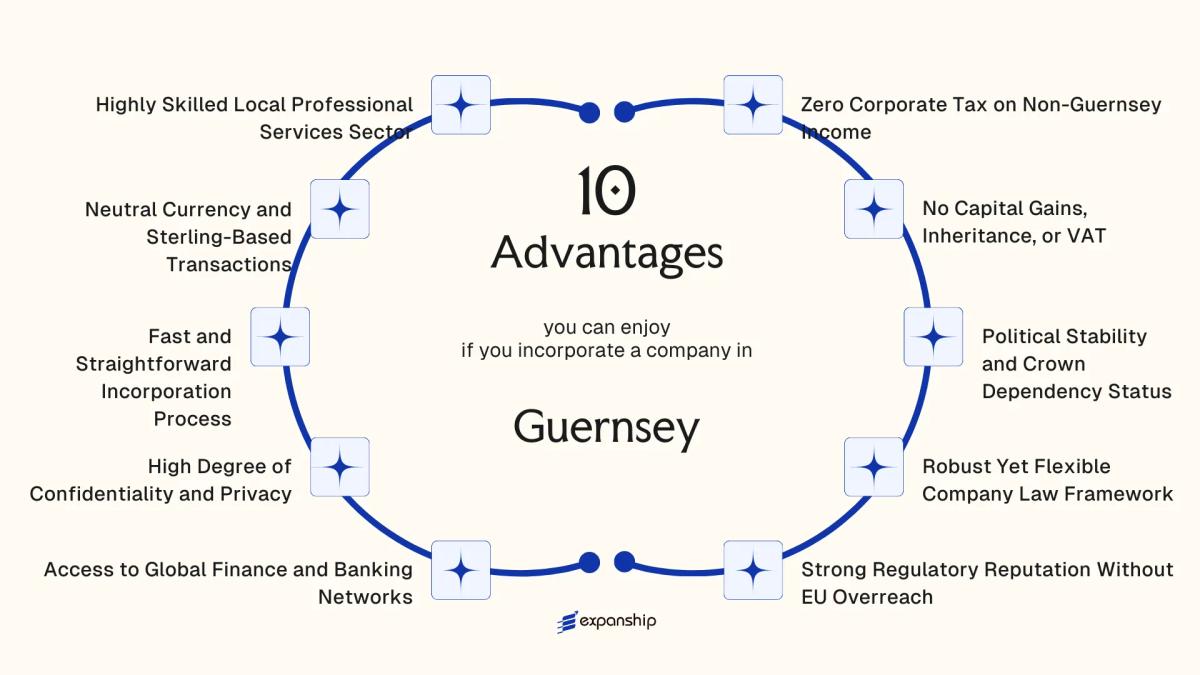
Understanding the benefits of incorporating in Guernsey requires looking at several distinct factors — from its regulatory environment to its professional infrastructure. This article examines those factors in detail, drawing on the legal and procedural realities that define corporate life on the island.
Zero Corporate Tax on Non-Guernsey Income
Guernsey zero corporate tax on non-resident income is the defining structural feature of the island's tax regime for foreign businesses. Under the Income Tax (Guernsey) Law, 1975, as amended, companies incorporated there are subject to a standard corporate income tax rate of 0% on profits derived outside the island.
What the Zero Rate Actually Covers
For a foreign business owner, this means that trading income, service revenues, royalties, and most passive income generated from non-Guernsey sources flow through the entity without triggering a corporate tax liability at the company level. The practical effect is that your firm retains a substantially higher proportion of overseas earnings compared to operating through a jurisdiction with a standard corporate rate, such as the UK's 25% rate or the EU average of approximately 21%.
The Conditions That Apply
The 0% rate applies to standard companies; a small number of activities, including certain banking operations and income derived from Guernsey land or property, fall under a 10% or 20% rate instead. Confirming the applicable rate against your specific activity with a licensed Guernsey advocate or tax adviser before structuring is advisable.
Overseas profits earned through a Guernsey company are not subject to corporate income tax, leaving retained earnings available for reinvestment or distribution without a mandatory deduction at the entity level.
No Capital Gains, Inheritance, or VAT
Guernsey imposes no capital gains tax. That single fact has direct consequences for how you structure investments, hold assets, and exit positions. Profits from the disposal of shares, property held outside the island, or other appreciating assets are not subject to any separate gains charge under Guernsey domestic law, meaning your returns are not eroded at the point of realisation.
Inheritance tax does not apply to Guernsey-registered entities or the assets held within them, which has particular relevance for succession planning and intergenerational wealth structures. Families and business owners who use the island for holding company purposes can transfer interests without triggering the kind of estate-level charges that apply in jurisdictions such as the United Kingdom, where inheritance tax can reach 40%.
No VAT regime exists in the jurisdiction. Unlike EU member states, where standard VAT rates currently range from 17% to 27%, trading through a Guernsey entity removes the administrative and financial burden of VAT registration, returns, and cross-border reclaim procedures entirely.
The practical advantages of this three-part absence include:
- Asset disposals within a holding structure do not generate a secondary tax event on top of any underlying income
- Estate and succession arrangements can be designed around commercial logic rather than tax liability thresholds
- Pricing structures for goods and services face no statutory consumption tax layer at the entity level
The zero-VAT position applies to commercial activity conducted through the entity, not to the personal tax position of owners resident elsewhere.

Company Incorporation in Guernsey
Set up a Guernsey company with full compliance support across entity selection, registration, and ongoing maintenance.
Political Stability and Crown Dependency Status
Guernsey's Crown Dependency political stability benefits stem from a constitutional arrangement that has remained unchanged in its fundamentals for centuries. The island is a self-governing possession of the British Crown, not part of the United Kingdom and not a member of the European Union. Domestic affairs, including tax policy and company law, fall under the authority of the States of Guernsey, the island's parliament. That autonomy insulates your business from legislative shifts originating in Westminster or Brussels.
| Feature | Detail |
|---|---|
| Constitutional Status | Crown Dependency, self-governing |
| Legislative Authority | States of Guernsey |
| EU Membership | None |
| UK Parliament Authority | External affairs and defence only |
| Legal System | Customary Norman law and English common law |
Political continuity here is not incidental. The jurisdiction has maintained a stable, functioning government without significant constitutional disruption for decades, which directly reduces the regulatory and legislative risk that foreign business owners routinely factor into offshore structuring decisions. Tax policy changes, when they occur, follow a deliberate consultation process through the States of Guernsey rather than being imposed externally.
For a foreign-owned entity, this structure means your company operates under a legal framework that the island's own legislature controls and defends. Decisions affecting your corporate environment are made locally, by a small, accountable government with an identifiable interest in preserving the jurisdiction's commercial credibility.
Robust Yet Flexible Company Law Framework
The Guernsey Companies (Guernsey) Law 2008 governs the formation and operation of companies incorporated on the island, and its design reflects a deliberate policy of statutory flexibility without sacrificing legal certainty. This matters for foreign business owners because the law accommodates a wide range of corporate structures, including companies limited by shares, companies limited by guarantee, unlimited liability companies, and cell companies, each suited to different commercial purposes.
Under the 2008 Law, a company's articles of incorporation can be tailored with considerable freedom. There is no requirement to adopt model articles, so your entity's constitutional documents can reflect specific investor arrangements, voting mechanics, or profit distribution structures that standard off-the-shelf templates in other jurisdictions would not permit.
Protected Cell Companies (PCCs) and Incorporated Cell Companies (ICCs) were developed under Guernsey law and remain a structurally distinct feature. Each cell holds assets and liabilities separately, which makes the PCC and ICC formats particularly useful for investment funds and insurance captives.
- Confirm your chosen corporate structure is permitted under the 2008 Law
- Ensure your articles of incorporation reflect your actual operational and governance needs
- Verify whether a PCC or ICC structure applies if asset segregation is a priority
- Engage a local registered agent, as one is required for all incorporated entities
The Guernsey Companies (Guernsey) Law 2008 permits a company to be incorporated with a single member and a single director, with no requirement for the director to be resident on the island.
Strong Regulatory Reputation Without EU Overreach
Guernsey's regulatory reputation advantages stem from a deliberate policy choice: the island has developed its own financial oversight framework, independent of EU directives, while maintaining standards that satisfy major institutional counterparties. That combination gives your business access to credible, well-regarded regulation without the compliance overhead that EU membership imposes.
An Independent Regulator With International Recognition
The Guernsey Financial Services Commission (GFSC) supervises financial services, fiduciary activities, and insurance under local legislation including the Financial Services Commission (Bailiwick of Guernsey) Law, 1987. Because the GFSC operates outside EU jurisdiction, your entity is not subject to directives such as AIFMD or MiFID II unless it actively seeks EU market access. For funds and financial firms targeting non-EU capital, this distinction reduces compliance costs materially.
The island holds equivalence or recognition status with a number of major markets, which means GFSC-regulated structures are accepted by institutional investors and counterparties who require a credentialed home jurisdiction. Recognition is earned, not assumed, and the GFSC's track record with bodies such as IOSCO underpins that standing.
Proportionate Oversight Designed for Private Capital
Regulatory requirements scale to the nature of the business. A private holding firm faces a different compliance profile than a licensed fund manager, and the framework is structured to reflect that distinction. This proportionality means you are not absorbing regulatory costs designed for systemic financial institutions when your operation does not warrant that level of oversight.
Get Clarity on Guernsey's Regulatory Advantages for Your Business
Speak with an Expanship specialist to understand how the GFSC framework applies to your specific structure and what compliance obligations are relevant to your business.
Access to Global Finance and Banking Networks
Guernsey's access to global finance advantages stems largely from its position as a well-regarded international finance centre with a mature, specialist banking sector. Firms incorporated here can open accounts with major private and institutional banks that are familiar with the jurisdiction's regulatory standards, reducing friction that companies from less-recognised offshore locations often encounter.
- The island hosts licensed subsidiaries and branches of major international banks, meaning your entity operates within the same institutions used for cross-border trade finance, treasury management, and capital deployment.
- The Guernsey Financial Services Commission supervises banking and investment activity under the Banking Supervision (Bailiwick of Guernsey) Law, 2020, giving counterparties in other jurisdictions a clear compliance reference point when conducting due diligence on your firm.
- Because Guernsey is not subject to EU financial regulation, your business avoids directives such as AIFMD in their EU form, while still maintaining standards that satisfy correspondent banking relationships globally.
- The island's fund industry, regulated under the Protection of Investors (Bailiwick of Guernsey) Law, 2020, creates an established ecosystem of custodians, administrators, and prime brokers, which benefits non-fund businesses that need access to the same institutional networks.
- Sterling-denominated accounts are standard, and multi-currency facilities are widely available, reducing conversion exposure on transactions with UK counterparties.
High Degree of Confidentiality and Privacy
Guernsey company confidentiality and privacy benefits are grounded in statute rather than administrative discretion. Under the Companies (Guernsey) Law, 2008, shareholder registers of private companies are not publicly accessible. Directors' residential addresses are similarly protected from public disclosure, which limits the personal exposure of officers in ways that many onshore jurisdictions do not permit.
Beneficial ownership information is held by the Guernsey Registry and accessible to competent authorities for regulatory and law enforcement purposes, but it is not published on any public register. This means your ownership structure remains outside the reach of commercial data aggregators, competitor searches, or unsolicited third-party scrutiny.
The distinction matters in practice. A business owner operating across multiple jurisdictions may have legitimate reasons, including asset protection and personal security, to keep ownership structures private. Guernsey's framework accommodates that without requiring the use of nominees or artificial structuring.
Hypothetical scenario: A non-resident director of a Guernsey private company holds shares through a disclosed beneficial ownership register accessible only to the Guernsey Financial Intelligence Unit and registered authorities. No part of that record appears in any publicly searchable database, meaning a competitor performing open-source due diligence on the director finds no traceable link to the entity.
Fast and Straightforward Incorporation Process
Guernsey fast company incorporation advantages are closely tied to the administrative structure of the Guernsey Registry, which operates under the Companies (Guernsey) Law, 2008. Standard company registration is typically processed within 24 to 48 hours, and same-day incorporation is available for an additional fee. For a foreign business owner, this turnaround means operational readiness comes quickly, without prolonged bureaucratic delays.
The Registry accepts applications through licensed Guernsey corporate service providers, meaning your formation documents are submitted by qualified local agents who understand the technical requirements. This reduces the risk of rejected filings and back-and-forth corrections that commonly extend timelines in other jurisdictions.
Key structural features that support a fast registration:
- A single director and single shareholder are sufficient to form a private company
- No mandatory paid-up share capital requirement at incorporation
- No requirement for local directors in most company structures
- Memorandum and Articles of Incorporation follow standardised formats under the 2008 Law
These requirements collectively reduce the documentation burden on foreign applicants. Fewer prerequisites mean fewer obstacles between signing engagement documents and receiving a certificate of incorporation.
Same-day incorporation requires submission through a licensed fiduciary or corporate service provider regulated by the Guernsey Financial Services Commission; you cannot file directly as an unregulated foreign applicant.
Neutral Currency and Sterling-Based Transactions
Guernsey sterling-based transactions advantages begin with a straightforward structural fact: the island uses the pound sterling (GBP) as its official currency. For business owners whose operations, contracts, or investor relationships are denominated in GBP, this eliminates the foreign exchange conversion layer that exists in euro-zone or dollar-denominated jurisdictions.
No Currency Conversion Friction
Operating in GBP means your firm avoids the transactional costs and accounting complexity that arise from currency conversion. UK-facing businesses, in particular, can price contracts, pay invoices, and distribute profits without reconciling across multiple currency positions. That operational simplicity has direct implications for margin management and financial reporting accuracy.
Stability Through Sterling Alignment
GBP is one of the most liquid and widely traded currencies globally. For an entity holding assets or transacting across international markets, this depth of liquidity reduces exposure to the volatility that can affect smaller or less-traded currencies used by competing offshore jurisdictions. The currency's international recognition also simplifies correspondent banking relationships, which can otherwise present friction for offshore structures.
Practical Implications for Structuring
- Contracts written in GBP require no conversion clauses when dealing with UK counterparties
- Financial statements prepared in sterling align directly with UK parent company consolidations
- Distributions to UK-based shareholders carry no currency conversion cost at the point of transfer
- Fund structures denominated in GBP can be marketed to sterling-based institutional investors without currency hedging requirements
Highly Skilled Local Professional Services Sector
Guernsey's professional services sector is one of the more substantive advantages for foreign businesses incorporating on the island. The concentration of licensed fiduciary service providers, law firms, and fund administrators operating under the oversight of the Guernsey Financial Services Commission (GFSC) means your entity has direct access to experienced practitioners who work within this specific regulatory environment daily.
Fiduciary services in particular are tightly regulated under the Regulation of Fiduciaries, Administration Businesses and Company Directors, etc. (Bailiwick of Guernsey) Law, 2000. Licensed providers must meet ongoing GFSC standards for competence and conduct, which means the professionals handling your corporate administration are operating under a defined legal obligation, not just a professional norm.
The local legal profession is governed by the Guernsey Bar, with advocates trained in the island's distinct legal system, which draws on Norman customary law as well as English common law principles. For structuring arrangements involving trusts, funds, or holding companies, this dual-framework familiarity is a practical asset rather than an abstract credential.
Key service areas available through licensed local professionals include:
- Corporate administration and registered office services
- Guernsey-specific trust and foundation structuring
- Fund establishment under the Protection of Investors (Bailiwick of Guernsey) Law, 1987
- Compliance and GFSC reporting support
- Accounting services aligned with local filing requirements
For a foreign business owner, this depth of on-island expertise reduces dependence on generalist offshore intermediaries who may lack jurisdiction-specific knowledge. The practitioners your firm engages are accountable to the GFSC and subject to licensing conditions that can be verified independently.
Why Guernsey Stands Out Among Offshore Jurisdictions
Comparing why Guernsey stands out among offshore jurisdictions requires looking at the right peer group. The jurisdictions most relevant here are Jersey, the Isle of Man, and the British Virgin Islands — each targets a similar profile of international investor, operates outside EU tax law, and offers comparable confidentiality standards. What the comparison reveals is not that these jurisdictions are inferior across the board, but that the combination of factors Guernsey offers is structured differently, particularly around regulatory credibility and institutional depth.
Where Jersey shares Crown Dependency status, it applies a financial services regulatory regime under the Jersey Financial Services Commission that some fund structures find more prescriptive. The Isle of Man carries stronger EU equivalence exposure through its VAT-sharing agreement with the UK. The BVI offers lower costs at incorporation but operates under a different legal tradition and carries a different risk profile for institutional counterparties. Guernsey's position under the Guernsey Financial Services Commission is consistently recognised on OECD and FATF-aligned whitelists, which has a direct bearing on how correspondent banks and institutional partners treat your entity.
| Parameter | Guernsey | Jersey | Isle of Man | British Virgin Islands |
|---|---|---|---|---|
| Corporate Tax Rate (non-local income) | 0% | 0% | 0% | 0% |
| VAT | None | None | 20% (UK-linked) | None |
| Capital Gains Tax | None | None | None | None |
| Crown Dependency | Yes | Yes | Yes | No |
| EU Regulatory Exposure | None | None | Partial (VAT link) | None |
| FATF / OECD Whitelist Status | Yes | Yes | Yes | Yes |
| Recognised Fund Regime | Yes (POI Law) | Yes | Yes | Limited |
| Inheritance Tax | None | None | None | None |
| Primary Regulatory Body | GFSC | JFSC | FSA | BVI FSC |
Compliance Services for Companies in Guernsey
Maintain good standing under the Companies (Guernsey) Law, 2008 with ongoing compliance support covering annual filings, economic substance obligations, and regulatory reporting.
Conclusion
Guernsey's position as an incorporated entity location holds together because of how its individual structural features reinforce one another. A zero-rate corporate tax environment combined with the absence of capital gains and inheritance tax means that a foreign business owner retains a materially larger share of profits and accumulated value than in most onshore alternatives. That fiscal architecture is underpinned by a stable constitutional relationship with the Crown and a legal framework governed by the Companies (Guernsey) Law, 2008, which gives directors and shareholders genuine flexibility without sacrificing creditor protections.
The benefits of incorporating in Guernsey are not uniformly applicable to every business model. A firm with substantial trading activity inside the island, or one operating in a sector subject to the standard 10% or 20% rate, faces a different calculation than a holding company or investment vehicle with no local income source. Sector, ownership structure, and the jurisdictions where your clients or assets are based all shape how much of this framework applies in practice.
For businesses that do fall within its scope, the combination of tax neutrality, regulatory credibility through the Guernsey Financial Services Commission, and access to established professional infrastructure creates conditions that are difficult to replicate in comparable offshore jurisdictions. The next step is matching those structural features to your specific corporate objectives with the help of qualified local advisers.
Start Your Guernsey Company Formation With Expanship Today
Guernsey company formation with Expanship covers the full scope of what the earlier sections of this blog have outlined: the zero-rate tax position on non-local income, the privacy framework, the absence of capital gains and inheritance taxes, and the company structures available under the Companies (Guernsey) Law, 2008. Expanship manages the process from initial entity selection through to filing with the Guernsey Registry, the body responsible for company registration on the island.
Expanship's services for Guernsey incorporations include:
- Preparation and legalization of incorporation documents
- Registered agent and registered office provision in Guernsey
- Filing and liaison with the Guernsey Registry on your behalf
- Post-incorporation compliance management, including annual confirmation statements
- Banking introduction assistance to support account opening with island-based or international institutions
- Ongoing corporate secretarial support to maintain good standing under local law
Expanship Guernsey incorporation services are available to foreign nationals and internationally owned entities without restriction on beneficial ownership origin, which aligns with the island's policy of maintaining an accessible and well-regulated environment for cross-border business structures.
Contact Expanship Guernsey to discuss your incorporation requirements.
Frequently Asked Questions (FAQ)
Income sourced outside the jurisdiction is subject to a 0% corporate tax rate under the standard corporate tax regime. The 0% rate applies to most companies by default; exceptions include entities operating in specific regulated sectors such as banking, insurance, or the importation and supply of hydrocarbon fuel, which are taxed at 10% or 20%. Your company's applicable rate is determined by the nature of its activities, not its country of ownership.
The Guernsey Financial Services Commission (GFSC) is an independent regulatory body established under the Financial Services Commission (Bailiwick of Guernsey) Law, 1987. Because the island is a Crown Dependency and not part of the European Union, it is not subject to EU directives such as AIFMD or MiFID II, though it maintains equivalent standards recognised by international bodies. This gives firms a degree of regulatory flexibility that is not available within EU member states while still meeting FATF and OECD compliance benchmarks.
Standard incorporation is generally completed within one to two business days once all required documentation has been submitted to the Guernsey Registry. An expedited same-day service is available for an additional fee. The timeline assumes all documents are in order; delays typically arise from incomplete beneficial ownership disclosures or outstanding identity verification under the Registry's requirements.
Guernsey is not listed on the EU's list of non-cooperative jurisdictions for tax purposes, and it holds a strong compliance record with the OECD's Base Erosion and Profit Shifting (BEPS) framework. The island was among the early adopters of the Common Reporting Standard (CRS) and has an extensive network of Tax Information Exchange Agreements (TIEAs). Its regulatory standing means that banking counterparties and institutional investors generally do not treat it as a high-risk offshore centre.
A registered office address in the Bailiwick is mandatory under the Companies (Guernsey) Law, 2008, and this must be a physical address rather than a forwarding service. Beyond the registered office, substance requirements depend on whether your entity falls within the scope of the Income Tax (Substance Requirements) (Implementation) Regulations, 2018, which apply to companies in defined relevant sectors such as holding, financing, or intellectual property activities. Companies outside those categories face no mandated local staffing or operational presence.
The Guernsey pound sterling is the functional currency, which operates at par with the British pound. The island does not operate an independent central bank or monetary policy; it uses sterling as its base currency under an arrangement tied to the United Kingdom. This eliminates foreign exchange risk for businesses transacting primarily in GBP and provides monetary stability without the volatility associated with smaller independent currencies.
Under the Companies (Guernsey) Law, 2008, director names are disclosed to the Guernsey Registry, but the register of members is not automatically available for public inspection. Beneficial ownership information is held in a central register accessible to law enforcement and competent authorities but is not open to general public searches. This structure provides a meaningful degree of privacy while meeting international transparency obligations under the Financial Action Task Force (FATF) standards.
Legal Disclaimer
The information provided in this article is for general informational purposes only and does not constitute legal, tax, or professional advice. While we strive to ensure the accuracy and timeliness of the content, laws and regulations are subject to change, and the application of laws can vary widely based on specific facts and circumstances.
Readers should not act upon this information without seeking professional counsel tailored to their individual situation. Expanship and its authors disclaim any liability for actions taken or not taken based on the content of this article.
For specific advice regarding your business setup, compliance requirements, or any legal matters, please consult with qualified legal and tax professionals in the relevant jurisdiction.