

Key Takeaways
- Georgia's territorial tax system offers notable advantages, but the country's limited network of double taxation treaties creates measurable exposure for cross-border structures that depend on treaty-based withholding rate reductions and dispute resolution mechanisms.
- Under the Law of Georgia on Entrepreneurs, the corporate framework has been modernized, yet enforcement gaps in intellectual property protection leave technology companies and brand-sensitive businesses without reliable recourse against infringement.
- Currency risk is a concrete operational burden, as the Georgian Lari has experienced sustained volatility that directly affects foreign-currency-denominated liabilities, import costs, and the repatriation of profits for multinational subsidiaries.
- Institutional financing options remain constrained by underdeveloped domestic capital markets, which forces growth-stage companies to rely on retained earnings or offshore funding structures rather than local debt or equity instruments.
Georgia operates under an evolving regulatory framework, with its primary corporate legislation codified in the Law of Georgia on Entrepreneurs. The framework has undergone significant reform in recent years, but gaps in enforcement, institutional capacity, and international integration continue to present real operational challenges.
The disadvantages of incorporating in Georgia span several distinct categories, from financing constraints to treaty limitations and labor market depth.
Not every business will encounter these issues at the same intensity. A small trading company faces a materially different risk profile than a technology firm seeking external funding or a manufacturer dependent on imported skilled labor.
This article is most relevant to foreign investors, multinational subsidiaries, and entrepreneurs incorporating a Limited Liability Company (LLC) or Joint Stock Company (JSC) in Georgia who intend to operate across borders, seek institutional financing, or scale beyond the domestic market.
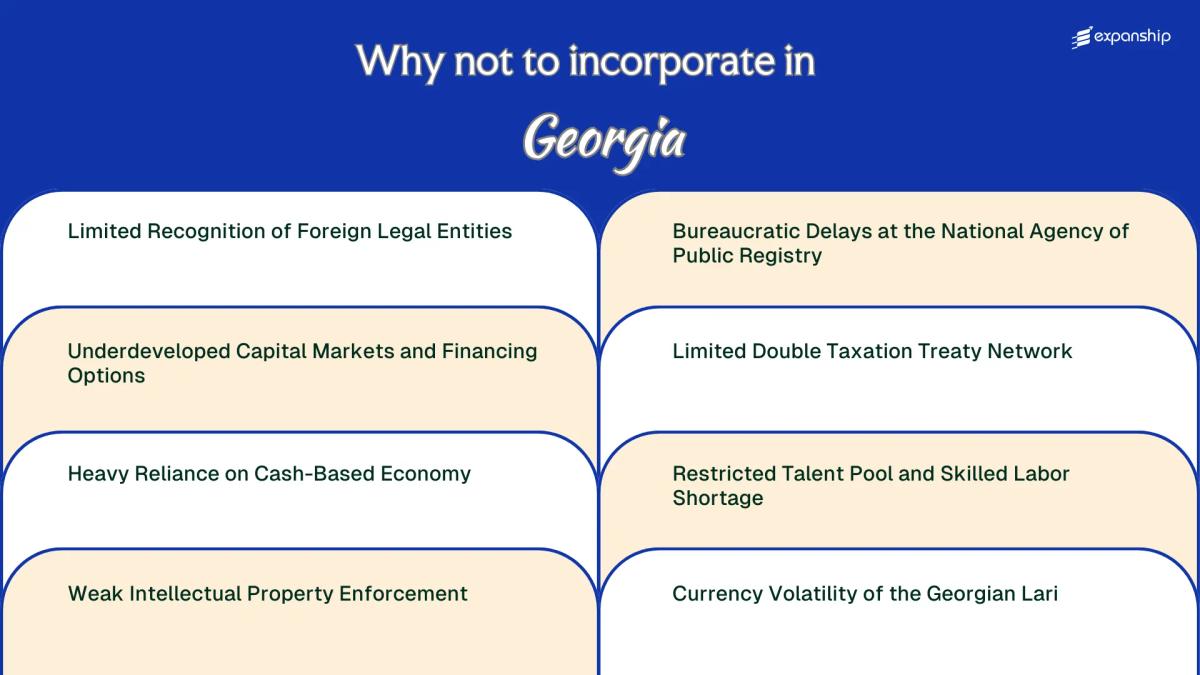
Limited Recognition of Foreign Legal Entities
Foreign entity recognition limitations Georgia presents a structural challenge that many international business owners encounter only after they have committed resources to market entry.
No Direct Branch Registration Pathway for Foreign Entities
Under Georgian law, a foreign company cannot simply register a branch as a standalone legal entity with independent liability. The branch or representative office of a foreign firm must be registered through the National Agency of Public Registry (NAPR), but it remains legally subordinate to its parent, meaning the parent entity bears full liability for Georgian operations. For businesses with a holding structure designed to ring-fence risk, this dependency creates direct exposure that a locally incorporated entity would otherwise limit.
Restricted Recognition of Foreign Corporate Structures
Certain foreign legal forms, particularly those from civil law jurisdictions with hybrid or non-standard structures, have no direct Georgian equivalent, which complicates recognition and registration. The absence of a clear statutory mapping between foreign corporate forms and Georgian entity types under the Law of Georgia on Entrepreneurs can result in classification disputes at the NAPR, delaying operational timelines and generating additional legal costs.
If your foreign entity structure lacks a recognized Georgian equivalent, NAPR registration may require restructuring or reincorporation, adding cost and time before your business can legally operate.
Underdeveloped Capital Markets and Financing Options
Georgia's underdeveloped capital markets create a structural financing gap that directly affects how foreign-owned companies raise growth capital. The Georgian Stock Exchange (GSE) remains thin by regional standards, with limited listed securities and low daily trading volumes, which means equity financing through public markets is not a realistic option for most businesses.
Bank lending dominates the private sector financing environment. Georgian commercial banks typically apply conservative loan-to-value ratios and require substantial collateral, creating high barriers for early-stage or asset-light companies.
For foreign founders, the practical burden compounds quickly:
- Venture capital and private equity activity is nascent, leaving startups without the institutional funding channels available in more mature markets
- Access to bond markets is functionally closed for small and mid-sized firms due to issuance costs and regulatory complexity under the National Bank of Georgia's oversight framework
- Foreign currency denominated loans expose your business to Georgian Lari volatility, adding repayment risk on top of already restrictive credit terms
- Development finance institutions occasionally fill gaps, but their mandates are sector-specific and approval timelines can extend to several months
Georgia's business financing limitations are not offset by a well-developed angel investment network. The domestic investor base remains concentrated, and deal sizes are comparatively small.

Company Incorporation in Georgia
Set up your company in Georgia with full guidance on legal structure, registration, and compliance requirements.
Heavy Reliance on Cash-Based Economy
Cash economy risks for businesses in Georgia stem from a structural reality: a significant share of commercial activity outside Tbilisi and major urban centers still operates through informal, undocumented cash transactions. For a foreign-incorporated entity, this creates immediate friction around accounting accuracy, counterparty verification, and audit readiness.
Georgian tax law, administered by the Revenue Service of Georgia, requires documented proof of income and expenditure. When local suppliers or service providers operate outside the formal system, your firm absorbs the compliance burden of those gaps, often finding itself unable to substantiate deductions or validate transaction chains.
| Risk Area | Specific Burden |
|---|---|
| Input VAT recovery | Cannot claim VAT credits on undocumented cash purchases |
| Audit exposure | Revenue Service can disallow expenses lacking tax invoices |
| AML compliance | Unexplained cash flows trigger reporting obligations under Georgian AML law |
| Banking friction | Cash-heavy accounts face enhanced due diligence from Georgian commercial banks |
Georgia's Anti-Money Laundering framework, governed by the Financial Monitoring Service, imposes transaction reporting thresholds that a cash-intensive operating environment frequently triggers. Each flagged transaction requires documentation your local partners may not retain.
The informal economy's prevalence is uneven across sectors, with agriculture, retail, and small construction trades carrying the highest cash dependency, meaning the drawback is most acute in those verticals.
Weak Intellectual Property Enforcement
Intellectual property enforcement problems in Georgia GE stem from structural gaps in the country's IP protection framework rather than an absence of legislation. Georgia is a member of the World Intellectual Property Organization and has enacted trademark and copyright laws aligned with international standards. Despite this, enforcement at the practical level remains inconsistent.
The IP enforcement authority is Sakpatenti, the National Intellectual Property Center of Georgia. While Sakpatenti handles registration, actual enforcement against infringement relies heavily on court proceedings, which can be slow and unpredictable for foreign rights holders unfamiliar with the local judicial system.
Counterfeiting and unauthorized use of registered marks have been documented in Georgia's retail and digital sectors. For a foreign company holding valuable trademarks or proprietary software, the cost of pursuing civil litigation locally often exceeds the practical value of recovery.
Georgia IP law limitations for foreign companies become most visible when cross-border infringement occurs, since jurisdictional reach is limited and mutual legal assistance mechanisms are not always effective.
- IP registration through Sakpatenti is mandatory before any local enforcement action can be initiated
- Civil litigation is the primary recourse; criminal prosecution for IP violations requires a high evidentiary threshold
- Foreign judgments related to IP disputes are not automatically enforceable under Georgian law
- Copyright protection periods and scope follow Georgian national law, which may differ from your home jurisdiction
Georgia has no dedicated IP court, meaning all intellectual property disputes are handled by general civil courts with no specialist IP judiciary.
Bureaucratic Delays at the National Agency of Public Registry
National Agency of Public Registry Georgia delays affect foreign incorporations more than local ones, largely because non-resident founders have fewer options to resolve issues in person or through familiar institutional channels.
Structural Bottlenecks at the NAPR
The National Agency of Public Registry (NAPR) processes most company registrations within one to three business days under the standard procedure, but this timeline applies when documentation is complete and unambiguous. When a submission triggers manual review, due to inconsistencies in notarized translations, unrecognized foreign ID formats, or discrepancies in signatory authority documents, resolution timelines extend without formal notification to the applicant.
Foreign-owned entities face a disproportionate share of these review triggers. Your incorporation paperwork must often include apostilled foreign documents, certified translations, and notarized powers of attorney, each of which introduces another point of potential rejection.
Practical Cost for Foreign Business Owners
Delays at the NAPR translate directly into financial exposure. Your registered address contract, preliminary commercial agreements, and bank account timeline are all contingent on receiving the registration certificate, meaning a two-week administrative hold can cascade across multiple pending obligations.
NAPR Georgia incorporation drawbacks are rarely disclosed upfront; applicants typically discover documentation gaps only after submission.
Resolving NAPR Registration Challenges in Georgia
If your incorporation is stalled due to documentation requirements or NAPR review delays, our team can assess your submission and coordinate the necessary corrections on your behalf.
Limited Double Taxation Treaty Network
Georgia's double taxation treaty limitations present a concrete structural problem: the country has concluded fewer than 60 tax treaties, leaving significant trading partners uncovered and exposing cross-border income to dual taxation.
- Dividends, royalties, and interest payments routed between your Georgian entity and a counterpart in a non-treaty country will be taxed in both jurisdictions with no legal mechanism to offset that liability.
- Withholding tax rates under domestic Georgian law apply in full where no treaty exists, increasing the cost of repatriating profits to certain home countries.
- Treaty gaps create uncertainty when structuring holding arrangements, since the absence of a residency tie-breaker clause forces reliance on domestic rules that may conflict with foreign tax authorities.
- Countries with broader treaty networks, such as Cyprus or the Netherlands, offer foreign investors more predictable withholding outcomes across a wider range of jurisdictions.
- Even existing treaties may contain limitation-of-benefits provisions that restrict access for entities not meeting specific ownership or activity thresholds.
Restricted Talent Pool and Skilled Labor Shortage
The skilled labor shortage in Georgia (GE) creates a measurable hiring constraint for foreign businesses, particularly those requiring mid-to-senior level technical, financial, or legal professionals. The domestic workforce is relatively small, with a population of approximately 3.7 million, and consistent emigration of working-age professionals to the EU has further thinned the available pool.
Sectors such as fintech, software development, and advanced manufacturing face the sharpest shortages. Your business may find itself competing against both local firms and remote-first international employers for the same narrow segment of qualified candidates.
Recruiting internationally is a partial solution, but it introduces its own friction. Georgia's work permit process, administered under the Law of Georgia on Legal Status of Aliens and Stateless Persons, requires documentation and processing time that can delay operational timelines.
- Specialized roles in engineering, compliance, and finance are particularly difficult to fill locally.
- English-language business proficiency, while improving, remains uneven outside Tbilisi.
A foreign fintech firm hiring five mid-level software engineers locally at market rates may still face a 3-to-6 month vacancy period per role, effectively delaying product development cycles by a full quarter or more.
Currency Volatility of the Georgian Lari
Georgian Lari currency volatility risks are a recurring operational concern for foreign-owned entities registered in the country. The GEL is not a freely convertible reserve currency, and its exchange rate is managed under a floating regime by the National Bank of Georgia, meaning market pressures can drive sharp depreciations with limited institutional buffer.
Between 2014 and 2016, the Lari lost roughly 40% of its value against the US dollar. For a foreign business holding GEL-denominated receivables or operating with local cost structures, that kind of swing directly erodes repatriated profits.
Revenue earned in GEL does not automatically convert to stable returns in euros or dollars. If your firm invoices clients locally but reports or distributes earnings in a foreign currency, every exchange conversion introduces margin risk that compounds over time.
GEL exchange rate risks for foreign businesses are particularly acute in sectors with thin margins, such as retail or services, where pricing adjustments cannot keep pace with currency moves.
If your entity holds contracts, loans, or financial obligations denominated in foreign currency while generating GEL revenue, exchange rate mismatches can create structural insolvency risk that no local legal protection addresses.
Overcoming These Drawbacks Strategically
Overcoming these drawbacks strategically requires a structural approach rather than reactive fixes. Foreign business owners who research Georgia's regulatory environment before incorporation tend to face fewer compliance gaps.
- Register your entity through the National Agency of Public Registry to ensure legal standing is established under Georgian law from the outset.
- Draft contracts in both Georgian and English, specifying dispute resolution under a recognised international arbitration framework, to reduce exposure from limited foreign entity recognition.
- Open multi-currency accounts with licensed Georgian banks to manage Lari volatility against operating currencies.
- File for trademark and patent protection under the Sakpatenti registration system before commencing commercial activity, given the documented weaknesses in IP enforcement.
- Structure cross-border transactions with reference to Georgia's active tax treaty partners to reduce withholding tax exposure within the limited DTT network.
- Source technical roles from international talent pipelines to offset gaps in the local skilled labour market.
Each of these steps operates within a framework governed by the Law of Georgia on Entrepreneurs and sector-specific regulations. The measures do not eliminate the structural constraints documented in this blog, but they reduce the operational risk of ignoring them.
Georgia Still a Viable Business Destination
Despite the disadvantages covered across this blog, Georgia remains a credible incorporation destination for foreign businesses that understand where its structural gaps lie. Its flat 15% corporate tax rate, low operational costs, and the speed of company registration through the National Agency of Public Registry continue to attract internationally oriented businesses.
| Pros | Cons |
|---|---|
| Flat 15% corporate tax rate with a territorial application for certain structures | Limited double taxation treaty network reduces protection against withholding taxes in counterparty countries |
| Company registration can be completed within one to three business days | Bureaucratic delays and inconsistent processing times occur at the National Agency of Public Registry |
| No minimum share capital requirement for most entity types | Underdeveloped capital markets restrict access to local debt and equity financing |
| Georgia's liberal foreign ownership rules allow 100% foreign-held entities | Weak enforcement of intellectual property rights creates exposure for IP-dependent businesses |
| Low cost base for office space and general operations | Currency volatility of the Georgian Lari introduces exchange rate risk for foreign currency transactions |
Structural advantages exist alongside real constraints. Your decision should weigh both columns with equal seriousness.
Compliance Services for Companies in Georgia
Maintain good standing with Georgian regulatory requirements, including annual filings, tax obligations, and corporate record-keeping under local law.
Conclusion
Georgia's overall position as a business destination involves genuine structural trade-offs. A Georgia incorporation cons and challenges summary must account for the limited double taxation treaty network, which increases exposure to withholding taxes across key trading corridors, and the Georgian lari's susceptibility to exchange rate fluctuations, which complicates multi-currency financial planning. Weak intellectual property enforcement adds further unpredictability for firms holding proprietary assets. These are not peripheral concerns. Professional guidance specific to Georgian corporate law and the National Agency of Public Registry's requirements remains the practical starting point for any firm weighing registration here.
Expanship's Georgia Incorporation Services
From managing filings with the National Agency of Public Registry to addressing Georgia's limited tax treaty coverage and Lari-related currency exposure, Expanship Georgia company incorporation services are structured around the specific compliance demands this jurisdiction places on foreign investors. Our role is to reduce the operational weight of these obligations, not to suggest they can be avoided.
We support businesses at each stage of their setup and ongoing presence in Georgia.
- Preparing incorporation documents and registering your company with the relevant Georgian authorities.
- Providing a registered agent and local office address to satisfy residency requirements.
- Handling government filings and liaising directly with regulatory bodies on your behalf.
- Managing post-incorporation compliance obligations as they arise.
- Facilitating introductions to banking institutions operating in Georgia.
- Registering your business for tax purposes and coordinating with local authorities.
To discuss your incorporation requirements, reach out to Expanship Georgia.
Frequently Asked Questions (FAQ)
It affects shareholders from countries that have no active DTT with Georgia, and the impact is direct: dividends, royalties, and interest paid to residents of those countries are subject to Georgian withholding tax with no treaty reduction available. Georgia has signed fewer than 60 DTTs, leaving many of its largest trading partners and common holding jurisdictions outside the treaty network. Shareholders from non-treaty countries cannot claim reduced withholding rates, which increases the effective tax cost of repatriating profits.
Registering a trademark with Sakpatenti, Georgia's national IP office, grants you legal title but does not guarantee enforcement. Georgian courts have limited institutional experience with complex IP litigation, and border enforcement against counterfeit goods remains inconsistent. For businesses where brand integrity or proprietary technology is central to the business model, legal registration alone provides insufficient protection.
While standard incorporation at the NAPR can technically be completed within one business day, complications involving document apostilles, foreign director verification, or corrections to submitted filings can extend the process by several weeks. Banks in Georgia require the NAPR-issued extract confirming registration before opening a corporate account, so any registry delay directly delays your ability to transact. There is no expedited banking pathway that bypasses the NAPR documentation requirement.
Georgia's talent pool is smaller in absolute terms, and the shortage is more acute in specialized sectors such as fintech, software engineering, and advanced manufacturing. Estonia has invested heavily in digital skills infrastructure, and its EU membership gives businesses access to the broader European labor market, neither of which applies to Georgia. For service businesses that rely on locally recruited technical staff rather than relocated personnel, the constraint is a genuine operational limitation, not a marginal inconvenience.
Interposing a holding entity in a jurisdiction that has an active DTT with Georgia can reduce withholding tax on outbound payments, but Georgian tax authorities may apply substance requirements or challenge arrangements deemed artificial. The Tax Code of Georgia does not yet have a fully codified general anti-avoidance rule equivalent to the OECD standard, but treaty shopping structures face increasing scrutiny under Georgia's commitments to the BEPS framework. The effectiveness of any intermediary structure depends on whether it carries genuine economic substance in the holding jurisdiction.
A significant portion of domestic commercial transactions in Georgia still occur outside the formal banking system, and accepting undocumented cash payments exposes your entity to scrutiny under the Law of Georgia on Facilitating the Prevention of Money Laundering and Terrorism Financing. The Financial Monitoring Service of Georgia requires businesses in designated sectors to conduct customer due diligence and file suspicious transaction reports, and failures in this area carry administrative and criminal penalties. For foreign-owned firms accustomed to fully documented digital payment trails, operating in a predominantly cash environment introduces compliance obligations that are difficult to manage remotely.
Legal Disclaimer
The information provided in this article is for general informational purposes only and does not constitute legal, tax, or professional advice. While we strive to ensure the accuracy and timeliness of the content, laws and regulations are subject to change, and the application of laws can vary widely based on specific facts and circumstances.
Readers should not act upon this information without seeking professional counsel tailored to their individual situation. Expanship and its authors disclaim any liability for actions taken or not taken based on the content of this article.
For specific advice regarding your business setup, compliance requirements, or any legal matters, please consult with qualified legal and tax professionals in the relevant jurisdiction.