

Key Takeaways
- Georgia's territorial tax system taxes only Georgia-sourced income, meaning foreign-derived revenue can remain outside the Georgian tax base entirely under the country's standard corporate framework.
- Companies established in Georgia's Free Industrial Zones qualify for full exemptions from corporate income tax, VAT, and import duties, provided they meet the operational conditions defined under Georgian law.
- Registration through the National Agency of Public Registry can be completed without a minimum capital contribution, lowering the financial barrier to establishing a legally compliant Georgian LLC.
- Georgia's network of double tax treaties reduces withholding tax exposure across multiple jurisdictions, giving foreign-owned entities a measurable advantage when structuring cross-border income flows.
Located in the South Caucasus and bordered by Russia, Turkey, Armenia, and Azerbaijan, Georgia is an independent nation and a member of the Council of Europe. Company registration is administered by the National Agency of Public Registry, which operates under the Ministry of Justice. Foreign investors most commonly establish a Limited Liability Company when entering the market. The country operates a territorial tax system with low flat rates, making it a structurally favorable environment for internationally oriented businesses.
The benefits of incorporating in Georgia extend across tax efficiency, operational cost, and regulatory simplicity. Foreign nationals face no restrictions on owning Georgian entities outright, and the government has maintained a consistent policy of openness toward foreign direct investment across most sectors.
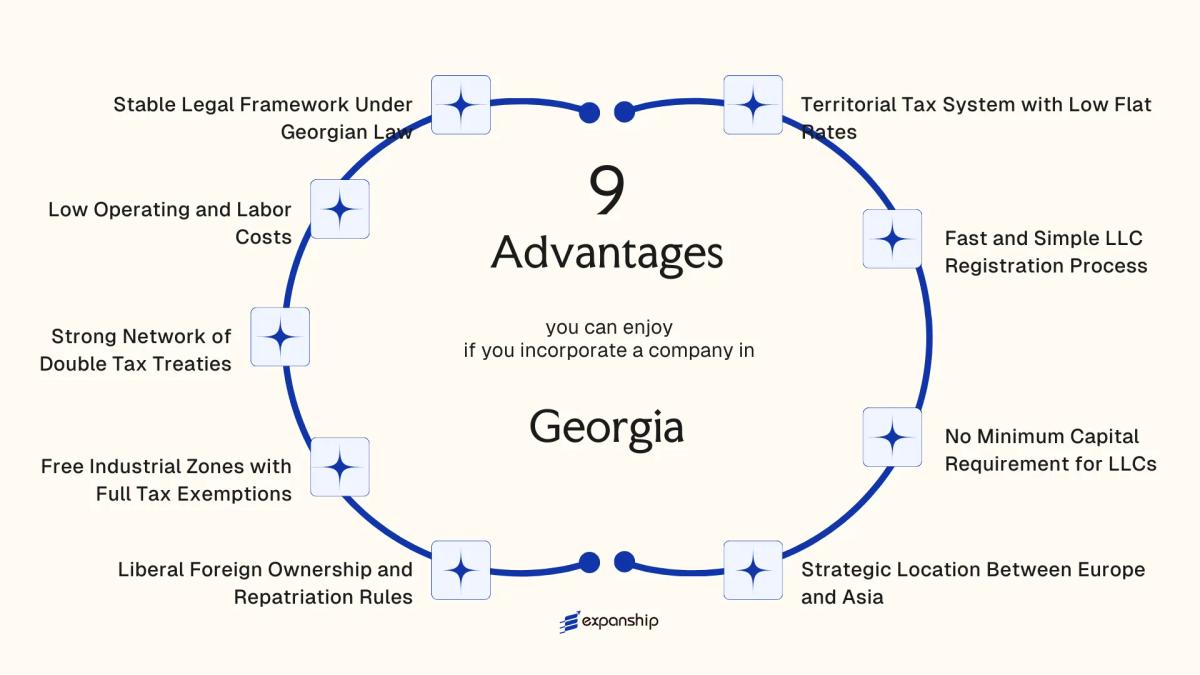
This article examines the key advantages that make Georgia company formation worth evaluating for businesses of varying size and industry focus.
Territorial Tax System with Low Flat Rates
Georgia's territorial tax system advantages are among the most structurally significant for foreign-owned businesses. Under the Tax Code of Georgia, profits earned outside the country are not subject to local corporate tax, regardless of where the income originates.
How the Rate Structure Works for Foreign Owners
The standard corporate income tax rate stands at 15%, but under the Estonian-model tax regime introduced in 2017, retained earnings are not taxed at the entity level. Tax is only triggered upon distribution of profits as dividends, meaning your business can accumulate and reinvest income without an immediate tax liability.
What Exemption on Foreign Income Means in Practice
For a company operating across multiple markets, income sourced from outside Georgia is excluded from the taxable base entirely. A Georgian-registered LLC acting as a holding or trading vehicle for international transactions can therefore generate foreign revenue without that income being drawn into the local tax net, which produces a meaningful reduction in the overall effective tax rate across your corporate structure.
Retained foreign earnings held inside a Georgian entity are not taxed until distributed, allowing capital to remain working within the structure longer.
Fast and Simple LLC Registration Process
Registering an LLC, known locally as a Mkharegrdzeli Pasuxismgeblobis Kompania (MPK), ranks among the most cited Georgia LLC registration benefits for businesses evaluating entry into the South Caucasus market. The process is administered through the National Agency of the Public Registry (NAPR), and registration can typically be completed within one to two business days when documentation is in order.
Foreign nationals face no residency requirement to register a company. You are not required to be physically present in Georgia to complete the process, as registration can be handled through a notarized power of attorney, which removes a practical obstacle that exists in many other jurisdictions.
The documentation threshold is low by international standards:
- A passport copy satisfies identity verification for foreign shareholders, with no apostille required in most cases
- No local registered director is mandated, so your existing management structure can remain intact
- The articles of association follow a standard template accepted by NAPR, reducing drafting complexity
- No notarized translation is required if documents are already in Georgian or accompanied by a certified translation
Fast company registration in Georgia means your entity can be legally operational within days of submitting the application, allowing you to open bank accounts, sign contracts, and hire staff without the weeks-long delays common in EU jurisdictions.

Company Incorporation in Georgia
Register your LLC in Georgia through NAPR with full support from document preparation to post-incorporation compliance.
No Minimum Capital Requirement for LLCs
There is no minimum capital requirement for a Georgia LLC (known locally as a "Shezoghebuli Pasuxismgeblobis Kompania," or SPK). Under the Law of Entrepreneurs of Georgia, you can register an SPK with any capital amount you choose, including a nominal sum. That structural feature directly reduces the financial barrier to entry for foreign founders.
| Feature | Detail |
|---|---|
| Minimum share capital | None required by law |
| Governing legislation | Law of Entrepreneurs of Georgia (2021) |
| Registration authority | National Agency of Public Registry (NAPR) |
| Capital paid-in at registration | No mandatory timeline |
For early-stage ventures or holding structures, this means you are not forced to commit capital before the business generates revenue. Unlike many European jurisdictions that require minimum paid-in amounts before registration is complete, Georgian law imposes no such threshold. Your initial capital can reflect actual operational needs rather than a statutory obligation.
This also simplifies multi-entity structuring. If your firm operates subsidiaries or special-purpose vehicles across several markets, incorporating an SPK without a capital floor keeps administrative overhead low from the outset. Founders retain full discretion over how capital is introduced, whether through cash contributions, in-kind assets, or other permissible means as defined under the same statute.
Strategic Location Between Europe and Asia
Georgia's strategic location Europe Asia business hub position is defined by geography, not just marketing language. Sitting at the intersection of the South Caucasus, the country shares borders with Russia to the north, Turkey and Armenia to the south, and Azerbaijan to the east, placing it within a four-hour flight of major cities including Istanbul, Dubai, and Moscow.
This positioning gives your business direct access to a combined market exceeding 1.5 billion people across Europe, Central Asia, and the Middle East. The Baku-Tbilisi-Kars railway corridor and the Black Sea ports of Poti and Batumi form a physical trade route connecting Asian supply chains to European markets, which means a company registered here can serve as an operational midpoint without the overhead costs of EU-based entities.
Under Georgia's Association Agreement with the European Union and its Deep and Comprehensive Free Trade Area (DCFTA), goods produced or processed in the country can enter EU markets under preferential tariff conditions. A similar arrangement exists with China under a bilateral free trade agreement in force since 2018.
Keep these structural factors in mind:
- DCFTA covers trade in goods, services, and investment protections with the EU
- The China-Georgia FTA is one of the few such agreements China has signed with a non-Asian country
- Poti Free Industrial Zone sits adjacent to a functioning Black Sea seaport
- FTA benefits apply to goods meeting defined rules of origin; verify product eligibility before structuring logistics through the entity
Georgia is one of only a handful of non-EU countries that holds both a DCFTA with the European Union and a bilateral free trade agreement with China simultaneously.
Liberal Foreign Ownership and Repatriation Rules
Georgia foreign ownership rules advantages begin with a foundational principle: foreign nationals face no restrictions on owning 100 percent of a Georgian legal entity. Unlike many jurisdictions that require a local partner or impose sector-specific ownership caps on non-residents, Georgian law imposes no such conditions on most business activities. This means your firm operates under the same ownership rights as a domestically owned business.
Full Ownership Without a Local Partner
Under the Law of Georgia on Entrepreneurs, foreign individuals and foreign legal entities may establish and wholly own a Limited Liability Company or a Joint Stock Company without involving a Georgian resident as a shareholder or director. There is no mandatory local nominee structure. For investors concerned about dilution of control, this eliminates a common structural constraint found in jurisdictions across Southeast Asia and parts of the Middle East.
Unrestricted Profit Repatriation
Georgia profit repatriation rules for investors are equally direct. There are no foreign exchange controls, no central bank approval requirements, and no caps on the amount of profit that can be transferred abroad. Dividends paid to a non-resident shareholder are subject to a 5 percent withholding tax under the Tax Code of Georgia, which is among the lower rates applied within the broader European and Caucasus region.
Your business can distribute profits and move capital internationally without filing for prior authorization, giving you predictable access to your returns.
Structure Your Georgian Company for Full Ownership and Free Capital Movement
Understand how Georgian ownership rules and repatriation provisions apply to your specific business structure.
Free Industrial Zones with Full Tax Exemptions
Georgia's Free Industrial Zones (FIZs) offer one of the most complete tax exemption structures available to foreign-owned businesses under Georgian law. Entities registered and operating within a designated FIZ are exempt from corporate income tax, VAT, import tax, and property tax on assets used within the zone. This combination of exemptions is established under the Law of Georgia on Free Industrial Zones, making the benefit legally grounded rather than discretionary.
- Corporate income tax does not apply to profits generated from FIZ operations, meaning your business retains earnings in full rather than remitting a share to the state.
- Goods brought into a FIZ from abroad are not subject to import duties, which reduces the landed cost of raw materials and components for manufacturing or processing businesses.
- VAT is not charged on transactions conducted within the zone, removing a significant compliance and cash-flow burden from day-to-day commercial activity.
- The Poti Free Industrial Zone, one of the established FIZ operators, sits adjacent to the Black Sea port, giving zone-registered firms direct access to maritime freight routes without leaving the tax-exempt perimeter.
- FIZ status is available to foreign-owned companies, and there is no requirement for local equity participation, preserving full ownership and profit control for international investors.
Strong Network of Double Tax Treaties
Georgia's double tax treaty network advantages are most visible when you look at the practical effect on cross-border income flows. The country has signed DTTs with over 55 jurisdictions, including Germany, the United Kingdom, the Netherlands, China, and the United Arab Emirates. Under these agreements, withholding tax rates on dividends, interest, and royalties paid to foreign residents are reduced — often significantly below the standard domestic rate.
For a holding or trading entity registered in Georgia, this means profits distributed to parent companies or individual shareholders in treaty partner countries face lower withholding deductions, preserving more after-tax returns.
Treaty eligibility is generally subject to residency and beneficial ownership conditions, meaning shell structures without genuine economic substance may not qualify for reduced rates.
- Dividends to qualifying residents of several treaty partners are taxed at 0% or 5% under specific DTT provisions
- Interest and royalty payments similarly benefit from reduced withholding, depending on the counterpart jurisdiction
- Treaties follow the OECD Model Convention framework in most cases, providing predictable interpretive standards
A Georgian-registered firm distributing $200,000 in dividends to a German parent could face a 5% treaty withholding rate rather than the standard 5% domestic rate — confirming treaty rates align with or improve upon domestic provisions, making treaty access a planning tool rather than a redundancy.
Low Operating and Labor Costs
Georgia low operating costs for businesses are among the most structurally significant advantages the country offers foreign investors. Office space, utilities, and general administrative expenses run considerably below Western European benchmarks, which directly reduces the fixed-cost base your entity carries from day one.
Labor costs reflect the same pattern. Average monthly wages in Georgia sit well below EU member state averages, yet the country produces a educated, multilingual workforce concentrated in Tbilisi and Batumi. For service-oriented businesses or back-office operations, this gap translates into meaningful reductions in payroll expenditure without proportional reductions in output quality.
Under the Labour Code of Georgia, employment contracts offer reasonable flexibility in structuring working arrangements. Statutory social contributions are also comparatively low, adding to the cost advantage for firms hiring local staff.
- Office rental costs in prime Tbilisi locations remain significantly cheaper than equivalent space in Warsaw, Bucharest, or Vienna.
- Utility costs, including electricity and internet connectivity, carry rates that support cost-efficient day-to-day operations.
- Hiring locally reduces reliance on expatriate staffing, which compounds savings over time.
Wage levels and labor regulations can vary by sector and employment type, so verify current rates and applicable collective agreements before building your payroll projections.
Stable Legal Framework Under Georgian Law
Georgia's legal framework stability for businesses rests on a foundation that has been deliberately modernized over the past two decades. The primary statute governing commercial entities is the Law of Georgia on Entrepreneurs, which was substantially revised and entered into force in 2022. This revision aligned Georgian corporate law more closely with continental European standards, giving foreign investors a predictable, well-structured statutory base rather than a patchwork of ad hoc regulations.
One concrete advantage of this modernization is the codification of shareholder rights, director liability rules, and corporate governance requirements under a single coherent instrument. For a foreign owner, this means the rules governing your entity's internal structure are clearly defined in statute, reducing dependence on contractual workarounds or legal uncertainty. Disputes over ownership, decision-making authority, and profit distribution have statutory resolution mechanisms rather than relying solely on judicial discretion.
Georgia business law investor protections are further reinforced through the Investment Law, which guarantees foreign investors the same legal standing as domestic ones and protects against discriminatory regulatory treatment. This principle of national treatment is codified, not merely a policy position, which gives it legal enforceability before Georgian courts and, where applicable, international arbitration.
The National Agency of Public Registry (NAPR) serves as the central authority for company registration and corporate record maintenance. Its statutory mandate and digitized processes mean that changes to your company's registered data, ownership structure, or legal address are recorded within a defined legal framework with public accountability.
- The Law on Entrepreneurs governs LLC formation, governance, and dissolution
- The Investment Law codifies national treatment for foreign-owned entities
- NAPR maintains the official register with legal authority over corporate records
- International arbitration access is available under applicable bilateral investment treaties
Why Georgia Stands Out Among Emerging Business Destinations
Situated at the intersection of European and Central Asian trade routes, Georgia draws comparisons with Armenia, Azerbaijan, and Montenegro — jurisdictions that share a similar incorporation profile and compete for the same pool of foreign investors seeking low-tax, low-bureaucracy environments outside the EU. What distinguishes Georgia from these alternatives is the structural breadth of its advantages: the combination of a territorial tax system, a free zone framework, and unrestricted foreign ownership creates a layered commercial environment that individual competitors only partially replicate.
Armenia, for instance, offers competitive flat tax rates but lacks the same depth of free industrial zone infrastructure. Montenegro provides EU-accession appeal but carries higher operating costs and a more complex regulatory environment. Azerbaijan presents strategic energy-sector opportunities, yet imposes greater restrictions on foreign ownership in certain sectors. For a foreign business owner evaluating your options in this region, the comparison reveals that no single competitor matches the same convergence of tax efficiency, registration simplicity, and open ownership rules that Georgia provides under its current legal framework.
| Parameter | Georgia | Armenia | Montenegro | Azerbaijan |
|---|---|---|---|---|
| Corporate Income Tax Rate | 15% (distributed profits only) | 18% | 9% | 20% |
| Foreign Ownership Restrictions | None | None | None | Sector-specific restrictions apply |
| Free Zone Tax Exemptions | Full (VFIZ, Kutaisi FIZ) | Limited | Limited | Available in select zones |
| Minimum Share Capital (LLC) | None | None | EUR 1 | None |
| Double Tax Treaties (approx.) | 56+ | 40+ | 40+ | 50+ |
| Company Registration Timeline | 1–2 business days | 1–3 business days | 5–10 business days | 3–5 business days |
Compliance Services for Companies in Georgia
Stay current with Georgia's corporate filing obligations, annual reporting requirements, and regulatory deadlines under Georgian law.
Conclusion
Georgia's territorial tax system, combined with zero minimum capital requirements for LLCs and full tax exemptions available through its Free Industrial Zones, creates a structural environment that reduces both the cost of entry and the ongoing tax burden for foreign-owned businesses.
That combination is not universally applicable. The territorial tax regime benefits entities deriving income from outside Georgia, while Free Industrial Zone status carries specific operational conditions under Georgian law. Your business model, revenue source, and industry determine which of these advantages actually apply.
For foreign investors and founders who qualify, the overall framework under Georgian law offers measurable financial and operational advantages that are difficult to replicate at this cost level within comparable markets. Engaging qualified legal and corporate advisors registered in Georgia remains the practical starting point for structuring your entity correctly from the outset.
Start Your Georgia Company with Expanship Today
Expanship supports foreign entrepreneurs through each stage of company formation in Georgia, from initial structuring decisions to post-registration compliance. The services directly address the regulatory touchpoints covered in this blog: LLC registration under the Law of Georgia on Entrepreneurs, filings with the National Agency of Public Registry, and the ongoing obligations that keep a Georgian entity in good standing.
Expanship Georgia company formation services cover the following:
- Preparation and legalization of incorporation documents, including the charter and founder resolutions
- Registered agent and registered office provision to satisfy local address requirements
- Government filing and liaison with the National Agency of Public Registry on your behalf
- Post-incorporation compliance management, including annual reporting and directorship obligations
- Bank account introduction assistance with Georgian and international financial institutions
- Support with applications related to Virtual Zone or Free Industrial Zone status where applicable
To discuss your incorporation requirements, contact Expanship Georgia directly.
Frequently Asked Questions (FAQ)
Registration through the National Agency of Public Registry (NAPR) is typically completed within one business day under the standard procedure, with same-day registration available for an additional fee. The process can be initiated and completed electronically, and no physical presence in Georgia is required. A notarized power of attorney allows a local representative to act on your behalf throughout the process.
Georgia applies a 15% corporate income tax rate, but only on distributed profits under the Estonian-model system adopted in 2017. Foreign-sourced income retained within the company is not subject to tax until distribution. This makes the effective tax burden dependent on your dividend policy rather than gross profit.
Tax exemptions in Georgia's Free Industrial Zones (FIZs) apply to qualifying business activities conducted within the zone, including corporate income tax, VAT, and import duties on goods brought into the zone. Activities must comply with the specific operational rules of the designated zone, and certain sectors may face restrictions. Profits distributed from FIZ entities to non-residents are also exempt from withholding tax under Georgian tax legislation.
Georgia has concluded double tax treaties with over 50 countries, including EU member states, China, the UAE, and several CIS nations. Whether a specific treaty applies to your situation depends on your country of tax residency and the nature of the income. The treaties generally reduce or eliminate withholding taxes on dividends, interest, and royalties paid between contracting states.
Failure to file required financial statements or tax returns with the Revenue Service of Georgia can result in administrative penalties and potential suspension of the entity's registration. The severity of the penalty is generally proportional to the nature and duration of the non-compliance. Persistent non-filing can trigger enforcement action, including compulsory deregistration under Georgian procedural law.
No minimum share capital is required to register an LLC in Georgia. The Law of Georgia on Entrepreneurs sets no statutory floor on paid-in capital for this entity type, meaning you can incorporate with a nominal amount. The capital structure is left to the founders' discretion as defined in the company's charter.
Georgia is a signatory to the International Centre for Settlement of Investment Disputes (ICSID) Convention and has ratified the New York Convention on the Recognition and Enforcement of Foreign Arbitral Awards. These commitments allow foreign investors to pursue international arbitration rather than relying solely on domestic courts in disputes with the Georgian state. The Law of Georgia on the Promotion and Guarantees of Investment also provides statutory protections against discriminatory treatment and expropriation without compensation.
Legal Disclaimer
The information provided in this article is for general informational purposes only and does not constitute legal, tax, or professional advice. While we strive to ensure the accuracy and timeliness of the content, laws and regulations are subject to change, and the application of laws can vary widely based on specific facts and circumstances.
Readers should not act upon this information without seeking professional counsel tailored to their individual situation. Expanship and its authors disclaim any liability for actions taken or not taken based on the content of this article.
For specific advice regarding your business setup, compliance requirements, or any legal matters, please consult with qualified legal and tax professionals in the relevant jurisdiction.