

Key Takeaways
- Under the International Companies Act, any IBC registered in Grenada must appoint a licensed registered agent — an informal intermediary does not satisfy this statutory obligation.
- Beneficial ownership records must be maintained in a form that remains accessible to Grenada's regulatory authorities, making UBO disclosure an ongoing compliance requirement rather than a one-time filing.
- Incorporation requirements in Grenada vary based on entity type, operating sector, and the residency status of the applicant, meaning foreign investors cannot assume a uniform standard applies across all structures.
- The Companies Registry, administered under the Ministry of Finance and governed by the Companies Act, Cap. 60 of the Laws of Grenada, serves as the competent authority for entity registration and has the power to strike off companies that fail to maintain post-incorporation compliance.
Company formation in Grenada is governed by the Companies Act, Cap. 60 of the Laws of Grenada, administered through the Companies Registry under the Ministry of Finance. This article addresses the formal incorporation requirements in Grenada that apply at the point of entity registration and ongoing compliance.
Failure to satisfy these requirements results in rejection of the registration application or, where deficiencies arise post-incorporation, potential striking off of the company from the register.
Requirements vary depending on the type of entity being formed, the sector in which it will operate, and whether the applicant is a resident or foreign national. Reviewing the Companies Act directly is advisable before proceeding.
This article is most relevant to foreign investors and non-resident business owners seeking to register a company under Grenada's domestic corporate framework.
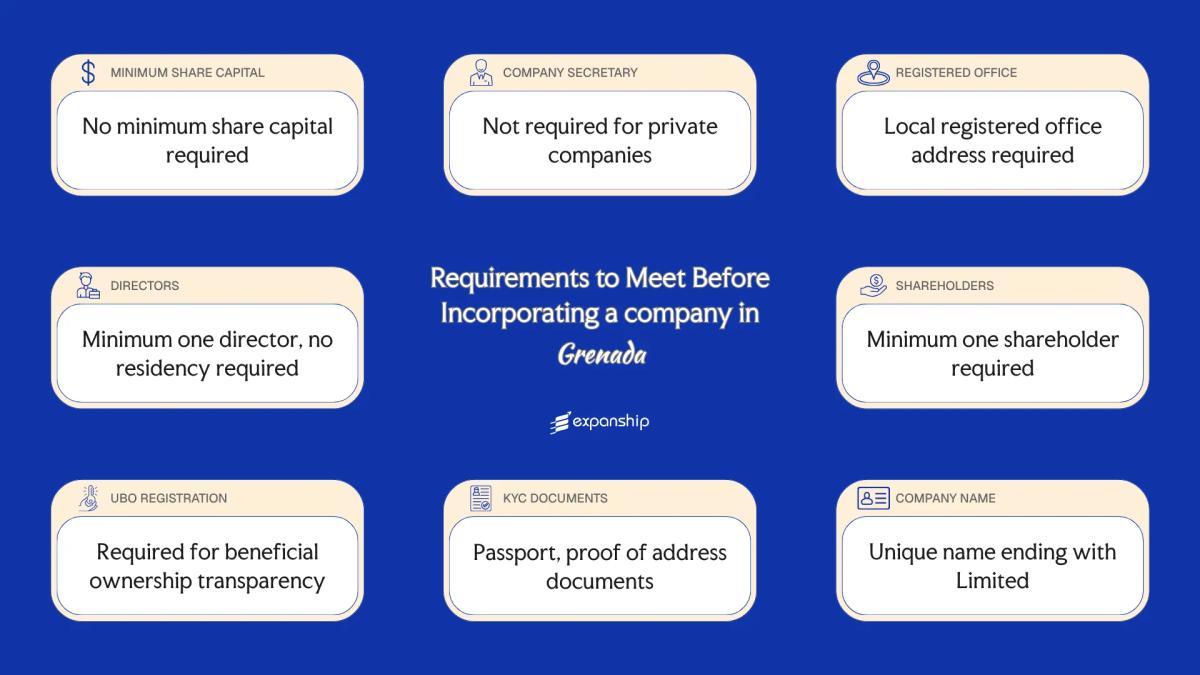
Minimum Share Capital Requirements in Grenada
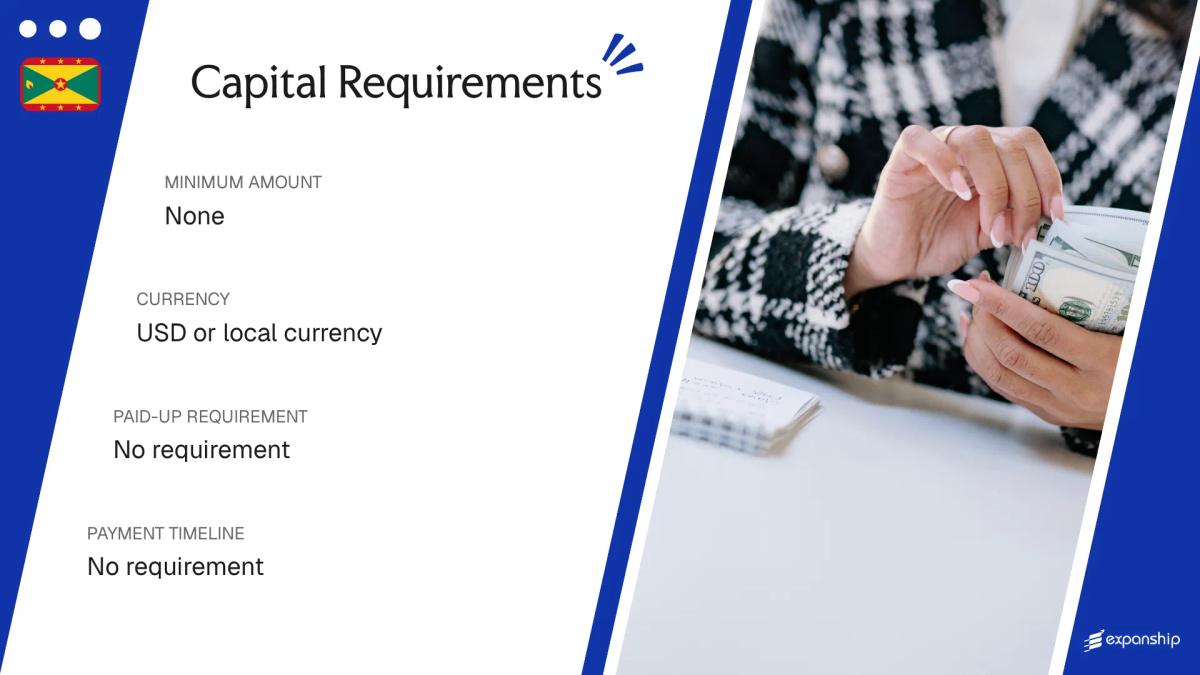
Under the International Companies Act of Grenada, there are no Grenada minimum share capital requirements for international business companies. The Registrar of International Business Companies, operating under the Ministry of Finance, does not mandate a minimum authorized or paid-up capital at the point of incorporation.
Authorized share capital must still be declared in the company's articles of incorporation. A common default structure used in practice is 100,000 shares at a par value of USD 1.00 each, though no-par value shares are also permitted under the Act.
| Parameter | Detail |
|---|---|
| Minimum Authorized Share Capital | No statutory minimum |
| Maximum Authorized Share Capital | No statutory maximum |
| Minimum Paid-Up Capital | No statutory requirement |
| Paid-Up Requirement at Incorporation | No statutory requirement |
| Accepted Currency | Any major foreign currency; USD is most common |
| Accepted Forms of Contribution | Cash, property, or services as permitted by the articles |
| Timeframe to Deposit Capital | No statutory timeframe |
Even without a statutory minimum, your company's articles of incorporation must define an authorized share capital structure. Omitting this detail can create complications when opening bank accounts or entering into commercial agreements.
Registered Agent Requirements in Grenada
Under the International Companies Act, every IBC registered in Grenada must appoint a registered agent at the time of incorporation. This is a statutory requirement, not an administrative formality, and the agent must be maintained for the life of the company.
The registered agent holds certain ongoing obligations to the company. These include maintaining the company's statutory registers, receiving official correspondence and legal notices on the company's behalf, and ensuring that records required under the Act remain accessible within the jurisdiction.
Qualification criteria for serving as a registered agent in Grenada:
- Must be a person or entity licensed to act as a registered agent under the relevant licensing framework.
- Corporate agents must be incorporated or registered to conduct business within the jurisdiction.
- Individual agents must be resident in Grenada.
- The agent must hold a valid licence issued or recognised by the Grenada International Financial Services Authority (GIFSA).
- Foreign-incorporated entities are not eligible to serve directly without local registration.

Incorporate a Company in Grenada
Set up your Grenada IBC with full statutory compliance, including registered agent appointment and ongoing maintenance support.
Registered Office Requirements in Grenada
Under the Companies Act of Grenada, every registered company must maintain a registered office address within the country at all times. Failure to comply with Grenada registered office requirements can result in administrative penalties or the company being struck off the registry maintained by the Registrar of Companies.
- A physical address is required; a P.O. Box alone does not satisfy the registered office obligation.
- The address must be located within Grenada; overseas addresses are not permitted.
- Virtual office addresses may be used, provided they correspond to a physical, identifiable location.
- No ownership of the premises is required; a lease or service agreement with an address provider is acceptable.
- The registered office address is recorded on the public company registry and is available for inspection.
- Any change of registered office address must be formally notified to the Registrar of Companies; the updated address takes effect upon filing the requisite notice.
Director Requirements in Grenada
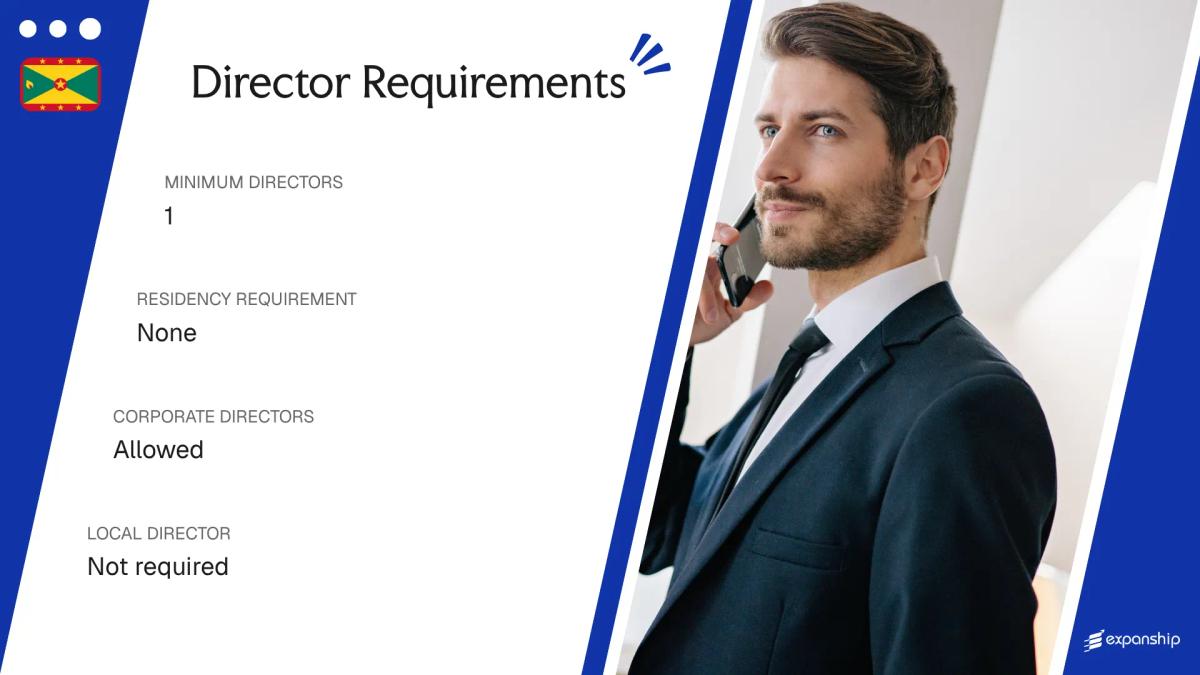
Under the International Business Companies Act of Grenada, directors assume statutory duties of care, loyalty, and fiduciary responsibility toward the company upon appointment. Grenada director requirements company regulations permit considerable flexibility in director composition, though directors remain personally liable for resolutions passed in breach of the Act.
| Parameter | Detail |
|---|---|
| Minimum Number of Directors | One director is required. |
| Maximum Number of Directors | No statutory maximum is imposed. |
| Local/Resident Director Required | No local or resident director is required. |
| Nationality Restrictions | No nationality restrictions apply. |
| Minimum Age Requirement | Directors must be at least 18 years of age. |
| Corporate Directors Permitted | Yes, corporate directors are permitted under the IBC Act. |
| Director Must Be a Shareholder | No, directors are not required to hold shares in the company. |
| Publicly Listed on Registry | Director information is not publicly disclosed on the registry. |
| Disqualification Conditions | A person who is bankrupt or has been convicted of an offense involving fraud or dishonesty may be disqualified from acting as director. |
Despite Grenada's IBC framework allowing full foreign directorship, director details are kept off the public register, meaning no public record links an individual's name to their role in the company.
Shareholder Requirements in Grenada
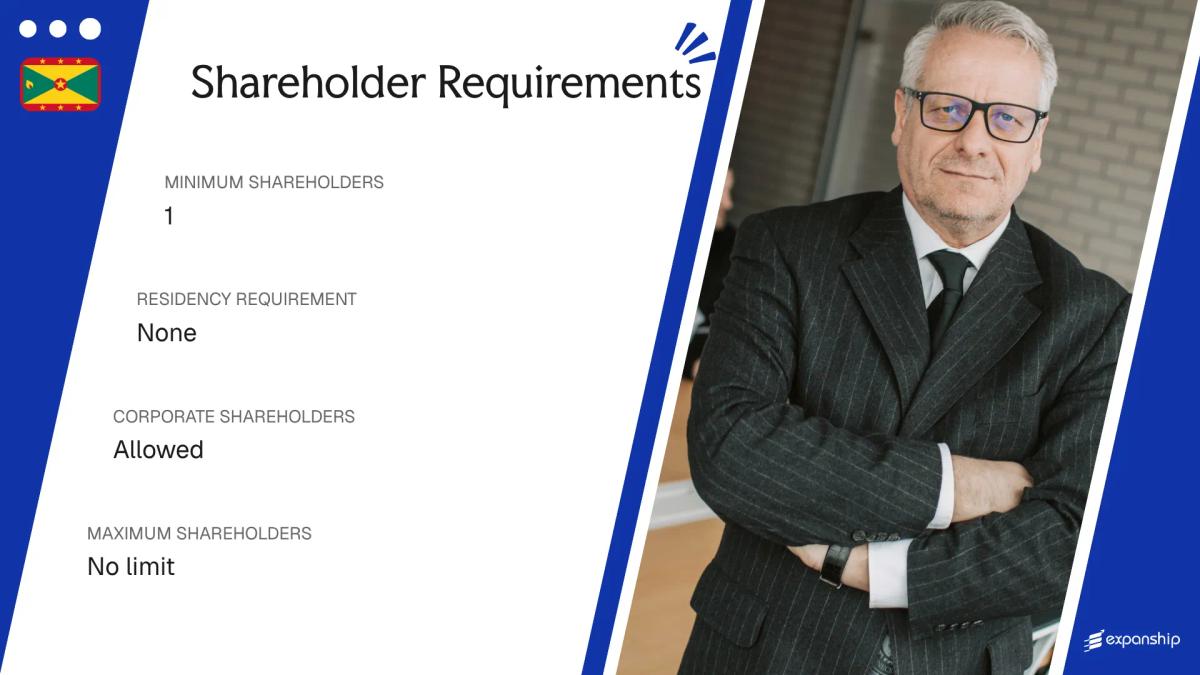
Under the International Business Companies Act of Grenada, an IBC requires a minimum of one shareholder. There is no prescribed maximum, allowing for sole-member structures as well as multi-shareholder arrangements.
Nationality and Residency Restrictions
Grenada shareholder requirements company rules impose no nationality or residency conditions on shareholders. Foreign nationals and non-residents may hold shares without restriction on ownership percentage.
Corporate Shareholders
Corporate entities are permitted to act as shareholders in a Grenadian IBC. No additional licensing or local nexus is required for a corporate body to hold shares in the firm.
Shareholder Liability
Liability is limited to the amount unpaid on a shareholder's shares. No general circumstances under the IBC framework extend personal liability beyond that capital contribution.
Register of Shareholders
A register of shareholders must be maintained by the entity, typically held at the registered office. This register is not publicly accessible, though it must be kept current and available for inspection by authorised parties.
Shareholder Structuring for Your Grenada Incorporation
Get guidance on structuring your shareholding arrangement to meet Grenada's IBC requirements before you incorporate.
UBO / Beneficial Ownership Disclosure Requirements in Grenada
Under the International Companies Act (Cap. 152) and the Financial Intelligence Unit Act, Grenada beneficial ownership disclosure requirements apply to any individual who ultimately owns or controls 25% or more of a company's shares or voting rights.
- Identify all beneficial owners meeting the 25% ownership or control threshold at the time of incorporation.
- Record beneficial ownership information in the company's internal statutory register, maintained at the registered office or with the registered agent.
- Submit beneficial ownership details to the Grenada International Financial Services Authority (GIFSA) or the relevant competent authority as required under anti-money laundering obligations.
- Update the register within a reasonable period whenever a change in beneficial ownership occurs.
| Parameter | Detail |
|---|---|
| Ownership Threshold for UBO Status | 25% of shares or voting rights |
| Filing Authority | Grenada International Financial Services Authority (GIFSA) / Registered Agent |
| Disclosure Deadline at Incorporation | At time of incorporation |
| Publicly Accessible Register | No |
| Penalties for Non-Disclosure | Subject to regulatory penalties under the Financial Intelligence Unit Act |
| Ongoing Update Obligation | Yes; register must be updated upon any change in beneficial ownership |
KYC / Document Requirements in Grenada
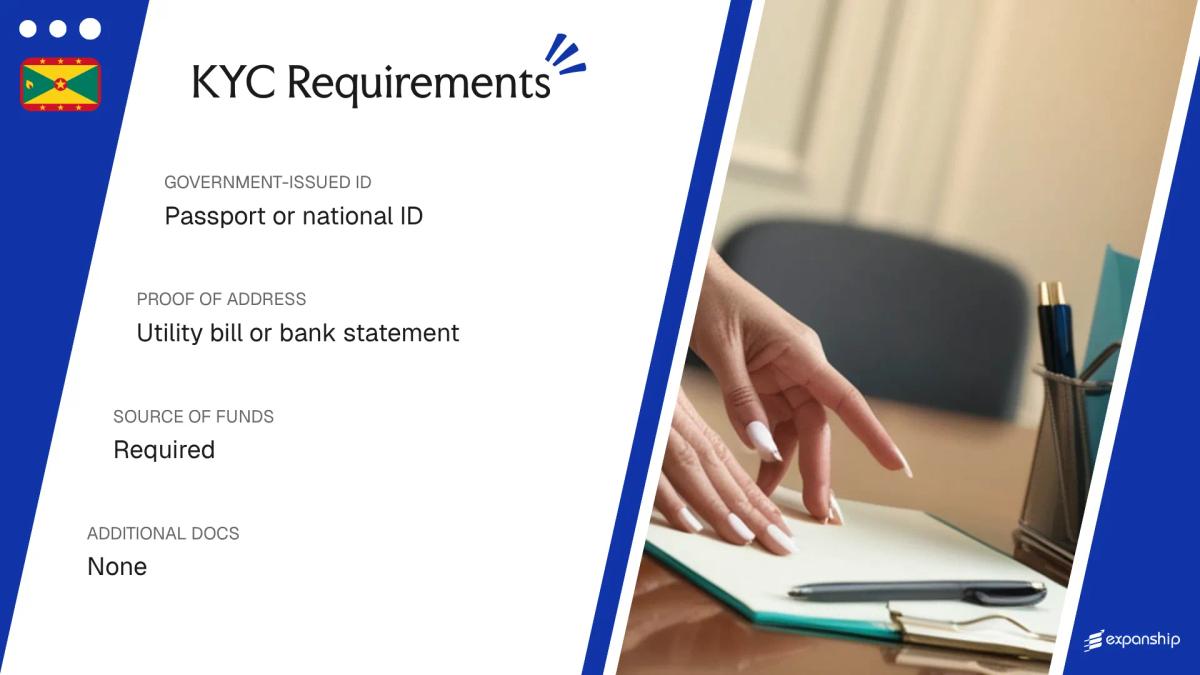
Grenada KYC document requirements apply at the point of incorporation and are governed by the Proceeds of Crime Act and the Anti-Money Laundering Regulations administered by the FIU Grenada.
Individual / Personal Documents
- Valid government-issued passport or national identity card
- Proof of residential address dated within three months, such as a utility bill or bank statement
- A signed and dated declaration of beneficial ownership where applicable
- Recent bank reference letter confirming the individual's account standing
Corporate Documents
- Certificate of incorporation from the entity's home jurisdiction
- Constitutional documents, including articles of association or equivalent
- Register of directors and register of shareholders from the corporate entity
- Proof of registered office address for the corporate shareholder or director
Source of Funds Documentation
- Bank statements covering the preceding three to six months
- Audited financial accounts or management accounts for established entities
- A written source of funds declaration signed by the relevant principal
Notarisation and Apostille Requirements
- Foreign-issued identity documents generally require notarisation by a qualified notary
- Documents originating from Hague Convention countries should carry an apostille
- Documents in languages other than English require a certified translation
Incomplete source of funds documentation is the most frequently cited reason for delays in IBC registration in Grenada.
Company Name Requirements in Grenada
Grenada company name requirements are assessed at the point of incorporation through a name availability check conducted against existing registered entities. Names that are identical or deceptively similar to an already-registered business will not be approved.
The chosen name must end with a suffix indicating limited liability, such as "Limited," "Ltd.," "Corporation," "Corp.," "Incorporated," or "Inc." Names must be in the Latin alphabet, and certain abbreviated or misleading forms are generally not permitted.
Words implying a connection to government bodies, financial institutions, or regulated professions fall into restricted categories. Terms such as "Bank," "Insurance," "Trust," and "Royal" typically require prior consent from the relevant authority before the name can be accepted.
Name reservation is available prior to formal incorporation. A reserved name is generally held for a fixed period, after which it lapses if incorporation has not been completed. The application is submitted to the companies registry along with the applicable fee.
Company Compliance Services in Grenada
Keep your Grenada-registered entity in good standing with ongoing compliance support, including annual returns, registered agent maintenance, and regulatory filings.
Conclusion
Grenada company registration requirements span several distinct areas, from share capital and director appointments to UBO disclosure and company naming rules. Among the more notable obligations is the mandatory appointment of a licensed registered agent under the International Companies Act, which applies to IBC structures and cannot be delegated to an informal intermediary. Beneficial ownership records must also be maintained in a manner accessible to Grenada's regulatory authorities. Once these requirements are understood, a foreign investor's next step is translating that framework into a compliant incorporation filing.
Expanship's Company Formation Services in Grenada
Expanship's Grenada company formation services cover the full scope of what incorporating under the International Companies Act demands, from sourcing a licensed registered agent to meeting the Registrar of Companies' filing obligations. Your business can engage Expanship at any stage of this process, whether preparing constitutional documents or managing ongoing statutory requirements. The operational burden of coordinating across local authorities, agents, and compliance timelines is where Expanship's involvement makes a measurable difference.
Expanship supports IBC formation assistance and the full post-incorporation cycle across Grenada's regulatory framework.
- Company registration documents are prepared and submitted in accordance with Grenada's Companies Act requirements.
- Registered agent and registered office services are provided through locally compliant partners.
- Government filings and liaison with the Registrar of Companies are handled on your behalf.
- Post-incorporation compliance obligations are monitored and managed on an ongoing basis.
- Banking introduction support is coordinated to facilitate account opening.
- Tax registration and local authority liaison are arranged as required.
To discuss your requirements, contact Expanship Grenada.
Frequently Asked Questions (FAQ)
A foreign national can serve as the sole director of a Grenada IBC. The International Companies Act imposes no residency or nationality requirement on directors, so your entire board can consist of non-residents without affecting the company's standing with the Grenada International Financial Services Authority.
Failure to maintain a licensed registered agent puts your company in breach of the International Companies Act, which can result in the Registrar striking the entity off the register. Reinstatement is possible but involves additional fees and administrative filings, and the company loses its good standing for any period it operates without a compliant agent.
Beneficial ownership information filed in Grenada is held on a non-public register, meaning it is not accessible to the general public. Disclosure is made to the Grenada International Financial Services Authority and can be shared with competent authorities for law enforcement or regulatory purposes, consistent with the jurisdiction's FATF compliance commitments.
Certified copies are generally accepted, though the specific standard depends on the registered agent handling your filing. Documents originating from countries outside the Hague Apostille Convention may require notarization by a local authority, while apostille certification suffices for documents from member states.
Certain restricted words require prior approval or a relevant license before they can appear in a company name. Terms such as "Bank," "Insurance," "Trust," and "Royal" fall under this category in Grenada, and the Registrar will reject a name application that includes them without the corresponding regulatory authorization.
Legal Disclaimer
The information provided in this article is for general informational purposes only and does not constitute legal, tax, or professional advice. While we strive to ensure the accuracy and timeliness of the content, laws and regulations are subject to change, and the application of laws can vary widely based on specific facts and circumstances.
Readers should not act upon this information without seeking professional counsel tailored to their individual situation. Expanship and its authors disclaim any liability for actions taken or not taken based on the content of this article.
For specific advice regarding your business setup, compliance requirements, or any legal matters, please consult with qualified legal and tax professionals in the relevant jurisdiction.


