

Key Takeaways
- Grenada's International Business Companies Act provides a statutory zero-rate treatment on foreign-sourced income, meaning qualifying offshore entities operate entirely outside the domestic tax base on earnings generated abroad.
- Under the IBC framework, director and beneficial owner information is protected by codified confidentiality provisions rather than administrative discretion, giving offshore structures a legally grounded layer of privacy.
- The complete absence of exchange controls means a Grenada-registered entity can hold, transact, and transfer foreign currencies across borders without regulatory intervention at the point of movement.
- Membership in CARICOM extends market access benefits to Grenada-incorporated businesses, positioning them within a regional trade framework that spans multiple Caribbean economies.
Grenada is an independent Caribbean nation located in the southeastern Caribbean Sea, governed as a constitutional monarchy within the Commonwealth. Understanding the benefits of incorporating in Grenada begins with knowing which authority oversees the process: company registration falls under the purview of the Grenada Companies Registry, which administers corporate filings in accordance with the Companies Act and related legislation. Foreign investors most commonly establish an International Business Company when structuring operations through this jurisdiction.
From a tax standpoint, Grenada operates a territorial-based system that exempts qualifying offshore entities from local taxation on foreign-sourced income. The regulatory environment places no restrictions on full foreign ownership of locally registered companies, making it accessible to non-resident entrepreneurs and multinational structures alike. This openness to foreign direct investment is reflected in the straightforward treatment of foreign shareholders under current corporate law.
This article examines the key advantages that the jurisdiction offers to businesses considering incorporation here.
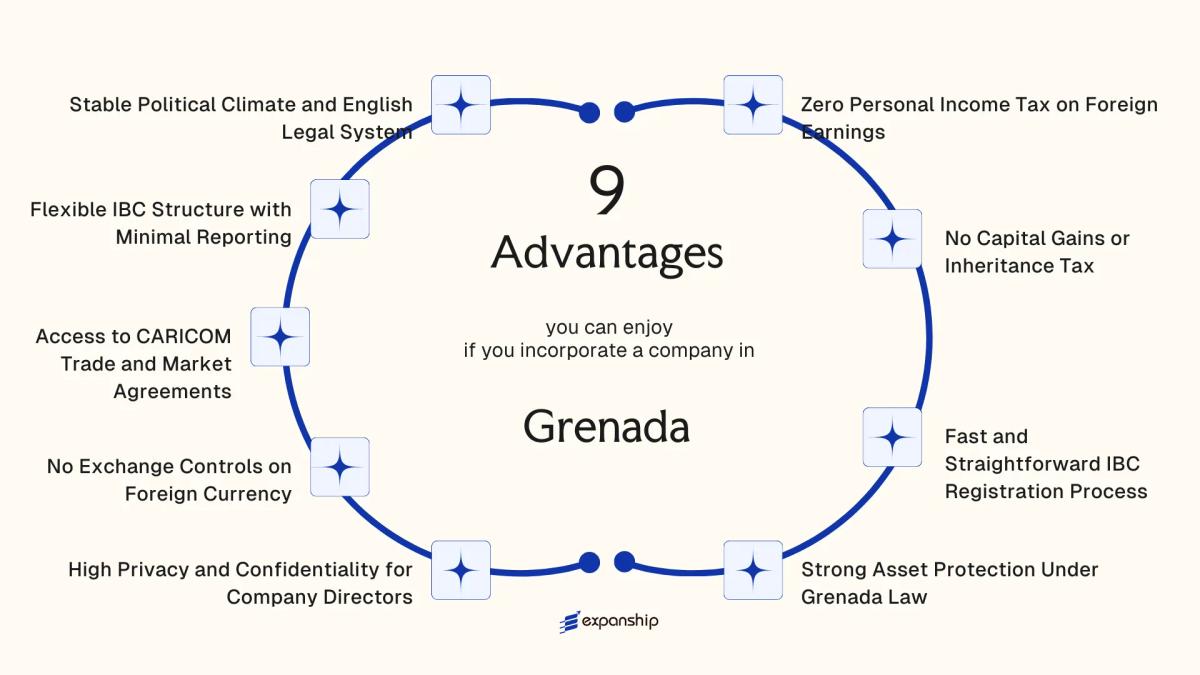
Zero Personal Income Tax on Foreign Earnings
Grenada zero personal income tax on foreign earnings is one of the most structurally significant advantages the jurisdiction offers to non-resident business owners and investors. Under Grenada's tax framework, income sourced from outside the country is not subject to personal income tax for qualifying individuals and IBC shareholders.
How the Exemption Is Structured
The Income Tax Act of Grenada applies taxation on a territorial basis, meaning personal income tax is assessed on locally sourced income only. Foreign-derived earnings — including dividends, royalties, and service fees paid from an International Business Company to its non-resident principals — fall outside the scope of domestic personal tax liability.
This distinction matters because it allows a foreign principal to extract profits from an offshore entity without triggering a personal tax charge in Grenada. Your retained earnings remain intact at the point of distribution, which directly affects net returns.
What This Means for Non-Resident Shareholders
For non-resident shareholders, the absence of withholding tax on dividends paid by a Grenada IBC compounds this advantage. The combination of zero corporate tax at the entity level and no personal tax on foreign earnings creates a full pass-through structure with no in-jurisdiction leakage.
Eligibility depends on maintaining non-resident status and ensuring the income genuinely originates from foreign sources, as domestic transactions are treated differently under the Act.
Foreign earnings distributed from your Grenada IBC to non-resident shareholders carry no personal income tax liability under Grenada's territorial tax system.
No Capital Gains or Inheritance Tax
Grenada's International Business Companies (IBCs) are not subject to capital gains tax. That means profits you generate from selling shares, disposing of assets, or realising investment returns within the IBC structure are not taxed at the corporate level. For a holding company or investment vehicle, this directly preserves the full value of asset disposals rather than eroding them through tax on appreciation.
Inheritance tax does not apply to IBCs or their underlying assets. Ownership of shares in a Grenadian IBC can pass between generations or be restructured without triggering a tax event at the point of transfer. This makes the structure relevant for estate planning purposes, particularly where the business holds appreciating assets across multiple jurisdictions.
The no capital gains tax Grenada IBC framework is grounded in the International Companies Act, which defines the tax treatment of qualifying offshore entities. To benefit, the company must derive income from outside the country and remain compliant with its registered agent requirements.
Some practical reasons this tax treatment stands out:
- Asset sales within the IBC generate no taxable gain, regardless of the appreciation amount
- Investment portfolios held through the entity are not subject to disposal taxes that would reduce compounding returns
- Share transfers between related parties do not create a chargeable event under Grenadian law
- There is no wealth or estate duty applied to IBC shareholdings upon succession

Incorporate a Company in Grenada
Register your Grenada IBC and access a zero capital gains and inheritance tax environment for your international business or investment structure.
Fast and Straightforward IBC Registration Process
Registering an International Business Company under the International Business Companies Act of Grenada is a process designed with minimal bureaucratic friction. One of the more tangible Grenada IBC registration advantages is the speed at which a company can be incorporated — formation is typically completed within a few business days once documentation is submitted to the Grenada International Financial Services Authority (GIFSA), the regulatory body overseeing offshore entities.
| Parameter | Detail |
|---|---|
| Governing Legislation | International Business Companies Act |
| Regulatory Authority | Grenada International Financial Services Authority (GIFSA) |
| Typical Formation Timeline | 2 to 5 business days |
| Minimum Shareholders Required | 1 |
| Minimum Directors Required | 1 |
| Registered Agent Required | Yes, must be locally licensed |
A single shareholder and one director are sufficient to form an IBC, and both roles can be held by the same individual. This structural simplicity means your business can be operational far sooner than in jurisdictions requiring multi-member boards or mandatory local director appointments.
The entity does not need to hold an annual general meeting within Grenada, and the corporate documentation can be maintained abroad. For investors managing multiple international structures, this removes a recurring logistical obligation that would otherwise demand time and local coordination.
Strong Asset Protection Under Grenada Law
Grenada asset protection offshore company structures draw their legal strength from the International Business Companies Act (Cap. 152), which establishes a statutory framework designed to insulate assets held within an IBC from foreign judgments and creditor claims.
Under this legislation, assets transferred into a Grenada IBC are treated as corporate property, legally separated from your personal estate. A foreign court judgment against you personally does not automatically attach to assets owned by the entity. This separation is not merely contractual — it is grounded in statutory law, which gives it a durability that informal arrangements cannot replicate.
The IBC Act also supports the use of nominee shareholders and the issuance of bearer-style registered shares, which can make it structurally difficult to trace beneficial ownership through public records alone. For individuals managing intergenerational wealth or cross-border business interests, this structural opacity has direct practical value.
Keep these points in mind when relying on Grenada's asset protection framework:
- Asset protection is strongest when the IBC is established before any legal dispute arises
- Transfers made to defraud existing creditors can be challenged under fraudulent conveyance principles
- The IBC must maintain its registered agent in Grenada to preserve legal standing
- Local compliance with the IBC Act is a condition for the statutory protections to apply
Grenada's IBC framework does not require a minimum capital deposit, meaning you can establish a fully protected corporate structure without locking up any nominal share capital.
High Privacy and Confidentiality for Company Directors
Grenada company director privacy benefits are grounded in the International Companies Act, which governs International Business Companies (IBCs) registered in the jurisdiction. Under this legislation, the names of directors and shareholders are not required to be filed in any public registry. For a foreign business owner, this means your personal identity is not exposed to competitors, litigants, or third parties through routine public record searches.
What the Law Protects and Why It Matters
The Registrar of Companies in Grenada does not maintain a publicly searchable database of beneficial owners or directors for IBCs. This structural feature means that corporate intelligence searches conducted against your firm yield no actionable personal data.
Nominee director arrangements are also permissible under the IBC framework. Using a nominee places an additional layer of separation between your name and the operating entity, which can be material in jurisdictions where disclosed directorships trigger tax obligations or regulatory scrutiny.
Confidentiality Obligations on Service Providers
Registered agents operating in Grenada are subject to statutory confidentiality obligations, meaning they cannot disclose client information except under specific legal compulsion, such as a court order tied to a criminal investigation. This obligation is not discretionary.
That said, Grenada does participate in international information exchange frameworks, so confidentiality applies to public disclosure, not to lawful regulatory cooperation between competent authorities. Your business benefits from privacy against commercial exposure, not from shielding information in cases of legitimate legal process.
Maximize Your Privacy Benefits in Grenada
Speak with an Expanship specialist about structuring your Grenada IBC to fully utilize the director confidentiality provisions available under the International Companies Act.
No Exchange Controls on Foreign Currency
Grenada imposes no exchange controls on foreign currency transactions conducted through an International Business Company. Under the International Companies Act, an IBC registered in Grenada is explicitly exempt from any local currency restrictions, meaning your business can hold accounts, receive payments, and transfer funds in any currency without seeking regulatory approval.
- You can repatriate profits to your home country or any third jurisdiction without restriction, removing the conversion delays and compliance costs that businesses face in countries with managed currency regimes.
- Foreign currency accounts can be maintained in multiple denominations simultaneously, giving a firm the flexibility to settle contracts, pay suppliers, and hold reserves in the currency that best suits its operational needs.
- There is no requirement to convert foreign earnings into Eastern Caribbean Dollars, the local currency governed by the Eastern Caribbean Central Bank, which means exchange rate exposure on operating capital stays entirely within your control.
- Fund transfers between the IBC and its foreign shareholders, directors, or related entities face no prior approval requirements from local monetary authorities, reducing administrative friction on routine treasury operations.
For businesses managing cross-border payments, licensing fees, or international supply chains, this structural freedom means transaction timing is determined by commercial logic rather than regulatory clearance schedules.
Access to CARICOM Trade and Market Agreements
Grenada CARICOM trade agreement benefits apply directly to companies incorporated under the jurisdiction's International Business Companies Act, though the full scope of preferential access depends on how the business is structured and where it conducts substantive operations.
As a full member of the Caribbean Community (CARICOM), Grenada participates in the CARICOM Single Market and Economy (CSME). Under this framework, goods originating from member states move with reduced or eliminated tariffs across participating economies. For a trading company sourcing or distributing within the Caribbean, this means lower landed costs and fewer customs barriers than firms operating outside the bloc would face.
CARICOM also maintains external trade arrangements, including the CARIFORUM-EU Economic Partnership Agreement (EPA). This treaty grants preferential access to EU markets for goods and services originating in eligible Caribbean states.
- Qualifying goods can enter EU markets at reduced duties under the EPA's Rules of Origin provisions.
- Services suppliers from CSME member states gain market access commitments not available to non-CARICOM firms.
A goods exporter incorporated in a non-CARICOM jurisdiction exporting to the EU pays the standard Most Favoured Nation (MFN) tariff rate. An equivalent firm with qualifying origin status under the CARIFORUM-EU EPA may pay 0%, depending on the product category, under the EPA's scheduled tariff elimination timetable.
Flexible IBC Structure with Minimal Reporting
Grenada IBC flexible structure benefits stem directly from the International Companies Act, which governs offshore entities incorporated under this framework. The Act permits a single shareholder and a single director, who may be the same person, to constitute a fully operational company. This removes the multi-party requirements common in many other offshore regimes and reduces administrative overhead from the outset.
Annual reporting obligations for an IBC are limited. There is no requirement to file audited financial statements with a public registry, and no mandatory local audit applies under the standard IBC framework.
For your business, this means the ongoing compliance burden stays proportionate to actual operational needs rather than regulatory tradition. Time and professional fees that would otherwise go toward extensive annual filings can remain directed at core business activity.
- No public disclosure of shareholder or director registers
- Single-member structure permitted
- No statutory audit requirement under the standard IBC framework
- Meetings of directors and shareholders may be held outside Grenada
The minimal reporting framework applies specifically to IBCs conducting business outside Grenada; entities engaged in local commercial activity are subject to separate regulatory requirements.
Stable Political Climate and English Legal System
Grenada's stable political climate business benefits are grounded in institutional continuity. The country has maintained uninterrupted democratic governance since independence in 1974, with peaceful transfers of power and a functioning parliamentary system modeled on the Westminster framework. For a foreign business owner, this means the regulatory and legal environment governing your company is unlikely to shift abruptly due to political disruption.
English Common Law Foundation
The legal system operates under English common law, the same framework underpinning jurisdictions like the United Kingdom, Singapore, and the Cayman Islands. Contract enforcement, property rights, and corporate disputes are adjudicated using well-established common law principles, which reduces interpretive uncertainty for international parties. If your business operates across multiple common law jurisdictions, Grenada's legal system integrates without significant doctrinal friction.
Judicial Structure and Appellate Access
The Eastern Caribbean Supreme Court has jurisdiction over civil and commercial matters, with appeals available to the Privy Council in London as the final appellate body. Access to the Privy Council provides a meaningful check on judicial decisions, since rulings are subject to review by a court with deep common law expertise outside the jurisdiction.
Practical Implications for Corporate Structures
- IBCs incorporated under the International Companies Act are governed by statute that draws on common law principles
- Directors and shareholders benefit from contract and fiduciary law concepts that are familiar to advisers in most English-speaking markets
- Dispute resolution agreements referencing English common law are generally enforceable without significant procedural complications
Why Grenada Stands Out Among Offshore Jurisdictions
Compared against other Caribbean offshore jurisdictions, Grenada holds a specific combination of features that foreign investors evaluating the region would find difficult to replicate in a single alternative. The jurisdictions most commonly considered alongside it are St. Kitts and Nevis, Belize, and the British Virgin Islands. Each targets a similar profile of international business owner, which makes the comparison meaningful rather than arbitrary.
What the table below surfaces is not simply a list of similar offerings, but where structural differences have practical consequences. Grenada's membership in CARICOM creates a trade access dimension that purely offshore centres like the BVI cannot match. At the same time, its International Business Companies Act and the absence of exchange controls place it alongside Belize in terms of operational flexibility, though Grenada's English common law foundation and OECS court system give it a more defined judicial framework than some lower-cost alternatives.
| Parameter | Grenada | St. Kitts & Nevis | Belize | British Virgin Islands |
|---|---|---|---|---|
| Corporate Tax on Foreign Income | 0% | 0% | 0% | 0% |
| Capital Gains Tax | None | None | None | None |
| Exchange Controls on Foreign Currency | None | None | None | None |
| CARICOM Membership | Yes | Yes | Yes | No |
| Governing Legislation for IBCs | International Business Companies Act | Nevis Business Corporation Ordinance | International Business Companies Act | BVI Business Companies Act |
| Legal System | English Common Law (OECS) | English Common Law (OECS) | English Common Law | English Common Law (Privy Council) |
| Director Privacy | High | High | High | Moderate (beneficial ownership register) |
| Annual Reporting for IBCs | Minimal | Minimal | Minimal | More extensive |
Compliance Services for Companies in Grenada
Stay current with Grenada's IBC requirements, including annual renewals, registered agent obligations, and regulatory filings under the International Business Companies Act.
Conclusion
Grenada presents a well-defined case for incorporation — one built on structural tax exemptions, a statutory privacy framework, and currency freedom that directly affects how you manage and move capital across borders.
The benefits of incorporating in Grenada rest on a foundation that is both legally defined and practically consequential. The absence of capital gains tax and the zero-rate treatment of foreign-sourced income under the International Business Companies Act mean that offshore earnings remain outside the domestic tax base. Combined with the absence of exchange controls, your entity can transact in foreign currencies without regulatory intervention at the point of transfer.
Privacy protections under the IBC framework give directors and beneficial owners a structural layer of confidentiality that most onshore jurisdictions do not offer. That protection is not incidental — it is codified, which means it does not depend on administrative discretion.
Grenada company formation advantages hold genuine weight for holding structures, investment vehicles, and internationally trading businesses. The applicability of those advantages, however, depends on how your business is structured, where its activities occur, and the tax rules of your own country of residence.
The path forward involves matching your operational and legal requirements against what this jurisdiction's framework actually provides. Engaging qualified corporate services support at the outset is the most direct way to determine whether an IBC structure here aligns with your specific objectives.
Start Your Grenada Company with Expanship Today
Expanship assists foreign business owners with the full formation process under the Grenada International Business Companies Act, from preparing and legalizing incorporation documents to liaising directly with the Grenada International Financial Services Authority (GIFSA), the regulatory body responsible for IBC registration and ongoing oversight. The benefits covered throughout this blog, ranging from the absence of capital gains tax to flexible reporting obligations, are precisely the areas where precise document handling and regulatory compliance matter most. Expanship's service structure is built around these specific requirements.
Services provided include:
- Preparation and legalization of all incorporation documents required under the IBC Act
- Registered agent and registered office provision, as mandated for all Grenada IBCs
- Government filing and direct liaison with GIFSA throughout the registration process
- Post-incorporation compliance management, including annual renewal and record maintenance
- Corporate secretarial support covering statutory registers and director documentation
- Banking introduction assistance with institutions familiar with Grenada-incorporated entities
To discuss your incorporation requirements, contact Expanship Grenada.
Frequently Asked Questions (FAQ)
A Grenada IBC is not subject to corporate income tax on profits derived from business conducted outside the jurisdiction. This exemption is a feature of the offshore regime established under the International Companies Act, which ring-fences IBCs from the domestic tax system. Income generated within Grenada itself would be treated differently and may attract local tax obligations.
No capital gains tax applies to the disposal of assets or shares held through a Grenada IBC. This applies to gains arising from transactions conducted outside the country, consistent with the territorial scope of the offshore regime. There is also no inheritance or estate tax imposed on the transfer of IBC shares upon the death of a shareholder.
Registration timelines with the Grenada Companies Registry are generally short, often completed within a few business days once all required documentation is submitted in proper order. The process involves filing the Memorandum and Articles of Association along with a registered agent appointment. Delays typically arise from incomplete submissions rather than procedural backlogs at the Registry.
Director information for IBCs is not disclosed on a public register under the confidentiality provisions of the International Companies Act. The registered agent holds this information, but it is not made available to the general public through routine company searches. Disclosure can occur in response to a valid court order or formal regulatory request under applicable legal frameworks.
CARICOM trade benefits under the Revised Treaty of Chaguaramas are primarily structured around goods originating within member states and businesses engaged in regional trade. An IBC focused entirely on activities outside the CARICOM region would not automatically qualify for preferential treatment under those arrangements. Businesses with genuine regional operations may access applicable benefits, subject to origin and establishment criteria under the Treaty.
Failure to meet annual obligations, such as paying the renewal fee or maintaining a registered agent on the island, can result in the company being struck off the register. A struck-off entity loses its good standing and its legal capacity to conduct business, enter contracts, or hold assets. Restoration is possible under the Companies Act, but it involves additional fees and procedural steps, and the period during which the company was struck off may create legal gaps in its operational history.
Grenada does not impose exchange controls on foreign currency transactions conducted by IBCs operating outside the jurisdiction. The entity can hold multi-currency bank accounts, remit funds internationally, and transact in any major currency without requiring approval from a central monetary authority. This absence of exchange restrictions applies specifically to the offshore structure and does not extend to domestic businesses operating under the standard regulatory framework.
Legal Disclaimer
The information provided in this article is for general informational purposes only and does not constitute legal, tax, or professional advice. While we strive to ensure the accuracy and timeliness of the content, laws and regulations are subject to change, and the application of laws can vary widely based on specific facts and circumstances.
Readers should not act upon this information without seeking professional counsel tailored to their individual situation. Expanship and its authors disclaim any liability for actions taken or not taken based on the content of this article.
For specific advice regarding your business setup, compliance requirements, or any legal matters, please consult with qualified legal and tax professionals in the relevant jurisdiction.