

Key Takeaways
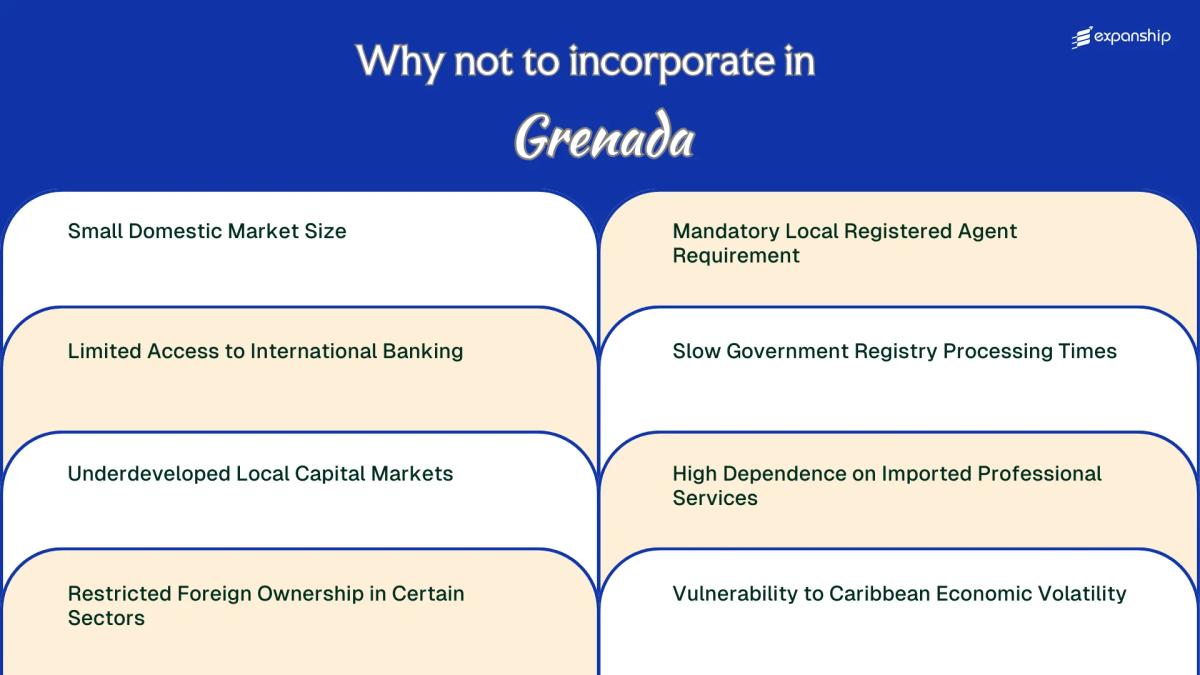
- Grenada's Companies Act imposes a mandatory local registered agent requirement, adding a recurring operational cost and administrative dependency that foreign-incorporated entities cannot bypass.
- With a domestic population of roughly 125,000, the local consumer market is too small to sustain most business models without reliance on export-oriented or regionally diversified revenue streams.
- Foreign investors face restricted ownership thresholds in certain strategic sectors, limiting the degree of control available to non-nationals structuring an active operating entity rather than a passive holding structure.
- Grenada's limited integration into major international banking networks means newly incorporated entities frequently encounter difficulty opening and maintaining correspondent banking relationships, slowing operational deployment.
Grenada operates under an evolving regulatory framework governed primarily by the Companies Act, which sets out the foundational requirements for business registration and corporate compliance. The disadvantages of incorporating in Grenada span operational, financial, and structural categories that foreign investors should assess before committing to a corporate structure here.
Not every drawback applies equally across all business types. A holding company faces a different risk profile than an active trading entity, and sector-specific regulations introduce additional variables depending on your industry.
This article is most relevant to foreign entrepreneurs and small-to-mid-sized businesses considering Grenada as a base for Caribbean operations or as part of a broader international structure.
Small Domestic Market Size
Grenada small domestic market limitations present a structural constraint that affects the long-term commercial viability of businesses incorporated there. With a population of approximately 125,000, the consumer base is simply too small to sustain most product or service-driven business models without external revenue sources.
Scale Constraints on Revenue Generation
Domestic demand across key sectors, including retail, professional services, and consumer goods, remains constrained by the size of the population. A firm that depends on local sales volume to recover incorporation and operational costs will find that threshold difficult to reach, given that GDP per capita figures position Grenada well below larger Caribbean economies.
Structural Ceiling on Growth
The limited consumer base means that market saturation can occur at a scale that would be considered early-stage in larger jurisdictions. For a foreign business owner, this creates a ceiling on organic growth that cannot be resolved through competitive positioning alone.
Foreign business owners should not treat the local market as a viable primary revenue source; any entity incorporated here must be structured from the outset around export-facing or international service delivery models to generate sustainable returns.
Limited Access to International Banking
Grenada international banking access problems are a consistent friction point for foreign-incorporated entities. The country is not classified as a major offshore financial center, and correspondent banking relationships between local institutions and global banks have thinned considerably over the past decade due to de-risking policies applied across the Eastern Caribbean.
Opening a corporate bank account through a Grenadian entity typically requires physical presence, notarized documentation, and extended due diligence periods. For a foreign director managing operations remotely, this creates real delays in becoming operationally functional.
Specific burdens this creates for your business include:
- Waiting weeks or months for account approval while your entity sits dormant and unable to transact
- Being declined by international payment processors that do not recognize Eastern Caribbean-domiciled companies as low-risk counterparts
- Bearing additional compliance costs when correspondent banks require enhanced due diligence on Caribbean-registered firms
- Facing restricted multi-currency account options compared to jurisdictions with established offshore banking infrastructure
The Eastern Caribbean Central Bank oversees monetary policy in the region, but it does not directly resolve the correspondent banking gaps that affect account access for foreign-owned firms.

Company Incorporation in Grenada
Understand the full corporate setup process for a Grenadian entity, including registered agent requirements and documentation obligations.
Underdeveloped Local Capital Markets
Grenada capital markets underdeveloped risks are a structural reality that foreign business owners encounter quickly after incorporation. The Eastern Caribbean Securities Exchange (ECSE), which serves as the regional stock exchange, lists only a small number of instruments, and domestically issued equity or debt products available to operating companies are extremely limited in volume and variety.
For a business that needs growth capital beyond its initial equity injection, the absence of a functioning local capital market means that public fundraising through share issuance or bond offerings is not a practical option. Your firm cannot rely on local institutional investors to absorb a meaningful capital raise.
| Financing Mechanism | Local Availability | Practical Constraint |
|---|---|---|
| Public equity issuance via ECSE | Severely restricted | Thin trading volume; insufficient investor base to absorb new listings |
| Corporate bond market | Effectively absent | No domestic secondary market for corporate debt instruments |
| Venture capital funding | Not established locally | No formal VC ecosystem exists within the jurisdiction |
| Development finance access | Narrow eligibility | Caribbean Development Bank facilities target public-sector borrowers |
Credit from domestic commercial banks remains the primary financing channel, but lending to incorporated entities is typically collateral-heavy and carries interest rates that reflect the limited competition among local lenders. This lack of investment infrastructure forces most foreign-owned firms to source capital entirely from outside the jurisdiction, adding currency conversion exposure and cross-border transfer complexity to what would otherwise be a straightforward corporate funding decision. Companies in sectors ineligible for international development financing face particularly constrained options.
Restricted Foreign Ownership in Certain Sectors
Grenada foreign ownership restrictions across sectors create direct structural barriers for foreign investors that are often underestimated at the planning stage. Under the Alien Landholding Licence Act, non-citizens must obtain a licence before acquiring land, a process that introduces both cost and delay into real estate-linked business ventures.
Beyond land, certain economic activities are informally or formally reserved for Grenadian nationals, particularly in small-scale retail and agricultural sectors. Your business may qualify under corporate law yet still face exclusion or conditional access at the operational level.
The Invest Grenada authority oversees FDI facilitation, but licensing decisions in restricted sectors fall under separate ministerial discretion, adding an unpredictable approval layer that most jurisdictions consolidate into a single authority.
- Alien Landholding Licence required for any foreign acquisition of land or land-tied assets
- Certain retail and agricultural activities carry nationality-based access restrictions
- Ministerial approval is required separately from standard company registration in restricted categories
- Licence fees and processing timelines are not fixed by statute and can vary by application
Even a foreign-owned entity incorporated locally in Grenada does not automatically bypass the Alien Landholding Licence requirement — the corporate veil provides no exemption.
Mandatory Local Registered Agent Requirement
Under the Grenada Companies Act, any company incorporated in Grenada must appoint a local registered agent and maintain a registered office within the country. One of the more concrete Grenada registered agent requirement drawbacks is that this agent cannot be a foreign individual or entity, meaning your business must engage a licensed local professional regardless of where your operations actually occur.
Structural Obligations Imposed on Foreign Entities
As a mandatory local agent Grenada company requirement, this creates an ongoing contractual dependency that generates recurring fees even when the business has no physical activity on the island. The agent must be a qualified person or firm recognized under local law, which limits the pool of available providers and reduces your negotiating position on cost.
Compliance Burden on Passive or Holding Structures
For holding companies or special purpose vehicles with no local commercial activity, the Grenada registered office compliance burden is particularly disproportionate. Annual maintenance of this requirement adds a fixed administrative cost that exists entirely to satisfy a procedural rule rather than serve any operational function of the entity.
Managing Incorporation Compliance Requirements in Grenada
Understand the registered agent obligations and structural compliance requirements that apply to your Grenada company under local law.
Slow Government Registry Processing Times
Grenada company registry processing delays add measurable time costs to incorporation timelines that faster offshore jurisdictions do not impose. The Companies Registry, operating under the Companies Act (Cap. 75), has historically processed incorporation applications manually, which extends wait times beyond what digitally automated registries deliver.
- Manual, paper-based processing at the Companies Registry means your incorporation filing competes in a physical queue, stretching standard turnaround times to several business days or longer rather than the near-instant approvals available in digitally mature jurisdictions.
- The absence of a fully operational online incorporation portal forces applicants to submit documents through a registered agent in person or by courier, adding logistical steps that delay your entity's legal existence.
- Government office capacity constraints in a small public administration mean that peak periods or staff shortages can extend Grenada business registration wait times unpredictably, with no published service-level guarantee to hold the Registry accountable.
- Delays in receiving your Certificate of Incorporation directly postpone your ability to open a corporate bank account, execute contracts, or begin regulated operations.
High Dependence on Imported Professional Services
Grenada professional services import dependence is a structural cost built into incorporating and operating a business on the island. The local pool of attorneys, auditors, tax advisors, and corporate secretaries with specialist international business experience is narrow, which drives up fees and extends turnaround times for routine compliance work.
Firms registered under the Companies Act (Cap. 54) face ongoing obligations — annual returns, audited accounts, statutory filings — that require qualified professionals. When local capacity is insufficient, your business must either pay premium rates to the few available local specialists or engage external consultants from Barbados, Trinidad, or further afield, adding cross-border coordination costs.
The situation is compounded by geography. Air and communication delays between Grenada and major financial centers mean that sourcing external advisory support rarely happens at the speed that time-sensitive transactions or regulatory deadlines demand.
- Forensic accounting and transfer pricing expertise are particularly scarce locally.
- Specialist corporate tax advice typically requires engagement with regional or international firms.
- Legal opinions on cross-border structures are rarely available through domestic practitioners alone.
Hypothetical scenario: A foreign-owned International Business Company requiring an audited financial statement and a cross-border tax opinion could realistically incur USD 8,000–14,000 in combined fees, compared to USD 3,000–6,000 for equivalent services sourced in a more commercially developed Caribbean jurisdiction such as Barbados. This differential reflects the cost of importing professional expertise rather than sourcing it locally.
Vulnerability to Caribbean Economic Volatility
Caribbean economic volatility Grenada business risks are closely tied to two structural realities: the island's heavy dependence on tourism revenue and its geographic exposure to Atlantic hurricanes. Tourism typically accounts for a significant share of GDP, meaning a single external shock — a global downturn, a regional health event, or a major storm — can sharply contract the consumer and services economy your business may depend on.
Grenada is a member of the OECS and uses the Eastern Caribbean Dollar (XCD), pegged to the USD at 2.70. While the peg provides nominal exchange rate stability, it removes any monetary policy flexibility, so the government cannot devalue to restore competitiveness during a downturn, and the fiscal adjustment falls entirely on public spending.
Hurricane Ivan in 2004 caused damage estimated at approximately 200% of GDP. That single event illustrates how physical destruction can wipe out years of accumulated business infrastructure with no equivalent recovery mechanism available to foreign-owned entities.
- Recovery timelines following major storm events typically extend several years.
- Business interruption insurance coverage in the region is limited and expensive to source for foreign firms.
- Supply chains for imported inputs face compounded disruption when regional ports and logistics networks are simultaneously affected.
Foreign businesses incorporated in Grenada with no physical presence or local client base are not insulated from this volatility — regional banking disruptions, port closures, and OECS-wide contractionary periods directly affect operational continuity regardless of where your end customers are located.
How to Overcome These Incorporation Challenges
Overcoming Grenada incorporation challenges requires structural preparation rather than reactive problem-solving. Foreign firms that address banking access, ownership restrictions, and registry timelines before incorporation tend to encounter fewer compliance gaps.
- Pre-screen international banks against the CFATF compliance standards that influence correspondent banking relationships with Grenadian institutions.
- Confirm sector-specific foreign ownership limits under the Companies Act (Cap. 42) before selecting your business activity and entity type.
- Appoint a locally qualified registered agent listed with the Grenada Registrar of Companies prior to filing incorporation documents.
- Submit all formation documents with verified apostilles to reduce processing delays at the Corporate Affairs and Intellectual Property Office (CAIPO).
- Structure capital contributions through established correspondent banking channels to reduce exposure to regional financial volatility.
- Source legal and accounting professionals with cross-border Caribbean credentials to offset reliance on imported professional services.
These steps operate within a regulatory environment governed primarily by the Companies Act and overseen by CAIPO. Addressing each structural requirement at the pre-incorporation stage reduces the likelihood of procedural delays and compliance shortfalls.
Grenada's Overall Investment Value
Grenada investment risks vs opportunities sit on opposite ends of a clearly defined spectrum. The structural constraints covered throughout this blog are real and measurable, yet the jurisdiction retains a credible standing as a mid-tier offshore and regional incorporation destination under the Companies Act (Cap. 55) framework.
| Pros | Cons |
|---|---|
| No corporate tax on foreign-sourced income for qualifying international business entities | The domestic market of approximately 125,000 people limits locally generated revenue |
| Grenada's CBI program through the National Transformation Fund offers a recognized second residency pathway | Correspondent banking relationships remain difficult to establish for newly registered companies |
| English common law legal system provides a familiar framework for contract enforcement | Government registry processing times can extend incorporation timelines unpredictably |
| Regulated sectors such as tourism and financial services offer defined entry points for foreign capital | Foreign ownership restrictions apply in specific sectors, limiting full equity control |
| Proximity to larger Caribbean markets supports regional trade activity | Local capital markets are underdeveloped, restricting access to debt and equity financing within the jurisdiction |
The Grenada business environment overall assessment points toward selective suitability. Businesses oriented toward offshore structuring, regional trade, or CBI-linked activity will find more alignment here than those requiring deep local market access or sophisticated domestic financial infrastructure.
Compliance Services for Companies in Grenada
Maintain your Grenada company's good standing with annual filings, registered agent obligations, and regulatory reporting under the Companies Act framework.
Conclusion
Grenada's position as an incorporation destination carries a specific set of structural limitations that any prospective registrant should factor into decision-making. The Grenada company formation drawbacks summary points to three areas with the most practical weight: constrained access to correspondent banking, the slow processing timelines at the Companies Registry, and the island's exposure to Caribbean-wide economic disruptions. These are not peripheral concerns — they affect day-to-day operations, capital access, and long-term business continuity. Structural limitations like these require deliberate planning before and after registration, not adjustments made after problems arise.
Expanship's Grenada Company Formation Support
Expanship's Grenada company formation support is designed to reduce the operational burden that comes with incorporating under the Companies Act (Cap. 77) and maintaining compliance with the Grenada Financial Intelligence Unit's requirements, among other obligations covered throughout this blog. Expanship does not eliminate these structural realities, but it does handle the procedural weight so your business can move forward without unnecessary delays.
From initial registration through to ongoing compliance, the scope of support covers the following:
- Your company registration and all supporting document preparation are handled end to end.
- A qualified registered agent and local office address are provided to satisfy mandatory requirements.
- All government filings are submitted directly, with liaison to the relevant regulatory bodies on your behalf.
- Post-incorporation compliance obligations are monitored and managed on a continuing basis.
- Banking introduction assistance is available to help your entity access suitable financial institutions.
- Tax registration and coordination with local authorities are included as part of the onboarding process.
Reach out to Expanship Grenada to discuss your incorporation requirements.
Frequently Asked Questions (FAQ)
Restrictions are sector-specific, not blanket. Under Grenada's Investment Policy framework, foreign investors face ownership limitations in areas such as retail trade, certain agricultural activities, and businesses considered strategic to national interests. Full foreign ownership is generally permitted in the sectors Grenada actively promotes for investment, such as tourism and financial services.
A Grenada-registered company is legally required to maintain a local registered agent under the Companies Act. Operating without one puts the entity in breach of its statutory obligations, which can result in administrative penalties and jeopardize the company's good standing with the Grenada Companies Registry. Reinstatement after a struck-off status involves additional fees and processing delays.
Compared to jurisdictions like the British Virgin Islands or Cayman Islands, which have heavily digitized and expedited their registry processes, Grenada's Companies Registry operates at a noticeably slower pace for both incorporation filings and post-incorporation amendments. Turnaround times that take days elsewhere can stretch to several weeks in Grenada, particularly for filings requiring manual review.
There is no fixed figure, but the cost premium is material. Because Grenada has a shallow local market for specialized legal, accounting, and corporate advisory professionals, many businesses source these services from providers based in Barbados, Trinidad, or further abroad, which introduces international billing rates plus travel or coordination costs. For smaller entities, this overhead can represent a disproportionate share of annual compliance expenditure.
Grenada's economy is heavily dependent on tourism and remittances, both of which are highly sensitive to external shocks such as hurricanes, global recessions, and regional political instability. This concentration risk means that a company whose revenues depend on local economic activity faces revenue disruption during events that are largely outside its control. The 2017 passage of Hurricane Maria, which devastated neighboring Dominica, illustrated how quickly regional conditions can deteriorate.
Unlike some offshore jurisdictions that offer a formal same-day or 24-hour expedited registry service for an additional fee, Grenada does not operate a well-established fast-track incorporation track. Processing timelines are largely determined by the Companies Registry's internal workload and staffing, which means even straightforward applications can experience delays without any formal mechanism to accelerate them. Planning your incorporation timeline with a buffer of several weeks is advisable.
Legal Disclaimer
The information provided in this article is for general informational purposes only and does not constitute legal, tax, or professional advice. While we strive to ensure the accuracy and timeliness of the content, laws and regulations are subject to change, and the application of laws can vary widely based on specific facts and circumstances.
Readers should not act upon this information without seeking professional counsel tailored to their individual situation. Expanship and its authors disclaim any liability for actions taken or not taken based on the content of this article.
For specific advice regarding your business setup, compliance requirements, or any legal matters, please consult with qualified legal and tax professionals in the relevant jurisdiction.