
Key Takeaways
- Gabon's corporate tax rate imposes a significant fiscal burden on incorporated entities, reducing after-tax returns for foreign investors relative to more competitive jurisdictions in the region.
- Registration through the Agence Nationale de Promotion des Investissements (ANPI) introduces procedural delays at the formation stage that extend the timeline before a foreign entity can lawfully commence operations.
- Despite operating under the OHADA supranational commercial law framework, Gabon maintains a limited network of double taxation treaties, exposing cross-border transactions and profit repatriation to the risk of double taxation without treaty relief.
- Foreign investors in certain sectors face ownership restrictions that cap equity participation, constraining the degree of operational control available to non-Gabonese shareholders.
Gabon operates under an evolving regulatory framework shaped by OHADA (Organisation pour l'Harmonisation en Afrique des Droits des Affaires) supranational commercial law, layered with national-level requirements enforced by bodies such as the Agence Nationale de Promotion des Investissements (ANPI). The disadvantages of incorporating in Gabon span procedural, fiscal, financial, and legal dimensions. Understanding Gabon's commercial code helps clarify which obligations apply at formation versus ongoing compliance.
Not every obstacle will affect your business equally. The drawbacks of setting up a company in Gabon carry different weight depending on your sector, chosen entity structure, and whether operations involve foreign capital or imported services.
This article is most relevant to foreign investors and internationally operating businesses considering equity participation, branch registration, or subsidiary formation in the country for the first time.
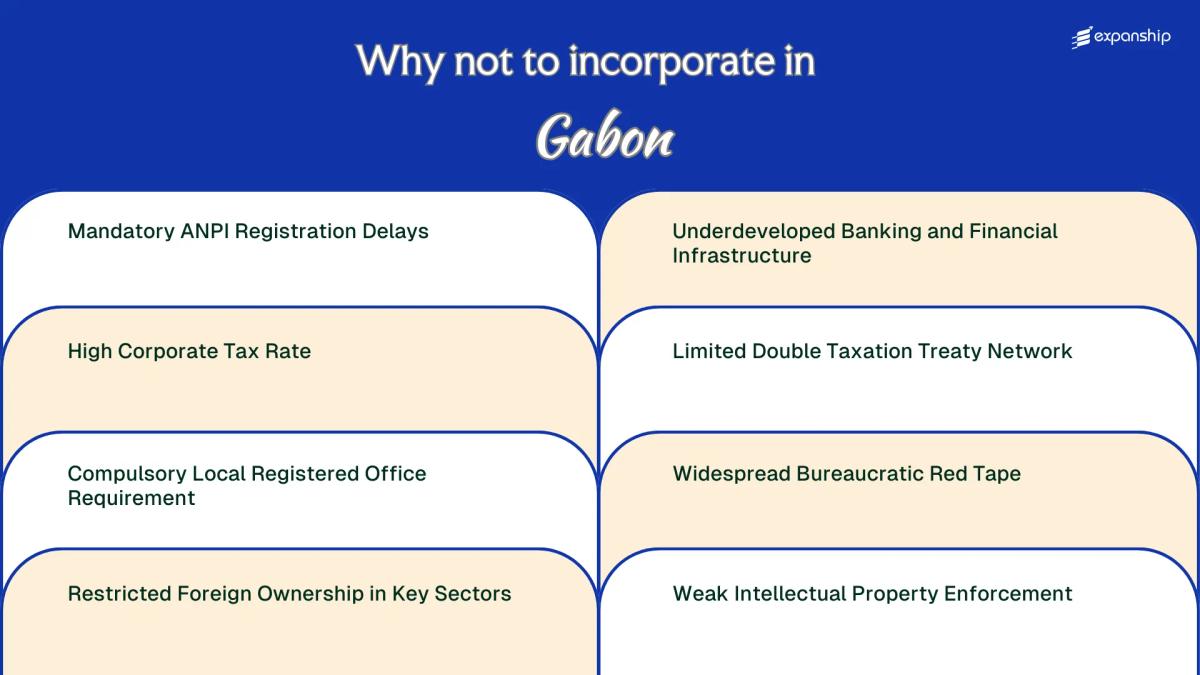
Mandatory ANPI Registration Delays
ANPI registration delays in Gabon represent one of the most immediate operational obstacles for foreign businesses seeking to establish a local entity. Processing timelines that should be measured in days frequently extend into weeks or months.
Structural Bottlenecks at the ANPI
The Agence Nationale de Promotion des Investissements serves as the single-window authority for company registration, yet its internal coordination with bodies such as the Direction Générale des Impôts and the Caisse Nationale de Sécurité Sociale creates compounding delays when any linked administration falls behind. Your business cannot begin lawful operations until all approvals from these interconnected institutions are confirmed, meaning a bottleneck in one agency stalls the entire incorporation.
Physical documentation requirements add further friction, as certified translations, notarised instruments, and apostilled foreign records must each be submitted in prescribed formats before the file progresses.
What Delayed Registration Costs Your Business
Every week spent waiting on administrative clearance is a week your entity cannot open a corporate bank account, sign contracts, or hire staff under a formal employment framework. This gap generates direct financial exposure through extended reliance on costlier interim structures.
Online processing remains limited in scope, so in-person follow-up is frequently required, placing overseas principals at a practical disadvantage.
Until ANPI issues final registration confirmation, your company has no legal standing in Gabon, and any commercial activity conducted during that window carries regulatory and contractual liability.
High Corporate Tax Rate
Gabon applies a standard corporate income tax rate of 35%, one of the higher rates in the Central African Economic and Monetary Community (CEMAC) region. For a foreign-owned entity operating with already thin margins, this rate directly reduces retained earnings and slows capital reinvestment.
The applicable legal framework is the General Tax Code (Code Général des Impôts), which also imposes a minimum flat tax — the impôt minimum forfaitaire — even when a company records a loss. Your business pays regardless of profitability.
This combination creates compounding pressure on early-stage operations:
- Pre-revenue periods still trigger minimum tax obligations, draining startup capital before income is generated
- The 35% rate applied to distributed profits reduces the effective return for foreign shareholders repatriating dividends
- Companies in extractive or concession-based sectors may face additional sector-specific fiscal levies, further inflating the total tax burden
- Compliance with CEMAC-aligned transfer pricing rules adds professional advisory costs that smaller foreign firms cannot absorb easily
A limited exemption framework exists under the Investment Charter, but qualifying conditions are narrow and approvals are not guaranteed.

Company Incorporation in Gabon
Understand the full cost structure and tax obligations before registering your company in Gabon.
Compulsory Local Registered Office Requirement
Gabon's registered office requirement restrictions add a layer of operational cost that many foreign investors underestimate before incorporation. Under the OHADA Uniform Act on Commercial Companies, every entity incorporated in Gabon must maintain a physical registered address within the country. A virtual address or a foreign mailing address does not satisfy this obligation.
This means your business must secure a physical premises in Gabon before or during the incorporation process. That requirement generates immediate costs: local office leases in Libreville, where most commercial activity is concentrated, are not inexpensive relative to the market size.
| Requirement | Detail | Implication for Foreign Entity |
|---|---|---|
| Address type accepted | Physical premises only | Virtual offices do not satisfy legal threshold |
| Jurisdiction of address | Must be within Gabon | Foreign or regional addresses invalid |
| Primary commercial city | Libreville | Limited alternatives outside the capital |
| Proof required at incorporation | Lease agreement or title deed | Requires upfront commitment before entity is operational |
The compulsory local office Gabon company rule also creates an ongoing administrative obligation. You must keep the registered address current with the Centre de Formalités des Entreprises (CFE) and update any change through a formal modification procedure, which incurs fees and processing time.
For a foreign firm testing the market, this Gabon legal address incorporation drawback means capital is committed to physical presence before revenue is generated.
Restricted Foreign Ownership in Key Sectors
Foreign ownership restrictions in Gabon apply across several sectors that foreign investors tend to prioritize, and these limitations can materially affect how a business is structured before it even begins operating.
Under Gabonese law, certain strategic industries require mandatory local participation. The extractive sector, forestry, and parts of the telecommunications industry are subject to rules that either cap foreign equity or require the state — often through entities such as the Gabonese state holding company — to retain a defined ownership share. This directly reduces your ability to hold full operational control over the entity.
The Gabonese Investment Charter and sector-specific legislation govern these restrictions. Foreign firms cannot simply negotiate around these thresholds; they impose fixed structural conditions on any inbound investment.
- Foreign equity caps in extractive and forestry sectors restrict majority ownership for non-Gabonese investors
- State participation requirements may apply regardless of the size or scale of the foreign investment
- Sector-specific legislation overrides general company law where conflicts arise
- Joint venture arrangements with local partners may be legally mandated, not optional
- Approval from sector regulators is required in addition to standard ANPI registration
Restrictions are generally more stringent in sectors tied to natural resources, where the state has historically retained strategic stakes.
Gabon's forestry sector prohibits the export of unprocessed logs, meaning foreign investors in timber must invest in local transformation infrastructure as a legal condition, not a business choice.
Underdeveloped Banking and Financial Infrastructure
Gabon's banking infrastructure limitations create friction from the moment a foreign entity attempts to open a corporate account. Correspondent banking relationships between Gabonese banks and major international institutions are limited, which means cross-border transfers frequently face delays, higher transaction fees, and manual processing requirements that affect day-to-day treasury operations.
Structural Gaps in the Banking Sector
Gabon's banking sector is supervised by the Central African Banking Commission (COBAC), which operates across the CEMAC zone, yet the domestic implementation of banking services remains uneven. Foreign firms often find that local banks offer a narrow range of products, with limited access to trade finance, multi-currency accounts, or structured credit facilities that would be standard in more developed financial markets.
This directly constrains working capital management, as your business cannot rely on local banking infrastructure to support payroll in foreign currencies or facilitate rapid outbound payments to foreign suppliers.
Implications for Foreign Business Operations
Underdeveloped financial services in Gabon compound the difficulty of repatriating profits. Capital transfers are subject to CEMAC foreign exchange regulations, and executing them through institutions with weak correspondent networks adds both cost and processing time.
Digital banking penetration among business-oriented clients remains low, meaning that many financial transactions still depend on physical branch presence, which is a structural inefficiency that affects operational speed for any foreign-owned company.
Support for Managing Banking and Financial Challenges in Gabon
Operating in Gabon's constrained banking environment requires careful planning around account setup, foreign exchange compliance, and cross-border transaction structures. Our team can help you assess the practical financial implications before you commit to incorporating.
Limited Double Taxation Treaty Network
Gabon's double taxation treaty limitations present a direct structural cost for foreign businesses operating across multiple jurisdictions. The country's DTT network is among the thinnest in Central Africa, leaving most cross-border income flows unprotected from dual taxation.
- Without a bilateral tax treaty in place between your home country and Gabon, dividends, royalties, and service fees paid out of the country are subject to withholding taxes that cannot be offset against your domestic tax liability.
- Gabon's treaties are largely confined to France and a small number of CEMAC member states, meaning investors from the UK, US, Germany, or Asia-Pacific have no treaty relief available to them.
- Foreign firms structured through holding companies in treaty-friendly jurisdictions still face exposure because Gabonese tax authorities can apply anti-avoidance provisions under the CEMAC tax framework to challenge artificial routing arrangements.
- The absence of treaty protection inflates the effective tax burden on repatriated profits, compressing returns for foreign shareholders beyond what the statutory corporate rate alone would suggest.
Widespread Bureaucratic Red Tape
Bureaucratic red tape in Gabon business operations extends well beyond the ANPI registration process. Multiple ministries retain parallel approval authority over commercial activities, meaning a single transaction or operational change can require sign-off from several government bodies simultaneously.
Procedures that should be administrative in nature, such as obtaining sector-specific operating permits or renewing business licenses, frequently involve in-person submissions, notarized documentation, and extended waiting periods with no formal resolution timeline. Your firm has limited recourse when deadlines are missed by the issuing authority.
The Direction Générale des Impôts manages tax filings, while the Caisse Nationale de Sécurité Sociale handles social contributions, and each institution maintains separate submission requirements. Fragmentation across agencies means compliance is not a single process — it is a recurring coordination burden.
- Obtaining statutory approvals often requires physical presence at government offices, which increases operational costs for foreign-owned entities without local management.
- Document authentication requirements through notarial channels add time and expense to routine administrative tasks.
A foreign-owned entity that requires permits from three separate ministries before commencing operations could realistically face a pre-launch administrative period of three to six months, during which fixed costs accumulate without revenue generation.
Weak Intellectual Property Enforcement
Weak intellectual property enforcement in Gabon creates direct exposure for foreign businesses that rely on proprietary assets, including trademarks, patents, and trade secrets, to generate commercial value. The country is a member of the African Intellectual Property Organization (OAPI), which administers IP registrations across 17 member states under the Bangui Agreement. Registration through OAPI does not, however, translate into effective on-the-ground protection.
Enforcement of registered rights depends on Gabonese courts and national customs authorities, both of which have limited institutional capacity for IP disputes. Counterfeiting and unauthorized use of marks can persist without meaningful legal recourse, since civil litigation in this jurisdiction is slow and outcomes are difficult to predict.
For technology companies, franchisors, or any firm transferring proprietary processes to a local entity, this gap between registration and enforcement means your legal ownership provides weaker commercial protection than the paperwork implies.
- Trademark disputes require domestic litigation rather than an OAPI-level remedy
- Customs enforcement against infringing imports is inconsistently applied
- Criminal IP enforcement actions are rare in practice
If your business model depends on licensing or brand exclusivity, registration through OAPI alone does not guarantee that infringing parties operating locally will face any enforceable legal consequence.
Overcoming Incorporation Challenges in Gabon
Overcoming Gabon incorporation challenges requires structural preparation before the company formation process begins. No single workaround eliminates all friction, but deliberate planning reduces exposure to the most consequential barriers.
- Research sector-specific foreign ownership caps under the Gabonese Investment Charter before selecting your business activity and corporate structure.
- Prepare notarised and apostilled incorporation documents in advance to reduce delays at ANPI registration.
- Elect a corporate tax structure that accurately reflects your anticipated profit margins, given the 30% corporate income tax rate.
- Secure a compliant physical registered office address in Gabon prior to submitting incorporation filings.
- Open a business bank account with an established regional institution early, accounting for the limited correspondent banking options available locally.
- Assess your home jurisdiction's bilateral tax treaty status with Gabon before finalising your holding structure.
These steps address the most structurally significant friction points, but they operate within a regulatory environment where administrative timelines and enforcement consistency remain variable. Foreign businesses should factor that variability into operational planning from the outset.
Gabon's Business Potential in Perspective
Gabon presents a credible incorporation destination for foreign businesses oriented toward natural resources, regional trade, or Central African market access. The disadvantages covered in this blog are real and measurable, but they exist within a jurisdiction that maintains a functioning legal framework under OHADA and holds membership in CEMAC.
| Pros | Cons |
|---|---|
| OHADA membership provides a standardized commercial legal framework shared across 17 African states | ANPI registration processes are subject to delays that extend the time before a company can legally operate |
| Gabon's oil revenues support relatively stable public finances compared to many regional peers | The corporate income tax rate of 35% places a significant burden on foreign-owned entities |
| Membership in CEMAC facilitates cross-border trade across six Central African economies | Restricted foreign ownership in strategic sectors limits the scope of permissible investment structures |
| The country's small population and urbanization rate produce a concentrated consumer base | The double taxation treaty network is limited, increasing exposure to cross-border tax inefficiencies |
| A mandatory local registered office requirement is a known compliance cost that can be planned for | Weak intellectual property enforcement creates commercial risk for firms holding proprietary assets |
Gabon's banking sector remains underdeveloped relative to the transactional needs of internationally active businesses. Bureaucratic red tape adds operational friction that affects timelines across licensing, permits, and public administration.
Corporate Compliance Services in Gabon
Maintaining good standing in Gabon involves recurring obligations under OHADA regulations, CEMAC directives, and national tax law. This service covers the compliance requirements applicable to foreign-owned entities registered in Gabon.
Conclusion
Gabon presents a defined set of structural barriers for foreign businesses, and the cons of incorporating in Gabon are not incidental — they reflect systemic conditions within the country's regulatory and financial environment. ANPI registration delays, a corporate tax rate that reduces post-tax returns, and a limited treaty network that leaves cross-border income exposed all carry material consequences for how a business operates and what it retains. Structural engagement with the right advisory support remains the most direct path through these conditions.
Expanship's Gabon Expansion Support
Gabon business expansion support services from Expanship are structured around the specific compliance demands your business faces in this jurisdiction. From ANPI registration timelines to the requirements imposed by the Direction Générale des Impôts on tax filings, Expanship's team works to reduce the administrative weight these obligations place on your operations. The goal is to keep your entity moving forward without the delays that derail many foreign entrants.
Expanship offers a practical range of corporate services tailored to the Gabonese regulatory environment.
- Your company's registration documents are prepared and filed in accordance with local requirements.
- A registered agent and physical office address in Gabon are provided to satisfy the mandatory local presence rule.
- Expanship liaises directly with government bodies and regulatory authorities on your behalf.
- Ongoing post-incorporation compliance is managed to keep your firm in good standing.
- Banking introductions are facilitated to help your business establish a local account.
- Tax registration and local authority liaison are handled to ensure your obligations are met from the start.
Reach out through Expanship Gabon to discuss your incorporation requirements.
Frequently Asked Questions (FAQ)
The standard corporate income tax rate of 30% applies broadly to companies operating in Gabon, though entities that qualify under the Investment Charter may access temporary exemptions or reduced rates during an approved investment period. Outside of those negotiated arrangements, most foreign-owned firms will face the full rate, which sits above the sub-Saharan average and directly reduces after-tax returns. The qualifying criteria for preferential treatment are neither automatic nor straightforward for new entrants to meet.
Restrictions on foreign ownership are concentrated in sectors considered strategically sensitive, including natural resources and certain service industries, where Gabonese nationals or the state may be required to hold a minimum equity stake. In some cases, the restriction affects controlling ownership; in others, it extends to the overall structure of shareholding. The exact thresholds depend on the sector and the applicable regulatory framework, so a firm must conduct sector-specific due diligence before committing to a structure.
Gabon has signed relatively few double taxation agreements, which means income repatriated to most countries will not benefit from treaty-reduced withholding tax rates. Dividends, royalties, and service fees paid to foreign parent companies are therefore subject to domestic withholding rates with no treaty offset, increasing the overall tax cost of operating through a Gabonese subsidiary. For businesses headquartered in jurisdictions without a bilateral treaty with Gabon, this creates a structural tax inefficiency that cannot be resolved through entity design alone.
Gabon is a member of the Organisation Africaine de la Propriété Intellectuelle (OAPI), which provides a regional registration framework, but domestic enforcement of IP rights remains inconsistent and underfunded. Registration through OAPI does not guarantee that infringement will be pursued or prosecuted effectively by local authorities. A foreign firm relying on proprietary processes, software, or brand identity faces elevated exposure, particularly if it lacks the resources to pursue civil remedies independently through Gabon's court system.
Maintaining a physical registered office in Gabon is a legal requirement under the OHADA Uniform Act on Commercial Companies, and it cannot be satisfied by a virtual address or a foreign address. Failure to comply can result in the company's registration being challenged and may create liability for directors or managers named in the incorporation documents. The ongoing cost of a compliant local office adds a fixed operational expense that foreign businesses must factor into their entity maintenance budget from the outset.
Gabon's administrative processes are broadly comparable in difficulty to several other OHADA-member states, but the combination of slow inter-agency coordination, inconsistent document requirements, and limited digital processing infrastructure places it toward the more challenging end of the regional spectrum. Businesses that have incorporated in Senegal or Côte d'Ivoire, where e-government reforms have progressed further, often find Gabon's manual, in-person procedures more disruptive. The gap is less about legal complexity and more about administrative execution.
Gabon's banking sector is limited in both the number of institutions and the sophistication of services available to corporate clients, which creates practical friction around opening accounts, processing international transfers, and accessing trade finance. Some foreign-owned entities report extended delays in corporate account approval, which can stall post-incorporation operations even after registration is complete. Firms dependent on fast capital movement or multi-currency treasury management will find these constraints genuinely limiting rather than a minor inconvenience.
Legal Disclaimer
The information provided in this article is for general informational purposes only and does not constitute legal, tax, or professional advice. While we strive to ensure the accuracy and timeliness of the content, laws and regulations are subject to change, and the application of laws can vary widely based on specific facts and circumstances.
Readers should not act upon this information without seeking professional counsel tailored to their individual situation. Expanship and its authors disclaim any liability for actions taken or not taken based on the content of this article.
For specific advice regarding your business setup, compliance requirements, or any legal matters, please consult with qualified legal and tax professionals in the relevant jurisdiction.