
Key Takeaways
- Membership in the CEMAC free trade zone gives Gabon-registered businesses preferential access to cross-border commerce across six Central African member states without the tariff friction that non-member entities face.
- The OHADA Uniform Acts provide a standardized, supranational commercial legal framework that reduces the risk of regulatory unpredictability that is common in single-jurisdiction legal systems across the region.
- Foreign investors benefit from bilateral investment treaty protections that shield capital and repatriated returns from arbitrary state action, a material advantage for capital-intensive operations in extractive or export sectors.
- Gabon's Atlantic coastline and formal corporate structures — including the Société Anonyme — position export-oriented businesses to move goods through established maritime routes while operating under a governance framework with defined shareholder and liability rules.
Gabon is an independent republic on the Atlantic coast of Central Africa, bordered by Cameroon, the Republic of Congo, and Equatorial Guinea. The country operates a standard corporate tax regime rather than a zero-tax or offshore model, with fiscal obligations governed by the Direction Générale des Impôts. Company registration falls under the oversight of the Centre de Développement des Entreprises, which administers the formal incorporation process. Foreign businesses entering the market most commonly do so through a Société Anonyme or Société à Responsabilité Limitée.
On foreign ownership, the general legal framework permits foreign nationals to hold equity in locally incorporated entities, and the government has signaled openness to foreign direct investment across several sectors. Specific conditions may apply depending on the industry, so verification against current regulations is advisable.
The country applies a territorial dimension to certain aspects of its tax treatment, though the full corporate tax structure is detailed separately. This article examines the principal advantages that the benefits of incorporating in Gabon present for internationally oriented businesses.
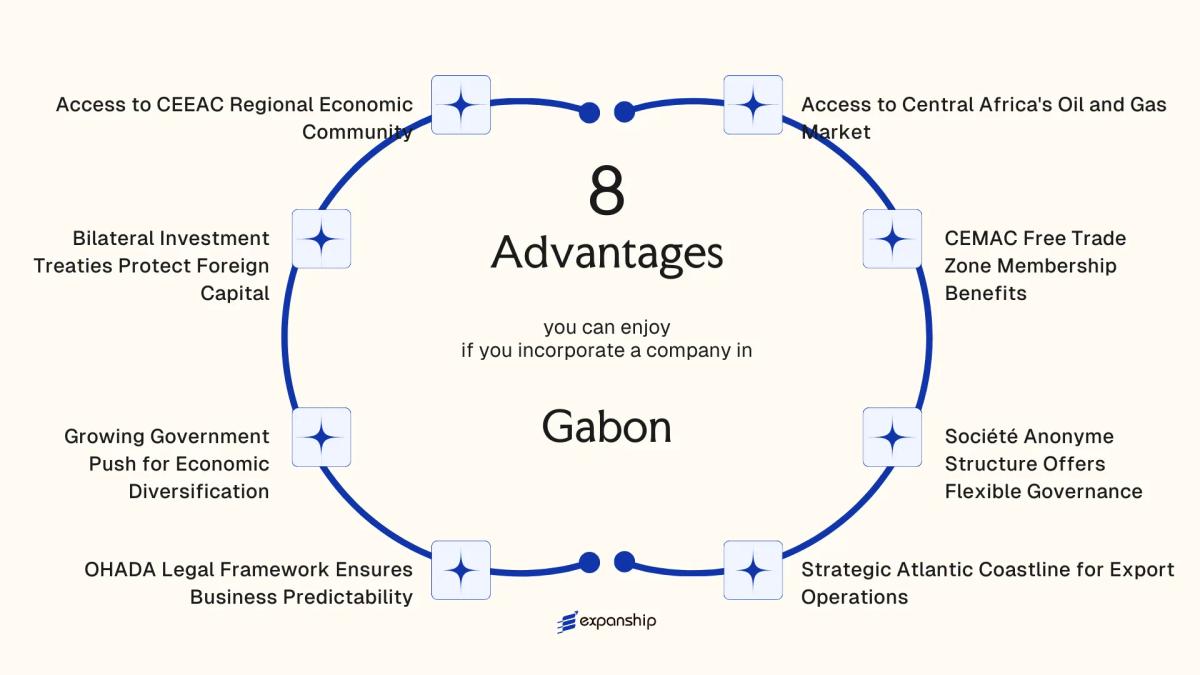
Access to Central Africa's Oil and Gas Market
Gabon oil and gas market access for investors is one of the most concrete advantages of establishing a corporate presence in the country. Oil production has defined the national economy since the 1970s, and the regulatory architecture built around it remains accessible to foreign-incorporated entities.
A Sector With Defined Legal Entry Points
The hydrocarbon sector operates under the framework of the Gabonese Petroleum Code, which governs exploration permits, production sharing contracts, and operator licensing. Your business can participate through production sharing agreements with the state hydrocarbon company, Gabon Oil Company (GOC), which structures the commercial terms for foreign participation.
What Foreign Businesses Can Access
Upstream activity remains the primary entry point for foreign capital in Gabon's petroleum industry, though service and supply chain companies also operate under established procurement frameworks. The Direction Générale des Hydrocarbures oversees licensing, giving your firm a defined regulatory counterpart rather than a fragmented approval process.
A locally incorporated entity can contract directly with GOC and apply for operator licenses under the Petroleum Code, positioning your firm within the formal legal chain of the sector.
CEMAC Free Trade Zone Membership Benefits
Gabon's membership in the Communauté Économique et Monétaire de l'Afrique Centrale (CEMAC) creates a defined trade structure that foreign businesses can use to access a multi-country regional market. CEMAC free trade zone benefits for businesses operating in the region include the elimination of customs duties on qualifying goods traded between the six member states: Gabon, Cameroon, the Central African Republic, Chad, the Republic of Congo, and Equatorial Guinea.
For a company incorporated in Gabon, this means goods produced or processed locally can move across member state borders without attracting import tariffs under the CEMAC customs union framework. That removes a direct cost layer for manufacturers, distributors, and processors targeting regional buyers.
The shared currency, the CFA franc (XAF), issued by the Banque des États de l'Afrique Centrale (BEAC), further reduces transactional friction. Currency conversion costs and exchange rate exposure, common in multi-country trade, do not apply within this monetary zone.
Why this structure favours foreign-owned entities incorporated in Gabon:
- No tariff barriers mean regional pricing remains competitive without relying on subsidies
- A single currency across six markets simplifies invoicing, contracts, and repatriation
- CEMAC's harmonised customs code reduces administrative variation between member states
- Regional incorporation through Gabon gives access to a combined population exceeding 60 million
Qualification for intra-CEMAC preferential treatment generally depends on rules of origin criteria, which requires that goods meet a defined local content or processing threshold.

Company Incorporation in Gabon
Incorporate your business in Gabon and access the CEMAC regional market through a compliant legal structure.
Société Anonyme Structure Offers Flexible Governance
Under the OHADA Uniform Act on Commercial Companies and Economic Interest Groups (AUSCGIE), the Société Anonyme (SA) is the primary vehicle for large-scale foreign investment in Gabon. It requires a minimum share capital of XAF 10 million, and shares can be distributed among an unlimited number of shareholders, giving investors meaningful flexibility in how ownership is structured from the outset.
Governance arrangements within an SA can take one of two forms: a single-tier board (conseil d'administration) or a two-tier structure separating management from supervisory functions. This distinction matters because it allows your business to align internal governance with the expectations of foreign parent companies, institutional co-investors, or development finance institutions that may require defined oversight mechanisms before committing capital.
| Governance Feature | Single-Tier Board | Two-Tier Structure |
|---|---|---|
| Decision-making body | Board of Directors | Management Board + Supervisory Board |
| Minimum directors | 3 | 1 per board |
| Shareholder approval required | For major resolutions | For major resolutions |
| Suited for | Closely held entities | Multi-investor structures |
Shares in an SA are freely transferable by default, unless the articles of association impose restrictions. That transferability makes equity restructuring, bringing in new partners, or staging exits considerably more straightforward than in a private limited structure. Because the AUSCGIE is a supranational instrument, its provisions apply uniformly, so the governance rules your legal team reviews in the text of the Act are the rules that govern the entity in practice.
Strategic Atlantic Coastline for Export Operations
Gabon Atlantic coastline export business advantages are grounded in geography that few Central African nations can replicate. The country's 885-kilometre Atlantic seaboard provides direct ocean access without transit dependency on neighbouring states, which reduces logistical costs and delivery timelines for goods moving to European, American, and Asian markets.
Port Gentil and the Port of Libreville function as the two primary commercial gateways. Port Gentil, in particular, handles significant volumes of petroleum and timber cargo, making it the operational hub for commodity exporters. Your business benefits from established port infrastructure rather than building logistics chains from scratch.
Owning or operating a company registered under Gabonese commercial law means your firm can contract directly with port operators and access freight services without requiring a local intermediary in most cases.
Keep these points in mind when structuring export operations:
- Confirm your product category falls within permitted export classifications under Gabon's customs code
- Verify whether your goods require an export licence from the Direction Générale des Douanes
- Account for port handling tariffs, which vary by cargo type at each facility
- Timber exports are subject to specific domestic transformation requirements before export under national forestry regulations
Gabon banned the export of raw logs in 2010, which means timber businesses incorporated there must invest in local processing, creating a value-added manufacturing obligation most investors do not anticipate.
OHADA Legal Framework Ensures Business Predictability
One of the substantive OHADA legal framework benefits for investors in Gabon is the removal of legal ambiguity across core business functions. As a member state of the Organisation pour l'Harmonisation en Afrique des Affaires (OHADA), Gabon operates under a set of Uniform Acts that govern company formation, contracts, securities, insolvency, and arbitration uniformly across all 17 member states. Foreign investors are not subject to an untested domestic commercial code; instead, they operate under legislation that has been interpreted and applied consistently across the region.
A Single Legal Reference Point for Commercial Activity
The OHADA Uniform Acts, including the Acte Uniforme relatif au Droit des Sociétés Commerciales et du Groupement d'Intérêt Économique (AUSCGIE), carry direct legal force in Gabon without requiring separate domestic implementation. This means contractual obligations, shareholder rights, and corporate governance structures are defined by the same instrument your legal counsel can review in Paris, Dakar, or Douala.
Disputes arising from commercial agreements may be referred to the Common Court of Justice and Arbitration (CCJA), OHADA's supranational court. That access to a recognized regional arbitration mechanism gives foreign firms a neutral, enforceable forum for resolving disagreements without relying exclusively on local courts.
Consistency Across the Company Lifecycle
Gabon OHADA business law advantages extend beyond formation. Accounting standards, enforcement procedures, and insolvency rules all follow OHADA's harmonized framework, meaning your compliance obligations remain predictable as the business scales.
Structure Your Gabon Incorporation With Legal Clarity
Understand how OHADA-backed regulations apply to your specific company structure in Gabon and what compliance looks like from day one.
Growing Government Push for Economic Diversification
Gabon economic diversification opportunities for investors have expanded significantly following the government's adoption of the Plan Stratégique Gabon Emergent (PSGE), a long-term development framework targeting sectors outside hydrocarbons. Oil revenues have historically accounted for the majority of export earnings, but deliberate policy shifts now direct public investment and regulatory attention toward agriculture, timber processing, mining, and tourism.
- The Special Economic Zones program, administered through GABON SPECIAL ECONOMIC ZONE S.A. (GSEZ), grants qualifying firms reduced corporate tax rates, customs exemptions on imported equipment, and VAT relief during the operational startup phase. For a foreign entity, this translates to a materially lower cost of entry compared to operating under the standard fiscal regime.
- The government has prioritized domestic value-added processing over raw material exports. A ban on unprocessed log exports, introduced in 2010, created a structural opening for firms investing in downstream timber and wood product manufacturing within the country.
- Incentives under the Investment Charter (Law No. 001/2016) include profit repatriation guarantees and protection against discriminatory tax treatment, which gives non-oil sector investors a defined legal basis for their fiscal expectations rather than relying on discretionary administrative practice.
- Diversification policy has increased the number of bankable projects in sectors that previously received limited foreign participation, expanding the practical range of business activities available to your company upon incorporation.
Bilateral Investment Treaties Protect Foreign Capital
Gabon bilateral investment treaties foreign capital protection forms a concrete legal layer that sits above domestic policy risk. The country has concluded BITs with several nations, including France, Germany, and the United States, each providing protections that domestic legislation alone cannot guarantee.
Under these treaties, your investment typically receives:
- Protection against expropriation without fair and prompt compensation
- Guaranteed transfer of profits, dividends, and capital out of the country
- Access to international arbitration if the host state breaches treaty obligations
The arbitration access point carries particular weight. Rather than resolving disputes through domestic courts, you can pursue claims under ICSID (the International Centre for Settlement of Investment Disputes), which operates independently of Gabonese judicial processes. This removes a significant layer of jurisdictional uncertainty from cross-border capital deployment.
Treaty protections generally apply to investments formally established in the jurisdiction, which means your corporate structure and entry method can affect eligibility. Confirming treaty coverage before finalizing your structure is a procedural step with direct financial consequences.
A foreign investor holding an expropriated asset valued at $5 million USD in a BIT-covered jurisdiction can pursue ICSID arbitration for full compensation plus interest, bypassing local court timelines that may extend several years.
Access to CEEAC Regional Economic Community
Gabon holds full membership in the Communauté Économique des États de l'Afrique Centrale (CEEAC), a regional bloc of eleven Central African states. The CEEAC regional community benefits for Gabon companies extend to preferential access across a combined market of more than 200 million people, covering economies from Cameroon and the Democratic Republic of Congo to Chad and the Central African Republic.
Membership translates into a defined framework for reducing intra-regional trade barriers. For a foreign-owned entity registered in Gabon, this creates a structural pathway into multiple national markets through a single point of incorporation, rather than requiring separate legal establishments in each member state.
CEEAC operates under treaty instruments that govern trade facilitation, investment cooperation, and cross-border movement of goods. Your business benefits from these treaty-level protections without needing to negotiate bilateral arrangements independently in each country.
Key operational advantages include:
- Recognized corporate status across member states under regional protocols
- Participation in CEEAC-aligned infrastructure and corridor development programs
- Access to regional investment promotion frameworks coordinated through the bloc
The degree to which specific trade preferences apply depends on whether individual member states have implemented CEEAC protocols into domestic law, which varies by country.
Why Gabon Stands Out in Central Africa
Compared to Central African peers, why Gabon stands out for business in Central Africa becomes clearer when the structural differences are placed side by side. The jurisdictions most relevant to this comparison are Cameroon, the Republic of Congo, and Equatorial Guinea — all CEMAC members targeting a similar investor profile and competing for foreign direct investment in extractive industries and services.
What the comparison reveals is not simply a matter of geography or oil reserves. Gabon's combination of OHADA legal integration, an established bilateral investment treaty network, and a formal economic diversification programme under the Plan Stratégique Gabon Emergent creates a regulatory environment that goes beyond what most Central African peers currently offer in codified form. Cameroon presents a larger consumer market, but also greater administrative complexity. Equatorial Guinea holds significant hydrocarbon wealth yet operates with fewer published investor protections. The Republic of Congo shares CEMAC membership but has a narrower treaty framework.
| Parameter | Gabon | Cameroon | Republic of Congo | Equatorial Guinea |
|---|---|---|---|---|
| OHADA Member | Yes | Yes | Yes | No |
| CEMAC Member | Yes | Yes | Yes | Yes |
| Bilateral Investment Treaties | 30+ | 20+ | Limited | Very limited |
| Corporate Tax Rate | 30% | 33% | 28% | 35% |
| Economic Diversification Policy | Formal (PSGE) | Partial | Limited | Partial |
| Atlantic Port Access | Yes | Yes (Douala) | Yes (Pointe-Noire) | Yes (Malabo/Bata) |
Compliance Services for Companies in Gabon
Maintain your Gabonese entity in good standing with ongoing regulatory filings, statutory reporting, and corporate maintenance support.
Conclusion
Gabon's position as a resource-rich, treaty-backed jurisdiction with OHADA-governed commercial law gives foreign investors a legally predictable operating environment that few Central African states can match. The combination of CEMAC free trade access and bilateral investment treaty protections means that capital and returns are not left exposed to regulatory improvisation. These structural features, taken together, make a credible case for Gabon company formation.
That said, the benefits of incorporating in Gabon are most tangible for businesses operating in extractive industries, regional trade, or export-oriented sectors tied to Atlantic shipping routes. A holding company pursuing passive income or a domestic retail operation would engage with these advantages differently than an energy firm or logistics provider would.
The OHADA Uniform Acts and the CEMAC treaty framework remain the most durable foundations for any entity registered here. For businesses whose models align with those frameworks, the next step is understanding which corporate structure, registration pathway, and compliance calendar apply to your specific circumstances.
Start Your Gabon Company Formation With Expanship
Gabon company formation with Expanship begins with understanding exactly what the regulatory environment demands. From registering a Société Anonyme or Société à Responsabilité Limitée with the Centre de Formalités des Entreprises to meeting the ongoing compliance requirements under the OHADA Uniform Acts, each stage carries specific obligations. Expanship manages this process in coordination with the relevant Gabonese authorities, so your entity is structured and maintained correctly from the outset.
Expanship's service scope across the formation and post-incorporation process covers:
- Preparation and legalization of incorporation documents, including notarized statutes and shareholder records
- Registered agent and registered office provision within Gabon
- Government filing and liaison with the Centre de Formalités des Entreprises and the Tribunal de Commerce
- Post-incorporation compliance management, including annual filings and corporate recordkeeping under OHADA standards
- Banking introduction assistance to support your firm's operational setup in-country
Each service is handled by professionals with direct knowledge of Gabonese corporate requirements, reducing the risk of procedural errors that can delay registration or trigger compliance exposure.
Contact Expanship Gabon to discuss your incorporation requirements.
Frequently Asked Questions (FAQ)
The OHADA Uniform Act on Commercial Companies governs dispute resolution and corporate rights uniformly across all 17 member states, including Gabon, meaning local courts must apply a standardized legal framework rather than purely domestic statutes. This reduces the risk of unpredictable judicial interpretation that can affect foreign investors in jurisdictions with less codified commercial law. Arbitration is also available through the Common Court of Justice and Arbitration (CCJA) in Abidjan.
Under the OHADA Uniform Act on Commercial Companies, the minimum share capital for a Société Anonyme is set at XAF 10,000,000. This amount must be fully subscribed at incorporation, though only a portion needs to be paid up at the time of registration, with the remainder callable within a defined period. A Société à Responsabilité Limitée carries a lower threshold and may suit smaller operations.
A company incorporated in Gabon can benefit from CEMAC's internal free trade framework, which eliminates customs duties on qualifying goods traded among the six member states: Gabon, Cameroon, the Republic of Congo, Chad, the Central African Republic, and Equatorial Guinea. Eligibility for preferential treatment generally depends on rules-of-origin compliance, meaning the goods must meet defined local content or processing criteria. Your entity would need to maintain documentation demonstrating conformity with those origin rules.
Gabon has concluded bilateral investment treaties with several countries, including France, the United States, and a number of European and African states, which typically provide protections against expropriation without compensation and guarantee access to international arbitration. The specific protections available to your business depend on your country of residence or the nationality of the investing entity. Reviewing the relevant treaty text is necessary to confirm which standards of protection and dispute mechanisms apply.
Registration through the Centre de Formalités des Entreprises (CFE) is intended to consolidate the steps required to legally constitute a business, and in practice the process can take anywhere from a few days to several weeks depending on document completeness and the type of entity being formed. Delays most commonly arise from notarization requirements, capital deposit confirmation, and publication in the Journal Officiel. Engaging a locally registered agent familiar with CFE procedures generally reduces processing time.
The Emerging Gabon Strategic Plan identifies diversification sectors including agriculture, timber processing, mining, and tourism as priority areas for investment, and companies operating in these fields may qualify for specific incentives under the Investment Charter. This is directly relevant to foreign investors who want exposure to the country's resource base without operating exclusively in the hydrocarbon sector. Incentive eligibility and applicable terms are administered through the relevant ministry and the investment promotion framework in force at the time of registration.
Legal Disclaimer
The information provided in this article is for general informational purposes only and does not constitute legal, tax, or professional advice. While we strive to ensure the accuracy and timeliness of the content, laws and regulations are subject to change, and the application of laws can vary widely based on specific facts and circumstances.
Readers should not act upon this information without seeking professional counsel tailored to their individual situation. Expanship and its authors disclaim any liability for actions taken or not taken based on the content of this article.
For specific advice regarding your business setup, compliance requirements, or any legal matters, please consult with qualified legal and tax professionals in the relevant jurisdiction.