
Key Takeaways
- Companies incorporating in Egypt must satisfy the formation requirements established under Companies Law No. 159 of 1981, with the General Authority for Investment and Free Zones (GAFI) serving as the principal registration authority responsible for reviewing and approving applications.
- Share capital thresholds differ by entity type, meaning a Limited Liability Company and a Joint Stock Company are subject to distinct minimum capital obligations that must be met before registration is completed.
- Beneficial ownership disclosure is a mandatory obligation under Egypt's anti-money laundering legislation, requiring companies to identify and report ultimate beneficial owners to the relevant authorities.
- A physical registered office address within Egypt is a formal prerequisite for incorporation, and failure to maintain one post-formation can result in the suspension of operating licences.
Egypt's incorporation framework is governed primarily by Companies Law No. 159 of 1981 and its executive regulations, alongside Law No. 17 of 1999 governing certain commercial activities. The General Authority for Investment and Free Zones (GAFI) serves as the principal regulatory body overseeing company registration and investor entry.
This article covers the formal requirements your business must satisfy to register a legal entity under Egyptian law. Failure to meet these requirements results in rejection of the registration application or, where deficiencies arise post-formation, potential suspension of operating licences.
Specific requirements differ depending on the entity type selected, whether the firm operates in a regulated industry, and the nationality structure of its ownership. Foreign investors, joint venture partners, and business owners establishing a presence through a Limited Liability Company or Joint Stock Company will find this article most directly applicable.
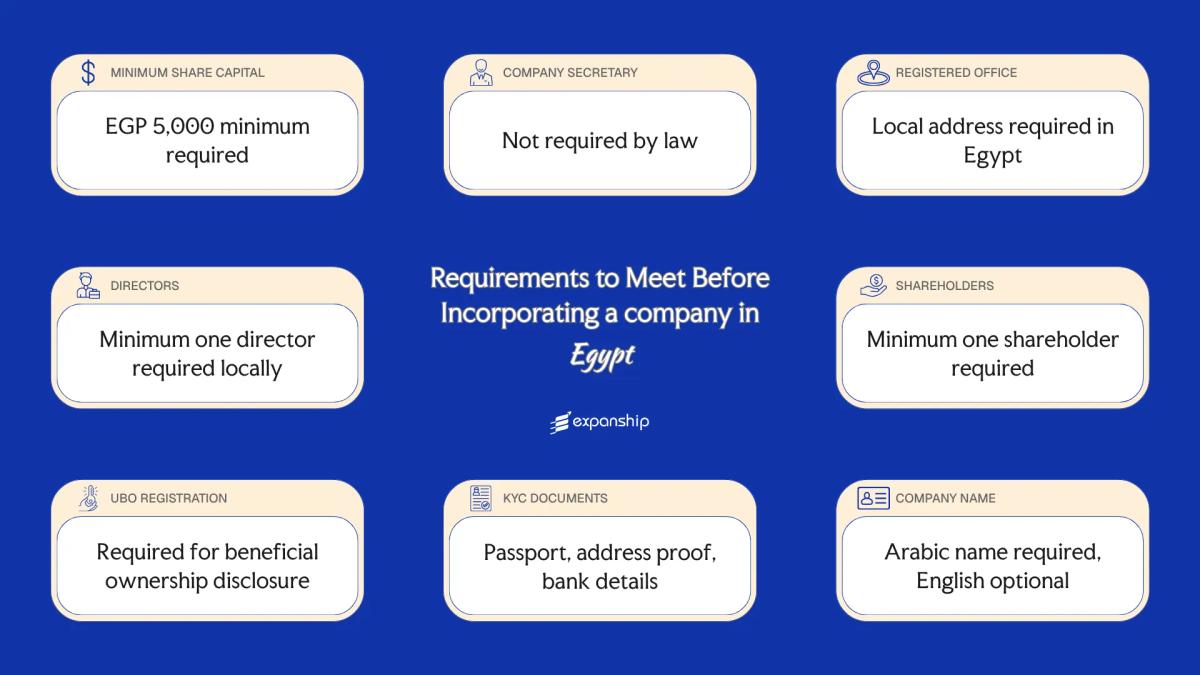
Minimum Share Capital Requirements in Egypt
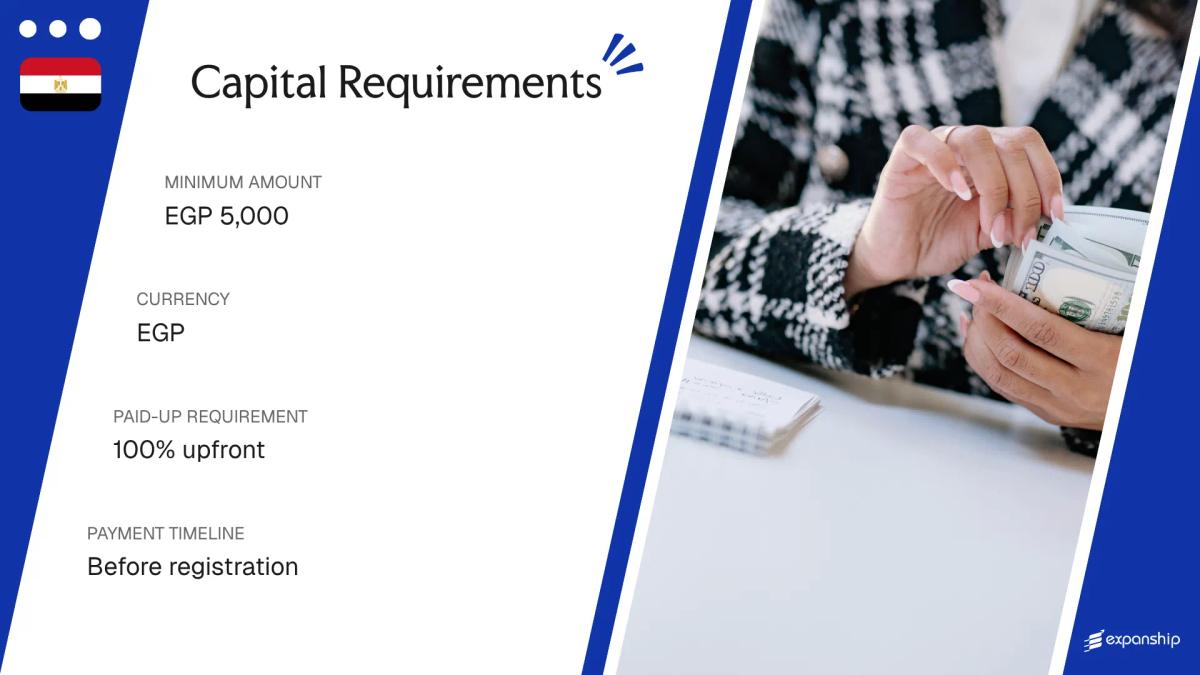
Minimum share capital requirements in Egypt vary by entity type and are governed primarily under the Companies Law No. 159 of 1981 and its executive regulations. The General Authority for Investment and Free Zones (GAFI) oversees the incorporation process and verifies capital compliance at the point of registration.
Egypt operates on a par value share system. Capital deposit requirements must be satisfied before the company receives its commercial registration, making this an incorporation threshold rather than a recurring statutory obligation.
| Parameter | Detail |
|---|---|
| Minimum Authorized Share Capital | EGP 250,000 for a Joint Stock Company (S.A.E.); no statutory minimum for a Limited Liability Company (W.L.L.) |
| Maximum Authorized Share Capital | No statutory maximum |
| Minimum Paid-Up Capital | 10% of authorized capital at incorporation for a Joint Stock Company; no statutory minimum for an LLC |
| Paid-Up Requirement at Incorporation | Required prior to obtaining commercial registration |
| Accepted Currency | Egyptian Pound (EGP); foreign currency contributions are subject to Central Bank of Egypt regulations |
| Accepted Forms of Contribution | Cash and in-kind contributions; in-kind assets must be independently valued |
| Timeframe to Deposit Capital | Prior to submission of incorporation documents to GAFI |
For Joint Stock Companies, the initial paid-up portion must be deposited in a blocked bank account before GAFI processes the incorporation application. The remaining unpaid capital must be called up within five years of registration.
Company Secretary Requirements in Egypt
Under the Companies Law No. 159 of 1981 and its executive regulations, Egypt does not mandate a dedicated corporate secretary role in the same way common law jurisdictions do. Certain administrative and compliance functions, however, must be fulfilled internally or through appointed representatives recognised by the General Authority for Investment and Free Zones (GAFI).
These duties include maintaining the company's statutory books, filing annual financial statements with GAFI, and ensuring shareholder meeting records are properly documented. Secretary compliance in Egypt company structures is typically handled by a senior officer or an appointed administrator rather than a separately licensed professional.
Qualification criteria for who may serve in this capacity:
- No statutory licensing requirement exists for corporate secretaries under Egyptian company law.
- The role may be fulfilled by an Egyptian resident or a non-resident with proper authorisation.
- A legal entity, such as a corporate services firm, may perform secretarial functions on behalf of the company.
- The individual or firm must have legal capacity under Egyptian civil law to act on behalf of a commercial entity.
- In practice, GAFI requires a designated point of contact for official correspondence and compliance submissions.

Incorporate a Company in Egypt
Set up your business entity in Egypt with full support on GAFI registration, document preparation, and ongoing compliance obligations.
Registered Office Requirements in Egypt
Registered office requirements in Egypt mandate that every company maintain a physical address within the country that serves as its official domicile for legal correspondence and regulatory purposes under the Companies Law No. 159 of 1981 and its executive regulations. Failure to maintain a compliant legal address can result in administrative penalties, difficulty receiving official notices, and potential complications with the General Authority for Investment and Free Zones (GAFI) during renewal or compliance procedures.
- A physical address located within Egypt is required; no entirely virtual office arrangement satisfies this obligation.
- The address must be a real, occupiable premises; a P.O. box alone does not meet the legal address requirements for an Egyptian company.
- Either ownership documentation or a valid lease agreement for the premises must be held by the company or its authorized occupant.
- The registered address is publicly recorded in the Commercial Registry maintained by the General Authority for Investment and Free Zones.
- Any change to the company's registered address must be formally notified to the Commercial Registry, with updated documentation submitted to reflect the new domicile.
- The address must fall within Egyptian territory; overseas addresses are not accepted for domestic entity registration purposes.
Director Requirements in Egypt
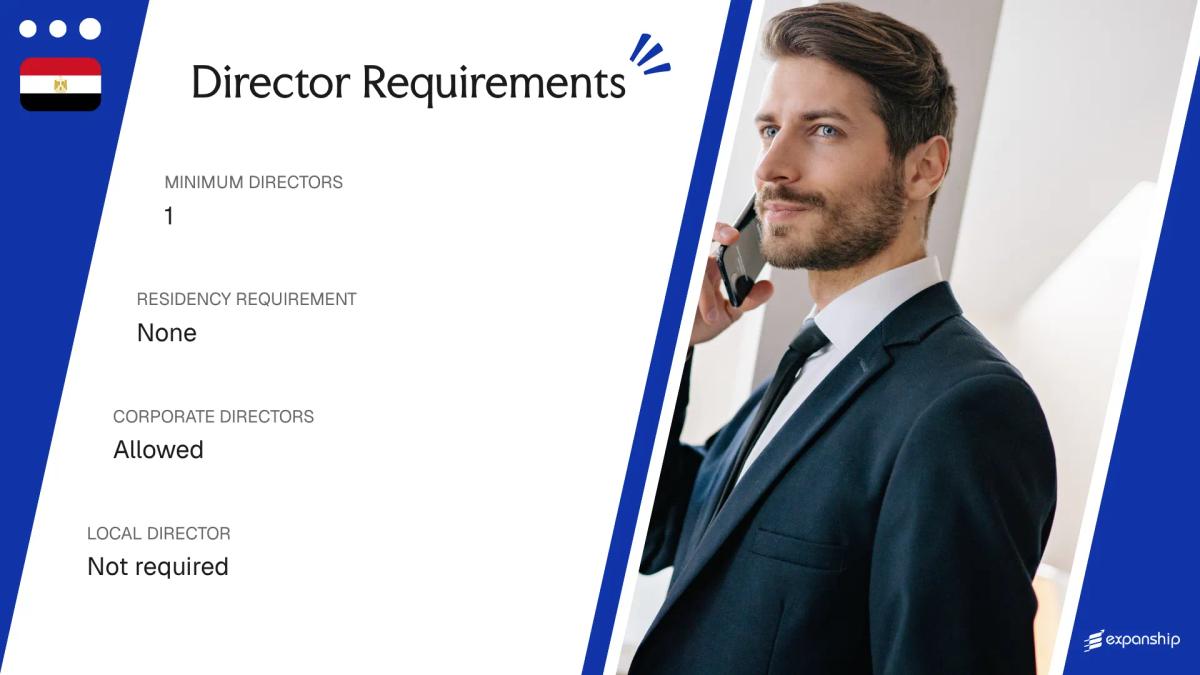
Under the Companies Law No. 159 of 1981 and its executive regulations, director requirements Egypt company structures must satisfy cover both appointment eligibility and ongoing statutory duties. Upon appointment, directors assume personal liability for resolutions passed in board meetings and are obligated to act in the best interests of the entity under Egyptian law.
| Parameter | Detail |
|---|---|
| Minimum Number of Directors | A joint stock company (S.A.E.) requires a minimum of three directors on its board. |
| Maximum Number of Directors | No statutory maximum is prescribed under Companies Law No. 159 of 1981. |
| Local/Resident Director Required | No statutory requirement for a locally resident director. |
| Nationality Restrictions | The majority of board members in certain regulated or state-adjacent sectors may be required to hold Egyptian nationality; no general restriction applies to private companies. |
| Minimum Age Requirement | Directors must be at least 21 years of age at the time of appointment. |
| Corporate Directors Permitted | Corporate directors are not permitted; directors must be natural persons. |
| Director Must Be a Shareholder | Directors of a joint stock company are required to hold a minimum number of guarantee shares as specified in the company's articles. |
| Publicly Listed on Registry | Director appointments are filed with the General Authority for Investment and Free Zones (GAFI) and recorded in the Commercial Register. |
| Disqualification Conditions | Individuals previously convicted of offences involving dishonesty, bankruptcy, or financial fraud are disqualified from serving as directors. |
Unlike many jurisdictions where directors hold purely supervisory roles, Egyptian joint stock company directors are legally required to deposit guarantee shares in the company's name for the duration of their tenure, making them financially bound to the firm they govern.
Shareholder Requirements in Egypt
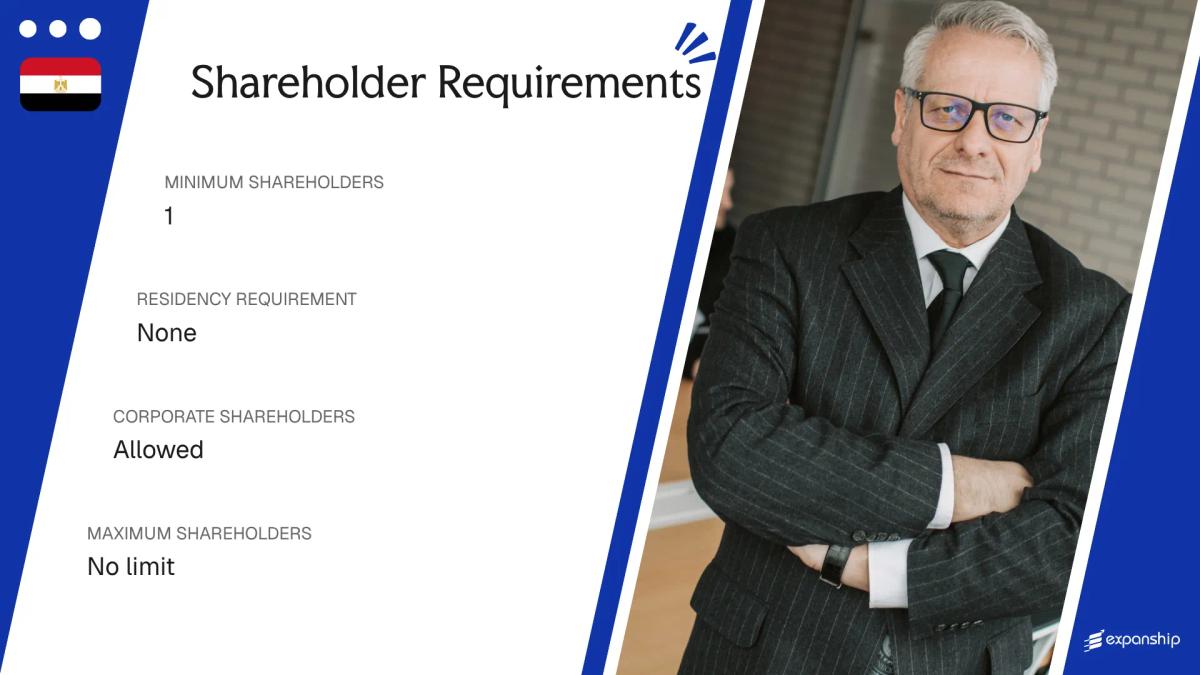
Under Egyptian law, a Limited Liability Company (LLC) requires a minimum of two shareholders and permits up to fifty. A Single Person Company (SPC), governed by the Companies Law No. 159 of 1981 and its amendments, allows sole ownership by one natural or legal person.
Nationality and Residency Restrictions
Meeting the shareholder requirements Egypt company formations impose does not require shareholders to be Egyptian nationals or residents. Foreign ownership is generally permitted across most sectors, though certain industries — such as land ownership, media, and defense-related activities — are subject to restrictions under sector-specific regulations.
Corporate Shareholders
Legal entities may hold shares in an Egyptian company. No residency or nationality requirement applies to corporate shareholders, though the participating entity must be a duly incorporated legal person under its home jurisdiction.
Shareholder Liability
In an LLC, each shareholder's liability is limited to their capital contribution. Egyptian company ownership requirements do not extend liability beyond the subscribed share amount under normal circumstances.
Register of Shareholders
An LLC must maintain an internal register of shareholders. This register is filed with the General Authority for Investment and Free Zones (GAFI), and any transfer of shares requires formal registration to take legal effect.
Structure Your Shareholding Correctly Before Incorporating in Egypt
Get guidance on ownership structures, foreign shareholder eligibility, and filing obligations with GAFI before your Egyptian company is formed.
UBO / Beneficial Ownership Disclosure Requirements in Egypt
Beneficial ownership disclosure Egypt is governed primarily by the Anti-Money Laundering Law No. 80 of 2002 and its executive regulations, which define a beneficial owner as any natural person who ultimately owns or controls 25% or more of an entity's shares or voting rights.
- Identify all natural persons meeting the 25% ownership or control threshold within the company structure.
- Submit beneficial ownership information to the Egyptian Financial Intelligence Unit (Efin) and the relevant registrar at the time of incorporation.
- Record UBO details in the company's internal ownership register, maintained at the registered address.
- Report any changes in beneficial ownership to the competent authority within a defined period following the change.
| Parameter | Detail |
|---|---|
| Ownership Threshold for UBO Status | 25% of shares or voting rights |
| Filing Authority | Egyptian Financial Intelligence Unit (EGIN) and Commercial Registry |
| Disclosure Deadline at Incorporation | At the time of incorporation |
| Publicly Accessible Register | No publicly accessible register |
| Penalties for Non-Disclosure | Fines and potential criminal liability under AML Law No. 80 of 2002 |
| Ongoing Update Obligation | Required upon any change in beneficial ownership |
KYC / Document Requirements in Egypt
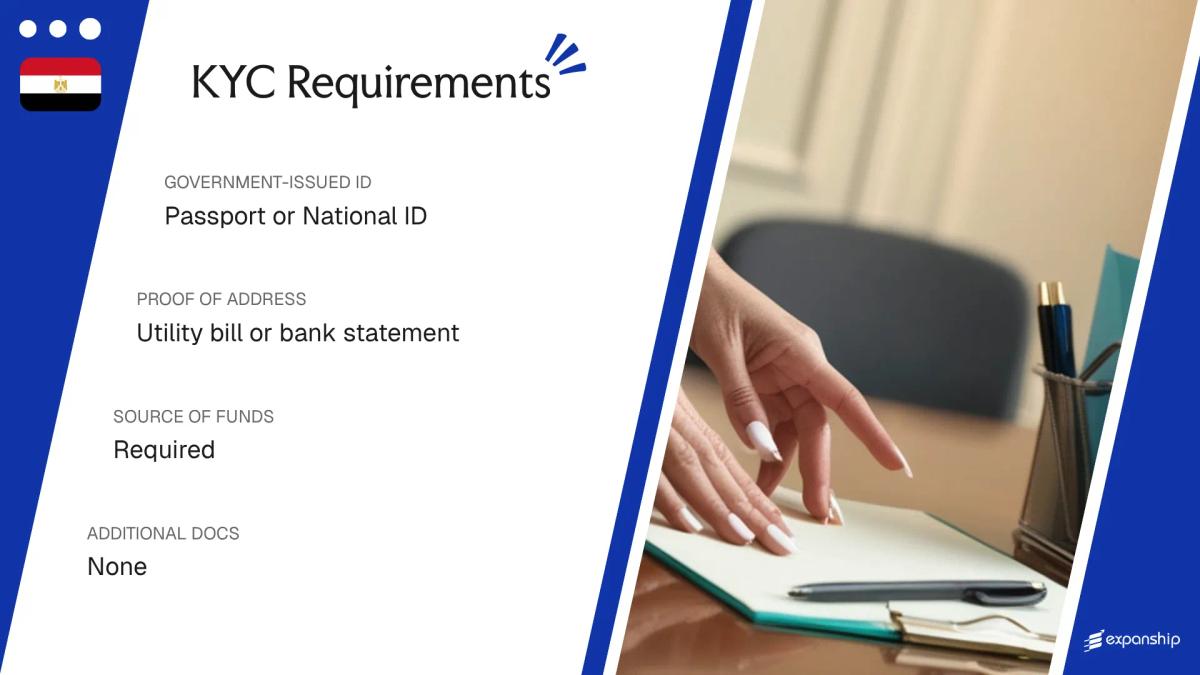
KYC document requirements Egypt arise at the point of incorporation and are governed by the Anti-Money Laundering Law No. 80 of 2002 and its executive regulations, enforced by the Egyptian FIU.
Individual / Personal Documents
- Valid national ID or passport for each individual director, shareholder, or beneficial owner
- Proof of residential address issued within the past three months, such as a utility bill or bank statement
- A recent passport-sized photograph may be required by the incorporating authority
- Tax identification number or equivalent, where the individual holds one
Corporate Documents
- Certificate of incorporation or equivalent constitutional document for any corporate shareholder or director
- Current register of directors issued by the relevant home jurisdiction authority
- Proof of registered address of the corporate entity, such as an official utility bill or government-issued document
- Corporate resolution authorising participation in the Egyptian entity
Source of Funds Documentation
- Bank statements covering a minimum recent period to evidence the origin of contributed capital
- Audited financial statements where the investing entity is a corporate body
- A written declaration of source of funds may be required for individual subscribers
Notarisation and Apostille Requirements
- Foreign documents must generally be notarised in the country of origin and legalised through the Egyptian consulate or apostilled if the issuing country is a Hague Convention signatory
- Arabic translation by a certified translator is required for all non-Arabic documents submitted to the General Authority for Investment and Free Zones (GAFI)
- Corporate documents originating outside Egypt require chain authentication before submission
Incomplete or un-translated foreign corporate documents are the most frequently cited reason for incorporation filing rejection at GAFI.
Company Name Requirements in Egypt
Proposed company name requirements Egypt are assessed by the General Authority for Investment and Free Zones (GAFI), which reviews submissions for uniqueness, appropriateness, and consistency with public policy before registration is approved.
Names must be written in Arabic or include an Arabic version. A legal suffix indicating the entity type is mandatory, such as "S.A.E." for joint stock companies or "W.L.L." for limited liability firms.
Certain words are prohibited outright, including terms implying government affiliation or international status without authorization. Words referencing financial services, religious institutions, or military bodies require prior approval from the relevant authority.
Name reservation is available through GAFI's electronic portal. Reservations are granted for a limited period, during which the name is held exclusively pending completion of the incorporation process.
Compliance Services for Companies in Egypt
Stay current with Egyptian regulatory obligations, from annual filings to statutory updates managed through GAFI and other competent authorities.
Conclusion
Egypt company incorporation requirements span multiple regulatory layers, governed primarily by the Companies Law No. 159 of 1981 and administered through the General Authority for Investment and Free Zones. Among the requirements covered, the mandatory physical registered office address and the UBO disclosure obligations introduced under anti-money laundering legislation carry particular weight for foreign investors. Share capital thresholds also vary meaningfully by entity type. Once these formation rules are understood, the practical next step involves coordinating documentation, regulatory filings, and ongoing compliance obligations within Egypt's statutory timeframes.
Expanship's Corporate Formation Services in Egypt
Egypt's specific requirements — from GAFI's role in approving and registering entities to the notarisation obligations and UBO disclosure framework under the Anti-Money Laundering Law — create a structured but multi-step formation process. Expanship's Egypt corporate formation services are built around managing that administrative workload on your behalf, so your focus stays on the business rather than the procedural sequence.
Our company registration support in Egypt covers each stage of the setup and ongoing compliance cycle:
- Preparing and filing all incorporation documents with GAFI and relevant Egyptian authorities
- Providing a registered agent and local office address to satisfy Egyptian residency requirements
- Handling government filings and liaising directly with regulatory bodies on your behalf
- Managing post-incorporation compliance obligations as your business continues to operate
- Facilitating introductions to banking institutions familiar with foreign-owned entities in Egypt
- Coordinating tax registration and engagement with the Egyptian Tax Authority and local agencies
To discuss your requirements directly, contact Expanship Egypt.
Frequently Asked Questions (FAQ)
Yes, and the difference is significant. A Joint Stock Company (S.A.E.) requires a minimum issued capital of EGP 250,000, while a Limited Liability Company (LLC) has no statutory minimum capital under the Companies Law No. 159 of 1981, though GAFI may impose sector-specific thresholds for certain licensed activities. Choosing the wrong structure relative to your intended activity can trigger additional capital requirements that were not anticipated at the outset.
Egypt's anti-money laundering framework, reinforced by the Anti-Money Laundering Law No. 80 of 2002 and its subsequent amendments, generally requires disclosure of any natural person holding 25% or more of the shares or voting rights in a company. This threshold applies regardless of whether ownership is held directly or through an intermediary holding structure. Failing to disclose qualifying beneficial owners can expose the company to regulatory sanctions from the Egyptian Financial Regulatory Authority or the Central Bank of Egypt, depending on the sector.
A foreign national can serve as a director of an Egyptian LLC, but certain restrictions apply in practice. If the company intends to hire expatriate staff or operate in regulated sectors, Egyptian authorities may scrutinize the directorship arrangement, and some licensing bodies require at least one Egyptian national or resident to hold a management role. The precise requirement varies by sector and the terms attached to any applicable investment license issued by GAFI.
A proposed company name that conflicts with an already-registered name or violates naming conventions under the Egyptian Commercial Law will be rejected outright during the Commercial Registry review, halting the entire incorporation process. There is no administrative fine at the application stage, but operating under an unregistered or improperly registered name after commencement of business can constitute a violation subject to penalties under Egyptian commercial regulations. Your incorporation timeline effectively resets until a compliant name is approved.
Foreign shareholders are required to submit apostilled or notarized identity documents, translated into Arabic by a certified translator, which adds both cost and processing time relative to Egyptian national shareholders who submit locally issued identification. GAFI and the Commercial Registry apply additional scrutiny to foreign-sourced documents, particularly corporate shareholders from jurisdictions with elevated AML risk classifications. In some cases, a certificate of good standing or equivalent document from the foreign entity's home jurisdiction is also required before registration can proceed.
Any material change in beneficial ownership must be reported to the relevant Egyptian authority within the timeframe specified under the AML regulatory framework, and failure to update the register is treated as a continuing violation rather than a one-time omission. The obligation applies each time a shareholder crosses the 25% threshold, whether through a share transfer, issuance of new shares, or a restructuring of an upstream holding entity. Companies operating in the financial or banking sectors face stricter reporting timelines enforced by the Central Bank of Egypt.
Legal Disclaimer
The information provided in this article is for general informational purposes only and does not constitute legal, tax, or professional advice. While we strive to ensure the accuracy and timeliness of the content, laws and regulations are subject to change, and the application of laws can vary widely based on specific facts and circumstances.
Readers should not act upon this information without seeking professional counsel tailored to their individual situation. Expanship and its authors disclaim any liability for actions taken or not taken based on the content of this article.
For specific advice regarding your business setup, compliance requirements, or any legal matters, please consult with qualified legal and tax professionals in the relevant jurisdiction.