
Key Takeaways
- Egypt's 22.5% corporate tax rate, combined with profit repatriation rights codified under Investment Law No. 72 of 2017, gives foreign-owned entities a predictable and legally protected financial baseline from which to operate.
- Businesses establishing entities through the General Authority for Investment and Free Zones can access full foreign ownership and customs exemptions within designated free zones, removing two of the most common structural barriers to market entry.
- With over 60 bilateral double taxation treaties in force, Egyptian-registered companies can distribute cross-border income with significantly reduced withholding tax exposure across a wide range of treaty partner jurisdictions.
- The absence of a minimum capital requirement for most LLC formations means early-stage and capital-light businesses can establish a legally compliant Egyptian presence without committing significant funds at the point of incorporation.
Incorporated as a sovereign republic in northeastern Africa, Egypt occupies a geographic position that connects three continents and borders both the Mediterranean Sea and the Red Sea. The primary authority overseeing business registration is the General Authority for Investment and Free Zones, which operates under the framework established by Investment Law No. 72 of 2017. Foreign investors most commonly establish a Limited Liability Company when entering the Egyptian market.
Egypt operates a territorial-based tax system with treaty obligations spanning a broad network of bilateral agreements. The country has progressively liberalized its foreign direct investment framework, and general policy permits full foreign ownership across a wide range of sectors, though certain industries remain subject to restrictions or approval requirements.
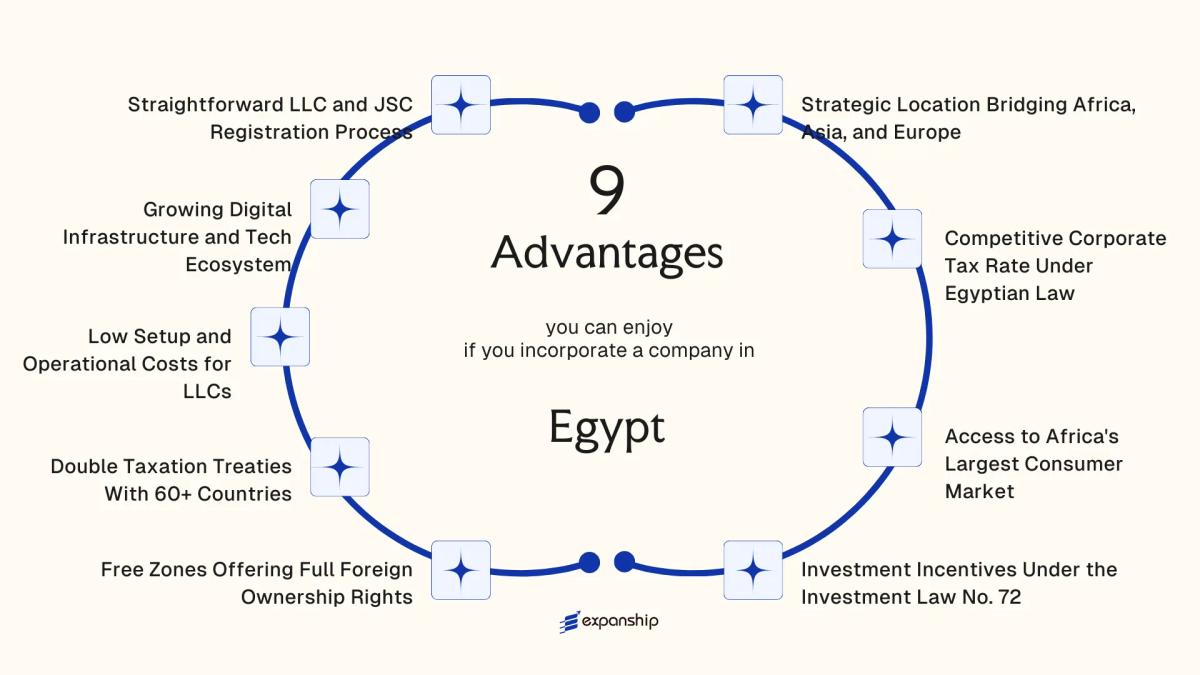
The benefits of incorporating in Egypt extend across regulatory, financial, and geographic dimensions — this article examines each advantage in detail. Understanding the full picture of Egypt company formation advantages helps your business assess whether this jurisdiction aligns with your operational and structural objectives.
Strategic Location Bridging Africa, Asia, and Europe
Egypt's geographic position gives your business simultaneous proximity to three of the world's most commercially significant regions. Sitting at the northeastern corner of Africa, the country connects sub-Saharan markets, the Gulf, and Mediterranean Europe through a single operating base.
The Suez Canal as a Trade Corridor
Roughly 12% of global maritime trade passes through the Suez Canal, which Egypt controls entirely. For businesses involved in physical goods, this means your supply chain sits adjacent to one of the highest-volume shipping lanes on the planet, reducing transit times between Asian manufacturers and European consumers significantly.
The 2015 expansion of the New Suez Canal added a parallel channel, increasing daily vessel passage capacity. A firm incorporated locally can position warehousing and logistics operations within the Suez Canal Economic Zone (SCZone), which operates under a distinct regulatory framework from Egypt's general investment law.
Access to Regional Trade Agreements
Egypt holds membership in COMESA, the Greater Arab Free Trade Area (GAFTA), and the Agadir Agreement, each covering distinct geographic blocs. These agreements allow goods produced or processed locally to enter member markets at reduced or zero tariff rates, giving your entity a cost structure that an offshore holding company alone cannot replicate.
A locally incorporated entity can access preferential tariff rates across African, Arab, and Mediterranean markets simultaneously from a single registered address.
Competitive Corporate Tax Rate Under Egyptian Law
Egypt applies a flat corporate income tax rate of 22.5% on net taxable profits, as established under the Income Tax Law No. 91 of 2005. For foreign investors comparing entry markets across the Middle East and North Africa region, this rate positions Egypt corporate tax rate advantages as a genuine structural benefit rather than a marginal one.
The rate applies uniformly to both resident companies and branches of foreign entities operating within Egyptian jurisdiction, which means your business is not subject to a higher rate simply because it is foreign-owned. Taxable income is calculated on net profits after allowable deductions, giving businesses room to reduce their effective liability through legitimate operating expenses.
Certain sectors benefit from reduced or exempted tax treatment. Activities conducted within Special Economic Zones or under the framework of Investment Law No. 72 of 2017 may qualify for partial or full tax holidays, depending on the investment category and geographic zone. This makes the statutory rate a ceiling rather than a fixed cost for many incorporated entities.
What makes this particularly practical for foreign-owned limited liability companies:
- The 22.5% rate applies regardless of whether the shareholder is a resident or non-resident individual
- Tax is assessed on Egyptian-source income, limiting exposure for holding structures with mixed-jurisdiction revenue
- The deductibility rules under Law No. 91 allow salaries, depreciation, and operating costs to offset gross profit before tax is applied
- No branch profits tax is separately imposed beyond the standard corporate rate

Register a Company in Egypt
Set up your Egyptian LLC or joint-stock company with full compliance support from Expanship.
Access to Africa's Largest Consumer Market
With over 106 million residents, Egypt holds the largest population of any Arab country and ranks among the top five most populous nations on the African continent. For a foreign business incorporated there, that demographic scale translates directly into domestic purchasing power that few regional markets can match.
Egypt's position within multiple trade frameworks amplifies this advantage considerably. The country is a signatory to the Common Market for Eastern and Southern Africa (COMESA), giving member-state-incorporated entities preferential tariff access across a bloc that covers roughly 600 million people. Membership in the African Continental Free Trade Area (AfCFTA) extends that reach further, placing your entity within a single African market framework designed to eliminate duties on the majority of intra-African goods.
| Trade Agreement | Member Countries | Combined Population (approx.) |
|---|---|---|
| AfCFTA | 54 signatory states | 1.4 billion |
| COMESA | 21 member states | 600 million |
| GAFTA (Greater Arab Free Trade Area) | 18 Arab League states | 430 million |
The domestic market itself is not uniform in structure. Egypt's urban centers, particularly Greater Cairo and Alexandria, concentrate a middle-income consumer segment that actively purchases imported goods, technology products, and professional services. An entity registered under Egyptian law can serve these consumers directly without the distribution costs associated with exporting through a third-country intermediary. That direct-access structure reduces the layers between production and end consumer, which has measurable implications for margin retention.
Investment Incentives Under the Investment Law No. 72
Egypt Investment Law No. 72 of 2017, formally titled the Investment Law, introduced a structured package of incentives designed to reduce cost burdens and protect capital for both domestic and foreign investors. GAFI (General Authority for Investment and Free Zones) administers these benefits and serves as the primary point of contact for eligible entities.
The law distinguishes between general incentives available to all qualifying projects and special incentives tied to geographic or sectoral criteria. Under the general regime, companies may deduct a percentage of the total cost of establishing or expanding a project from their net taxable profit. Special incentives go further, offering deductions of up to 50% of invested capital for projects in underdeveloped zones or in sectors the government designates as development priorities.
For a foreign business owner, the significance is structural. These deductions directly reduce the effective tax base from the earliest years of operation, which improves net returns during the period when most firms are absorbing setup costs.
Protections under Investment Law 72 also include guarantees against non-commercial asset seizure, the right to repatriate capital and profits in foreign currency, and equal treatment with Egyptian investors. These provisions reduce sovereign risk exposure for foreign-held entities.
Keep these points in mind:
- Deduction rates vary by zone classification and sector; confirm eligibility through GAFI before structuring your entity
- Capital repatriation rights apply provided the investment was registered under the law
- Equal treatment provisions do not exempt investors from sector-specific licensing requirements
Projects established in certain underdeveloped governorates can qualify for a tax base deduction of up to 50% of total project cost, regardless of the investor's nationality.
Free Zones Offering Full Foreign Ownership Rights
Egypt free zones foreign ownership benefits stand apart from the general investment framework because they remove a structural constraint that applies elsewhere in the economy: the requirement for local equity participation. Outside free zones, certain sectors impose partnership thresholds or majority local ownership conditions. Inside a designated free zone, a foreign investor can hold 100 percent of the registered entity without a domestic partner, which eliminates the need to negotiate equity splits or manage co-ownership arrangements that can complicate governance and profit distribution.
Public Free Zones and the General Authority Oversight
Public free zones operate under Law No. 83 of 1983 and are administered by the General Authority for Investment and Free Zones (GAFI). Entities incorporated under this framework are treated as operating outside Egyptian customs territory, which means imported machinery, raw materials, and production inputs are not subject to customs duties. The practical effect is that your cost base for manufacturing or distribution is calculated without the tariff layer that applies to domestically licensed companies.
Special Economic Zones and the SCZone Regime
The Suez Canal Economic Zone, governed by Law No. 83 of 2002 and managed by the General Authority for the Suez Canal Economic Zone (SCZone), operates under a separate regulatory structure with its own dispute resolution mechanism and a flat corporate income tax rate of 10 percent. Production outputs sold into the local Egyptian market are subject to applicable customs duties as if imported, but exports face no such burden, making the zone particularly relevant for businesses targeting international markets.
Structure Your Free Zone Entry in Egypt
Get direct guidance on free zone eligibility, entity structure, and the GAFI or SCZone registration process for your specific business activity.
Double Taxation Treaties With 60+ Countries
Egypt has signed double taxation treaties with over 60 countries, covering major trading and investment partners across Europe, the Arab world, Africa, and Asia. For a foreign business owner, this network directly reduces the tax cost of cross-border income flows between your home country and Egypt.
- Reduced withholding tax rates on dividends, interest, and royalties paid to non-resident shareholders are a direct consequence of treaty coverage. Without a treaty, Egyptian domestic withholding rates apply in full; with one, bilateral agreements typically set lower capped rates, preserving more after-tax income for foreign parent entities.
- Treaty provisions define permanent establishment thresholds, which determines when a foreign firm becomes taxable in Egypt. Clear thresholds allow you to structure operations and contractual arrangements with predictability, reducing unintended tax exposure.
- For investors based in treaty countries, Egypt double taxation treaty benefits include relief mechanisms such as tax credits or exemptions in the investor's home jurisdiction on income already taxed under Egyptian law. This prevents the same profit from being taxed twice across two jurisdictions.
- The treaty network supports Egypt tax treaty advantages for foreign companies operating regionally, since Egypt functions as a holding or intermediary jurisdiction for trade routed into Africa or the Middle East, with treaty protection applying to income repatriated upward through the structure.
Low Setup and Operational Costs for LLCs
Egypt LLC low operational cost advantages stem partly from the relatively modest capital requirements governing limited liability companies. Under the Companies Law No. 159 of 1981, an LLC can be incorporated with a minimum paid-up capital of EGP 1,000, though in practice, the General Authority for Investment and Free Zones (GAFI) may apply higher thresholds depending on the activity sector. This low barrier means your startup capital is preserved for operations rather than tied up in statutory deposits.
Staffing costs add to the overall cost picture. Egypt's labor market offers a large pool of university-educated professionals at salary levels that are considerably lower than comparable markets in the Gulf or Eastern Europe, reducing your monthly payroll burden without proportional reductions in output quality.
Office and commercial lease costs in secondary business districts outside Cairo's central zones remain accessible by regional standards, allowing firms to maintain a credible registered presence without committing to premium real estate.
A foreign-owned LLC registered in Cairo with five mid-level employees and a standard commercial lease could reasonably operate within a monthly overhead of USD 4,000 to USD 6,000, a figure that reflects salary, rent, and basic administrative costs at current market rates.
Growing Digital Infrastructure and Tech Ecosystem
Egypt digital infrastructure benefits for business have become more tangible since the government launched its Digital Egypt strategy, which targets nationwide broadband coverage, e-government integration, and expanded data center capacity. For companies requiring reliable connectivity and cloud access, this investment reduces operational friction that has historically affected regional markets.
The Egypt ICT Ministry has established dedicated technology zones, most notably the Smart Village business park outside Cairo, which houses over 170 technology firms including regional offices of multinational corporations. Locating within or near these clusters gives your business access to shared infrastructure, a trained technical workforce, and proximity to sector-specific regulators.
Key infrastructure developments relevant to foreign businesses include:
- Submarine cable connectivity through the Red Sea and Mediterranean, positioning the country as a data transit corridor between continents
- A growing network of Tier III data centers certified to international standards
- The Fintech Egypt initiative under the Central Bank, which provides a regulatory sandbox for financial technology firms
Access to certain technology zones and sandbox programs requires registration with the relevant sector authority, and eligibility conditions vary by business activity and legal structure.
Straightforward LLC and JSC Registration Process
Among the Egypt LLC and JSC registration advantages, the procedural structure itself reduces the time and administrative burden that foreign investors typically face in comparable emerging markets.
Both the Limited Liability Company and the Joint Stock Company are registered through the General Authority for Investment and Free Zones, known as GAFI. This single entry point consolidates approvals that would otherwise require multiple government interactions, cutting the number of touch points your business needs to manage before commencing operations.
LLC formation requires a minimum of two shareholders and carries no minimum capital requirement for most standard activities. That absence of a capital threshold means you can establish a legal presence without committing significant funds upfront, preserving working capital for operational needs.
The JSC structure suits firms planning to raise equity or list on the Egyptian Exchange at a later stage. Minimum share capital requirements apply, but the structure is designed to accommodate institutional investors and broader ownership distribution from the outset.
GAFI operates a one-stop-shop service that processes documentation, issues commercial registration, and coordinates with the Tax Authority and relevant line ministries. For foreign investors, this consolidation shortens the timeline between application and receiving a valid commercial registration certificate.
Key procedural features relevant to foreign applicants include:
- Foreign nationals can hold 100% ownership in both LLC and JSC structures outside designated restricted sectors
- Articles of association must be notarised and submitted in Arabic
- The company name must be cleared through GAFI prior to registration submission
- A local registered address is required to complete the filing
Why Egypt Stands Out Against Regional Competitors
Comparing Egypt's advantages over regional business competitors requires selecting jurisdictions that attract a similar investor profile. The three chosen here, the UAE, Morocco, and Jordan, are frequently evaluated alongside Egypt by foreign investors targeting MENA and African markets. Each offers a distinct value proposition, which makes the comparison meaningful rather than arbitrary. What the table below surfaces is that Egypt's combination of market scale, treaty coverage, and cost structure positions it differently from peers that compete primarily on regulatory branding or tax-free regimes.
One distinction that pure comparisons can miss: free zone arrangements in the UAE offer zero corporate tax, but access to Egypt's domestic consumer base of over 100 million people, governed under Investment Law No. 72 of 2017, cannot be replicated from an offshore or free zone structure in another country. Investors who require real market penetration, not just a holding address, face a different calculation entirely.
| Parameter | Egypt | UAE | Morocco | Jordan |
|---|---|---|---|---|
| Standard Corporate Tax Rate | 22.5% | 9% (from 2023) | 20–35% (progressive) | 20% |
| Foreign Ownership (Mainland) | Up to 100% in most sectors | 100% (post-2021 reforms) | Generally permitted; sector restrictions apply | Up to 100% in most sectors |
| Double Taxation Treaties | 60+ | 130+ | 50+ | 30+ |
| Free Zone Availability | Yes, including GAFI-administered zones | Yes, extensive | Yes, CFC and others | Yes, Aqaba SEZ |
| Domestic Market Size | 100M+ population | ~10M population | ~37M population | ~10M population |
| Regional Trade Access | Africa, Arab League, EU Association | GCC, broader MENA | EU, Africa, Arab League | Arab League, EU Association |
Compliance Services for Companies in Egypt
Maintain your Egyptian company's standing with ongoing compliance support, including annual filings, regulatory reporting, and GAFI obligations.
Conclusion
The benefits of incorporating in Egypt rest on a convergence of structural factors that are difficult to replicate elsewhere in the region. Egypt's position under Investment Law No. 72 of 2017, which grants profit repatriation rights and tax incentive packages, combined with a 22.5% corporate tax rate and access to over 60 double taxation treaties, creates a foundation that serves both regional operators and internationally oriented businesses.
Free zone structures under the General Authority for Investment and Free Zones allow full foreign ownership with customs exemptions, while the standard LLC formation path requires no minimum capital for most activities. These are not incidental features; they reflect a deliberate policy architecture designed to reduce friction for foreign capital.
That said, the value of Egypt company formation advantages depends on your specific industry, target market, and operational model. A manufacturing firm oriented toward Sub-Saharan Africa will draw different value from this jurisdiction than a technology business serving the MENA region. Both can find structural advantages here, but the alignment between entity type, free zone eligibility, and applicable incentives requires careful matching against your business objectives. Engaging with the right formation and compliance framework from the outset is the factor that most consistently determines whether those advantages are fully realised.
Start Your Egyptian Company Formation With Expanship
Egypt company formation with Expanship covers the full registration lifecycle for both Limited Liability Companies and Joint Stock Companies under the Companies Law No. 159 of 1981 and Investment Law No. 72 of 2017. From preparing Articles of Association to filing with the General Authority for Investment and Free Zones (GAFI), every procedural step connects to a compliance obligation that Expanship manages directly on your behalf.
Expanship's service scope for Egyptian entity formation includes:
- Preparation and notarization of incorporation documents in Arabic, as required by GAFI
- Registered agent and registered office provision within Egypt
- Government filing and liaison with GAFI and the Commercial Registry
- Post-incorporation compliance management, including annual reporting obligations
- Tax registration support with the Egyptian Tax Authority
- Banking introduction assistance for corporate account opening
Reach out to Expanship Egypt to begin your entity registration.
Frequently Asked Questions (FAQ)
The standard corporate income tax rate in Egypt is 22.5%, applied to net taxable profits. Companies operating within free zones are generally exempt from this rate, along with customs duties and certain other levies, under the free zone regime governed by the Investment Law. The applicable rate for your entity will depend on where it is registered and the nature of its activities.
GAFI's one-stop shop is designed to consolidate approvals from multiple government bodies into a single point of contact, and straightforward LLC registrations can be completed within a few business days under this system. The timeline varies based on the business activity, document completeness, and whether sector-specific approvals are required. More complex structures or regulated industries may extend the process beyond the standard window.
Investment Law No. 72 of 2017 includes explicit protections against the expropriation or nationalization of private investments without fair and prompt compensation. These protections apply to both Egyptian and foreign investors registered under the law's framework. The law also grants investors the right to transfer profits and proceeds abroad in convertible currency, subject to applicable banking regulations.
Egypt has signed double taxation avoidance agreements with more than 60 countries, and many of these treaties include provisions that reduce withholding tax on dividends paid to foreign parent entities. The applicable rate depends on the specific treaty between Egypt and the parent company's country of residence. Where no treaty exists, domestic withholding tax rules apply, so the holding structure should be planned with the relevant treaty network in mind.
Egyptian law does not universally require a local director or resident shareholder for an LLC, particularly for entities established under the Investment Law framework. However, the managing director of the company must be formally appointed and registered with the Commercial Registry, and certain regulated sectors may impose additional residency or nationality conditions. Confirming sector-specific requirements with GAFI before finalizing your corporate structure is necessary.
Not all business activities qualify for free zone registration; activities targeting the domestic Egyptian market are generally not permitted under the free zone regime, which is oriented toward export-oriented and internationally focused operations. In such cases, incorporation as an onshore LLC or Joint Stock Company under the Companies Law No. 159 of 1981 would apply, with the standard tax and regulatory framework governing the entity. This structure still permits full or majority foreign ownership in most non-restricted sectors under the Investment Law.
Legal Disclaimer
The information provided in this article is for general informational purposes only and does not constitute legal, tax, or professional advice. While we strive to ensure the accuracy and timeliness of the content, laws and regulations are subject to change, and the application of laws can vary widely based on specific facts and circumstances.
Readers should not act upon this information without seeking professional counsel tailored to their individual situation. Expanship and its authors disclaim any liability for actions taken or not taken based on the content of this article.
For specific advice regarding your business setup, compliance requirements, or any legal matters, please consult with qualified legal and tax professionals in the relevant jurisdiction.