
Key Takeaways
- Foreign investors operating under Investment Law No. 72 of 2017 must navigate a multi-stage registration process through GAFI that adds time and administrative cost compared to more streamlined incorporation regimes.
- Certain strategic sectors in Egypt impose restrictions or outright prohibitions on foreign ownership, which materially limits the structural options available to multinational firms seeking full equity control.
- Egypt's corporate tax compliance obligations under the Egyptian Tax Authority involve layered reporting requirements that increase the operational burden for foreign-owned entities relative to jurisdictions with consolidated filing systems.
- Profit repatriation from Egypt remains subject to currency control mechanisms that can constrain a foreign parent company's ability to freely transfer returns out of the country on its preferred timeline.
Egypt operates under an evolving but heavily regulated corporate framework, where foreign businesses face a distinct set of structural and procedural constraints that differ materially from more liberalized markets. The disadvantages of incorporating in Egypt span regulatory, financial, and operational dimensions — each addressed in the specific sections of this article.
The degree of exposure to these drawbacks depends significantly on your business type, ownership structure, and target sector. A wholly foreign-owned trading company faces a different compliance burden than a joint venture operating in a restricted industry.
This article is most relevant to foreign investors and multinational firms considering direct market entry through a locally registered entity. Primary corporate activity in Egypt is governed by Investment Law No. 72 of 2017 and the Companies Law No. 159 of 1981, which together set the foundational legal conditions for company formation and operation.
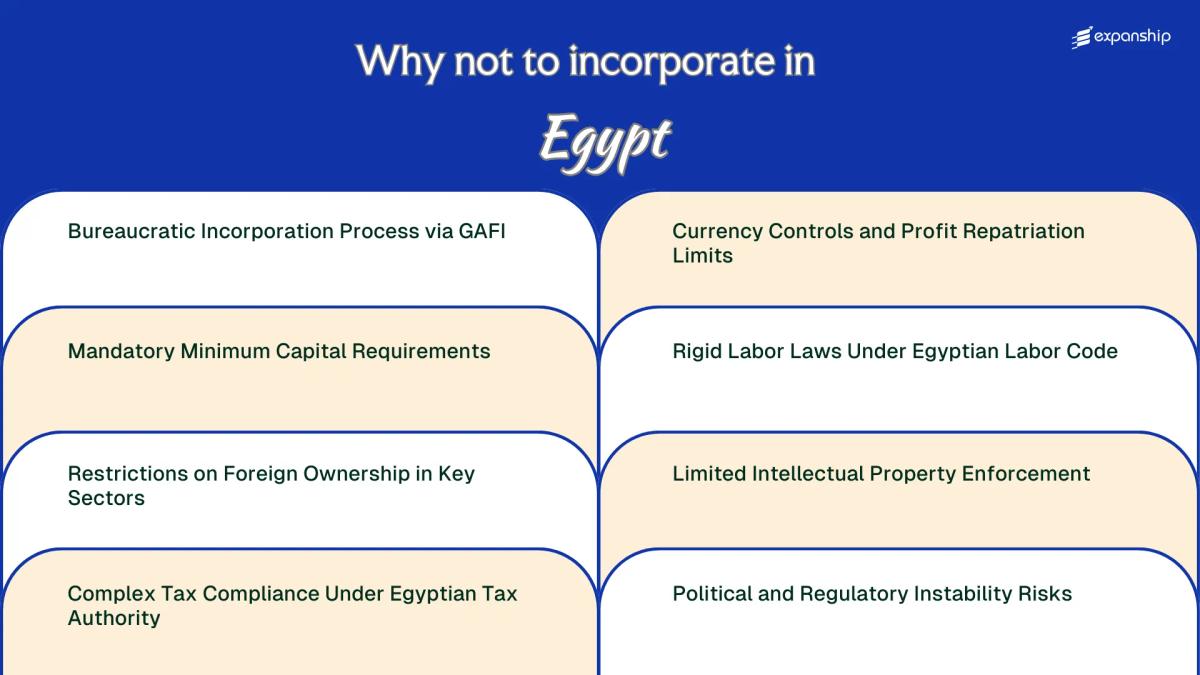
Bureaucratic Incorporation Process via GAFI
The Egypt GAFI incorporation bureaucracy presents one of the most document-intensive registration experiences in the MENA region. Processing times and procedural requirements add measurable cost before your business generates a single transaction.
Multiple Agencies, Sequential Approvals
Registration through the General Authority for Investment and Free Zones requires coordination across several government bodies, including the Tax Authority, the Commercial Registry, and in some cases sector-specific ministries. Each body operates on its own timeline, and delays at one stage stall all subsequent steps.
Certain regulated activities require pre-approvals that sit entirely outside GAFI's control, meaning the authority cannot accelerate your timeline regardless of how complete your documentation is.
Document Requirements and Practical Delays
Foreign founders must submit notarized and apostilled corporate documents, translated into Arabic by certified translators, which adds both preparation time and third-party costs before submission is even possible. Egypt company registration delays commonly extend registration to several weeks, even for standard limited liability company formations under Law No. 159 of 1981.
A single missing or incorrectly formatted document triggers a full restart of the affected stage.
GAFI registration problems are compounded for foreign founders by the absence of a guaranteed processing window, making it difficult to commit to launch dates or pre-signed commercial agreements.
Mandatory Minimum Capital Requirements
Egypt minimum capital requirements restrictions differ significantly by entity type, and the gap between them creates an immediate financial constraint before your business earns a single pound. A Limited Liability Company (LLC) formed under Law No. 159 of 1981 carries no statutory minimum capital, but a Joint Stock Company (JSC) requires a minimum issued capital of EGP 250,000, with at least 10% paid up at incorporation.
That threshold may appear modest, but the mandatory share capital for an Egypt company compounds when sector-specific licensing authorities impose their own capital floors on top of the baseline.
For foreign business owners, these requirements translate into concrete operational friction:
- Capital locked at registration cannot fund early operating costs, reducing your liquidity before revenue begins
- JSC capital requirements demand a local bank certificate confirming deposit, adding banking lead time to an already extended incorporation timeline
- Sector regulators, such as the Financial Regulatory Authority for financial services, can impose capital minimums that far exceed the Companies Law baseline, forcing early over-capitalization
- Revaluing paid-in capital after depreciation of the Egyptian pound inflates the real cost of maintaining statutory compliance
The LLC structure avoids the JSC floor, but that flexibility disappears once your activity classification or licensing requirement mandates the JSC form.

Company Incorporation in Egypt
Understand the capital requirements and entity options before committing to a structure in Egypt.
Restrictions on Foreign Ownership in Key Sectors
Egypt foreign ownership restrictions across sectors remain one of the more consequential structural barriers for foreign investors. Under the Investment Law No. 72 of 2017 and its executive regulations, certain industries are either partially closed to foreign capital or subject to ownership caps that require a local Egyptian partner to hold a minimum equity stake.
| Sector | Foreign Ownership Cap | Practical Constraint |
|---|---|---|
| Land transport and road freight | Up to 49% foreign ownership | Majority control prohibited without Egyptian partner |
| Import activity (commercial agencies) | Egyptian nationality required for licensee | Foreign firms cannot hold the import license directly |
| Media and broadcasting | Restrictions apply under Press and Media Regulation Law | Foreign equity participation tightly controlled |
| Maritime transport agencies | Egyptian majority ownership required | Limits structural autonomy for foreign operators |
In sectors where a local partner is legally required, your firm is exposed to dependency on that partner's continued cooperation, financial standing, and legal status. If that relationship deteriorates, unwinding the structure is costly and time-consuming under Egyptian civil and commercial law.
The General Authority for Investment and Free Zones (GAFI) administers these restrictions, but sector-specific regulators, such as the Egyptian Financial Regulatory Authority, impose additional ownership conditions independently. This dual-layer oversight means a single ministry's approval does not guarantee sector clearance. Free zones offer limited relief, but only for export-oriented activity, leaving most domestically focused businesses subject to the full restriction framework.
Complex Tax Compliance Under Egyptian Tax Authority
Egypt tax compliance challenges businesses face are compounded by a multi-layered filing structure administered by the Egyptian Tax Authority (ETA). Corporate income tax is levied at a flat 22.5% rate, and while the rate itself is not exceptional, the administrative burden around documentation, transfer pricing disclosures, and audit exposure significantly raises the cost of doing business for foreign-owned entities.
VAT was introduced under Law No. 67 of 2016 at a standard rate of 14%. Your business must register once taxable turnover crosses EGP 500,000 annually, and monthly filing is mandatory, meaning any lapse creates immediate penalty liability.
Egyptian Tax Authority filing problems arise partly because the ETA retains broad discretionary authority to reassess filed returns. Disputes are common, and the appeals process is slow, often extending across multiple administrative tiers before resolution.
- Corporate income tax returns are due within four months of the fiscal year-end.
- Transfer pricing rules apply to related-party transactions and require contemporaneous documentation under ETA guidelines.
- VAT returns must be filed monthly, regardless of transaction volume in that period.
- Withholding tax obligations apply to dividends, royalties, and service payments made to non-residents.
- Tax residency determinations can trigger additional disclosure requirements for foreign-controlled entities.
Egypt's tax authority can issue estimated assessments if it deems your filed return insufficient, shifting the burden of proof entirely onto your business to disprove the ETA's figures.
Currency Controls and Profit Repatriation Limits
Egypt currency controls and profit repatriation risks remain a significant structural concern for foreign investors operating through locally incorporated entities. The Central Bank of Egypt (CBE) governs foreign exchange policy, and periodic tightening of that policy has created unpredictable conditions for outbound capital flows.
Structural Restrictions on Foreign Exchange Access
Under CBE regulations, companies must channel foreign currency transactions through licensed Egyptian banks, and access to hard currency has historically been rationed during periods of macroeconomic stress. The Egyptian pound's repeated devaluations since 2016 have compounded this problem, eroding the real value of profits before they can be converted and remitted.
Foreign exchange restrictions affect your business most acutely when revenue is earned in Egyptian pounds but obligations to parent companies or shareholders are denominated in dollars or euros.
Practical Consequences for Profit Repatriation
While Law No. 72 of 2017 on Investment guarantees the right to repatriate profits, the guarantee is only as reliable as the CBE's capacity to supply foreign currency at the point of transfer. During dollar shortages, banks have imposed informal queuing systems that delayed actual remittances by months, regardless of legal entitlement.
This gap between statutory rights and operational reality introduces liquidity risk that most comparable emerging markets do not impose to the same degree.
Managing Currency and Repatriation Challenges in Egypt
Understand the foreign exchange restrictions and profit repatriation constraints that affect incorporated entities in Egypt, and how to structure your operations accordingly.
Rigid Labor Laws Under Egyptian Labor Code
Egypt labor law restrictions foreign employers represent one of the most operationally constraining aspects of running a business under Law No. 12 of 2003 (the Egyptian Labor Code). Terminating an employee without documented just cause exposes your firm to mandatory reinstatement orders or severance obligations that courts enforce strictly.
- Indefinite contracts are the default employment form, meaning your business cannot easily exit a staffing arrangement once an employee has been onboarded.
- Terminating a worker without proven cause under Article 69 of the Labor Code requires paying compensation equivalent to two months' salary per year of service, creating significant financial exposure.
- Egyptian Labor Code challenges businesses face include mandatory profit-sharing distributions to employees, calculated as a percentage of net profits, which adds an unpredictable annual cost layer.
- Rigid labor regulations Egypt company operators encounter include strict quotas requiring that Egyptian nationals comprise at least 90% of the total workforce, limiting your ability to staff senior roles with foreign specialists.
- The quota threshold can be adjusted by ministerial decree in certain technical sectors, but the approval process is discretionary and adds administrative delay.
Limited Intellectual Property Enforcement
Egypt intellectual property enforcement problems present a concrete operational risk for foreign businesses holding trademarks, patents, or copyrighted materials. The country's primary legislative framework includes Law No. 82 of 2002 on the Protection of Intellectual Property Rights, administered through the Egyptian Intellectual Property Office (EIPO), but the gap between legal text and enforcement practice is significant.
Counterfeiting and trademark infringement are documented concerns in Egyptian markets, and your firm's registered rights do not guarantee market protection in practice. Civil litigation through Egyptian courts is slow, and customs-level intervention against infringing goods is inconsistent.
EIPO registration is a prerequisite for enforcement action, but registration alone does not produce reliable deterrence. Rights holders frequently face difficulty obtaining injunctive relief quickly enough to prevent commercial damage.
- Criminal penalties for IP violations exist under Law No. 82, but prosecution rates remain low
- Border enforcement mechanisms are available in principle but unevenly applied
- Pharmaceutical and software sectors face particularly high infringement exposure
A foreign software firm operating in Egypt that discovers unauthorized copies of its product in local distribution channels may spend 18 to 24 months in civil proceedings before obtaining any enforceable judgment, during which infringing sales continue unabated.
Political and Regulatory Instability Risks
Egypt political instability business risks are not abstract concerns — they translate into concrete operational disruptions for foreign firms. Policy reversals, abrupt regulatory amendments, and shifts in enforcement priorities have historically occurred with little advance notice, leaving companies unable to plan capital deployment or contract structures with confidence.
The Investment Law No. 72 of 2017 was introduced to stabilize the framework, yet subsidiary regulations and executive decisions have continued to modify its application in ways that create regulatory uncertainty Egypt foreign companies must absorb retroactively. A licensing condition that existed at the time of incorporation may no longer reflect current requirements within 12 to 24 months.
Foreign exchange policy adjustments by the Central Bank of Egypt have, in prior cycles, altered the cost basis of repatriation mid-operation. Decisions of that nature fall outside the Investment Law's protections and directly affect project economics.
Political risks incorporating Egypt also carry a sectoral dimension. Industries deemed sensitive by the state, such as media, utilities, and certain agricultural activities, can face expedited regulatory intervention with limited recourse through standard administrative channels.
The General Authority for Investment and Free Zones (GAFI) serves as the primary point of contact, but it cannot override directives issued through the presidential or ministerial tier of government.
If your business operates in a sector subject to national security or public interest classifications under Egyptian law, standard investor protection provisions under Investment Law No. 72 of 2017 may not fully apply, and your operational licenses can be suspended or revoked through executive channels without standard judicial review.
Strategies to Overcome These Challenges
Overcoming Egypt incorporation challenges requires structural preparation before you file a single document with GAFI. The regulatory environment is rule-bound rather than discretionary, which means procedural compliance, not flexibility, determines outcomes.
- Register your entity type deliberately: a Joint Stock Company suits capital-intensive operations, while a Limited Liability Company carries lower minimum capital thresholds under the Companies Law No. 159 of 1981 and its amendments.
- Appoint a licensed local tax advisor familiar with the Egyptian Tax Authority filing calendar to manage corporate tax, VAT, and withholding obligations from day one.
- Structure equity through a foreign holding company to work within sectoral foreign ownership caps imposed on areas such as media and land ownership.
- Open a foreign currency account with a Central Bank of Egypt-licensed commercial bank to manage repatriation under existing foreign exchange regulations.
- Register trademarks and patents with the Egyptian Patent Office under ITIDA's administrative umbrella before commencing operations.
- Ensure employment contracts comply with Labor Law No. 12 of 2003, including mandatory provisions on termination notice and end-of-service entitlements.
Mitigating Egypt business risks depends on how accurately your corporate structure is mapped to existing statutory requirements before incorporation. The constraints outlined across this blog are embedded in law, not administrative practice, and structural decisions made at formation are difficult to reverse.
Egypt's Overall Investment Appeal
Egypt's investment appeal despite drawbacks is real, but it is conditional. The country holds the largest population in the Arab world, sits at the intersection of African and Middle Eastern markets, and has attracted significant foreign capital through Suez Canal Zone incentives and the New Administrative Capital project. Those structural advantages exist alongside the regulatory friction this blog has documented.
| Pros | Cons |
|---|---|
| Large domestic consumer market of over 100 million people | GAFI's multi-agency incorporation process extends timelines significantly |
| Special Economic Zones offer sector-specific tax incentives | Minimum capital requirements create an upfront financial barrier for smaller firms |
| Strategic geographic position linking Africa, Europe, and the Gulf | Foreign ownership is capped or restricted in sectors such as media, land, and certain services |
| Investment Law No. 72 of 2017 provides formal profit repatriation rights | Currency volatility and historical foreign exchange shortages have disrupted actual repatriation |
| Bilateral investment treaties with over 100 countries offer dispute protections | Intellectual property enforcement remains inconsistent despite formal treaty obligations |
Your exposure to political and regulatory risk does not disappear because the market is large. The Egyptian Tax Authority's compliance requirements and the rigidity of the Labor Code add ongoing operational costs that accumulate beyond the incorporation stage.
Corporate Compliance Services in Egypt
Maintain good standing with the Egyptian Tax Authority, GAFI, and other regulatory bodies through structured compliance support covering annual filings, labor obligations, and reporting requirements.
Conclusion
The cons of Egypt company incorporation span regulatory, financial, and operational dimensions that require clear-eyed assessment before committing resources. Among the most consequential friction points are the currency control framework governing foreign exchange transactions, sector-specific restrictions that limit foreign equity stakes under Egyptian Investment Law, and the layered tax compliance obligations administered by the Egyptian Tax Authority. These are structural features of the Egyptian business environment, not temporary conditions. Firms that enter with accurate expectations and appropriate legal and financial counsel are better positioned to manage ongoing compliance obligations effectively.
Expanship's Egypt Expansion Support
Incorporating in Egypt means working within a regulatory environment shaped by GAFI's multi-step registration process, the Egyptian Tax Authority's layered compliance obligations, sector-specific foreign ownership caps, and the Central Bank's foreign exchange controls. Egypt expansion support corporate services from Expanship are structured around exactly these requirements, helping your business manage the administrative workload that comes with each stage, from initial registration through ongoing compliance.
Expanship's service scope covers the full incorporation and post-incorporation cycle for entities establishing in Egypt.
- Your company registration documents are prepared in line with GAFI's requirements and Egyptian Commercial Registry standards.
- A registered agent and local office address are provided to satisfy Egyptian legal presence requirements.
- Government filings and liaison with GAFI, the Tax Authority, and other relevant bodies are handled on your behalf.
- Post-incorporation compliance obligations, including annual filings, are actively monitored and managed.
- Banking introductions are arranged to support your Egyptian business account setup.
- Tax registration with the Egyptian Tax Authority and coordination with local authorities is managed for your entity.
Reach out to Expanship Egypt to discuss your incorporation requirements.
Frequently Asked Questions (FAQ)
No, the requirement varies by entity type. A Joint Stock Company (S.A.E.) requires a minimum issued capital of EGP 250,000, while a Limited Liability Company (LLC) has no statutory minimum under the Companies Law No. 159 of 1981, though the General Authority for Investment and Free Zones (GAFI) may impose capital conditions depending on the activity license sought. For companies in regulated industries, sector-specific authorities can impose higher thresholds independently.
Late filing or non-payment triggers financial penalties under the Income Tax Law No. 91 of 2005, including a monthly interest surcharge on unpaid tax balances. The Egyptian Tax Authority can also issue estimated assessments if returns are not submitted, which typically overstate liability and shift the burden of proof onto the company. Disputing such assessments requires a formal objection process that can extend for months.
Currency controls present a genuine operational constraint, not a theoretical one. Egypt's foreign exchange regulations, administered through the Central Bank of Egypt, require that profit repatriation be routed through licensed banks and supported by audited financial statements and tax clearance certificates. During periods of foreign currency scarcity, as seen repeatedly since 2016, delays in accessing hard currency have affected even fully compliant businesses.
Enforcement gaps in Egypt are widely documented and place it below regional peers such as the UAE in practical IP protection. While Egypt is a signatory to TRIPS and has domestic legislation under Law No. 82 of 2002 on Intellectual Property Rights, court proceedings for infringement are slow and outcomes are inconsistent. Counterfeiting and unauthorized use of trademarks remain common, particularly in consumer goods and software sectors.
Unlawful termination under Labor Law No. 12 of 2003 can result in reinstatement orders or mandatory compensation awards of up to two months' wages per year of service, with no fixed ceiling in certain cases. Egyptian labor courts have historically ruled in favor of employees in termination disputes, and the process of contesting a claim can take one to three years. Employers also face administrative fines for non-compliance with mandatory contract registration and social insurance enrollment requirements.
Regulatory changes in Egypt can affect your entity retroactively through executive decrees, which do not always require parliamentary approval or advance notice. Investment incentives and sector-specific regulations have been modified multiple times since the 2014 constitution, creating uncertainty for long-term planning. GAFI itself has undergone structural reforms, which have periodically altered the licensing and approval procedures that registered companies must follow for activity amendments or capital increases.
Legal Disclaimer
The information provided in this article is for general informational purposes only and does not constitute legal, tax, or professional advice. While we strive to ensure the accuracy and timeliness of the content, laws and regulations are subject to change, and the application of laws can vary widely based on specific facts and circumstances.
Readers should not act upon this information without seeking professional counsel tailored to their individual situation. Expanship and its authors disclaim any liability for actions taken or not taken based on the content of this article.
For specific advice regarding your business setup, compliance requirements, or any legal matters, please consult with qualified legal and tax professionals in the relevant jurisdiction.