

Key Takeaways
- All companies incorporating in Estonia must register with the Estonian Business Register, administered by the Centre of Registers and Information Systems (RIK), under the framework established by the Commercial Code (Äriseadustik).
- A private limited company (OÜ) and a public limited company (AS) carry distinct share capital thresholds and structural obligations that determine which formation requirements apply to a given entity.
- Beneficial ownership information must be disclosed and maintained in the Estonian Business Register, with non-compliance carrying potential legal liability for the registered entity.
- Foreign entrepreneurs and non-resident investors are subject to the same director eligibility, registered office, and KYC documentation obligations as resident founders under Estonian law.
Entity formation in Estonia is governed by the Commercial Code (Äriseadustik), with the Centre of Registers and Information Systems (RIK) administering the Estonian Business Register where all companies must be registered. Estonia incorporation requirements span several categories, from capital thresholds and director eligibility to registered address obligations and beneficial ownership disclosure.
Failure to satisfy these requirements results in rejection of the registration application or, where non-compliance occurs post-incorporation, potential legal liability and the inability to conduct business lawfully.
Requirements can differ depending on the chosen entity type, the industry your business operates in, and the residency status of the founders or investors. A private limited company (OÜ) carries distinct obligations compared to a public limited company (AS).
This article is primarily relevant to foreign entrepreneurs, non-resident investors, and overseas businesses planning to establish a legal presence in the Estonian market.
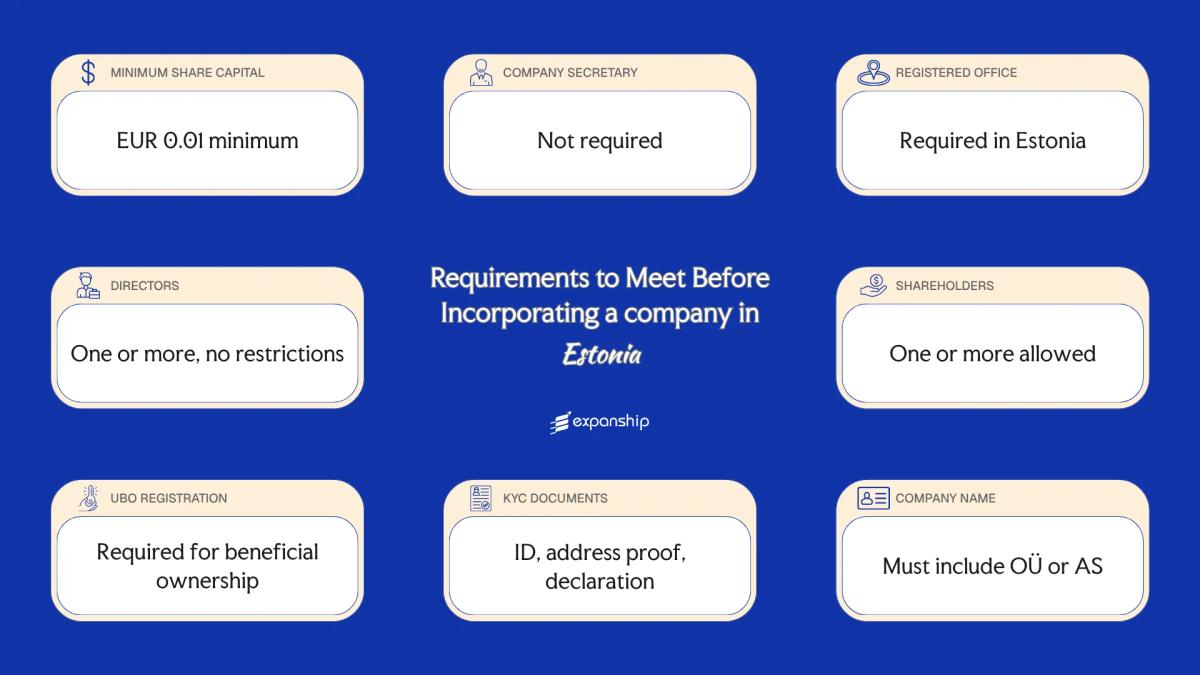
Minimum Share Capital Requirements in Estonia

Under the Commercial Code (Äriseadustik), Estonia minimum share capital requirements differ by entity type, with the private limited company (osaühing, or OÜ) subject to a statutory minimum of EUR 2,500. Shares in an OÜ are issued at a nominal value, meaning the entity operates on a par value system.
Capital contributions are verified through the Estonian Commercial Register (Äriregister), administered by the Centre of Registers and Information Systems (RIK). Your business must satisfy the paid-up capital requirement before the entity can be registered, making this a condition of incorporation rather than a post-registration obligation.
| Parameter | Detail |
|---|---|
| Minimum Authorized Share Capital | EUR 2,500 (OÜ) |
| Maximum Authorized Share Capital | No statutory requirement |
| Minimum Paid-Up Capital | EUR 2,500 |
| Paid-Up Requirement at Incorporation | Full amount must be paid up prior to registration |
| Accepted Currency | Euro (EUR) |
| Accepted Forms of Contribution | Monetary contributions; non-monetary (in-kind) contributions subject to valuation rules |
| Timeframe to Deposit Capital | Prior to submission of incorporation application to the Äriregister |
The full share capital must be deposited before the registration application is submitted. Registration will not proceed if the contribution has not been made and confirmed.
Company Secretary Requirements in Estonia
Under Estonian law, there is no statutory requirement for a company secretary as a distinct corporate officer. For an OÜ (osaühing), Estonia company secretary requirements do not exist in the conventional sense — the management board (juhatus) collectively assumes the administrative and compliance functions that a secretary would handle elsewhere.
Day-to-day obligations fall to the management board members, who are responsible for maintaining shareholder registers, filing annual reports with the Estonian Commercial Register, and ensuring that statutory records remain accurate and current.
Eligible persons or entities that may fulfill equivalent administrative and representative functions must meet the following conditions:
- Natural persons must be at least 18 years of age and possess full legal capacity.
- No Estonian residency is required; foreign nationals may serve without restriction.
- Persons with a criminal conviction for economic offences may be disqualified under the Commercial Code.
- Legal entities are not permitted to serve on the management board in this capacity.
- No professional licensing or certification is mandated for board members performing these functions.

Incorporate a Company in Estonia
Set up your Estonian OÜ with full compliance support, from Commercial Register filing to management board structuring.
Registered Office Requirements in Estonia
Estonia registered office requirements are defined under the Commercial Code (Äriseadustik), which obliges every registered company to maintain a legal address in Estonia at which official correspondence and state authority communications can be received. Failure to maintain a valid registered address can result in the Business Register initiating compulsory dissolution proceedings against the entity.
- A physical, deliverable address is required; a P.O. box alone does not satisfy the legal address requirement.
- Virtual office addresses are permitted, provided they allow for actual receipt of official correspondence at that location.
- The address must be located within Estonia; a foreign address cannot serve as the registered seat.
- No ownership of the premises is required, but a lease or service agreement with the address provider must be in place.
- The registered address is publicly listed in the Estonian Business Register (Äriregister) and accessible to third parties.
- Any change to the registered address must be formally notified to the Business Register, and the amendment takes legal effect only upon registration.
Director Requirements in Estonia

Under the Commercial Code (Äriseadustik), a director of an Estonian private limited company (OÜ) — referred to as a juhatuse liige — bears personal liability for damages caused to the company through breach of their duties, including the obligation to manage the entity with due diligence and in its best interests.
| Parameter | Detail |
|---|---|
| Minimum Number of Directors | One director is required. |
| Maximum Number of Directors | No statutory maximum; the articles of association may specify a limit. |
| Local/Resident Director Required | No residency requirement is imposed under Estonian law. |
| Nationality Restrictions | No nationality restrictions apply. |
| Minimum Age Requirement | Directors must be at least 18 years of age. |
| Corporate Directors Permitted | Corporate directors are not permitted; only natural persons may serve. |
| Director Must Be a Shareholder | No requirement for a director to hold shares in the company. |
| Publicly Listed on Registry | Directors are publicly listed on the Estonian Business Register (Äriregister). |
| Disqualification Conditions | A person previously disqualified by court order or convicted of certain economic offences may be barred from serving as a director. |
Non-residents can be sole directors of an Estonian OÜ without ever physically entering the country, as the entire appointment process can be completed remotely through the e-Business Register using e-Residency credentials.
Shareholder Requirements in Estonia

An Estonian private limited company (OÜ) requires at least one shareholder, with no statutory maximum. A sole shareholder structure is fully permitted under the Commercial Code.
Nationality and Residency Restrictions
Estonia imposes no nationality or residency requirements on shareholders. Foreign individuals and entities may hold 100% ownership in an OÜ without restriction.
Corporate Shareholders
Corporate entities are permitted to act as shareholders in an OÜ. No additional conditions are attached solely by virtue of the shareholder being a legal person rather than an individual.
Shareholder Liability
Shareholders bear limited liability, capped at their share capital contribution. Under the Commercial Code, personal liability does not ordinarily extend beyond that amount, though courts may pierce the corporate veil in cases of fraud or abuse of the legal form.
Register of Shareholders
An OÜ must maintain an internal register of shareholders. This register is not publicly accessible, though certain ownership data is submitted to the Estonian Business Register and becomes part of the public record.
Shareholder Structure Guidance for Your Estonian Company
Get clarity on ownership setup, shareholder eligibility, and registration obligations when incorporating an OÜ in Estonia.
UBO / Beneficial Ownership Registration Requirements in Estonia
Under Estonia's beneficial ownership registration requirements, a beneficial owner (tegelik kasusaaja) is defined as any natural person who ultimately owns or controls more than 25% of a company's shares, voting rights, or exercises control through other means. The legal framework derives from the Money Laundering and Terrorist Financing Prevention Act (MLTFPA), implemented in alignment with the EU's Fourth and Fifth Anti-Money Laundering Directives.
- Identify all natural persons meeting the UBO threshold prior to or at the time of incorporation.
- Submit UBO data to the Estonian Business Register (Äriregister) through the e-Business Register portal.
- Disclose each UBO's full name, date of birth, nationality, country of residence, and the nature and extent of their controlling interest.
- Update the register within 30 days of any change to UBO information.
| Parameter | Detail |
|---|---|
| Ownership Threshold for UBO Status | More than 25% of shares or voting rights |
| Filing Authority | Estonian Business Register (Äriregister) |
| Disclosure Deadline at Incorporation | At the time of incorporation |
| Publicly Accessible Register | Yes |
| Penalties for Non-Disclosure | Fines applicable under the MLTFPA; amount determined by supervisory authority |
| Ongoing Update Obligation | Within 30 days of any change |
KYC / Document Requirements in Estonia
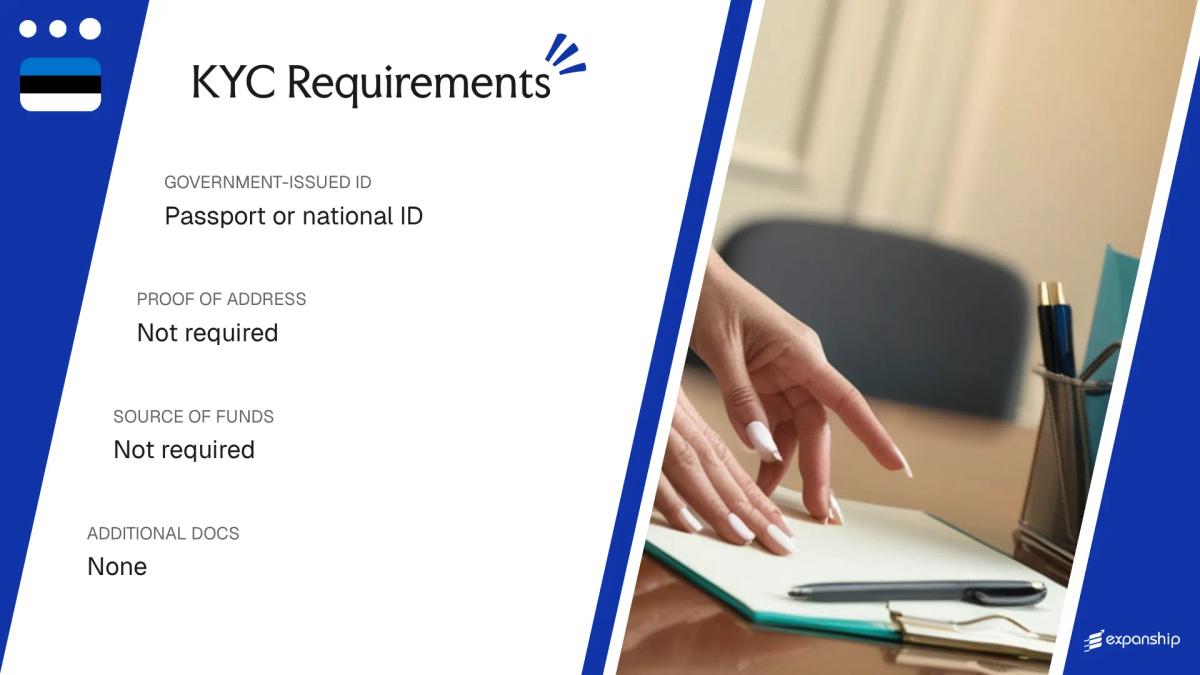
Estonia KYC document requirements apply at the point of incorporation and are governed by the Money Laundering and Terrorist Financing Prevention Act (rahapesu seadus), administered by the Financial Intelligence Unit (FIU).
Individual / Personal Documents
- Valid government-issued photo ID (passport or national ID card) for each director, shareholder, and beneficial owner
- Proof of residential address dated within three months, such as a utility bill or bank statement
- A signed declaration confirming the individual's role and capacity within the entity
- A completed beneficial ownership declaration where the individual holds 25% or more of shares or voting rights
Corporate Documents
- Certificate of incorporation or equivalent constitutional registration document for the corporate shareholder or director
- Articles of association or equivalent constitutional document showing governance structure
- Current register of directors confirming authorised signatories
- Proof of the corporate entity's registered office address
Source of Funds Documentation
- Bank statements covering a minimum of three to six months prior to incorporation
- Audited financial statements where the entity has trading history
- A written explanation of the origin of capital if the source is not self-evident from account records
Notarisation and Apostille Requirements
- Foreign public documents must carry an Apostille under the Hague Convention of 1961
- Documents not in Estonian or English generally require a certified translation
- Notarisation requirements vary by document type and the issuing country's legal system
The most common cause of incorporation delay is submission of proof-of-address documents that exceed the three-month validity threshold accepted by the Commercial Register.
Company Name Requirements in Estonia
Under Estonia company name requirements, proposed names are assessed against a uniqueness standard at the point of registration. The name must be clearly distinguishable from existing entries in the Estonian Business Register.
All private limited companies must append the suffix "osaühing" or its abbreviation "OÜ" to the business name. The name must be expressed in Estonian-compatible Latin characters.
Certain words implying state authority, financial supervision, or connection to regulated industries require prior approval from the relevant supervisory authority before registration is accepted. Words suggesting a link to the Estonian state or government are subject to additional scrutiny.
Name reservation is available through the Business Register portal. A reserved name is held for a defined period, during which no other entity may register an identical or confusingly similar name.
Compliance Services for Companies in Estonia
Maintain good standing with Estonian regulatory requirements, from annual reporting to Business Register filings.
Conclusion
Estonia incorporation requirements span several distinct legal obligations — from share capital thresholds under the Commercial Code to director residency rules and UBO registration with the Business Register. The e-Residency programme and fully digital registration process through the Company Registration Portal distinguish how foreign investors interact with these obligations in practice. Once the requirements are understood, the immediate next step involves preparing compliant documentation and identifying the right structure before formally submitting to the Estonian Business Register.
Expanship's Corporate Services for Estonia Expansion
Establishing an OÜ in Estonia involves several interlocking obligations, from share capital deposits and e-Residency considerations to UBO registration with the Estonian Business Register and maintaining a local contact address. Expanship's Estonia company formation services are structured around these specific requirements, so the administrative groundwork is handled methodically from the outset rather than left to you to piece together.
Beyond initial registration, Expanship supports your business across the full incorporation and post-incorporation cycle:
- We prepare and file all company registration documents with the Estonian Business Register on your behalf.
- A registered address and resident contact point in Estonia are provided to satisfy local office requirements.
- We liaise directly with the relevant government authorities throughout the filing process.
- Ongoing compliance obligations, including annual reporting, are managed to keep your entity in good standing.
- Where needed, we can facilitate introductions to banking partners familiar with Estonian-registered entities.
- VAT registration and coordination with the Estonian Tax and Customs Board are handled as part of our service.
Reach out to discuss your incorporation requirements with Expanship Estonia.
Frequently Asked Questions (FAQ)
Yes, a non-resident can be appointed as the sole director of an Estonian OÜ. Estonia imposes no nationality or residency requirement on board members under the Commercial Code. However, if no director holds a valid Estonian address or e-Residency, service of legal documents and communication with the Commercial Register may require additional procedural arrangements.
Failure to register beneficial ownership data in the Estonian Business Register, as required under the Money Laundering and Terrorist Financing Prevention Act, is a compliance violation that can result in administrative sanctions. The registry is publicly accessible, and omissions or inaccuracies are treated seriously by the Financial Intelligence Unit. Keeping this information current is an ongoing obligation, not a one-time registration step.
Estonia does not impose a statutory company secretary requirement under the Commercial Code, so there is no obligation to appoint one at all, local or otherwise. Corporate governance responsibilities that might fall to a secretary in other jurisdictions are typically handled by the management board in an OÜ structure.
The registered address must be a valid, legally recognised address in Estonia where official correspondence can be received, but it does not need to be a commercial office space. A registered agent address or virtual office service that meets the requirements of the Estonian Business Register is acceptable. The address is publicly listed in the register and must remain accurate at all times.
A single individual or legal entity can hold 100% of the shares in an Estonian OÜ. Shareholder information is recorded in the Estonian Business Register and is publicly accessible, meaning the identity of shareholders is not kept confidential. If the shareholder is also the ultimate beneficial owner, that information must separately appear in the beneficial ownership register under the Money Laundering and Terrorist Financing Prevention Act.
Incorporation cannot proceed until a name that satisfies the Commercial Code's naming requirements is accepted by the Estonian Business Register. There is no provision for a temporary or placeholder name during the process. You must submit a compliant name, which means it must be sufficiently distinct from existing registered entities and must not contain prohibited or misleading terms.
Legal Disclaimer
The information provided in this article is for general informational purposes only and does not constitute legal, tax, or professional advice. While we strive to ensure the accuracy and timeliness of the content, laws and regulations are subject to change, and the application of laws can vary widely based on specific facts and circumstances.
Readers should not act upon this information without seeking professional counsel tailored to their individual situation. Expanship and its authors disclaim any liability for actions taken or not taken based on the content of this article.
For specific advice regarding your business setup, compliance requirements, or any legal matters, please consult with qualified legal and tax professionals in the relevant jurisdiction.