

Key Takeaways
- Non-resident founders operating entirely outside Estonia face material difficulties opening and maintaining a corporate bank account, as most Estonian banks require a demonstrable local economic nexus that e-Residents typically cannot establish.
- Under the Estonian Income Tax Act, retained earnings in an OÜ are not taxed until distributed, but this deferred-distribution model also means profit extraction triggers a corporate income tax liability at the point of payout, creating a compliance event that requires careful cash-flow planning.
- OÜs that exceed statutory thresholds for turnover, assets, or headcount become subject to mandatory annual audit requirements, adding a recurring cost and administrative obligation that smaller foreign-owned entities may not have anticipated at incorporation.
- All official submissions to the Commercial Register and the Estonian Tax and Customs Board operate primarily in Estonian, meaning non-Estonian-speaking founders must bear the ongoing cost of translation or professional intermediary services to remain compliant.
Estonia operates under a well-documented regulatory framework, with company law governed by the Commercial Code. The framework is neither opaque nor minimally enforced — compliance obligations are clearly codified and actively monitored by bodies including the Estonian Tax and Customs Board and the Commercial Register.
The disadvantages of incorporating in Estonia span several distinct categories, from banking access to statutory filing requirements, each of which this article addresses in turn.
Not every foreign-owned OÜ will encounter the same friction. The business type, the owner's country of residence, and whether the firm has any physical presence in the country all affect which drawbacks carry practical weight.
This article is most relevant to non-resident founders, particularly those registering through e-Residency, who operate their business entirely from outside the country and have no local directors or staff.
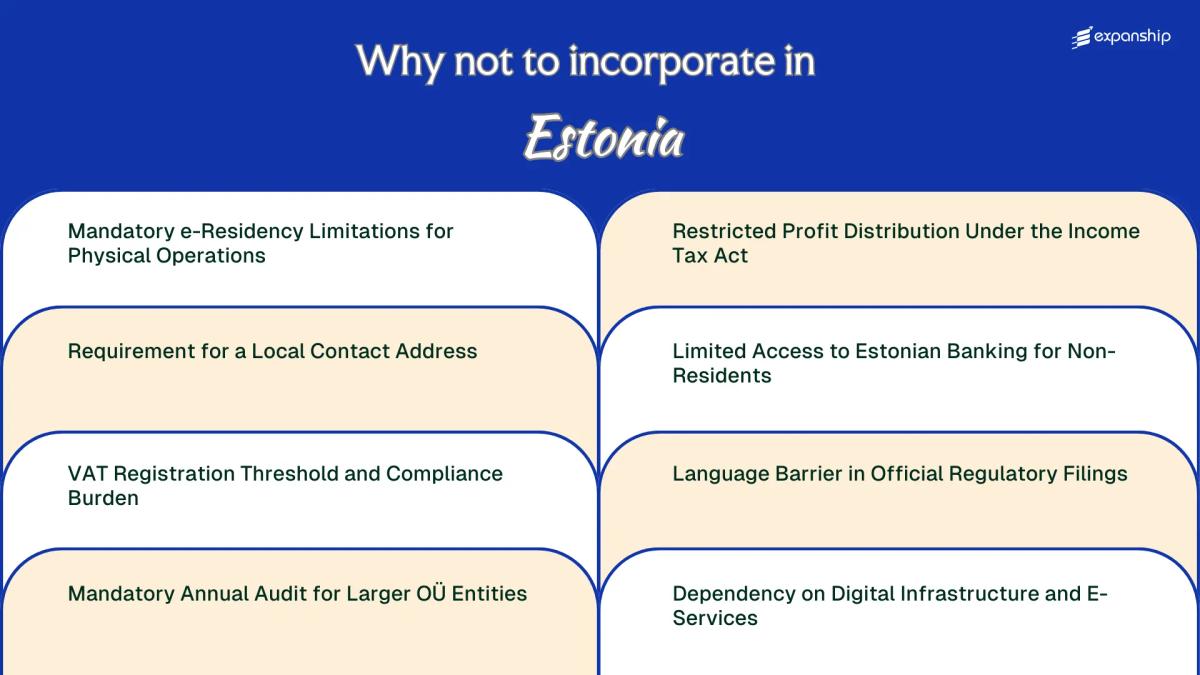
Mandatory e-Residency Limitations for Physical Operations
Estonia e-Residency physical operations limitations affect non-resident founders in ways that go beyond digital inconvenience. The e-Residency programme grants access to digital business tools, not a right to conduct physical commercial activity in the country.
Physical Presence Cannot Be Substituted by Digital Status
E-Residency is a digital identity issued by the Police and Border Guard Board. It does not confer the right to physically reside, work, or operate premises within Estonian territory, which means any business requiring local staff, warehouse space, or in-person client interaction cannot rely on e-Residency status alone to satisfy those operational needs.
Your OÜ remains legally registered, but the e-Residency restrictions Estonia imposes mean the firm has no physical footprint by default. For businesses in logistics, retail, or professional services requiring client-facing presence, this structural gap creates a real operational cost.
Cross-Border Management Adds Administrative Friction
Running an Estonian OÜ from abroad means company decisions, document signings, and regulatory correspondence must all be handled remotely. When time-sensitive filings or notarial acts arise, the absence of authorised local representation can delay processes significantly.
If your business model depends on any form of physical commercial activity in Estonia, e-Residency alone provides no legal basis for it, requiring separate arrangements that add cost and complexity.
Requirement for a Local Contact Address
Every OÜ registered in Estonia must maintain a valid local contact address in the Estonian commercial register. This Estonia company local contact address requirement is not optional — the address must be functional, able to receive official correspondence, and kept current at all times under the Commercial Code (äriseadustik).
For a foreign founder operating remotely, this means paying a registered address provider on an ongoing basis. The cost is a recurring overhead with no operational benefit, purely a compliance obligation tied to maintaining legal standing in the register.
The practical burdens this creates include:
- You must contract with a third-party address provider, adding a vendor dependency that requires active management
- Delays from a provider forwarding official post can cause missed deadlines for regulatory responses
- Address changes require a formal amendment to the commercial register, which generates additional administrative steps
- If your provider ceases operations, your registration risks becoming non-compliant until a replacement is secured
The Estonian Registration Department can flag or restrict a company if its registered address becomes invalid. That exposure falls entirely on the director, regardless of where they are physically located.

Company Incorporation in Estonia
Register your Estonian OÜ with a compliant local contact address handled as part of the formation process.
VAT Registration Threshold and Compliance Burden
Estonia VAT registration threshold problems tend to surface quickly for foreign-founded OÜs that generate revenue faster than anticipated. Under the Value Added Tax Act, the mandatory registration threshold is €40,000 in taxable turnover within a calendar year. Once crossed, registration with the Estonian Tax and Revenue Board (EMTA) becomes compulsory, and the obligations that follow are not trivial.
Monthly VAT returns are required after registration, regardless of transaction volume in a given period. For a non-resident director managing an Estonian entity remotely, this creates a recurring administrative obligation that demands either personal familiarity with EMTA's e-Tax portal or a paid local accountant.
| Obligation | Frequency | Consequence of Non-Compliance |
|---|---|---|
| VAT return filing | Monthly | Penalty interest and surcharges from EMTA |
| VAT payment deadline | By 20th of following month | Late payment interest at 0.06% per day |
| EC Sales List (for intra-EU supplies) | Monthly | Separate filing failure triggers penalties |
| VAT registration application | Within 3 days of exceeding threshold | Retroactive liability from threshold breach date |
The three-day registration window after breaching the threshold is particularly punishing for businesses without real-time revenue monitoring. Missing that window exposes your firm to retroactive VAT liability, meaning output tax is owed on sales made before registration was even completed.
Businesses supplying digital services to Estonian consumers face an additional layer of complexity, as EU OSS registration does not exempt you from local EMTA obligations in every scenario. The compliance burden grows disproportionately for small-revenue entities operating just above the threshold.
Mandatory Annual Audit for Larger OÜ Entities
Estonia OÜ mandatory audit requirements apply once a private limited company crosses specific size thresholds defined under the Auditors Activities Act and the Accounting Act. Triggering the obligation requires meeting at least two of three criteria: annual net sales exceeding €4 million, a balance sheet total above €2 million, or an average headcount of more than 50 employees.
For most early-stage foreign-owned firms, these figures may seem distant. But a growing e-commerce or SaaS business can breach two thresholds faster than anticipated, at which point the company must engage a licensed Estonian auditor, adding a recurring professional cost that has no equivalent in jurisdictions with higher or no mandatory audit thresholds.
The audit must be conducted by a sworn auditor approved under the Auditors Activities Act. Sourcing a qualified auditor from abroad is not straightforward, since the Estonian Board of Auditors regulates who can perform these engagements.
- Two of three statutory size thresholds must be met before the obligation activates
- The audit must be completed by a sworn auditor registered in Estonia
- Audited annual accounts must be submitted to the Business Register
- The obligation recurs annually for as long as the firm exceeds the thresholds
- Failure to comply can result in enforcement action from the Business Register
An OÜ with a sole shareholder who is also the sole board member is still subject to mandatory audit if size thresholds are met, regardless of how simple the company's ownership structure is.
Restricted Profit Distribution Under the Income Tax Act
Estonia profit distribution restrictions arise directly from the structure of the Income Tax Act (Tulumaksuseadus), which defers corporate tax until profits are actually distributed rather than earned.
How the Tax Deferral Creates a Withdrawal Constraint
Under the Tulumaksuseadus, an OÜ pays a 20% corporate income tax only at the point of profit distribution. While this defers the tax liability, it means your business cannot extract retained earnings without triggering an immediate 20/80 tax charge on the gross distribution, making large or frequent withdrawals disproportionately costly compared to jurisdictions where tax is paid annually on accrued profit regardless of distribution.
Practical Burden on Foreign Shareholders
For a non-resident founder relying on the company as a primary income source, the tax-on-distribution model discourages regular dividend withdrawals and can create cash flow tension between the entity's reported profit and the founder's accessible income. The Estonian Tax and Customs Board (Maksu- ja Tolliamet) administers this obligation, and any misclassification of a distribution as a loan or expense to avoid the charge carries significant penalty exposure.
Guidance on Profit Distribution Challenges in Estonia
Understand how Estonia's income tax structure affects your withdrawal strategy before committing to incorporation.
Limited Access to Estonian Banking for Non-Residents
Estonia banking access problems for non-residents are among the most consistently reported friction points when operating an OÜ from abroad. Major Estonian banks, including Swedbank, SEB, and LHV, apply stringent due diligence requirements that disproportionately affect non-resident directors.
- Banks operating under Estonia's anti-money laundering framework regularly decline account applications from OÜ entities with no local economic substance, leaving many foreign-owned firms without a domestic banking relationship.
- LHV, which actively serves e-residents, still requires demonstrable business activity tied to the EU to approve an account, meaning a purely offshore operational model is likely to be rejected.
- Non-resident directors unable to visit a branch in person face additional document verification hurdles that domestic applicants do not encounter.
- Without a local Estonian bank account, collecting VAT, paying state fees to the Tax and Customs Board, and processing payroll becomes operationally dependent on foreign banking workarounds.
- The OÜ banking challenges non-resident directors face are compounded when the firm's clients, suppliers, or revenues have no visible connection to the European Economic Area.
Language Barrier in Official Regulatory Filings
The Estonia regulatory filings language barrier is a structural obstacle that tends to catch foreign founders off guard after incorporation. Under the Commercial Code and the rules administered by the Centre of Registers and Information Systems (RIK), the official language of all state registry submissions is Estonian.
Annual reports filed with the e-Business Register, shareholder resolutions, and amendments to the articles of association must all be submitted in Estonian. If your documents originate in another language, certified translation is required before submission, adding both cost and delay to routine compliance tasks.
For an OÜ with international owners who have no Estonian-language capability, this dependency extends beyond one-off filings. Ongoing correspondence from the Tax and Customs Board (EMTA) is also conducted in Estonian by default.
- Official filings with RIK must be in Estonian
- EMTA tax notices and audit communications default to Estonian
- Certified translations are not always accepted as substitutes for original-language documents in formal proceedings
A foreign-owned OÜ requiring certified Estonian translation for its annual report, two shareholder resolutions, and one registry amendment in a calendar year could realistically incur EUR 800–1,500 in translation fees alone, before accounting for any delays caused by translator availability or document revision cycles.
Dependency on Digital Infrastructure and E-Services
Estonia digital infrastructure dependency risks are not theoretical. The entire corporate compliance system, from filing annual reports with the Commercial Register to submitting tax declarations through the Estonian Tax and Customs Board (EMTA) portal, operates through state-run digital platforms. Any outage, authentication failure, or technical fault in these systems directly interrupts your ability to meet statutory deadlines.
Your access to these platforms depends on a functioning e-Residency smart card and compatible card reader hardware. If your card expires, is damaged, or encounters a software conflict with your operating system, you cannot authenticate into the e-Business Register or EMTA until the issue is resolved, which may take days or weeks depending on your location relative to a Police and Border Guard Board service point.
- Filing annual accounts through the e-Business Register requires uninterrupted digital access at the point of submission.
- Tax obligations, including VAT returns and corporate income tax declarations, are submitted exclusively through EMTA's e-services environment.
- Notarial acts conducted remotely depend on the availability of the notary's digital infrastructure alongside your own.
There is no parallel paper-based fallback for most of these filings. Missed deadlines due to technical failures on your end carry the same legal consequences as any other non-compliance.
If your e-Residency card is revoked by the Police and Border Guard Board, access to all linked digital services is suspended immediately, leaving your OÜ unable to fulfil statutory filings until a replacement is issued and authenticated.
Overcoming These Incorporation Challenges
Overcoming These Incorporation Challenges
Overcoming Estonia incorporation challenges requires structural preparation rather than reactive fixes. Several of the barriers discussed in this blog have established procedural pathways that allow foreign businesses to operate within the existing regulatory framework.
- Register a virtual office through a licensed provider to satisfy the mandatory local contact address requirement under the Commercial Code.
- Apply for e-Residency through the Police and Border Guard Board before initiating OÜ formation to avoid delays in digital access.
- Open a payment institution account as an interim banking solution while pursuing a full Estonian bank relationship.
- Engage a sworn translator for Estonian-language filings submitted to the Commercial Register to maintain compliance.
- Monitor annual revenue against the VAT registration threshold with the Estonian Tax and Customs Board to avoid unintentional non-compliance.
Each of these steps operates within a digitally administered system where the e-Business Register and the Tax and Customs Board serve as the primary compliance interfaces. Structural preparation before incorporation reduces the risk of procedural gaps once the entity is active.
Estonia's Overall Appeal for Foreign Investors
Despite the disadvantages covered throughout this blog, Estonia remains a credible incorporation destination for foreign-owned digital businesses, particularly those operating without a physical presence in Europe. The e-residency programme, the distributed profit tax model under the Income Tax Act, and the digital-first company registry give it a functional infrastructure that few jurisdictions at this price point can match.
| Pros | Cons |
|---|---|
| Corporate tax is deferred until profit distribution, preserving cash within the business | Distributed profits are subject to a flat 22% income tax rate with no participation exemption for most structures |
| Company formation and management are handled digitally through the e-Business Register | Banking access for non-resident directors remains restricted, with most major Estonian banks declining account applications |
| Annual reporting obligations are straightforward for smaller OÜ entities | Larger firms meeting the thresholds under the Auditing Activities Act face mandatory statutory audit costs |
| The e-residency programme enables remote directorship without relocation | E-residency confers no right of entry, tax residency, or EU physical presence |
| VAT registration is required once turnover exceeds €40,000, which is lower than several EU peers | VAT compliance and filings add administrative burden for service-based businesses crossing the threshold |
Foreign owners should assess whether their business model aligns with the digital-service profile the system was designed to support. Firms requiring physical banking relationships, local staff, or on-the-ground operations will encounter friction that the digital infrastructure does not resolve.
Compliance Services for Estonian Companies
Annual reporting, VAT filings, and ongoing regulatory compliance for OÜ entities registered in Estonia.
Conclusion
The cons of Estonia company registration are real and specific, not theoretical. Banking access for non-residents remains a persistent friction point, with most licensed credit institutions applying heightened due diligence that delays or blocks account opening entirely. Dependency on the e-Residency digital infrastructure introduces operational risk when systems are unavailable or certificates require renewal. The Estonian Income Tax Act's deferred taxation model, while often cited as an advantage, imposes constraints on how and when profits can be extracted. Professional guidance on local compliance obligations can reduce exposure to these structural limitations.
Expanship's Estonia Company Formation Support
Incorporating in Estonia carries real administrative weight, particularly for non-residents managing e-Residency limitations, contact address obligations, and filings with the Äriregister. Expanship's Estonia company formation support is designed to reduce the operational burden these requirements place on foreign founders, from initial registration through ongoing compliance with the Commercial Code and Estonian Tax and Customs Board obligations.
Beyond formation, our services cover the full post-incorporation cycle.
- We prepare and file all company registration documentation with the Äriregister on your behalf.
- A registered agent and Estonian contact address are provided to satisfy local presence requirements.
- We liaise directly with government bodies and regulatory authorities for filings and correspondence.
- Post-incorporation compliance management keeps your entity in good standing year to year.
- Banking introduction assistance connects your business with institutions familiar with non-resident OÜ structures.
- Tax registration and coordination with the Estonian Tax and Customs Board are handled as part of our service.
Reach out through Expanship Estonia to discuss your incorporation requirements.
Frequently Asked Questions (FAQ)
Yes. Under the Estonian Income Tax Act, corporate profits are only taxed at the point of distribution, not when earned. This deferred taxation model means the 20% corporate income tax applies when you declare a dividend, and the timing of that distribution is a deliberate financial decision, not a free withdrawal. Retaining profits inside the entity is straightforward, but any distribution triggers the tax obligation immediately.
If your OÜ's taxable turnover exceeds €40,000 in a calendar year and you have not registered for VAT with the Estonian Tax and Customs Board (EMTA), you are liable for the VAT that should have been charged on past transactions, potentially including penalties and interest. EMTA can audit and assess back-taxes on unregistered supplies. The obligation to register arises at the point the threshold is crossed, not at year-end.
No, the statutory audit requirement applies only to larger OÜ entities that meet specific thresholds under the Auditors Activities Act. A company must exceed at least two of three criteria across two consecutive financial years: net revenue over €4 million, total assets over €2 million, or an average of more than 50 employees. Smaller entities fall under a less intensive agreed-upon procedures review or may be exempt entirely, depending on their size.
Costs vary by provider, but registered address services for an Estonian OÜ typically range from €100 to €300 per year for a basic legal address. Some providers bundle this with mail handling or document forwarding for a higher fee. The address must be a genuine Estonian address registered in the commercial register, and using an invalid or outdated address can result in the company being struck off by the registrar.
Estonian is the sole official language for filings submitted to the commercial register (äriregister) and EMTA, which places a higher translation burden on non-Estonian-speaking directors than in jurisdictions like Ireland or the Netherlands where English is widely accepted officially. While the e-Business Register portal has an English interface for many functions, formal documents such as annual reports and articles of amendment must meet Estonian language requirements. This is not unique among smaller EU member states, but it adds a recurring administrative cost that founders frequently underestimate.
The registrar can issue a warning and impose a fine for late submission, and persistent non-compliance can result in compulsory dissolution proceedings initiated by the registrar under the Commercial Code. Annual reports are due within six months of the financial year-end, typically by June 30 for entities with a calendar year. Directors bear personal responsibility for ensuring timely submission, and the entity's good standing status visible in the public register is affected immediately once a report becomes overdue.
Appointing a local contact person satisfies the commercial register's formal address and contact requirements under the Commercial Code, but it does not resolve the economic substance concerns that Estonian banks use to assess account applications. Banks evaluate where management decisions are made, where clients are located, and whether the business has genuine ties to Estonia. A contact person is an administrative appointment, not evidence of local substance, and will not meaningfully improve your chances of securing a full Estonian bank account.
Legal Disclaimer
The information provided in this article is for general informational purposes only and does not constitute legal, tax, or professional advice. While we strive to ensure the accuracy and timeliness of the content, laws and regulations are subject to change, and the application of laws can vary widely based on specific facts and circumstances.
Readers should not act upon this information without seeking professional counsel tailored to their individual situation. Expanship and its authors disclaim any liability for actions taken or not taken based on the content of this article.
For specific advice regarding your business setup, compliance requirements, or any legal matters, please consult with qualified legal and tax professionals in the relevant jurisdiction.