

Key Takeaways
- Under Estonia's Income Tax Act, corporate profits face zero tax at the point of retention, meaning businesses that reinvest earnings rather than distribute them can defer corporate income tax indefinitely.
- Formation of an OÜ (Osaühing) through the e-Business Registry requires no physical presence in Estonia, removing a structural barrier that complicates incorporation in most other EU jurisdictions.
- The e-Residency programme gives non-resident entrepreneurs legal access to Estonian digital business infrastructure, enabling them to operate an EU-registered entity without relocating or establishing a physical office.
- Foreign investors can hold 100% of shares in an Estonian entity without a local partner or government approval, providing full ownership control from the date of registration.
Estonia is an independent republic and EU member state located in Northern Europe, bordered by Latvia to the south and Russia to the east. Company registration is administered by the e-Business Registry, which operates under the Centre of Registers and Information Systems. Foreign investors most commonly establish an OÜ (Osaühing) when setting up operations in the country.
From a tax standpoint, corporate profits are not taxed at the point of retention — only distributed earnings trigger corporate income tax, making the benefits of incorporating in Estonia particularly relevant to businesses that reinvest capital. Foreign ownership faces no structural restrictions; non-residents can hold 100% of shares in a locally registered entity without requiring a local partner or government approval.
Your business does not need to be physically based in Europe to register here, and the firm you establish can open banking relationships and enter EU contracts from day one. This article outlines the concrete advantages that Estonia company formation offers to foreign investors across operational, regulatory, and fiscal dimensions.
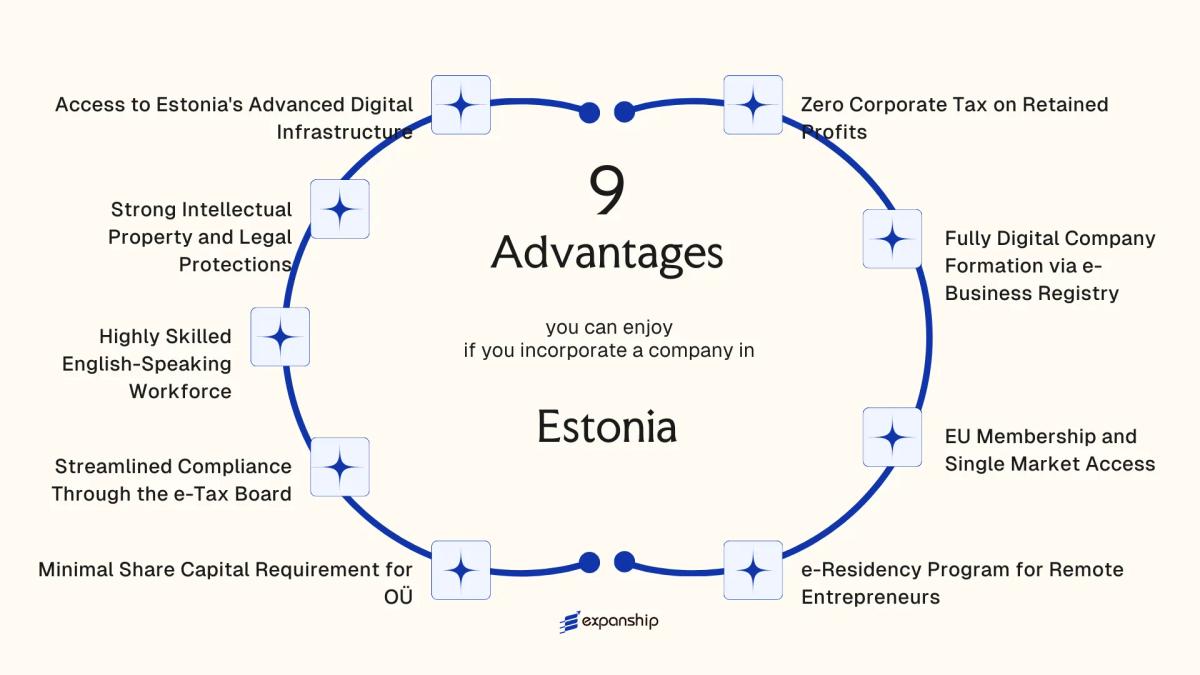
Zero Corporate Tax on Retained Profits
Under the Estonian Income Tax Act, corporate profits are not taxed at the point of earning. Tax liability arises only when profits are distributed, making Estonia zero tax on retained profits one of the most structurally distinctive features of the country's fiscal regime.
How the Deferral Mechanism Works
Retained earnings sit on the balance sheet of an OÜ (osaühing) without triggering any corporate income tax obligation. This Estonia corporate tax deferral advantage means your business can reinvest 100% of its net profits into operations, equipment, or expansion without first losing a percentage to the state.
What Triggers the Tax Charge
Distribution events — dividends paid to shareholders — activate a 20% tax, calculated on a gross-up basis (20/80 of the net amount). Qualifying regular distributions made by companies meeting specific payment history criteria are taxed at a reduced 14% rate under Article 50¹ of the Income Tax Act. The Estonian OÜ retained earnings tax benefit therefore rewards businesses that prioritize growth over early profit extraction.
Retained profits compound untaxed inside your OÜ for as long as you choose not to distribute them.
Fully Digital Company Formation via e-Business Registry
Registering a company through the e-Business Registry (Ettevõtjaportaal) takes as little as 15 to 30 minutes for applicants who hold an e-Residency card or an Estonian digital ID. This is not a simplified filing portal — it is a fully legally binding registration system that produces a registered OÜ (osaühing) without requiring physical presence, notarization, or in-person attendance at a government office. For a foreign business owner, that distinction eliminates an entire category of logistical friction that exists in most other EU jurisdictions.
The practical implication is direct: your company can be incorporated, receive its registry code, and be legally operational — all without travel, local agents, or paper documents.
What makes this structure genuinely favourable for foreign founders:
- The registry accepts digital signatures under the EU's eIDAS regulation, giving them the same legal standing as handwritten signatures across member states.
- No notary is required for standard OÜ formation, unlike in Germany, France, or Austria.
- The registry integrates directly with the Tax and Customs Board (Maksu- ja Tolliamet), so VAT registration can follow immediately after incorporation.
- All filings, annual reports, and amendments to the articles of association are managed through the same portal.
Estonia's digital company formation benefits are most accessible to founders who already hold valid digital identification credentials — without these, the process requires a contact person resident in Estonia.

Company Incorporation in Estonia
Incorporate your Estonian OÜ through the e-Business Registry without travel or paper-based filings.
EU Membership and Single Market Access
As an EU member state, Estonia grants incorporated companies full access to the single market, which covers over 440 million consumers across 27 countries. For a foreign business owner, this means your Estonian entity can sell goods, supply services, and enter commercial contracts across the bloc without establishing separate legal presences in each target market. That operational reach, available through one registered company, has a direct effect on cost structure and market entry timelines.
| Access Right | Applicable Scope | Governing Framework |
|---|---|---|
| Free movement of goods | All EU member states | TFEU Articles 28-37 |
| Freedom to provide services | All EU member states | TFEU Articles 56-62 |
| Freedom of establishment | All EU member states | TFEU Articles 49-55 |
| EU VAT registration (MOSS/OSS) | Cross-border digital and goods sales | EU VAT Directive 2006/112/EC |
Participation in EU procurement frameworks is another concrete outcome. An Estonian-registered firm can bid on public contracts throughout the union under the same rules as locally incorporated entities. For businesses targeting government or institutional buyers in multiple European markets, this removes a structural barrier that non-EU companies routinely face.
EU membership also means your business operates under the mutual recognition principles embedded in the Treaty on the Functioning of the European Union. Regulatory approvals, professional qualifications, and certain product certifications obtained under Estonian or EU standards carry weight across member states, reducing redundant compliance work when expanding within the bloc.
e-Residency Program for Remote Entrepreneurs
Estonia's e-Residency program, launched in 2014 under the Digital Identity and Trust Services Act framework, grants non-residents a government-issued digital identity. This allows you to establish and manage an Estonian private limited company (OÜ) entirely without relocating. For a foreign entrepreneur operating across borders, that separation between physical presence and legal business identity has direct, practical value.
Your digital ID card enables you to sign documents, file with the e-Business Registry, submit tax declarations through the e-MTA portal, and operate a banking relationship — all remotely. The business exists within EU legal jurisdiction from day one, which affects how counterparties, payment processors, and institutional clients assess your firm's credibility.
Because the OÜ is incorporated under Estonian law and registered with the Commercial Register (Äriregister), it is treated as an EU-resident entity, not an offshore structure. That distinction affects access to EU-based financial services and compliance standing under international due diligence frameworks.
Keep these points in mind:
- e-Residency grants digital identity only; it does not confer tax residency or the right to live in Estonia
- Your company's tax residency is determined by place of effective management, not incorporation
- A licensed service provider or local contact address is required for OÜ registration
- Banking access depends on your business profile and individual provider requirements
e-Residency holders from over 170 countries have used the program, yet the digital ID itself carries no travel or immigration privileges whatsoever.
Minimal Share Capital Requirement for OÜ
The Estonia OÜ low share capital advantage is one of the most structurally significant features of the Estonian private limited company form. Under the Commercial Code (Äriseadustik), an OÜ can be founded with a minimum share capital of just €2,500. More consequentially, founders may defer the actual contribution of that capital until the company begins generating revenue, provided the articles of association permit this arrangement.
What the Capital Rules Actually Allow
For a foreign investor, this deferred contribution model means the entity can be registered and fully operational before any capital is transferred to a corporate account. The obligation to pay in the share capital arises upon a shareholders' resolution or when the company's financial position requires it, not at the moment of registration.
This structure reduces the liquidity burden at formation. Capital that would otherwise be locked into a statutory deposit remains available for early-stage operating costs.
Why the Threshold Matters Relative to Other EU Structures
Across the EU, minimum capital requirements for equivalent private limited company structures vary considerably. Germany's GmbH, for instance, requires €25,000 in fully paid-up capital at formation. The OÜ threshold is ten times lower, and the deferred payment option is a further distinction that reduces the financial barrier for foreign nationals forming a business remotely.
That said, certain regulated activities in Estonia may impose their own minimum capital requirements, which supersede the general Commercial Code threshold.
Plan Your Estonian Company Formation with Confidence
Get tailored guidance on capital structure, registration requirements, and compliance obligations for your OÜ in Estonia.
Streamlined Compliance Through the e-Tax Board
Estonia's e-Tax Board (e-MTA) is the digital portal through which resident and non-resident companies submit VAT returns, employment taxes, corporate income tax declarations, and customs-related filings. The Estonia e-Tax Board compliance advantages for foreign-owned firms come down to one structural reality: obligations that typically require local accountants or in-person visits in other EU member states can be met entirely online, from any location.
- VAT returns, TSD (income and social tax) declarations, and annual income tax reports are all submitted through e-MTA without paper forms or notarised documents.
- The system pre-populates certain fields using data already held by the Tax and Customs Board (Maksu- ja Tolliamet), reducing manual input and the likelihood of filing errors.
- Filing deadlines are standardised, with most periodic declarations due by the 10th of the following month, giving your finance team a predictable compliance calendar.
- Estonian MTA digital tax filing benefits extend to payment processing: tax liabilities can be settled directly through the portal via bank transfer, with immediate confirmation.
- Access is managed through the same e-Residency digital ID or Mobile-ID used across other Estonian government systems, meaning no separate credentials or local representative are required solely for tax purposes.
Highly Skilled English-Speaking Workforce
The Estonia English-speaking workforce advantage is particularly relevant for foreign companies that need functional teams without the overhead of language training or translation infrastructure. English proficiency among working-age professionals is high, a pattern consistent with Estonia's long-standing integration of English-language education at the secondary and university levels.
Tallinn's universities, including Tallinn University of Technology (TalTech) and the University of Tartu, produce graduates across engineering, software development, cybersecurity, and finance. Many degree programs are delivered in English, which shapes a talent pool already accustomed to operating in international business environments.
For an international firm, this reduces onboarding friction considerably. Communication with local staff, contractors, or co-founders does not require intermediaries, and employment contracts, internal policies, and corporate documentation can be maintained in English without legal complications under Estonian private law.
The country's population is small at roughly 1.4 million, so absolute talent volume is limited. Within the tech and digital services sectors, however, the ratio of skilled professionals relative to market size is disproportionately favorable, which benefits hiring in Estonia for international businesses operating in those verticals.
According to the EF English Proficiency Index 2023, Estonia ranks among the top tier of European countries for English proficiency, placing it in the "Very High Proficiency" band alongside the Nordic states.
Strong Intellectual Property and Legal Protections
Estonia intellectual property protection benefits stem from a legal framework grounded in EU-harmonised law, including alignment with the EU Trademark Regulation, the Software Directive, and the Copyright Directive. Because the country is a signatory to the Berne Convention, the Paris Convention, and the TRIPS Agreement, IP rights registered or created here carry international enforceability across member states and signatory jurisdictions.
Domestic IP rights are administered through the Estonian Patent Office (Patendiamet), which handles patents, trademarks, industrial designs, and utility models. Registration through this body can also feed into EU-wide protection mechanisms, meaning a single filing pathway can yield broader territorial coverage.
For software-focused and digitally native businesses, Estonia's legal treatment of software is particularly relevant. Software is protected as a literary work under copyright law, without requiring registration, which reduces administrative overhead for tech firms building proprietary products.
- Contract law and IP ownership disputes are handled through the Estonian court system, which operates under the Code of Civil Procedure.
- The judiciary is fully independent, and commercial cases at first instance are heard by county courts, with appeal rights extending to circuit courts and the Supreme Court (Riigikohus).
IP rights registered solely through Patendiamet provide national protection; separate EU-level or international filings are required for broader territorial coverage.
Access to Estonia's Advanced Digital Infrastructure
Estonia digital infrastructure benefits for business extend well beyond e-government convenience. The country operates one of the most interconnected public digital ecosystems in the EU, built on the X-Road data exchange layer, a decentralised infrastructure that links government databases, financial institutions, and private sector systems. For a foreign-owned company registered here, this means your business can interact with state registries, tax authorities, and banking systems through a single authenticated digital identity rather than parallel paper-based processes.
X-Road and Interoperability
X-Road allows government agencies and private entities to exchange data securely without centralising that data in a single repository. Your company can query business registry records, verify tax standing, or confirm VAT registration status programmatically, which has direct value if you operate compliance-sensitive services or need to automate due diligence workflows.
Digital Identity as a Functional Business Tool
Authentication in the Estonian system uses chip-based ID cards and digital signature certificates that carry legal equivalence to handwritten signatures under the Electronic Identification and Trust Services Regulation (eIDAS). Contracts, filings, and authorisations executed digitally carry the same legal weight as physical documents across all EU member states.
Infrastructure Reliability and Legal Grounding
The digital framework is governed under the Information Society Services Act and supported by the Estonian Information System Authority (RIA), which sets technical standards and monitors system integrity. Your business operations depend on infrastructure with defined legal accountability, not informal technical arrangements.
- Business registry queries are available via machine-readable API
- Digital signatures issued in Estonia are accepted across EU jurisdictions under eIDAS
- The X-Road environment includes both public sector and private sector participants
Why Estonia Stands Out Among EU Jurisdictions
Among EU member states targeting foreign-incorporated businesses, the jurisdictions a non-resident founder realistically weighs against Estonia tend to be Ireland, the Netherlands, and Latvia. Ireland and the Netherlands attract similar profiles of internationally mobile businesses due to their EU status and tax structures. Latvia shares geographic proximity, a comparable digital agenda, and a similar OÜ-equivalent corporate form. Comparing these three reveals where Estonia's structural advantages are most distinct.
What the table below shows is not simply a feature checklist, but a pattern: Estonia's combination of a deferred corporate tax model under the Income Tax Act, non-resident directorship permissions, and the e-Residency programme creates a formation and operational profile that does not require physical presence at any stage. Ireland and the Netherlands offer competitive tax environments, but neither replicates the fully digital formation process through the e-Business Registry or the statutory deferral of tax until profit distribution.
| Parameter | Estonia | Ireland | Netherlands | Latvia |
|---|---|---|---|---|
| Corporate Tax on Retained Profits | 0% (tax deferred until distribution) | 12.5% on trading income | 19–25.8% (tiered) | 20% (deferred model also available) |
| Non-Resident Director Permitted | Yes | Yes (with resident secretary requirement) | Yes | Yes |
| Fully Digital Non-Resident Formation | Yes, via e-Business Registry | Partial | Partial | Partial |
| e-Residency Programme | Yes | No | No | No |
| Minimum Share Capital (Private Company) | EUR 0.01 (OÜ) | EUR 1 | EUR 0.01 | EUR 1 |
| EU VAT Registration Access | Yes | Yes | Yes | Yes |
Compliance Services for Estonian Companies
Maintain your Estonian company's statutory obligations with structured support across annual reporting, tax filings, and regulatory submissions.
Conclusion
Estonia's position as a EU-member digital economy gives foreign entrepreneurs a structurally distinctive foundation: deferred corporate taxation under the Income Tax Act means retained profits remain untaxed until distributed, and formation through the e-Business Registry can be completed without physical presence. These are not incidental conveniences but design features of the Estonian system.
Two structural factors carry particular weight for foreign investors. The e-Residency programme grants non-residents legal access to Estonian digital business infrastructure, and EU membership provides the market access and regulatory standing that underpins cross-border commercial activity. Together, they reduce two of the most common friction points for internationally mobile businesses: physical presence requirements and market entry barriers.
The Estonia company formation advantages outlined across this article apply broadly, but their value depends on your specific circumstances. A holding entity structured around deferred distribution has different requirements than a software firm seeking EU market access, and neither profile is identical to a remote entrepreneur using e-Residency as their primary operational framework. Alignment between your business model and these structural features is what determines practical benefit.
As the regulatory environment for digital businesses continues to shift across EU member states, understanding how Estonian corporate law, tax treatment, and digital infrastructure interact with your specific structure becomes the foundation for any informed formation decision.
Start Your Estonian Company Formation with Expanship Today
Expanship assists foreign entrepreneurs and corporate clients with incorporating private limited companies (OÜ) under the Commercial Code of Estonia and maintaining compliance with the obligations administered by the Centre of Registers and Information Systems (RIK) and the Estonian Tax and Customs Board (EMTA). The services cover the full formation process, from initial structuring through post-incorporation requirements, without requiring your physical presence in Estonia at any stage.
Expanship's scope for Estonian company formation includes:
- Preparation and legalization of incorporation documents, including the articles of association and shareholder resolutions
- Registered address and contact person provision to satisfy the Commercial Code requirements for a local presence
- Filing and liaison with the e-Business Registry through the RIK portal on your behalf
- Post-incorporation compliance management, including annual report submissions to EMTA and maintenance of statutory records
- Registered agent services to handle official correspondence from Estonian regulatory authorities
- Banking introduction assistance to support account opening with Estonian or EU-based financial institutions
Starting your Estonia company formation with Expanship means each of these steps is handled with reference to the specific regulatory framework covered throughout this guide, from the OÜ's share capital mechanics to VAT registration thresholds under the Value Added Tax Act.
Reach out to Expanship Estonia to discuss your incorporation requirements.
Frequently Asked Questions (FAQ)
Under the Income Tax Act, corporate profits are not taxed at the point of earning but at the point of distribution. The standard rate applied to distributed profits is 20%, calculated on a gross-up basis, which means the effective rate on net profit is approximately 20/80. Retained earnings reinvested within the business carry no annual corporate tax liability until a dividend or deemed distribution is triggered.
The minimum share capital for a private limited company (OÜ) under the Commercial Code is €2,500, but founding shareholders may defer full payment under certain conditions permitted by law. The deferred contribution must be paid in before the company makes distributions to shareholders. This provision allows early-stage businesses to register and begin operations before committing the full capital amount.
E-Residency does not establish personal tax residency in Estonia, nor does it grant any right of residence, visa, or access to public services. The program is solely a digital identity scheme administered by the Estonian Police and Border Guard Board, designed to give non-residents access to Estonia's digital business environment. Your personal tax obligations remain governed by the tax laws of your country of residence.
An Estonian company can register trademarks, designs, and patents through the Estonian Patent Office, and EU-wide protections are accessible through the European Union Intellectual Property Office (EUIPO) and the European Patent Office (EPO) by virtue of EU membership. The Copyright Act and Industrial Property Acts govern domestic IP rights, and Estonia is a signatory to major international IP conventions including the Paris Convention and the Berne Convention. These frameworks allow your firm to secure and enforce IP rights across EU member states from a single registration base.
Formation through the e-Business Registry's online portal typically takes one business day for straightforward applications submitted with e-Residency credentials. More complex formations, or those requiring notarial involvement due to in-kind contributions or special share structures, may extend the timeline. The registry operates under the Commercial Code, which sets specific procedural requirements that affect processing time depending on the complexity of the founding documents.
Failure to file annual tax returns or financial statements with the e-Tax Board (Maksu- ja Tolliamet) and the Commercial Register respectively can result in financial penalties and, in persistent cases, compulsory dissolution proceedings initiated by the registrar. Directors bear personal liability under the Commercial Code if the company incurs obligations it cannot meet due to compliance failures. The registrar monitors submission deadlines and can issue warnings before escalating to formal enforcement action.
Legal Disclaimer
The information provided in this article is for general informational purposes only and does not constitute legal, tax, or professional advice. While we strive to ensure the accuracy and timeliness of the content, laws and regulations are subject to change, and the application of laws can vary widely based on specific facts and circumstances.
Readers should not act upon this information without seeking professional counsel tailored to their individual situation. Expanship and its authors disclaim any liability for actions taken or not taken based on the content of this article.
For specific advice regarding your business setup, compliance requirements, or any legal matters, please consult with qualified legal and tax professionals in the relevant jurisdiction.