

Key Takeaways
- All companies formed in Ecuador must register with the Superintendencia de Compañías, Valores y Seguros (SCVS) under the Ley de Compañías, and failure to complete this registration prevents the entity from operating as a legally recognized business.
- Foreign investors and local shareholders alike are subject to beneficial ownership disclosure obligations through the Registro de Accionistas, making transparent ownership reporting a mandatory compliance requirement rather than a voluntary disclosure.
- Maintaining a locally registered physical address in Ecuador is a structural prerequisite for incorporation, not an administrative formality that can be deferred after company formation.
- The regulatory framework governing Ecuador's corporate environment spans multiple instruments, including the Código Orgánico de la Producción, Comercio e Inversiones, meaning compliance obligations extend beyond entity formation into ongoing operational and reporting requirements.
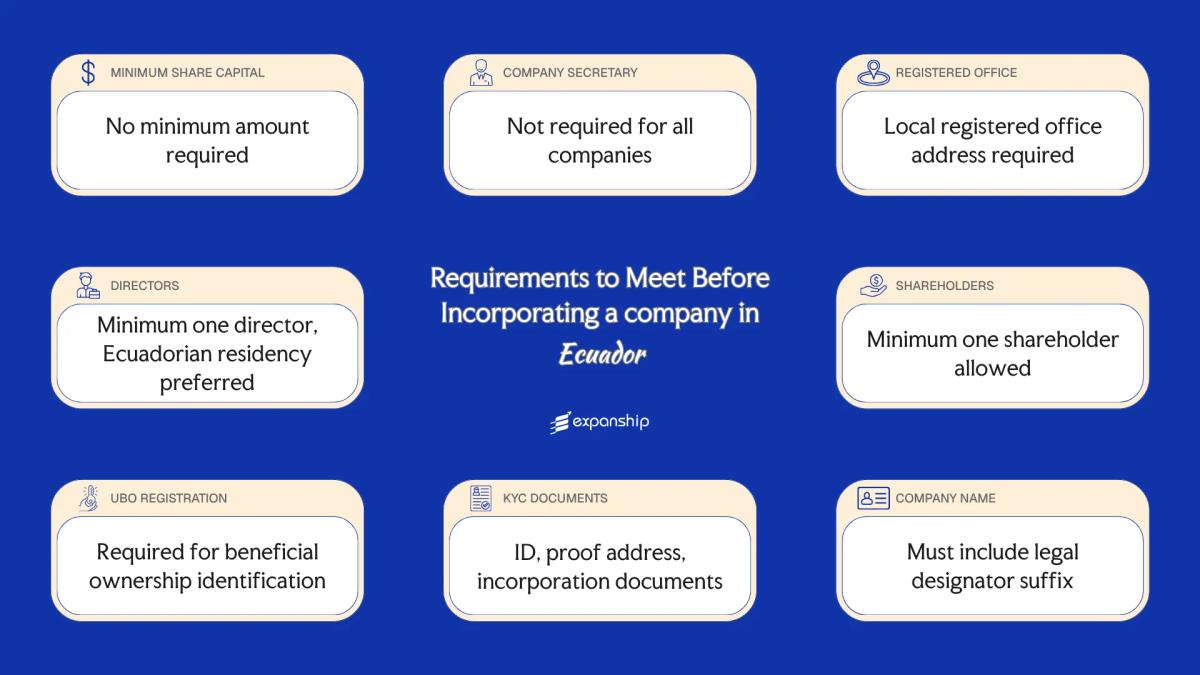
Corporate entity formation in Ecuador is governed primarily by the Ley de Compañías, administered by the Superintendencia de Compañías, Valores y Seguros (SCVS). This regulatory body oversees the registration, supervision, and dissolution of legal entities across the country. Meeting the incorporation requirements in Ecuador is not optional; failure to satisfy them results in rejection of the registration application or the inability to operate as a legally recognized entity.
This article covers the structural, documentary, and compliance-related requirements applicable to business formation under Ecuadorian law. Requirements can differ depending on the type of entity chosen, the sector in which the company will operate, and whether the applicant is a foreign national or a locally resident investor. You can review the governing legislation directly in the Ley de Compañías.
This article is most relevant to foreign investors and business owners seeking to establish a legal presence in Ecuador for the first time.
Minimum Share Capital Requirements in Ecuador
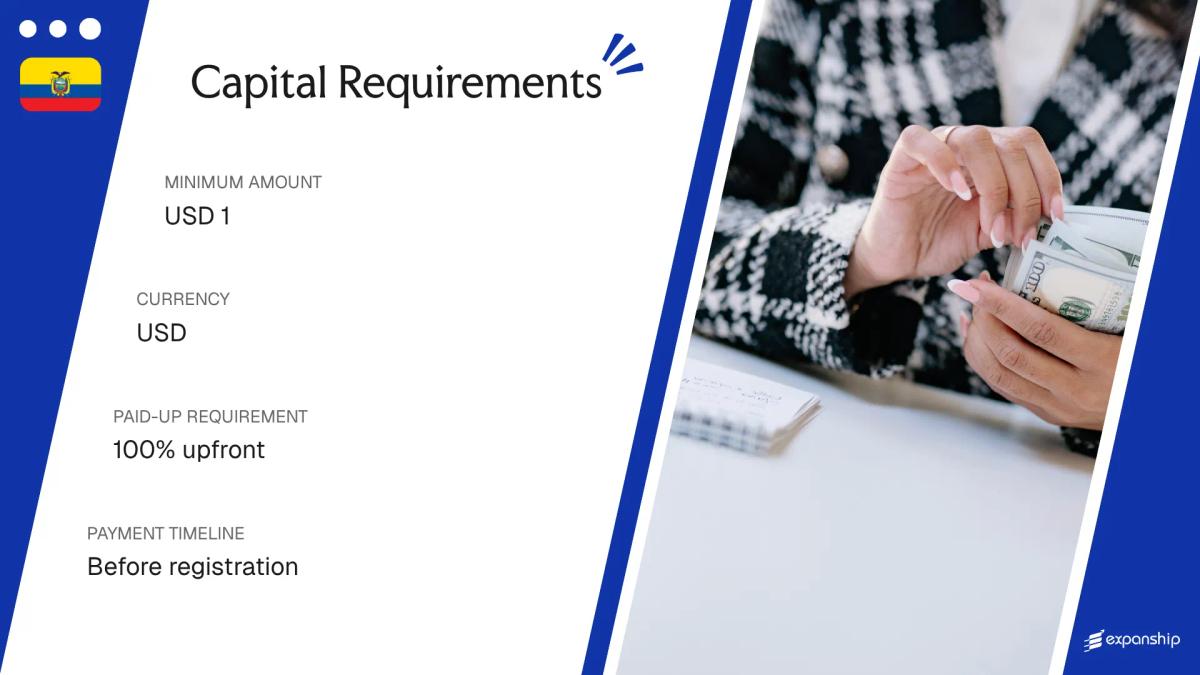
Minimum share capital requirements in Ecuador differ by entity type and are governed by the Ley de Compañías, enforced by the Superintendencia de Compañías, Valores y Seguros (SCVS). Ecuador operates on a par value share system, meaning each share carries a stated nominal value that must be reflected in the company's founding documents.
Capital must be deposited into a bank account opened in the company's name prior to registration with the SCVS. This deposit serves as a prerequisite for the incorporation process, not a post-registration obligation.
| Parameter | Detail |
|---|---|
| Minimum Authorized Share Capital | USD 400 for a Compañía de Responsabilidad Limitada; USD 800 for a Compañía Anónima |
| Maximum Authorized Share Capital | No statutory maximum |
| Minimum Paid-Up Capital | USD 400 (Cía. Ltda.); USD 800 (S.A.) |
| Paid-Up Requirement at Incorporation | 50% of subscribed capital must be paid up at incorporation |
| Accepted Currency | United States Dollar (USD) |
| Accepted Forms of Contribution | Cash or in-kind assets; in-kind contributions require independent valuation |
| Timeframe to Deposit Capital | Prior to filing with the SCVS |
The bank deposit confirming paid-up capital must exist before the SCVS will process the incorporation deed. Opening a corporate account without first having a registered entity requires using a provisional account, which the notary references in the public deed.
Company Secretary Requirements in Ecuador
Under the Ley de Compañías, companies incorporated in Ecuador are not required to appoint a company secretary as a distinct corporate officer in the way common law jurisdictions mandate. The Superintendencia de Compañías, Valores y Seguros (SCVS) governs corporate compliance, and certain secretarial functions are typically absorbed by the legal representative or a designated administrator.
That said, formal secretarial duties do exist within Ecuadorian corporate practice. Whoever fulfills this role is responsible for certifying shareholder meeting minutes, maintaining the company's statutory books, and ensuring timely submission of required documentation to the SCVS.
Qualification criteria for those serving in this capacity include:
- Must be a natural person; a corporate entity cannot hold this role directly
- No mandatory professional license is required under general corporate rules, though legal knowledge is expected in practice
- Residency in Ecuador is not explicitly required by statute, though physical accessibility is a practical consideration
- The role may be performed by the legal representative themselves if no separate appointment is made
- Foreign nationals may serve, subject to general legal capacity requirements under Ecuadorian civil law

Incorporate a Company in Ecuador
Set up your business entity in Ecuador with full compliance support, from SCVS registration to statutory documentation.
Registered Office Requirements in Ecuador
Registered office requirements in Ecuador mandate that every company maintain a physical domicilio social within the country, registered with the Superintendencia de Compañías, Valores y Seguros (SCVS). Failure to maintain a compliant legal address can result in administrative sanctions, including the suspension of the company's legal standing in the SCVS registry.
- A physical address is required; virtual offices are not accepted as a registered address.
- The address must be located within Ecuador, in the canton specified in the company's estatutos sociales.
- Supporting documentation, such as a lease agreement or proof of property ownership, must correspond to the declared address.
- The registered address is publicly listed in the SCVS mercantile registry and accessible to third parties.
- Any change to the domicilio social requires formal amendment of the company's estatutos and notification to the SCVS.
- The address must match the operational canton declared at the time of incorporation; relocating to a different canton requires additional regulatory steps.
Director Requirements in Ecuador
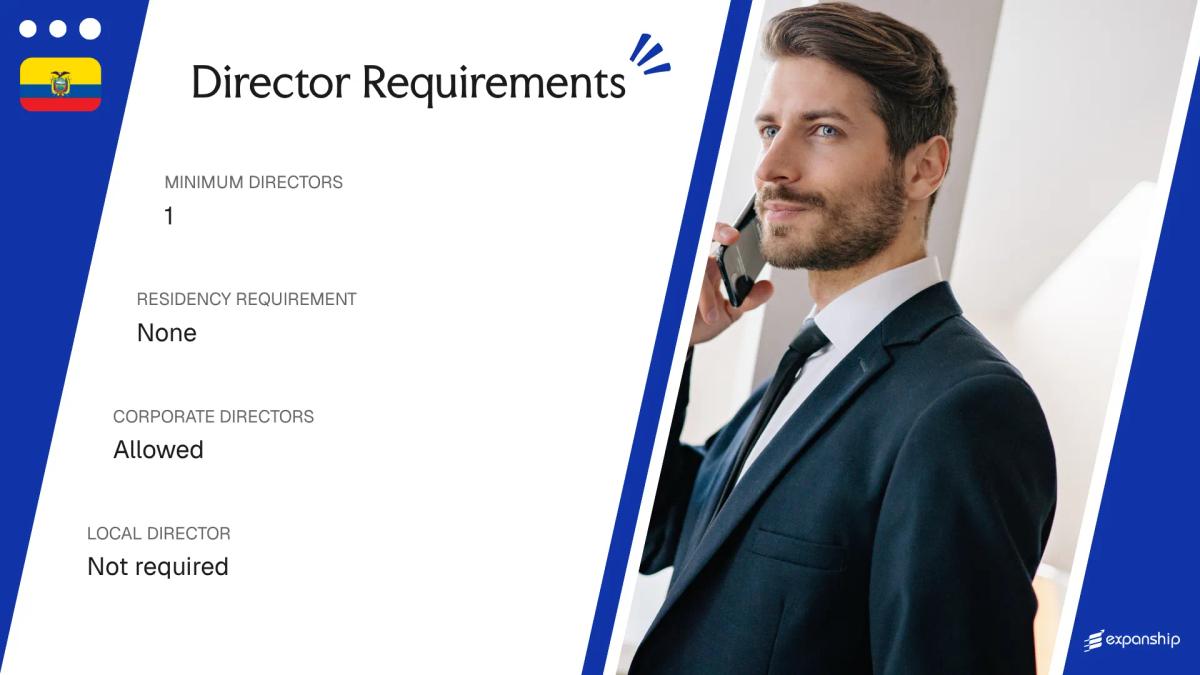
Upon appointment, directors of an Ecuadorian company assume statutory duties under the Ley de Compañías, administered by the Superintendencia de Compañías, Valores y Seguros (SCVS), including fiduciary obligations toward shareholders and personal liability for acts carried out beyond the scope of their authorized powers. Meeting director requirements Ecuador company standards means understanding that liability can extend to tax obligations, regulatory infractions, and damages arising from resolutions passed during their tenure.
| Parameter | Detail |
|---|---|
| Minimum Number of Directors | A Sociedad Anónima requires at least one administrador or a board; a Compañía Limitada is managed by one or more managers (gerentes). |
| Maximum Number of Directors | No statutory maximum is prescribed under the Ley de Compañías. |
| Local/Resident Director Required | No statutory residency requirement, though a local legal representative is commonly required for regulatory purposes. |
| Nationality Restrictions | No nationality restrictions are imposed on directors or administrators. |
| Minimum Age Requirement | Directors must have full legal capacity, which under Ecuadorian civil law requires being at least 18 years of age. |
| Corporate Directors Permitted | No statutory provision explicitly permits corporate directors; natural persons are the standard in practice. |
| Director Must Be a Shareholder | No statutory requirement for directors to hold shares in the entity. |
| Publicly Listed on Registry | Director appointments are registered with the SCVS and published in the Registro Mercantil, making them publicly accessible. |
| Disqualification Conditions | Persons under legal incapacity, those convicted of certain financial crimes, or individuals subject to judicial prohibition may be disqualified from serving. |
Despite having no formal residency requirement for directors, Ecuador requires a locally domiciled legal representative (representante legal) to be registered with the SCVS, meaning the director serving in this capacity must have a demonstrable legal presence within the country.
Shareholder Requirements in Ecuador
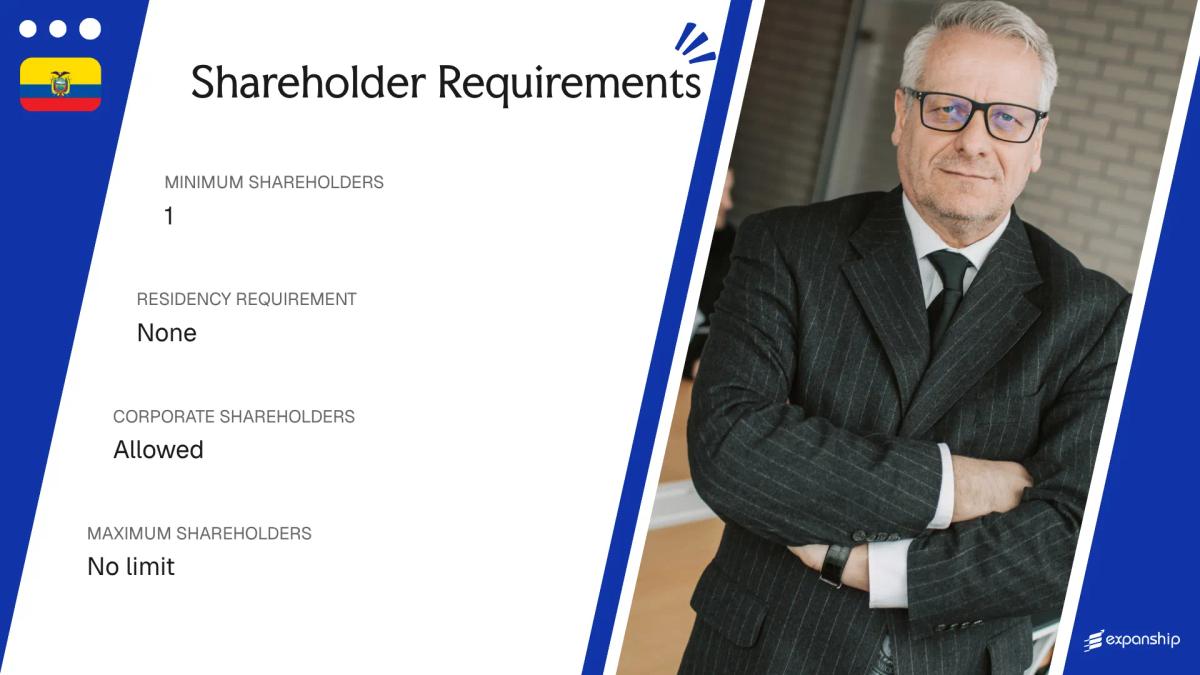
Under the Ley de Compañías, a Sociedad Anónima (S.A.) requires a minimum of two shareholders, with no statutory upper limit. A Compañía de Responsabilidad Limitada (Cía. Ltda.) also requires at least two socios but caps participation at fifteen.
Nationality and Residency Restrictions
No nationality or residency requirement applies to shareholders under Ecuadorian corporate law. Foreign nationals and non-resident individuals may hold shares without restriction on ownership percentage.
Corporate Shareholders
Legal entities may act as shareholders in both the S.A. and Cía. Ltda. structures. Corporate accionistas must provide constituent documents and proof of legal standing when subscribing shares.
Shareholder Liability
In a Cía. Ltda., each socio's liability is limited to their capital contribution. S.A. shareholders bear no personal liability beyond the value of their subscribed shares.
Register of Shareholders
A Cía. Ltda. must maintain a libro de participaciones, while an S.A. maintains a libro de acciones y accionistas. Both registers are held at the company's registered office and updates must be reported to the Superintendencia de Compañías, Valores y Seguros.
Shareholder Structuring Support for Your Ecuador Incorporation
Get guidance on meeting shareholder requirements when setting up a company in Ecuador, from share subscription to register compliance.
UBO / Beneficial Ownership Disclosure Requirements in Ecuador
Under Ecuador's beneficial ownership disclosure framework, the beneficiario final is defined as any natural person who directly or indirectly holds 25% or more of the capital or voting rights of a legal entity. The Servicio de Rentas Internas (SRI) administers this obligation under the Ley Orgánica para la Transparencia Fiscal and its associated regulations.
- Identify all natural persons meeting the 25% ownership or control threshold within the corporate structure.
- Submit the beneficiario final declaration to the SRI through its online portal at the time of filing the entity's tax registration or annual return.
- Update the declaration within 30 days of any change in beneficial ownership.
- Retain supporting documentation that substantiates the declared ownership chain.
| Parameter | Detail |
|---|---|
| Ownership Threshold for UBO Status | 25% of capital or voting rights |
| Filing Authority | Servicio de Rentas Internas (SRI) |
| Disclosure Deadline at Incorporation | At tax registration filing |
| Publicly Accessible Register | No public register; held by SRI |
| Penalties for Non-Disclosure | Administrative fines applicable under fiscal transparency legislation |
| Ongoing Update Obligation | Within 30 days of any ownership change |
KYC / Document Requirements in Ecuador
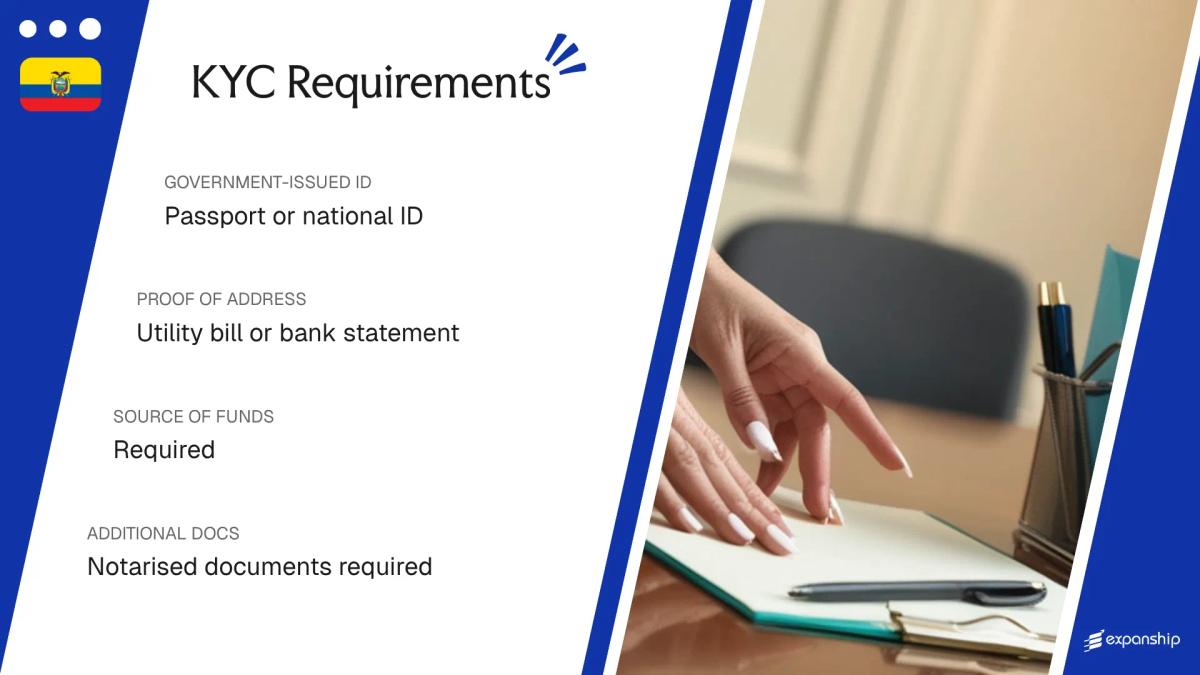
KYC document requirements Ecuador are governed primarily by the Ley Orgánica de Prevención, Detección y Erradicación del Delito de Lavado de Activos y del Financiamiento de Delitos, with oversight administered by the UAFE. All parties connected to an incorporation — directors, shareholders, and beneficial owners — must undergo identity verification before the entity is registered with the Superintendencia de Compañías, Valores y Seguros.
Individual / Personal Documents
- Valid government-issued passport or national identity document (cédula de ciudadanía for Ecuadorian nationals)
- Proof of residential address dated within the past three months, such as a utility bill or bank statement
- Recent passport-sized photograph may be required by the notary or formation agent
- Tax identification number (RUC or, for foreign individuals, a foreign tax ID)
Corporate Documents
- Certificate of incorporation or equivalent constitutive document from the entity's home jurisdiction
- Articles of association or equivalent constitutional document
- Current register of directors issued by the relevant authority in the home jurisdiction
- Proof of the corporate entity's registered address
Source of Funds Documentation
- Bank statements covering a minimum recent period to evidence the origin of capital
- Audited financial statements where the entity has an established operating history
- A signed source of funds declaration may be required by the notarising official
Notarisation and Apostille Requirements
- Foreign documents must generally be apostilled under the Hague Apostille Convention before submission
- Official Spanish translations are required for all documents not originally issued in Spanish
- Translations must be completed by a certified public translator recognised in Ecuador
Incorporation filings are frequently delayed when foreign corporate documents arrive without an apostille or a certified Spanish translation.
Company Name Requirements in Ecuador
Company name requirements in Ecuador are assessed by the Superintendencia de Compañías, Valores y Seguros (SCVS) at the point of incorporation. Proposed names must be unique and are checked against the existing registry to prevent duplication or close similarity with registered entities.
Names must be in Spanish, though foreign words are permitted if they do not conflict with other naming rules. The legal suffix must reflect the chosen entity type, such as "S.A." for a Sociedad Anónima or "Cía. Ltda." for a Compañía de Responsabilidad Limitada.
Certain words implying government affiliation, financial regulation, or protected designations require prior authorization from the relevant authority before approval. Words considered offensive or misleading about the firm's activities are outright prohibited.
Name reservation is available through the SCVS online portal. Once approved, the reservation is held for a limited period, during which your business must proceed with the formal incorporation process.
Compliance Services for Companies in Ecuador
Maintain good standing with Ecuadorian corporate regulations through ongoing compliance support, including annual filings and regulatory reporting obligations.
Conclusion
Ecuador company incorporation requirements span several distinct areas governed primarily by the Código Orgánico de la Producción, Comercio e Inversiones and overseen by the Superintendencia de Compañías, Valores y Seguros. Among the most consequential requirements are the mandatory local registered address and the beneficial ownership disclosure obligations tied to the Registro de Accionistas. Once your business has a clear picture of what incorporation demands, the practical next step involves coordinating filings, appointing the correct officers, and ensuring ongoing compliance with Ecuadorian corporate law.
Expanship's Corporate Services for Ecuador Expansion
Expanship supports your Ecuador corporate services expansion by helping you manage the specific documentation, capital structuring, and beneficial ownership disclosure obligations that Ecuadorian law imposes on foreign-owned entities. From preparing notarized incorporation deeds to coordinating with the Superintendencia de Compañías, Valores y Seguros, the firm reduces the operational burden of working across both local and international requirements.
Beyond initial formation, Expanship offers a broader range of Ecuador company formation services:
- Your company is registered with all required documents prepared and notarized to Ecuadorian standards.
- A registered agent and local office address are provided to satisfy domicile requirements.
- Government filings and liaison with relevant regulatory bodies, including the SCVS and SRI, are handled on your behalf.
- Post-incorporation compliance obligations, including annual filings, are managed on an ongoing basis.
- Banking introduction assistance is available to support your account-opening process.
- Tax registration with the SRI and coordination with local authorities are covered from the outset.
Reach out to Expanship Ecuador to discuss your incorporation requirements.
Frequently Asked Questions (FAQ)
The UBO disclosure obligation applies to all shareholders regardless of nationality. Under Ecuador's anti-money laundering framework, foreign individuals and entities holding ultimate beneficial ownership must be identified and reported to the SCVS, with supporting documentation that meets local KYC standards. Failure to disclose foreign beneficial owners does not exempt a company from the requirement.
Submitting false documentation can result in the rejection of the incorporation filing, administrative sanctions from the SCVS, and potential referral to Ecuador's financial intelligence unit, the UAFE. The SCVS holds authority to suspend or dissolve a company if fraudulent documentation is discovered after registration. These consequences apply to both the entity and the individuals responsible for the filing.
A foreign national can serve as a director, but must hold a valid Ecuadorian RUC (Registro Único de Contribuyentes) tax identification number and, in most cases, a cedula de identidad or valid residency status. The practical requirement for local tax registration means that purely non-resident directors face procedural barriers that can delay incorporation. Some structures mitigate this by appointing a local legal representative alongside the foreign director.
The statutory minimum paid-in capital is fixed at USD 400 for a Compañía Limitada and USD 800 for a Sociedad Anónima under the Ley de Compañías. Certain regulated sectors, such as financial services or insurance, impose sector-specific capital requirements that supersede these baseline figures. For most standard commercial activities, the statutory minimums apply without adjustment.
The company must notify the SCVS of any change to its registered office address through a formal amendment filing. Operating with an outdated or unverifiable registered address can result in compliance notices going undelivered, which may trigger administrative penalties or a company being flagged as non-compliant. The registered address must be a physical location within Ecuador and cannot be a P.O. box.
A name reservation with the SCVS is binding for the applicant during the reservation period, preventing other parties from registering an identical or confusingly similar name. The reservation is temporary, and if the full incorporation process is not completed within that window, the name reverts to availability. The SCVS conducts a distinctiveness check to ensure the proposed name does not conflict with existing registered entities in the same commercial category.
Legal Disclaimer
The information provided in this article is for general informational purposes only and does not constitute legal, tax, or professional advice. While we strive to ensure the accuracy and timeliness of the content, laws and regulations are subject to change, and the application of laws can vary widely based on specific facts and circumstances.
Readers should not act upon this information without seeking professional counsel tailored to their individual situation. Expanship and its authors disclaim any liability for actions taken or not taken based on the content of this article.
For specific advice regarding your business setup, compliance requirements, or any legal matters, please consult with qualified legal and tax professionals in the relevant jurisdiction.