
Key Takeaways
- Ecuador's full dollarization removes exchange rate exposure entirely, allowing foreign-owned entities to plan costs, contracts, and profit repatriation without hedging against currency fluctuation.
- The Sociedad por Acciones Simplificada (SAS) framework permits a single foreign national to establish and fully control a company without a local partner, reducing both setup complexity and ownership dilution.
- Incentive provisions under the Organic Code of Production, Trade and Investment create targeted tax reductions for qualifying businesses, meaning the effective corporate burden can fall below Ecuador's standard income tax rate for eligible sectors and structures.
- Double taxation treaties with key trading partners limit withholding obligations on cross-border income flows, making Ecuador a structurally efficient base for businesses operating across multiple jurisdictions simultaneously.
Incorporating a company in Ecuador offers a defined legal pathway for foreign businesses seeking a regulated presence in South America. Ecuador is an independent republic situated on the northwestern coast of the continent, sharing borders with Colombia and Peru. The Superintendencia de Compañías oversees company registration and ongoing corporate compliance for all private entities operating within the country.
Foreign nationals face no general prohibition on owning or controlling a local company, and the legal framework broadly permits 100% foreign ownership across most sectors. The SAS — Sociedad por Acciones Simplificada — has become the preferred vehicle for foreign business registration due to its procedural accessibility.
On taxation, Ecuador operates a territorial-plus-source system, meaning domestic income is taxed while certain foreign-sourced income may be treated differently under applicable rules. The country has also entered into a number of bilateral investment and tax treaties that shape the environment for cross-border operations.
This article examines the concrete advantages that Ecuador company formation offers to foreign investors and business owners.
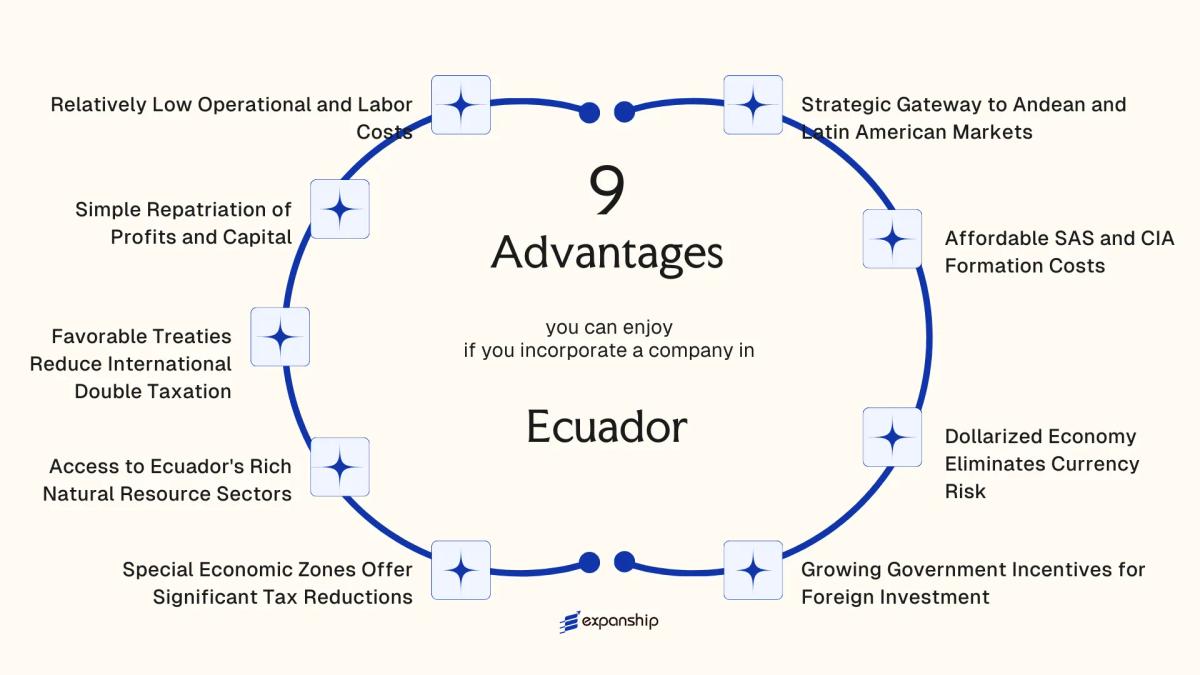
Strategic Gateway to Andean and Latin American Markets
Positioned on the Pacific coast of South America, Ecuador sits at the geographic center of the Andean region, making it a practical base for companies targeting the broader Latin American market. Its borders with Colombia to the north and Peru to the south place it directly within the Andean Community (CAN) trading bloc.
Andean Community Membership and What It Unlocks
CAN membership grants Ecuadorian-registered entities preferential tariff treatment across Bolivia, Colombia, and Peru under Decision 416 and related instruments. A company incorporated here can move goods across these borders without standard third-country duties, reducing landed costs and accelerating regional distribution.
Pacific Access and Trade Agreement Reach
Ecuador holds trade agreements with the United States and the European Union, and its Pacific ports, including Guayaquil, connect directly to major shipping routes. For your business, this means goods produced or processed domestically can reach North American and European buyers under preferential conditions.
Incorporating locally positions your firm to serve both Andean neighbors and transatlantic markets from a single operating entity, rather than requiring separate structures in multiple countries.
A single Ecuador-registered entity can access CAN preferential tariffs, U.S. and EU trade agreement benefits, and Pacific shipping routes simultaneously.
Affordable SAS and CIA Formation Costs
Formation costs for an SAS (Sociedad por Acciones Simplificada) and a CIA (Compañía de Responsabilidad Limitada) sit notably below what comparable structures cost in neighboring Colombia or Peru. The SAS, introduced under Ecuador's Ley de Compañías reforms, requires a minimum capital contribution of just $400 USD, while the CIA threshold is set at $400 USD as well, with each participation valued at a minimum of $1 USD. Because the country operates on the US dollar, those figures carry no exchange rate ambiguity.
Ecuador SAS and CIA formation cost advantages extend beyond the initial capital requirement. Registration fees paid to the Superintendencia de Compañías, Valores y Seguros (SCVS) are calculated as a fraction of the company's subscribed capital, keeping official costs predictable and proportionate for smaller firms.
Several structural features reinforce this affordability:
- The SCVS maintains a fully digitized registration portal, reducing notarization steps that typically generate fees in civil law jurisdictions
- A simplified one-tier governance structure for the SAS eliminates the cost of mandatory supervisory boards
- Minimum shareholder requirements are low enough that a single foreign investor can form an SAS without local partners
Your total government-facing incorporation expenditure can be brought to closure within days rather than weeks, which directly reduces the professional fees your legal or corporate services provider will need to charge for the process.

Company Incorporation in Ecuador
Set up your SAS or CIA in Ecuador with accurate filing through the SCVS and full compliance from day one.
Dollarized Economy Eliminates Currency Risk
Since 2000, Ecuador has operated entirely on the US dollar, following the elimination of its national currency, the sucre. For foreign investors, this structural feature directly removes one of the most common financial risks associated with operating in emerging markets: exchange rate volatility. Your revenues, contracts, capital contributions, and distributions are all denominated in USD from day one.
When a business earns and spends in the same currency as its home-country reporting requirements, financial planning becomes considerably more predictable. There is no need to hedge against devaluation, no conversion losses on profit repatriation, and no exposure to central bank monetary interventions that could erode the real value of your investment.
| Financial Factor | Implication for Foreign Business |
|---|---|
| Currency denomination | All transactions, contracts, and accounts operate in USD |
| Exchange rate risk | Eliminated at the operational level |
| Financial reporting | USD-denominated books align with US and international standards |
| Profit repatriation value | No conversion loss between local and foreign currency |
The Banco Central del Ecuador no longer issues domestic currency or sets an independent exchange rate, which means monetary policy cannot be used to devalue the currency in ways that would affect your holdings. This arrangement is codified in the Ley de Transformación Económica del Ecuador (Ley Trole I), which established full dollarization as a legal framework rather than a temporary measure. For any firm holding assets or receivables in-country, this provides a structurally stable monetary environment that is uncommon across Latin America.
Growing Government Incentives for Foreign Investment
Ecuador government incentives for foreign investors are codified primarily in the Código Orgánico de la Producción, Comercio e Inversiones, known as the COPCI. This law establishes a formal framework of protections and fiscal benefits that apply directly to foreign-owned entities registered in the country.
Under COPCI, qualifying new investments can access income tax exemptions for periods ranging from five to fifteen years, depending on sector and geographic location. That range matters because it directly reduces the effective tax burden during the years when a business is scaling and cash flow is most sensitive.
The investment registry process is administered by the Ministerio de Producción, Comercio Exterior, Inversiones y Pesca, which formalizes the rights granted under COPCI and provides legal stability against future regulatory changes.
Keep these points in mind:
- Registration with the investment ministry is required to activate COPCI protections
- Tax exemption periods vary by sector; priority industries include technology, agribusiness, and manufacturing
- Stability agreements can lock in the fiscal conditions at the time of registration
- Exemptions apply to new productive investment, not to the acquisition of existing assets
Stability agreements are a distinct advantage. A foreign company that registers its investment can contractually fix its tax and regulatory conditions for up to fifteen years, insulating it from adverse legislative changes during that period.
Ecuador's investment stability agreements can be enforceable through international arbitration under COPCI, giving foreign investors treaty-grade protection without requiring a separate bilateral investment treaty.
Special Economic Zones Offer Significant Tax Reductions
Ecuador's Special Economic Zone framework offers one of the more tangible tax reduction structures in the Andean region. Under the ZEDE (Zonas Especiales de Desarrollo Económico) regime, established through the Organic Code of Production, Trade and Investment (COPCI), qualifying businesses can access a reduced corporate income tax rate of 0% during an initial period, compared to the standard 25% rate applied to ordinary entities. That differential alone significantly alters the cost structure for foreign-owned operations from day one.
Reduced Tax Burden on Qualifying Operations
Businesses admitted into a ZEDE may also benefit from VAT exemptions on goods and services used within the zone. Imports of capital goods and raw materials destined for ZEDE-based production activities are generally exempt from customs duties, which reduces upfront capital expenditure for firms establishing manufacturing or technology operations.
Eligibility is not automatic. Operators must obtain authorization from the governing body and demonstrate alignment with one of the permitted activity categories, which historically include technology development, industrial processing, and logistics distribution.
Structural Advantages for Export-Oriented Firms
For a foreign business structured around export revenue, the combination of near-zero tax liability and duty-free inputs directly improves margin without requiring complex offshore arrangements. The ZEDE regime provides a legally codified basis for these benefits, meaning they are enforceable under Ecuadorian law rather than dependent on discretionary incentives.
Approved entities operating within a ZEDE also retain access to Ecuador's broader network of trade agreements, so export privileges extend beyond the zone itself.
Plan Your Entry into Ecuador's ZEDE Framework
Speak with Expanship's team about structuring your incorporation to qualify for Special Economic Zone tax benefits under Ecuador's COPCI regime.
Access to Ecuador's Rich Natural Resource Sectors
Ecuador natural resource sector investment benefits are substantial for foreign companies, primarily because the country holds commercially significant reserves across oil, mining, and agriculture. These sectors operate under defined legal frameworks that determine how private and foreign capital can participate, which reduces ambiguity when structuring an investment vehicle.
- The hydrocarbon sector is governed by the Ley de Hidrocarburos and administered by the Agencia de Regulación y Control de Energía y Recursos Naturales No Renovables (ARCERNNR). Foreign firms can participate through service contracts with state-owned Petroecuador, creating a defined entry mechanism without requiring full concession ownership.
- Large-scale mining is regulated under the Ley de Minería, with concessions administered by the Agencia de Regulación y Control Minero (ARCOM). This creates a clear licensing pathway for foreign entities seeking copper, gold, and silver extraction rights.
- Ecuador agriculture sector business opportunities are anchored by the country's position as the world's largest banana exporter and a leading cacao producer. Foreign firms incorporated locally can access export supply chains directly, rather than operating through intermediaries.
- Companies operating in extractive industries may qualify for investment protection contracts under the Código Orgánico de la Producción, which can fix certain tax conditions for up to 15 years, providing cost predictability across long-horizon resource projects.
Favorable Treaties Reduce International Double Taxation
Ecuador's double taxation treaty benefits derive from a network of bilateral tax agreements signed with countries including Germany, France, Italy, Spain, Switzerland, China, Brazil, and others. Under these treaties, income earned by a foreign-owned entity operating in Ecuador is not taxed twice, once by Ecuador and again by the investor's home country. For a business owner distributing dividends or receiving royalties across borders, this structural protection directly reduces the effective tax burden on cross-border income flows.
The legal basis sits within each bilateral Convenio para Evitar la Doble Imposición, ratified through Ecuador's National Assembly and administered under the Servicio de Rentas Internas (SRI). Treaty benefits typically apply to residents of the contracting states, so the ownership structure of your entity determines eligibility.
Ecuador is also a member of the Andean Community (CAN), which applies Decision 578, a supranational instrument eliminating double taxation among member states: Bolivia, Colombia, and Peru. For regional operations structured through an Ecuadorian entity, this adds a treaty layer beyond bilateral agreements.
A firm repatriating USD 200,000 in annual royalties to a Spanish parent company would, under the Ecuador-Spain DTT, have withholding tax reduced from the standard domestic rate to the treaty-capped rate, potentially saving tens of thousands of dollars annually depending on the applicable article.
Simple Repatriation of Profits and Capital
Ecuador profit repatriation benefits for investors are grounded in a clear legal framework. Under the Organic Code of Production, Commerce and Investment (COPCI), foreign investors have the right to freely remit profits, dividends, and capital abroad after meeting local tax obligations. No government approval or prior authorization is required to transfer funds out of the country.
Dividends paid to non-resident shareholders are subject to a withholding tax, generally at 10%, though this rate can be reduced under applicable double taxation treaties. Because Ecuador operates on the US dollar, there is no conversion step between local currency and a major reserve currency when repatriating capital — your funds leave in the same denomination they were held.
Key structural advantages for repatriating capital include:
- No exchange controls restricting outbound transfers
- No minimum holding period before profits can be remitted
- No reinvestment requirement imposed on foreign-owned entities as a condition of repatriation
The Servicio de Rentas Internas (SRI) administers the underlying tax compliance obligations. Once your firm has filed and settled its corporate income tax, dividend distributions to foreign investors can proceed without additional regulatory clearance.
Repatriation rights under COPCI apply to registered foreign investments; confirm your investment is formally registered with the competent authority to rely on these protections.
Relatively Low Operational and Labor Costs
Ecuador low operational costs for businesses stem from a combination of below-regional-average wages, moderate commercial lease rates, and utility pricing that remains among the lower tiers in South America.
Labor Costs Under the Unified Basic Salary Framework
The Ministerio del Trabajo sets the Salario Básico Unificado (SBU) annually. For 2024, this figure stands at USD 460 per month for general private-sector workers. Because the economy is fully dollarized, your payroll projections carry no currency conversion exposure, and the monthly wage floor is straightforward to budget against.
Employer social security contributions are remitted to the Instituto Ecuatoriano de Seguridad Social (IESS). The employer contribution rate is approximately 11.15% of the employee's monthly salary, a figure that compares favorably to employer burdens exceeding 20-30% in several neighboring economies.
Operational Overhead in Practice
Office and industrial space in secondary cities such as Cuenca or Guayaquil runs at rates materially below Bogotá or Lima equivalents, reducing fixed overhead for firms that do not require a Quito address. Electricity and telecommunications infrastructure costs are regulated, providing some predictability in monthly operating expenses.
- Skilled bilingual professionals are available at wage levels below comparable profiles in Chile or Colombia
- Manufacturing and agro-industrial operations benefit from proximity to port infrastructure without the premium associated with larger regional hubs
- The Código del Trabajo governs employment contracts, providing a clear legal framework that reduces the uncertainty typically associated with workforce management in newer markets
Why Ecuador Stands Out Against Regional Competitors
Businesses evaluating Ecuador versus Latin America incorporation advantages are most often also weighing Colombia, Peru, and Chile. These three markets share the Andean corridor, compete for similar categories of foreign direct investment, and offer broadly comparable legal frameworks for foreign-owned entities. The comparison below focuses on parameters where Ecuador holds a neutral or favourable structural position, drawing on factors covered throughout this article.
One feature that consistently differentiates Ecuador from its neighbours is monetary stability. Colombia and Peru maintain independent currencies subject to exchange rate fluctuation, which introduces transactional and balance-sheet risk that foreign firms must actively manage. Operating in a fully dollarized economy removes that variable entirely, without any hedging requirement. Combined with profit repatriation rules under the Ley Orgánica de Inversiones that impose no prior-approval requirement for transfers abroad, this structural combination is relatively uncommon among comparable Andean markets.
| Parameter | Ecuador | Colombia | Peru | Chile |
|---|---|---|---|---|
| Official Currency | USD (dollarized) | Colombian Peso | Peruvian Sol | Chilean Peso |
| Currency Risk for Foreign Investors | None | Present | Present | Present |
| Simplified Share Company (SAS equivalent) | Yes (SAS) | Yes (SAS) | No direct equivalent | SpA (similar) |
| Special Economic Zones | Yes (ZEDEs) | Yes | Yes | Limited |
| Corporate Income Tax Rate | 25% | 35% | 29.5% | 27% |
| Double Taxation Treaties | 15+ | 15+ | 10+ | 35+ |
| Foreign Profit Repatriation | No prior approval required | Generally permitted | Generally permitted | Generally permitted |
Compliance Services for Companies in Ecuador
Maintain your Ecuador entity in good standing with SRI, Superintendencia de Compañías, and all applicable statutory obligations.
Conclusion
The core benefits of incorporating in Ecuador rest on structural features that directly reduce cost and risk for foreign business owners: full dollarization removes exchange rate exposure, the SAS formation framework allows a single shareholder to establish and control a company without local partner requirements, and double taxation treaties with key trading partners limit withholding obligations on cross-border income.
These advantages do not apply uniformly to every business model. A firm targeting natural resource extraction operates under a different regulatory framework than a technology startup seeking incentives under the Organic Code of Production, Trade and Investment. Your industry, ownership structure, and intended profit repatriation strategy each determine how much of the available framework your entity can actually use.
For businesses where these conditions align, Ecuador company formation offers a legally sound, cost-effective entry point into the Andean region. Getting the structure right from the outset, including the correct entity type, share configuration, and tax registration with the Servicio de Rentas Internas, determines whether those advantages hold over time.
Let Expanship Handle Your Ecuador Company Formation
Expanship Ecuador company formation service covers the full incorporation process, from selecting between an S.A.S. and a Compañía Limitada to registering your entity with the Superintendencia de Compañías, Valores y Seguros (SCVS) and obtaining your RUC through the Servicio de Rentas Internas (SRI). The range of benefits discussed throughout this blog, including dollarization, treaty protections, SEZ incentives, and low capital thresholds, each carry specific compliance obligations that require accurate documentation and timely filings to preserve.
Expanship manages each stage of that process on your behalf:
- Preparation and notarization of incorporation documents, including articles of incorporation and shareholder agreements
- Registered agent and legal domicile provision to satisfy SCVS residency requirements
- Company registration filing and ongoing liaison with the SCVS and SRI
- Post-incorporation compliance management, including annual reporting and capital updates
- Municipal operating license (Patente Municipal) coordination
- Banking introduction assistance to support corporate account establishment
For firms that want to engage Ecuador's natural resource sectors, qualify for ZEDE tax treatment, or operate under one of the country's active double taxation agreements, having a locally grounded corporate services team managing your compliance reduces the risk of procedural errors that could affect your standing with Ecuadorian regulators.
Reach out to Expanship Ecuador to discuss your incorporation requirements.
Frequently Asked Questions (FAQ)
A SAS can typically be incorporated within a few business days once all documents are submitted to the SCVS, making it the faster of the two main entity types available to foreign investors. The CIA. Ltda. involves a notarized deed and SCVS registration, which can extend the process to several weeks depending on documentation completeness. Both entities require a registered address in Ecuador and a legal representative domiciled in the country.
The standard corporate income tax rate is 25% on net profits, applied under the Ley de Régimen Tributario Interno and administered by the Servicio de Rentas Internas (SRI). Companies operating within approved Special Economic Zones (ZEDEs) may qualify for a reduced rate of 15%. Reinvested profits can attract further reductions under specific investment incentive provisions, though eligibility conditions apply.
Ecuador's double taxation agreements generally cover multiple income categories, including dividends, royalties, interest, and business profits, though the specific provisions vary by treaty. The agreement with the United States, for example, follows a different framework than those with Andean Community member states under Decision 578. Reviewing the applicable treaty text is necessary to determine withholding tax rates on specific payment types between your home country and Ecuador.
Failure to submit annual reports and financial statements to the SCVS can result in fines, and persistent non-compliance may lead to the company being placed on a non-compliant register or subject to dissolution proceedings. The SCVS actively monitors filing status, and companies in arrears may face restrictions on certain corporate actions, including capital changes or issuing certificates of good standing. Reinstating compliant status requires settling outstanding obligations and filing overdue documentation.
Because Ecuador uses the US dollar as its official currency, there is no conversion step when repatriating profits to a US-based parent, and companies dealing in dollars internationally avoid exchange rate exposure entirely. For investors from non-dollar economies, the fixed-dollar environment still eliminates local currency devaluation risk, which has historically affected profit repatriation in other Latin American jurisdictions. Repatriation itself is permitted without prior government authorization, though standard SRI tax clearance on distributed dividends applies.
ZEDEs offer a reduced 15% corporate income tax rate and exemptions on import duties for goods used within the zone, which go beyond the general incentives available under the Código Orgánico de la Producción, Comercio e Inversiones (COPCI). COPCI-based incentives are available nationally and include tax exemptions on reinvested profits and stability agreements through investment contracts with the government. The ZEDE regime is geographically restricted and requires formal approval from the ZEDE governing body, whereas COPCI incentives are accessible to a broader range of qualifying investments across the country.
Legal Disclaimer
The information provided in this article is for general informational purposes only and does not constitute legal, tax, or professional advice. While we strive to ensure the accuracy and timeliness of the content, laws and regulations are subject to change, and the application of laws can vary widely based on specific facts and circumstances.
Readers should not act upon this information without seeking professional counsel tailored to their individual situation. Expanship and its authors disclaim any liability for actions taken or not taken based on the content of this article.
For specific advice regarding your business setup, compliance requirements, or any legal matters, please consult with qualified legal and tax professionals in the relevant jurisdiction.