
Key Takeaways
- Dominica's corporate framework, regulated under the Companies Act and overseen by the Registrar of Companies, accommodates both resident and non-resident operators across ten distinct entity types.
- The International Business Company (IBC) is the primary structure for non-residents pursuing tax-exempt international holding or trading activity under Dominica's favorable treatment of foreign-sourced income.
- Internationally oriented financial services structures face an additional layer of oversight from the Financial Services Unit (FSU), separate from standard company registration requirements.
- Entity selection in Dominica turns on specific operational factors — domestic versus international activity, liability exposure, and capital-raising needs — rather than a one-size-fits-all default.
Introduction to Entity Types in Dominica
Dominica is a small island nation in the eastern Caribbean, situated between Guadeloupe to the north and Martinique to the south, within the Lesser Antilles chain. It is an independent republic and a member of the Commonwealth, operating under a legal system rooted in English common law.
Company registration and ongoing corporate compliance fall under the authority of the Registrar of Companies, which operates within the government's administrative framework. Certain regulated activities — particularly those involving international financial services — are overseen by the Financial Services Unit (FSU). The general tax posture for internationally oriented structures leans toward exemption on foreign-sourced income, though domestic entities are subject to standard corporate taxation.
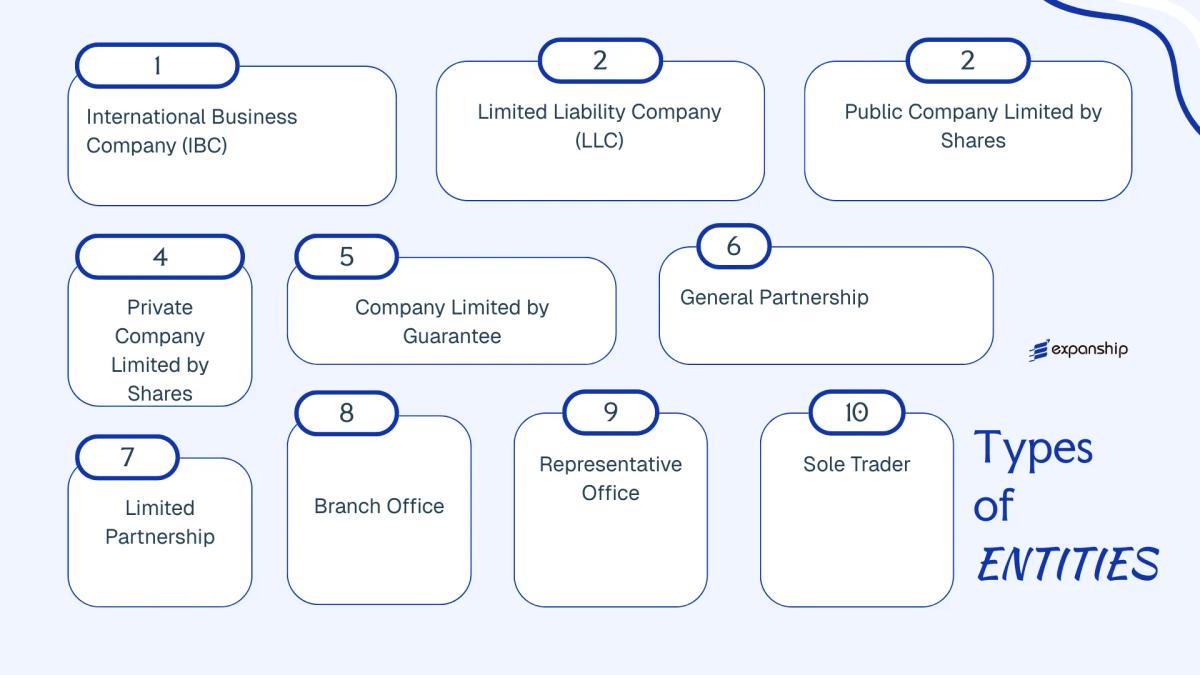
Several types of business entities in Dominica are available to both residents and non-residents. These include the International Business Company (IBC), Limited Liability Company (LLC), Public Company Limited by Shares, Private Company Limited by Shares, Company Limited by Guarantee, General Partnership, Limited Partnership, Branch Office, Representative Office, and Sole Trader.
Each structure carries distinct formation requirements, liability implications, and regulatory obligations. The sections below examine each one in detail.
An Overview of Business Structures in Dominica
Dominica's company law framework provides several distinct entity types, governed primarily by the Companies Act of 1994 and, for offshore structures, the International Business Companies Act. Each legal form carries different implications for liability, taxation, membership, and permitted activities.
Business Structures at a Glance
| Entity Type | Legal Form | Liability | Tax Status | Local Trading | Minimum Members | Regulatory Authority | Governing Act |
|---|---|---|---|---|---|---|---|
| IBC | Corporation | Limited | Exempt | Not permitted | 1 shareholder | FSU / Registered Agent | IBC Act |
| LLC | Hybrid entity | Limited | Depends on structure | Permitted | 1 member | Companies Registry | Companies Act 1994 |
| Public Company (Ltd by Shares) | Corporation | Limited | Taxable | Permitted | 2 shareholders | Companies Registry | Companies Act 1994 |
| Private Company (Ltd by Shares) | Corporation | Limited | Taxable | Permitted | 1 shareholder | Companies Registry | Companies Act 1994 |
| Company Ltd by Guarantee | Corporation | Guaranteed amount | Taxable | Permitted | 1 member | Companies Registry | Companies Act 1994 |
| General Partnership | Unincorporated | Unlimited | Taxable | Permitted | 2 partners | Companies Registry | Partnership Act |
| Limited Partnership | Unincorporated | Mixed | Taxable | Permitted | 2 partners | Companies Registry | Partnership Act |
| Branch Office | Foreign entity extension | Parent liability | Taxable | Permitted | N/A | Companies Registry | Companies Act 1994 |
| Representative Office | Foreign entity extension | Parent liability | Generally exempt | Not permitted | N/A | Companies Registry | Companies Act 1994 |
| Sole Trader | Unincorporated | Unlimited | Taxable | Permitted | 1 person | Inland Revenue | General law |
Each of these structures is examined in full in the sections below.
International Business Company (IBC)
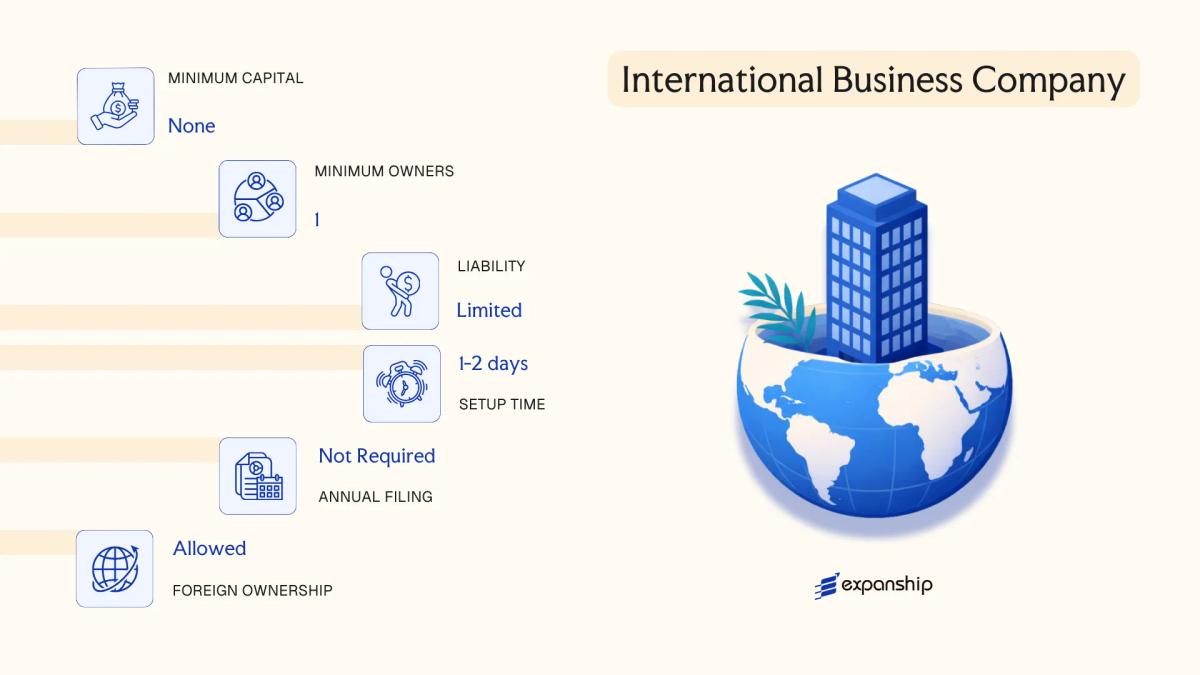
The Dominica International Business Company IBC is governed by the International Business Companies Act of 1996, as subsequently amended. Structured as a separate legal entity with limited liability, it is the jurisdiction's primary vehicle for cross-border commercial activity.
Incorporation under the Act confers full legal personality on the entity, meaning it can hold assets, enter contracts, and initiate legal proceedings in its own name. Ownership is evidenced through shares, and liability of shareholders is confined to their subscribed capital.
Key Characteristics
| Requirement | Detail | Notes |
|---|---|---|
| Legal Form | Corporation (company limited by shares) | Separate legal personality from inception |
| Members & Officers | Min. 1 shareholder; min. 1 director; no maximum | Director and shareholder may be the same person; corporate directors permitted |
| Local Presence | Registered Agent required; no registered office separately mandated beyond agent's address | Registered Agent must be a licensed provider in Dominica |
| Capital | No minimum share capital; shares may be issued in any currency | Bearer shares are prohibited |
| Privacy | Register of members and directors is not publicly accessible | Beneficial ownership information is held by the Registered Agent |
Focus Points
- Taxation: IBCs are exempt from corporate income tax, withholding tax, and stamp duty on transactions conducted outside Dominica; no VAT applies to offshore activities.
- Economic Substance: IBCs conducting relevant activities may be subject to economic substance requirements under applicable regulations.
- Annual Compliance: Annual renewal fees are payable to maintain good standing; financial statements are not required to be filed publicly.
- Treaty Access: Dominica's limited double tax treaty network may restrict treaty benefits for IBCs depending on the counterparty jurisdiction.
- Restrictions: IBCs are prohibited from conducting business with residents of Dominica or owning local real estate without specific authorisation.
Closing
The IBC suits holding structures, IP ownership, international trading, and investment vehicles where offshore operations are conducted entirely outside the jurisdiction. Its principal advantage is the broad statutory tax exemption; the principal limitation is restricted access to tax treaties, which can affect cross-border withholding positions.
The IBC is most appropriate for non-resident founders conducting international business who do not require local market access or treaty-based tax relief.

Company Incorporation in Dominica
Incorporate an IBC or other business entity in Dominica with end-to-end support from Expanship.
Limited Liability Company (LLC)
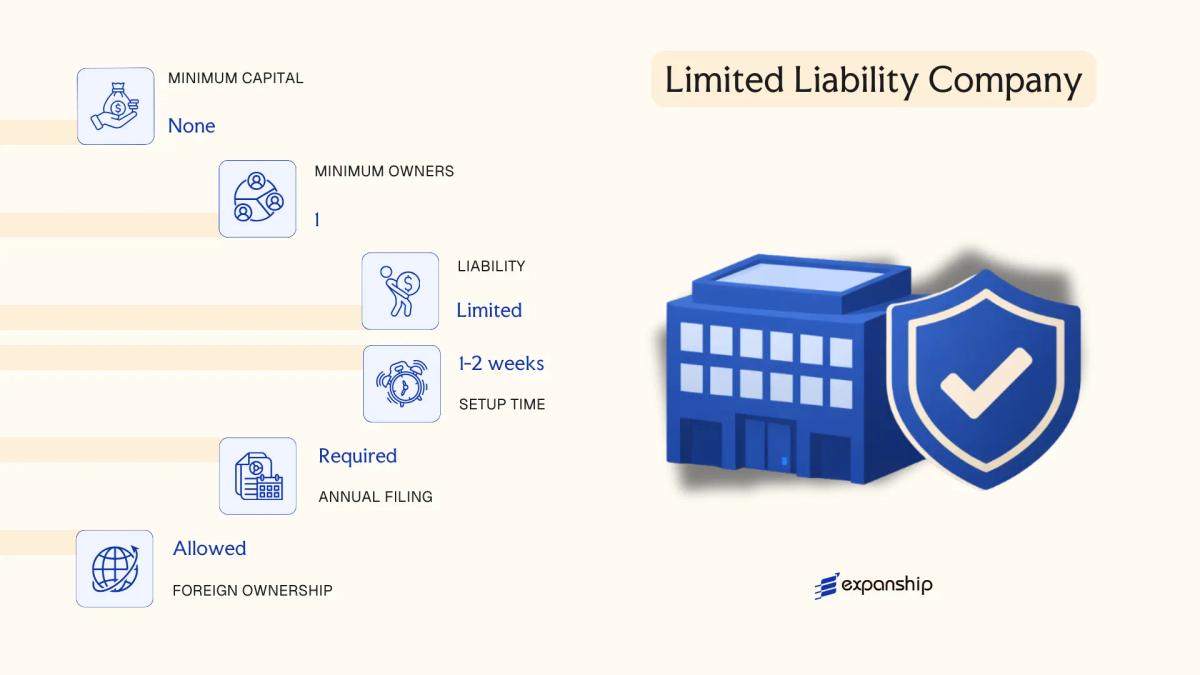
Dominica LLC formation requirements are governed by the Limited Liability Company Act, Chapter 91:07, which established the LLC as a distinct legal entity separate from its members. The structure combines the liability protection of a corporation with the operational flexibility typically associated with partnerships, making it a hybrid form suited to a range of commercial purposes.
Key Characteristics
| Requirement | Detail | Notes |
|---|---|---|
| Legal Form | Limited Liability Company (LLC) | Separate legal personality; members not personally liable for company debts |
| Members | 1 to no statutory maximum | Members may manage directly or appoint managers; both roles can be held by non-residents |
| Local Presence | Registered Agent and Registered Office required | Both must be maintained within Dominica at all times |
| Capital | No minimum capital requirement; USD common | Contributions can be cash, property, or services |
| Governance | Managed by members or appointed managers | Operating agreement governs internal arrangements; not required to be filed publicly |
| Privacy | Member names not publicly disclosed | Details held by the Registered Agent; beneficial ownership subject to competent authority access |
Focus Points
- Taxation: LLCs may be structured as pass-through entities for tax purposes, with income attributed to members; no corporate income tax applies at the entity level for qualifying structures, and no withholding tax on distributions to non-resident members under standard conditions.
- Economic Substance: Entities conducting relevant activities must satisfy substance requirements under the Economic Substance Act.
- Annual Compliance: Annual fees and filings are due to the Registrar of Companies; an updated register of members must be maintained.
- Treaty Access: Dominica has a limited tax treaty network, which may restrict treaty-based withholding tax relief for LLC members.
- Conversion: An LLC may generally be converted to another entity type or continued into a foreign jurisdiction, subject to statutory procedures.
Closing
The LLC structure suits holding arrangements, asset protection vehicles, and joint venture operations where flexible profit-sharing and management arrangements are required. Its pass-through tax treatment is an operational advantage, though the limited bilateral tax treaty coverage can restrict its utility for certain cross-border income flows.
Best suited for small to mid-sized international ventures and holding structures where operational flexibility and member-level tax treatment are priorities over access to broad treaty networks.
Public Company Limited by Shares
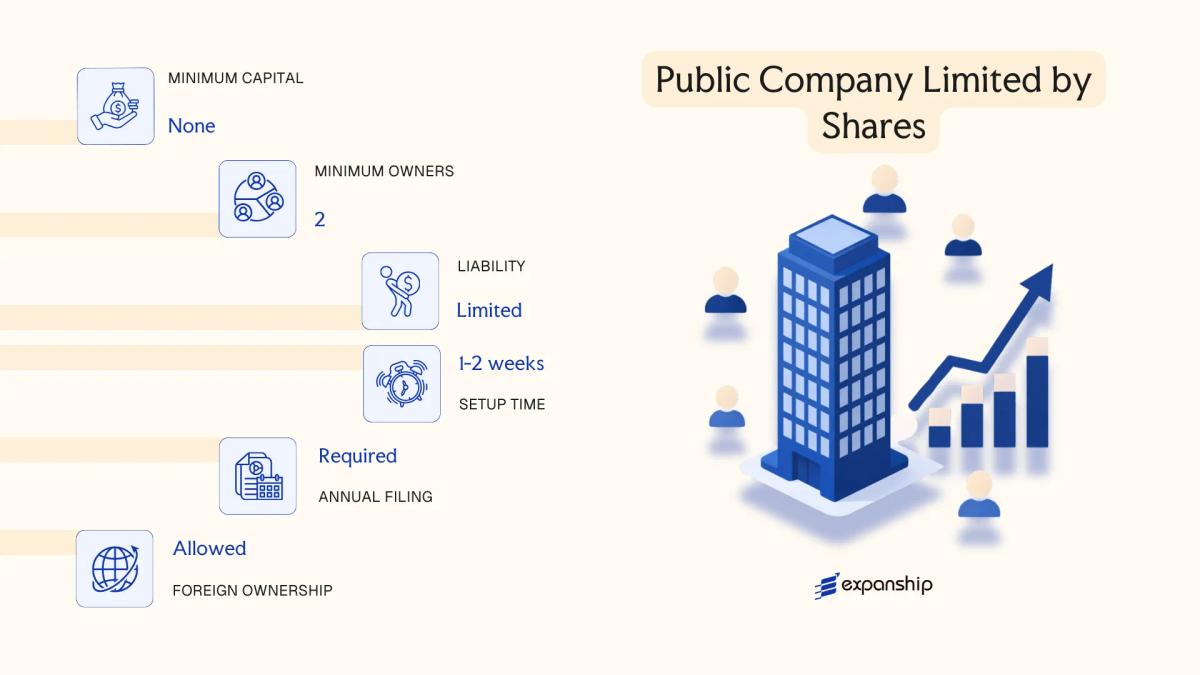
A Dominica public company limited by shares is governed by the Companies Act of 1994, the primary legislation regulating corporate structures on the island. This entity type carries separate legal personality, meaning it exists independently of its shareholders, whose financial exposure is confined to the value of their unpaid shares.
Unlike private companies, a public company may offer its shares to the general public and is subject to more stringent disclosure and governance requirements as a result.
Key Characteristics
| Requirement | Detail | Notes |
|---|---|---|
| Legal Form | Company limited by shares | Incorporated under the Companies Act 1994 |
| Members | Shareholders; minimum 1 director, no statutory cap on shareholders | Shares may be offered to the public |
| Local Presence | Registered office in Dominica required | Registered agent not mandated by statute but standard practice |
| Capital | Eastern Caribbean Dollar (XCD); no prescribed minimum share capital | Par or no-par value shares permitted |
| Privacy | Shareholder and director details filed with the Registrar of Companies | Records are accessible to the public |
Focus Points
- Taxation: Subject to corporate income tax on domestic income; VAT may apply to business activities; withholding tax applies to dividends paid to non-residents; stamp duty may apply on share transfers.
- Annual Compliance: Annual returns and audited financial statements must be filed with the Registrar of Companies.
- Public Disclosure: Financial records and ownership information are not shielded from public inspection, unlike private structures.
- Stock Listing: A public company may list shares on a recognised exchange, though Dominica has no domestic stock exchange; cross-border listings would require compliance with the relevant foreign exchange's rules.
- Economic Substance: Domestic-facing operations are generally subject to standard local tax and regulatory obligations rather than the offshore substance regimes.
This structure suits businesses seeking access to capital through public share offerings or those planning eventual cross-border listings. The ability to raise funds from an unrestricted shareholder base is a distinguishing feature, though the accompanying disclosure obligations and compliance costs are considerably higher than those of a private company.
Larger enterprises or groups intending to raise public capital or eventually pursue a stock exchange listing.
Private Company Limited by Shares
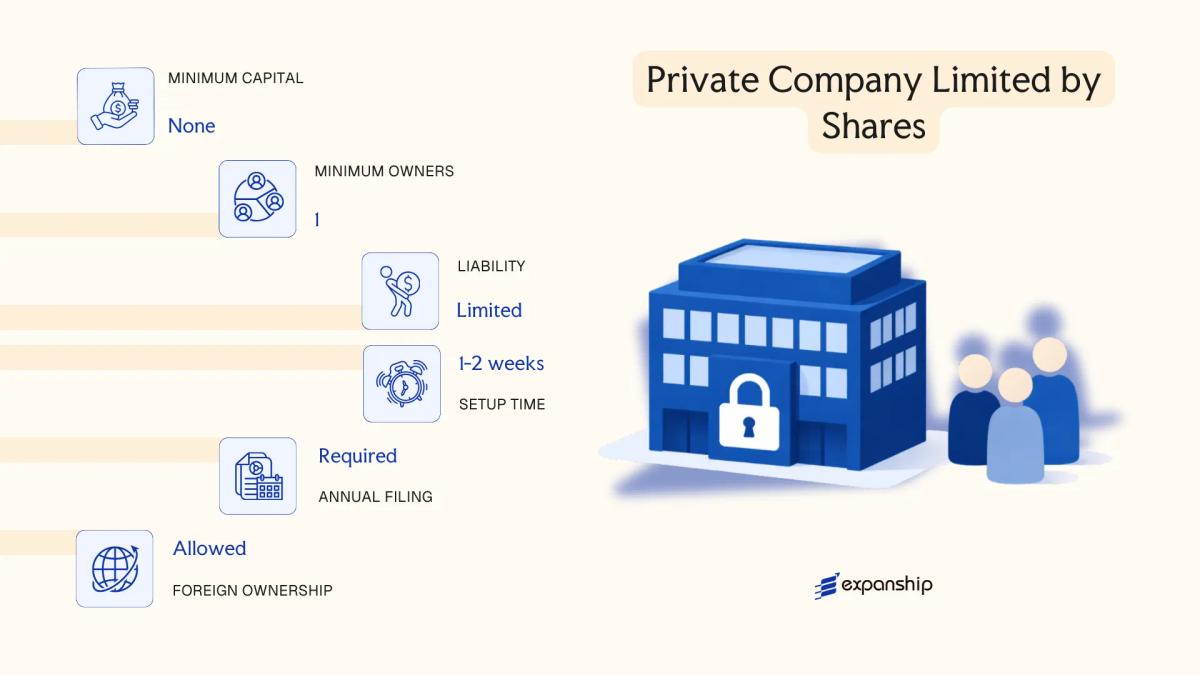
A Dominica private company limited by shares is governed by the Companies Act, Chapter 21:01, which grants the entity separate legal personality distinct from its shareholders. Liability for each member is confined to any unpaid amount on their shares.
Operationally, this structure sits between a sole trader and a public company, making it the most common vehicle for resident trading businesses and closely held family enterprises.
Key Characteristics
| Requirement | Detail | Notes |
|---|---|---|
| Legal Form | Private Company Limited by Shares | Incorporated under Companies Act, Chapter 21:01 |
| Members | Shareholders: min. 1, max. 50 | Shares cannot be offered to the general public |
| Directors | Min. 1 director; no residency requirement | Corporate directors permitted |
| Local Presence | Registered office in Dominica required | A registered agent is not mandated but commonly appointed |
| Capital | No statutory minimum share capital; denominated in any currency | Shares may be issued at par or no-par value |
| Privacy | Register of directors is public; shareholder register may be inspected by members | No public beneficial ownership register at time of writing |
Focus Points
- Taxation: Subject to corporate income tax on worldwide income; standard rate applies to net profits. VAT registration is required once turnover exceeds the prescribed threshold. Withholding tax may apply to dividends and certain payments to non-residents.
- Annual Compliance: Annual return and financial statements must be filed with the Registrar of Companies.
- Economic Substance: Domestic private companies are not subject to the economic substance regime applicable to IBCs.
- Treaty Access: Dominica's limited tax treaty network restricts double taxation relief for most private companies.
- Restrictions: The articles must restrict any transfer or public offering of shares; this restriction is a defining legal requirement, not merely optional.
Closing
This structure suits resident trading operations, holding arrangements, and family-owned businesses where share transferability can be controlled and liability contained. The primary constraint is the 50-shareholder cap, which limits scalability for businesses seeking broader equity participation.
Best suited for entrepreneurs and small-to-medium businesses seeking a straightforward incorporated presence in Dominica with controlled ownership.
Company Limited by Guarantee
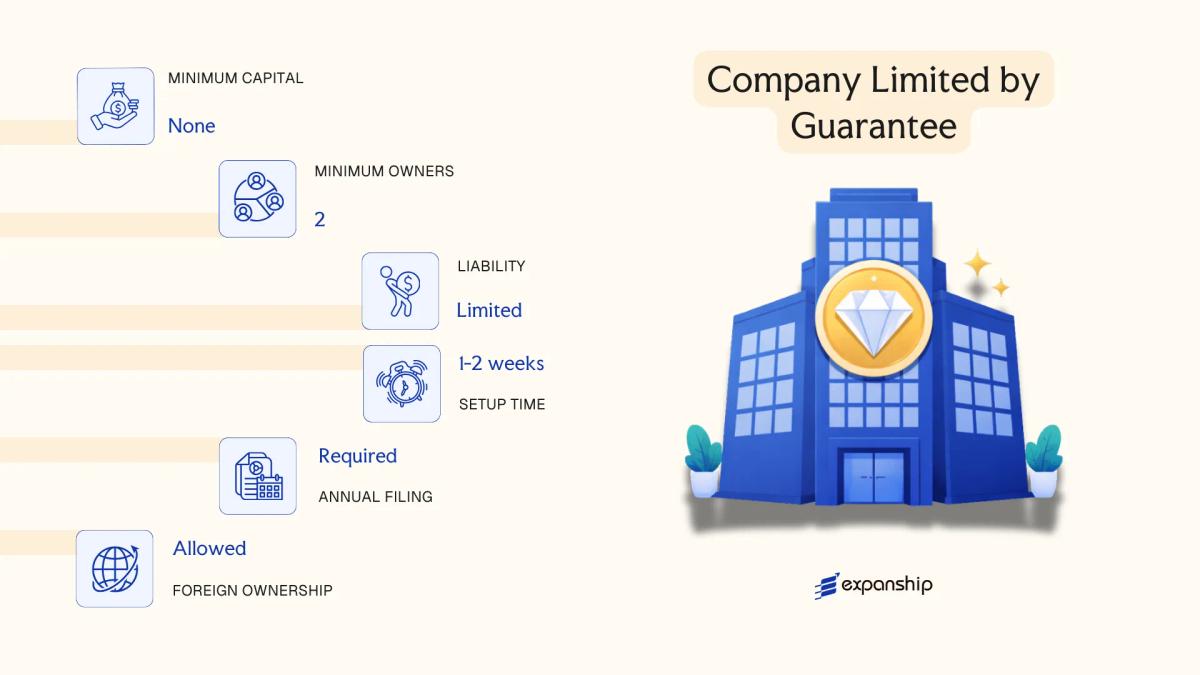
A company limited by guarantee Dominica recognises as a distinct legal form is governed under the Companies Act, Chapter 21:01 of the Laws of Dominica. Unlike share-based structures, this entity has no share capital; members' liability is limited to the amount each has undertaken to contribute in the event of winding up.
Separate legal personality applies, meaning the entity can own property, enter contracts, and sue or be sued in its own name. This structure is typically adopted by non-profit organisations, associations, and institutions where generating distributable profit is not the primary purpose.
Key Characteristics
| Requirement | Detail | Notes |
|---|---|---|
| Legal Form | Body corporate with separate legal personality | No share capital issued |
| Members | Referred to as members; minimum 1, no statutory maximum | Members act as guarantors, not shareholders |
| Directors | Minimum 1 director required | No residency requirement under general law |
| Local Presence | Registered office and registered agent required in Dominica | Must be maintained at all times |
| Capital | No share capital; guarantee amount defined in Memorandum | Guarantee is typically a nominal sum |
| Privacy | Member and director details filed with the Companies Registry | Public record applies |
Focus Points
- Taxation: Generally exempt from corporate income tax on non-profit activities; however, commercial income may attract tax; VAT and withholding tax obligations depend on the nature of activities conducted.
- Annual Compliance: Annual return filing with the Companies Registry is required; financial statements may be required depending on the entity's activities and size.
- Economic Substance: No economic substance obligations apply to non-profit guarantee companies under current Dominica regulations.
- Conversion: Conversion to a share-based company is not a standard permitted procedure; dissolution and re-incorporation would typically be required.
- Treaty Access: This entity type does not qualify for tax treaty benefits in most contexts, given its non-profit nature and limited tax exposure.
Closing
A non-profit company structure Dominica administrations recognise through the guarantee model suits membership-based organisations, charities, professional bodies, and cultural associations, with the primary advantage being limited member liability without the requirement to issue shares. The main limitation is the restriction on profit distribution, which disqualifies this structure for any commercial or investment purpose.
This entity is most appropriate for non-governmental organisations, trade associations, and foundations that require legal personality and member liability protection without a profit distribution mandate.
Partnerships [General Partnership, Limited Partnership]
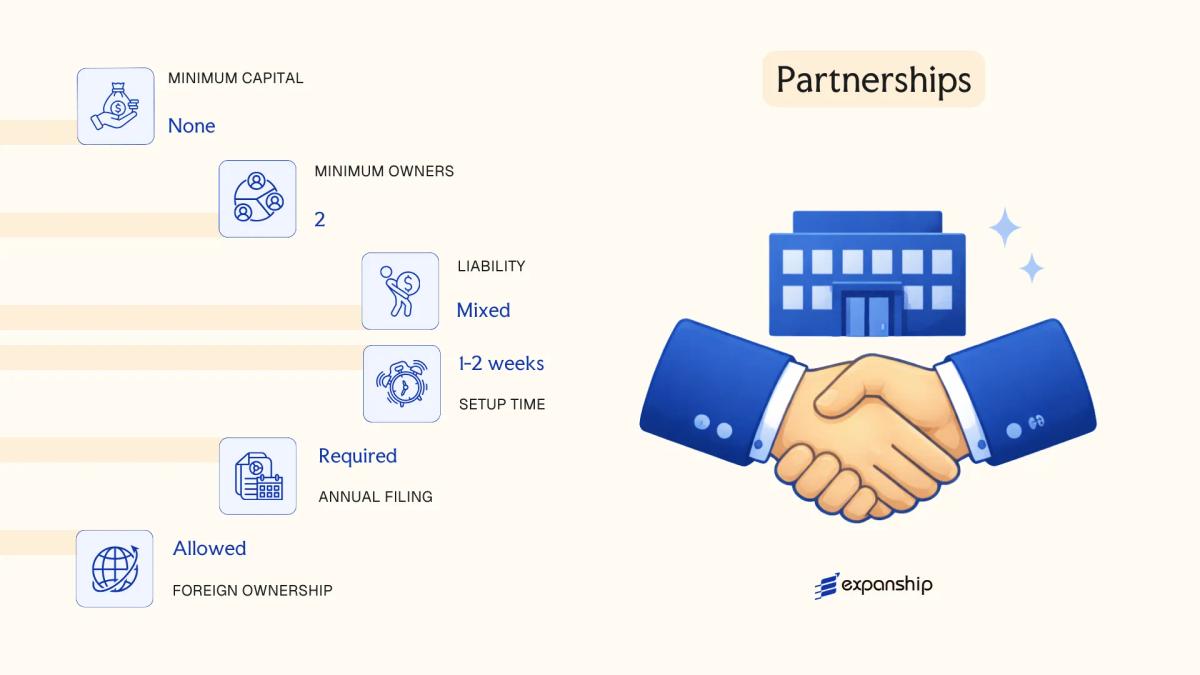
Partnership registration in Dominica is governed by the Partnership Act, with both general and limited partnership structures available to local and foreign operators. Neither structure is typically treated as a separate legal person distinct from its partners, meaning partners hold rights and bear liabilities through the partnership rather than through an independent legal entity.
Registration is handled through the Companies and Intellectual Property Office (CIPO) of Dominica. A limited partnership must file a certificate of limited partnership to formalise the distinction between general and limited partners, while a general partnership may arise by agreement without that formality, though registration is standard practice.
Key Characteristics
| Requirement | General Partnership | Limited Partnership |
|---|---|---|
| Legal Form | Unincorporated association; no separate legal personality | Unincorporated; statutory structure with defined partner roles |
| Members | Partners (minimum 2; no statutory maximum) | At least 1 general partner and 1 limited partner |
| Liability | All partners bear unlimited joint liability | General partners: unlimited; limited partners: capped at capital contribution |
| Local Presence | Registered office in Dominica required | Registered office in Dominica required |
| Capital | No minimum prescribed; contributions by agreement | No minimum; limited partners contribute agreed capital |
| Privacy | Partnership agreement not publicly filed; partner names may appear on registration documents |
Focus Points
- Taxation: Partnerships are generally treated as tax-transparent; income passes through to partners and is taxed at the individual or corporate level based on each partner's residency and applicable rates — no separate entity-level corporate tax, VAT, or withholding at the partnership level under standard treatment.
- Annual Compliance: Annual renewal filings are required with CIPO to maintain active status.
- Economic Substance: Substance obligations do not typically apply to partnerships in the same manner as companies, though the position should be confirmed against current regulations.
- Limited Partner Restrictions: A limited partner who participates in management risks losing limited liability protection and being treated as a general partner.
- Conversion: Conversion from a general to a limited partnership requires filing the appropriate certificate with CIPO; the reverse is also permissible.
Sub-Types
General Partnership
All partners share management authority and carry unlimited personal liability for the obligations of the firm. This structure suits small domestic businesses or professional practices where partners actively manage operations.
Limited Partnership
At least one general partner manages the business and retains unlimited liability, while limited partners contribute capital and remain passive. This arrangement is commonly used for investment vehicles, joint ventures, and fund structures where investor liability must be contained.
General partnerships suit small operating businesses with closely held ownership, while limited partnerships are more frequently used for investment or project-specific vehicles. The primary advantage of both structures is operational flexibility without the formality of a corporate entity; the principal drawback is that at least one participant — the general partner — always carries unlimited personal liability.
Limited partnerships in Dominica are best suited to investment arrangements or joint ventures where passive capital contributors require liability protection and a managing partner is willing to accept full operational responsibility.
Foreign Business Structures [Branch Office, Representative Office]
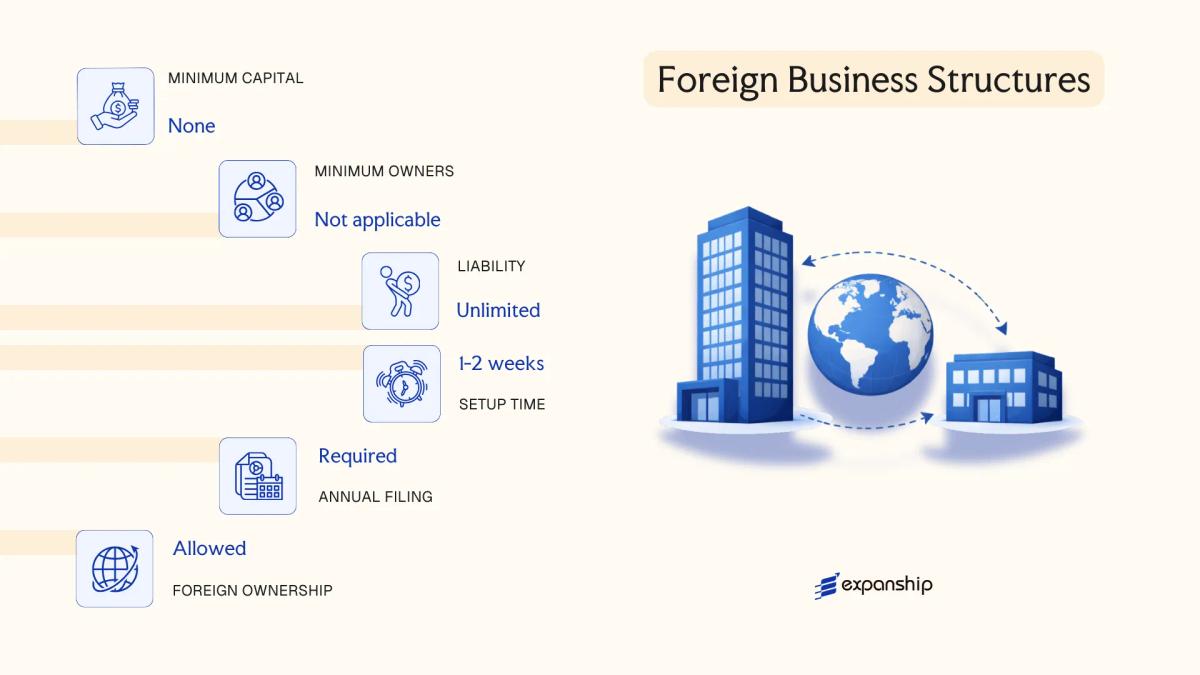
Registering a foreign company branch office in Dominica allows an overseas entity to conduct business activities on the island without forming a separate local company. The governing framework falls under the Companies Act of Dominica, which sets out registration requirements for external companies — the formal term used for foreign corporations operating within the jurisdiction.
A branch office is not a legally distinct entity from its parent; the parent company retains full liability for the branch's obligations. A representative office, by contrast, is generally limited to non-commercial activities such as market research and liaison functions, and does not generate taxable revenue locally.
Key Characteristics
| Requirement | Branch Office | Representative Office |
|---|---|---|
| Legal Form | Extension of foreign parent; no separate legal personality | Extension of foreign parent; no separate legal personality |
| Designated Officer | Locally appointed agent or representative | Locally appointed contact person |
| Local Presence | Registered agent and registered office required | Registered address required |
| Permitted Activities | Commercial trading and operational activities | Non-commercial only (liaison, research, promotion) |
| Capital Requirement | No minimum prescribed locally; parent's capital applies | None |
| Privacy | Parent company details filed with the Registrar of Companies | Parent company details filed publicly |
Focus Points
- Taxation: Branch profits may be subject to local corporate tax; representative offices with no local income are generally outside the corporate tax net, though VAT registration may apply if thresholds are met.
- Annual Compliance: External companies must file annual returns and financial statements with the Registrar of Companies under the Companies Act.
- Economic Substance: Trading branches may attract economic substance considerations depending on activity type and applicable regulations.
- Treaty Access: Dominica's limited double tax treaty network may restrict the branch's ability to benefit from reduced withholding rates on cross-border payments.
- Conversion: A branch can be converted into a locally incorporated entity, though the process requires fresh registration rather than a simple re-designation.
Sub-Types
Branch Office
A branch conducts full commercial operations under the parent's name and legal identity, making the parent directly liable for all local obligations. This structure suits firms testing market entry before committing to local incorporation.
Representative Office
A representative office is restricted to promotional and liaison activities and cannot enter into contracts or generate local revenue. Foreign businesses use this structure primarily for market research or to support regional sales teams without establishing a taxable presence.
A branch office suits foreign companies seeking direct operational presence without the cost of incorporating a separate local entity, though the key drawback is that the parent assumes unlimited liability for all branch obligations.
Established foreign firms conducting short-term or exploratory operations in Dominica that do not yet require a separately incorporated local subsidiary.
Sole Trader
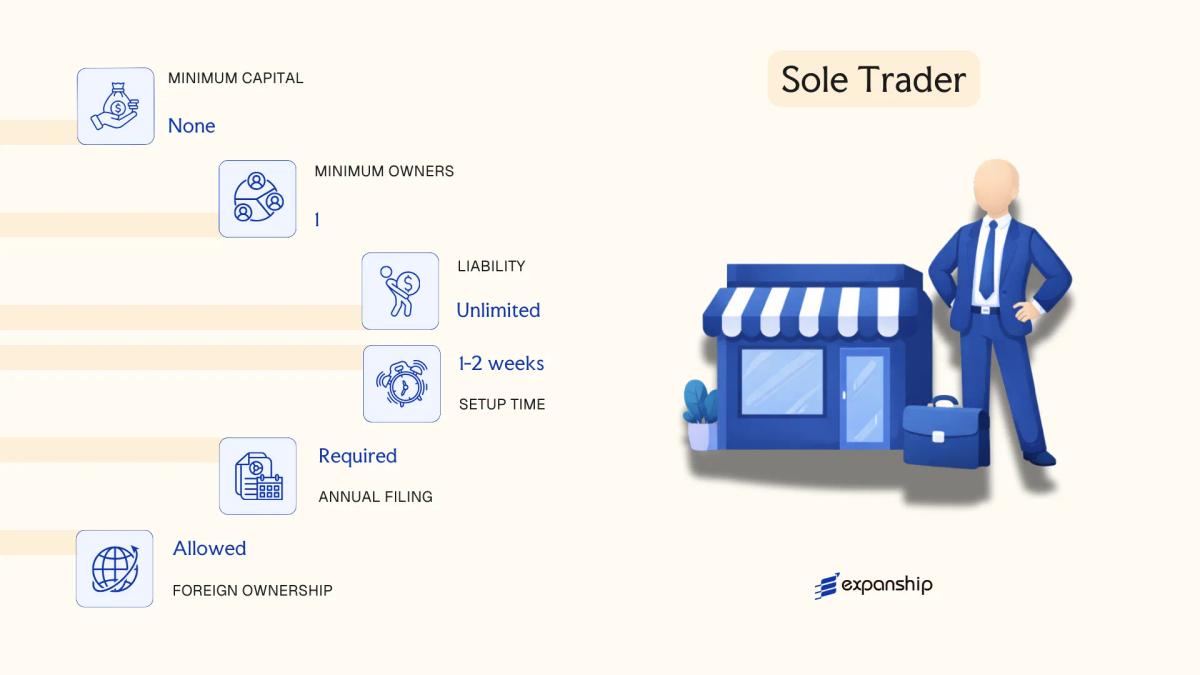
Sole trader registration in Dominica establishes the simplest form of business operation available under local law. Unlike incorporated entities, a sole proprietorship carries no separate legal personality — you and the business are legally the same, meaning personal assets are exposed to business liabilities.
Registration is handled through the Dominica Companies and Intellectual Property Office (CIPO), and trading under a name other than your own requires a business name registration under the Business Names Act. The process is straightforward, with no share capital requirements or formal governance documents.
Key Characteristics
| Requirement | Detail | Notes |
|---|---|---|
| Legal Form | Sole Proprietorship | No separate legal personality; owner and business are one |
| Member Type | Proprietor | Single individual only; no co-owners permitted |
| Local Presence | Business address in Dominica | No registered agent requirement, but a local address is needed |
| Capital | No minimum | No statutory capital requirement |
| Privacy | Business name publicly registered | Owner's identity linked to the registered business name |
Focus Points
- Taxation: Subject to personal income tax on business profits; no separate corporate tax applies; VAT registration may be required once turnover exceeds the statutory threshold.
- Annual Compliance: Business name renewal required periodically with CIPO; no audited accounts mandated.
- Liability: Unlimited personal liability for all business debts and obligations.
- Restrictions: Cannot issue shares or admit partners; growth and capital-raising capacity is inherently limited.
- Conversion: Can be converted to a private company by incorporating a new entity and transferring business assets.
Closing
A sole trader structure suits resident individuals running small-scale service or trading operations where simplicity and low overhead outweigh liability concerns. The absence of formation complexity is the primary advantage, while unlimited personal liability remains the defining drawback.
Resident self-employed individuals or micro-business operators conducting low-risk, single-person trading or service activities in Dominica.
How to Choose the Right Entity Type in Dominica
Selecting the wrong structure from the outset carries concrete regulatory and financial consequences — knowing how to choose a business entity in Dominica before filing avoids outcomes that are costly to reverse.
Why Your Entity Choice Matters
The Companies Act of Dominica governs most registered structures, and misapplication of its provisions creates measurable risk:
- Registering an International Business Company while intending to trade locally places the entity in breach of the IBC Act, which expressly prohibits domestic business activity and can result in striking off.
- Choosing a tax-exempt entity forfeits access to double taxation treaty benefits, meaning withholding taxes imposed in counterpart jurisdictions cannot be reduced or reclaimed.
- Forming a private company limited by shares for estate planning or succession purposes binds the structure to annual shareholder obligations and formal governance requirements that a trust or foundation would not carry.
- Selecting any structure that requires audited financial statements for a single-person consultancy introduces recurring professional fees that serve no operational purpose.
Key Factors to Consider
- Business Activity: Active trading, passive asset-holding, and regulated activities such as banking or insurance each point toward a distinct structure under Dominican law.
- Local vs. Offshore Operations: Transacting with Dominican residents requires a locally licensed structure; purely cross-border activity opens the IBC as a viable option.
- Ownership and Management: A single-member operation may suit an LLC or sole trader registration, while multi-party ventures typically require a company or limited partnership framework.
- Tax Objectives: Full exemption, local tax residency, and treaty eligibility are mutually exclusive in some configurations — confirm which applies before filing.
- Privacy Requirements: Director and shareholder details filed with the Registrar of Companies carry public disclosure implications; nominee arrangements alter this exposure.
- Exit Strategy: Not all Dominican structures permit redomiciliation or conversion; confirming these options at formation avoids procedural constraints later.
Compliance Services for Companies in Dominica
Maintain good standing with Dominica's Registrar of Companies through annual filings, registered agent obligations, and ongoing regulatory requirements.
Conclusion
Dominica company incorporation summary across the available structures reveals a clear pattern: each entity type serves a distinct purpose, and the right choice depends on your operational model, residency status, and long-term objectives.
The IBC remains the default choice for non-resident entrepreneurs seeking tax-exempt international holding or trading arrangements. For domestic commercial activity, the Private Company Limited by Shares is the standard vehicle. Public companies suit businesses with broader capital-raising ambitions, while companies limited by guarantee serve non-commercial or membership-based purposes. General and limited partnerships fit professional or joint-venture arrangements where pass-through treatment matters. Branch offices extend foreign legal persons without creating a new entity, and sole traders remain the simplest structure for individual operators.
Regulated under the Companies Act and overseen by the Registrar of Companies, Dominica continues to refine its corporate framework. Understanding how these structures align with your objectives is the starting point for any formation decision.
How Expanship Can Assist You
Expanship Dominica company formation services cover the full process of registering your chosen entity under the relevant legislation — whether that's an International Business Company under the IBC Act, a domestic company under the Companies Act, or a limited partnership. From initial structure selection to filing with the Registrar of Companies, our team handles each step with direct knowledge of what Dominica's regulatory requirements actually demand.
Here is what you can expect from working with us:
- Document preparation, notarization, and legalization
- Registered agent and registered office provision
- Government filing and liaison with the Registrar of Companies
- Post-incorporation compliance management, including annual returns
- Banking introduction assistance for corporate accounts
Reach out to our team through Expanship Dominica to discuss how we can support your registration and ongoing compliance needs in Dominica.
Frequently Asked Questions (FAQ)
The International Business Company (IBC) is the most frequently incorporated structure, largely because it exempts non-resident shareholders from local income tax and imposes minimal ongoing reporting obligations. Its straightforward registration process under the International Business Companies Act draws significant volume from foreign entrepreneurs.
An IBC is restricted from trading with Dominican residents or owning local real estate, whereas a Private Company Limited by Shares can conduct business domestically without such restrictions. Tax treatment also diverges: the Private Company is subject to standard corporate tax, while the IBC operates in a tax-neutral environment for qualifying foreign-source income. Compliance obligations are correspondingly heavier for the domestic private company.
The IBC offers the highest level of confidentiality. Beneficial ownership details and shareholder registers are not publicly accessible, and nominee directors and shareholders are permitted under the Act.
One person can form an IBC or a Private Company Limited by Shares, as both require only one director and one shareholder. Partnerships, by definition, require at least two parties and cannot be established by a sole individual.
Foreign nationals may register an IBC, LLC, or Private Company Limited by Shares without restriction. Branch offices require a parent company registered abroad, while sole trader registration is generally reserved for individuals with local residency or work authorization.
Dominica's corporate legislation allows for re-registration and continuation procedures between certain structures, though the available conversion paths depend on the entities involved. An IBC cannot simply convert into a domestic private company without dissolution and fresh incorporation. Professional legal advice should be sought before initiating any such process.
The IBC imposes the lightest compliance burden, with no mandatory annual financial statements filed publicly and no audit requirement in most cases. The Company Limited by Guarantee and Public Company Limited by Shares carry the most extensive reporting obligations among registered structures.
Legal Disclaimer
The information provided in this article is for general informational purposes only and does not constitute legal, tax, or professional advice. While we strive to ensure the accuracy and timeliness of the content, laws and regulations are subject to change, and the application of laws can vary widely based on specific facts and circumstances.
Readers should not act upon this information without seeking professional counsel tailored to their individual situation. Expanship and its authors disclaim any liability for actions taken or not taken based on the content of this article.
For specific advice regarding your business setup, compliance requirements, or any legal matters, please consult with qualified legal and tax professionals in the relevant jurisdiction.