
Key Takeaways
- Dominica IBCs incorporated under the International Business Companies Act are legally prohibited from conducting business with Dominica residents or owning local real estate, which structurally limits the entity to purely offshore activity and creates operational friction for businesses that need any domestic presence.
- The Financial Services Unit's limited regulatory infrastructure translates into reduced investor protections and weaker dispute resolution mechanisms, which can be a material concern for counterparties evaluating whether to contract with a Dominica-registered entity.
- Dominica maintains a negligible network of double taxation treaties, meaning IBC holders face unrelieved withholding taxes in counterparty jurisdictions with no treaty-based mechanism to reduce that burden.
- Heightened FATF and OECD scrutiny of Caribbean offshore jurisdictions increases the compliance burden on Dominica IBC holders, as correspondent banks and institutional partners routinely apply enhanced due diligence to entities registered in jurisdictions perceived as high-risk.
Dominica operates under a lightly regulated offshore framework, governed primarily by the International Business Companies Act and overseen by the Financial Services Unit (FSU). This framework creates a specific set of structural and operational disadvantages that this article examines across banking, taxation, compliance, and professional infrastructure.
The disadvantages of incorporating in Dominica do not apply uniformly. Your exposure to these limitations depends on your business model, target markets, and whether the entity is intended for active trading or passive holding purposes.
This article is most relevant to foreign investors and entrepreneurs considering an International Business Company (IBC) for cross-border trade, contract holding, or service delivery — structures that tend to surface these drawbacks most visibly in practice.
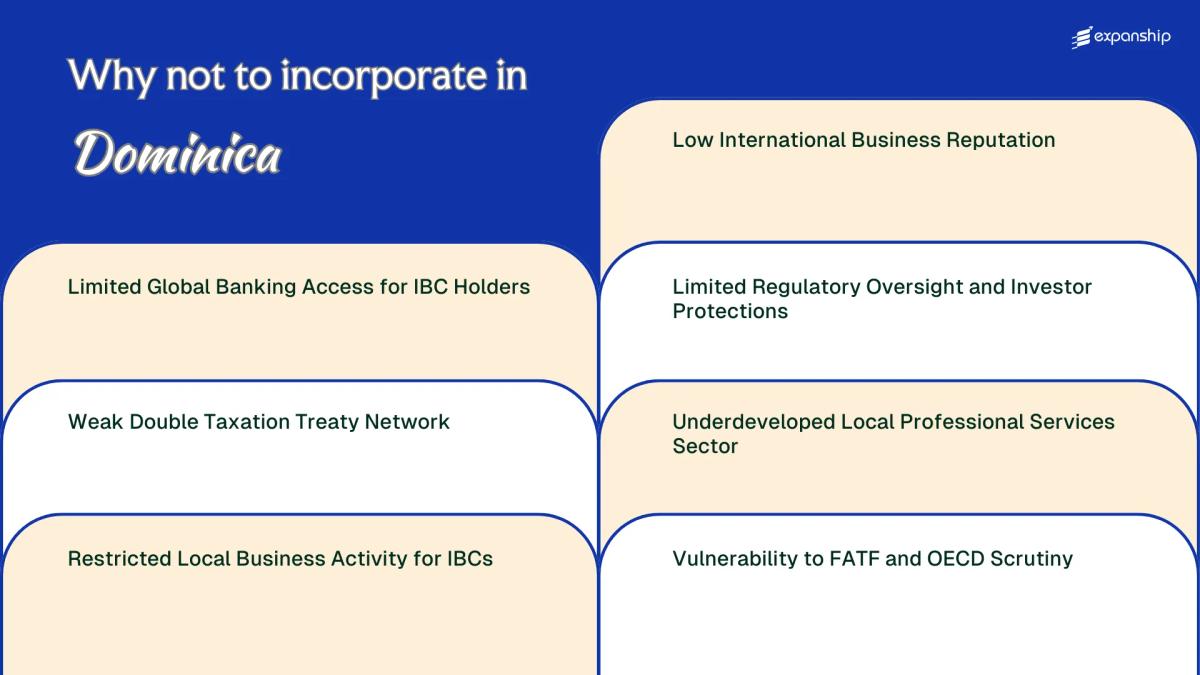
Limited Global Banking Access for IBC Holders
Dominica IBC banking access problems are among the most immediate operational obstacles you will face after incorporation. Opening and maintaining a functional business bank account is harder for IBC holders here than in most comparable offshore centres.
Correspondent Banking Relationships Are Severely Restricted
Global correspondent banks, particularly those in the United States and European Union, apply heightened due diligence to entities incorporated in jurisdictions perceived as high-risk. Dominica-registered IBCs routinely trigger these filters, resulting in account refusals or frozen transactions even when the underlying business activity is entirely legitimate.
Domestic banks in Dominica have lost several correspondent banking relationships over the past decade, which directly limits the currencies and payment corridors your entity can access.
Account Opening Outside Dominica Is Equally Difficult
Offshore banking restrictions tied to Dominica's international reputation mean that third-country banks in jurisdictions like Singapore or the UAE frequently decline IBC applicants outright. Your business may complete incorporation successfully under the International Business Companies Act yet still have no viable banking solution.
This structural gap means the entity can exist legally while remaining commercially non-operational.
Many Dominica IBCs remain unbanked for months after incorporation, making it impossible to receive payments, settle invoices, or execute contracts.
Weak Double Taxation Treaty Network
Dominica tax treaty network limitations present a direct structural problem for foreign business owners operating through an International Business Company. The country has signed very few comprehensive double taxation agreements, leaving most cross-border income flows without treaty protection.
When your IBC receives dividends, royalties, or service fees from counterparties in high-tax jurisdictions, those payments are likely subject to withholding tax at the source country's domestic rate. No bilateral treaty exists to reduce or eliminate that rate, meaning your effective tax burden increases at the point of payment rather than at the point of receipt.
This absence creates friction across several common business scenarios:
- Royalty income sourced from EU member states may face statutory withholding rates of 15-25%, with no treaty mechanism available to reduce the charge
- Dividend distributions from foreign subsidiaries back to your IBC carry no protection against double taxation in the subsidiary's home country
- Service fee payments from certain counterparties trigger withholding obligations that your IBC cannot reclaim through a competent authority process
- Banking and payment partners may apply additional scrutiny to structures lacking treaty coverage, increasing compliance documentation costs
Jurisdictions such as Cyprus or Malta maintain extensive treaty networks that actively reduce withholding exposures. Without equivalent agreements, an IBC registered under the Dominica Exempt and Ordinary Companies Act has no equivalent mechanism to recover tax withheld abroad.

Company Incorporation in Dominica
Understand the full regulatory and tax implications before registering an IBC in Dominica.
Restricted Local Business Activity for IBCs
Dominica IBC local business restrictions are written directly into the legal framework governing these entities. Under the International Business Companies Act, an IBC is explicitly prohibited from conducting business with residents of Dominica, owning real property on the island, or engaging in any activity directed at the domestic market.
| Restricted Activity | Practical Consequence | Scope of Restriction |
|---|---|---|
| Trading with Dominica residents | No domestic revenue generation permitted | Absolute prohibition |
| Owning local real estate | Cannot hold property as a business asset within the jurisdiction | Applies to all IBCs regardless of structure |
| Banking with local institutions for domestic purposes | Severely limited access to in-country financial infrastructure | Functionally restricts onshore operations |
| Employing local staff for domestic operations | Cannot build a genuine local commercial presence | Tied to the domestic trading ban |
This structural separation between the IBC and the domestic economy is what makes the vehicle unsuitable if your business model requires any local footprint. A firm needing a physical presence, local contracts, or onshore client relationships cannot operate through this structure without breaching its foundational legal conditions.
The prohibition extends to using the IBC as a vehicle for owning Dominican assets, which limits its utility for real estate holding strategies within the jurisdiction. Foreign investors who later identify domestic opportunities find the entity legally incompatible with that expansion.
Low International Business Reputation
Dominica offshore company reputation risks are well-documented among international banking and compliance professionals. Formed under the International Business Companies Act of 1996, IBCs registered here carry a geographic stigma that translates directly into operational friction — rejected bank applications, heightened due diligence requests, and diminished counterparty confidence.
Correspondent banks in the United States and European Union routinely flag entities from smaller Caribbean jurisdictions as elevated-risk. For your business, this means disclosure obligations and compliance costs that exceed what a company incorporated in a mid-tier EU jurisdiction would face.
Dominica IBC international recognition issues extend beyond banking. Foreign courts, institutional investors, and procurement agencies in OECD countries treat Caribbean IBCs with structural skepticism, which can affect contract enforceability and partnership negotiations before any transaction begins.
- Counterparties may require certified apostille documentation and additional KYC at every stage of a transaction
- Your entity's jurisdiction of incorporation must be disclosed in many jurisdictions' beneficial ownership registers
- Some institutional investors apply blanket exclusions to entities from non-OECD offshore jurisdictions
- Enhanced due diligence requirements under EU AMLD frameworks apply to businesses originating from listed high-risk third countries
Dominica's citizenship-by-investment programme, despite being one of the Caribbean's oldest, has increased international scrutiny of all Dominica-registered entities — not just passport holders.
Limited Regulatory Oversight and Investor Protections
Dominica IBC regulatory oversight limitations are less stringent than those in established offshore centres like the Cayman Islands or British Virgin Islands, leaving your business exposed to governance gaps that more mature regimes have addressed through legislation.
Structural Gaps in the Oversight Framework
The Financial Services Unit (FSU), operating under the Dominica Offshore Banking Act and the International Business Companies Act, carries supervisory responsibility for registered entities, but its enforcement capacity and resources are limited relative to the volume of companies registered. This means that misconduct, misrepresentation, or mismanagement within an IBC may go undetected for extended periods, with few practical remedies available to defrauded investors or creditors.
Consequences for Investor Confidence and Dispute Resolution
Dominica investor protection drawbacks become tangible when a dispute arises, as the jurisdiction lacks a dedicated commercial or financial ombudsman for IBC-related grievances. Minority shareholders and foreign investors have limited statutory recourse mechanisms compared to jurisdictions with codified investor protection regimes, making the IBC structure unsuitable for arrangements where accountability between parties is operationally essential. The absence of mandatory audit requirements for most IBCs compounds this risk, since financial irregularities may not surface through any formal oversight channel.
Managing Governance and Compliance Risks for Your Dominica Entity
Understand the oversight limitations affecting Dominica IBCs and how to structure your entity with appropriate safeguards from the outset.
Underdeveloped Local Professional Services Sector
The Dominica professional services sector drawbacks are a practical constraint for any foreign business owner who needs reliable, specialist support to manage an IBC after incorporation.
- The pool of licensed corporate service providers, auditors, and legal firms with IBC-specific experience is small, meaning you may face limited choices, slower turnaround times, and higher per-service costs than in more established offshore centres.
- Accounting firms with cross-border tax structuring expertise are scarce, leaving your entity dependent on foreign advisers who may have limited familiarity with the Offshore Companies Act or local filing conventions.
- Dominica offshore legal and accounting services infrastructure has not scaled proportionally with IBC registrations, so specialist legal opinions on corporate restructuring or ownership changes can require sourcing counsel from outside the jurisdiction at additional cost.
- The absence of a deep local talent pool means succession planning for corporate administration roles carries operational risk that your business would not face in jurisdictions with mature financial services centres.
Vulnerability to FATF and OECD Scrutiny
Dominica FATF OECD scrutiny risks are a tangible operational concern for any foreign business owner holding an IBC registered under the Commonwealth of Dominica's International Business Companies Act. The country has faced periods of heightened monitoring from international bodies, and its offshore framework has drawn attention from both the FATF and the OECD's Global Forum on Transparency and Exchange of Information for Tax Purposes.
The Global Forum has previously rated jurisdictions on their adherence to the international standard on exchange of information on request (EOIR). A less-than-satisfactory rating restricts how foreign counterparties, banks, and institutional partners perceive entities incorporated there.
Offshore tax haven blacklist risks are real for Dominica-registered firms. The EU's list of non-cooperative jurisdictions for tax purposes has included or flagged Caribbean offshore centers based on economic substance and transparency criteria, creating direct reputational and compliance exposure for your business.
Correspondent banks and payment processors apply their own risk-scoring models. If your entity's jurisdiction appears on a monitoring list or grey list, counterparties may terminate relationships or apply enhanced due diligence requirements, generating direct operational costs.
Hypothetical scenario: A Dominica IBC applying for a merchant processing account in 2024 is flagged under enhanced due diligence protocols by a European acquirer. Compliance review delays the account activation by 8 to 12 weeks, with legal and consulting fees reaching approximately $3,500 USD before the account is approved or declined.
Overcoming These Incorporation Drawbacks
Overcoming Dominica incorporation drawbacks requires structural planning rather than reactive fixes. The challenges discussed in this blog, from banking access to FATF scrutiny, share a common thread: they respond to deliberate compliance choices made at formation and maintained afterward.
- Register your IBC under the International Business Companies Act and confirm it holds a valid certificate of good standing before approaching any correspondent banking relationship.
- Elect a jurisdiction with an active tax treaty network as the residence of your operating entity, using the Dominica IBC as a holding structure only.
- Ensure your IBC's constitutional documents explicitly prohibit local trading activity, preserving its status under the offshore regulatory framework.
- File all annual returns on time with the Registrar of Companies to avoid automatic striking-off, which accelerates reputational and compliance risk.
- Appoint a registered agent licensed under Dominican law to maintain a local registered office, satisfying the statutory presence requirement.
These steps operate within the framework administered by the Financial Services Unit, which oversees IBC compliance alongside anti-money laundering obligations. Structural decisions made at formation carry the most weight in determining how manageable these disadvantages remain over time.
Dominica's Overall Business Case
Weighing the Dominica offshore company pros and cons against each other, the jurisdiction presents a mixed picture. The International Business Companies Act provides a functional legal framework, and registration costs remain low relative to comparable offshore centers. That said, the disadvantages documented throughout this blog are structural, not incidental, and they narrow the viable use cases considerably.
| Pros | Cons |
|---|---|
| No corporate tax, income tax, or capital gains tax on offshore income | Limited access to correspondent banking makes holding and moving funds difficult |
| Low formation and annual maintenance costs under the IBC Act | Absence of substantive double taxation treaties restricts cross-border tax planning |
| Fast incorporation with minimal disclosure requirements | IBCs are legally barred from conducting business with Dominica residents or owning local real estate |
| No requirement to file audited accounts or public financial statements | Heightened FATF and OECD scrutiny increases the risk of your entity being flagged by foreign banks |
| Flexible share structures permitted under the IBC Act | The jurisdiction carries a weaker international reputation than established IBC centers, affecting counterparty acceptance |
Professional services infrastructure on the island remains thin, which can affect ongoing compliance quality.
Compliance Services for Companies in Dominica
Maintain your Dominica IBC in good standing with annual filings, registered agent requirements, and regulatory obligations under the International Business Companies Act.
Conclusion
Dominica's position as an IBC jurisdiction is defined as much by its structural limitations as by its low-cost entry point. The Dominica company incorporation disadvantages summary is clear: thin banking access, an absent tax treaty network, and persistent exposure to FATF and OECD scrutiny create real operational friction for businesses that require cross-border functionality. These are not peripheral concerns. Addressing them requires deliberate structuring, appropriate professional guidance, and a clear-eyed assessment of whether the jurisdiction fits your specific commercial objectives.
Expanship's Dominica Incorporation Support
Dominica IBC formation support from Expanship is structured around the specific compliance pressures that IBCs face under the International Business Companies Act and the oversight expectations set by the Financial Services Unit. The banking access barriers, treaty gaps, and FATF scrutiny covered throughout this blog represent real operational friction, and Expanship's role is to reduce the administrative burden those challenges create for your business.
Our services across Dominica company registration and offshore structuring include:
- Preparing and filing all company registration documents with the relevant Dominica authorities.
- Providing a registered agent and local office address as required under Dominica IBC regulations.
- Managing government filings and liaising with the Financial Services Unit on your behalf.
- Handling ongoing post-incorporation compliance obligations to keep your entity in good standing.
- Facilitating introductions to banking institutions familiar with Dominica-registered structures.
- Coordinating tax registration and correspondence with local authorities where applicable.
To discuss your incorporation requirements, contact Expanship Dominica.
Frequently Asked Questions (FAQ)
It affects any business where cross-border income flows are involved, which covers most international trading, consulting, or holding structures. Dominica has a very limited number of double taxation agreements in force, meaning withholding taxes on dividends, royalties, or interest paid to a Dominica entity from treaty-heavy jurisdictions cannot typically be reduced through treaty relief. Businesses that depend on structured cross-border payments will bear a direct financial cost as a result.
IBCs incorporated under Dominica's International Business Companies Act are prohibited from carrying on business with residents of Dominica or owning real property in the country. The restriction is structural, not a compliance lapse, meaning it is built into the IBC framework itself. If your business model requires any local commercial presence or Dominican customer base, an IBC is the wrong vehicle entirely.
Dominica has faced periods of heightened international scrutiny that comparable jurisdictions with stronger regulatory track records, such as the Cayman Islands or BVI, have largely avoided at the same intensity. FATF evaluations assess the effectiveness of anti-money laundering frameworks, and weaker supervisory infrastructure in Dominica means entities registered there can face increased correspondent banking restrictions as a downstream effect. That risk is not hypothetical; it directly affects your firm's ability to process international payments.
Failure to pay the annual government fee or file required documentation can result in the company being struck off the register maintained by the Dominica Financial Services Unit. Reinstatement is possible but involves additional fees and administrative delay, during which your entity has no legal standing. Any contracts entered into or assets held during the struck-off period may be legally compromised.
Yes, directly. The Financial Services Unit has limited supervisory capacity compared to regulators in jurisdictions like Jersey or Singapore, which means misconduct by local registered agents or directors is less likely to be detected and acted upon promptly. Shareholders in a Dominica IBC have fewer procedural protections and enforcement mechanisms available to them if a dispute arises over the management of the company.
It pushes costs upward indirectly. Because the local pool of qualified corporate lawyers, accountants, and compliance specialists is limited, many IBC holders must engage service providers from outside Dominica, adding layers of cost and coordination complexity. This also means that professional advice specific to Dominica's regulatory environment can be harder to source and verify for quality.
It can, particularly where counterparties in OECD-member countries apply their own domestic anti-avoidance rules or controlled foreign corporation legislation. Some counterparties will request evidence of economic substance or local activity that a Dominica IBC, by its structural design, cannot credibly provide. This does not make transactions illegal, but it can slow contract negotiations or cause counterparties to request alternative structuring.
Legal Disclaimer
The information provided in this article is for general informational purposes only and does not constitute legal, tax, or professional advice. While we strive to ensure the accuracy and timeliness of the content, laws and regulations are subject to change, and the application of laws can vary widely based on specific facts and circumstances.
Readers should not act upon this information without seeking professional counsel tailored to their individual situation. Expanship and its authors disclaim any liability for actions taken or not taken based on the content of this article.
For specific advice regarding your business setup, compliance requirements, or any legal matters, please consult with qualified legal and tax professionals in the relevant jurisdiction.