
Key Takeaways
- Dominica's International Business Companies Act provides a full exemption from tax on foreign-sourced income, eliminating one of the primary cost drivers in cross-border corporate structuring.
- Neither directors nor shareholders are subject to public disclosure requirements, allowing ownership and control structures to remain confidential without the use of complex layering arrangements.
- The legal framework derives from English common law, meaning foreign investors can assess contractual enforceability and corporate governance obligations without interpreting an unfamiliar legal tradition.
- Incorporation and ongoing maintenance fees remain low relative to comparable offshore jurisdictions, reducing the minimum threshold at which the structure becomes economically justified.
Dominica is an independent island nation in the eastern Caribbean, operating under a Westminster-style parliamentary system with a legal framework derived from English common law. Company registration falls under the authority of the Registrar of Companies, which administers the formation and ongoing compliance of business entities incorporated under the Companies Act. Foreign investors most commonly establish an International Business Company when structuring operations through this jurisdiction.
The tax posture is broadly zero-tax on foreign-sourced income, making it a frequently selected destination for international structuring. There are no restrictions on foreign ownership of locally incorporated entities, and the government has maintained an open stance toward foreign direct investment across most sectors. Your business can be wholly foreign-owned without requiring a local partner or shareholder.
Understanding the benefits of incorporating in Dominica requires examining several distinct regulatory and structural factors that collectively define what the jurisdiction offers. This article addresses those key advantages in detail across the sections that follow.
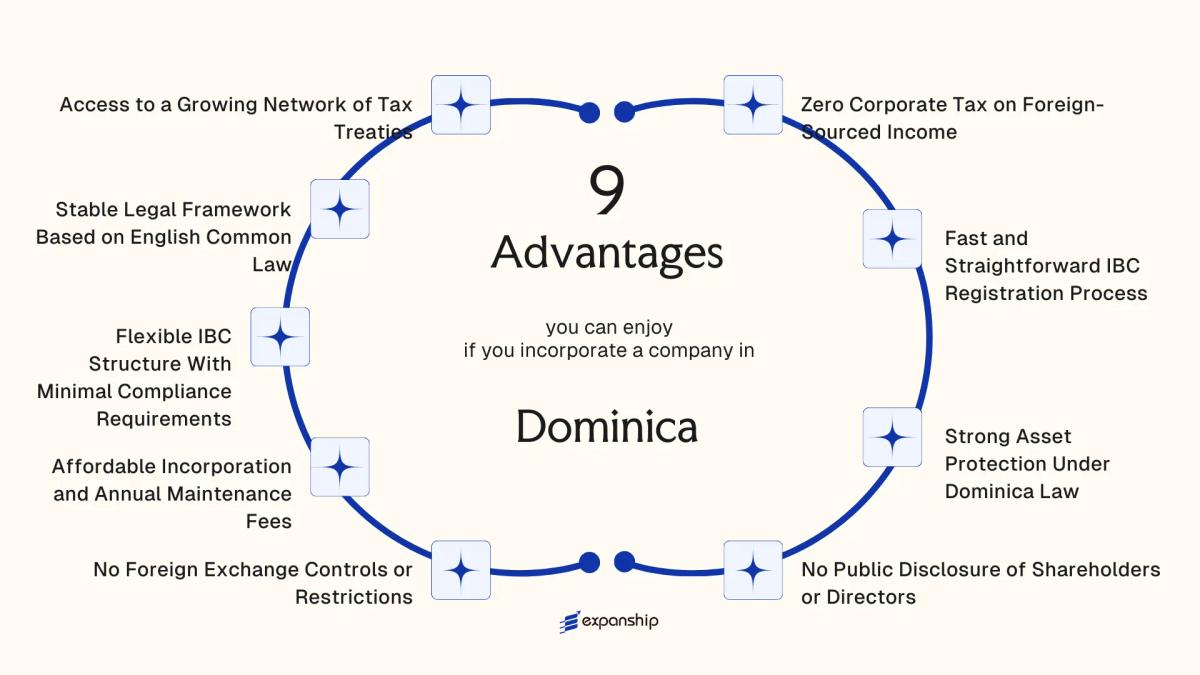
Zero Corporate Tax on Foreign-Sourced Income
Dominica zero tax on foreign income is the defining structural advantage of the International Business Company (IBC) regime established under the Companies Act. Income earned outside the jurisdiction is fully exempt from corporate tax, regardless of the amount or the source country.
How the Exemption Is Structured
Under Dominica's IBC framework, a registered company that conducts all its business activities outside the country owes no corporate income tax on those earnings. This means your retained profits remain intact, rather than being reduced by a tax liability before reinvestment or distribution.
What This Means in Practical Terms
The Dominica IBC tax exemption on foreign income applies as long as the entity does not engage in business with residents or locally sourced revenue. For firms operating internationally — holding intellectual property, managing cross-border trade, or receiving foreign investment returns — the full profit stays within the business structure.
Eligibility hinges on maintaining the IBC's qualifying status, which requires that revenue originates from outside the territory.
Foreign-sourced profits flow into your IBC without reduction from corporate tax, preserving the full value of your international earnings.
Fast and Straightforward IBC Registration Process
Registered under the International Business Companies Act of Dominica, an IBC can be formed within a matter of days. The registry process does not require the physical presence of directors or shareholders, and the entire procedure can be completed remotely through a licensed registered agent based in the country.
This speed is a practical advantage because it means your business can begin operating under a formally incorporated entity without the prolonged waiting periods common in many onshore jurisdictions. For time-sensitive transactions or international structures that require a legal entity to be in place quickly, this efficiency has direct operational value.
Several features of the registration framework contribute to this speed:
- Only one director and one shareholder are required, removing the need to assemble a complex governance structure before incorporation
- No minimum paid-up capital is prescribed, so the entity can be formed without capital deposits or proof-of-funds requirements at registration stage
- The registered agent handles filing with the Registrar of Companies on your behalf, eliminating the need for direct interaction with the registry
- No government approval or pre-incorporation review is required for standard IBC activities
The combination of a single-step filing process and minimal upfront documentation means Dominica IBC registration advantages extend beyond convenience. Your corporate structure is legally constituted and ready for use in a timeframe that most comparable offshore frameworks cannot match.

Incorporate Your IBC in Dominica
Set up your Dominica International Business Company remotely through Expanship, with a licensed registered agent handling the full filing process on your behalf.
Strong Asset Protection Under Dominica Law
Dominica asset protection benefits are rooted in specific statutory provisions rather than general common law principles alone. The International Business Companies Act, which governs IBC formation, includes explicit protections that limit the enforceability of foreign judgments and court orders against locally registered entities. A judgment obtained in a foreign court does not automatically bind assets held within a Dominica IBC, meaning creditors must satisfy additional legal thresholds before any claim can proceed domestically.
| Feature | Statutory Basis | Practical Effect |
|---|---|---|
| Foreign judgment limitation | IBC Act | Foreign rulings not automatically enforceable |
| Fraudulent transfer rules | General trust and corporate law | Transfers must predate any known claim |
| Nominee structures permitted | IBC Act | Legal ownership separable from beneficial interest |
| Confidentiality of ownership | IBC Act | Beneficial owners not exposed in public filings |
Nominee shareholding arrangements are expressly permitted under the IBC framework, allowing beneficial owners to separate their identity from legal title. This structural separation creates a meaningful layer of insulation between personal assets and any liabilities attached to the registered entity.
For Dominica offshore asset protection law to apply fully, the transfer of assets into the IBC must occur before any claim or legal action is initiated. Transfers made after a creditor relationship has formed may be subject to fraudulent conveyance challenges under general equitable principles. Understanding that timing point is essential to structuring the entity before any disputes arise.
No Public Disclosure of Shareholders or Directors
Under the International Business Companies Act, IBCs registered in Dominica are not required to file shareholder or director information with any public registry. No government database exposes the names of beneficial owners or company officers to outside parties. This structural feature is foundational to Dominica IBC shareholder privacy benefits, as it means your ownership position remains invisible to competitors, litigants, and third parties by default.
The practical consequence is significant. A foreign investor who holds shares in a Dominica IBC cannot have that ownership traced through a public records search. For business owners operating in politically sensitive markets, or those managing family wealth across multiple jurisdictions, this separation between identity and ownership has direct legal and operational value.
Registered agent confidentiality requirements reinforce this protection. The agent holds identity records for compliance purposes, but these are not transmitted to any publicly searchable state database under ordinary circumstances.
Keep the following in mind:
- Nominee director and shareholder arrangements are permitted under Dominica law, adding an additional layer of structural separation
- Confidentiality applies to both legal owners and beneficial owners under normal operating conditions
- Internal records must still be maintained by the registered agent, even if not publicly filed
- Disclosure obligations can arise under mutual legal assistance treaties or international information exchange requests
Dominica does not maintain a central public register of beneficial ownership that is accessible to the general public, which puts it outside the disclosure norms now adopted across much of the EU and Caribbean.
No Foreign Exchange Controls or Restrictions
Dominica imposes no foreign exchange controls on International Business Companies, which means your business can move capital across borders without regulatory approval, reporting thresholds tied to currency conversion, or government-mandated holding periods. This Dominica no foreign exchange controls benefit is codified under the International Business Companies Act, which exempts IBCs from the currency restrictions that apply to domestic companies operating within the local economy.
Freedom to Transact in Any Currency
An IBC registered in Dominica can hold bank accounts, execute contracts, and settle transactions in any currency. There is no obligation to convert revenues into Eastern Caribbean Dollars or route funds through a local financial institution before transferring them abroad. For a business receiving payments from clients across multiple regions, this eliminates a layer of operational friction that jurisdictions with managed exchange regimes routinely impose.
Unrestricted Capital Repatriation
Profits, dividends, and capital gains generated outside the jurisdiction can be repatriated to owners or parent entities without restriction. No withholding mechanism applies to outbound transfers from an IBC to foreign shareholders, provided the income originates from qualifying foreign-source activities. This structural feature means your firm retains full control over how and when funds are distributed, which has direct implications for treasury planning and cross-border cash management.
Unlock the Full Benefits of Your Dominica IBC
Speak with an Expanship specialist about structuring your Dominica IBC to take full advantage of its foreign exchange freedoms and broader offshore benefits.
Affordable Incorporation and Annual Maintenance Fees
Dominica affordable IBC maintenance advantages are a consistent draw for business owners who need to manage operating costs without sacrificing jurisdictional credibility. Under the International Business Companies Act, government fees and registered agent costs remain among the lower end of what comparable offshore jurisdictions charge.
- The government incorporation fee for an IBC is modest relative to jurisdictions such as the British Virgin Islands or Cayman Islands, where annual fees can run into several hundred to over a thousand dollars before professional costs are added.
- Annual maintenance fees, covering the government renewal fee and registered agent requirements, are structured to remain affordable year over year, so your ongoing compliance budget stays predictable.
- No minimum capital requirement applies to IBCs under the Act, which means you are not obligated to tie up funds at the point of formation or during annual renewals.
- The registered agent requirement, while mandatory, is fulfilled through licensed local agents whose fees reflect the jurisdiction's competitive cost structure rather than a premium offshore market.
- Lower formation and maintenance costs translate directly into a shorter breakeven timeline for the entity, which matters most for holding structures, early-stage ventures, or businesses with lean operational budgets.
Flexible IBC Structure With Minimal Compliance Requirements
Dominica IBC flexible structure advantages are rooted in the International Business Companies Act, which gives IBCs broad latitude in how they organize their internal governance. There is no statutory requirement for annual general meetings to be held in-country, and board meetings can take place anywhere in the world or be conducted by written resolution.
IBCs registered under this Act are not subject to mandatory audit requirements or annual financial statement filings with the Registrar of Companies. For a foreign business owner, this removes a recurring administrative cost that is standard in most onshore jurisdictions, where audited accounts are a compliance baseline.
The minimum share capital requirement is flexible, with no prescribed paid-up minimum for most standard IBC structures. Your company can also issue shares in any currency, a practical advantage for entities that operate across multiple currency environments.
- A single director and a single shareholder suffice to form and operate the entity
- Corporate directors and corporate shareholders are permitted
- No residency requirement applies to directors or officers
A foreign-owned IBC with one director and one shareholder, conducting all meetings by written resolution outside Dominica and filing no annual financial statements locally, can maintain full compliance at a fraction of the administrative overhead required in comparable onshore structures.
Stable Legal Framework Based on English Common Law
Dominica's legal system descends directly from English common law, and the Dominica English common law framework benefits foreign businesses in a concrete way: contracts, corporate structures, and dispute resolutions follow principles that are well-understood across the UK, Canada, Australia, and most major commercial centers. That shared legal heritage significantly reduces uncertainty when drafting agreements or anticipating how courts might interpret obligations.
IBCs incorporated under the International Business Companies Act operate within a jurisdiction where judicial precedent carries binding authority. This means legal outcomes are more predictable than in civil law systems, where codified statutes can leave less room for interpretive flexibility in commercial disputes.
Because local courts apply principles drawn from centuries of English commercial case law, your legal counsel in major financial hubs will already be familiar with the foundational rules governing your entity. That cross-border legal familiarity reduces advisory costs and shortens due diligence timelines when dealing with counterparties abroad.
- Court decisions follow binding precedent, reducing unpredictable outcomes in contractual disputes
- Corporate governance concepts such as fiduciary duty and ultra vires align with conventions recognized in most common law jurisdictions
- Legal documentation prepared under English common law principles is generally accepted by international banks and institutional counterparties
While the legal framework mirrors English common law principles, Dominica's domestic courts have limited capacity for complex international commercial litigation, so high-value disputes may benefit from arbitration clauses specifying a neutral offshore venue.
Access to a Growing Network of Tax Treaties
Dominica's tax treaty network advantages are modest in scale but relevant in application. The country has signed a limited number of double taxation agreements, primarily within the Caribbean Community (CARICOM) framework. Under the CARICOM Agreement for the Avoidance of Double Taxation, member states coordinate tax treatment on income flows between signatory nations, which directly reduces the risk of the same income being taxed twice when your business operates across multiple Caribbean markets.
What Treaty Access Means in Practice
For an IBC incorporated under the International Business Companies Act, treaty benefits apply where the entity meets residency and substance requirements under the relevant agreement. This matters because without treaty protection, dividends, royalties, or service fees paid across borders can attract withholding tax in the source country. Treaty coverage gives your entity a defined legal basis to claim reduced or eliminated withholding rates, rather than relying on unilateral domestic exemptions that can be changed without notice.
Scope and Limitations to Understand
The treaty network is not as extensive as those maintained by jurisdictions like the Netherlands or Singapore. However, for businesses whose primary operations and clients are concentrated in the Caribbean basin, CARICOM treaty access addresses the most relevant cross-border tax exposures directly. Treaty eligibility generally requires that the entity have genuine economic substance and residency status in the jurisdiction, conditions that should be assessed against your specific operational structure.
- CARICOM double taxation agreement covers income from business profits, dividends, and employment
- Treaty benefits apply at the agreement level, not automatically to all IBC structures
- Residency and substance conditions determine eligibility for reduced withholding rates
Why Dominica Stands Out Against Competing Offshore Jurisdictions
Evaluated against its most direct competitors, the Dominica IBC vs other offshore jurisdictions advantages become clearest when comparing structural factors that directly affect cost, privacy, and operational ease. The jurisdictions most relevant to this comparison are Belize, Seychelles, and St. Kitts and Nevis — all of which target a similar profile of foreign investor, offer comparable IBC-type structures, and operate within the same general regulatory tier. What the comparison reveals is not that one jurisdiction dominates every category, but that Dominica holds a consistently favourable position across the parameters that matter most to cost-conscious, privacy-focused business owners.
Where Dominica differentiates itself is in the combination of low annual fees and the absence of a mandatory registered capital requirement under the International Business Companies Act, factors that reduce both entry costs and ongoing obligations. Belize imposes no corporate tax either, but its offshore sector has faced greater international scrutiny in recent years. Seychelles offers a similar privacy framework yet carries higher government fees at certain filing thresholds.
| Parameter | Dominica | Belize | Seychelles | St. Kitts & Nevis |
|---|---|---|---|---|
| Corporate Tax on Foreign Income | 0% | 0% | 0% | 0% |
| Public Register of Directors | No | No | No | No |
| Minimum Share Capital Required | None | None | None | None |
| Annual Government Fee Level | Low | Low–Medium | Medium | Medium |
| Common Law Legal System | Yes | Yes | Hybrid | Yes |
| Foreign Exchange Controls | None | None | None | None |
Compliance Services for Companies in Dominica
Stay current with Dominica's IBC annual filing, registered agent, and good standing requirements through Expanship's managed compliance service.
Conclusion
Dominica's value as an incorporation destination rests on a combination of structural features that are difficult to find together in a single jurisdiction. The benefits of incorporating in Dominica converge around three pillars: the exemption from tax on foreign-sourced income under the International Business Companies Act, the absence of public disclosure requirements for directors and shareholders, and a legal framework grounded in English common law that foreign investors can interpret without ambiguity.
These advantages are not equally relevant to every business. A firm with significant domestic trading activity, for example, operates under a different set of rules than one structured purely for international commerce. Your specific industry, ownership structure, and the jurisdictions where clients and counterparties are based will determine how much practical weight each of these features carries.
What makes this jurisdiction coherent as a choice is that its regulatory architecture was designed with international business in mind from the outset, rather than adapted from a domestic framework as an afterthought. The International Business Companies Act, the privacy protections, and the low compliance burden form a consistent package rather than a set of disconnected incentives. For a foreign investor or business owner assessing where to establish an offshore entity, that internal consistency reduces administrative friction over the life of the company. The next step is determining whether that structure aligns with your operational requirements and how to execute the registration correctly.
Start Your Dominica Incorporation Journey With Expanship
Expanship supports the full lifecycle of an IBC formation under the International Business Companies Act — from preparing your incorporation documents to liaising with the Registrar of Companies in Roseau. The benefits this blog has outlined, from Dominica's zero tax on foreign-sourced income to the absence of foreign exchange controls and public disclosure requirements, are accessible in practice only when the underlying filing and compliance work is handled accurately.
To incorporate in Dominica with Expanship, you receive structured support across each stage of the process:
- Preparation and legalization of incorporation documents, including the Memorandum and Articles of Association
- Provision of a registered agent and registered office address, as required under the IBC Act
- Filing and direct liaison with the Registrar of Companies on your behalf
- Post-incorporation compliance management, including annual renewal obligations
- Banking introduction assistance to support your entity's operational setup
Dominica company incorporation advantages through Expanship extend to clients who may be establishing an offshore structure for the first time and are unfamiliar with the Documentation, Registry, or agent requirements that apply locally.
Reach out to Expanship Dominica to discuss your specific structure, intended use of the IBC, and any compliance obligations relevant to your home jurisdiction.
Frequently Asked Questions (FAQ)
A Dominica IBC pays zero corporate tax on income generated outside the jurisdiction. This exemption is established under the International Business Companies Act and applies as long as the company does not conduct business with Dominica residents or derive income from within the territory. Income sourced domestically does not qualify for this exemption and would be subject to standard tax treatment.
Registration is typically completed within one to two business days once all required documents are submitted to the Registrar of Companies. The process requires submission of the Memorandum and Articles of Association, along with standard due diligence documentation through a licensed registered agent. Delays generally occur only when submitted documents are incomplete or require clarification.
No foreign exchange controls apply to Dominica IBCs, meaning the company can freely transfer funds, repatriate profits, and hold accounts in any currency without regulatory approval. This treatment is consistent with the jurisdiction's framework for international business entities. Domestic companies operating within Dominica are subject to different rules and fall outside this exemption.
Beneficial ownership details, shareholder identities, and director information are not included in the public register maintained by the Registrar of Companies. Nominee structures are permitted under the International Business Companies Act, which further insulates the identities of underlying principals. Disclosure obligations exist toward the registered agent for compliance purposes but do not extend to the public domain.
Dominica has entered into a limited number of tax information exchange agreements and maintains some treaty arrangements, though its network is narrower than larger offshore centres. An IBC should not be structured with the assumption of broad treaty access, and professional advice is necessary to assess whether a specific treaty applies to a given transaction or counterparty jurisdiction. The practical treaty benefit available to a Dominica IBC will depend on the residency of the other party and the nature of the income involved.
Failure to pay the annual government fee by the due date results in the company falling into arrears, which can eventually lead to the entity being struck off the register. Reinstatement is possible under the International Business Companies Act, but it requires payment of outstanding fees along with applicable penalties. An entity struck off loses its legal standing, which can affect the validity of contracts and asset ownership held in the company's name.
Legal Disclaimer
The information provided in this article is for general informational purposes only and does not constitute legal, tax, or professional advice. While we strive to ensure the accuracy and timeliness of the content, laws and regulations are subject to change, and the application of laws can vary widely based on specific facts and circumstances.
Readers should not act upon this information without seeking professional counsel tailored to their individual situation. Expanship and its authors disclaim any liability for actions taken or not taken based on the content of this article.
For specific advice regarding your business setup, compliance requirements, or any legal matters, please consult with qualified legal and tax professionals in the relevant jurisdiction.