
Key Takeaways
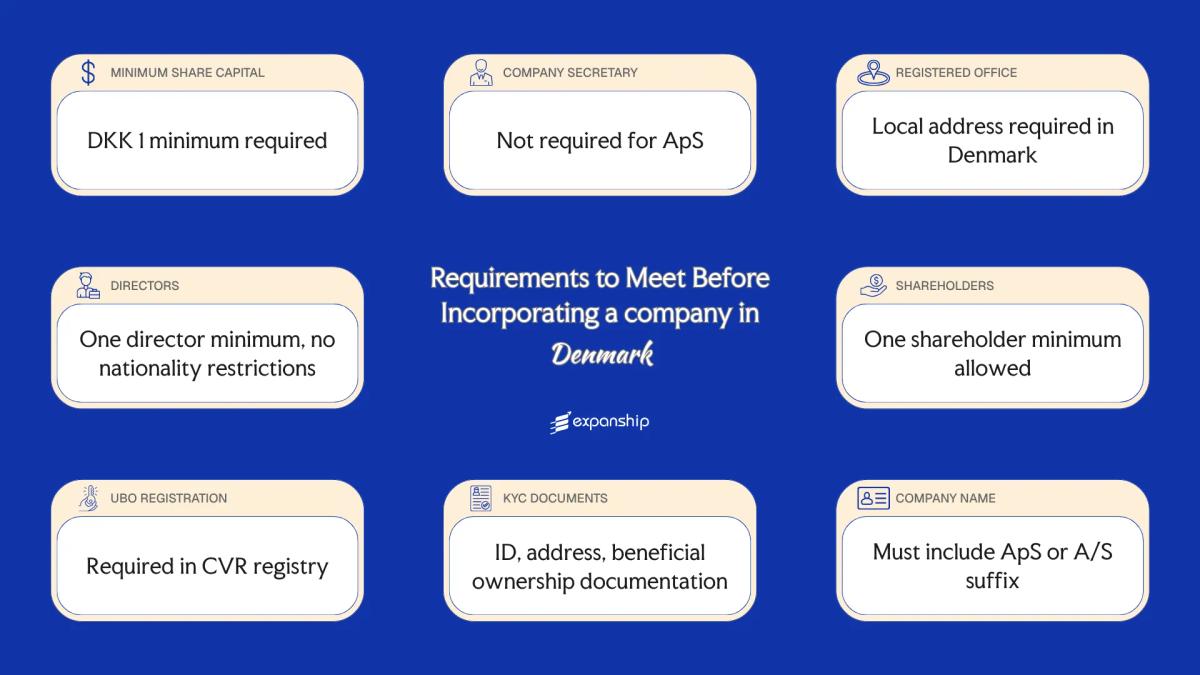
- Entities incorporating as a private limited company (ApS) in Denmark must meet a minimum share capital threshold of DKK 40,000 under the Danish Companies Act (Selskabsloven) before registration can proceed.
- All companies registered in Denmark are required to identify and record their ultimate beneficial owners in the Danish Business Authority's (Erhvervsstyrelsen) central register, a separate compliance obligation imposed by the Danish Money Laundering Act.
- A physical registered office address located within Denmark must be provided at the time of incorporation, as the Danish Business Authority uses this address for all official correspondence and compliance notices.
- Foreign investors must ensure that director, shareholder, and KYC documentation requirements are satisfied in accordance with the Selskabsloven, as incomplete submissions result in outright rejection of the registration application by the Erhvervsstyrelsen.
Incorporation requirements in Denmark are governed by the Danish Companies Act (Selskabsloven), which consolidates the rules for forming and maintaining legal entities in the country. The Danish Business Authority (Erhvervsstyrelsen) serves as the central registry and regulatory body overseeing entity formation and ongoing compliance.
This article addresses the structural, capital, identity, and administrative requirements applicable to businesses registering under Danish law.
Failure to satisfy these requirements will result in rejection of the registration application or, where non-compliance arises post-registration, potential legal liability and loss of good standing with the Erhvervsstyrelsen.
Requirements can differ based on the entity type selected, the sector in which your business operates, and whether the applicant is a resident or foreign national. Consulting the Danish Companies Act directly is advisable before proceeding.
This article is primarily relevant to foreign investors and non-resident entrepreneurs seeking to establish a legal presence in Denmark for the first time.
Minimum Share Capital Requirements in Denmark
Denmark minimum share capital requirements differ by entity type and are governed by the Danish Companies Act (selskabsloven). The Erhvervsstyrelsen (Danish Business Authority) handles registration and verifies that capital conditions are met before a company is formally registered.
Share capital under Danish law operates on a par value system. Once deposited, the capital obligation is a one-time incorporation requirement rather than an ongoing obligation, though the registered amount must be maintained and cannot fall below the statutory minimum.
| Parameter | Detail |
|---|---|
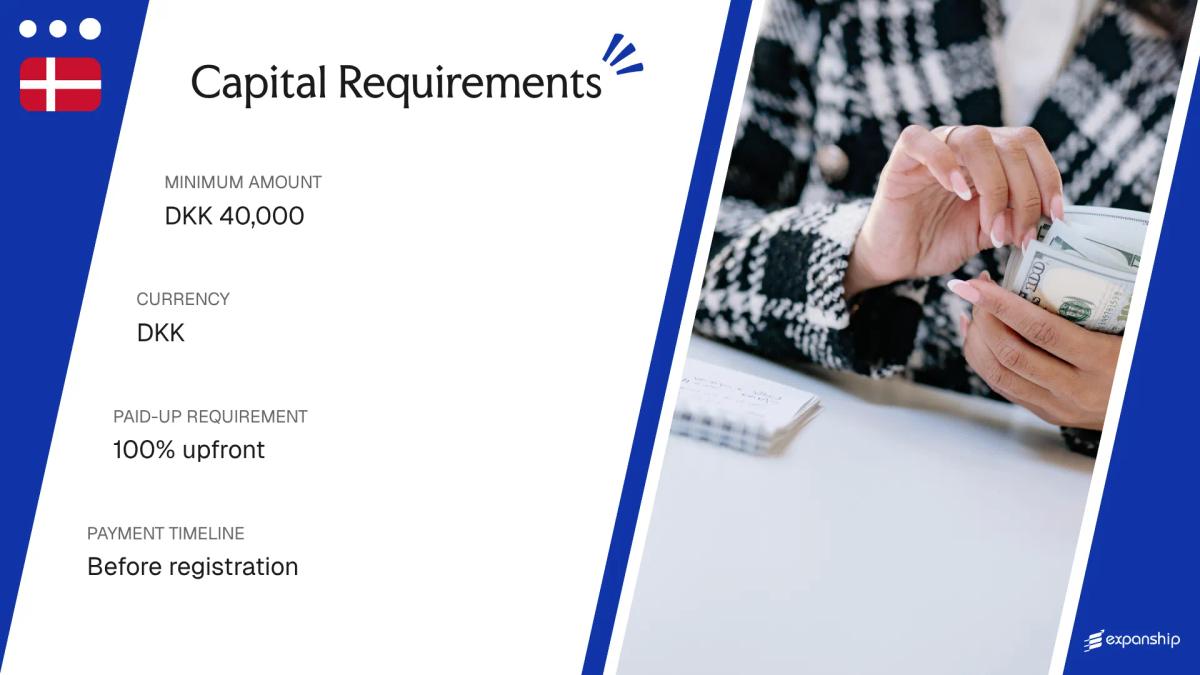
| Minimum Authorized Share Capital | DKK 40,000 for an ApS (private limited company); DKK 400,000 for an A/S (public limited company) |
| Maximum Authorized Share Capital | No statutory maximum |
| Minimum Paid-Up Capital | Full amount must be paid up at incorporation for an ApS; at least 25% for an A/S, subject to a minimum of DKK 400,000 |
| Paid-Up Requirement at Incorporation | Yes, required before registration with the Erhvervsstyrelsen |
| Accepted Currency | Danish Krone (DKK) |
| Accepted Forms of Contribution | Cash or non-cash contributions (in-kind assets subject to independent valuation) |
| Timeframe to Deposit Capital | Prior to submission of incorporation documents |
The Erhvervsstyrelsen will not register your company until the required capital has been deposited. For an ApS, this means the full DKK 40,000 must be available before the incorporation filing is submitted.
Company Secretary Requirements in Denmark
Under the Selskabsloven (the Danish Companies Act), there is no statutory requirement for a company secretary in Denmark. Private limited companies (ApS) and public limited companies (A/S) are not obligated to appoint a dedicated corporate secretary as a formal officer role. Certain administrative and compliance functions that a company secretary would typically handle are instead distributed among the board of directors or executive management.
That said, larger A/S entities with a two-tier governance structure may assign secretarial duties to designated personnel. Denmark corporate secretary obligations, where they exist in practice, generally include maintaining statutory registers, supporting board meeting procedures, and managing filings with the Danish Business Authority (Erhvervsstyrelsen).
Eligibility to serve in an informal company secretary capacity is subject to the following general conditions:
- No statutory licensing or professional certification is required under Danish law.
- Both natural persons and legal entities may be appointed to perform secretarial functions.
- There is no residency requirement tied to this role.
- The individual or entity must not be subject to disqualification orders under the Selskabsloven.

Incorporate a Company in Denmark
Set up your Danish ApS or A/S with full compliance support, from registration with Erhvervsstyrelsen to post-incorporation obligations.
Registered Office Requirements in Denmark
Registered office requirements Denmark mandate that every Danish company must maintain a physical address within the country's borders, as set out under the Danish Companies Act (Selskabsloven).
- A physical address is required; a P.O. box alone does not satisfy the requirement.
- Virtual office addresses are generally permitted, provided they correspond to a genuine, reachable physical location in Denmark.
- The address must be situated within Denmark; a foreign address cannot serve as the CVR registered office.
- No ownership of the premises is required, but you must hold a valid basis for use, such as a lease or a service agreement with an address provider.
- The registered address is publicly listed in the Central Business Register (CVR), making it visible to third parties, authorities, and creditors.
- Any change to the Denmark company domicile must be formally notified to the Danish Business Authority (Erhvervsstyrelsen) through the CVR portal; failure to update the register can result in administrative sanctions, including compulsory dissolution proceedings under Selskabsloven.
Director Requirements in Denmark
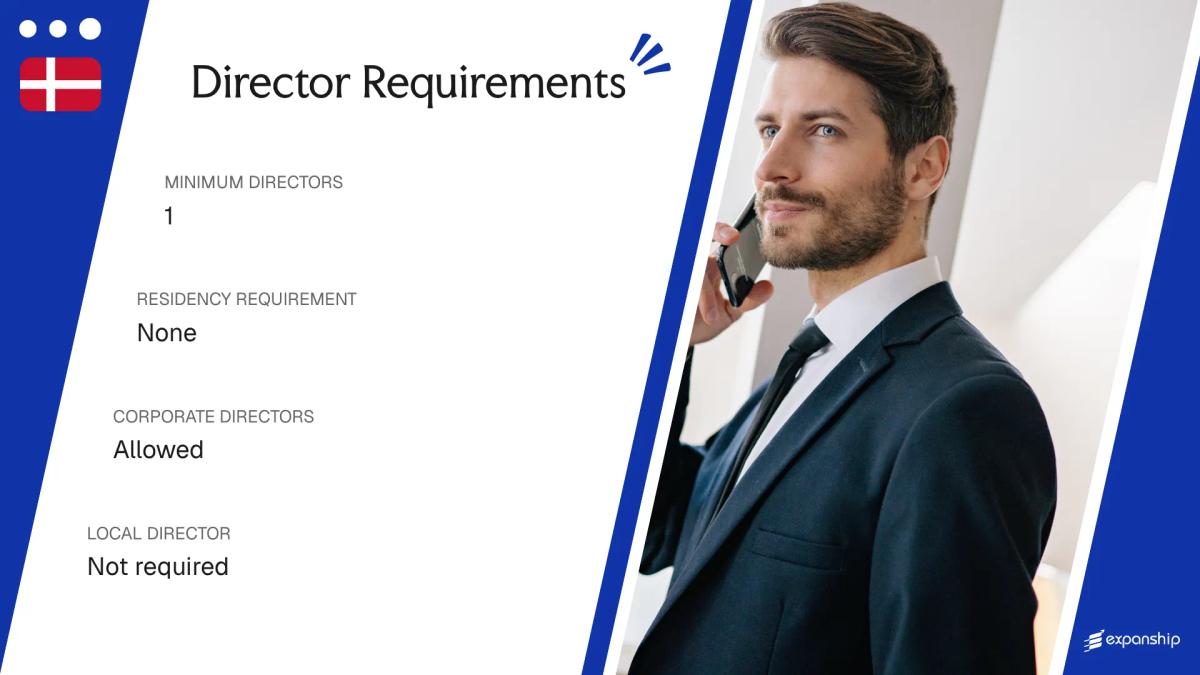
Upon appointment as a director (direktør) of a Danish Anpartsselskab (ApS) or Aktieselskab (A/S), you assume statutory duties under the Danish Companies Act (Selskabsloven), including fiduciary responsibility toward the entity, obligation to act in the company's best interests, and personal liability for losses caused by negligent or unlawful conduct.
| Parameter | Detail |
|---|---|
| Minimum Number of Directors | One director is required for an ApS; an A/S requires a management board of at least one member. |
| Maximum Number of Directors | No statutory maximum is prescribed under the Selskabsloven. |
| Local/Resident Director Required | No residency requirement applies under Danish law. |
| Nationality Restrictions | No nationality restrictions are imposed on directors. |
| Minimum Age Requirement | Directors must be at least 18 years of age. |
| Corporate Directors Permitted | Corporate directors are not permitted; only natural persons may serve. |
| Director Must Be a Shareholder | No statutory requirement for a director to hold shares in the company. |
| Publicly Listed on Registry | Directors are registered with and publicly visible through the Danish Business Authority (Erhvervsstyrelsen) via the CVR register. |
| Disqualification Conditions | A person who has been declared bankrupt or is subject to a legal incapacity order under Danish law may not serve as a director. |
Despite Denmark's EU membership, there is no requirement for a director to be a resident of Denmark or even the EU, meaning a director based anywhere in the world can legally manage a Danish company without any local representative obligation.
Shareholder Requirements in Denmark
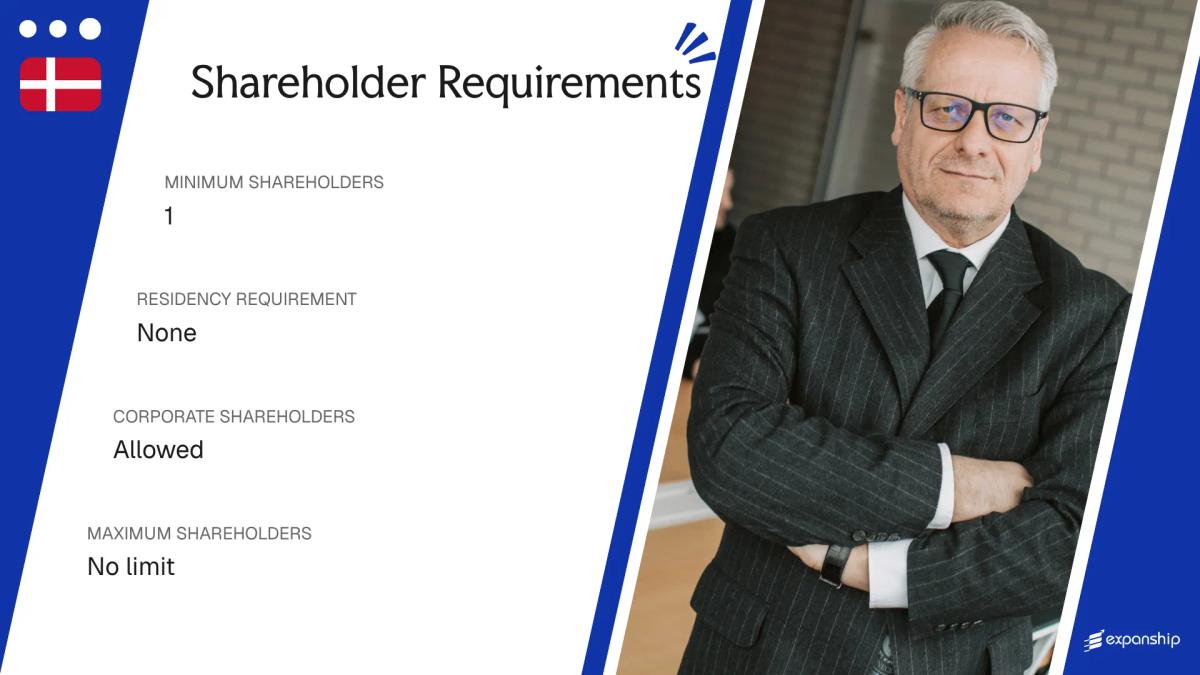
An Anpartsselskab (ApS) requires at least one shareholder, meaning a sole shareholder structure is fully permissible. No statutory maximum applies, so the entity can accommodate any number of shareholders.
Nationality and Residency Restrictions
Shareholder requirements in Denmark impose no nationality or residency conditions on individuals or entities holding shares. Foreign nationals and non-residents may own 100% of an ApS without restriction.
Corporate Shareholders
Corporate entities are permitted to act as shareholders in a Danish ApS or A/S. No special conditions are attached solely by virtue of the shareholder being a legal entity rather than a natural person.
Shareholder Liability
Liability is limited to each shareholder's capital contribution. Under the Danish Companies Act (Selskabsloven), no circumstance ordinarily extends personal liability beyond the subscribed amount, except in cases of fraud or wrongful trading.
Register of Shareholders
An ApS must maintain an internal register of shareholders, though it is not publicly accessible through the Danish Business Authority (Erhvervsstyrelsen). Any changes in ownership must be recorded promptly in that internal register.
Setting Up Your Ownership Structure in Denmark
Get guidance on structuring your shareholders correctly when incorporating a company in Denmark, ensuring your setup meets local legal requirements from day one.
UBO / Beneficial Ownership Registration Requirements in Denmark
UBO registration requirements Denmark are governed by the Danish Companies Act (selskabsloven) and the Anti-Money Laundering Act (hvidvaskloven), which define a beneficial owner as any individual who directly or indirectly holds more than 25% of shares, voting rights, or equivalent control over a Danish entity.
- Identify all individuals meeting the beneficial ownership threshold prior to registration and gather the required identification details for each.
- Register the beneficial owners in the Danish Business Authority's (Erhvervsstyrelsen) central UBO register (CVR-registeret) at the time of company incorporation.
- Document the basis for each individual's UBO status, including the ownership or control chain.
- If no natural person qualifies, register the member(s) of the entity's executive board as the UBO by default.
- Update the register within 14 days whenever a change in beneficial ownership occurs.
| Parameter | Detail |
|---|---|
| Ownership Threshold for UBO Status | More than 25% of shares, voting rights, or equivalent control |
| Filing Authority | Danish Business Authority (Erhvervsstyrelsen) via CVR-registeret |
| Disclosure Deadline at Incorporation | At the time of registration |
| Publicly Accessible Register | Yes, the CVR register is publicly accessible |
| Penalties for Non-Disclosure | Fines under selskabsloven; severity varies by circumstance |
| Ongoing Update Obligation | Yes, within 14 days of any change |
KYC / Document Requirements in Denmark
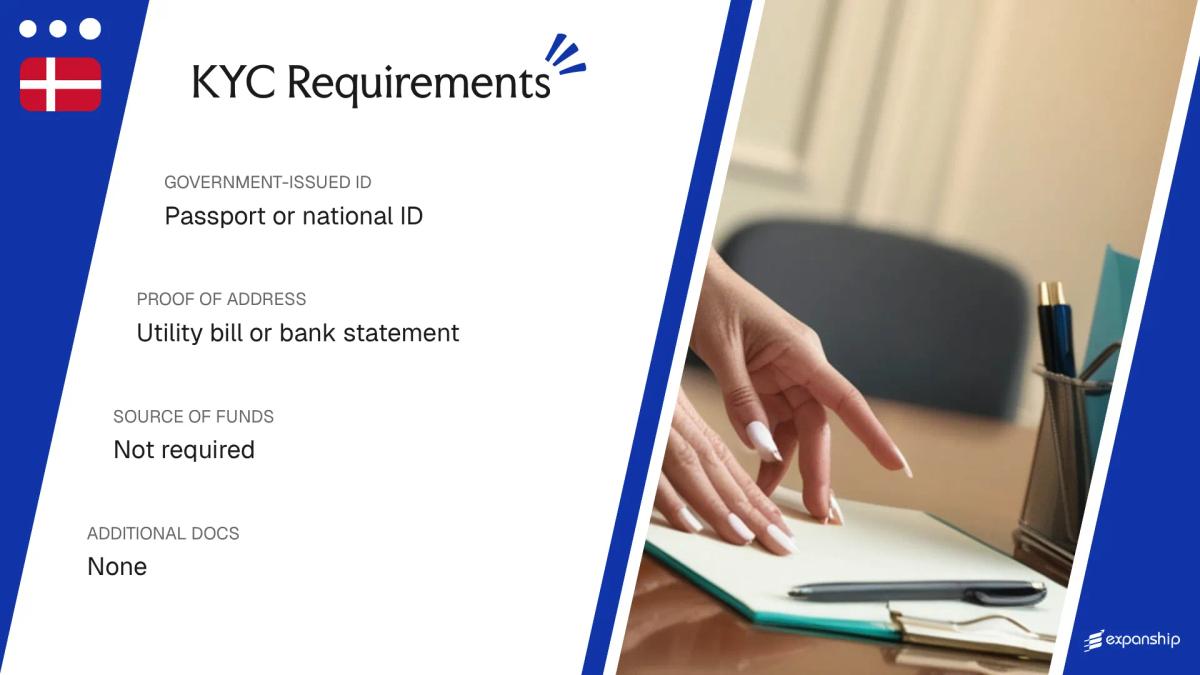
KYC document requirements Denmark are governed by the Hvidvaskloven (the Danish Anti-Money Laundering Act), which imposes customer due diligence obligations on the service providers facilitating incorporation. The Hvidvaskning unit under the Danish Business Authority oversees AML compliance in this context.
Individual / Personal Documents
- Valid government-issued photo ID (passport or national identity card) for each director, shareholder, and beneficial owner
- Proof of residential address dated within three months, such as a utility bill or official bank statement
- Full legal name, date of birth, and nationality details as they appear on official documents
- Tax identification number where applicable
Corporate Documents
- Certificate of incorporation for any corporate shareholder or director
- Constitutional documents, such as articles of association or equivalent
- Register of directors confirming current officeholders
- Proof of the corporate entity's registered address
Source of Funds Documentation
- Recent bank statements covering a minimum of three months
- Audited financial accounts where the subscribing entity is an established business
- A written declaration of the origin of capital if documentary evidence is limited
Notarisation and Apostille Requirements
- Foreign-issued identity documents may require certified translation into Danish or English
- Documents originating outside the EU may need apostille certification under the Hague Convention
- Notarisation requirements depend on the issuing country's standing agreements with Denmark
Incomplete or uncertified foreign identity documents are the most frequent cause of incorporation delays under Danish AML review procedures.
Company Name Requirements in Denmark
Company name requirements Denmark are assessed by the Danish Business Authority (Erhvervsstyrelsen) at the point of registration. Each proposed name must be distinguishable from existing registered names in the CVR (Central Business Register).
Names must include a legal suffix reflecting the entity type, such as "ApS" for a private limited company or "A/S" for a public limited company. Danish is not mandated, but the name must use the Latin alphabet.
Certain words are restricted. Terms implying a regulated activity, such as "bank," "forsikring" (insurance), or "fond" (foundation), require prior approval from the relevant supervisory authority.
Name reservation is available through the Erhvervsstyrelsen. A reserved name is held for a defined period before the formal incorporation filing must be submitted.
Compliance Services for Companies in Denmark
Expanship supports Danish entities with ongoing compliance obligations, including CVR filings, annual reporting, and regulatory updates.
Conclusion
Denmark company incorporation requirements span several distinct areas, each governed by specific provisions under the Danish Companies Act (selskabsloven) and administered through the Danish Business Authority (Erhvervsstyrelsen). Share capital thresholds vary by entity type, with the ApS requiring a minimum of DKK 40,000. UBO registration obligations under the Danish Money Laundering Act add a further compliance layer that foreign investors must satisfy before the entity becomes fully operational. Once these requirements are understood, the practical work of executing registration, sourcing a local address, and preparing compliant documentation becomes the immediate priority.
Expanship's Corporate Services for Denmark Expansion
Satisfying Denmark's incorporation requirements involves more than submitting forms to the Danish Business Authority. From structuring your ApS or A/S correctly to meeting UBO registration obligations under the Danish Companies Act, the administrative layer can absorb significant time. Expanship's Denmark company formation services are designed to reduce that operational burden, handling the procedural and compliance-facing work so your team can focus elsewhere.
Beyond formation, our scope covers the full lifecycle of your Danish entity:
- We prepare and submit all company registration documentation on your behalf.
- Our team provides a registered agent and compliant local office address.
- We liaise directly with the Danish Business Authority and other relevant regulatory bodies.
- Post-incorporation compliance management keeps your entity in good standing over time.
- We facilitate introductions to banking partners suited to your business profile.
- Tax registration and coordination with SKAT is handled as part of your setup.
To discuss how we can support your expansion, contact [Expanship Denmark](/dk/contact-us).
Frequently Asked Questions (FAQ)
A non-Danish resident can serve as director of a Danish ApS, as there is no statutory residency requirement for directors under the Selskabsloven. However, if the company's day-to-day management is conducted from Denmark, the director's physical location may have implications for corporate tax residency determinations by the Danish Tax Agency (Skattestyrelsen). Your legal and tax advisors should assess this before structuring the board.
Any individual who directly or indirectly holds more than 25% of the shares, voting rights, or ownership interest in a Danish company is required to be registered as a beneficial owner in the Central Business Register (CVR). This obligation arises at the point of incorporation and must be updated whenever ownership changes. Failure to register or maintain accurate UBO records is a criminal offence under Danish law.
A service address can satisfy the registered office requirement, provided the address is a physical location in Denmark where official correspondence can be received and the company is formally reachable. A P.O. box alone does not meet this requirement. The address must be registered in the CVR, and any change must be updated promptly to remain compliant.
The Danish Business Authority enforces company name rules under the Selskabsloven, which prohibits names that are misleading, identical, or confusingly similar to existing registered names. Names implying a regulated activity — such as banking or insurance — require prior approval or licensing from the relevant supervisory authority before registration is granted. Your chosen name must also clearly indicate the legal form, such as "ApS" or "A/S", as part of the registered name.
Foreign individual shareholders are generally required to submit a certified copy of a government-issued passport, proof of residential address, and documentation supporting the source of funds. For foreign corporate shareholders, the Danish Business Authority and due diligence processes typically require certified constitutional documents, a certificate of good standing, and UBO disclosure for the parent entity. These requirements align with Denmark's obligations under the EU Anti-Money Laundering Directives transposed into Danish law.
Operating with an incorrect or outdated registered office in the CVR can result in the Danish Business Authority being unable to serve legal notices, which does not suspend the legal effect of those communications. The company remains liable for any regulatory action or filing deadlines, regardless of whether correspondence was received. Persistent non-compliance can lead to administrative penalties or, in serious cases, compulsory dissolution proceedings.
Legal Disclaimer
The information provided in this article is for general informational purposes only and does not constitute legal, tax, or professional advice. While we strive to ensure the accuracy and timeliness of the content, laws and regulations are subject to change, and the application of laws can vary widely based on specific facts and circumstances.
Readers should not act upon this information without seeking professional counsel tailored to their individual situation. Expanship and its authors disclaim any liability for actions taken or not taken based on the content of this article.
For specific advice regarding your business setup, compliance requirements, or any legal matters, please consult with qualified legal and tax professionals in the relevant jurisdiction.