
Key Takeaways
- Denmark's 22% corporate tax rate, combined with an extensive bilateral tax treaty network, allows businesses engaged in cross-border income flows to structure their affairs with meaningful predictability and reduced withholding exposure.
- Foreign founders can wholly own an Anpartsselskab (ApS) without a local partner requirement, and registration through Erhvervsstyrelsen via Virk removes the administrative bottlenecks that characterize incorporation in many comparable European jurisdictions.
- Membership in the EU single market means a Danish entity provides direct, treaty-backed access to one of the world's largest trading blocs without the need for subsidiary structures across individual member states.
- Denmark's intellectual property framework, operating within the EU's broader IP protection architecture, makes an ApS or A/S a structurally suitable holding vehicle for technology and IP-intensive businesses that require enforceable rights across European markets.
Situated in Northern Europe, Denmark is a sovereign nation and a full member of the European Union, giving businesses incorporated there direct access to one of the world's largest single markets. The benefits of incorporating in Denmark draw interest from founders and multinational firms alike, particularly given the country's treaty-based tax framework and general openness to foreign direct investment — there are no blanket restrictions on non-resident ownership of Danish companies. Company registration is administered through Erhvervsstyrelsen (the Danish Business Authority), which maintains the central business register.
The most common legal vehicle used by foreign businesses entering the market is the Anpartsselskab, or ApS. Denmark operates a treaty-based tax posture, with extensive bilateral agreements shaping how cross-border income is treated. Foreign nationals can, in most cases, wholly own a Danish entity without requiring a local partner or resident shareholder. This article examines the key advantages that Denmark company formation offers to businesses seeking a stable and well-regulated European base.
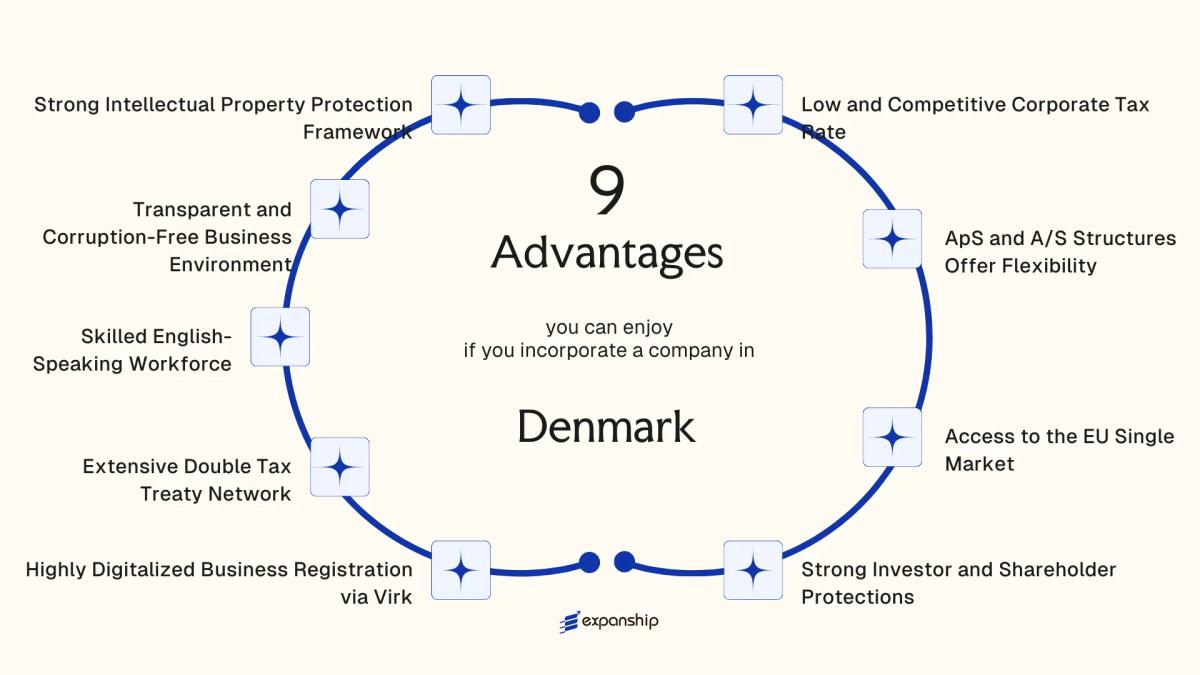
Low and Competitive Corporate Tax Rate
Denmark applies a corporate income tax rate of 22 percent, which sits below the OECD average and positions the country as a cost-efficient base for profitable operations across Europe.
What the 22 Percent Rate Means in Practice
Under the Danish Corporation Tax Act (Selskabsskatteloven), resident companies are taxed on their worldwide income at this flat rate. For a foreign-owned ApS or A/S, this predictability allows accurate profit forecasting without exposure to tiered or variable rate structures common in other jurisdictions.
Taxable income is calculated after deductions for ordinary business expenses, depreciation, and interest costs. The result is that your effective tax burden can fall meaningfully below the statutory 22 percent rate depending on the firm's capital structure and expenditure profile.
Withholding Tax and Holding Structures
Dividend distributions from a Danish subsidiary to a qualifying EU or treaty-resident parent company may be exempt from Danish withholding tax under the EU Parent-Subsidiary Directive or applicable bilateral treaties. This exemption applies when minimum ownership thresholds are met, typically one year of continuous holding at the required participation percentage.
Holding structures that route profits upward through a compliant Danish entity can therefore exit earnings with reduced tax friction, provided the arrangement reflects genuine economic substance.
A 22 percent flat rate combined with withholding tax exemptions under EU directives can significantly reduce your group's effective tax cost on Danish-sourced profits.
ApS and A/S Structures Offer Flexibility
Danish company law provides two primary structures for foreign investors: the Anpartsselskab (ApS) and the Aktieselskab (A/S). Each serves a distinct purpose, and understanding which fits your operating model is where the Denmark ApS and A/S structure benefits become concrete.
The ApS is a private limited company requiring a minimum share capital of DKK 40,000. Ownership is restricted to registered shareholders, and shares cannot be publicly traded. This closed structure suits founders and small investor groups who want defined ownership boundaries without public disclosure obligations on share transfers.
The A/S is a public limited company with a minimum share capital of DKK 400,000. Shares can be listed on a stock exchange or issued to a broader investor base, making this entity suited to businesses planning institutional fundraising or eventual public listing.
Both forms are governed by the Danish Companies Act (Selskabsloven), which provides clear rules on governance, capital, and shareholder rights. What makes this dual-structure system an advantage:
- Either entity can be wholly owned by a foreign individual or company, with no local shareholder requirement
- The A/S structure supports share issuances across investor classes without restructuring the entity
- ApS formation requires no notarial deed, reducing setup formality
- Both structures permit a single-member board, reducing governance overhead for smaller operations

Incorporate a Company in Denmark
Set up your ApS or A/S in Denmark with Expanship's end-to-end incorporation service.
Access to the EU Single Market
Incorporating in Denmark places your business inside the EU single market from day one — a trading bloc covering over 440 million consumers with no internal tariffs, harmonized product standards, and free movement of capital, services, and goods across member states.
A Danish-registered entity operates under EU law directly, meaning it can supply services or establish branches in other EU and EEA countries without requiring a separate local incorporation in each jurisdiction. This right, grounded in the Treaty on the Functioning of the European Union (TFEU), significantly reduces the administrative and legal overhead of expanding across Europe from a single base.
| Access Right | Applicable To | Governing Framework |
|---|---|---|
| Free movement of goods | Physical products | TFEU Articles 34-36 |
| Freedom to provide services | Cross-border service delivery | TFEU Article 56 |
| Freedom of establishment | Branches and subsidiaries | TFEU Article 49 |
| Free movement of capital | Investment and financing | TFEU Article 63 |
Passporting rights under EU financial directives, including MiFID II and the AIFMD, allow qualifying Danish-licensed firms to offer regulated financial services across the EU without obtaining separate authorizations in each member state. For businesses in fintech, asset management, or investment services, this single authorization carries considerable operational value.
Your company also benefits from EU mutual recognition of professional qualifications, CE marking acceptance, and access to EU public procurement markets — all without the intermediary layer that a non-EU holding structure would require.
Strong Investor and Shareholder Protections
Denmark investor and shareholder protections are grounded in statute rather than left to contractual discretion. The Danish Companies Act (Selskabsloven), which governs both the ApS and A/S structures, codifies minority shareholder rights, board accountability obligations, and capital protection rules. Foreign investors can rely on a legal framework that functions independently of who they know or where they are based.
Under Selskabsloven, minority shareholders in an A/S hold statutory rights to request information, challenge resolutions at general meetings, and, under specific conditions, compel a buyout. These protections are not optional provisions a majority can simply override through articles of association. That distinction matters: your position as a minority investor is defined by law, not negotiated goodwill.
For the ApS structure, the Act sets clear rules on capital distributions, shareholder approval thresholds, and director duties. Directors owe fiduciary obligations to the company and its shareholders, with civil liability attaching to breaches. The Danish Business Authority (Erhvervsstyrelsen) supervises compliance and maintains publicly accessible records for all registered entities.
Keep these points in mind:
- General meetings require minimum notice periods as specified in Selskabsloven
- Amendments to articles of association typically require a qualified majority vote
- Minority shareholders may have exit rights under certain structural changes
- Director liability under Danish law extends to acts of negligence, not just fraud
Danish shareholders can vote remotely at general meetings as a statutory right, not merely a pandemic-era accommodation that companies may choose to withdraw.
Highly Digitalized Business Registration via Virk
Denmark's Virk digital business registration benefits are most apparent when you compare the process to the multi-week timelines common in many EU member states. Through Virk.dk, the Danish Business Authority's official digital portal, a private limited company (ApS) can be registered in as little as one business day. That speed translates directly into reduced setup costs and faster market entry for foreign entrepreneurs.
A Single Portal That Replaces Manual Bureaucracy
Virk consolidates company registration, tax enrollment with the Danish Tax Agency (Skattestyrelsen), and VAT registration into one integrated system. For a foreign founder who would otherwise need to coordinate across multiple agencies in person, this centralization eliminates logistical friction that carries real financial cost. All filings, including annual accounts and ownership changes, are submitted and tracked through the same platform, giving you a single point of accountability for ongoing compliance.
Digital Infrastructure as a Structural Advantage
Because Virk operates on NemID/MitID authentication standards, the platform supports legally valid digital signatures, removing the need for notarized physical documents in most standard registration scenarios. This matters particularly to non-resident directors who cannot easily appear in person before Danish authorities. The Danish Companies Act (Selskabsloven) governs the registration requirements underpinning the platform, meaning the legal framework is codified rather than subject to administrative discretion. Non-residents may need a Danish representative or CPR number in certain scenarios, but these requirements are clearly defined within the Act.
Get Guidance on Incorporating in Denmark
Speak with a specialist about navigating Danish registration requirements through Virk and ensuring your company structure meets all legal obligations from day one.
Extensive Double Tax Treaty Network
Denmark's double tax treaty network advantages are substantial for any foreign-owned entity operating across borders. The country has concluded over 70 bilateral double taxation agreements, covering major trading partners across Europe, North America, Asia, and the Middle East.
- Reduced or eliminated withholding taxes on dividends, interest, and royalties paid between a Danish entity and counterparties in treaty countries mean that cross-border profit repatriation carries a lower tax cost than in many comparable jurisdictions.
- Under most of Denmark's DTTs, the permanent establishment threshold is clearly defined, giving your business greater certainty about when a foreign presence triggers local tax liability.
- Treaty provisions typically include mutual agreement procedures, allowing Danish-resident companies to resolve cross-border tax disputes between competent authorities without resorting to litigation.
- Because Denmark is an EU member state, its treaty network operates alongside EU Directives such as the Parent-Subsidiary Directive and the Interest and Royalties Directive, which can further reduce withholding taxes on qualifying intra-group payments.
- For holding structures, treaty residence in Denmark can reduce the tax burden on dividend flows from subsidiaries located in treaty partner countries, provided substance requirements under Danish tax law and OECD guidelines are met.
Treaty benefits are not automatic. Eligibility depends on satisfying residency conditions and, in many cases, principal purpose or limitation-on-benefits tests now incorporated into updated agreements following the OECD's Multilateral Instrument (MLI).
Skilled English-Speaking Workforce
Denmark English-speaking skilled workforce advantages are well-documented: the country consistently ranks among the highest in Europe for English proficiency among non-native speakers, according to the EF English Proficiency Index. For a foreign-owned business, this means your management, client communications, and day-to-day operations can function in English without requiring dedicated translation infrastructure.
Danish universities, including the University of Copenhagen and Aarhus University, produce graduates across engineering, life sciences, fintech, and logistics. Many degree programs are taught entirely in English, which broadens the talent pool available to internationally oriented firms. You are not limited to candidates who studied abroad.
The Danish labour market is governed by the flexicurity model, a framework combining flexible hiring and dismissal rules with strong public unemployment support. For a foreign employer, this reduces the legal friction typically associated with workforce adjustments, since Danish employment law does not impose the same rigid dismissal procedures found in several other EU member states.
According to the EF English Proficiency Index 2023, Denmark ranked 5th globally out of 113 countries, with a score placing it in the "Very High Proficiency" band. For a foreign business owner, this translates directly into reduced onboarding friction when deploying international teams or serving English-speaking clients from a Danish entity.
Transparent and Corruption-Free Business Environment
Denmark's transparent corruption-free business environment consistently ranks among the least corrupt in the world, according to Transparency International's Corruption Perceptions Index, where it regularly holds a top-three position globally. For a foreign business owner, this means procurement decisions, licensing approvals, and regulatory interactions are governed by rules rather than relationships.
Public sector conduct is regulated under the Danish Criminal Code, which criminalises both active and passive bribery of public officials. Business registration data, company ownership, and beneficial ownership information are publicly accessible through the Central Business Register (CVR), reducing the risk that your entity becomes entangled with opaque intermediaries or undisclosed interests.
Beneficial ownership disclosure is mandatory under the Danish Companies Act, aligned with EU Anti-Money Laundering Directives. This means counterparties and investors can verify ownership structures before entering agreements, which directly reduces due diligence friction when your Danish entity seeks financing or partnerships.
- Contracts are enforced through an independent judiciary with no documented systemic bias toward domestic firms.
- Public tenders follow EU procurement rules, giving foreign-owned entities equal standing.
- Regulatory decisions by bodies such as the Danish Business Authority are subject to administrative review.
Beneficial ownership information for your Danish entity must be registered in the CVR within 14 days of any change, and non-compliance can result in fines or forced dissolution.
Strong Intellectual Property Protection Framework
Denmark intellectual property protection advantages stem from a legal infrastructure that is both EU-compliant and independently reinforced through national legislation. The Danish Patents Act, the Trademark Act, and the Copyright Act together form the domestic statutory foundation, while the country's membership in the EU extends protection through mechanisms such as the EU Trade Mark (EUTM) and the Unitary Patent system.
The Danish Patent and Trademark Office (DKPTO) administers patent, trademark, and design registrations at the national level. Rights granted through the DKPTO carry full legal enforceability before Danish courts, which consistently apply damages and injunctive relief in IP infringement cases. For foreign companies holding IP assets, this means your rights are backed by an independent judiciary with a documented record of upholding them.
Denmark is a signatory to the Patent Cooperation Treaty (PCT), the Madrid Protocol for trademarks, and the Berne Convention for copyright. This means IP rights registered in or through Denmark extend across member jurisdictions without requiring separate filings in each country, reducing administrative costs for foreign-owned businesses.
Holding IP assets within a Danish entity can also align with the country's tax framework. Denmark operates a patent box regime under which qualifying income derived from IP assets may be taxed at a reduced effective rate, currently at 17% as of the most recent applicable legislation. This is below the standard corporate tax rate of 22%, creating a measurable tax differential for IP-intensive businesses.
- Qualifying IP income includes patents, supplementary protection certificates, and certain protected software
- The regime applies to income from both licensing and direct use of qualifying assets
- Eligibility requires that the IP was developed or substantially improved by the Danish entity
Why Denmark Stands Out Among European Business Destinations
Evaluated against comparable northern European jurisdictions, Denmark holds a consistent position across the parameters that foreign investors most commonly assess: tax predictability, legal transparency, entity flexibility, and digital administrative infrastructure. The competitors selected for this comparison — the Netherlands, Sweden, and Ireland — share a similar incorporation profile and regularly appear alongside Denmark in foreign investor evaluations of European entry points. Each offers EU membership, English-language business capability, and developed treaty networks, making them the most realistic alternatives a reader would be weighing.
What the comparison reveals is not a single dominant advantage but a cluster of aligned strengths. Denmark's 22% corporate tax rate sits below Sweden's 20.6% but above Ireland's 12.5%; however, when set against its transfer pricing framework and the absence of controlled foreign corporation rules targeting passive income in the same manner as some peers, the effective position for operating companies is often more favourable than the headline rate suggests. Structurally, the ApS minimum share capital requirement and the digital registration process via Virk distinguish the Danish setup experience from the Netherlands and Sweden in terms of time and administrative cost.
| Parameter | Denmark | Netherlands | Sweden | Ireland |
|---|---|---|---|---|
| Standard Corporate Tax Rate | 22% | 25.8% | 20.6% | 12.5% (trading) |
| Main Private Entity Type | ApS | BV | AB | Limited Company |
| Minimum Share Capital (Private Entity) | DKK 40,000 | €0.01 (nominal) | SEK 25,000 | €1 (nominal) |
| Digital Company Registration | Yes, via Virk | Partial | Yes, via Bolagsverket | Yes, via CRO |
| Double Tax Treaties (approx.) | 80+ | 100+ | 80+ | 70+ |
| EU VAT OSS Access | Yes | Yes | Yes | Yes |
| Corruption Perceptions Index (Transparency International) | Top 5 globally | Top 10 globally | Top 5 globally | Top 20 globally |
| English Proficiency in Business | Very high | Very high | Very high | Native |
Compliance Services for Companies in Denmark
Ongoing compliance for Danish entities covers annual reporting to the Danish Business Authority, VAT registration and filing with Skattestyrelsen, and maintenance of the beneficial ownership register. Expanship manages these obligations on your behalf.
Conclusion
Denmark offers a compelling case for foreign incorporation: a 22% corporate tax rate, direct access to the EU single market, and a business registration system administered through Virk that removes much of the administrative friction foreign founders typically face. These are not incidental features but structural qualities embedded in Danish company law and fiscal policy.
That said, the benefits of incorporating in Denmark are most pronounced for businesses where EU market access, treaty-based tax planning, or IP holding structures are operationally relevant. A holding company, a technology firm seeking EU-based IP protection, or an export-oriented business will find the Danish framework materially advantageous. For businesses with no European operations or client base, the fit is less direct.
Your specific industry, ownership structure, and growth objectives determine how much weight each of these factors carries. Danish company formation advantages are real and well-documented, but their relevance depends on how your business model aligns with what the jurisdiction structurally provides. The next step is assessing that alignment with advisors who understand both the legal mechanics and the commercial context.
Start Your Danish Company Formation With Expanship Today
Incorporating in Denmark involves registering with the Danish Business Authority (Erhvervsstyrelsen) through the Virk platform, selecting the right entity structure — an ApS or A/S — and meeting ongoing compliance obligations under the Danish Companies Act (Selskabsloven). Expanship handles the technical and administrative requirements at each of these stages, from initial entity selection through post-incorporation maintenance.
Expanship's services for your Danish business formation include:
- Preparation and legalization of all incorporation documents required by Erhvervsstyrelsen
- Registered address and agent provision to meet Danish domicile requirements
- Filing liaison with the Danish Business Authority and Virk platform
- Post-incorporation compliance management, including annual reporting obligations
- Support with corporate bank account introduction in Denmark
Expanship Denmark is available to assist with your company formation inquiry.
Frequently Asked Questions (FAQ)
Yes, non-residents can incorporate a Danish Anpartsselskab (ApS) or Aktieselskab (A/S) without being physically present. Registration is completed digitally through Virk, the Danish Business Authority's official business portal, and does not require in-country attendance. However, if you lack a Danish NemID or MitID credential, you will typically need a local representative or a certified agent to submit the registration on your behalf.
The standard corporate income tax rate in Denmark is 22%, applied uniformly regardless of company size. There is no reduced rate tier for small or newly incorporated businesses under the general regime. Certain sector-specific rules, such as those applying to oil and gas extraction, carry different rates, but standard commercial entities are subject to the flat 22% rate.
Danish company law does not impose a statutory requirement for a resident director in most standard incorporation structures. An ApS can be managed by a single director of any nationality residing anywhere, provided the company maintains a registered address in Denmark. For an A/S, a board of directors is required, but residency conditions for members were largely removed following EU freedom of establishment principles.
A straightforward digital registration through Virk is typically processed within one to five business days once all required documentation is submitted correctly. Delays generally arise from incomplete articles of association, unverified shareholder identity documents, or capital deposit confirmation. Registrations involving foreign corporate shareholders may take longer due to additional verification requirements.
Denmark has concluded over 80 double tax treaties, and the applicable withholding tax rate on dividends paid to a foreign parent depends on the specific treaty in force between Denmark and the recipient's country of residence. Under domestic Danish law, the standard withholding tax on dividends is 27%, but this can be reduced under a relevant treaty or eliminated entirely under the EU Parent-Subsidiary Directive where the parent holds at least 10% of share capital. The specific rate must be confirmed against the treaty text or directive conditions applicable to your structure.
An ApS requires a minimum share capital of DKK 40,000, while an A/S requires a minimum of DKK 400,000. For the A/S, at least 25% of the registered share capital must be paid up at the time of incorporation, with the remainder callable later according to the articles of association. The ApS capital must be fully paid upon registration.
A company registered in Denmark holds the right to trade goods and services across all EU member states without customs duties or quota restrictions under the Single Market framework. It can also passport certain financial and professional service licenses across member states, reducing the need to separately incorporate in each jurisdiction. This access is governed by EU treaty law and applicable EU directives, with Denmark as a full EU member rather than part of the EEA only.
Shareholder rights in Danish companies are governed by the Danish Companies Act (Selskabsloven), which provides minority shareholders with specific statutory protections, including the right to challenge resolutions that unjustifiably disadvantage certain shareholders relative to others. Disputes can be brought before the Danish courts, and the Danish Business Authority has oversight functions relating to certain compliance matters. Foreign investors are not treated differently from domestic shareholders under the Act, and Denmark's membership in international arbitration conventions provides an additional layer of dispute resolution options.
Legal Disclaimer
The information provided in this article is for general informational purposes only and does not constitute legal, tax, or professional advice. While we strive to ensure the accuracy and timeliness of the content, laws and regulations are subject to change, and the application of laws can vary widely based on specific facts and circumstances.
Readers should not act upon this information without seeking professional counsel tailored to their individual situation. Expanship and its authors disclaim any liability for actions taken or not taken based on the content of this article.
For specific advice regarding your business setup, compliance requirements, or any legal matters, please consult with qualified legal and tax professionals in the relevant jurisdiction.