
Key Takeaways
- Denmark's corporate income tax rate, combined with withholding tax on dividends distributed to foreign shareholders, creates a layered tax exposure that can materially reduce returns for non-resident investors.
- Under the Danish Financial Statements Act (årsregnskabsloven), companies face tiered but nonetheless substantive accounting and audit obligations that add ongoing compliance costs beyond what many comparable EU jurisdictions require.
- Founders of an ApS must commit a minimum share capital of DKK 40,000 at incorporation, tying up capital before the entity has generated any revenue.
- The Danish Business Authority (Erhvervsstyrelsen) enforces strict annual filing and disclosure requirements that demand consistent administrative attention, leaving little tolerance for late or incomplete submissions.
Denmark operates within a heavily regulated corporate environment, governed primarily by the Danish Companies Act (selskabsloven) and administered through the Danish Business Authority (Erhvervsstyrelsen). The disadvantages of incorporating in Denmark span tax exposure, capital requirements, employment law, and ongoing compliance obligations.
Not every drawback carries equal weight across all business types. A foreign-owned holding structure faces a different set of constraints than a trading entity or a branch operation, and industry-specific licensing adds further variation.
This article is most relevant to non-resident founders, foreign investors, and international firms considering a Danish private limited company (ApS) or public limited company (A/S) as their primary operating or holding vehicle within the EU.
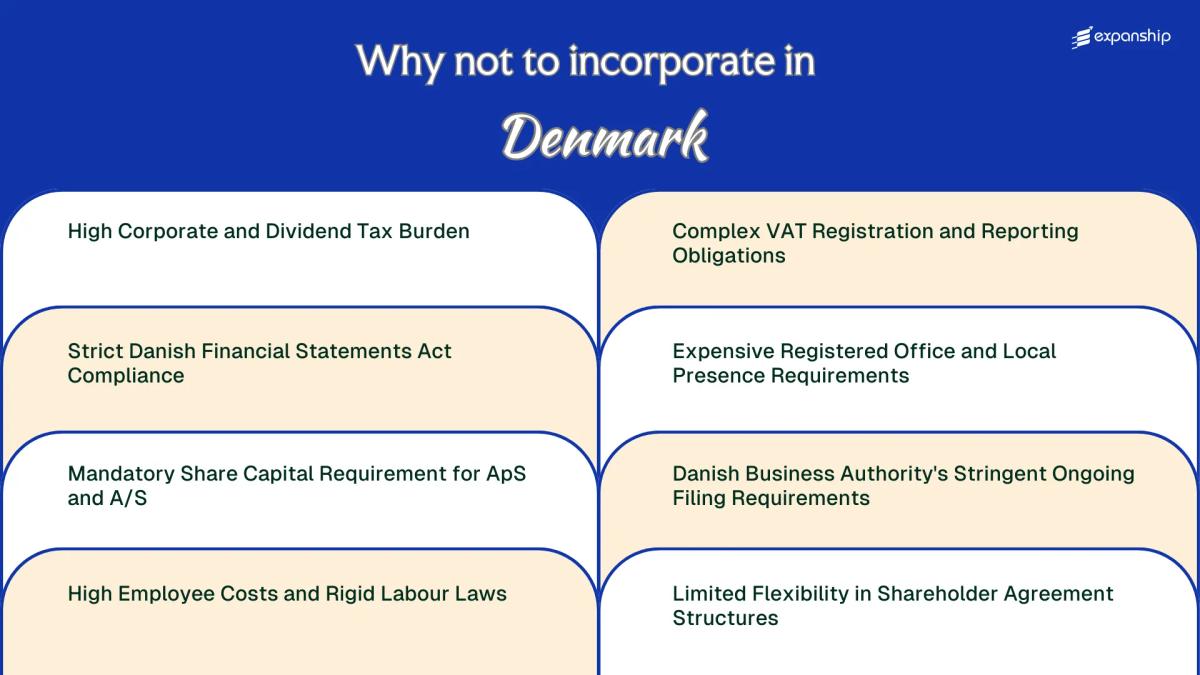
High Corporate and Dividend Tax Burden
The Denmark corporate tax burden drawbacks are significant for foreign-owned entities. Two structural tax exposures combine to make profit extraction notably expensive compared to many EU peers.
Corporate Tax Rate and Its Effect on Retained Earnings
The standard corporate income tax rate is 22%, applied under the Danish Corporation Tax Act (Selskabsskatteloven). While 22% sits close to the EU average, it eliminates the cost advantage that lower-tax jurisdictions offer, particularly for businesses with thin margins or high reinvestment needs.
Holding structures do not automatically resolve this. Dividend distributions from an operating subsidiary to a foreign parent may trigger Danish withholding tax, generally at 22% unless reduced by a tax treaty or the EU Parent-Subsidiary Directive.
Dividend Withholding and the Foreign Shareholder Position
For non-resident shareholders outside qualifying treaty or directive protection, the Danish dividend tax limitations become a direct cash-flow cost. Treaty rates vary by jurisdiction and often require advance certification, creating administrative overhead before any distribution is made.
Minority foreign shareholders face particular exposure, as treaty relief provisions sometimes exclude holdings below specific ownership thresholds.
Foreign shareholders who fail to pre-certify treaty eligibility with Skattestyrelsen before dividend payment are subject to the full 22% withholding rate, with reclaim procedures that can take over a year to resolve.
Strict Danish Financial Statements Act Compliance
Danish Financial Statements Act compliance challenges begin the moment your company is assigned a reporting class. Under the Årsregnskabsloven (Annual Accounts Act), all Danish entities are categorised into reporting classes A through D, each carrying progressively demanding disclosure requirements. Even a small private limited company (ApS) classified under Class B must prepare full annual reports following Danish GAAP or IFRS standards, submitted to the Erhvervsstyrelsen (Danish Business Authority).
Foreign-owned businesses frequently underestimate the cost of meeting these Denmark accounting reporting restrictions. Preparing a compliant annual report requires either a locally qualified accountant or an audit firm familiar with Danish standards, both of which carry significant fees.
Practical burdens this creates for a foreign business owner include:
- Annual reports must be submitted in Danish, forcing non-Danish-speaking owners to pay for translation and local professional review
- Class C and D entities face mandatory statutory audit requirements, adding audit fees on top of preparation costs
- Deadlines are fixed at five months after the financial year-end, with penalties for late filing that accumulate without warning
- Financial statements become publicly accessible once filed, exposing your revenue and cost structure to competitors
Class A entities, typically sole traders and partnerships, face lighter obligations, but most foreign-incorporated structures default into Class B or above.

Company Incorporation in Denmark
Set up your Danish entity with accurate classification, compliant accounting structures, and filing support from day one.
Mandatory Share Capital Requirement for ApS and A/S
Denmark share capital requirements restrictions create an immediate financial barrier before your business generates a single krone of revenue. Forming a private limited company (ApS) requires a minimum share capital of DKK 40,000, which must be fully paid up at the time of registration.
For a public limited company (A/S), the threshold rises sharply to DKK 400,000. That tenfold increase reflects the structurally different compliance burden attached to the A/S form, and for foreign founders planning a subsidiary or holding structure, it represents a significant upfront capital lock-in.
| Entity Type | Minimum Capital Required | Payment Condition |
|---|---|---|
| ApS (Private Limited) | DKK 40,000 (~EUR 5,370) | Fully paid at registration |
| A/S (Public Limited) | DKK 400,000 (~EUR 53,700) | Fully paid at registration |
Unlike jurisdictions that permit deferred or partial payment arrangements, Danish corporate law under the Danish Companies Act (Selskabsloven) mandates full payment upfront. Your capital cannot be staged across a formation period, which removes any flexibility in capital planning.
For early-stage ventures or lean-structure holding companies, ApS minimum share capital drawbacks are most acute when the deposited funds cannot be immediately deployed because banking processes or regulatory confirmation delays access. Denmark A/S capital requirements limitations become especially relevant where the chosen entity type is driven by investor expectations rather than operational need, requiring capital commitment at a scale disproportionate to the business's initial activity.
High Employee Costs and Rigid Labour Laws
Denmark labour law restrictions for businesses present a significant cost burden that many foreign founders underestimate before establishing a local entity. Salaries alone do not reflect the true cost of employment; mandatory employer contributions, statutory notice periods, and collectively bargained rights add layers of financial obligation that are difficult to restructure once contracts are in place.
Collective agreements (overenskomster), negotiated between employer associations and trade unions, govern large portions of the Danish workforce. Even businesses not formally party to a collective agreement may find that industry norms create de facto obligations around pay, working hours, and severance.
The statutory notice period under the Salaried Employees Act (Funktionærloven) can extend up to six months for senior or long-tenured staff, meaning termination costs remain high regardless of business performance.
- Employer social contributions (ATP, AES, AUB) are mandatory for all registered employees
- Collective agreements may apply by industry even without direct union membership
- Statutory notice periods under Funktionærloven range from one to six months depending on tenure
- Severance entitlements apply after 12 or 17 years of continuous employment
- Working time, holiday entitlement, and sick pay minimums are set by statute, not employer discretion
Denmark has no statutory national minimum wage; pay floors are set entirely through collective bargaining, meaning your actual minimum labour cost depends on which industry agreement applies to your sector.
Complex VAT Registration and Reporting Obligations
Denmark VAT registration challenges begin before your company earns its first krone. Any business with taxable turnover exceeding DKK 50,000 annually must register for MOMS (meromsætningsafgift) with the Danish Tax Agency (Skattestyrelsen), and foreign entities without a local establishment face additional scrutiny during that process.
Structural Demands of MOMS Compliance
The standard VAT rate sits at 25%, one of the highest in the EU, and Danish MOMS reporting obligations problems compound for foreign-owned firms because filings are typically required bi-annually, quarterly, or monthly depending on turnover thresholds. Each reporting frequency carries its own deadlines and reconciliation requirements, meaning your administrative overhead scales directly with revenue growth.
Operational Consequences for Foreign Entities
Firms supplying digital services or goods across borders must also account for reverse-charge rules and distance-selling thresholds, which add layers of transactional classification work that requires local tax expertise. Denmark VAT compliance restrictions apply even to dormant companies that have registered, obligating them to file nil returns on schedule or face automatic penalties from Skattestyrelsen.
Managing VAT and MOMS Compliance Challenges in Denmark
Get structured guidance on MOMS registration requirements, reporting obligations, and compliance timelines for foreign-owned entities operating in Denmark.
Expensive Registered Office and Local Presence Requirements
Maintaining a registered address in Denmark carries real financial weight, particularly for foreign-owned entities with no organic local footprint. Denmark registered office requirements drawbacks become apparent quickly when you factor in the cost of professional address services, which are commonly used by non-resident directors who cannot supply a physical Danish premises.
- Every ApS and A/S must maintain a registered address in Denmark, meaning foreign founders without a physical presence must pay for a commercial address service, adding an ongoing operational cost with no direct business function.
- Unlike some EU jurisdictions, Denmark does not permit a purely nominal foreign address for domestic registration, so remote-only structures face a structural gap that requires a third-party solution.
- The Danish Business Authority uses the registered address as the official point of contact for regulatory correspondence, meaning delays in mail handling by a third-party provider can result in missed compliance deadlines.
- Local presence requirements in Denmark also affect director residency considerations, as certain banking and contractual counterparties expect a demonstrable local connection before engaging with the entity.
Danish Business Authority's Stringent Ongoing Filing Requirements
The Danish Business Authority filing requirements burden is not a one-time administrative exercise. Once your company is registered, the Erhvervsstyrelsen imposes a continuous cycle of filings that carry hard deadlines, mandatory digital submission, and financial penalties for non-compliance.
All limited liability entities must file annual reports through the Erhvervsstyrelsen's digital portal, Virk.dk, with deadlines that vary by company class but cannot be extended unilaterally. Missing a deadline triggers automatic fines, and repeated failures can result in compulsory dissolution under the Danish Companies Act (Selskabsloven).
Ownership changes, board appointments, and amendments to the articles of association must each be reported separately and promptly. For a foreign owner managing operations remotely, each event generates its own filing obligation, often requiring a locally authorised contact to execute submissions correctly.
Denmark Erhvervsstyrelsen compliance challenges extend beyond annual reporting. Beneficial ownership data must be registered and kept current in the Real Owners Register (det offentlige ejerregister), with updates required within 14 days of any change.
A foreign-owned ApS that undergoes three ownership changes in a single year faces at minimum three separate beneficial ownership filings, three Virk.dk updates, and potential notary or legal fees per transaction, each carrying independent non-compliance exposure if deadlines are missed.
Limited Flexibility in Shareholder Agreement Structures
Denmark shareholder agreement limitations stem largely from the Companies Act (Selskabsloven), which governs both the private ApS and the public A/S. Shareholder agreements themselves are not formally registered with the Danish Business Authority (Erhvervsstyrelsen), meaning they operate outside the company's constitutional documents and carry no direct legal enforcement against the entity itself.
This creates a structural gap. Provisions you negotiate privately between shareholders — drag-along rights, veto mechanisms, or pre-emption procedures — bind only the parties to that agreement, not the company as a legal person. If a shareholder breaches the agreement, your remedy is contractual damages, not automatic enforcement through the corporate structure.
The Selskabsloven also imposes mandatory rules on shareholder meetings, voting procedures, and minority protections that cannot be contracted away. Foreign founders accustomed to jurisdictions with highly permissive constitutional flexibility will find that Danish company law leaves limited room to deviate from statutory defaults, even where all shareholders consent.
- Customised share class structures face statutory constraints under the Selskabsloven
- Squeeze-out mechanisms follow prescribed statutory thresholds and cannot be freely modified
- Dispute resolution clauses in shareholder agreements do not bind the company itself as a party
Any shareholder agreement provision that conflicts with the Selskabsloven is unenforceable as against the company, regardless of unanimous shareholder consent.
Overcoming Incorporation Challenges in Denmark
Overcoming Denmark incorporation challenges requires deliberate structural planning before registration, not reactive adjustments after the entity is established. The solutions to Danish company formation drawbacks are procedural and structural in nature, grounded in the specific requirements of Danish company law and the Danish Business Authority.
- Register your ApS or A/S with the minimum required share capital fully deposited in a Danish bank account before submitting formation documents to the Danish Business Authority.
- Elect an auditor-exempt status under the Danish Financial Statements Act if your firm qualifies under the thresholds for Class A reporting to reduce audit obligations.
- File for VAT registration through virk.dk at least eight days before commencing taxable activity to avoid penalties under the Danish VAT Act.
- Structure employment contracts with reference to the applicable collective agreements and the Salaried Employees Act to ensure wage and termination provisions are legally sound from the outset.
- Establish a compliant registered office address in Denmark that satisfies the Danish Business Authority's local presence requirements prior to incorporation.
Denmark's regulatory framework is administered by multiple statutory bodies, each with independent filing and compliance timelines. Addressing these obligations simultaneously, rather than sequentially, reduces the risk of registration delays and post-incorporation penalties.
Denmark's Value as a Business Destination
Denmark's overall administrative and tax environment is demanding, and the disadvantages covered in this blog are real friction points for foreign business owners. That said, the country offers a stable legal system, a highly transparent regulatory framework under the Danish Business Authority, and consistent EU market access — factors that make it a credible incorporation destination for the right business profile.
| Pros | Cons |
|---|---|
| EU membership provides access to the single market and cross-border trade frameworks | Corporate tax at 22% combined with a 27–42% dividend withholding rate creates a significant tax burden |
| The Danish Business Authority operates a transparent, digitised registration system | The Financial Statements Act imposes tiered reporting obligations that increase with company size |
| Denmark's legal system consistently enforces contracts and protects shareholder rights | ApS formation requires DKK 40,000 in share capital, which must be deposited before registration |
| A stable, well-regulated labour market supports workforce reliability | Employer costs extend well beyond gross salary due to pension contributions and statutory entitlements |
| VAT registration through the Erhvervsstyrelsen follows defined procedures | VAT filing frequencies and Intrastat obligations add recurring administrative load for active trading entities |
Compliance Services for Companies in Denmark
Ongoing compliance for Danish entities covers annual filing with the Danish Business Authority, Financial Statements Act reporting, VAT submissions, and beneficial ownership maintenance. Find out what staying compliant in Denmark involves.
Conclusion
Incorporating in Denmark carries real structural costs. The cons of Denmark company registration are concentrated in a few areas: the combined weight of corporate and dividend taxation, mandatory share capital thresholds for both the ApS and A/S structures, and the ongoing compliance demands imposed by the Danish Business Authority and the Financial Statements Act. These are not incidental friction points but fixed features of the Danish regulatory framework. Understanding them fully before incorporation allows your business to plan capital, staffing, and reporting structures with accuracy rather than assumption.
Expanship's Denmark Incorporation Support Services
Expanship's Denmark incorporation support covers the specific compliance demands that make establishing a business here more demanding than in many comparable jurisdictions. From satisfying the Danish Business Authority's filing schedules to meeting the Financial Statements Act's reporting tiers and managing VAT obligations through SKAT, Expanship works alongside your business to reduce the operational weight these requirements place on foreign founders.
Our services span the full incorporation and post-registration cycle:
- We prepare and submit all company registration documents with the Danish Business Authority on your behalf.
- Registered agent and office solutions are provided to satisfy Denmark's local presence requirements.
- We handle government filings and liaise directly with relevant Danish regulatory bodies.
- Ongoing compliance management keeps your entity in good standing after incorporation.
- Banking introduction assistance is available to help your business establish a local account.
- Tax registration and liaison with SKAT is coordinated to meet your obligations from day one.
Reach out to Expanship Denmark to discuss your incorporation requirements.
Frequently Asked Questions (FAQ)
The Danish Financial Statements Act applies to all registered companies in Denmark, including small ApS entities, though the reporting requirements scale with company size across four reporting classes (A through D). Even Class B companies, which cover most small private limited firms, must prepare annual accounts following the Act's prescribed standards and submit them to the Danish Business Authority. There is no blanket exemption for newly incorporated or dormant entities.
Missing the Danish Business Authority's filing deadline triggers automatic fines, and persistent non-compliance can result in compulsory dissolution of the company. The fines are issued per director and can accumulate monthly if the breach continues. Reinstatement after dissolution is possible but requires separate legal proceedings and additional costs.
The full DKK 40,000 must be paid up at the time of incorporation; unlike some jurisdictions that permit deferred payment, Denmark does not allow partial subscription for an ApS at formation. This capital must be deposited into a Danish bank account before the Business Authority will complete registration. For an A/S, the threshold rises to DKK 400,000, making the upfront financial commitment considerably higher.
A registered address in Denmark is a legal requirement under the Danish Companies Act, and a virtual or nominee address service is the minimum acceptable arrangement if your business has no physical premises. However, certain regulated activities and VAT-registered entities may trigger additional scrutiny regarding the substance of local presence. Using a registered address service satisfies incorporation formalities but does not substitute for the operational presence some authorities may expect for tax residency or licensing purposes.
VAT registration with the Danish Tax Agency (Skattestyrelsen) becomes mandatory once annual taxable turnover exceeds DKK 50,000, a threshold that most active businesses cross quickly. After registration, quarterly VAT returns are standard, though businesses with higher turnover may be required to file monthly. Errors in VAT reporting carry interest charges and can prompt audits, and the Danish system's integration with the mandatory e-accounting requirements adds a further layer of administrative obligation.
Denmark's labour market is governed by a combination of statutory law and sector-wide collective agreements, and in practice many employers become bound by collective agreements even without directly signing them, through industry-level bargaining. Dismissal requirements, notice periods, and severance entitlements are strictly regulated, and the cost of a full-time employee routinely exceeds the base salary by 30% to 40% when employer pension contributions, holiday pay, and mandatory supplements are included. For a foreign business accustomed to more flexible employment regimes, this structure can make workforce adjustments slow and costly.
Danish corporate law places meaningful limits on what shareholder agreements can override relative to the Companies Act, particularly regarding minority shareholder protections and voting rights attached to share classes. Provisions that conflict with mandatory rules in the Companies Act are unenforceable regardless of what the agreement states, which limits the contractual flexibility that shareholders in some other jurisdictions take for granted. This becomes especially relevant when structuring drag-along, tag-along, or deadlock resolution mechanisms for a Danish ApS with multiple foreign co-owners.
Legal Disclaimer
The information provided in this article is for general informational purposes only and does not constitute legal, tax, or professional advice. While we strive to ensure the accuracy and timeliness of the content, laws and regulations are subject to change, and the application of laws can vary widely based on specific facts and circumstances.
Readers should not act upon this information without seeking professional counsel tailored to their individual situation. Expanship and its authors disclaim any liability for actions taken or not taken based on the content of this article.
For specific advice regarding your business setup, compliance requirements, or any legal matters, please consult with qualified legal and tax professionals in the relevant jurisdiction.