
Key Takeaways
- Foreign businesses incorporating in Djibouti must comply with the Code de Commerce, which requires all legal documentation to be filed in Arabic or French, creating a structural translation burden for non-Francophone and non-Arabic-speaking entities.
- Djibouti's domestic consumer market remains one of the smallest in the region, limiting revenue scalability for firms whose business model depends on local demand rather than transit or re-export activity.
- The absence of deep local capital markets means incorporated entities cannot rely on domestic financing channels and must instead structure funding from external sources, adding cross-border capital management complexity.
- Businesses establishing operations in Djibouti face elevated setup and running costs driven by near-total dependence on imported goods and services, since the country produces few intermediate or consumer inputs domestically.
Djibouti operates under an evolving regulatory framework, shaped by a civil law tradition influenced by French commercial principles and codified through its Code de Commerce. The disadvantages of incorporating in Djibouti span structural, operational, legal, and market-related categories, each carrying distinct implications for foreign-owned entities.
How severely these disadvantages affect your business depends on the sector, the chosen legal structure, and your firm's reliance on local infrastructure or talent. A logistics operator using Djibouti purely as a transit hub faces a different risk profile than a firm targeting domestic consumers.
This article is most relevant to foreign investors and internationally incorporated businesses considering a locally registered presence, particularly those from outside the COMESA or Arab League trade bloc who may be unfamiliar with the local compliance environment.
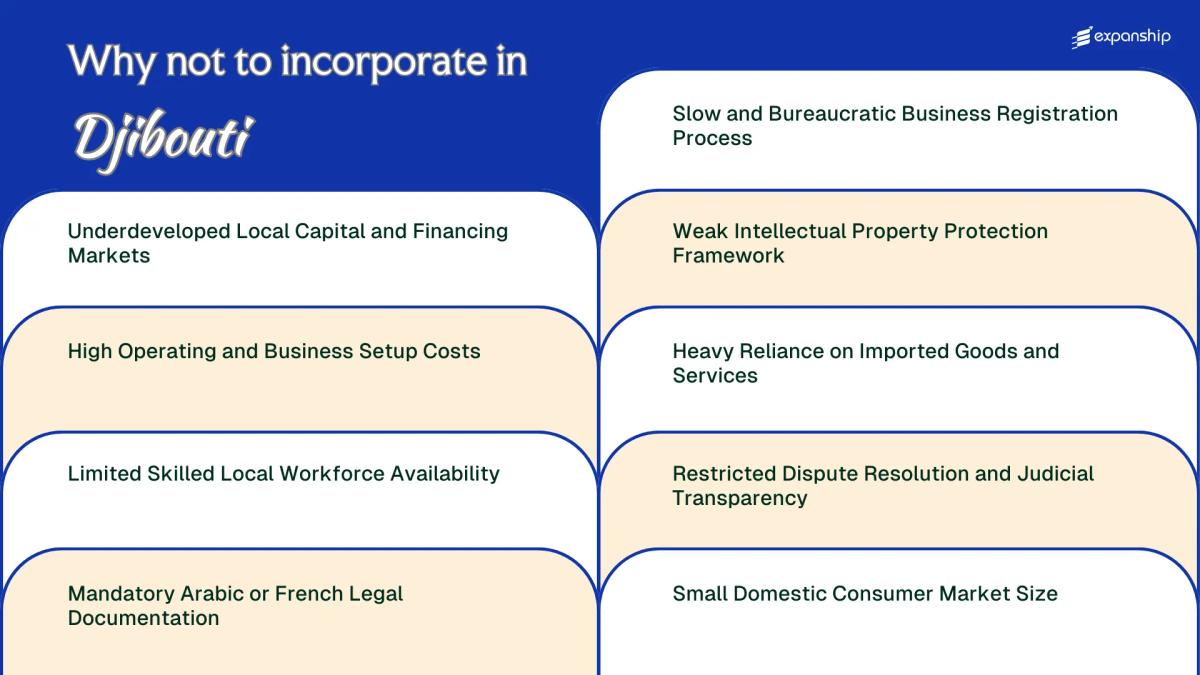
Underdeveloped Local Capital and Financing Markets
Djibouti capital market limitations present a structural obstacle that foreign-incorporated entities encounter almost immediately when seeking local financing. The country's financial sector remains shallow by regional standards, with a small number of commercial banks and no functioning stock exchange.
Restricted Access to Formal Credit
The Banque Centrale de Djibouti oversees a banking sector dominated by a handful of institutions, most of which apply conservative lending criteria that disproportionately affect newly established foreign entities without a local credit history. Collateral requirements tend to be high relative to loan values, making debt financing inaccessible for early-stage operations.
Private equity and venture capital channels are effectively absent. Your business cannot rely on domestic capital markets to raise growth funding, meaning external financing must be arranged entirely offshore, adding currency exposure and transactional complexity.
Limited Instruments for Business Funding
No local bond market or securities exchange exists through which a registered firm could raise institutional capital. This absence forces businesses with capital-intensive models to depend on foreign correspondent banking relationships, which carry their own compliance costs under international anti-money laundering frameworks.
Financing challenges for Djibouti businesses are compounded by interest rates that remain elevated compared to mature markets, reflecting the perceived risk premium local banks apply to commercial lending.
Foreign business owners cannot rely on domestic capital markets for growth financing, meaning all significant funding rounds must be structured and executed entirely outside Djibouti, increasing both cost and operational dependency on offshore financial institutions.
High Operating and Business Setup Costs
High business setup costs in Djibouti begin before your company generates a single franc. Capital requirements for commercial entities registered under the OHADA Uniform Act framework are not trivial, and notarial fees, registration charges at the Registre du Commerce et des Sociétés, and mandatory legal documentation costs accumulate quickly at the formation stage.
Office space compounds the problem. Djibouti City commands some of the highest commercial rental rates in the Horn of Africa region, driven by constrained urban land supply and the concentration of logistics infrastructure near the port.
These cost pressures create specific operational friction:
- Utility tariffs for electricity, supplied primarily through Électricité de Djibouti, are among the highest on the continent, directly inflating monthly overhead for any facility-dependent operation.
- Importing standard office equipment or industrial materials triggers port handling fees and customs duties that raise acquisition costs well above what you would pay in most comparable jurisdictions.
- Expatriate compensation packages must account for Djibouti's elevated cost of living, pushing your salary expenditure significantly higher than regional competitors.
Firms with thin margins or early-stage cash flow face disproportionate strain under these conditions.

Company Incorporation in Djibouti
Set up your business entity in Djibouti with accurate cost projections and regulatory guidance from the outset.
Limited Skilled Local Workforce Availability
Djibouti workforce availability problems are a structural constraint, not a temporary gap. The country's working-age population is small, and tertiary education enrollment rates remain low by regional standards, meaning the pipeline of locally trained professionals in technical, financial, or legal disciplines is genuinely thin.
For a foreign business owner, this translates directly into a staffing ceiling. Sourcing qualified accountants, compliance officers, or sector-specific engineers locally is difficult, and the pool narrows further when fluency in a business language other than Arabic or French is required.
| Constraint | Practical Impact on Your Business |
|---|---|
| Low tertiary enrollment rate (est. below 10% of eligible population) | Severely limits the available pool of degree-qualified local candidates |
| Expatriate work permit processing through ANEFIP | Adds administrative lead time and cost before any foreign hire can legally work |
| Mandatory local hiring preferences in certain sectors | Restricts your ability to fill roles with the most qualified available candidates |
| Limited vocational training infrastructure | Few mid-level technical workers available without employer-funded upskilling |
Reliance on expatriate hires is the default response to Djibouti human capital limitations, but that route carries its own burden. Work authorizations are processed through the Agence Nationale pour l'Emploi, la Formation et l'Insertion Professionnelle (ANEFIP), and the associated costs, permit fees, housing allowances, and international recruitment expenses substantially increase your payroll overhead compared with hiring locally in higher-capacity markets.
Hiring challenges incorporating in Djibouti are most acute in regulated sectors such as finance, telecoms, and logistics, where technical licensing requirements compound the scarcity of qualified candidates. Your entity may face extended vacancy periods for critical roles, directly delaying operational readiness.
Mandatory Arabic or French Legal Documentation
Djibouti's legal documentation requirements impose a direct operational constraint on foreign business owners. Under the country's dual official language framework, all legal filings, contracts, and corporate documents must be submitted in either Arabic or French — the two languages recognized under the Djiboutian legal system. If your internal corporate language is English, Mandarin, or any other language, every founding document, shareholder agreement, and statutory filing requires professional translation before it is legally valid.
This isn't merely an administrative formality. Certified legal translation adds cost and delays to each compliance cycle, and errors in translation can invalidate documents or trigger rejection by the Centre de Formalités des Entreprises (CFE).
For firms operating under common law frameworks, the French civil law tradition embedded in Djibouti's system compounds the difficulty. Legal concepts don't always map cleanly between systems, and a direct translation can misrepresent the intended legal meaning.
- All articles of association and shareholder resolutions must be filed in Arabic or French
- Translated documents must reflect civil law legal concepts accurately, not just linguistically
- Bilingual filing drawbacks extend to ongoing compliance, not just initial registration
- Contracts with local partners that are not in Arabic or French may lack enforceability
- Arabic French compliance requirements apply to government submissions and notarial acts
Djibouti officially recognizes both Arabic and French as equal languages of law, yet the majority of commercial contracts and court proceedings in practice default to French, meaning Arabic-language filings can still face practical processing delays.
Slow and Bureaucratic Business Registration Process
Djibouti business registration process delays are a documented obstacle for foreign investors, with the Centre de Formalités des Créateurs d'Entreprises (CFCE) serving as the official single-window registration body.
Structural Delays Within the CFCE Process
Although the CFCE was established to consolidate company formation procedures, multi-agency coordination requirements between the Ministry of Commerce, tax authorities, and the commercial court often extend processing timelines well beyond official estimates. Your entity may face sequential approval dependencies rather than parallel processing, meaning a delay at one stage blocks all subsequent steps.
Practical Consequences for Foreign Business Owners
Slow company setup in Djibouti translates directly into deferred operational capacity, which compounds costs when office leases, staff contracts, or client commitments are already in place. Bureaucratic incorporation challenges are amplified for foreign-owned structures where notarised documentation must be authenticated before submission, adding a layer that domestic applicants rarely encounter to the same degree. Firms operating under time-sensitive project mandates or port concession windows carry heightened exposure to this administrative friction.
Support for Managing Business Registration Delays in Djibouti
Get structured guidance on working through CFCE procedures, multi-agency coordination requirements, and documentation authentication for foreign-owned entities.
Weak Intellectual Property Protection Framework
Weak intellectual property protection in Djibouti presents a concrete operational risk for any foreign business holding proprietary assets, whether trademarks, patents, or copyrighted materials. The country's IP framework remains underdeveloped relative to the enforcement standards found in most OECD jurisdictions.
- Djibouti's adherence to international IP conventions is limited, meaning your trademarks or patents registered elsewhere carry no automatic protection within the country's borders.
- The absence of a dedicated national IP office means trademark registration limitations in Djibouti force businesses to rely on a fragmented administrative process that lacks a centralized enforcement authority.
- Judicial capacity to handle IP infringement cases is constrained, which significantly increases the time and cost of pursuing Djibouti IP rights enforcement through local courts.
- No specialist IP tribunal exists, so disputes are channelled through general civil courts where judges may have limited exposure to IP-specific legal standards.
- Foreign firms in technology, pharmaceuticals, or branded goods sectors face the highest exposure, as counterfeiting or imitation carries minimal deterrent risk under the current framework.
Heavy Reliance on Imported Goods and Services
Djibouti's import dependency business risks are structural, not incidental. The country produces almost no manufactured goods domestically and has negligible agricultural output, meaning virtually every input your business requires — equipment, raw materials, packaging, and many services — must be sourced from abroad.
Port congestion at the Port of Djibouti, one of the country's most critical logistics nodes, creates unpredictable lead times. Delays at the port translate directly into operational disruptions for businesses that cannot stockpile large inventories due to limited warehousing capacity.
Imported goods are subject to customs duties administered under Djibouti's customs code, and while the country operates a free zone framework through the Djibouti Free Zone and Djibouti International Free Trade Zone, businesses operating outside those zones bear the full cost of import tariffs. For most sectors, this means input costs that are structurally higher than in markets with domestic supply chains.
Currency exposure compounds the problem. Since most imports are priced in US dollars or euros, any movement in procurement costs is absorbed directly by your firm.
A manufacturing business importing $200,000 worth of machinery components annually, subject to applicable customs duties outside the free zone framework, and absorbing a 10–15% logistics cost premium over regional suppliers, could face $20,000–$30,000 in additional annual overhead compared to a similar operation based in a country with domestic supply alternatives — before accounting for port delay costs.
Restricted Dispute Resolution and Judicial Transparency
Djibouti judicial transparency limitations present a tangible operational risk for foreign businesses. The country's commercial judiciary operates under a civil law system influenced by French legal tradition, but institutional capacity remains thin. Case backlogs are common, and the timeline for resolving a commercial dispute through the Tribunal de Commerce can extend well beyond what most foreign investors anticipate.
Judicial independence from executive influence is not structurally guaranteed in practice, which undermines confidence in impartial outcomes for disputes involving state-linked entities or well-connected local partners.
Published court decisions are not systematically accessible, meaning you cannot research precedents before committing to a contractual structure. This opacity increases the legal risk on every commercial agreement your firm signs locally.
Arbitration is technically available, and Djibouti has ratified the New York Convention on the Recognition and Enforcement of Foreign Arbitral Awards. However, enforcing a foreign arbitral award still requires local court confirmation, reintroducing the same procedural delays and transparency concerns you were trying to avoid.
- Dispute resolution risks Djibouti business owners face are amplified when contracts lack explicit international arbitration clauses with a neutral seat.
- Weak legal system Djibouti conditions mean local litigation is rarely a reliable fallback.
Even with a valid arbitration clause, enforcement of a foreign award in Djibouti requires domestic court ratification, exposing your business to the same judicial delays and opacity that make local litigation unattractive.
Small Domestic Consumer Market Size
Djibouti's population sits at approximately one million people, making it one of the smallest consumer markets on the African continent. For a business targeting local sales, this ceiling on addressable demand is a structural constraint that no pricing strategy or marketing effort can resolve.
Formal household purchasing power remains low, with a significant share of the population concentrated in Djibouti City. Businesses dependent on volume-driven retail or consumer goods models will find that the limited consumer base makes achieving sustainable domestic revenue difficult.
Most commercially viable businesses registered in the country are oriented toward trade facilitation, logistics, or re-export rather than local consumption, which reflects the market's practical ceiling. If your firm's revenue model depends on domestic demand growth, the market size restrictions make profitability contingent on regional or international sales, not local uptake.
Overcoming Djibouti's Incorporation Challenges
Overcoming Djibouti's Incorporation Challenges
Structural disadvantages in this jurisdiction are real and measurable. Overcoming Djibouti incorporation challenges requires deliberate planning before the entity is formed, not after.
- Register your company through the Guichet Unique to consolidate the multi-agency registration process into a single administrative entry point.
- Prepare all constitutional and contractual documents in Arabic or French from inception, in accordance with the requirements of the Code de Commerce.
- Establish financing arrangements through international or regional development finance institutions before operations begin, given the absence of a developed local capital market.
- File trade mark and copyright registrations under the OAPI framework, to which Djibouti is a member state, as the primary mechanism for intellectual property protection.
- Designate arbitration clauses under recognised international arbitration rules in commercial contracts, to mitigate exposure to the domestic judiciary's procedural constraints.
Mitigating Djibouti business drawbacks does not eliminate underlying structural conditions. These steps reduce legal and operational exposure, but the jurisdiction's regulatory framework, workforce constraints, and market size remain fixed parameters that any foreign business must accept and plan around.
Djibouti's Overall Business Case Assessed
Djibouti's position as a commercial hub at the mouth of the Red Sea gives it a geographic rationale that few African jurisdictions can match. That said, the Djibouti business environment risks assessment presented across this blog reveals structural constraints — from thin capital markets to weak IP enforcement — that materially affect the cost and feasibility of operating there.
| Pros | Cons |
|---|---|
| Strategic location at the Bab-el-Mandeb strait supports trade and logistics operations | Business registration through the Guichet Unique is slow and subject to bureaucratic delays |
| Djibouti franc's peg to the USD removes currency conversion risk for USD-denominated businesses | Local capital markets are underdeveloped, limiting access to domestic financing |
| Free zone regimes offer tax exemptions and simplified customs procedures | Operating and setup costs are high relative to the size of the domestic consumer market |
| French and Arabic legal frameworks align with internationally familiar civil law structures | Judicial transparency is limited, and international arbitration infrastructure remains thin |
| Port infrastructure supports import-dependent business models | Skilled local talent is scarce, increasing reliance on expatriate hires and associated visa costs |
For the right entity profile — one oriented toward regional trade rather than local consumption — the jurisdiction offers a workable base. The structural drawbacks are real, but they are not uniformly prohibitive.
Corporate Compliance Services in Djibouti
Stay aligned with Djibouti's regulatory requirements, from annual filings and registered office obligations to ongoing statutory maintenance for your entity.
Conclusion
Djibouti's overall position as an incorporation destination reflects genuine structural constraints. The Djibouti incorporation drawbacks summary outlined across this blog points consistently to three compounding factors: shallow domestic financing channels, a slow registration process governed by the Guichet Unique pour la Création d'Entreprises, and limited judicial transparency that reduces enforceability confidence. These are not minor frictions. For a firm weighing long-term operational viability, understanding the full weight of these disadvantages of Djibouti company registration matters before any commitment is made. Specialist guidance on jurisdiction-specific compliance requirements remains the practical next step for any business considering this market.
Expanship's Expertise in Djibouti Expansion
Expanship Djibouti company formation support is structured around the specific friction points this jurisdiction presents: CEPEX registration requirements, French and Arabic documentation obligations, and post-incorporation compliance with the Direction Générale des Impôts. Your business absorbs those burdens regardless of who assists you, but working with an experienced team reduces the time and errors involved in managing them.
Expanship's service scope covers the full formation and maintenance cycle for entities established in Djibouti.
- Preparing and filing company registration documents with the relevant Djiboutian authorities.
- Providing a registered agent and local office address for your entity.
- Handling government filings and liaising with regulatory bodies on your behalf.
- Managing ongoing compliance obligations after your company is incorporated.
- Facilitating introductions to local banking institutions for account opening.
- Registering your business for tax purposes and coordinating with local fiscal authorities.
Reach out through Expanship Djibouti to discuss your incorporation requirements.
Frequently Asked Questions (FAQ)
Yes, all legal and regulatory documentation in Djibouti must be submitted in Arabic or French, regardless of the company structure you register. This applies to incorporation filings with the Centre de Formalités des Entreprises, contracts, court submissions, and ongoing compliance documents. If your internal legal team does not operate in either language, you will need certified translation for every formal filing, which adds both cost and processing time.
Djibouti imports the vast majority of its consumable goods, construction materials, and professional services, which pushes operating costs well above regional averages for comparable East African jurisdictions. A business that relies on physical infrastructure, equipment, or specialist contractors will face import duties and logistics costs that compress margins from the outset. This is particularly acute for manufacturing or service businesses that cannot source inputs locally.
Commercial dispute resolution in Djibouti is slower and less predictable than in jurisdictions such as Mauritius or Kenya, which have specialist commercial courts and clearer procedural timelines. Djibouti's judicial system does not have a dedicated commercial court with published performance benchmarks, and case backlogs can extend enforcement of contracts or judgments by several years. Foreign investors with high-value contractual exposures often seek arbitration clauses under international rules precisely because domestic court outcomes carry significant uncertainty.
Djibouti's population is under one million, which means a business dependent on local consumer demand will hit a revenue ceiling quickly and cannot scale purely on domestic sales. The market is further segmented by income concentration in Djibouti City, leaving the rest of the country with limited purchasing power. Companies that succeed in Djibouti typically use the jurisdiction as a transit and logistics hub rather than a consumer market in its own right.
Using a local agent or corporate services provider can reduce administrative friction, but it does not bypass the underlying procedural requirements set by the Centre de Formalités des Entreprises. All filings still require the same documentation, language compliance, and approvals from the relevant sectoral authorities. The timeline reduction from using an agent is marginal when the bottleneck lies in the government's internal processing capacity rather than document preparation.
Djibouti's labour market has a relatively small pool of formally educated, vocationally trained professionals, particularly in technical, financial, and managerial roles. If your business requires specialist skills, you will likely depend on expatriate hires, which triggers additional administrative steps under Djibouti's work permit and residency procedures, as well as higher compensation expectations. This adds recurring payroll costs that would not apply to the same extent in larger regional economies with deeper talent pools.
Local bank lending in Djibouti is constrained by limited liquidity, conservative lending practices, and the absence of a functioning domestic capital market or stock exchange. A foreign entity cannot raise equity capital through a local exchange, and access to debt financing typically requires substantial collateral that local banks will assess conservatively. In practice, most foreign businesses operating in Djibouti bring capital from their home jurisdiction or through international development finance institutions rather than relying on Djiboutian financial institutions.
Legal Disclaimer
The information provided in this article is for general informational purposes only and does not constitute legal, tax, or professional advice. While we strive to ensure the accuracy and timeliness of the content, laws and regulations are subject to change, and the application of laws can vary widely based on specific facts and circumstances.
Readers should not act upon this information without seeking professional counsel tailored to their individual situation. Expanship and its authors disclaim any liability for actions taken or not taken based on the content of this article.
For specific advice regarding your business setup, compliance requirements, or any legal matters, please consult with qualified legal and tax professionals in the relevant jurisdiction.