

Key Takeaways
- Djibouti's corporate tax regime maintains a generally low-tax posture, with further reductions available to entities registered within free zones administered by the Djibouti Ports and Free Zones Authority, giving foreign-owned companies a measurable cost advantage over onshore structures in comparable East African jurisdictions.
- Full foreign ownership is permitted without a mandatory local partner requirement, meaning shareholders face no forced equity dilution as a condition of market entry.
- Membership in COMESA and IGAD grants Djibouti-registered entities preferential access to a combined regional market that spans multiple East African and Horn of Africa economies, reducing tariff exposure for businesses engaged in cross-border trade.
- Companies incorporated through the Centre National du Registre du Commerce (CNRC) operate within a jurisdiction where the Djiboutian franc is pegged to the US dollar, eliminating local currency volatility as a variable in financial planning and cross-border settlement.
Djibouti is an independent republic situated at the southern entrance of the Red Sea, bordering Eritrea, Ethiopia, and Somalia. Its position at one of the world's most transited maritime corridors gives foreign investors a geographically distinct starting point for regional operations. The benefits of incorporating in Djibouti draw increasing attention from businesses seeking a regulated East African base with access to both continental and Gulf markets.
Company registration is administered by the Centre National du Registre du Commerce (CNRC), the official body responsible for formalizing commercial entities under Djiboutian law. Foreign businesses most commonly establish a Société à Responsabilité Limitée when entering the market. The jurisdiction maintains a generally low-tax posture, with further concessions available within designated free zones.
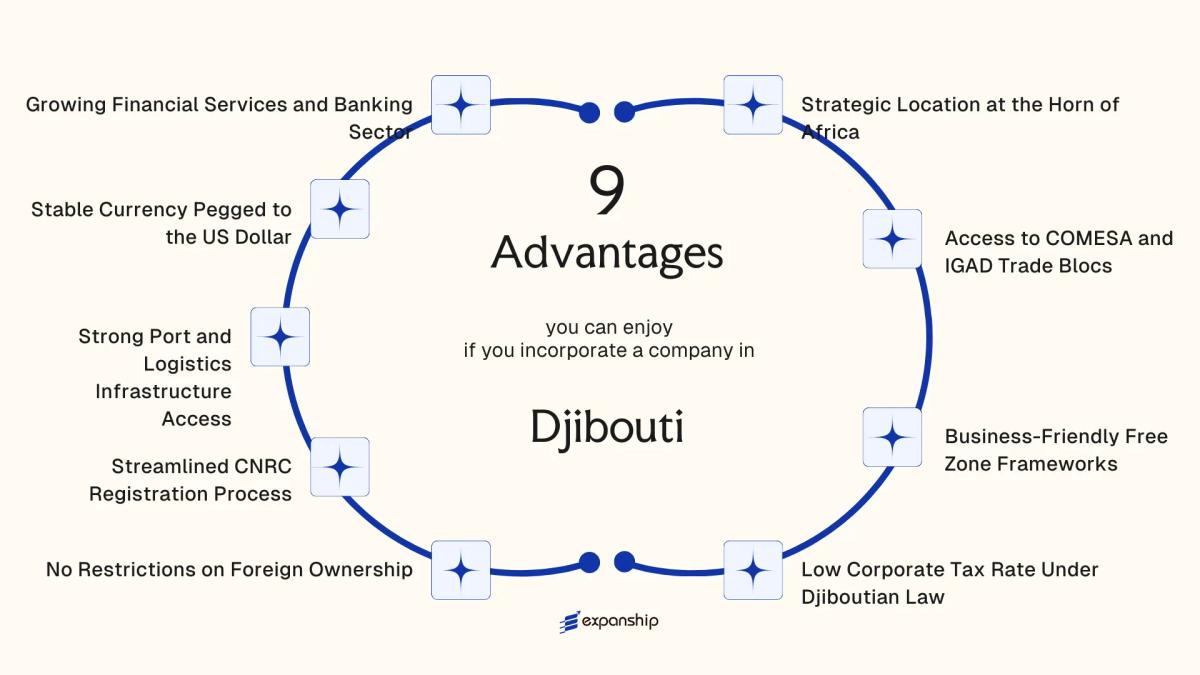
Foreign ownership is broadly permitted across most sectors, and the legal framework does not impose blanket nationality requirements on shareholders or directors. This openness to foreign direct investment is reflected in the country's active pursuit of bilateral agreements and its membership in several multilateral trade arrangements. This article examines the principal advantages your business gains through Djibouti company formation.
Strategic Location at the Horn of Africa
Djibouti sits at the intersection of the Red Sea and the Gulf of Aden, directly along one of the world's busiest shipping corridors. For any business that depends on access to African, Middle Eastern, or Asian markets, this positioning is a structural advantage, not incidental geography.
Proximity to High-Volume Trade Routes
Roughly 30% of global maritime trade passes through the Bab-el-Mandeb Strait, which Djibouti borders directly. A company registered here can physically coordinate import and export operations within hours of both East African inland markets and Arabian Peninsula commercial centers.
Gateway Function for Landlocked Neighbors
Ethiopia, one of Africa's largest economies by population, is landlocked and relies heavily on Djiboutian ports for over 90% of its external trade. Your business can position itself as a regional distribution or transit hub serving not just one market, but a cluster of economies with limited independent sea access.
A Djibouti-registered entity places your operations within direct reach of a trade corridor handling billions in annual cargo volume, without requiring secondary logistics infrastructure in neighboring countries.
Access to COMESA and IGAD Trade Blocs
Djibouti holds full membership in both COMESA and IGAD, two regional trade frameworks that together cover a combined population exceeding 700 million people. For a company incorporated here, that membership translates into preferential tariff access across a substantial portion of eastern and northeastern Africa without the need for separate bilateral trade negotiations.
COMESA operates a Free Trade Area that allows qualifying goods to move between member states at reduced or zero tariffs. Your business can export to markets in Kenya, Ethiopia, Egypt, Zambia, and more than a dozen other economies under this framework, significantly lowering the cost of cross-border trade compared to firms incorporated outside the bloc.
IGAD membership adds a separate but complementary layer of regional integration, particularly relevant for trade corridors linking the Horn of Africa with Sudan and South Sudan.
The practical advantages for foreign investors include:
- Preferential tariff schedules apply to goods originating from a Djibouti-registered entity, not just domestically produced goods in certain categories
- Regional rules of origin under COMESA are defined, giving your firm a clear compliance path rather than navigating ambiguous bilateral terms
- IGAD facilitates corridor development agreements that directly affect freight movement through the port, benefiting trading companies and logistics entities alike

Company Incorporation in Djibouti
Set up a Djibouti-registered entity to access COMESA and IGAD trade frameworks with guidance from Expanship's corporate specialists.
Business-Friendly Free Zone Frameworks
Djibouti free zone benefits for foreign businesses are most clearly visible within the Djibouti International Free Trade Zone (DIFTZ), which is the largest free trade zone on the African continent by planned area, spanning approximately 48 square kilometers at full build-out. Established under a public-private framework and developed in partnership with China Merchants Group, DIFTZ operates under a legal regime that grants zone-based entities a distinct set of fiscal and operational privileges not available to mainland companies.
| Incentive | Detail |
|---|---|
| Corporate tax exemption | Full exemption within the free zone for qualifying entities |
| Customs duties | Exempt on goods imported into and re-exported from the zone |
| Capital repatriation | No restrictions on profit or capital transfers abroad |
| Foreign workforce | No mandatory local employment quotas within zone operations |
Entities registered inside DIFTZ are exempt from customs duties on goods moved through the zone for re-export purposes, which directly reduces overhead for trading and distribution companies that use the zone as a transit or assembly hub. That cost structure differs substantially from mainland operations, where import duties apply under the general tariff schedule. Your business is not required to maintain a minimum capital threshold to access zone registration, removing a barrier that comparable zones in other African markets impose. Zone governance falls under a dedicated administrative authority, which handles licensing independently from the standard CNRC commercial registry process.
Low Corporate Tax Rate Under Djiboutian Law
Djibouti low corporate tax rate advantages begin with the standard corporate income tax rate of 25%, established under the Code Général des Impôts. While that headline rate is not negligible, companies operating within the free zones are taxed at a substantially reduced rate, and qualifying industrial or export-oriented entities can access further reductions through specific investment incentive regimes.
For foreign investors, the practical benefit is retained earnings. A lower effective tax burden means capital stays within the business rather than flowing to the treasury, directly improving reinvestment capacity and dividend repatriation calculations.
The Investment Code governs eligibility for preferential tax treatment. Approval typically routes through the Centre National de Promotion des Investissements (CNPI), the body responsible for assessing and granting fiscal incentives to qualifying businesses.
Keep these points in mind when structuring around this benefit:
- Confirm whether your activity qualifies under the Investment Code before assuming preferential rates apply
- Free zone entities and mainland-registered companies are taxed under different frameworks
- Tax holidays granted at establishment are time-limited; verify the duration attached to your approval
- Failure to meet ongoing compliance conditions with CNPI can result in incentive withdrawal
Djibouti imposes no personal income tax on salary earnings, meaning expatriate directors and locally paid employees operate in a jurisdiction where personal and corporate tax burdens are structurally separated in your favour.
No Restrictions on Foreign Ownership
Djibouti imposes no statutory ceiling on foreign equity participation in locally incorporated companies. Under the Investment Code established by Law No. 126/AN/17, foreign nationals may hold 100 percent of the shares in a Société à Responsabilité Limitée (SARL) or a Société Anonyme (SA) without requiring a local partner. That structural openness means your capital structure reflects your business intent, not a regulatory compromise.
Full Ownership Without a Local Partner Requirement
For many investors operating across East Africa, mandatory local partnership requirements dilute control and complicate profit repatriation. The absence of such conditions under Djiboutian law means foreign shareholders retain undivided governance rights from day one. Voting structures, dividend policies, and exit mechanisms remain entirely within the foreign owner's discretion.
This matters particularly for holding companies and logistics-oriented entities, where operational decisions must move quickly. Ownership fragmentation introduced by forced local equity stakes can slow board resolutions and create fiduciary conflicts that affect the firm's day-to-day functioning.
Implications for Capital and Profit Control
100 percent foreign ownership Djibouti company structures also affect how earnings flow back to parent entities abroad. When the entire equity sits with a single foreign shareholder or group, intercompany transactions, management fee arrangements, and dividend distributions do not require negotiation with a co-owner whose interests may diverge. The Investment Promotion Agency (ANPI) oversees investor registration and can confirm ownership eligibility at the point of entity formation.
Confirm Your Ownership Structure Before You Incorporate in Djibouti
Speak with an Expanship specialist to verify how full foreign ownership applies to your chosen entity type and sector under current Djiboutian law.
Streamlined CNRC Registration Process
Company registration in Djibouti is handled through the Centre National de Registre du Commerce (CNRC), the national body responsible for formalizing all commercial entities. The Djibouti CNRC registration advantages for businesses center on a process that consolidates multiple administrative steps under one authority, reducing the time and coordination burden typically associated with multi-agency incorporation in comparable markets across East Africa.
- The CNRC operates as a single-window registration point, meaning your business files its commercial documentation with one body rather than coordinating separately across tax, trade, and municipal agencies.
- Under Djiboutian commercial law, the minimum timeframe for completing standard company registration is among the shorter in the IGAD region, which directly reduces the gap between incorporation and operational activity.
- Foreign nationals face no additional procedural layer specific to their status during the CNRC registration process, placing them on equal procedural footing with domestic applicants.
- Required documentation is standardized across entity types, so a Société à Responsabilité Limitée (SARL) and a Société Anonyme (SA) follow a predictable submission framework, allowing legal advisors to prepare filings with a defined scope.
- Once registered, the CNRC issues a registration number that serves as the primary business identifier across government interactions, eliminating the need to re-register with separate bodies for basic operational compliance.
Strong Port and Logistics Infrastructure Access
Djibouti port infrastructure advantages for companies begin with a single geographic fact: the Port of Djibouti handles an estimated 95% of Ethiopia's import and export cargo, a landlocked country of over 120 million people. That volume alone makes the port one of the busiest transit points on the continent, giving businesses registered here direct commercial proximity to one of Africa's largest consumer markets.
Operated under the Djibouti Ports and Free Zones Authority (DPFZA), the port complex includes specialised terminals for containers, bulk cargo, and liquid hydrocarbons. Your firm gains access to this infrastructure not as an external shipper, but as a locally registered entity, which can affect the terms under which you contract logistics services and operate within the free zone perimeter.
Doraleh Container Terminal and the multi-purpose Doraleh Multipurpose Port expand the handling capacity beyond what legacy port facilities alone could accommodate. For trading companies and freight-dependent businesses, this translates directly into shorter dwell times and more frequent vessel calls.
A company registered within the Djibouti Free Zone with warehousing operations can receive goods off a vessel, repackage, and re-export to East African markets within the same bonded zone, deferring customs duties until the point of final destination entry.
Stable Currency Pegged to the US Dollar
The Djibouti Franc (DJF) has maintained a fixed peg to the US dollar at a rate of 177.72 DJF per USD since 1973. This peg is anchored through the country's currency board arrangement, which requires full foreign reserve backing for every franc in circulation. For your business, this means exchange rate risk between the DJF and USD is effectively eliminated.
Most international trade contracts, particularly in shipping and commodities, are denominated in US dollars. Operating from a USD-pegged environment means your revenue projections, cost structures, and profit repatriation calculations remain consistent over time without exposure to the currency volatility common across neighboring East African economies.
The currency board structure prevents discretionary monetary policy from weakening the franc. Unlike central bank systems where political pressure can lead to devaluation, the board's reserve requirement acts as a structural constraint. This gives foreign investors a degree of monetary predictability that is difficult to find elsewhere in the Horn of Africa region.
- No hedging instruments are needed to manage DJF-USD exposure
- USD-denominated contracts can be executed without conversion losses
- Financial reporting for parent companies in the US is simplified by the fixed rate
The currency board arrangement governs the DJF peg, but transactions in other currencies remain subject to standard foreign exchange rate fluctuations.
Growing Financial Services and Banking Sector
Djibouti financial services sector benefits for investors have expanded considerably since the passage of the Banking Law No. 11/AN/11 and the establishment of the Banque Centrale de Djibouti (BCD) as the principal regulatory authority. The BCD oversees licensing, monetary policy, and prudential supervision across all banking institutions operating in the country.
A Dollarized Banking Environment
Because the Djiboutian franc is pegged to the US dollar at a fixed rate, all banking transactions referencing USD face no conversion friction. Foreign firms holding accounts in local banks can move funds against a stable unit of account, which reduces the currency risk that typically complicates treasury operations in East African markets.
Islamic and Conventional Banking Under One Framework
The BCD licenses both conventional and Islamic (Sharia-compliant) financial institutions. For businesses with investors or counterparties in Gulf Cooperation Council markets, access to Islamic financing instruments within the same jurisdiction removes the need to structure transactions across separate legal systems.
Regional Correspondent Banking Access
Several international banks maintain branches or correspondent relationships through the financial center, giving your company access to trade finance instruments including letters of credit and documentary collections. This matters practically for import-export entities moving goods through the port, where payment security is a direct operational requirement.
Key financial institutions currently licensed and active include:
- Banque de Dépôts et de Crédit Djibouti (BDCD)
- Banque Internationale Arabe de Djibouti (BIAD)
- Exim Bank Djibouti
- Salaam African Bank
Why Djibouti Outpaces Regional Competitors
Comparing Djibouti against Ethiopia, Eritrea, and Somalia makes sense for any investor evaluating options in the Horn of Africa. These are the jurisdictions most geographically proximate and, in some cases, competing for the same foreign capital, particularly in logistics, trade facilitation, and regional hub services. The comparison reveals structural differences that go beyond port access or geographic position.
What the table below surfaces is that the Djiboutian advantages already covered in this blog are not incidental features. They reflect deliberate policy choices, including the USD peg maintained by the Banque Centrale de Djibouti, the legal framework governing the Djibouti Free Zones Authority, and the open foreign ownership rules under the CNRC registration regime. These structures are codified, which reduces the regulatory unpredictability that has historically constrained investment in neighbouring states.
| Parameter | Djibouti | Ethiopia | Eritrea |
|---|---|---|---|
| Foreign Ownership | 100% permitted in most sectors | Restricted in several strategic sectors | Heavily restricted; state involvement common |
| Currency Stability | USD-pegged (fixed rate since 1973) | Floating birr; subject to devaluation pressure | Nakfa not freely convertible |
| Free Zone Framework | Established statutory free zones under DAFZA | Special Economic Zones developing; less mature framework | Minimal functional free zone infrastructure |
| COMESA Membership | Full member | Full member | Not a member |
| Corporate Tax Rate | 25% standard rate | 30% standard rate | Up to 38% depending on profit band |
| Port Access | Direct access to Port of Djibouti | Landlocked; dependent on Djibouti port corridor | Access limited by political and sanctions context |
Compliance Services for Companies in Djibouti
Maintain your Djiboutian entity in good standing with CNRC filings, annual obligations, and ongoing regulatory requirements managed by our specialists.
Conclusion
Djibouti's position as a trade corridor between Africa, the Middle East, and Asia, combined with its USD-pegged franc and access to COMESA's preferential tariff arrangements, creates a structural environment where a foreign-owned company operates with meaningful economic and regulatory certainty from day one. Those two features alone — monetary stability and market reach — distinguish this jurisdiction from many regional alternatives that carry currency or trade policy risk.
The benefits of incorporating in Djibouti carry the most weight for businesses in logistics, trade finance, and regional distribution. The free zone frameworks, particularly those administered under the Djibouti Ports and Free Zones Authority, allow full foreign ownership with no mandatory local partner. For entities structured around physical goods movement or transhipment, this combination of ownership rights and port proximity is a substantive operational advantage.
Not every business model extracts equal value from this jurisdiction. A firm with no exposure to East African or Gulf trade flows may find fewer applicable advantages than one structured to serve those corridors. Your specific industry, ownership structure, and target markets will determine how much of this framework translates into practical benefit. Confirming the applicable tax treatment under Djiboutian revenue law and verifying CNRC registration requirements for your chosen entity type are the appropriate next steps before committing to formation.
Start Your Djibouti Company Formation With Expanship
Expanship supports foreign investors through every stage of incorporation in Djibouti, from selecting the appropriate legal structure under the OHADA Uniform Acts to meeting the ongoing compliance obligations that apply after registration. This includes working within the framework administered by the Centre National de Registre du Commerce (CNRC), the authority responsible for commercial registration. The service scope covers the full process discussed throughout this blog, including free zone entity establishment, foreign ownership structuring, and currency account considerations.
Across each engagement, Expanship handles the procedural and administrative requirements that fall between initial filing and operational readiness:
- Document preparation, notarization, and legalization for submission to Djiboutian authorities
- Registered agent and registered office provision within the required jurisdiction
- Government filing and direct liaison with the CNRC and relevant ministries
- Post-incorporation compliance management, including annual filings and statutory record maintenance
- Banking introduction assistance to support account opening with local and regional financial institutions
To discuss your incorporation requirements, contact Expanship Djibouti.
Frequently Asked Questions (FAQ)
The standard corporate income tax rate in Djibouti is 25% on net profits for onshore entities. Companies operating within approved free zone structures benefit from tax exemption arrangements, which can cover corporate income tax for a defined period under their respective free zone agreements. The applicable rate and any exemptions should be confirmed against the specific license category and zone designation relevant to your business activity.
Registration with the Centre National de Registre du Commerce (CNRC) can generally be completed within a few business days once all required documentation is submitted in proper order. The timeline depends on the completeness of your application, the legal form chosen, and whether additional regulatory approvals are required for the intended activity. Delays most commonly arise from missing notarized documents or outstanding capital deposit confirmations.
The Djiboutian franc has been pegged to the US dollar at a fixed rate since 1973, which eliminates exchange rate risk between the two currencies and simplifies financial planning for USD-denominated businesses. Foreign investors repatriating profits in dollars face no currency conversion exposure on that leg of the transaction. General foreign exchange regulations still apply, and transfers should comply with the conditions set by the Banque Centrale de Djibouti.
Djibouti is a member of both the Common Market for Eastern and Southern Africa (COMESA) and the Intergovernmental Authority on Development (IGAD), giving registered entities potential access to preferential trade arrangements across a combined market spanning much of East and Northeast Africa. COMESA membership, in particular, includes tariff reduction schedules and trade facilitation protocols that can reduce the cost of cross-border commerce. The specific benefits available to your entity depend on the nature of the goods or services traded and the counterpart country's obligations under those agreements.
Djibouti does not impose a blanket requirement for a locally resident director for standard commercial company formations under the CNRC framework. However, certain regulated activities and free zone licenses may carry specific management or local representation conditions set by the relevant authority. It is advisable to verify the requirements tied to your chosen legal structure and business activity before finalizing the incorporation documents.
A company incorporated in Djibouti gains physical proximity to one of the busiest transshipment points on the Red Sea-Gulf of Aden corridor, operated through Doraleh Container Terminal and associated port facilities managed under concession arrangements. For trading and logistics firms, this means reduced transit times and direct access to shipping routes connecting Asia, the Gulf, and East Africa. The ability to co-locate operations near bonded warehouse facilities and free zone logistics infrastructure further reduces the operational gap between corporate registration and physical trade execution.
Legal Disclaimer
The information provided in this article is for general informational purposes only and does not constitute legal, tax, or professional advice. While we strive to ensure the accuracy and timeliness of the content, laws and regulations are subject to change, and the application of laws can vary widely based on specific facts and circumstances.
Readers should not act upon this information without seeking professional counsel tailored to their individual situation. Expanship and its authors disclaim any liability for actions taken or not taken based on the content of this article.
For specific advice regarding your business setup, compliance requirements, or any legal matters, please consult with qualified legal and tax professionals in the relevant jurisdiction.