
Key Takeaways
- Founders of a GmbH must contribute a minimum share capital of €25,000 before the entity can be validly registered in the Handelsregister, with at least half of that amount paid up at the time of filing.
- Under the GmbHG, all incorporation filings must be submitted through a German notary and recorded with the relevant Amtsgericht before the entity acquires legal personality.
- Disclosure of beneficial ownership to the Transparenzregister is a mandatory compliance obligation that takes effect from the point of formation, not at a later operational stage.
- Foreign investors incorporating in Germany must satisfy the directorship, registered office, and shareholder requirements set out under the GmbHG or AktG depending on the chosen legal form, with non-compliance risking rejection of the filing or civil liability under German commercial law.
Entity formation in Germany is governed primarily by the Gesetz betreffend die Gesellschaften mit beschränkter Haftung (GmbHG) and the Aktiengesetz (AktG), depending on the chosen legal form. The Handelsregister, maintained through the local district courts (Amtsgerichte), serves as the official commercial register where all incorporation filings are submitted and recorded.
Meeting the incorporation requirements in Germany is a prerequisite for valid registration. Failure to satisfy them results in rejection of the filing or, in some cases, civil or criminal liability under applicable German commercial law.
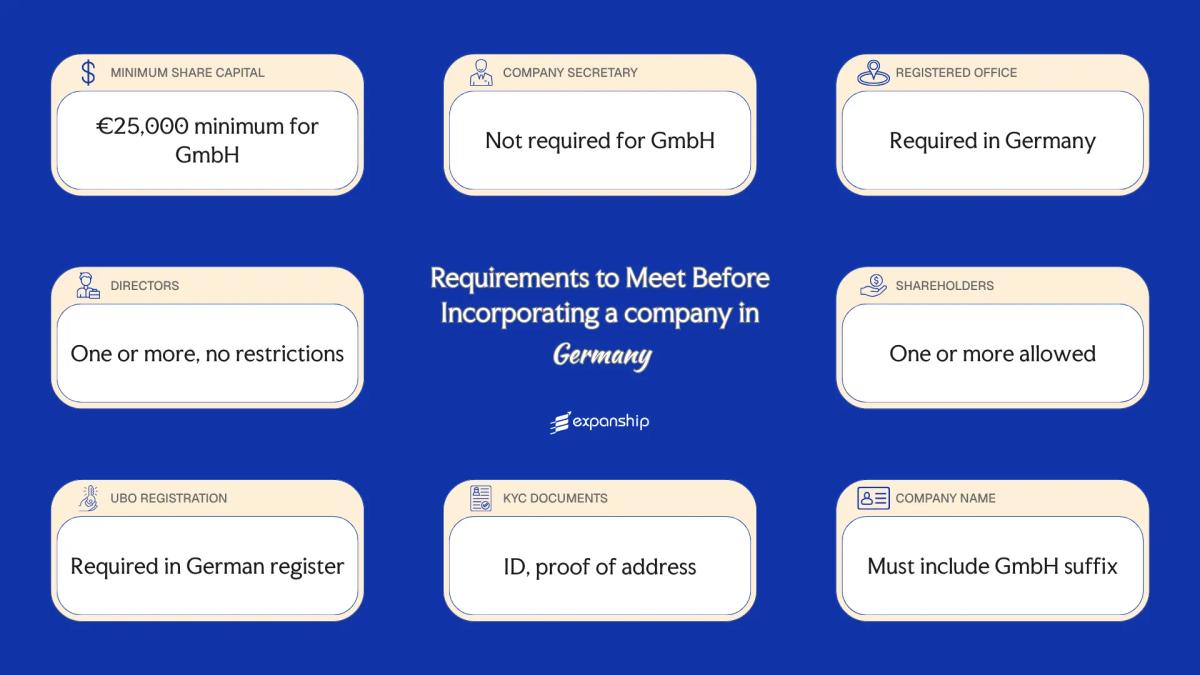
The Germany company registration requirements covered in this article span share capital thresholds, directorship rules, registered office obligations, beneficial ownership disclosure, and documentation standards. Specific requirements to incorporate in Germany vary by entity type, industry sector, and the nationality or residency profile of the founding shareholders or directors.
This article is most relevant to foreign investors and non-resident business owners establishing a new legal entity in Germany without prior familiarity with the GmbHG or AktG frameworks.
Minimum Share Capital Requirements in Germany
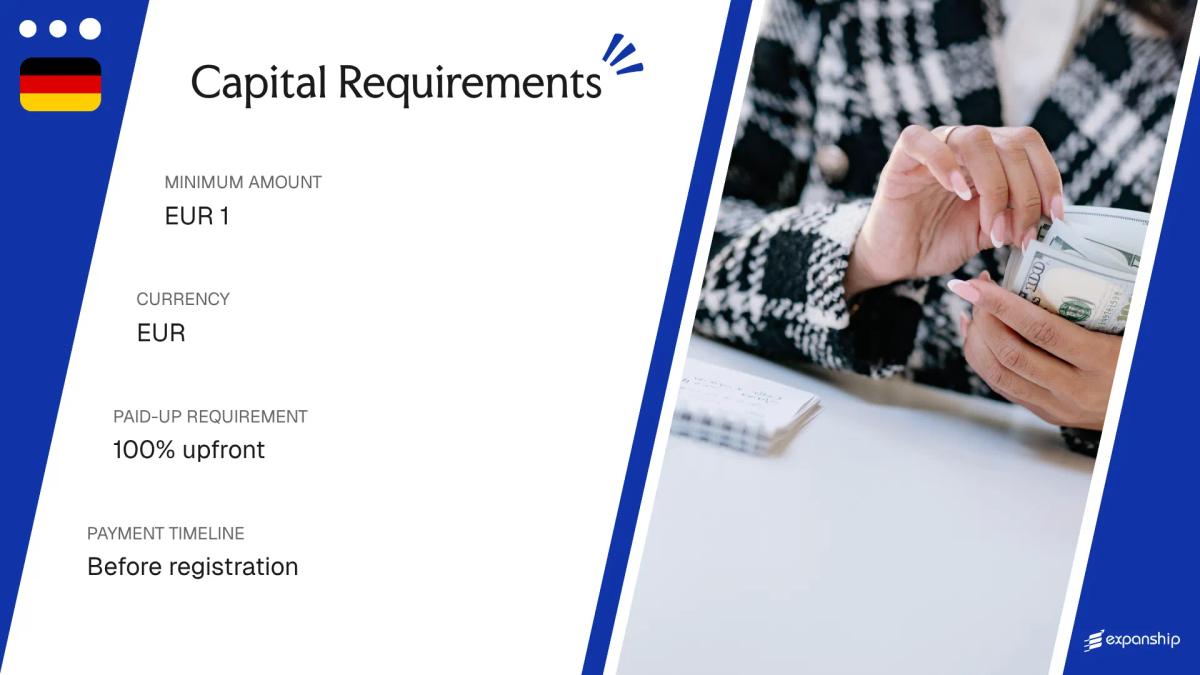
Germany minimum share capital requirements differ by entity type and are governed under the Gesetz betreffend die Gesellschaften mit beschränkter Haftung (GmbHG) for limited liability companies. The Handelsregister, administered through the local Amtsgericht, verifies capital compliance before registration is completed.
For a standard GmbH, the Stammkapital requirement is EUR 25,000, with at least half deposited into a business bank account prior to submission to the notary and subsequent filing with the Handelsregister. The Unternehmergesellschaft (haftungsbeschränkt), commonly referred to as the UG, permits formation with as little as EUR 1, though it carries a statutory obligation to retain 25% of annual net profit as a reserve until the accumulated amount reaches EUR 25,000.
| Parameter | Detail |
|---|---|
| Minimum Authorized Share Capital | EUR 25,000 for GmbH; EUR 1 for UG (haftungsbeschränkt) |
| Maximum Authorized Share Capital | No statutory requirement |
| Minimum Paid-Up Capital | EUR 12,500 for GmbH at incorporation; full amount for UG |
| Paid-Up Requirement at Incorporation | At least 50% of GmbH Stammkapital must be deposited before Handelsregister filing; UG requires full payment upfront |
| Accepted Currency | Euro (EUR) |
| Accepted Forms of Contribution | Cash contributions; non-cash (Sacheinlagen) permitted for GmbH subject to valuation report |
| Timeframe to Deposit Capital | Prior to notarial deed submission and Handelsregister registration |
The UG minimum capital Germany permits EUR 1 at formation, but the entity is legally required under section 5a GmbHG to retain 25% of annual surplus until reserves reach EUR 25,000, at which point conversion to a GmbH becomes possible.
Company Secretary Requirements in Germany
Unlike many jurisdictions, Germany does not impose a statutory requirement for a dedicated company secretary role. For a GmbH, the Geschäftsführer (managing director) holds responsibility for the administrative and compliance obligations that a company secretary would typically fulfil elsewhere.
German corporate secretary rules distribute these duties across the managing directorship. Obligations include maintaining the shareholder list, filing annual financial statements with the Unternehmensregister, and ensuring timely submissions to the Handelsregister (commercial register).
Qualification criteria for who may serve as a Geschäftsführer in this capacity:
- Must be a natural person; legal entities cannot hold the managing director position.
- No German residency requirement applies, though practical accessibility for regulatory filings is expected.
- Must have full legal capacity and must not be subject to a court-imposed prohibition on managing a business.
- Prior convictions for insolvency-related offences or fraud can disqualify an individual under the GmbH-Gesetz (GmbHG).
- No formal licensing or professional qualification is mandated by statute.

Incorporate Your Company in Germany
Set up a German GmbH or other business entity with guided support on registration, documentation, and Handelsregister filing.
Registered Office Requirements in Germany
Registered office requirements in Germany are governed by the GmbH-Gesetz (GmbHG) and the Aktiengesetz (AktG), both of which mandate that every company maintain a registered address, known as the Sitz, within the country. Failure to maintain a compliant Sitz can result in the Handelsregister (commercial register) initiating compulsory dissolution proceedings under section 394 of the Gesetz über das Verfahren in Familiensachen und in den Angelegenheiten der freiwilligen Gerichtsbarkeit (FamFG).
- A physical, reachable address in Germany is required; a P.O. box alone does not satisfy the Sitz requirement.
- Virtual office addresses are generally accepted provided they offer a verifiable physical location and mail handling.
- The registered address must be situated within Germany; foreign addresses do not fulfill the statutory obligation.
- Proof of entitlement to use the address, such as a lease agreement or owner's consent letter, must be submitted to the notary at incorporation.
- The Sitz is publicly listed in the Handelsregister, accessible via the Unternehmensregister portal.
- Any change to the registered address must be formally resolved by the shareholders and filed with the Handelsregister by a notary.
Director Requirements in Germany
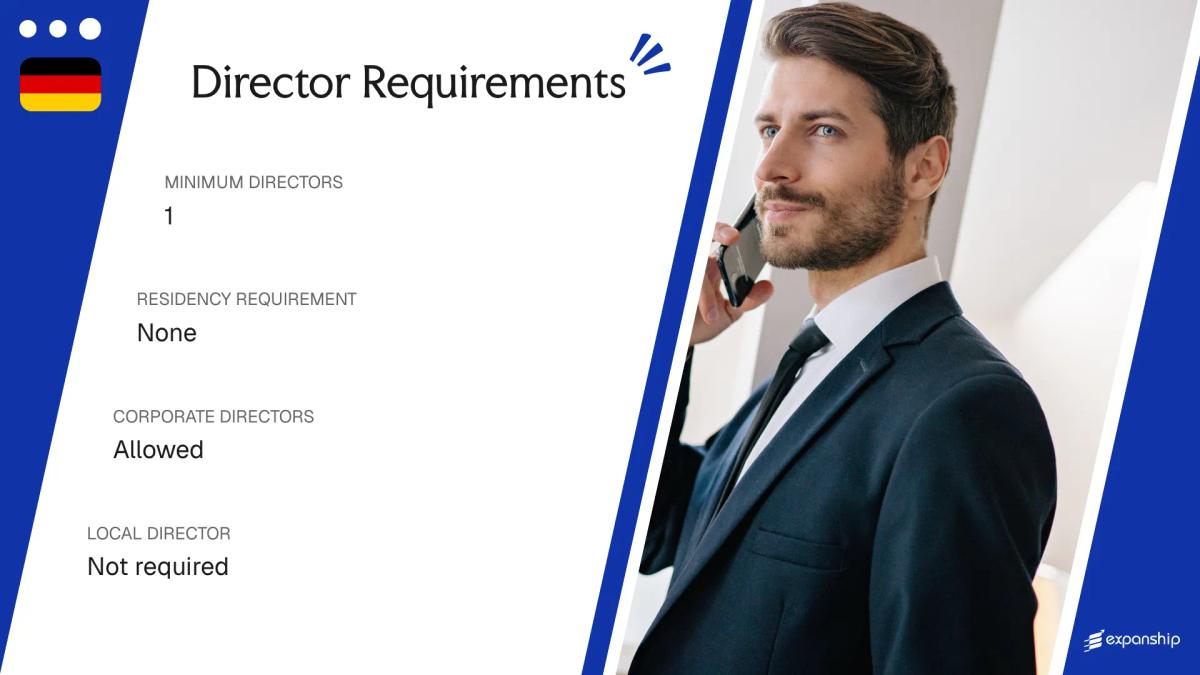
Under the GmbH structure, director requirements in Germany are governed by the Gesetz betreffend die Gesellschaften mit beschränkter Haftung (GmbHG), which imposes statutory duties of care, loyalty, and legal compliance on every appointed Geschäftsführer upon taking office. Liability exposure is personal and direct: under Section 43 GmbHG, a managing director who breaches the standard of care of a diligent businessman can be held personally liable to the company for resulting damages.
| Parameter | Detail |
|---|---|
| Minimum Number of Directors | One Geschäftsführer is required by law. |
| Maximum Number of Directors | No statutory maximum; the articles of association may define the number. |
| Local/Resident Director Required | No statutory residency requirement exists under German law. |
| Nationality Restrictions | No nationality restrictions apply to the appointment of a Geschäftsführer. |
| Minimum Age Requirement | Directors must have full legal capacity, which is attained at 18 years of age. |
| Corporate Directors Permitted | No; only natural persons may serve as Geschäftsführer under Section 6(2) GmbHG. |
| Director Must Be a Shareholder | No; a Geschäftsführer may be a non-shareholder third party. |
| Publicly Listed on Registry | Yes; all directors are registered in the Handelsregister and are publicly visible. |
| Disqualification Conditions | Under Section 6(2) GmbHG, persons convicted of insolvency-related offences or certain economic crimes are disqualified from serving. |
Although no local residency is required, German courts and tax authorities can scrutinise where management decisions are actually made, meaning a director operating entirely from abroad may trigger arguments about the company's place of effective management shifting outside Germany.
Shareholder Requirements in Germany
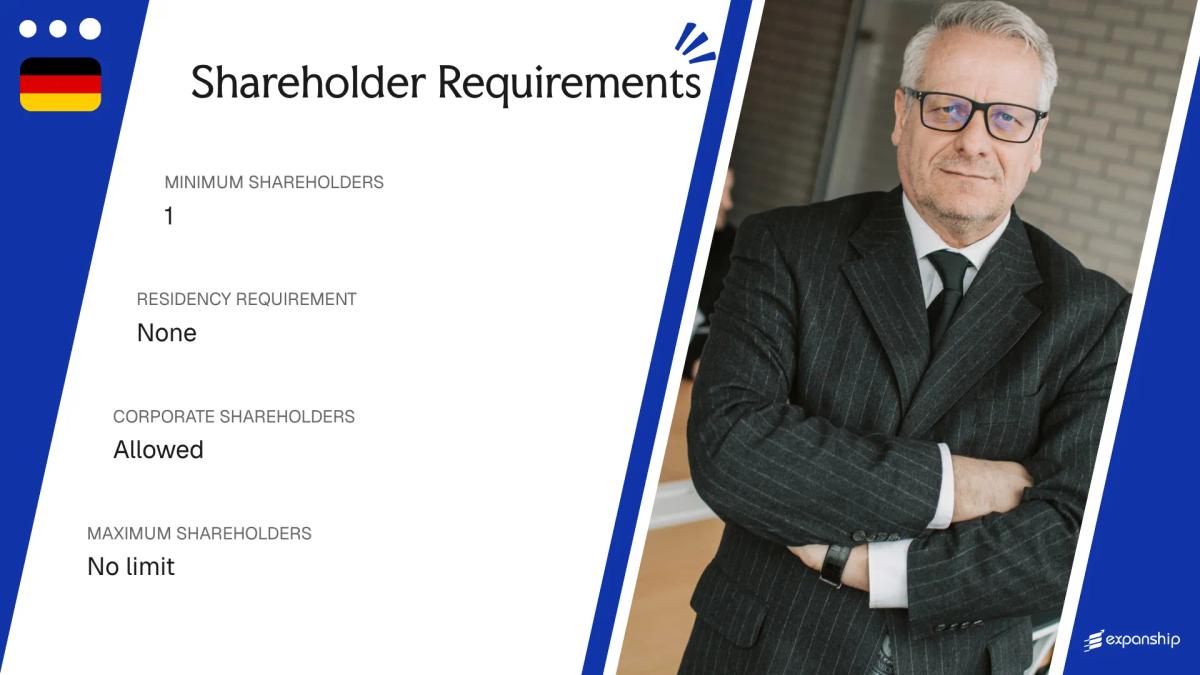
A GmbH can be formed by a single shareholder, making the sole-shareholder structure fully permissible under the GmbH-Gesetz (GmbHG). There is no statutory upper limit on the number of shareholders.
Nationality and Residency Restrictions
Shareholder requirements in Germany impose no nationality or residency conditions on individuals or entities holding shares in a GmbH. Foreign nationals and non-resident investors may hold 100% of the share capital without restriction.
Corporate Shareholders
Legal entities, including foreign corporations, are permitted to act as shareholders in a German GmbH. No additional licensing or local presence is required solely by virtue of the corporate shareholder's status.
Shareholder Liability
Under the GmbHG, each Gesellschafter's liability is limited to their respective capital contribution. Liability may extend beyond that amount in specific circumstances, such as when courts pierce the corporate veil due to asset commingling or abuse of the legal form.
Register of Shareholders
A Gesellschafterliste must be maintained and filed with the Handelsregister, where it becomes publicly accessible. Any change in shareholding must be reported by a notary and submitted to the commercial register promptly.
Support for Your German Incorporation Process
Get guidance on meeting the shareholder and structural requirements for setting up a GmbH in Germany.
UBO / Beneficial Ownership Registration Requirements in Germany
Under Germany's beneficial ownership registration requirements, a beneficial owner (wirtschaftlich Berechtigter) is defined under the Geldwäschegesetz (GwG) as any natural person who directly or indirectly holds more than 25% of the shares, voting rights, or capital of a legal entity. Disclosure is made to the Transparenzregister, maintained by the Bundesanzeiger Verlag.
- Identify all natural persons meeting the 25% ownership or control threshold.
- Prepare the required identifying data: full name, date of birth, nationality, country of residence, and the nature and extent of the beneficial interest.
- Submit this information electronically to the Transparenzregister at transparenzregister.de.
- Complete the filing within the deadline applicable to the entity type following incorporation or registration.
- Update the register promptly whenever a change in beneficial ownership occurs.
| Parameter | Detail |
|---|---|
| Ownership Threshold for UBO Status | More than 25% of shares, voting rights, or capital |
| Filing Authority | Transparenzregister (administered by Bundesanzeiger Verlag) |
| Disclosure Deadline at Incorporation | Within 2 weeks of incorporation or change |
| Publicly Accessible Register | Yes, with tiered access depending on requester |
| Penalties for Non-Disclosure | Administrative fines under §56 GwG; serious or repeated violations can result in fines up to €1 million or higher for certain entities |
| Ongoing Update Obligation | Yes; changes must be reported without undue delay |
KYC / Document Requirements in Germany
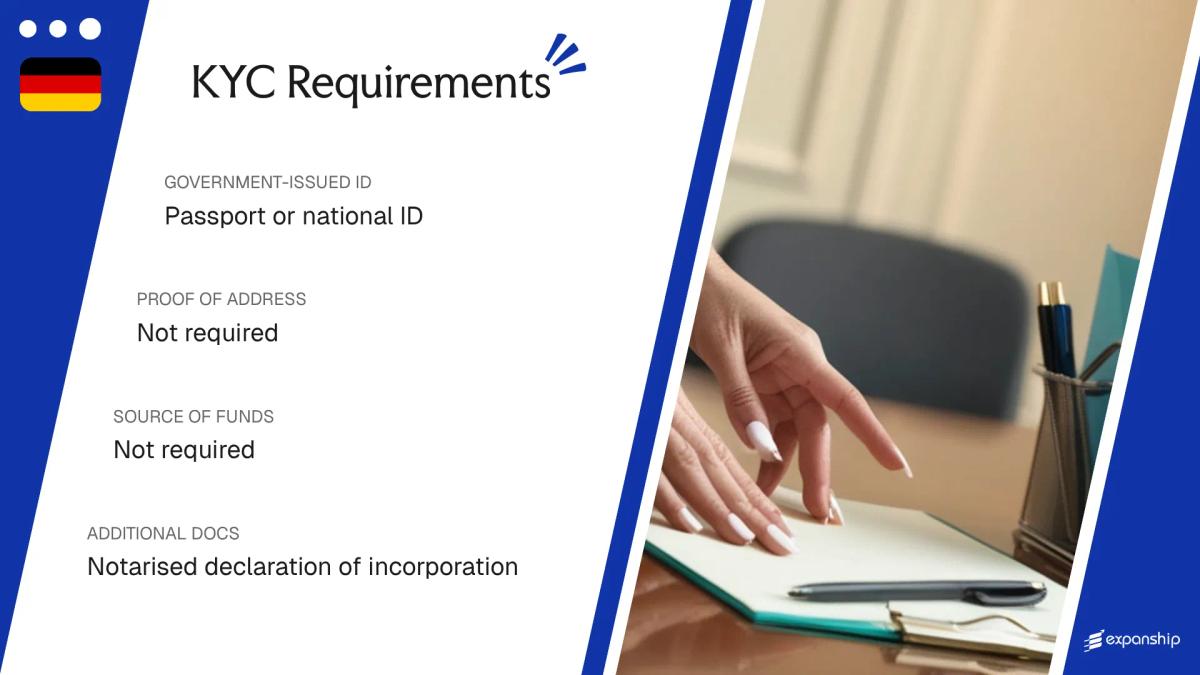
KYC document requirements Germany incorporation are governed by the Geldwäschegesetz (GwG), the national Anti-Money Laundering Act, which obligates notaries and formation agents to verify the identity of all parties before a GmbH or other entity can be registered. The Financial Intelligence Unit (FIU), administered by Germany's Customs authority, oversees suspicious transaction reporting under this framework.
Individual / Personal Documents
- Valid government-issued photo ID (passport or national identity card) for each director, shareholder, and UBO
- Proof of residential address dated within three months, such as a utility bill or official bank statement
- Completed self-disclosure form confirming UBO status where applicable
- Tax identification number may be requested depending on the notary's internal compliance procedures
Corporate Documents
- Certificate of incorporation or equivalent constitutional document for any corporate shareholder or director
- Current register of directors and shareholders from the entity's home jurisdiction
- Proof of the corporate entity's registered address, such as an official utility bill or lease agreement
- Good standing certificate issued within the preceding six months
Source of Funds Documentation
- Recent bank statements (typically covering the prior three to six months) evidencing the origin of share capital
- Audited financial statements where the subscribing entity is a corporate body
- Written declaration of the source of funds if the capital originates from a private individual
Notarisation and Apostille Requirements
- Foreign-language documents must be accompanied by a certified German translation prepared by a sworn translator
- Documents originating outside EU member states generally require an apostille under the 1961 Hague Convention
- Notarisation of constitutional documents by a German notary (Notar) is mandatory at the point of GmbH formation
Discrepancies between the UBO declaration submitted to the Transparenzregister and the identity documents provided to the notary are among the most common causes of registration delay.
Company Name Requirements in Germany
Germany company name requirements are assessed by the local Chamber of Commerce (Industrie- und Handelskammer, or IHK) prior to registration with the Handelsregister. The IHK evaluates whether a proposed name meets legal standards and does not conflict with existing registered firms.
A GmbH must include the suffix "Gesellschaft mit beschränkter Haftung" or the abbreviation "GmbH" in its registered name. Names must be in Latin script, though the language itself need not be German.
Certain words are restricted or prohibited. Terms implying governmental affiliation, such as "national" or "staatlich," require justification, while words like "Bank" or "Versicherung" are reserved for licensed entities under sector-specific regulation.
Formal name reservation is not a standalone procedure in Germany. Your proposed name is effectively secured only upon entry in the Handelsregister, though the IHK clearance obtained during notarial preparation does provide interim confirmation before filing.
Compliance Services for Companies in Germany
Maintain your German entity's good standing with ongoing compliance support, from Handelsregister filings to annual obligations.
Conclusion
The incorporation requirements in Germany are defined across civil and commercial law, with the Handelsgesetzbuch and GmbH-Gesetz establishing the foundational rules for most foreign investors. Among the requirements covered, the minimum share capital for a GmbH and the mandatory entry in the Handelsregister carry particular practical weight. Beneficial ownership disclosure to the Transparenzregister adds a further compliance layer that applies from the point of formation. Once these obligations are understood, a foreign investor's next step is operational: appointing the right local contacts, preparing notarised documentation, and initiating registration through a German notary.
Expanship's Corporate Services for Germany Expansion
Expanship supports businesses working through Germany's specific incorporation requirements, from preparing Articles of Association in notarised form to coordinating Transparenzregister filings and KYC submissions. Our role is to reduce the administrative weight these obligations place on your team, not to sidestep them. Germany company incorporation compliance services involve multiple regulated steps, and having structured support at each stage makes a material difference to timelines.
Beyond initial GmbH formation, Expanship offers a practical range of corporate services across the full lifecycle of your German entity:
- We prepare and file all incorporation documents, including notary-ready drafts and Handelsregister submissions.
- A registered office address and local agent are provided to satisfy German commercial law requirements.
- We liaise directly with the Handelsregister, Finanzamt, and other relevant authorities on your behalf.
- Ongoing compliance obligations, including annual filings and Transparenzregister updates, are managed post-incorporation.
- Banking introduction support is available to help your entity open a German business account.
- Tax registration with the relevant Finanzamt is coordinated as part of your setup.
To discuss your requirements, contact Expanship Germany.
Frequently Asked Questions (FAQ)
The EUR 25,000 minimum share capital for a GmbH under the GmbH-Gesetz applies regardless of how many shareholders the company has. Each shareholder must contribute a minimum of EUR 1,000 toward their share, and at least 25% of each contribution must be paid up before registration, with a combined minimum cash payment of EUR 12,500 at formation. The full amount does not need to be paid in at once, but the unpaid portion remains a callable liability on each shareholder.
Failure to register beneficial owners in the Transparenzregister, as required under the Geldwäschegesetz (GwG), can result in administrative fines. The Federal Administrative Office (Bundesverwaltungsamt) enforces these obligations and has the authority to impose fines of up to EUR 1 million for serious or repeated violations. Intentional concealment of beneficial ownership can carry significantly higher penalties and may trigger additional regulatory scrutiny.
No residency or nationality requirement applies to directors (Geschäftsführer) of a German GmbH under the GmbH-Gesetz. A foreign national can serve as sole managing director without holding German residency. However, the director must have legal capacity and must not be subject to a court-imposed prohibition on managing a business under German law.
No. The Handelsregister requires that a company's name be distinguishable from all other firms already registered within the same registration court district. If a proposed name is insufficiently distinct, the registration will be refused. The name must also include a legal form designation such as "GmbH" and must not be misleading as to the nature or scale of the business.
Before the 2021 amendment to the Geldwäschegesetz, companies could meet their Transparenzregister obligation by relying on publicly accessible information in other registers such as the Handelsregister. That exemption was abolished, meaning all legal entities must now file beneficial ownership data directly and independently into the Transparenzregister, regardless of what is disclosed elsewhere. The deadline for existing entities to comply passed in 2022, so any new entity must register its UBOs at the point of formation.
Under the GmbH-Gesetz, each share must have a nominal value of at least EUR 1, and each shareholder's individual contribution must be at least EUR 1,000. A GmbH can have a single shareholder or multiple shareholders, with no statutory upper limit on shareholder count. The total issued shares must collectively equal the registered share capital, so the number of shareholders is practically constrained by the minimum contribution thresholds relative to the company's total capital.
Legal Disclaimer
The information provided in this article is for general informational purposes only and does not constitute legal, tax, or professional advice. While we strive to ensure the accuracy and timeliness of the content, laws and regulations are subject to change, and the application of laws can vary widely based on specific facts and circumstances.
Readers should not act upon this information without seeking professional counsel tailored to their individual situation. Expanship and its authors disclaim any liability for actions taken or not taken based on the content of this article.
For specific advice regarding your business setup, compliance requirements, or any legal matters, please consult with qualified legal and tax professionals in the relevant jurisdiction.