
Key Takeaways
- Germany's 15% federal corporate tax rate, combined with a network of over 90 double taxation treaties, gives foreign-owned entities a structurally efficient base for managing cross-border tax exposure across major trading relationships.
- Under the GmbH-Gesetz, shareholders in a Gesellschaft mit beschränkter Haftung are shielded from personal liability beyond their contributed capital, providing a legally codified separation between personal and corporate risk that is enforceable through German courts.
- Non-resident investors face no general statutory restrictions on holding equity in a German entity, and registration through the Handelsregister grants the incorporated business immediate access to the EU Single Market across all 27 member states.
- Germany's position as continental Europe's largest economy, combined with a codified commercial framework under the HGB, means counterparties, lenders, and institutional investors treat German entities as low-risk partners by default — a practical advantage that reduces friction in financing and trade relationships.
Situated at the geographic heart of Europe, Germany is a sovereign federal republic and the continent's largest economy by GDP. Company registration falls under the remit of the Handelsregister, the official commercial register administered at the regional court level. Foreign investors most commonly establish a Gesellschaft mit beschränkter Haftung, or GmbH, when entering the German market.
The country operates a standard corporate tax regime with treaty-based mechanisms that govern cross-border taxation. On the question of foreign ownership, German law places no general restrictions on non-resident shareholders holding equity in a domestic entity, making the country broadly accessible to international capital.
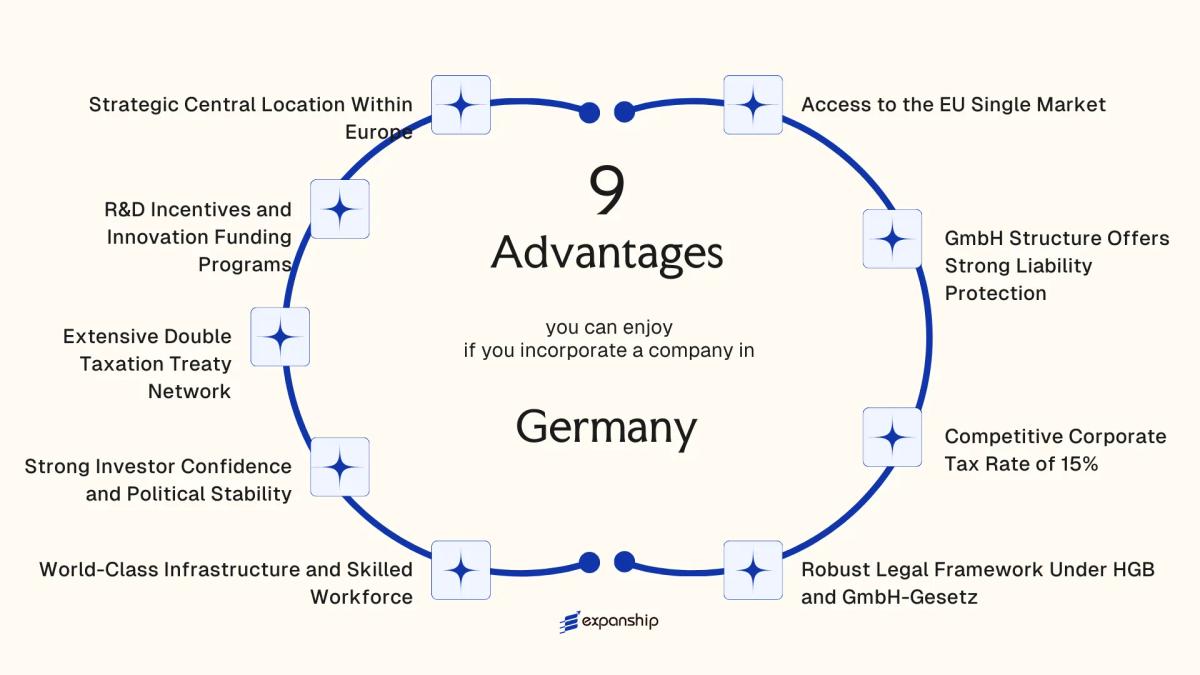
The benefits of incorporating in Germany are well-documented among practitioners of international corporate law, and this article examines the specific structural, fiscal, and operational advantages your business stands to gain. Whether you're a mid-sized firm expanding into continental Europe or a multinational seeking a regulated holding base, the advantages of Germany company formation extend across multiple dimensions of corporate planning.
Access to the EU Single Market
A German company registration gives your business direct, unconditional access to the EU single market — home to approximately 450 million consumers and governed by a unified regulatory framework under EU law.
Trading Across Borders Without Customs Barriers
Goods and services sold from a German entity move freely across all 27 EU member states without customs duties or border controls, under the principles established by the Treaty on the Functioning of the European Union (TFEU). For a foreign-owned firm, this eliminates the need to establish separate legal entities in each target country.
A single VAT registration under the EU's One Stop Shop (OSS) scheme can cover cross-border B2C sales across multiple member states. This consolidation materially reduces the administrative overhead of operating across different national tax jurisdictions.
Regulatory Passporting and Procurement Access
Certain regulated sectors, including financial services, benefit from EU passporting rights, allowing a German-registered entity to operate in other member states under a single authorization. Your business also gains eligibility for EU public procurement contracts, which represent a substantial share of economic activity across the bloc.
A single German entity can serve the entire EU market without replicating your legal or compliance structure in each member state.
GmbH Structure Offers Strong Liability Protection
The Gesellschaft mit beschränkter Haftung, governed by the GmbH-Gesetz (GmbHG), separates your personal assets from those of the company by design. Shareholders are liable only up to the value of their contributed capital. Germany GmbH liability protection advantages are therefore structural, not discretionary — they are built into the statutory framework and apply regardless of the shareholder's residency or nationality.
This separation has direct consequences for foreign investors. If the business incurs debt or faces legal claims, your personal wealth, property held abroad, or assets in other entities remain outside the reach of creditors. For investors holding stakes across multiple jurisdictions, this containment of risk within a single legal vehicle carries considerable practical value.
The minimum share capital requirement of EUR 25,000 underpins this protection in several ways:
- It establishes a defined creditor buffer without requiring shareholders to commit further personal funds
- Partial payment at formation (minimum EUR 12,500 cash) keeps initial outlay manageable while the entity still achieves legal standing
- The fixed capital structure gives institutional counterparties and lenders a verifiable baseline for assessing the firm's standing
Each shareholder's liability exposure is capped at their individual capital contribution, as set out in the GmbHG. This means co-investors do not inherit each other's obligations, which simplifies the risk allocation in multi-party ownership structures.

Incorporate a GmbH in Germany
Set up your German GmbH with clearly defined liability boundaries and full compliance with the GmbH-Gesetz from day one.
Competitive Corporate Tax Rate of 15%
At the federal level, Germany imposes a corporate income tax of 15% on retained earnings, making the Germany 15% corporate tax rate advantage a concrete factor in after-tax profit calculations for foreign-owned entities. This rate is governed by the Körperschaftsteuergesetz (KStG) and applies uniformly to resident corporations, including the GmbH. The implication is direct: a larger share of operating profit remains within the business rather than flowing to tax authorities.
| Tax Component | Rate | Governing Law |
|---|---|---|
| Corporate Income Tax (Körperschaftsteuer) | 15% | Körperschaftsteuergesetz (KStG) |
| Solidarity Surcharge (Solidaritätszuschlag) | 5.5% of CIT | Solidaritätszuschlaggesetz |
| Trade Tax (Gewerbesteuer) | ~14–17% (varies by municipality) | Gewerbesteuergesetz (GewStG) |
Trade tax, levied under the Gewerbesteuergesetz (GewStG), is assessed at the municipal level and varies by location, but a portion is creditable against personal income tax obligations for individual taxpayers. For corporate entities, the combined effective tax burden typically falls in the range of 28–33%, depending on the municipality of registration. Choosing a lower trade tax multiplier municipality can reduce the total burden meaningfully.
Dividend distributions from a GmbH to a qualifying corporate shareholder benefit from the participation exemption under Section 8b KStG, which exempts 95% of qualifying dividends from corporate income tax. For holding structures, this makes the entity an efficient vehicle for consolidating subsidiary income across jurisdictions.
Robust Legal Framework Under HGB and GmbH-Gesetz
Germany's legal architecture for commercial activity rests on two principal statutes: the Handelsgesetzbuch (HGB), which governs commercial law and accounting obligations, and the GmbH-Gesetz (GmbHG), which establishes the rules specifically for the Gesellschaft mit beschränkter Haftung. The Germany HGB GmbH-Gesetz legal framework benefits foreign founders directly by providing a codified, predictable system rather than one shaped primarily by case law or regulatory discretion.
Under the GmbHG, shareholder rights, capital maintenance rules, and director liability are defined by statute. For a foreign investor, this removes interpretive ambiguity. You can review the law, structure your shareholding accordingly, and rely on that structure holding up in court.
The HGB sets mandatory accounting standards that govern how financial records must be kept. Compliance with these standards is recognized across EU member states, which reduces the cost of cross-border reporting.
Keep these points in mind:
- The GmbHG requires a minimum share capital of EUR 25,000, at least half paid in at formation
- Shareholder agreements must align with GmbHG provisions; conflicting clauses are unenforceable
- HGB accounting obligations apply from the date of commercial registration
- Non-resident managing directors must ensure a German-registered office address is maintained
A GmbH can be formed with a single shareholder who also serves as the sole managing director, with no requirement for a locally resident co-founder or nominee director under the GmbHG.
World-Class Infrastructure and Skilled Workforce
Germany skilled workforce benefits for business are among the most cited reasons foreign companies choose to establish a local presence here. With over 45 million people in the labor force and a dual education system (Berufsausbildung) that integrates vocational training directly into industry, the country produces technically proficient workers at scale. That pipeline matters practically: your business can recruit qualified engineers, tradespeople, and specialists without the extended onboarding periods common in markets where formal technical training is less structured.
A Labor Market Built on Technical Depth
Universities of Applied Sciences (Fachhochschulen) and research universities together graduate hundreds of thousands of students annually across STEM, finance, and applied sciences. Clusters in Munich, Stuttgart, Hamburg, and the Rhine-Ruhr region concentrate sector-specific talent in automotive, chemical, fintech, and logistics industries, allowing firms to hire within established professional ecosystems rather than building from scratch.
Physical Infrastructure That Reduces Operational Friction
Germany's logistics network ranks consistently among Europe's most developed, anchored by the port of Hamburg, Frankfurt Airport (the continent's third-busiest cargo hub), and one of the densest autobahn and rail freight systems in the EU. For businesses dependent on supply chain reliability, this physical connectivity translates directly into lower transit times and more predictable distribution costs. The Gigabit Strategy (Gigabitstrategie), a federal initiative targeting nationwide high-speed broadband coverage, is actively expanding digital infrastructure capacity for commercially intensive operations.
Put Germany's Talent and Infrastructure to Work for Your Business
Speak with an Expanship specialist about structuring your German entity to make the most of the country's workforce and connectivity advantages.
Strong Investor Confidence and Political Stability
Germany's long track record of Germany political stability investor confidence stems from its position as a federal parliamentary democracy with consistent policy continuity across successive governments. The country holds one of the highest sovereign credit ratings among major economies, reflecting institutional reliability that translates directly into predictable operating conditions for foreign-owned entities.
- The Bundesbank and the Federal Financial Supervisory Authority (BaFin) provide independent oversight of monetary and financial market activities, reducing the risk of abrupt regulatory shifts that can disrupt business planning.
- Coalition governments in Germany operate within constitutional constraints set by the Grundgesetz (Basic Law), which limits executive overreach and protects property rights — a structural safeguard that benefits foreign shareholders directly.
- Contract enforcement through German civil courts is consistently ranked among the most reliable in the EU, giving your business a credible legal recourse mechanism rather than an uncertain one.
- Political risk ratings from organizations such as the OECD and World Bank consistently place Germany in the lowest-risk tier, which reduces the risk premium that investors and lenders typically apply to foreign operations.
- The country's stable regulatory environment means that compliance obligations set at the time of incorporation are unlikely to shift without extended legislative debate and transition periods, giving your firm time to adapt.
Extensive Double Taxation Treaty Network
Germany's double taxation treaty network benefits foreign businesses through one of the most extensive bilateral treaty frameworks in the world, covering over 90 countries. These agreements, known formally as Doppelbesteuerungsabkommen (DBA), prevent the same income from being taxed twice — once in Germany and again in the investor's home jurisdiction.
For a foreign business owner, this has a direct financial consequence. Withholding tax rates on dividends, interest, and royalties paid from a German entity to a foreign recipient are reduced under applicable treaties — in some cases to zero. Without treaty protection, the standard withholding tax on dividends under German domestic law is 25% plus solidarity surcharge.
Treaty eligibility depends on the residence of the recipient entity and, in some cases, on whether that entity meets specific beneficial ownership conditions defined within the relevant DBA.
A company resident in a treaty country receiving dividends from a German GmbH may see withholding tax reduced from 25% to as low as 5% or 15%, depending on the applicable treaty. On a EUR 500,000 dividend distribution, that reduction translates to a tax saving of up to EUR 100,000 in a single distribution cycle.
The treaties are negotiated and administered under the authority of the Bundeszentralamt für Steuern (Federal Central Tax Office), which also processes refund claims and advance rulings on withholding tax relief.
R&D Incentives and Innovation Funding Programs
Germany R&D tax incentives for companies became formally accessible through the Forschungslagengesetz (FZulG), which came into force in January 2020. Under this law, eligible businesses can claim a tax credit of up to 25% on qualifying R&D personnel costs, capped at €10 million in assessable expenses per year. For your business, this translates to a maximum annual credit of €2.5 million, applied directly against your tax liability rather than as a deduction from taxable income.
Eligibility extends to GmbHs and other corporate entities conducting R&D within Germany, including contract research commissioned from third parties. The credit applies regardless of whether your firm is currently profitable, meaning early-stage subsidiaries can still benefit.
Beyond FZulG, federal and state-level grants are administered through agencies such as:
- BMBF (Federal Ministry of Education and Research), which funds sector-specific innovation programs
- BMWK (Federal Ministry for Economic Affairs and Climate Action), which supports technology transfer and SME-oriented schemes
- KfW, the state-owned development bank, offering low-interest innovation financing
These funding channels operate independently of the FZulG credit, so a single qualifying project can draw from multiple sources simultaneously.
The FZulG credit requires a formal application to the Bescheinigungsbehörde (certification authority) before the tax credit can be claimed, and R&D activities must meet the definition set out in the OECD Frascati Manual to qualify.
Strategic Central Location Within Europe
Germany's geographic position sits at the heart of continental Europe, and for a foreign business owner, that translates directly into reduced transit times, lower logistics costs, and proximity to the continent's largest consumer markets. The Germany central European location business advantage is not abstract — Frankfurt, for example, connects to most major European cities within 90 minutes by air, while the country shares land borders with nine states including France, Poland, the Netherlands, and Austria.
Access to European Supply Chains
Bordering nine countries means your firm can draw from or distribute into multiple national markets without crossing more than one frontier. For manufacturing, assembly, or distribution operations, this removes a layer of routing complexity that companies based in peripheral jurisdictions routinely absorb into their operating costs.
Logistics Infrastructure That Serves the Continent
The Port of Hamburg ranks among Europe's largest container ports by throughput volume. Combined with the density of the Autobahn network and Germany's position as a major node in the European rail freight corridor system, goods can move predictably in multiple directions.
- Frankfurt Airport handles significant air cargo volumes across transatlantic and intra-European routes
- Rhine-Alpine and North Sea-Baltic rail corridors pass through or originate within German territory
- Road freight access to Eastern European markets is direct, with no need for transit through third-party logistics hubs
Time Zone and Business Alignment
Central European Time places your business in the same working hours as Paris, Amsterdam, Warsaw, and Zurich. That alignment reduces scheduling friction when coordinating across your European client base or supplier network.
Why Germany Stands Out Against Competing European Jurisdictions
Foreign businesses evaluating European incorporation options most commonly weigh Germany against the Netherlands, Ireland, and Poland. These three jurisdictions compete for similar investor profiles: export-oriented manufacturers, holding structures, and market-entry vehicles for non-EU companies. The comparison below focuses on parameters where Germany vs European jurisdictions for incorporation reveals structurally meaningful differences, not superficial ones.
What the table makes visible is a pattern: jurisdictions with lower headline tax rates often offset that advantage through narrower treaty networks, less codified creditor protections, or thinner capital market depth. Germany's GmbH-Gesetz provides a statutory framework that has been stress-tested through decades of cross-border litigation, which reduces legal uncertainty for foreign directors operating remotely. For businesses where legal predictability and counterparty trust carry commercial weight, the regulatory architecture matters as much as the rate.
| Parameter | Germany | Netherlands | Ireland | Poland |
|---|---|---|---|---|
| Standard Corporate Tax Rate | 15% (plus trade tax, effective ~30%) | 19–25.8% (tiered) | 12.5% | 19% |
| GmbH/Equivalent Entity | GmbH (min. €25,000) | BV (min. €0.01) | Limited Company (min. €1) | Sp. z o.o. (min. ~€1,250) |
| Double Tax Treaties | 90+ | 90+ | 70+ | 80+ |
| Governing Corporate Law | GmbH-Gesetz (1892, continuously updated) | Dutch Civil Code Book 2 | Companies Act 2014 | Polish Commercial Companies Code |
| EU Single Market Access | Full | Full | Full | Full |
| Commercial Court System | Specialised Handelsgerichte | District Courts (civil) | Commercial Court (Dublin) | District/Regional Courts |
| Language of Statutory Filings | German | Dutch (English accepted informally) | English | Polish |
Compliance Services for Companies in Germany
Stay aligned with Handelregister filing requirements, annual disclosure obligations, and ongoing regulatory duties under German commercial law.
Conclusion
Germany's position as a destination for company formation rests on a combination of structural, legal, and economic factors that few European jurisdictions can match collectively. The 15% federal corporate tax rate, underpinned by enforceable rights under the GmbH-Gesetz and HGB, gives your business a predictable operating environment from the first day of registration. Access to the EU Single Market through a German entity removes barriers that third-country firms otherwise face across 27 member states.
Not every foreign business owner will extract equal value from these advantages. A firm focused on manufacturing will benefit differently from Germany's skilled workforce and central logistics position than a holding structure optimised to use its double taxation treaty network, which spans over 90 agreements. The fit depends on your business model, the markets you intend to serve, and the entity type you establish.
What consistently draws foreign investors is the combination of legal certainty and economic depth. Germany's regulatory framework is codified, its courts are experienced in commercial disputes, and its institutions are stable. For businesses where counterparty confidence, financing access, or cross-border trade form the core of operations, those qualities translate directly into reduced friction and lower risk. The foundation is in place; the next step is structuring your formation correctly from the outset.
Start Your German Company Formation With Expanship Today
Germany company formation with Expanship covers the full scope of what foreign founders and investors need to establish a GmbH under the Gesellschaftsgesetz mit beschränkter Haftung (GmbH-Gesetz) and maintain ongoing compliance with the Handelsgesetzbuch (HGB). From coordinating notarized articles of association to liaising directly with the Handelsregister for commercial registration, Expanship manages the regulatory steps that fall between incorporation and operational readiness.
Expanship's services for your German entity include:
- Preparation and notarization of founding documents, including the Gesellschaftsvertrag
- Registered office and local agent provision to satisfy §4a GmbH-Gesetz requirements
- Filing coordination with the Handelsregister through a notary-appointed process
- Post-incorporation compliance management, including annual financial statement obligations under HGB
- Liaison support with the Finanzamt for tax registration and VAT enrollment
- Banking introduction assistance to support your business account setup with German financial institutions
Reach out to Expanship Germany to discuss how your incorporation can be structured and progressed.
Frequently Asked Questions (FAQ)
The minimum share capital for a GmbH is €25,000, of which at least €12,500 must be paid in before the company can be registered with the Handelsregister. This requirement is set out in §7 of the GmbH-Gesetz. Capital contributions can be made in cash or, under certain conditions, in kind, though in-kind contributions require independent valuation documentation submitted at the time of registration.
The federal corporate tax rate is 15%, but the effective total burden on retained profits is higher once the solidarity surcharge and trade tax (Gewerbesteuer) are factored in. Trade tax rates vary by municipality, with the total combined burden typically falling between 28% and 33% depending on where the business is registered. Choosing your municipality strategically can therefore have a measurable impact on your firm's overall tax position.
A foreign-owned entity incorporated in Germany has access to the same R&D incentives as domestically owned firms, provided it conducts qualifying research activities within the jurisdiction. The Research Allowance Act (Forschungslagengesetz, FZulG), introduced in 2020, grants a tax-based R&D allowance of up to 25% on eligible personnel and contract research costs, capped at €1 million in allowance per year. Beyond the FZulG, entities may also apply for project-based grants administered through bodies such as the Federal Ministry for Economic Affairs and Climate Action (BMWK).
No statutory provision under the GmbH-Gesetz requires the managing director (Geschäftsführer) to be a German resident or citizen. However, practical considerations apply: the managing director must be able to fulfill their legal obligations, including filing duties with the Handelsregister and the Finanzamt, and being reachable for regulatory correspondence. Some banks and authorities may in practice prefer or request a local contact point, though this is not a legal requirement.
Failure to file annual financial statements with the Unternehmensregister within the deadlines prescribed by the Handelsgesetzbuch (HGB) can result in administrative fines imposed by the Bundesamt für Justiz (Federal Office of Justice). The enforcement process is initiated automatically after the filing deadline passes, and fines can accumulate if the default continues. Directors bear personal responsibility for ensuring timely compliance, which means the liability protection afforded by the GmbH structure does not extend to cover deliberate or negligent non-filing.
Germany maintains one of the largest double taxation treaty networks in the world, with agreements covering approximately 100 jurisdictions. Most treaties reduce or eliminate withholding taxes on dividends, interest, and royalties paid between treaty partners, with specific rates varying by agreement. Within the EU, the Parent-Subsidiary Directive may further reduce or eliminate withholding tax on qualifying dividend distributions, depending on the ownership threshold and holding period conditions met by your entity.
The timeline from notarization of the articles of association to entry in the Handelsregister typically ranges from two to four weeks, assuming all documentation is in order and the share capital deposit confirmation from the bank is provided without delay. Processing times can vary by the specific Amtsgericht (local court) handling the registration, as each court administers its own Handelsregister. Delays most commonly arise from incomplete documentation or queries raised by the notary or registering court regarding the articles of association.
Legal Disclaimer
The information provided in this article is for general informational purposes only and does not constitute legal, tax, or professional advice. While we strive to ensure the accuracy and timeliness of the content, laws and regulations are subject to change, and the application of laws can vary widely based on specific facts and circumstances.
Readers should not act upon this information without seeking professional counsel tailored to their individual situation. Expanship and its authors disclaim any liability for actions taken or not taken based on the content of this article.
For specific advice regarding your business setup, compliance requirements, or any legal matters, please consult with qualified legal and tax professionals in the relevant jurisdiction.